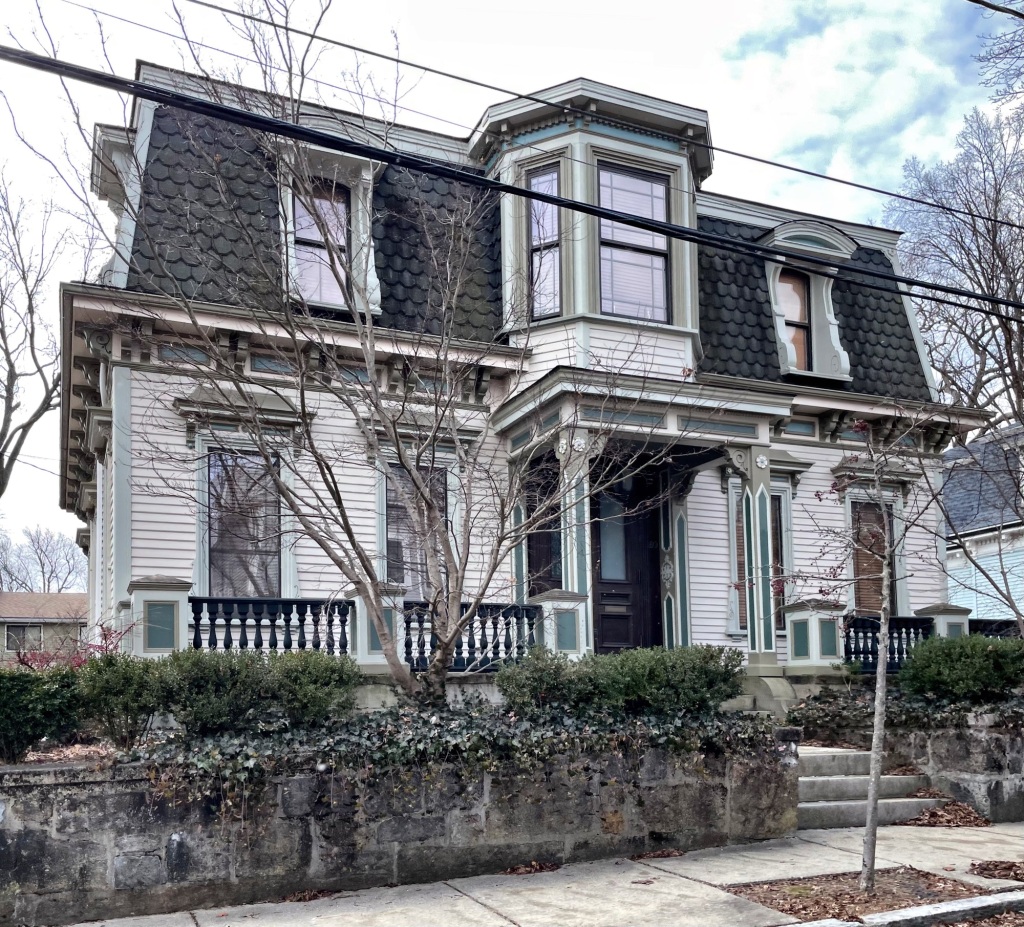
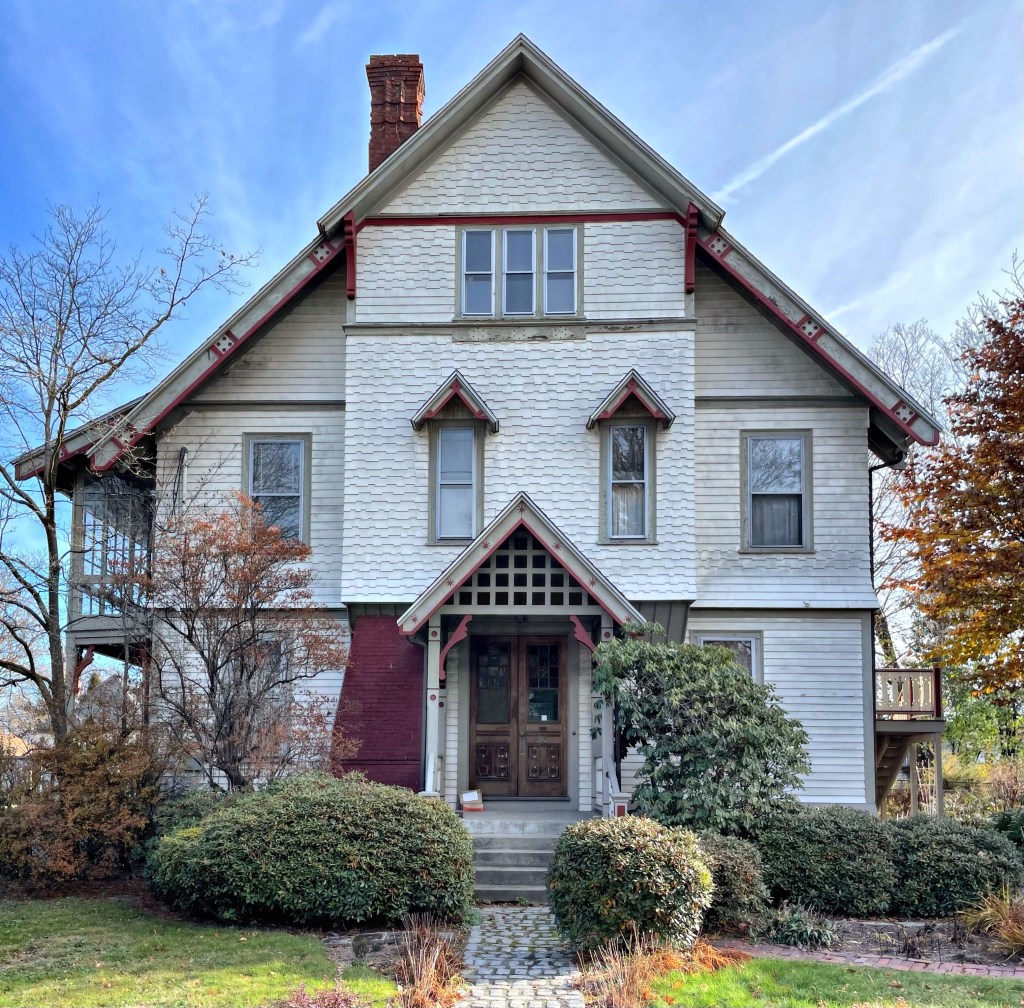
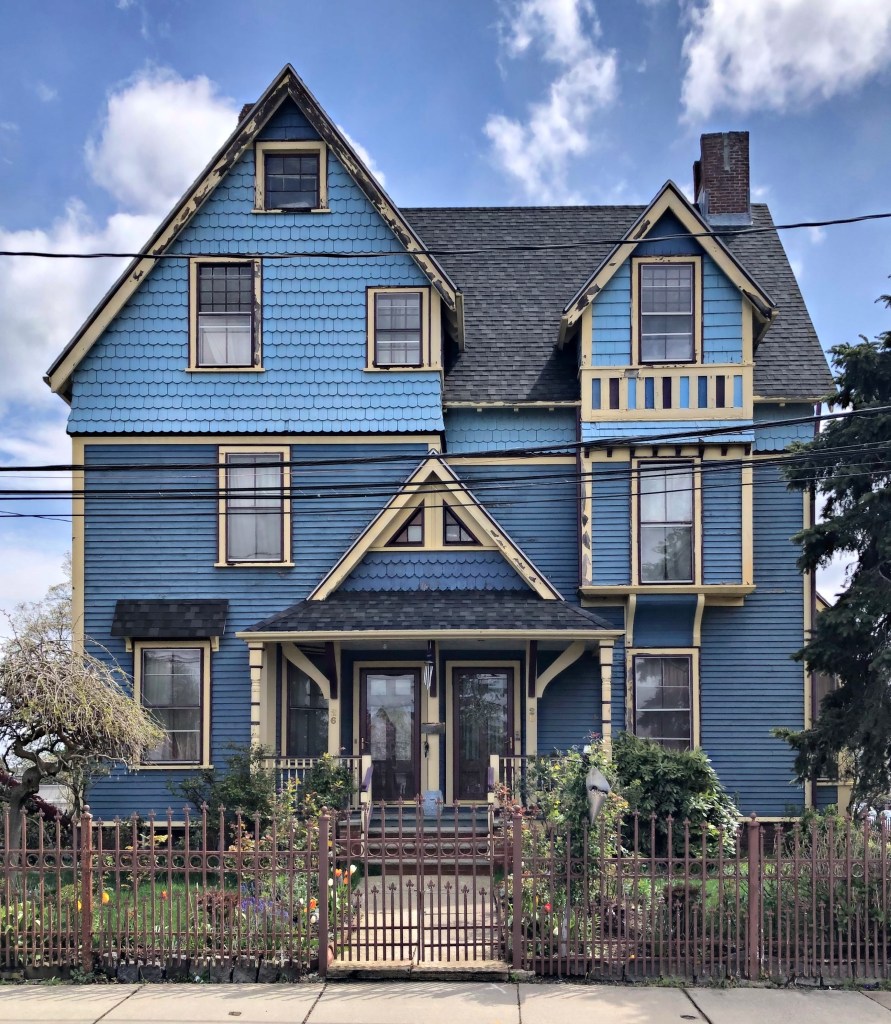
Built in 1883 for a member of the Thomas Wales family, this house in Clam Point, Dorchester, possesses a compact essentially rectangular clapboard and wood shingle-clad form. The architect, John A. Fox, designed the main façade elegantly with an open Stick style porch projecting from the center of the first floor which is enclosed by a steeply-pitched roof. The pitch of the porch roof is echoed in the small and shallow gable-like lintels which are really unique to the area. The treatment makes the facade read somewhat like a face.
Nothing beats a good Victorian-era house! This example in the Clam Point neighborhood of Dorchester does not disappoint. The Stick-style double-house was built for miss Mary E. Noyes and Ms. Hersey replacing an older house on the lot. The women hired architect John A. Fox to design the house which possesses one of the most complex forms and roof configurations in the neighborhood. Clad with clapboards at the first and second stories, its six intersecting gables are sheathed with scalloped shingles. At the main entrance on the façade is an open porch with square posts and railings with turned balusters. The side façade is even more complex with two side gables and a two-tier porch enlivened by Chinese Chippendale and spool work railings. The Herseys, along with Mary E. Noyes, co-owned the house until 1884; thereafter it was owned by Mary E. Noyes until around World War I. The stick style home really pops with that blue color, what do you think?
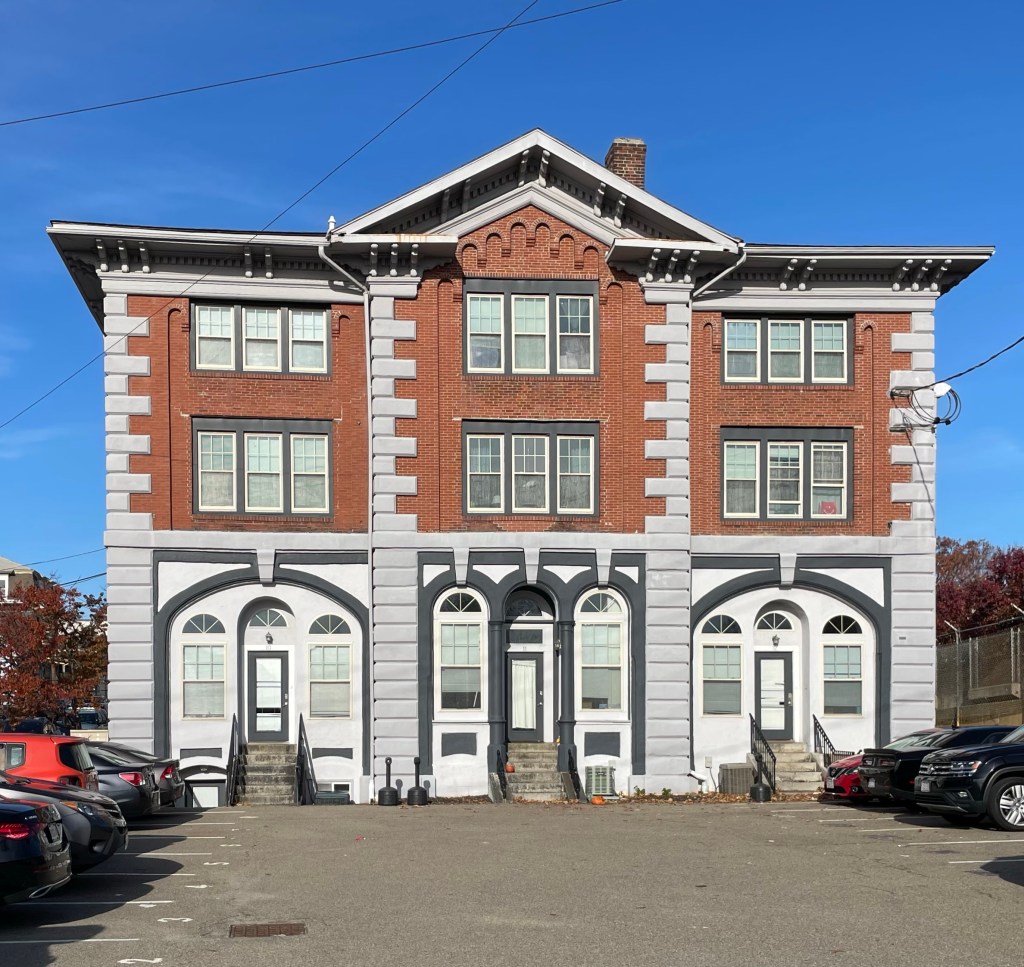
This is your sign to take a different route! When exploring a new town or neighborhood, I love to explore the obscure streets just as much as the iconic Main Streets as hidden treasures can always be found! This building in Dorchester’s Port Norfolk neighborhood was constructed in 1860 as the new home of the Dorchester Mutual Fire Insurance Company, which was incorporated in 1855. The company seemingly hired Dorchester-based architect Luther Briggs, who also laid out the streets for Port Norfolk and the Clam Point neighborhoods and designed many buildings in the area at the time. The high-style Italianate building features bold proportions, quoins, and cornice. While the former round-arched windows have since been enclosed and are traditional double-hung windows, they building still stands out! At the rear, Second Empire style rowhouses were built for private ownership. The building is now all condominiums following a renovation.
The Putnam Nail Company was founded in 1860 and located at the northern tip of the Port Norfolk neighborhood of Dorchester, Boston, Massachusetts. The company was founded by Silas Safford Putnam (1822-1895), who was the seventh of nine children by Israel Smith Putnam and Charlotte Safford of Hartford, NY. He moved to Boston and found work as Boston’s industrial growth took-off. He owned a curtain factory before patenting a process to manufacture wrought nails in the 1850s. After some time in Abington and Roxbury, he moved to Dorchester, purchasing large pieces of land and began building a manufacturing complex for his new Putnam Nail Company. The company made world-class horseshoe nails until it closed in the early 1900s. The property here was acquired by the George Lawley & Son Shipyard, who moved from their cramped City Point, South Boston shipyard to this newer yard. Already an established and respected New England manufacturer, the Lawley company had been building wooden ships in Massachusetts since 1866. The site was later the home to Seymour’s Ice Cream and was abandoned in the late 20th century. The large 1890s brick factory is now occupied by RISE, a development/construction management firm, with other buildings occupied by the Boston Winery and Boston Harbor Distillery.
The Stearns Lumber Company, which originally covered forty acres, was opened by Albert Thomas Stearns in 1849 at Port Norfolk, in Dorchester, Massachusetts. The location was ideal for transportation as wood could arrive by ship via the harbor or by rail. Stearns made everything from greenhouses, to water tanks, to millwork, but they specialized in wooden gutters, a necessary component in housing construction, and even invented a machine just for this purpose. Stearns’ machine removed the core of the gutter in one piece with a cylinder saw, which allowed the leftover product to be reduced into moulding, trim, ect. Stearns specialized in Cypress lumber and erected a saw mill in Florida, having it shipped up to his lumberyard in Port Norfolk. He became known as the Apostle of Cypress. The company eventually closed in 1968, after decades in losses of national lumber production and an increase in the use of cement and steel in building. The former Stearns Lumber Company yards were redeveloped and is now the site of Joseph Finnegan Park. The brick company office building is the last extant building from the historic A. T. Stearns Lumber Company, and its future is uncertain. The building is currently owned by the Massachusetts Department of Conservation and Recreation (DCR), who asked for the building to be demolished, causing the local neighborhood to speak out for its preservation. This is one to watch out for!
One of the few remaining Federal period buildings in Downtown Boston is this survivor located on Broad Street, one of the best streets in the city! The building was constructed for the Broad Street Association, which was made up of members: Uriah Cotting, Harrison Gray Otis, Francis Cabot Lowell and other prominent Boston entrepreneurs with the goal to upgrade Boston’s waterfront south of Long Wharf which comprised of an outdated system of individual wharves. The organization hired the esteemed Boston architect, Charles Bulfinch to furnish plans for the building, of which they paid him $100. While this modest example of the Federal style is not Bulfinch’s best work, is is notable as he was largely responsible for changing the architectural face of Boston, not only through own designs, but also through influence on other architects and builders of the time. This building was long owned by Francis Cabot Lowell and was rented out to commercial ventures, including some of the later decades of the 1800s when it was occupied by C. D. Brooks, a maker of pickles and preserves. The building was restored by CBT Architects in 2005 as part of a larger redevelopment of the block which includes a mid-rise apartment building, Folio.
Buildings not built for people, but for horses! This handsome masonry building sits at the heavily trafficked corner of Newbury Street at Massachusetts Avenue in the Back Bay neighborhood of Boston. It may get overlooked by some, but when you are not attempting to avoid shoppers on Newbury and cars and bicycles speeding along Mass. Ave., you’ll notice the amazing brickwork and details found on the former Charlesgate Stables. The building was constructed in 1892 as a five-story plus basement brick livery stable for owners Charles Kenney and Eugene L. Clark. Their permit called for storage of over 200 horses and other goods. The architectural firm of Peabody and Stearns designed the building to fit well within the surrounding area which is dominated by large, ornate townhouses and institutions. Inside the building horses were led up ramps to second floor stables leaving the first floor for carriage storage. This layout made it very difficult to save horses when fires occurred. The Renaissance Revival style building with contrasting brick was purchased by the Maxwell-Briscoe Trust after owners Eugene Clark died in 1907 and Charles Kenney died in 1909. The trustees were manufacturers of the Maxwell automobile, and they converted the former stable into an auto salesroom and garage, to keep up with the shift from horses to automobile. The building today has been converted to commercial use with retail on the ground floor and offices above.
An exemplar of late International Style, this stucco-clad concrete building stands apart from its traditional Back Bay neighbors and is located on one of the city’s most busy streets, Newbury Street. Built as the showroom and offices for Knoll International furniture, its crisp design is an elegant statement in form and details of Bauhaus- and Le Corbusier–inspired architecture, including its asymmetrical composition, curvilinear lower facade, horizontal window bands, and stairwell located behind a glass brick wall. The building was designed by Gwathmey, Siegel and Associates who have a great diversity of commissions, all with thoughtful site-specific designs. The building reinforced the positive qualities of modernist architecture at a time when some architects were advocating for historic revivals and Post-Modernism. The building was later occupied by DKNY and is presently rented out by Lenscrafters.
The only building that survived the wrecking ball of Urban Renewal on the stretch of Boston’s Boylston Street, south of the Public Garden was this six-story commercial building, known as the Garden Building. In 1911, architect Julius Adolphe Schweinfurth furnished plans for the new commercial building which was in the Beaux Arts style. The first floor was originally planned for three stores, with the upper five floors containing offices. A recessed penthouse floor served as studio space for artists and photographers with the large windows and skylights, the unobstructed views of the Public Garden didn’t hurt either! When the bulldozers of urban renewal came in the 1970s and 1980s to the area, this building surprisingly survived, and was reincorporated into the larger Heritage on the Garden condo development.
This one took me a while to write about because it still pains me to see it was demolished… The Arlington Building was constructed in 1904 as a mid-block building on Boylston Street, across from the Public Garden for the Bryant and Stratton Commercial School. It was designed by architect William Gibbons Rantoul of the firm Andrews, Jacques & Rantoul in the Beaux Arts style. The school building was significantly altered when Arlington Street was extended southward through Boylston Street, making this building suddenly a corner landmark. The new Arlington Street elevation was modeled after the Boylston Street facade. By 1929, Shreve, Crump & Low, established in 1796, the oldest purveyor of luxury goods in North America, moved into the building. The next year, they hired architect William T. Aldrich to add Art Deco embellishments and storefront designs, along with interior renovations to modernize the structure. The luxury company had downsized and moved out of the building, and its prominent site was threatened when owner/developer Druker Co. submitted for a demolition permit to raze the building (and others on the block) to erect a modern office/commercial building. After years of fighting between local preservationists and business interests and developers, the latter won and the building was demolished by late 2022. The new building, 350 Boylston Street, is presently undergoing construction, and in my opinion, is a poor attempt to fit into the surrounding context and is neither as unique or inspiring as the former building.
The Middlesex Reservoir and Spot Pond are located just north of Boston and have long been a little piece of the outdoors near the heart of New England’s largest metropolitan area. In 1894, the Massachusetts Legislature established the Metropolitan Parks Commission, which was endowed with the authority to acquire, maintain, and make recreational spaces available to the public. By 1900 the new commission had acquired 1,881 acres for the reservation. Part of this reservation, Spot Pond, is a natural water feature that for a number of years was integrated into the Boston area public drinking water supply, servicing the towns of Stoneham, Melrose, and Malden with drinking water. As part of this, gatehouses were built with hardware to open and close the pipes delivering the water to the adjacent towns. This gatehouse is in Stoneham was built in 1900 by the architectural firm of Shepley, Rutan & Coolidge, to not only protect the machinery inside, but to beautify the parkland, then maintained by the Metropolitan Parks Commission. The Renaissance Revival style building is today surrounded by a tall chain link fence, which really diminishes its presence in the landscape (but it does help prevent graffiti).
About ten years after the nearby Carlisle building (last post) was completed by owner Jonas Gerlusha Smith (1817-1893), he began construction on another large, apartment hotel next door. He again retained architect Arthur Vinal, who was acting City Architect for the City of Boston to furnish the plans on the building, which would be attached to the older portion which fronts Gray Street behind. The building is extremely well-preserved and has some stunning metal bays with decorative details which really pop!
In 1880, Jonas Gerlusha Smith (1817-1893) received a permit to erect a multi-family apartment building on Warren Avenue in present-day South End. The lot was close to his personal residence at 13 Warren Avenue and would have been easy to maintain and oversee tenants in the building. Mr. Smith hired 26-year-old architect Arthur H. Vinal, who furnished the plans for the handsome Queen Anne building. Vinal would later become the City Architect of Boston from 1884 to 1887, designing the High Service Building at the Chestnut Hill Reservoir just seven years after this building. By the late 1880s, the building was known as The Carlisle and it remained in the Smith family holdings under Walter Edward Clifton Smith until the 1930s. Walter attended the Cambridge Episcopal Theological School and later worked at various churches in the Boston area, serving as pastor in his later years. He lived on Follen Street in Cambridge while he held the Carlisle for additional income. Under new ownership in 1950, a retail storefront was added to the first floor which was occupied as a florist for some years. In 1979, after years of deferred maintenance, the property was purchased by Louis G. Manzo and his son David W. Manzo, who meticulously restored the building over time into the time-capsule that it is today!
Not much remains of one of Roxbury’s once grand rural estates, but as there is some left, I want to feature it before it’s all gone, possibly any day now! Horatio Harris was born in Dorchester (present-day South Boston) in 1821 and ran a prominent auction house in Boston. He built his country estate in Roxbury beginning in 1857 in the Gothic Revival style, adding on and updating numerous times. During the Civil War, the firm of Horatio Harris & Co. obtained the contract to sell at auction all goods which were confiscated by the United States’ land or naval forces and brought to Boston. He made a lot of money and added to his land holdings and estate house in Roxbury. The mansion’s construction was timely as Roxbury was transitioning from a rural town, with farms and country estates of wealthy Boston merchants, to a streetcar suburb, increasing the land value of his holdings. The estate included nearly 30 acres of meandering paths, a lake with an island, outbuildings, and an observation tower – one of which remain today besides the ruin of the former mansion. Horatio died in 1876, in the decades following his death, his heirs began subdividing the estate, developing some and selling other plots off for houselots. By the early 1900s, Jewish people began moving into Roxbury, mixing with the predominantly Yankee population. By 1915, the Harris manor house was owned by the Hebrew Alliance of Roxbury, Inc. By the 1920s, they expanded facilities, adding a school building to the front of the former Harris Mansion, completely obscuring the facade of the old estate. In the 1940s, the upper stories were removed. Seemingly the death knell of the old Harris Villa was a fire in 2019, which gutted much of the remaining original fabric of the estate. All that remains is a bay window, some window trim details and a Gothic porte-cochere at the rear of the estate. See it before it’s too late!
Harriswood Crescent was built in 1889-90 at the height of Roxbury’s development as a streetcar suburb which coincided with the electrification of the streetcar lines in Boston. The area of Roxbury in which the Crescent is located, known at the time as Boston Highlands due to its rocky terrain and steep grades, was an extremely desirable residential location. As land values raised, middle and upper-class families looked for varied housing types that fit their demands. Seen as a great investment of the family estate, the heirs of wealthy businessman Horatio Harris (1821-1876) redeveloped lots on one side of a rocky park for fine townhouses, which were named Harriswood Crescent. The name was probably chosen for its historical associations with Boston’s Tontine Crescent and the great Georgian crescents of London and Bath in England. Architect J. Williams Beal designed the row, which was one of his first commissions upon returning to Boston in 1888 after employment as a draftsman at McKim, Mead & White and a long study in England to view architecture. Built at 15 separate units, the row of Tudor style houses is among the only of such developments in Boston, and New England at large.