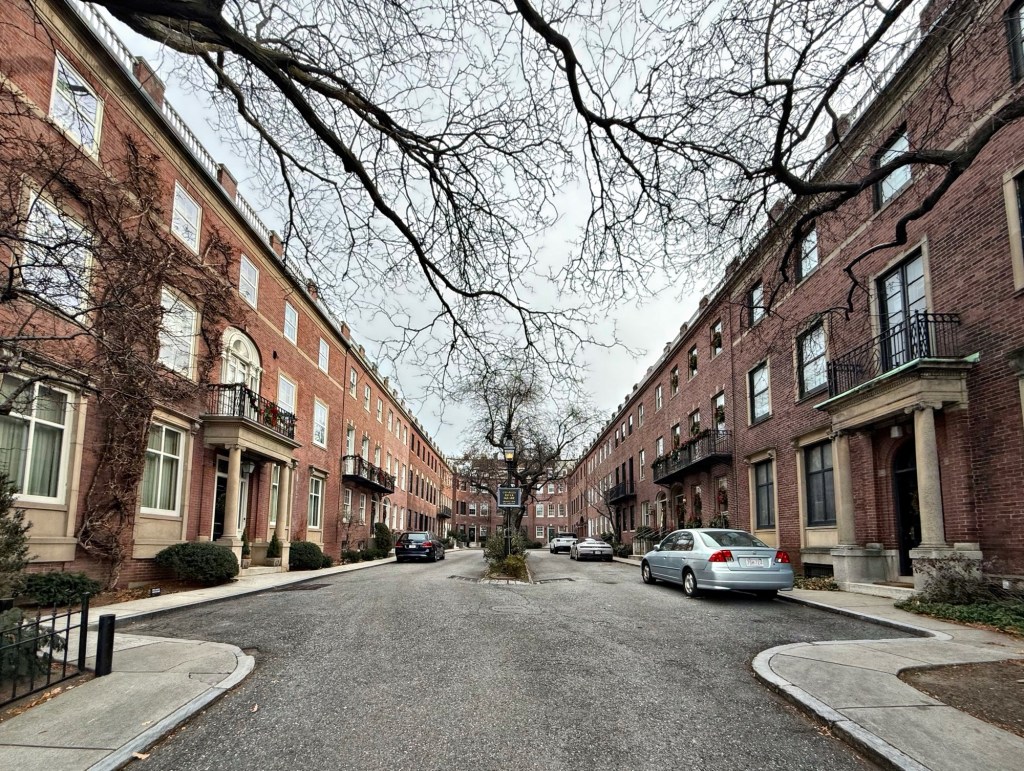
Charles River Square, a delightful development of red brick and cast-stone Colonial Revival townhomes in the Beacon Hill Flat, was developed in 1910 from plans by Boston architect, Frank A. Bourne. The development consists of a total of 21 residences, 19 of which front on the courtyard that is known as Charles River Square. The development is accessed off Charles River Road (which was made a busy thoroughfare in the 1950s and renamed Storrow Drive) and through a Palladianesque passageway off Revere Street. Along with its neighbor to the north, West Hill Place (1916), another group of attached townhouses organized around a courtyard built years later, its layout is a departure from the previous approach to urban planning, resembling the atmosphere of an old London street or mews. Charles River Square remains one of the most desirable developments in the exclusive Beacon Hill neighborhood.
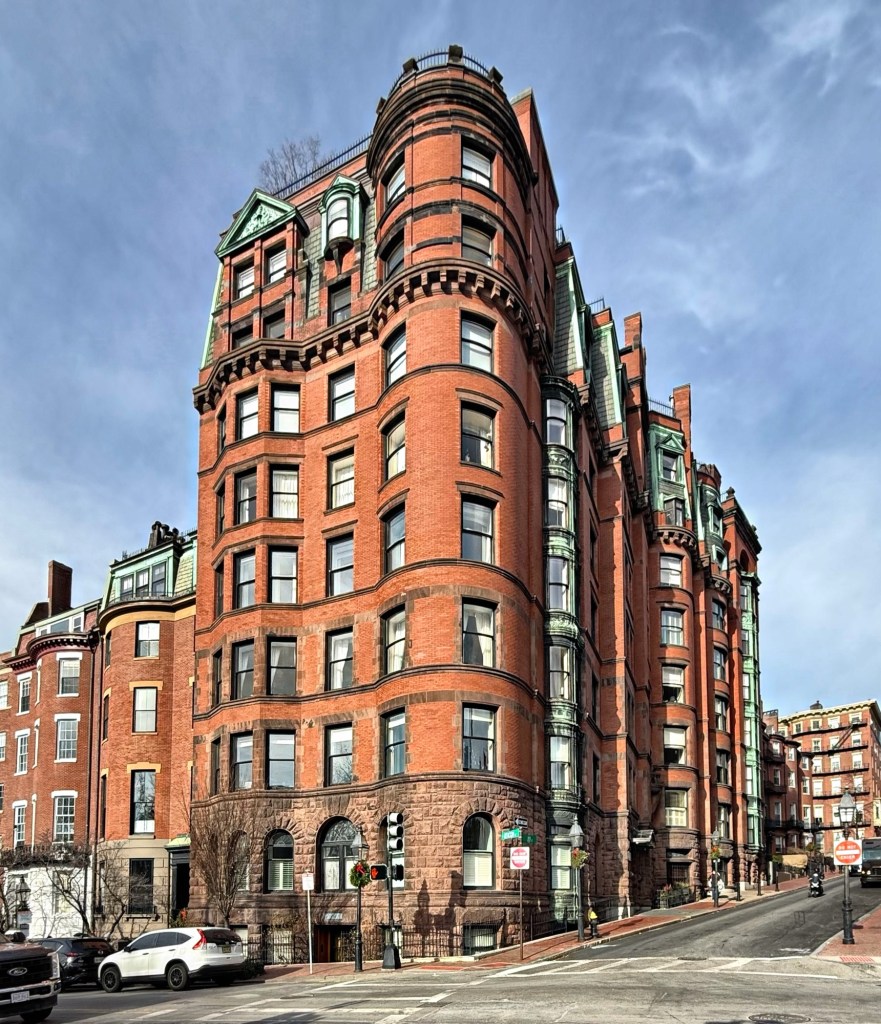
Frederic Tudor (1783-1864) was a businessman and merchant known as Boston’s “Ice King” having founded the Tudor Ice Company and becoming a pioneer of the international ice trade in the early 19th century. Frederic Tudor lived in a house at the corner of Beacon and Joy streets in Beacon Hill, Boston, and after his death, the property was inherited by his widow, Euphemia Fenno and their children. By 1885, the old Tudor House was demolished and replaced by The Tudor Apartments, which was built between 1885 and 1887 to house twelve upper-class families who sought smaller living space as opposed to the typical townhouses in Beacon Hill. Designed by architect, Samuel J. F. Thayer, the nine-story Queen Anne/Romanesque Revival building features a brownstone base with brick walls above, combining the traditional Boston bowfront with late 19th century flair at the upper floors with the partial mansard roof punctuated with dormers and oriel windows. Thayer designed the Joy Street elevation with cascading bays to provide interiors with views of the Boston Common and ample natural light.
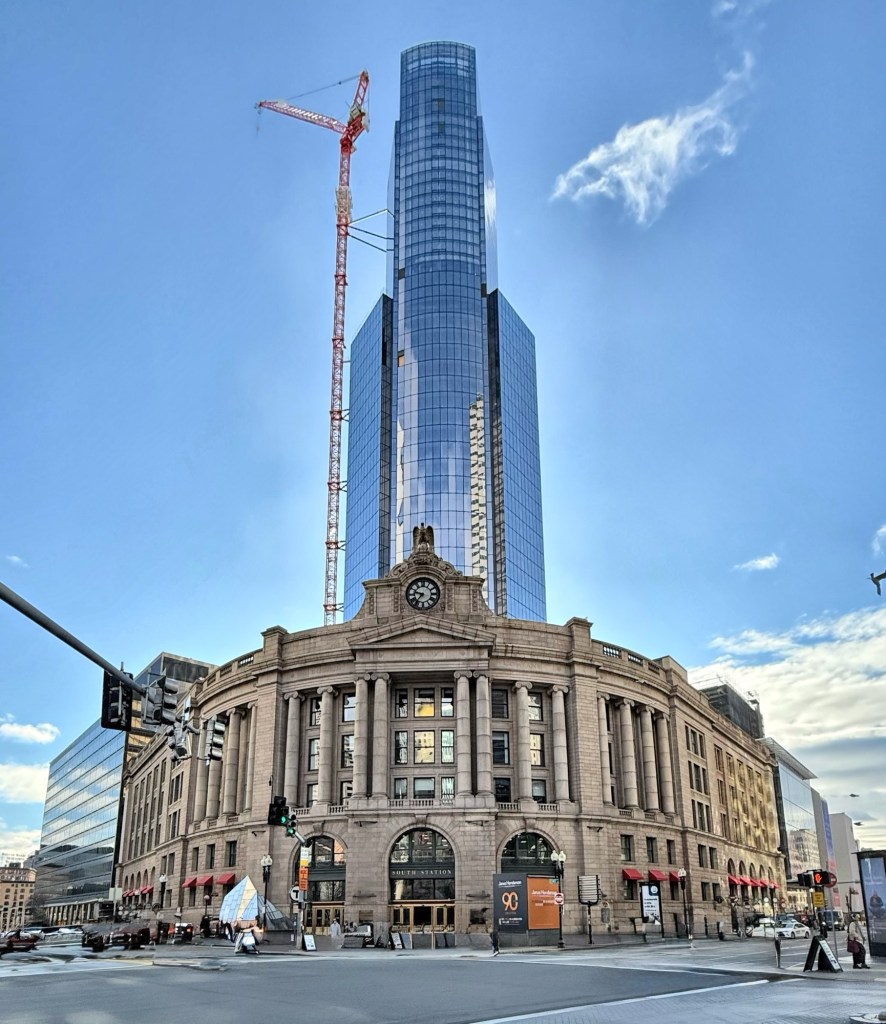
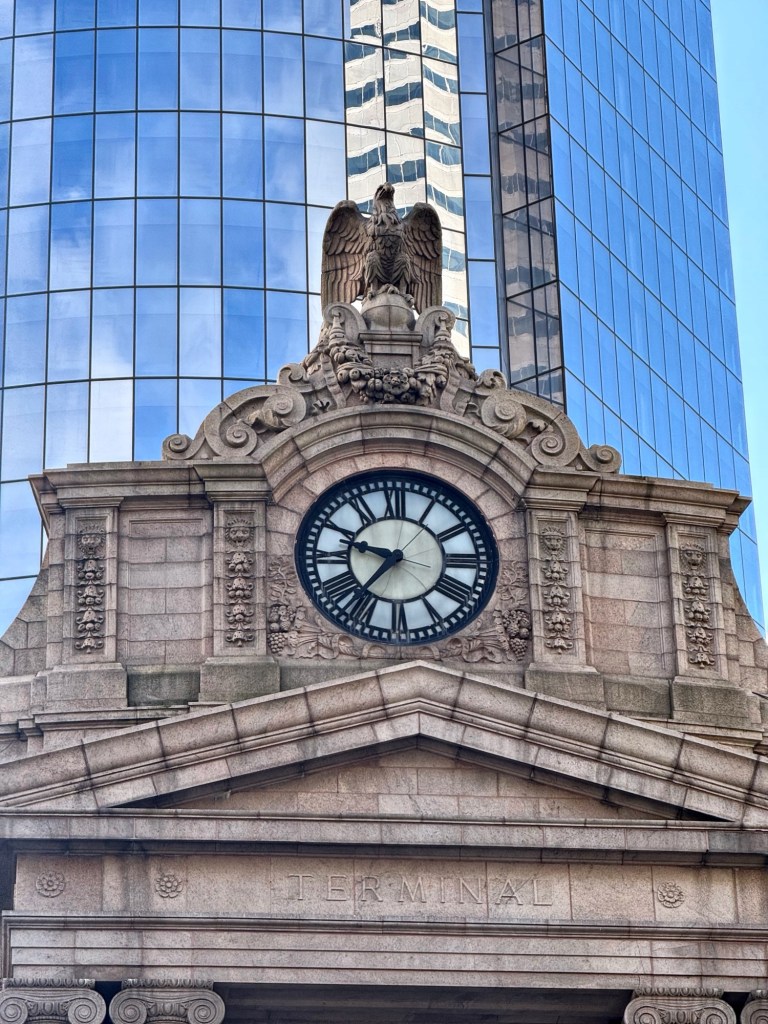
When the railroads serving Boston were first laid out and built, each line stopped at its own terminal which created a dysfunctional and cumbersome travel experience for those entering or leaving the city. The Boston Terminal Company, established in 1897, was charged with the task of consolidating service from the four terminals at a single terminal, a union station (similar to North Station), for routes south of the city. South Station was designed by architects were Shepley, Rutan and Coolidge of Boston and quickly became New England’s busiest transportation center. The five-story Classical Revival style station built of stone is an architectural landmark with three-story Ionic colonnade crowned by a clock surmounted by an eagle, stands above the triple-arched brick masonry lower level corner entrance. While the station handled 125,000 passengers each day during World War II, post-war passenger rail traffic declined in the US. South Station was sold to the Boston Redevelopment Authority in 1965 and (surprise!) they demolished portions of the building and later developed plans to demolish the rest of the station and replace it with a multi-use development including a new train and bus station with large parking garage. Luckily for everyone, the BRA failed in this endeavor and the building remained to the point where public transportation is again invested in and beloved and the building has since been restored. Recently, a glass “crown”, known as South Station Tower, a 51-story designed by Pelli, Clarke & Partners, with new office space, luxury residences, and a redesigned, arched interior concourse (which in my opinion, is the best part). The redevelopment is a push towards transit-oriented development and blends new and old in an innovative way.
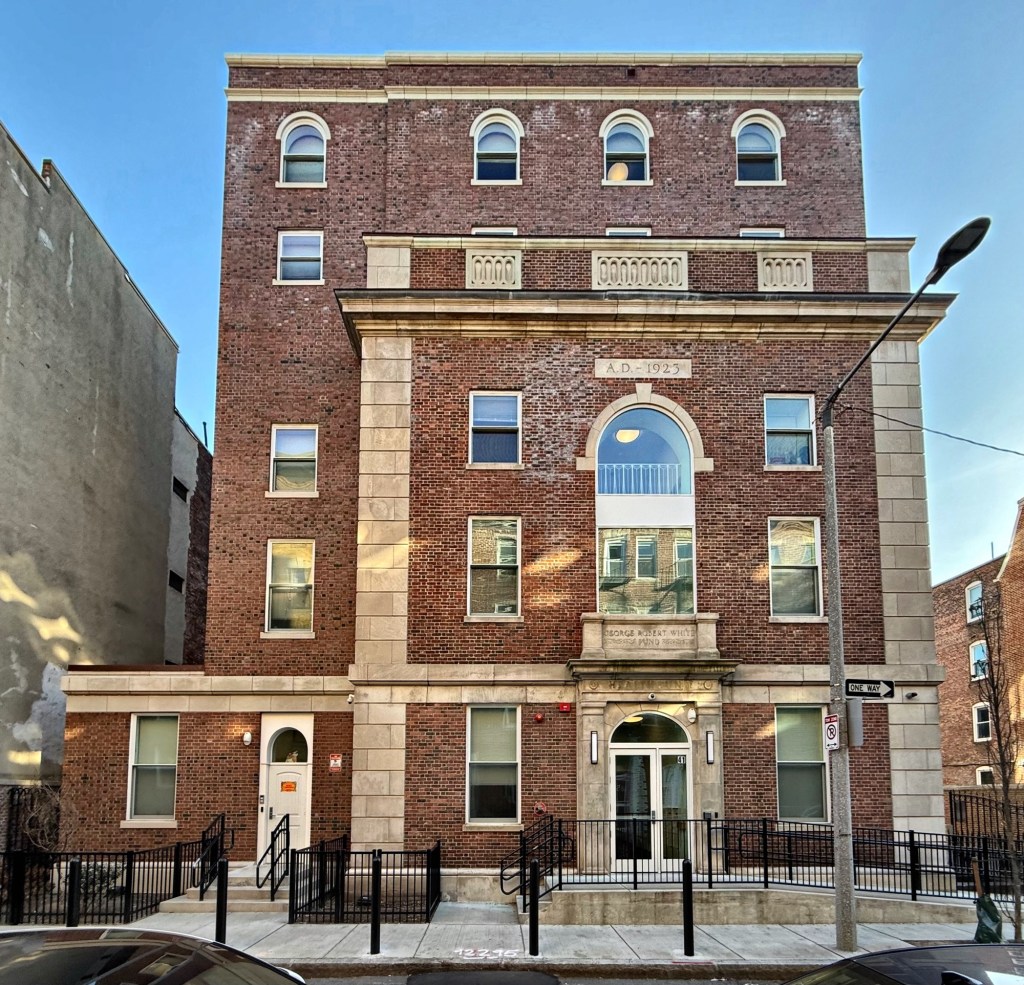
Originally known as the George Robert White Health Unit Number 2, this Colonial Revival style building is located on North Margin Street in the North End of Boston, and is significant as an early health center providing health and education services for some of Boston’s most underserved residents. The building was constructed in 1923 as one of the neighborhood-based health centers built in Boston in the 1920s and early 1930s from funding by the George Robert White charitable trust. George Robert White (1847-1922), a longtime resident of Boston, worked in the office of the Potter Drug and Chemical Company as a boy, eventually becoming president and an owner of the corporation. He was an investor in real estate and reportedly was known for many years as the largest individual taxpayer in Boston. Upon his death, his will specified that his bequest to the city, about $5 million in 1922 (approximately $93 Million valued today), would be held in a permanent charitable fund “to be used for creating public utility and beauty and for the use and enjoyment of the inhabitants of Boston.” The North End Health Unit was the second built (the first was in the West End), and designed in the Colonial Revival style from plans by Coolidge and Shattuck, later known as Coolidge, Shepley, Bulfinch & Abbott. Since the 1970s, the building was occupied by the Knights of Columbus, a fraternal organization, until 2020, when the building was renovated and converted into housing with 23 units for elderly residents.
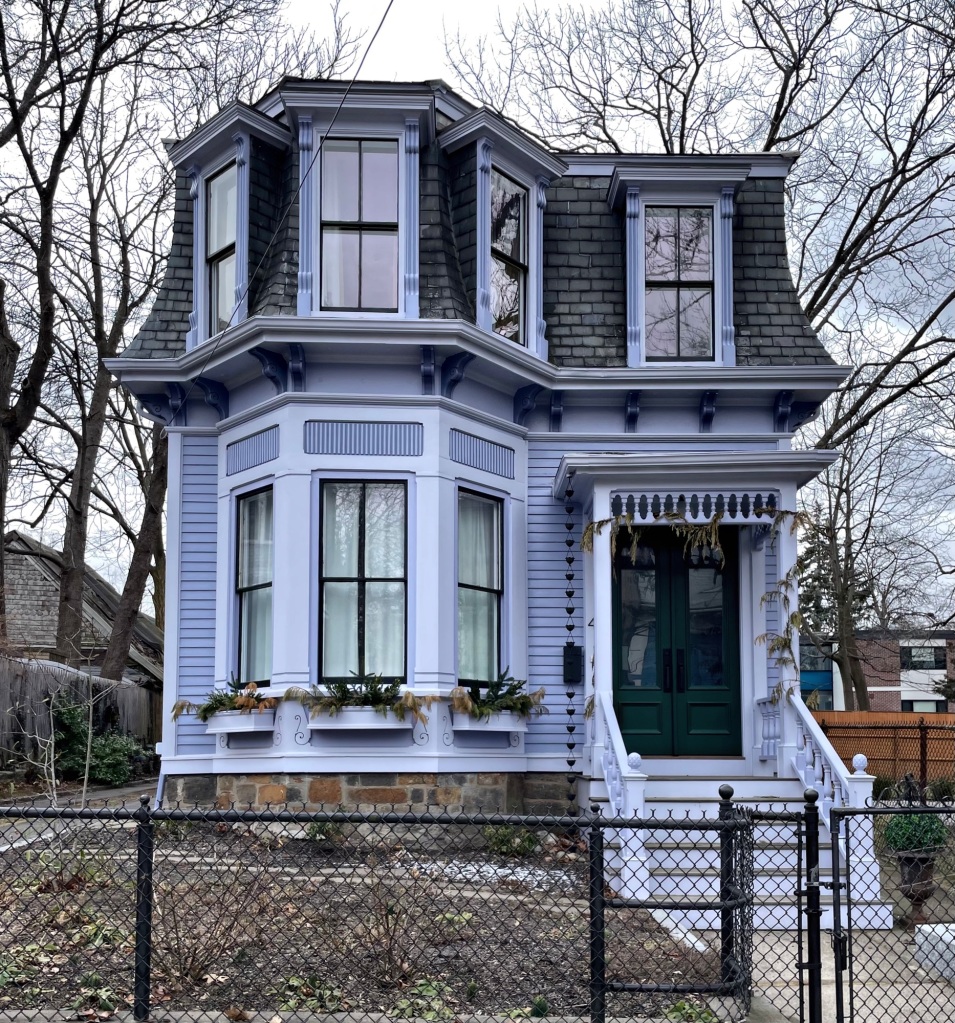
Albert Cabot Betteley (1816-1893) was an inventor and coal dealer in Boston. He invented an elevator to hoist goods into a warehouse, a peat grinder for the speedy drying of peat for fuel, and even patented wooden pavement…seriously. He eventually would build this home on Cobden Street in Roxbury where he and his wife Mary Jane would live out their retirement. While he didn’t “make it big” persay with his inventions, he exemplified the typical middle-class resident of Roxbury at the time and built this modest home, with its two-story form with octagonal bay, bracketed cornice, and mansard roof. The cottage was recently repainted the purple color, which I really enjoy!
One of the finest townhomes in the Back Bay of Boston is this stunning residence on Beacon Street. The house was constructed in 1907 for Henry Parsons King (1867-1913) and his wife Alice Spaulding King following the destruction of a house previously on the lot. Henry King was an extremely wealthy businessman who went to Harvard College before working his way up the ranks to become the president of the Whittier Machine Company and the Boston manager of the Otis Elevator Company. For their Back Bay mansion, the couple hired the esteemed firm of Little & Browne to design the stately home with its full bowed facade. Henry King died in October of 1913 and his funeral was in the home, with his body laid under the main circular staircase inside (which according to sources is one of only two free-floating marble staircases in the United States!) Alice King and their only surviving child, Henry Parsons King, Jr., continued to live at 118 Beacon. Alice died in 1938 and the family home was purchased the next year by the Fisher Business School (later Fisher College). The transaction was reported in the Boston Globe, which noted that 118 Beacon was “well known for its interior woodwork, paneling and flying staircase of polished marble,” and that the school would install “modern lighting and furnishings, including a cafeteria for student use.” Fisher College would purchase more buildings in the area and the former King Mansion is now home to the Fisher College Library.
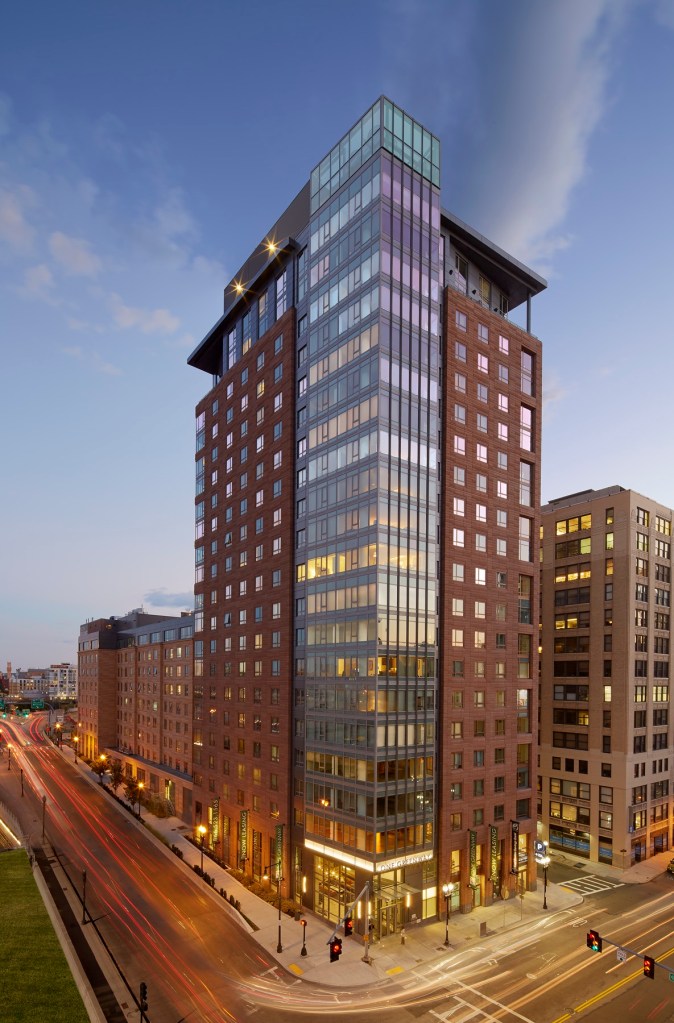
Replacing a vacant lot bordering I-93 at Kneeland Street, the One Greenway development provides much needed housing and design as one of the gateways into the Chinatown neighborhood of Boston. A result of community engagement, One Greenway is one of the largest new affordable housing projects in recent memory. The project restores the urban fabric that was lost half a century ago to the construction of major highways, which cut through the community and provides much-needed affordable housing in one of the nation’s oldest and largest immigrant communities. When the elevated highway was moved underground and the Rose Kennedy Greenway was laid out, parcels adjacent were available for reuse, and this was one of the last to be redeveloped. The building mixes 217 market-rate apartments and 95 affordable apartments, to create a mixed-income development, hopefully the future, as to not segregate affordable housing to less-desirable parts of cities. Designed by the firm Stantec, the building creates a solid street wall at the corner, and provides amazing open space at the rear in the form of a well-designed park designed by Crosby, Schlessinger, and Smallridge. The use of beige terracotta panels makes the large building more inviting, compared to the cold and sterile new apartment buildings going up all over the city and region.


 Buildings of New England