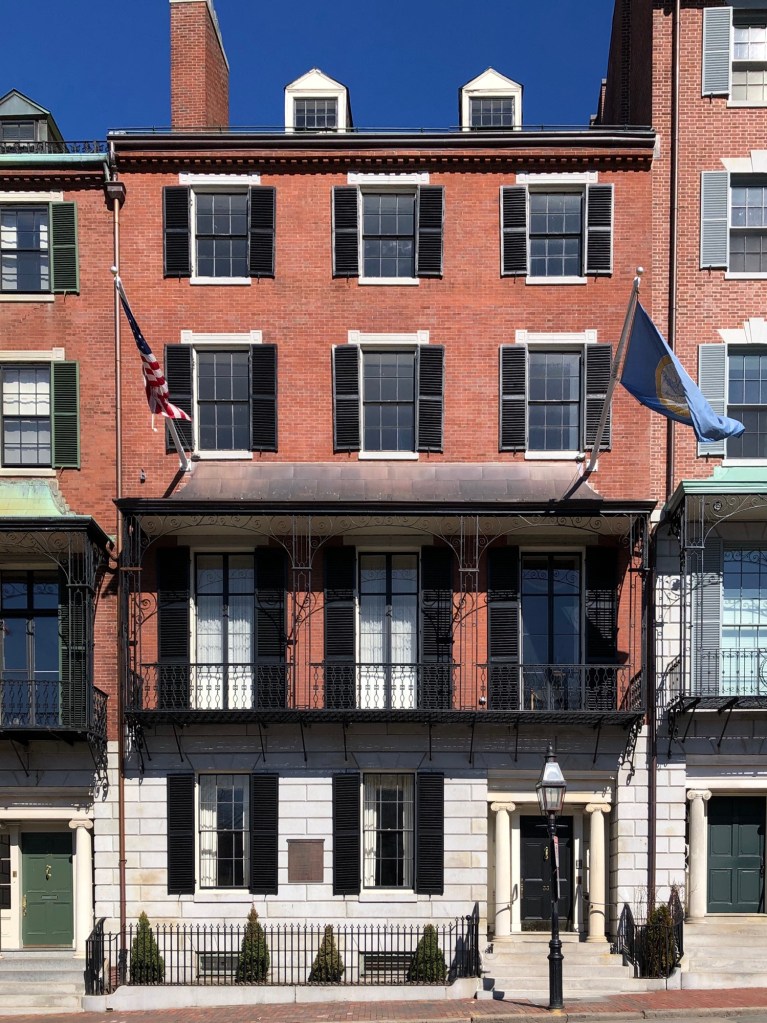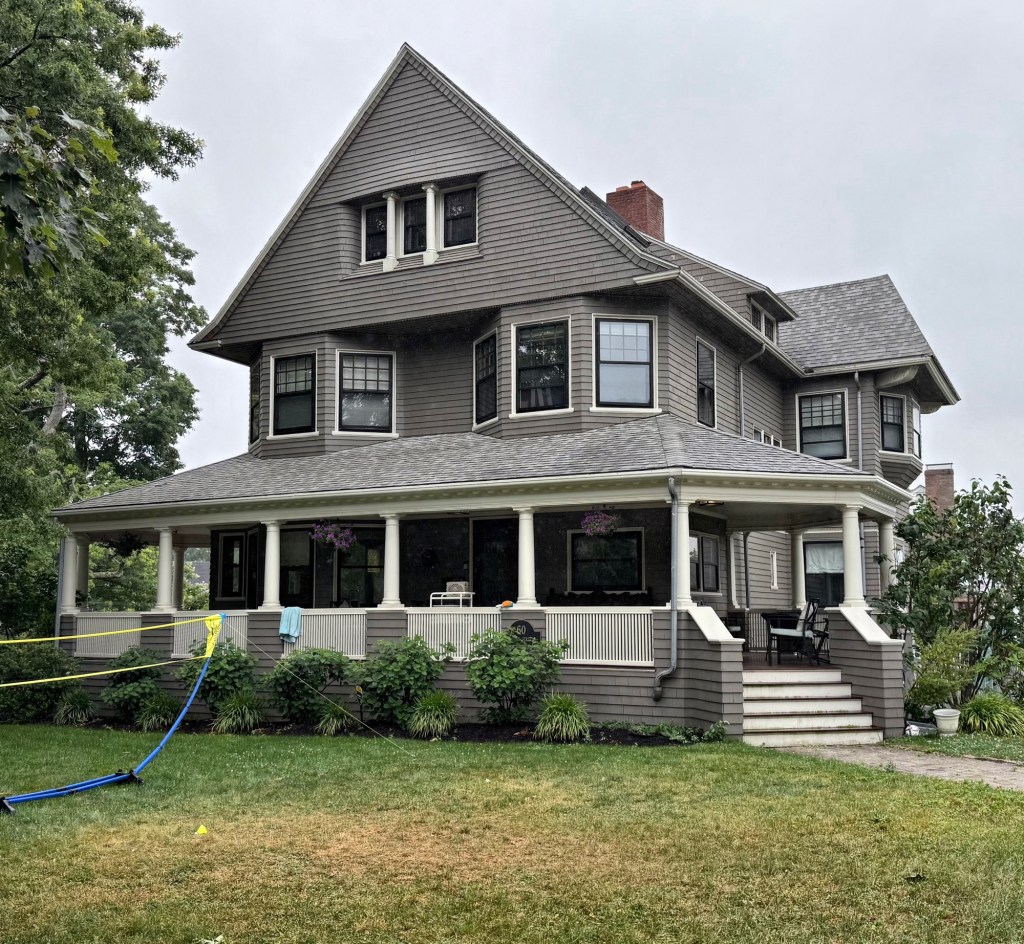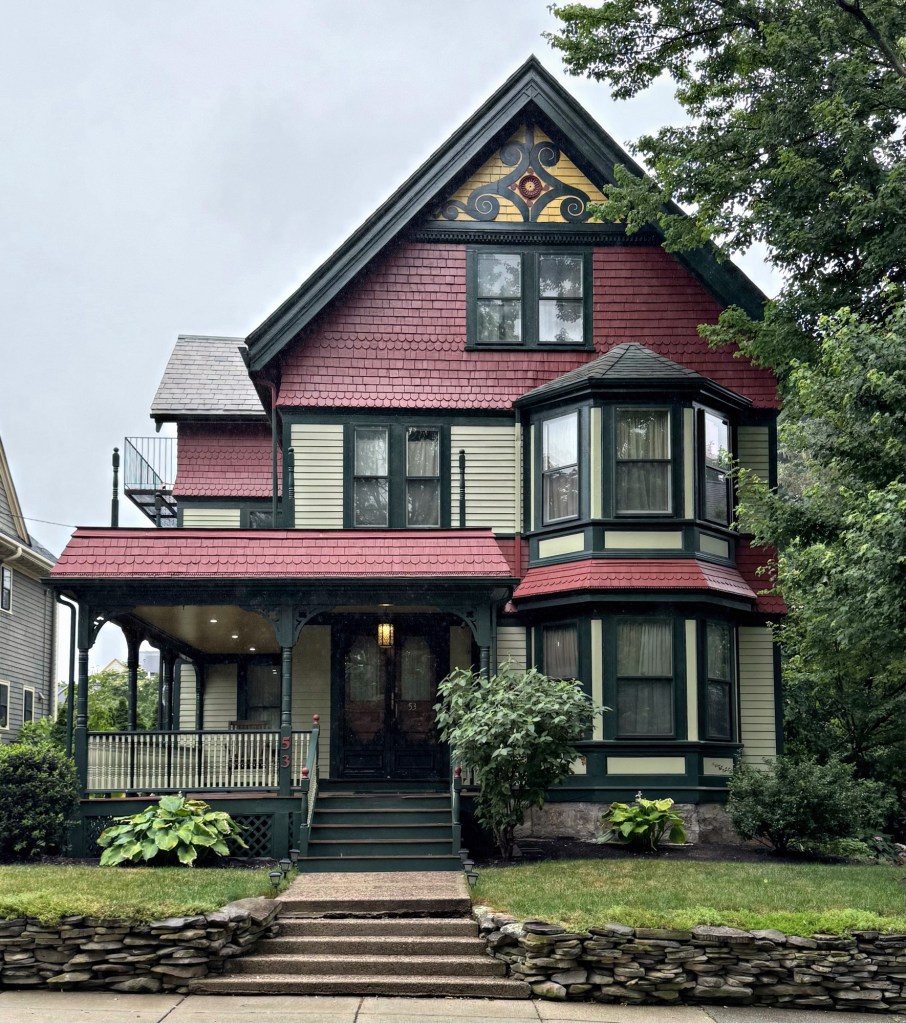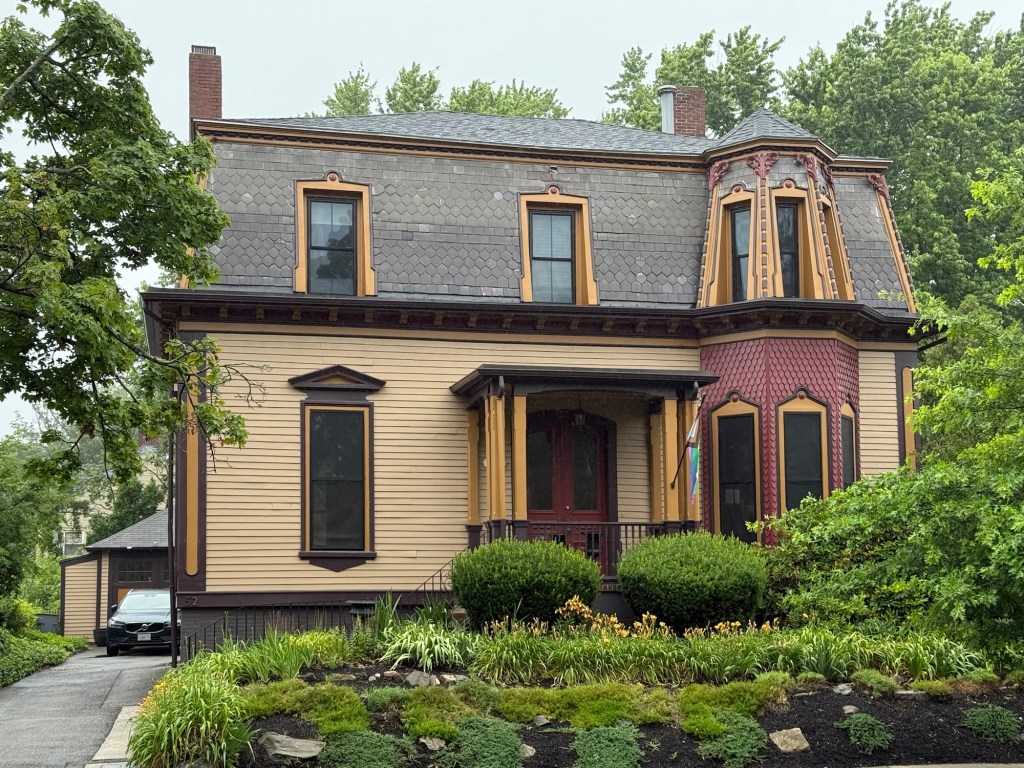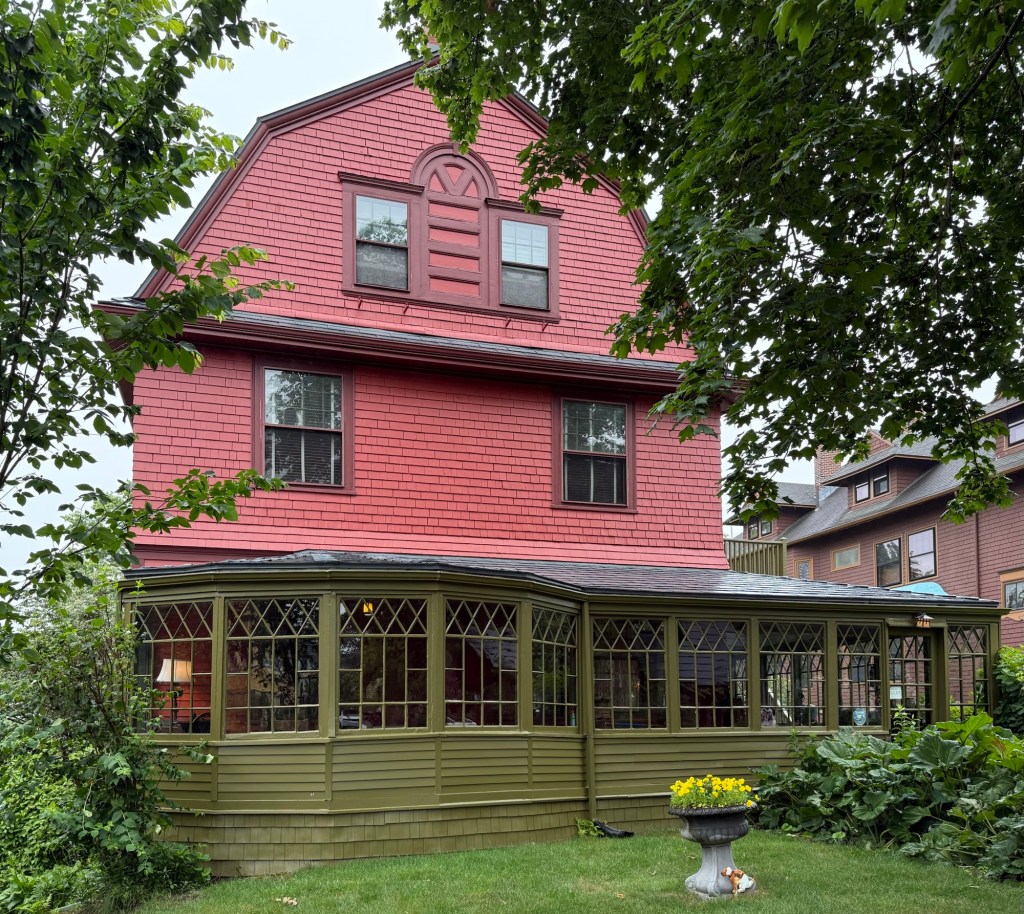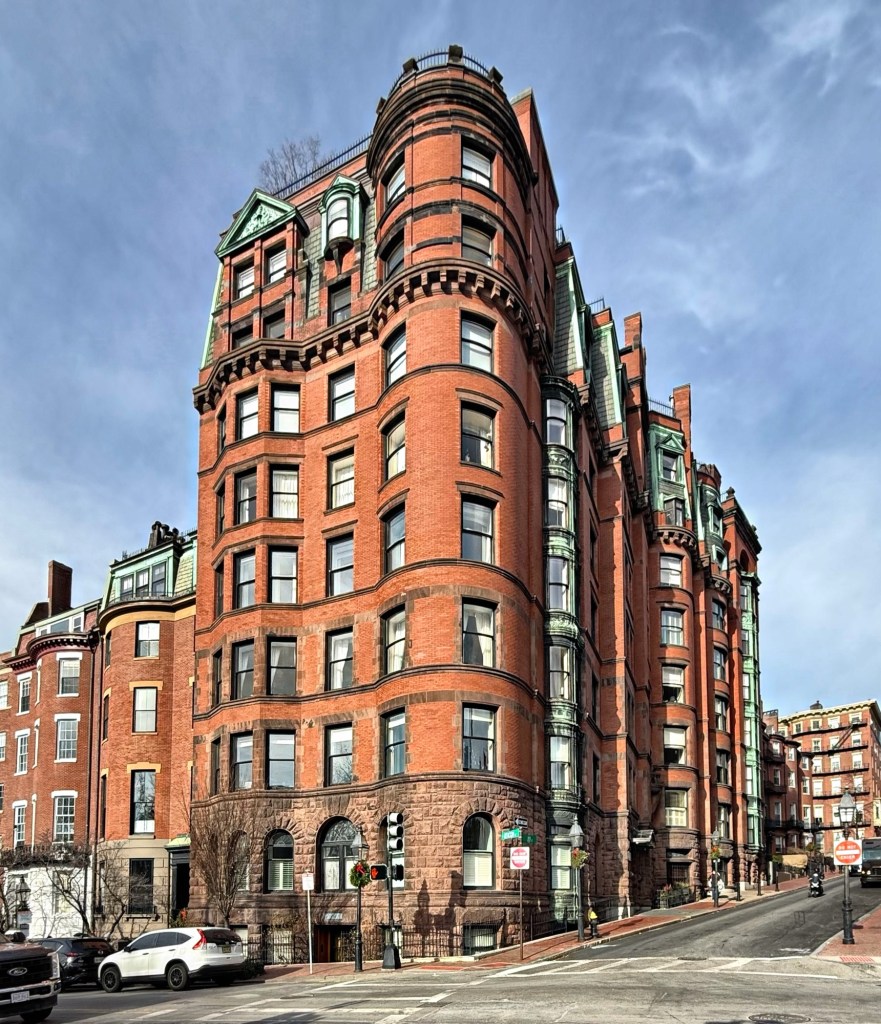
William Potter Rental House // 1889

William W. Potter, a shoe manufacturer and businessman, and his wife, Isabella Abbe Strickland Potter, lived in the Longwood section of Brookline and became active in the surround areas development in the last decades of the 19th century. William bought land off Kent Street and began to lay out house lots, becoming a developer overseeing construction of stately Queen Anne Victorian rental properties marketed to upper-middle-class residents. For this house on Francis Street, he commissioned architects George Rand and Bertram Taylor, who were known for producing stylish residential designs for the middle class in the Boston area. The massive property was a duplex, providing units to two lucky families! The building has just about every hallmark feature of the Queen Anne style including: the conical roof on a rounded corner bay, a complex roofline, asymmetrical plan, varied siding/materials, and applied ornamentation. In the 1920s, the house was owned by Simmons College, and used as a boarding house. Luckily, the property was restored and now is one of the finest residences in the neighborhood.

Orlando & Ellen Alford House // 1883

Orlando Hiram Alford (1840-1908) was an industrious and hardworking Vermonter who settled in the Boston area to make his wealth. He was a member of Bliss, Fabyan & Co., a large drygoods dealer, and would also become a director of the First National Bank, the City Trust Company, and the Franklin Savings Bank. In manufacturing, he serves the role of director of the Bates Manufacturing Company, the Merrimac River Towing Company, the Columbian Manufacturing Company, the Cordis Mills, and the Thorndike Company (among others). From his many positions and roles, he and his wife Ellen, were able to afford a house lot on Kent Street in the neighborhood between Longwood and Brookline Village. The Alford House, a stunning example of the Queen Anne style remained in family until after Ellen’s death in 1929, when it was purchased by the Boston Hospital for Women as a nurse’s residence. It was later used as apartments and was clad with vinyl siding, obscuring much of the original wood trim detailing. In the 2000s, later owners sought to demolish this house, which served as a rallying cry for neighborhood residents who understood the importance of the house and its context with surrounding lots. After the demolition delay process lapsed, they petitioned for a local district designation, effectively preserving the house for more generations to come! The Lawrence Local Historic District has since provided protection for houses in the area, but does not require a homeowner maintains or keeps up a property in a certain condition. Hopefully the Alford House will be restored soon!

McInnis House // 1901

Located next door to Ms. Matchett’s house on Chatham Street in the suburban Longwood neighborhood of Brookline, Massachusetts, you will find this very unique example of a Colonial Revival style single-family home. Built by 1901 for lawyer Edwin G. McInnis (sometime spelled McInnes) and his wife, Mabel, the house is high-style Colonial Revival with symmetrical facade, rustication, two-story Corinthian pilasters framing the bays, Palladian window, and Federal style entry with fanlight transom. No records of the architect could be located sadly.

Lawrence-Christian House // c.1855

Another of the early homes of the affluent Longwood subdivision of Brookline, Massachusetts is this painted brick house which dates to the 1850s. The house was developed by Amos A. Lawrence, who developed much of the neighborhood, renting out suburban houses to wealthy Boston-area residents. In 1866, Lawrence sold the property to Samuel S. Allen of Roxbury and it would change ownership a half-dozen times in the next century. The property was added onto and modernized a few times, notably during the ownership of Henry A. Christian, MD, the first Chief-of-Medicine at Peter Bent Brigham Hospital over the Muddy River in Boston. The streamlined late-Colonial Revival look with vestibule side entry, windows, and shallow hipped roof are all likely later alterations from the 1850s house.

Hutchings-Pfaff Gatehouse // c.1884

Once located at the entrance to the Hutchings-Pfaff Mansion, this small stone gatehouse is all that remains of a great Roxbury estate. Built of locally quarried Roxbury Puddingstone decades after the main house was completed, the Victorian Gothic style cottage surprisingly survived the subdividing of the large property and was sold as a private home in the early 20th century. It is uncommon to see these types of outbuildings survive into the 21st century, so I hope to see this charming cottage survive another 150 years!

Cushing-Gay Townhouse // 1862

The Cushing-Gay Townhouse at 170 Beacon Street in the Back Bay neighborhood of Boston stands out as one of the most unique and pleasing early remodeled homes to look at. 170 Beacon was built by 1862 as one of two contiguous houses (168-170 Beacon) built for John Gardiner Cushing and his younger brother, Robert Maynard Cushing. John Gardiner Cushing built this house, which was originally a Second Empire style home similar to the dark gray residence nextdoor. The Cushing Family owned the property until 1894 and the property was sold to Helen (Ellis) Brooke, the the wife of Rev. Stopford Wentworth Brooke a British politician and later a minister of the First Church (Unitarian) of Boston. The Brooke’s moved back to England in 1900 and this home was sold to Eben Howard Gay, a banker and note broker. Eben’s wife of less than two years died just before he purchased this house on Beacon Street, she was just 26 years old. As a bachelor, Eben Gay hired architect and interior designer Ogden Codman, Jr., to remodel the 1860s house, giving it the present Adamesque front façade and new interiors to provide a setting for his collection of Chippendale furniture. The after being bought and sold numerous times following Gay’s financial struggles and selling of his prized home, the Cushing-Gay Townhome was purchased by the German Government in 1966 and is today the Goethe Institute, Boston, a cultural center and language school for the German language.

Skinner Mansion // 1886

One of the best early examples of Classical Revival residential architecture in Boston can be found on Beacon Street in the Back Bay, at the Skinner Mansion. Built in 1886 for dry goods merchant Francis Skinner (1840-1905) and his wife, Eliza Blanchard (Gardner) Skinner (1846-1898), the house exhibits a light stone facade with carved detailed panels and fluted pilasters, stone parapet with urns at the corners and a decorative wooden entrance with ironwork. Eliza was the sister-in-law of Isabella Stewart Gardner who herself lived on Beacon Street until erecting what is now the Isabella Stewart Gardner Museum, in the early 1900s. The Skinners hired architects Shaw & Hunnewell to furnish plans for their Boston townhouse, and they did not disappoint! Today, the mansion is occupied by medical offices, but retains the residential charm and character as it is located in a local historic district.

Henry Parsons King Mansion // 1907

One of the finest townhomes in the Back Bay of Boston is this stunning residence on Beacon Street. The house was constructed in 1907 for Henry Parsons King (1867-1913) and his wife Alice Spaulding King following the destruction of a house previously on the lot. Henry King was an extremely wealthy businessman who went to Harvard College before working his way up the ranks to become the president of the Whittier Machine Company and the Boston manager of the Otis Elevator Company. For their Back Bay mansion, the couple hired the esteemed firm of Little & Browne to design the stately home with its full bowed facade. Henry King died in October of 1913 and his funeral was in the home, with his body laid under the main circular staircase inside (which according to sources is one of only two free-floating marble staircases in the United States!) Alice King and their only surviving child, Henry Parsons King, Jr., continued to live at 118 Beacon. Alice died in 1938 and the family home was purchased the next year by the Fisher Business School (later Fisher College). The transaction was reported in the Boston Globe, which noted that 118 Beacon was “well known for its interior woodwork, paneling and flying staircase of polished marble,” and that the school would install “modern lighting and furnishings, including a cafeteria for student use.” Fisher College would purchase more buildings in the area and the former King Mansion is now home to the Fisher College Library.

Derby Townhouse // 1886

Hasket Derby (1835-1914), was the grandson of Elias Hasket Derby, a prominent trader in Salem, MA., who was thought at one time to be the richest man in the United States. Hasket married Sarah Mason and the family lived in Boston. Dr. Hasket Derby was a renowned opthamologist and had this townhouse built in the Back Bay of Boston in 1886. He hired architect William Ralph Emerson, who ditched his prototypical Shingle style for the urban townhouse in the Colonial Revival style. The townhouse exhibits a brownstone swans neck pediment at the entry, three-story rounded bow, dentilled cornice and brick pilasters framing the bays. Its an often overlooked house in Back Bay, but so very special.

John and Gertrude Parkinson House // 1902

Teardowns have always been a common occurrence in cities, though replacement buildings from before WWII tended to be more substantially designed and built. This stately manse on Beacon Street in the Back Bay was built in 1902 on a lot previously comprised of two townhouses! This residence was built in 1902 for John and Gertrude Weld Parkinson from plans by the renowned firm of Peabody and Stearns. The Classical Revival style house has a limestone face and chunky stone lintels at the second floor to break up the facade. After income tax was introduced in the early 1900s and changing economic conditions for wealthy homeowners shifted, large single-family homes were no longer the norm. This home (and many others in Back Bay) was converted to a multi-family apartment building and today is home to eight condo units.