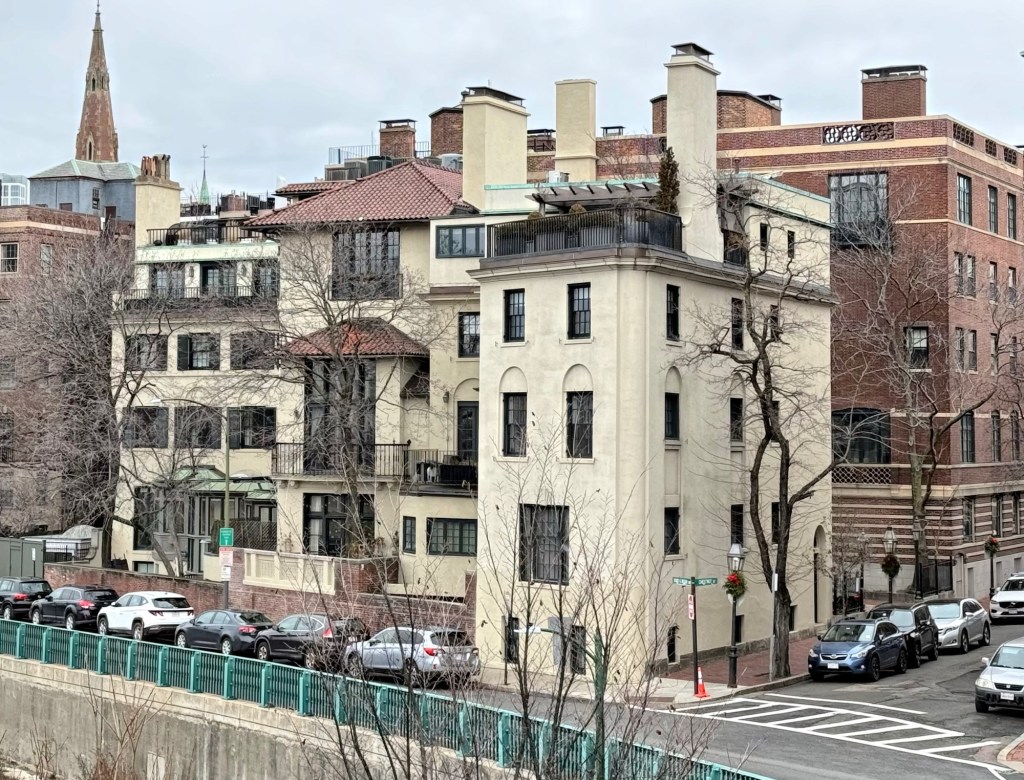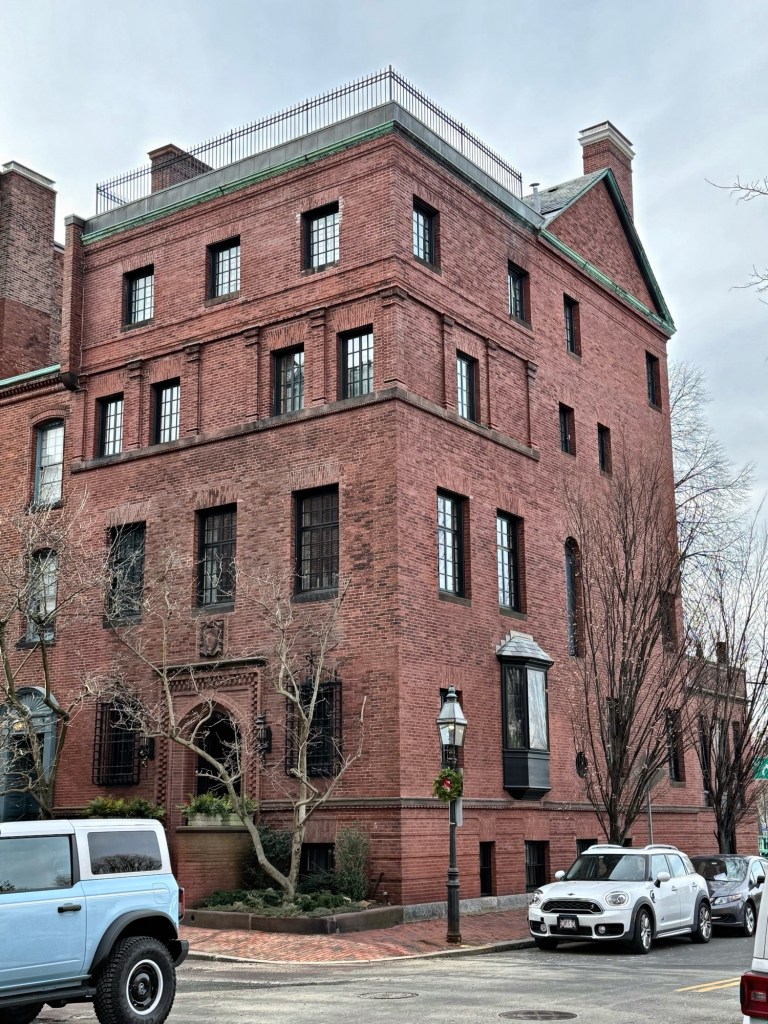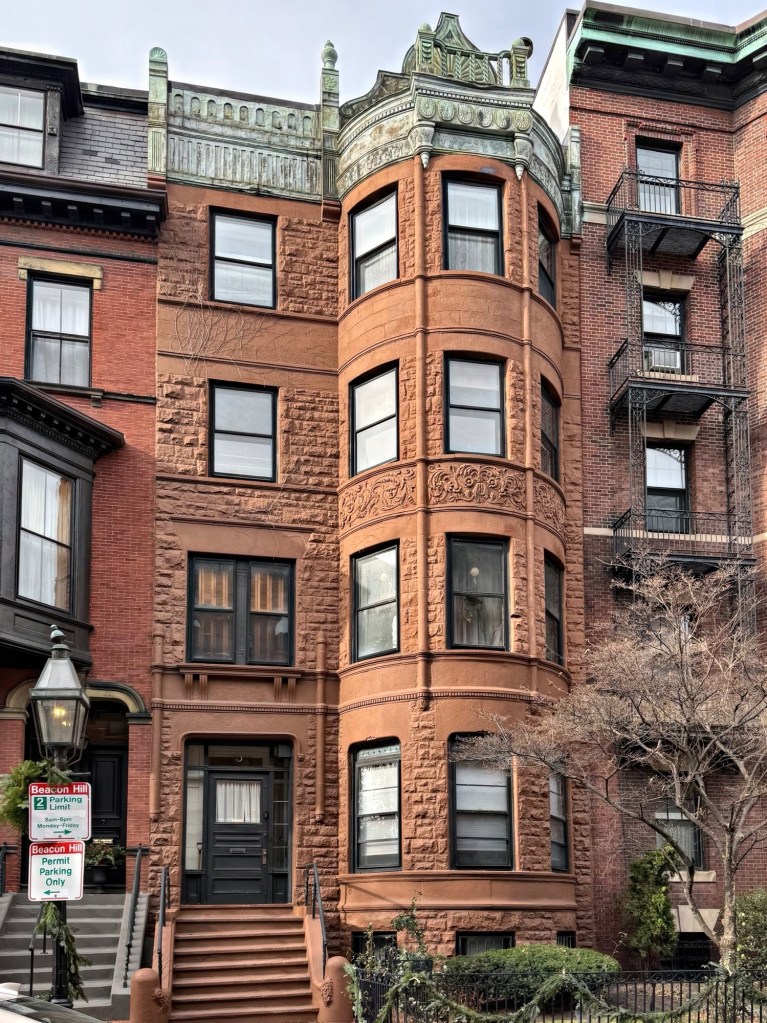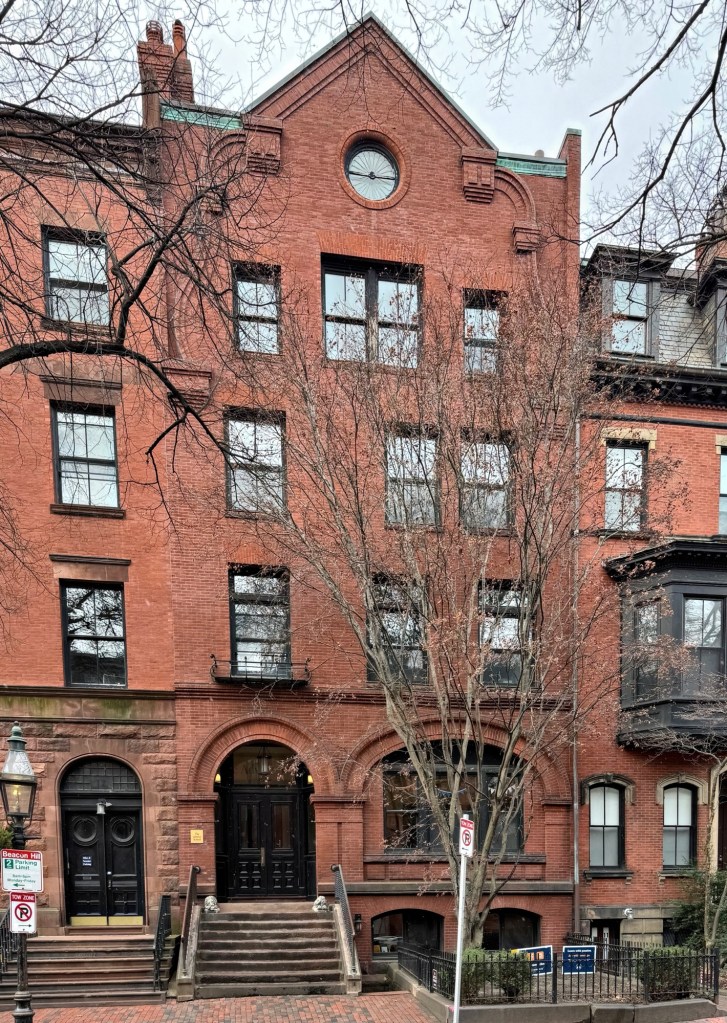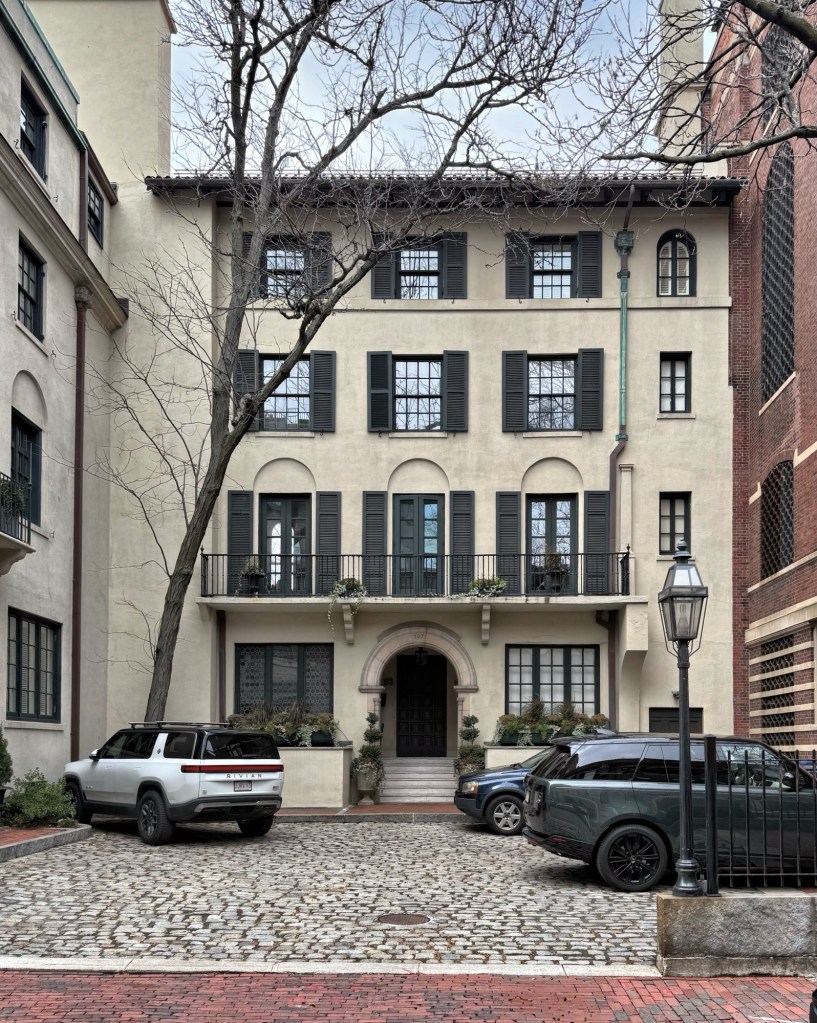
Charles and Elizabeth Ware Mansion // 1870

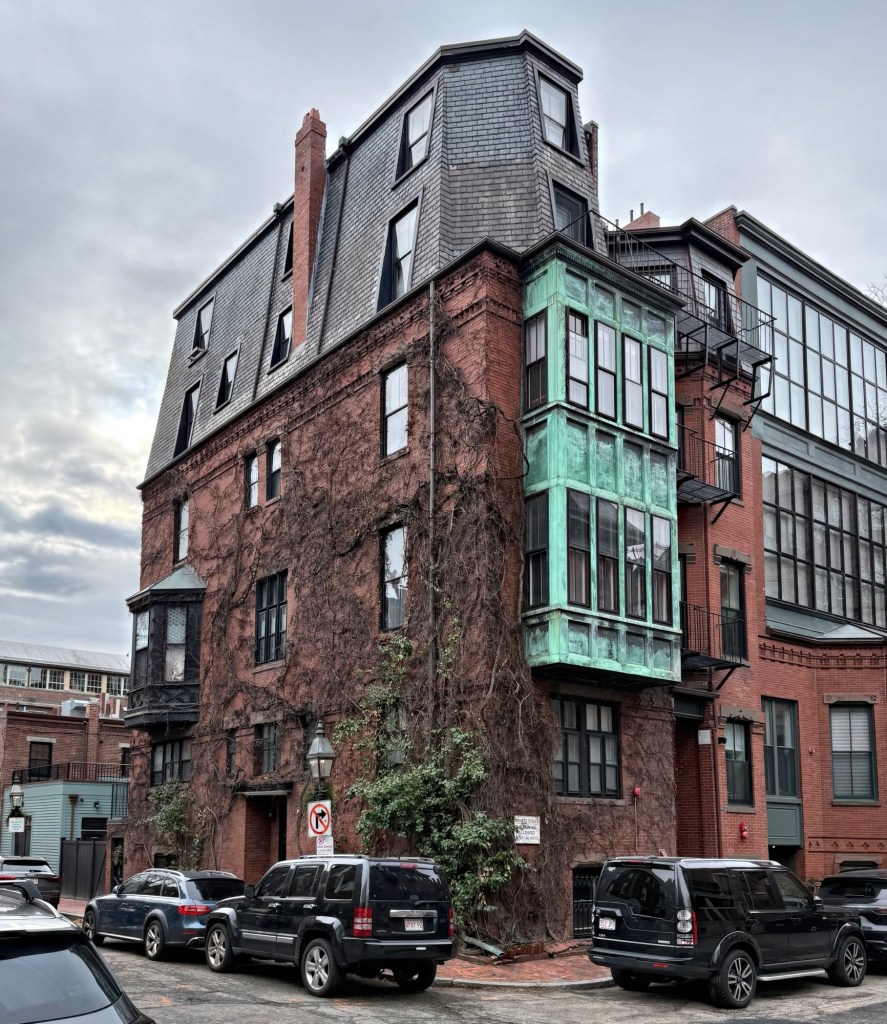
Located at the corner of Brimmer and Mount Vernon streets in Beacon Hill, this stately mansion showcases the various architectural styles and methods utilized by architects in the waning decades Victorian-era Boston. Set atop a brownstone base, the floors above are in the “Panel Brick” style, which utilizes brick masonry in a variety of decorative patterns of slight projecting or receding panels. The style was popularized by the Boston architectural firm of Ware & Van Brunt, as noted by architectural historian, Bainbridge Bunting. As expected, this house (and the attached townhouse next door) was designed by William Robert Ware for his uncle, Dr. Charles Eliot Ware (1814-1887) and his wife, Elizabeth Cabot Lee Ware. Dr. Ware was a physician at Massachusetts General Hospital and secretary of the Massachusetts Medical Society. After the death of Dr. Ware and Elizabeth, the property was inherited by their daughter, Mary L. Ware (1858-1937), a naturalist and botanist who was the principal sponsor of the Harvard Museum of Natural History‘s famous Glass Flowers. After the death of Mary, the property sold out of the family to Robert Wales Emmons III, a financier from a yachting family. The mansion remains in a great state of preservation, and is among the great Victorian-era residences in Beacon Hill.

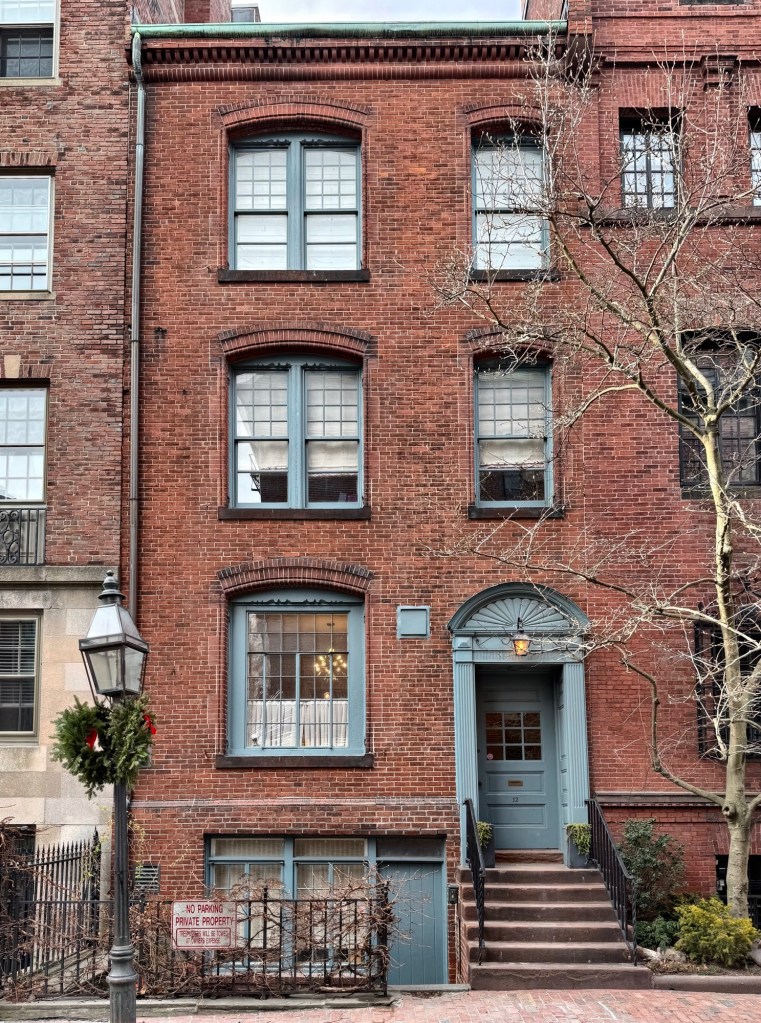
Perkins House – Diocesan House // 1832

Constructed of red brick and trimmed with brownstone, the beautiful townhouse at 1 Joy Street, is one of a few properties in Boston’s Beacon Hill neighborhood to have a front yard. Built in 1832, the four-story residence has its primary facade characterized by a flat entrance with a rounded bay extending upwards to the roof. Designed by architect, Cornelius Coolidge, who designed many other homes in this section of Beacon Hill, the completed house was purchased by Thomas Handasyd Perkins, Jr. (1796-1850), the eldest son of the enormously wealthy and influential Thomas Handasyd Perkins, Sr., who is considered by many to have been the most successful merchant prince of Boston’s Federal period. In 1892, the Episcopal Association purchased 1 Joy Street for use as headquarters of the diocese, and it became known as the Diocesan House. Today, the building is divided up into condominium units, providing residences just steps from the Boston Common.

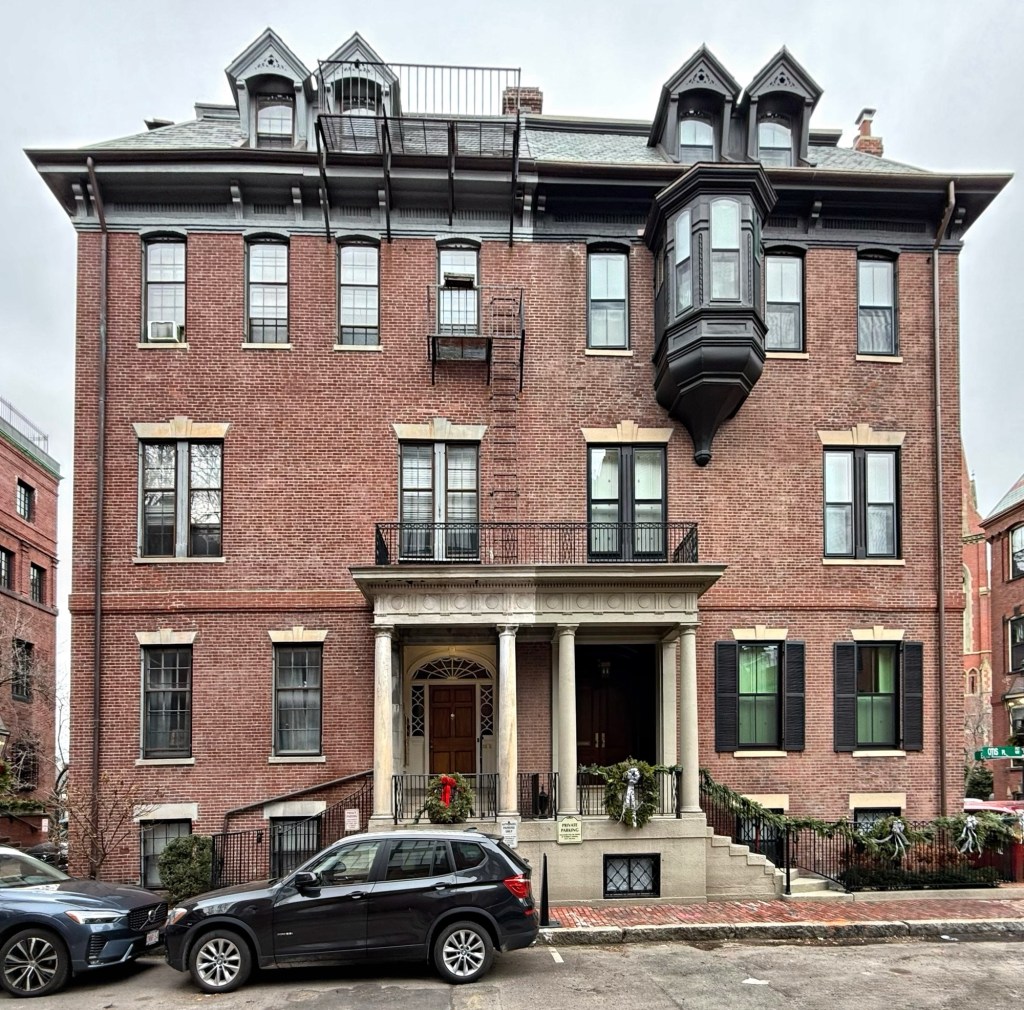
Motley-Davis Mansion // 1811

This stately Federal style mansion at 10 Walnut Street in Beacon Hill, was built in 1811 for Ebenezer Francis as an investment property on land he had purchased from Uriah Cotting, one of the premier real estate developers of 19th century Boston. By 1823, Thomas Motley, the father of historian John Lothrop Motley, lived here, and hosted impromptu melodramas enacted by a young John Motley and two of his friends,
Wendell Phillips and Thomas Gold Appleton, both of whom lived close by on Beacon Street. After the Civil War, the property was owned by James Davis (1806-1881), a wealthy coppersmith who co-founded The Revere Copper Company with Joseph Warren Revere, grandson of Paul Revere. James Davis remodelled the Federal style house with Second Empire detailing including a brownstone-faced first story and quoins, with an oriel window at the second story, and a slate mansard above a bracketed cornice. During the 1920s, 10 Walnut Street’s Victorian facade was removed and a Federal Revival facade was constructed in its place, closer to original conditions. Today, the Motley-Davis Mansion rises four stories from a low granite basement to a flat roof enclosed by a low parapet. The off-center entrance is marked by columns supporting a cornice-headed entablature. This entablature interrupts the continuous stone belt course separating the first and second stories. What a beauty.

Lyman-Gray House // 1834

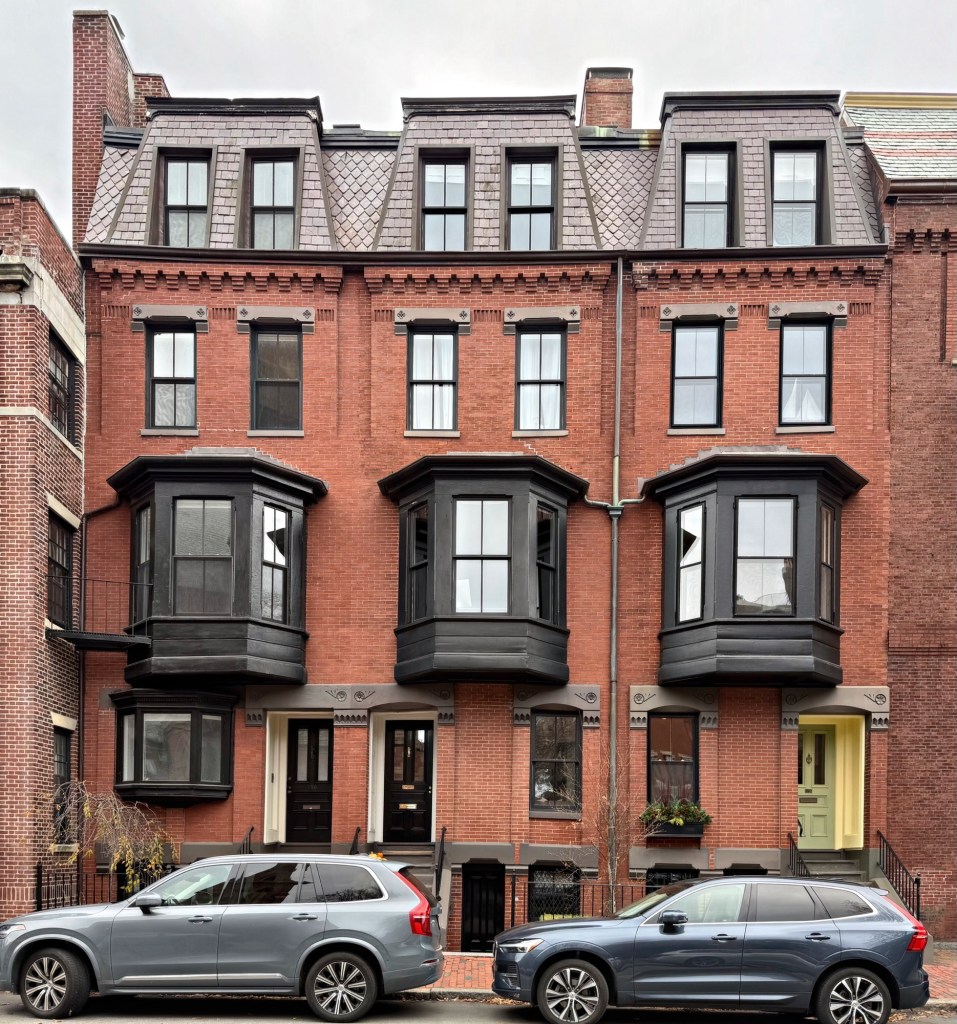
Mount Vernon Place is a short, dead-end street in Boston’s Beacon Hill neighborhood. The street was once an entire block of eight rowhouses, and was developed in the 1830s on land formerly owned by John Hancock and his family. The residences numbered 1-5 Mount Vernon Place were torn down during the 1910s to accommodate the expansion of the landscaped grounds of the State House, leaving just 6, 7, and 8 Mount Vernon Place. The center rowhouse, 7 Mount Vernon Place, was built in 1834 and is believed to have been designed by Alexander Parris, a prominent local architect who designed Quincy Market and mastered the Federal and Greek Revival architectural styles with many notable buildings all over the east coast. The residence has a three bay facade and brownstone sills, lintels, and door surround and has been preserved for nearly two centuries. The house was long-owned by George W. Lyman, an industrialist who lived nearby on Joy Street. The residence was rented for decades until it was purchased by Francis C. Gray a physician, and inherited by his grandson, Ralph Weld Gray, an architect through the 1940s.

Hutchings-Pfaff Gatehouse // c.1884

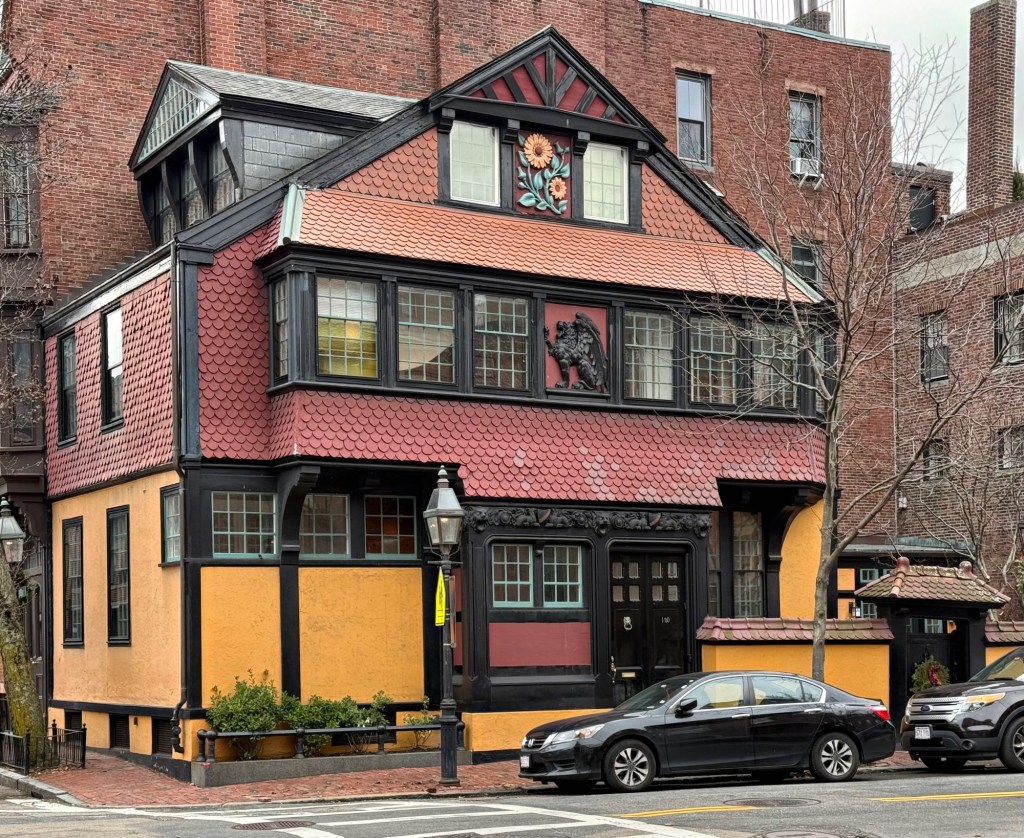
Once located at the entrance to the Hutchings-Pfaff Mansion, this small stone gatehouse is all that remains of a great Roxbury estate. Built of locally quarried Roxbury Puddingstone decades after the main house was completed, the Victorian Gothic style cottage surprisingly survived the subdividing of the large property and was sold as a private home in the early 20th century. It is uncommon to see these types of outbuildings survive into the 21st century, so I hope to see this charming cottage survive another 150 years!

The Carlisle // 1880

In 1880, Jonas Gerlusha Smith (1817-1893) received a permit to erect a multi-family apartment building on Warren Avenue in present-day South End. The lot was close to his personal residence at 13 Warren Avenue and would have been easy to maintain and oversee tenants in the building. Mr. Smith hired 26-year-old architect Arthur H. Vinal, who furnished the plans for the handsome Queen Anne building. Vinal would later become the City Architect of Boston from 1884 to 1887, designing the High Service Building at the Chestnut Hill Reservoir just seven years after this building. By the late 1880s, the building was known as The Carlisle and it remained in the Smith family holdings under Walter Edward Clifton Smith until the 1930s. Walter attended the Cambridge Episcopal Theological School and later worked at various churches in the Boston area, serving as pastor in his later years. He lived on Follen Street in Cambridge while he held the Carlisle for additional income. Under new ownership in 1950, a retail storefront was added to the first floor which was occupied as a florist for some years. In 1979, after years of deferred maintenance, the property was purchased by Louis G. Manzo and his son David W. Manzo, who meticulously restored the building over time into the time-capsule that it is today!

Daniel and Mary Knowlton House // 1880

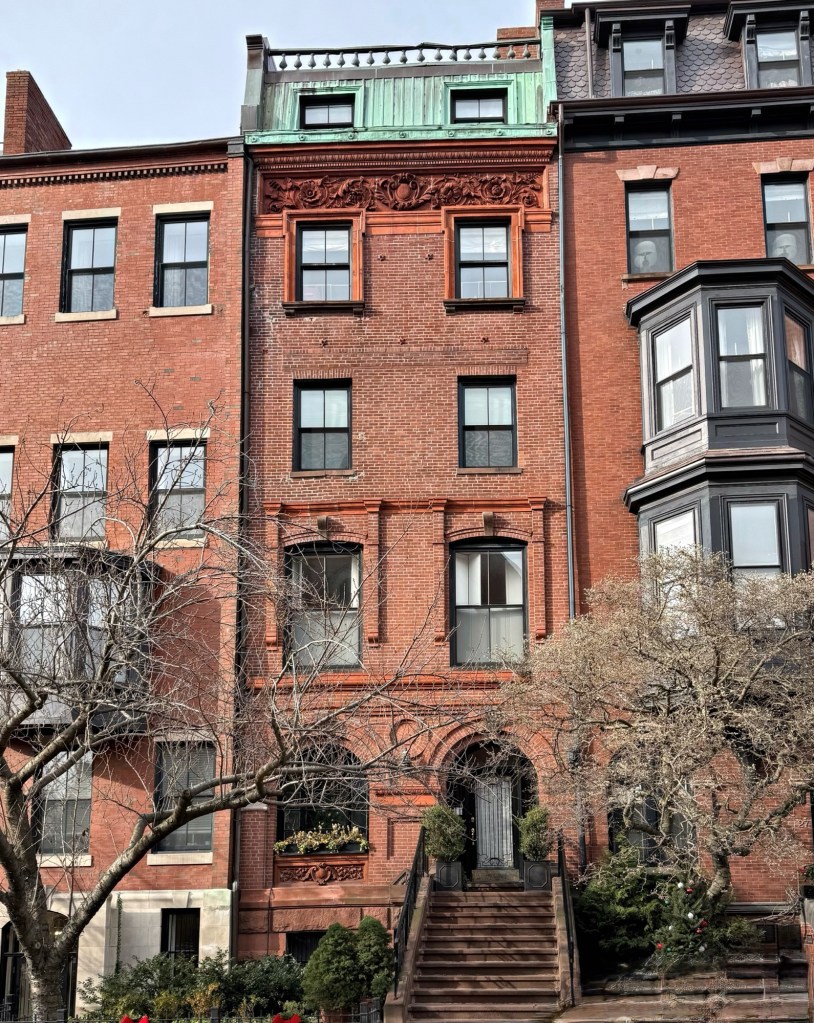
Another of my favorite townhouses in the Back Bay neighborhood of Boston is this Victorian Gothic mansion on Beacon Street, built for Daniel and Mary Knowlton. The residence was designed by the firm of Allen and Kenway and built in 1880 and stands out architecturally for its use of style and use of material amongst a sea of brick. A former cotton merchant, Daniel Knowlton was treasurer of the Flexible Shoe Nail Company and later worked as a stockbroker. The large single-family dwelling was converted into four condominium units in 1989, but has since been switched back to a single-family residence. It sold for $11.2 million dollars as a five bedroom, six full and two half bath home in 2017. Yikes!

Bauckman House // 1915

The Arts & Crafts movement in architecture provided some of the most stunning and well-designed properties of the early 20th century but sadly, there are not too many examples here in New England. When I find some, I always get excited and pull over to snap a photo! This home on busy Beacon Street in Waban, Newton, was built in 1915 for Harry W. Bauckman a salesman in Boston. The designs are credited to architect James G. Hutchinson, who specialized in Arts & Crafts and Tudor style buildings in the area. The Bauckman House is Foursquare in form which basically segments the house into four, large rooms on each floor with a stairhall in the center. The home is clad with banded shingles which extend to the piers at the porch, a subtle nod to Shingle style architecture. SWOON! I was later informed by a follower that this was also the home of landscape historian and author Judith Tankard for some time.