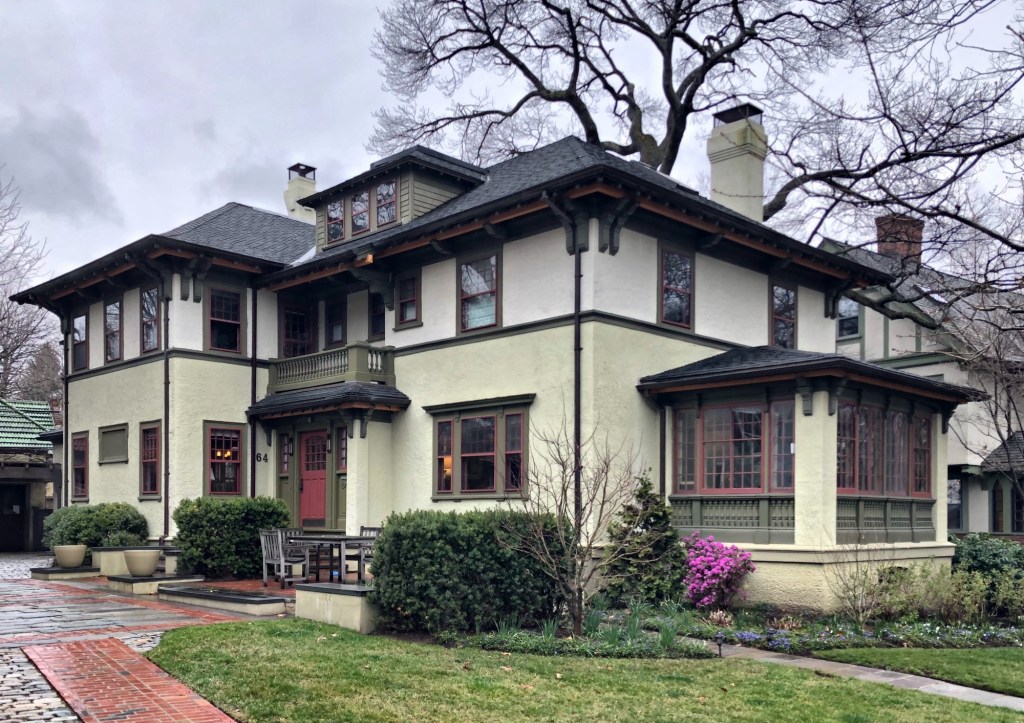
Partridge House // c.1908

Located on Amory Street in Brookline, this handsome Arts and Crafts style residence dates to about 1908 and while clearly Craftsman in style, does appear to follow the horizontality and form of the Prairie School of architecture, popularized by famed architect, Frank Lloyd Wright. While the architect of this house is unclear, we do know that the first owners were Mr. Frank T. Partridge and his wife, Edith Stevens Partridge. The stucco house features a horizontal belt course, shallow hip roof with broad eaves supported by brackets, and elaborate entry and porches. The colors enhance the architecture of the home perfectly. 
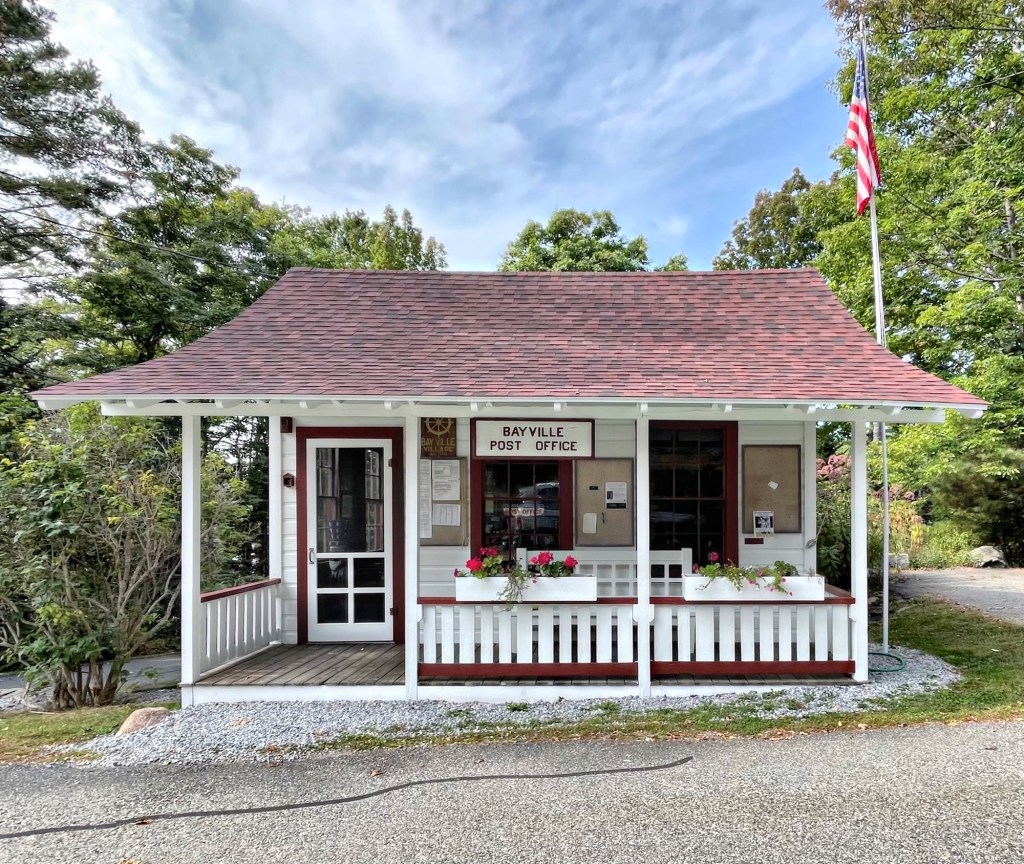
Bayville Post Office // c.1920

Bayville, is a quiet and picturesque coastal village on Linekin Bay, in the eastern part of Boothbay Harbor, Maine. The small village is comprised of roughly 40 cottages and a small post office. This post office was built around 1920 and has operated here seasonally every summer since. The rustic Craftsman style building features a broad roof with exposed rafter tails, extending to create a sheltered porch off the front.

Maud Howe Elliott Bungalow // c.1912

This shingled Craftsman bungalow on Rhode Island Avenue in Newport was built in the 1910s for Maud Howe Elliott (1854-1948), a Pulitzer prize winning author and active member in Newport’s art scene and her artist husband, John Elliott. Maud Howe was born at the Perkins School for the Blind in Boston, founded by her father, Samuel Gridley Howe. Her mother was the author and abolitionist Julia Ward Howe. In 1887, she married English artist John Elliott. John is known for his epic Symbolist murals including working alongside his friend and colleague John Singer Sargent to provide murals for the Boston Public library, and a mural at the Smithsonian Museum of Natural History. In Newport, Maud became a founding member of the Newport Art Association, and served as its secretary from 1912 to 1942. She also took part in the suffrage movement as she was greatly influenced by her mother’s ideas and convictions about women’s role in society and particularly so in terms of women’s suffrage. She fought passionately for women to be liberated from the societal expectations and roles determined to them by male dominated society. This was her home in Newport until her death in 1948.

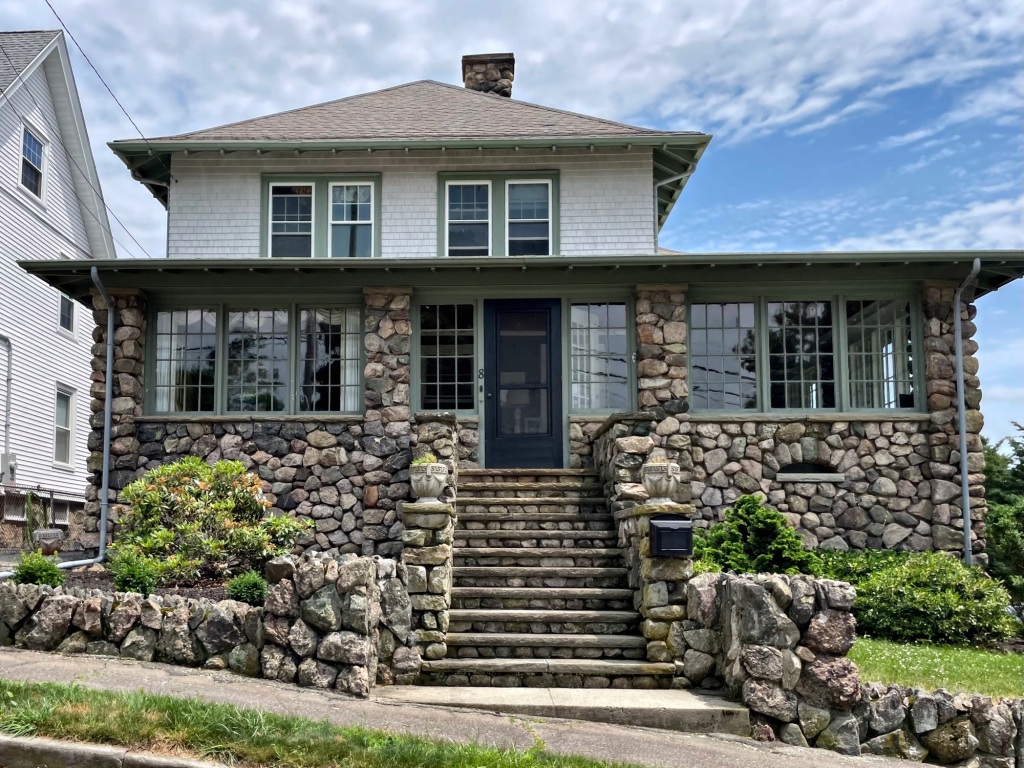
John Smith House // c.1895

Hull, Massachusetts is an often overlooked town (besides Nantasket Beach Reservation), but there are some really great old houses and buildings to be found in the seaside town. This is the John Smith House on Meade Avenue in the Atlantic Hill neighborhood inland from the peninsular part of town. Development here was fairly slow, but took-off in the late 19th century when cottagers began to develop some house lots here. They were soon joined by year-round residents like John Smith, an ice merchant who built this home around 1895. Craftsman in style, the house exhibits a mix of building materials with a rough fieldstone porch and two matching stone chimneys together with wood shingle siding. The stunning stonework extends from the foundation, uniting the house to its terraced, rocky site. It is one of a handful of homes here that have not yet been altered or covered up by vinyl siding.

Megunticook Clubhouse // 1901

As coastal communities in Maine’s mid-coast began to see more wealthy summer residents, these enclaves of cottages needed clubhouses and spaces to spend their summer days. In 1899, Philadelphian (and Rockport summer resident) Charles Wolcott Henry converted a section of his oceanfront summer estate at Rockport’s Beauchamp Point to a newly established golf club which quickly outcompeted all others nearby. Within a few years, Boston architect Charles H. Brigham, was hired to design this Craftsman style clubhouse that sits on an elevated site with an expansive wraparound veranda providing views of the new course and the Penobscot Bay. The rubble-stone foundation and walls clad in brown-stained shingles are well suited to the rugged coastal Maine site. The golf course, also designed in 1901, was planned by groundskeeper Thomas Grant as a 9-hole course. The recreational complex has been meticulously preserved and is a great example of a turn-of-the-century clubhouse in coastal Maine. The 1901 clubhouse is also said to be the oldest golf building in Maine!

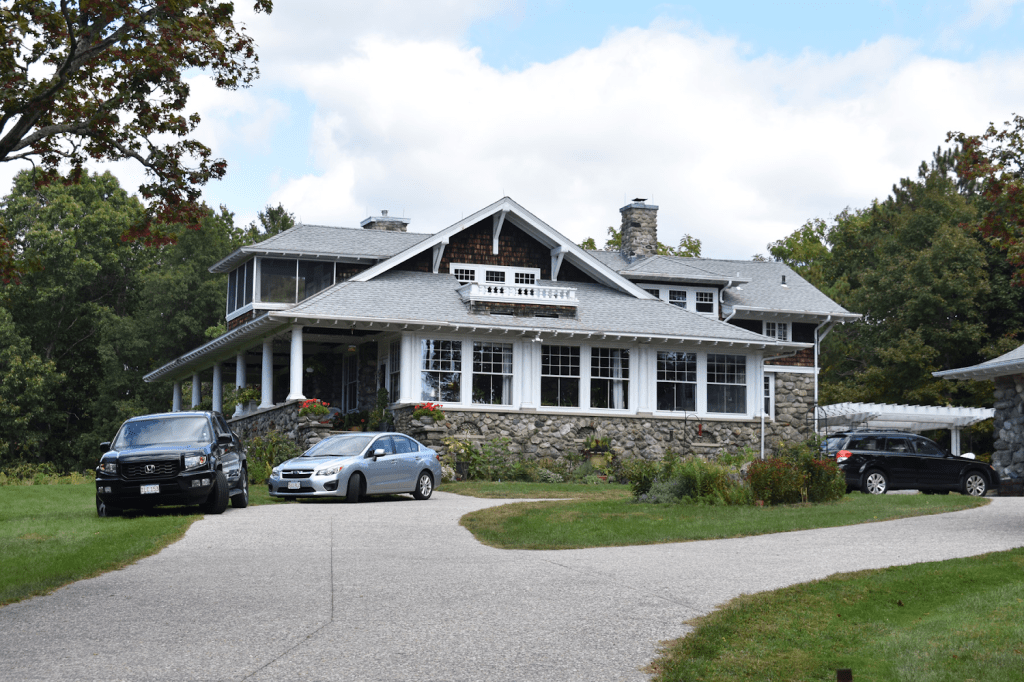
George and Effie Mead House // 1911

Prominently sited upon a hill on a dead-end street in West Acton, Massachusetts, this Craftsman Bungalow is a very elaborate and well-preserved example of the style. The house was built in 1911 for George Varnum Mead (1861-1940) and his wife Effie Wright Mead (1860-1926) as their summer home when they weren’t living in Somerville. Mr. Mead was born in West Acton to Varnum Balfour Mead, who operated the A. O. W. Mead Company, a produce marketing business in Acton and Boston. Varnum’s brother built an elaborate Second Empire style mansion in town which was featured on here yesterday. George Mead followed his father’s footsteps and worked in the family business, which was in operation starting in the 1840s. The A. O. W. Mead Company gathered produce from farmers all over West Acton, kept the produce in cold storage facilities erected by the family, and sent it to Boston for sale at Quincy Market until George’s death in 1940. The Craftsman style house has a fieldstone base, low, overhanging flared gable roof, and is sheathed in shingle siding. Characteristic features include the multiple dormers, exposed rafter tails, grouped windows, and the large fieldstone chimney.

Elwin Cove // 1908

While Blue Hill has historically been a summer colony for wealthy city-dwellers to escape to experience the beauty of Maine, it has never gotten the coverage as Bar Harbor or the other Mount Desert Island towns. Many of Blue Hill’s summer cottages are more refined and hidden away amongst the trees, and that is how the town likes it, unpretentious. I was lucky enough to take a wrong-turn and stumbled upon this gem of a cottage between the Blue Hill village and East Blue Hill, I had to take a photo! Upon further research, the rambling cottage was built in 1908 for Ellen and Edward J. Brooks of New Jersey. The cottage was named Elwin Cove, possibly as a merge of their children’s names ELinor and WINfred.

East Blue Hill Library // 1920

Every village needs a library, and East Blue Hill is no different! Without easy access to the main Blue Hill library, a group of “willing workers” amassed a collection of books with the hopes to donate to a future village library organization. A campaign to build the present building began in 1914 with the acquisition of land adjacent to the village post office, with major fundraising undertaken in 1917. The building, completed in 1920, was designed by John W. Merrow, a New York City theatrical architect and is an uncommon example of a small, Arts and Crafts style library in the state of Maine.

Annie Sheldon House // 1909

Even with a declining marble industry by the turn of the 20th century, Dorset, Vermont was seen as a beautiful retreat from city life, and it attracted well-to-do middle-class families to escape to the town for parts of the year. One of those families was head by Harry Waters Sheldon (1869-1942) and Annie C. Bourn Sheldon (1875-1958) who lived in Yonkers, N.Y. with their four children. The family lived in this home as a cottage retreat in 1909 and constructed the only Craftsman bungalow in the village of Dorset. The bungalow was later altered and the porches were enclosed, but it was restored in the past few years!

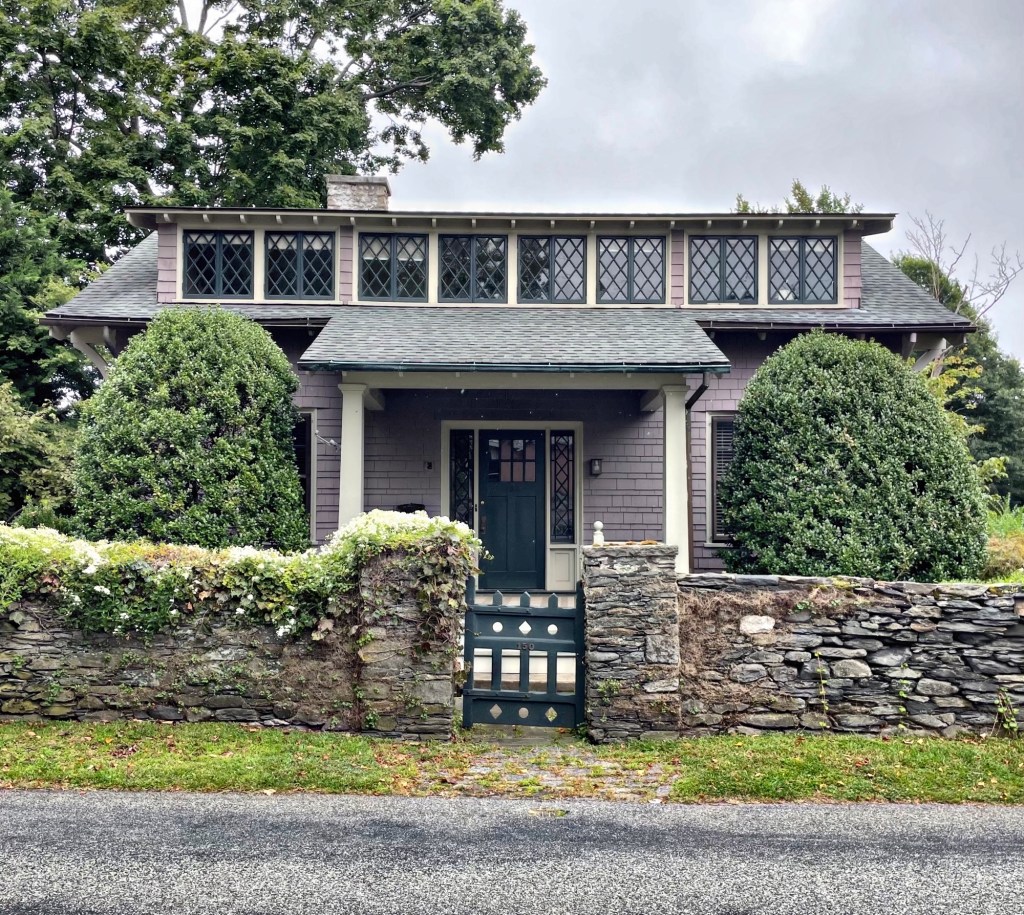
Bauckman House // 1915

The Arts & Crafts movement in architecture provided some of the most stunning and well-designed properties of the early 20th century but sadly, there are not too many examples here in New England. When I find some, I always get excited and pull over to snap a photo! This home on busy Beacon Street in Waban, Newton, was built in 1915 for Harry W. Bauckman a salesman in Boston. The designs are credited to architect James G. Hutchinson, who specialized in Arts & Crafts and Tudor style buildings in the area. The Bauckman House is Foursquare in form which basically segments the house into four, large rooms on each floor with a stairhall in the center. The home is clad with banded shingles which extend to the piers at the porch, a subtle nod to Shingle style architecture. SWOON! I was later informed by a follower that this was also the home of landscape historian and author Judith Tankard for some time.