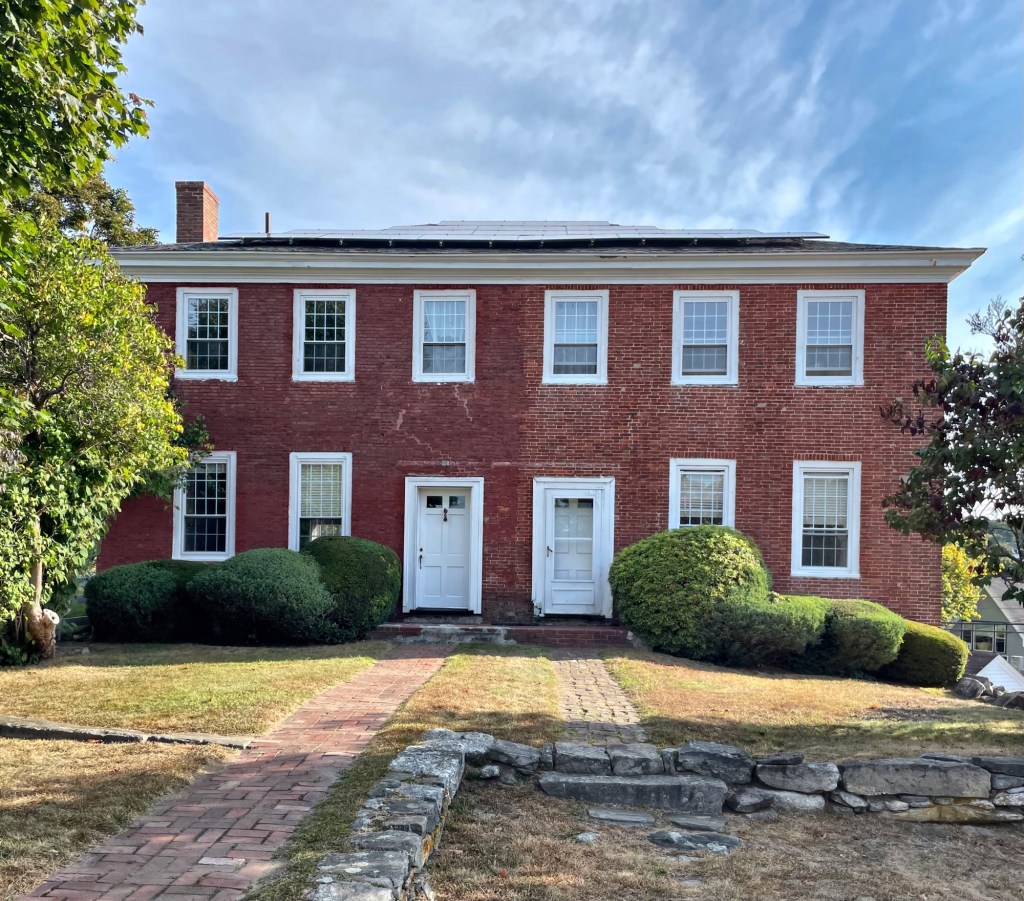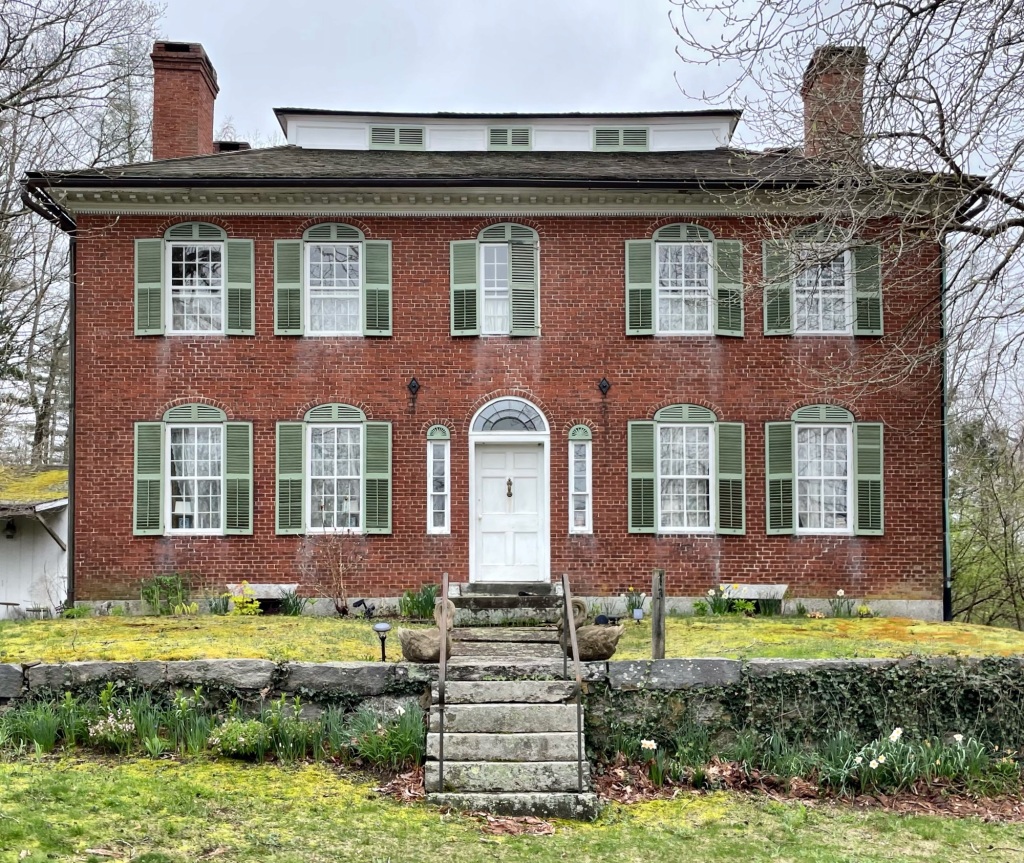
Church Farm // 1821

Here is your reminder that you can find amazing, high-style historic houses even on the most remote back roads in New England! This is Church Farm, located in Ashford, Connecticut, in the state’s Quiet Corner (northeast section of the state). The main part of the Church Farm house was built by Zalmon Aspinwall (1769-1844) and Mary Snow Aspinwall, his wife, in 1821; it is believed the house incorporates an earlier dwelling built in 1791 by Robert Snow in the ell. The Aspinwalls were a well-to-do Mansfield Center family, with more than 1,500 acres of land. Zalmon Aspinwall, who was related by marriage to the Snows, also held mortgages on several other Ashford farms. In the 1840s the house came into the hands of Lucinda Aspinwall Church (1807-1876) and her husband John Church. John was primarily a farmer, with 135 acres under cultivation in 1850, probably most as pasture and fodder for his 140 sheep, with which he raised wool. Subsequent generations of the Church Family retained ownership of this property Church Farm as the family homestead and country retreat. Servant rooms were added to the ell, and a large barn (said to be the second largest in Windham County) were built in the 1890s. The large Colonial Revival portico, added c.1930 to replace Victorian verandas, completed the house’s transformation into a country estate. The property was most recently gifted to the Eastern Connecticut State University Foundation, Inc., in 2007 by Joseph and Dorothy (Church) Zaring, and the house and grounds are maintained by the University.

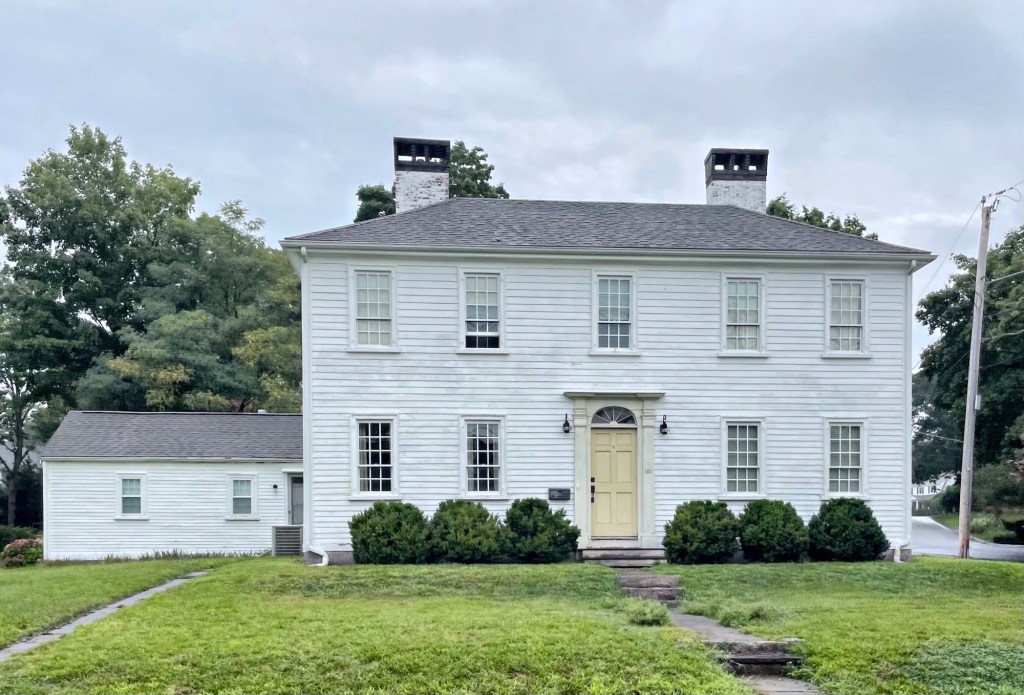
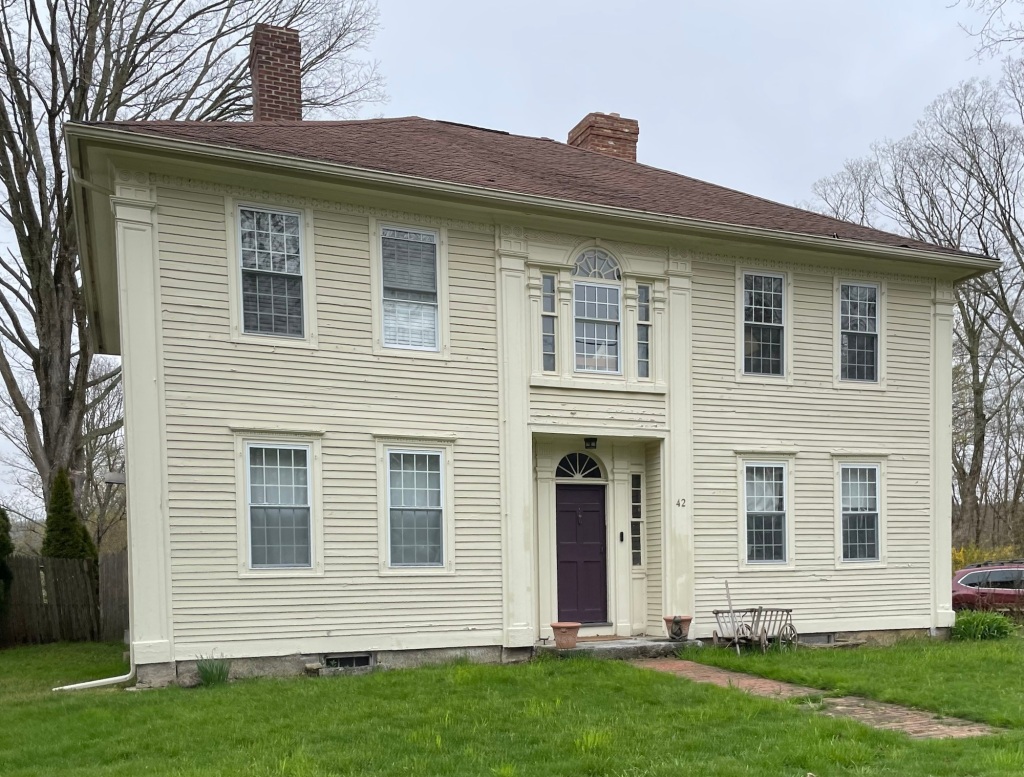
Samuel Read Hall House // 1831

Samuel Read Hall (1795–1877) was an American educator, who in 1823, started the first normal school, or school for training of teachers and educators, in the United States. He helped found the American Institute of Instruction in 1829, the oldest educational association in the U.S. He served as pastor in Brownington and Granby, Vermont from v 1846 to 1875 and would also become the principal and teacher at the Orleans County Grammar School in Brownington. He lived in this Federal style house in the village until his death. The Hall House is now a part of the Old Stone House Museum and Historic Village. Fun Fact: Samuel Read Hall is said to have been the earliest person to introduce the blackboard to the American classroom!

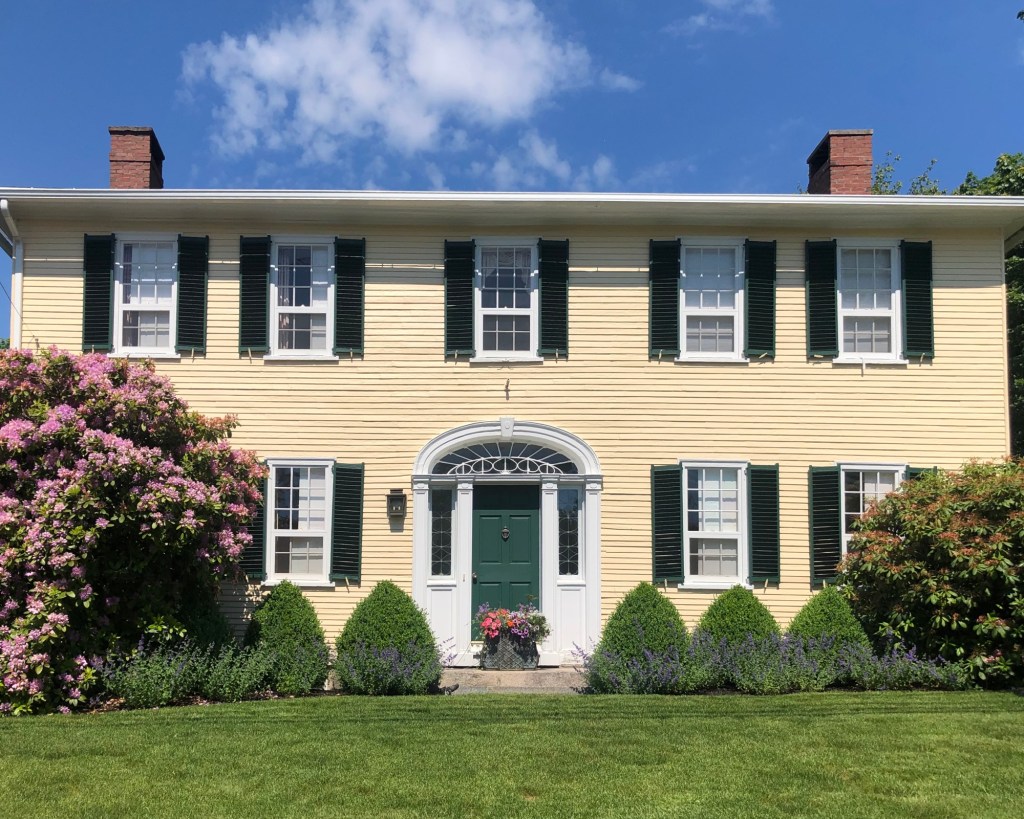
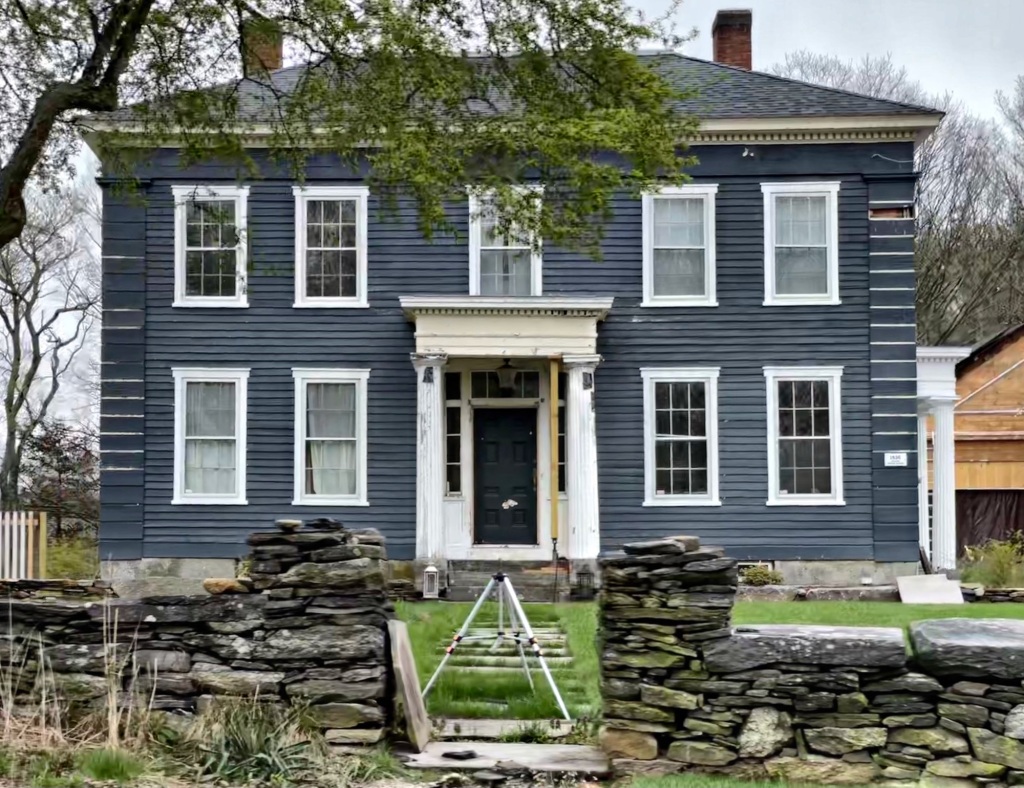
Cornè House // 1822

What does this house and the tomato have in common? Keep reading to find out!

Michele Felice Cornè (1752-1845) grew up in Naples Italy and became disillusioned with the Napoleonic Wars. After the French occupation of Naples in 1799, he fled and was brought to the United States on the ship Mount Vernon, commanded by Elias Hasket Derby Jr., and settled in Salem, Massachusetts. Cornè moved to Boston in 1807 and lived and worked there until 1822 when he moved to Newport, Rhode Island, purchasing a property containing a barn. Cornè either had the barn renovated into this 1822 house or built the Federal period house from its timbers. Here, Cornè would paint many maritime scenes as murals in homes and businesses. However, his true contribution to his adopted country was convincing his neighbors to eat the tomato. While in Newport, it is reputed that Cornè introduced the tomato into the American diet. In early 19th century New England tomatoes were thought to be deadly poison. Cornè was accustomed to eating tomatoes in his native land and would regularly eat them without ill effect and, thus, allayed the fears of the residents of his adopted country. Today, the popularity of the tomato in American cuisine can be credited (in part) to Cornè and his love for the tomato.

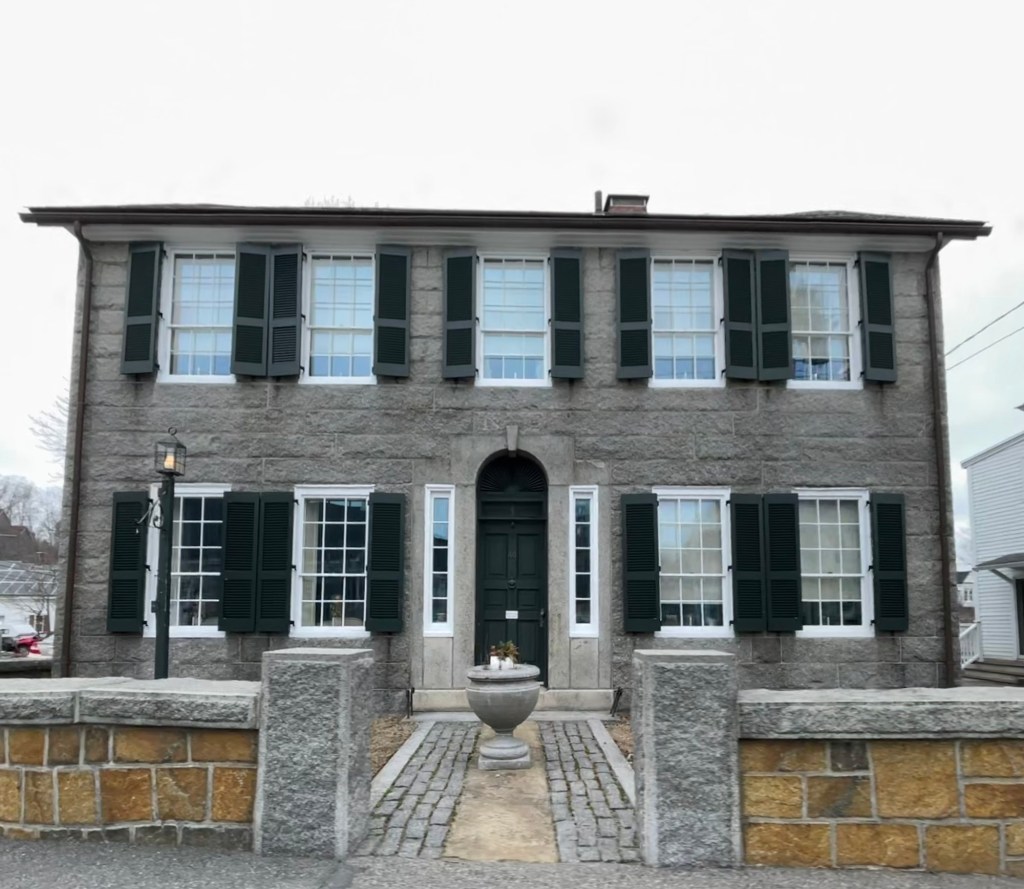
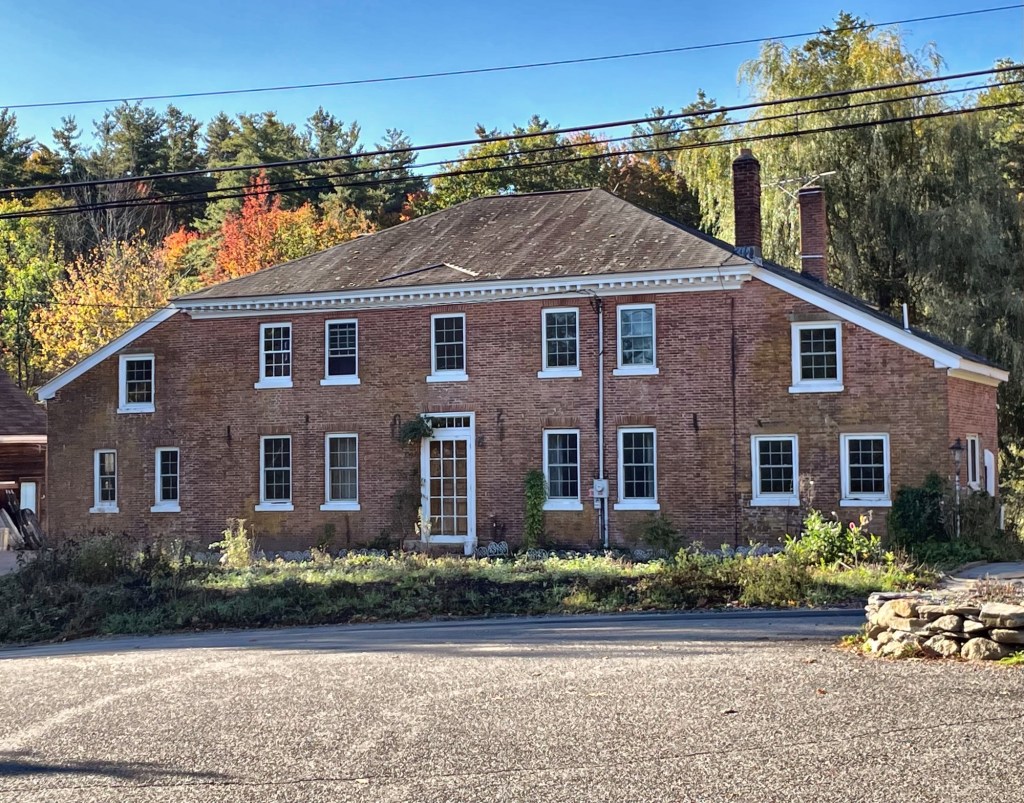
Folger House // 1831

Located in the middle of the commercial Main Street on Nantucket, the 1831 Folger House stands as a fully developed example of the Federal style in masonry construction. The house’s double bow front, brownstone lintels and Ionic portico, guilloche frieze, and cast-iron railings are the finest of their type in the community. Although the house was turned into commercial use in the mid-19th century with the addition of storefronts and the removal of its original hip roof, it retains substantial architectural elements of a more decorated design than was customary even among Nantucket’s wealthiest merchants in this period. The house was built for Philip H. Folger, a merchant and it was inherited by his son upon Philip’s death in 1865.

West-Hathaway House // c.1800

Located on Mill Street, overlooking Queen Anne Square, the West-Hathaway House is one of the most charming Federal period houses in Newport, but it didn’t always call this city “home”! Believe it or not, this five-bay Federal style house was originally built in Tiverton, Rhode Island around 1800 and relocated to Newport about fifty years ago. The house was built by Samuel West (1774-1838), of a line of physicians, and later sold to Samuel Hathaway. The house was located on large farmland presently occupied by the Pardon Gray Preserve in Tiverton but was later donated to the Newport Preservation Foundation in 1977 by the owners who likely hoped to redevelop the area where this house sat. The West-Hathaway House was dismantled, moved, and reassembled on this site that same year!

Billings Coggeshall Double House // c.1784

This unique double-house on Mill Street is stopped me in my tracks when strolling around Newport. The two-family house was built around 1784 by Billings Coggeshall (1733-1810) and is unique architecturally as it is comprised of two houses, each with its own separate pedimented entry, into a single lengthy block. Both houses have interior chimneys and are just one-room deep! When urban renewal hit Newport in the second half of the 20th century, traffic patterns and revitalization of the waterfront were top of mind (not necessarily slum clearance and wholesale redevelopment of neighborhoods like in Boston). To bring traffic into the downtown shopping area, Memorial Boulevard was laid out by 1969, and the Newport Restoration Foundation was integral to saving this building from the wrecking ball, as it was in the path of the new road. As luck would have it, an area around Trinity Church was cleared to establish Queen Anne Square, a town common-like park in the center of town. To provide the quintessential “New England charm”, many historic buildings were relocated to line the square, including this house. When the Billings Coggeshall House was moved here, it replaced a gas station, and it was given an even longer side addition with breezeway, providing screened parking and a rear addition for offices. Here’s to preservation!

Hadley Homestead // c.1776

George Hadley (1740-1823) moved to Weare, NH in 1775, buying lot sixty-one in town from the proprietors. Captain Hadley served in the French and Indian War and later in the Revolutionary War, though he was not so eager to serve again. He built his home soon after, living here with his family. The original Hadley Homestead would have been a more traditional Georgian farmhouse with large central chimney and minimal glass/windows. Sometime in the early 19th century – after his wife’s death in 1806 or after his own death in 1823 – the house was modernized in the Federal style. The stunning home has a fan light transom over the door, narrow corner pilasters and twin chimneys projecting through the roof. It sits next door to the South Weare Union Church.

Lemuel Bartlett House // c.1813

When originally settled by Quakers, the town of Unity, Maine, was known as “Twenty-Five Mile Pond Plantation”. The name came from its being located on a pond, twenty-five miles from Fort Halifax in Winslow (creative, right?) The name was changed to Unity upon incorporation as a town in 1804. The town grew steadily through the first few decades of the 19th century and some wealthier residents began building homes. Lemuel Bartlett (1762-1834) built this house around 1813, which is a great, vernacular example of a Federal style residence in rural, central Maine. Lemuel was born in Plymouth, Massachusetts and fought against the British during the Revolution. After the war, he settled in present-day Unity around 1780 and became one of the original proprietors and land-owners here. He worked as a mason and farmer, and likely built this house himself. The property is now occupied by the Unity Historical Society.

Oldfield – John Moseley House // 1818

Federal style houses are among my favorite styles! From the classical design details to the symmetrical facades, there are so many great examples of Federal style houses in New England. This house in Southbury, Connecticut dates to 1818 and was built by John Moseley (1775-1876), who lived to be 100 years old, and married twice, outliving both of his wives. According to a family history, Moseley personally went to Maine to pick out the wood used to build his house as there were no large trees left in the area when house construction began in 1818. In the early 1900s, the house was updated with a rear addition, built from a structure moved from across the street and attached to Oldfield, and with the addition of the large Colonial Revival style portico at the front entry. The house has been a bed & breakfast since the 1990s, originally called Cornucopia at Oldfield, it is now known as the Evergreen Inn.

Reverend Richard and Lavinia Dey House // 1823

Richard Varick Dey (1801-1837) was a young divinity student from New York City, attending the Theological Seminary in New Brunswick, New Jersey, when he met Lavinia Agnes Scott (1805-1886). Dey was the son of prominent New York attorney Anthony Dey and Catharine Laidlie; Catherine’s father, the Rev. Archibald Laidlie, was the first minister called to preach in English in the Dutch Church in New York City. Richard and Lavinia fell in love and became engaged on December 27, 1820. However, Lavinia’s parents were opposed to Richard, and her father even asked Richard’s theology professors at Rutgers to try to discourage his pursuit of Lavinia. It did not work and they married in September 1822. After graduating from the Seminary in 1822, Richard was licensed by the Congregationalists and the young couple moved to Greenfield Hill, in Fairfield, Connecticut, where he preached from 1822-1829. Local history states that it was actually Lavinia who designed this house in 1823 for their family and oversaw the builders during its construction. The Federal style house stands out for its clear Dutch form with its roof projecting to create a recessed verandah, likely influenced by the couple’s New York/New Jersey upbringing.

Reverend Dey, Lavinia, and their children relocated to New York City, and Richard preached at a number of churches the before he died unexpectedly in 1837, leaving his 32-year-old widow with four young children. Lavinia remained in New York, where she served as the manager of The Society for the Relief of Poor Widows with Small Children for over 25 years. She never would remarry and died in 1886.

Samuel Jones House // 1806

This home in Acton Center was built in 1806 by Samuel Jones, shortly after he and other esteemed residents laid out house lots just south of the Town Green. Samuel Jones worked as an attorney and he lived here with his family and widowed mother, who operated a dame school, where she taught local children out of the house. The Federal style farmhouse sits upon a brick and stone foundation and is five-bays at the facade. The entry features a panel front door with sidelights flanking it. The entry is surrounded by a traditional Federal style frame with pilasters and entablature. There is something so beautiful about the simplicity and proportions of old Federal style houses.

Amos Brown House // 1802

Tucked away on a dirt road in rural Whitingham, Vermont, the Amos Brown House sits among fields of tall grass, bounded by historic stone walls and rows of apple trees planted centuries ago. I was lucky enough to be able to stay at the Amos Brown House this past weekend and it was everything I could have imagined…and more! The property is owned and managed by the Landmark Trust USA, a nonprofit organization based in southern Vermont that preserves and restores historic properties through creative and sustainable uses for public enjoyment, education and inspiration. In the past, I stayed at the Kipling Carriage House, another charming property. The Amos Brown House is thought to be the oldest house in Whitingham, Vermont, and is a well-preserved example of a Federal style brick farmhouse in this part of the state. The telescoping ells of a summer kitchen, barn, chicken house, and shed showcase how farms would grow over time to serve the needs of these families in the undeveloped wilderness of New England. By the time of The Landmark Trust USA’s acquisition of this property in 2000, the house had seriously deteriorated. Inappropriate repairs and alterations in the 1960s and 1970s had weakened the brick walls, leading to severe cracking and small areas of collapse. They underwent a massive restoration of the property inside and out, and it remains an absolute treasure in the state to this day.

Clough-Hinckley House // 1832

This charming Federal style cape in Blue Hill Maine was built in 1832 by Moses P. Clough, a sea captain seemingly as a wedding gift to his new bride of that year, Sally Prince. He resided in the home off-and-on between excursions and trips at sea until his untimely death at sea in 1836 of bilious fever, possibly caused by malaria. After his death, his widow Sally, remarried and moved to Cherryfield, Maine. The old family home was sold to Bushrod W. Hinckley, an attorney who was involved in the town affairs. Today, the old Clough-Hinckley home is known as Arborvine, a great restaurant known for using local, farm-to-table ingredients. The home is excellently preserved by the owners, down to the leaded glass fanlight and sidelights at the entrance. Swoon!

Holt House – Blue Hill Historical Society // 1815

The Holt House in Blue Hill, Maine, was built in 1815 by Jeremiah Thorndike Holt, grandson of Nicholas Holt who brought Blue Hill’s fifth family from Andover, Massachusetts in 1765. Jeremiah was one of the first to locate at the head of the bay, in what is now the center of Blue Hill village. He was an influential businessman who kept a store at what became known as the Pendleton House, engaged in shipping, and became the town’s second postmaster. After Jeremiah died in 1832, his widow turned the house into the town’s only inn and tavern. In 1851 their son, Thomas Jefferson Napoleon Bonaparte Holt (what a name!) and his family occupied the house. It stayed in the family for over a hundred years until the Blue Hill Historical Society bought the Holt House and made it their headquarters in 1970. The Holt House remains as a well-preserved Federal style home in this part of Maine.

Captain Drisco House // 1790

The Captain Drisco House on Meetinghouse Hill Road is a recently restored example of the vernacular Federal period architecture so many flock to Portsmouth to see. The house sits in the middle of a warren of short streets where houses (all built before zoning and setbacks) were built right at the sidewalk creating the most pleasant walking experience. The symmetrical five-bay Federal house was built by Captain Drisco, who purchased the house lot after the Revolutionary War.