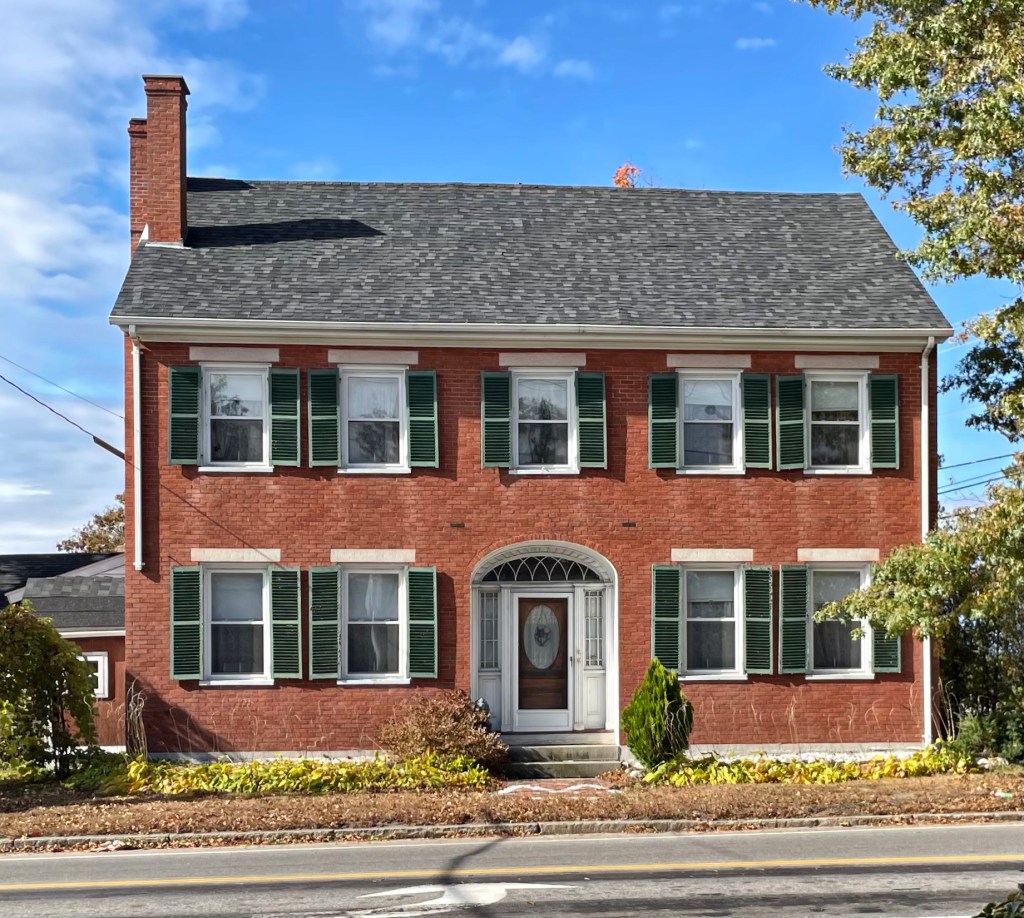
This stunning brick Federal style home sits in the center of Gray Village in Maine. The house dates to the early 19th century and was long-owned by members of the Morrill Family, seemingly first by William C. Morrill and remaining in the family for generations. The residence is a high-style example of the Federal style with recessed elliptical entrance with fanlight transom and sidelights with a Victorian-era front door. The house was likely built by a local mason or housewright who employed the designs of a Federal style plan book for the architectural detailing at the entry.
Built around 1784 for Reverend Samuel Perley, this Federal style home is one of the finest in the town of Gray, Maine. Samuel Perley (1742-1830) was educated at Harvard College and while there, met and befriended John Adams, who would later become the second President of the United States. The two maintained a lifelong friendship. Perley came to Gray in 1784 as a pastor of Gray’s first church. He likely had this house built at the time or purchased an existing house and updated it and the house is said to have Moses Eaton stencilling inside. At one point, Rev. Perley and his wife lived on one side of the house while his son Isaac, his wife, and their twelve children lived on the other.
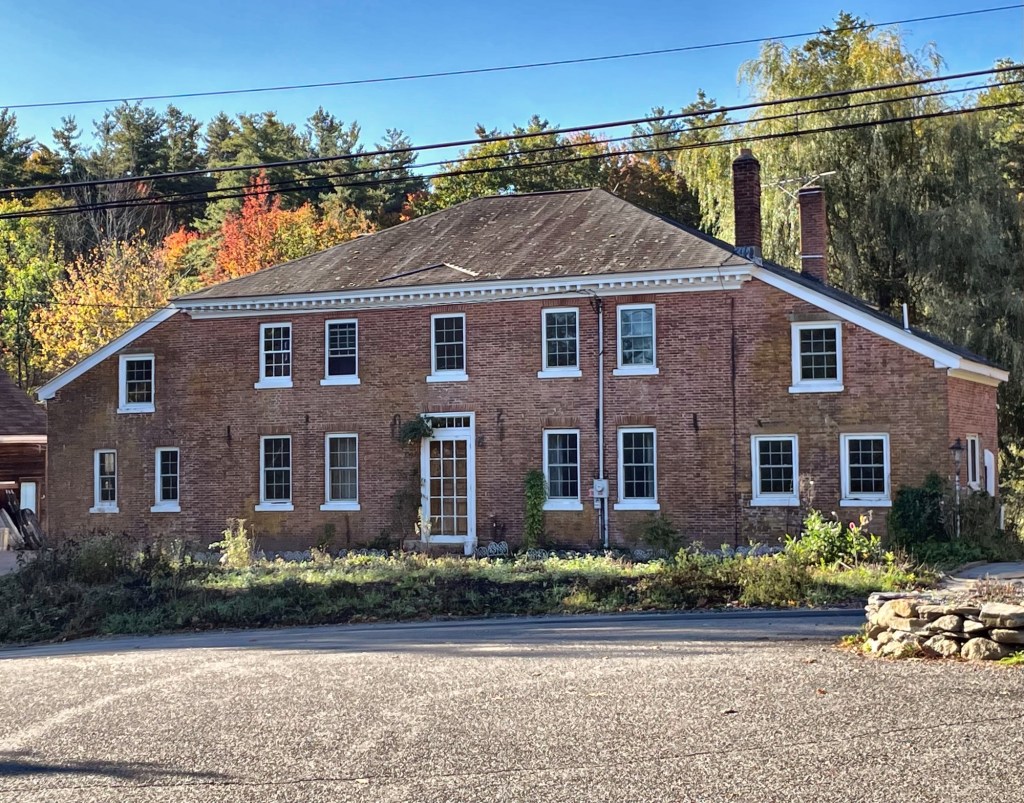
The Asa Kendall House is a significant Federal period house from the late 18th century on Richardson Road in Ashby, Massachusetts. The house here is actually believed to be the second built on this location, the first being the John Fitch House and Garrison. John Fitch was one of the earliest settlers in present-day Ashby, which in the mid-1700s, was sparsely developed and threats of attack by Native peoples limited development for decades. Due to raising tensions in the years leading up to the French and Indian War, Fitch petitioned the government for a garrison manned by three soldiers, which was approved. In 1745, the garrison was attacked and Fitch with his family, were kidnapped by Native Americans, held hostage for six months and brought up to Canada. The homestead and garrison were burned. He and his family were ransomed and would later return settling elsewhere in town. The former location of the garrison was purchased by Asa Kendall and this house was built around 1790 for him. The brick house with sloping wings was extensively documented as part of the Historic American Building Survey in 1936 and has been preserved by later owners ever-since!
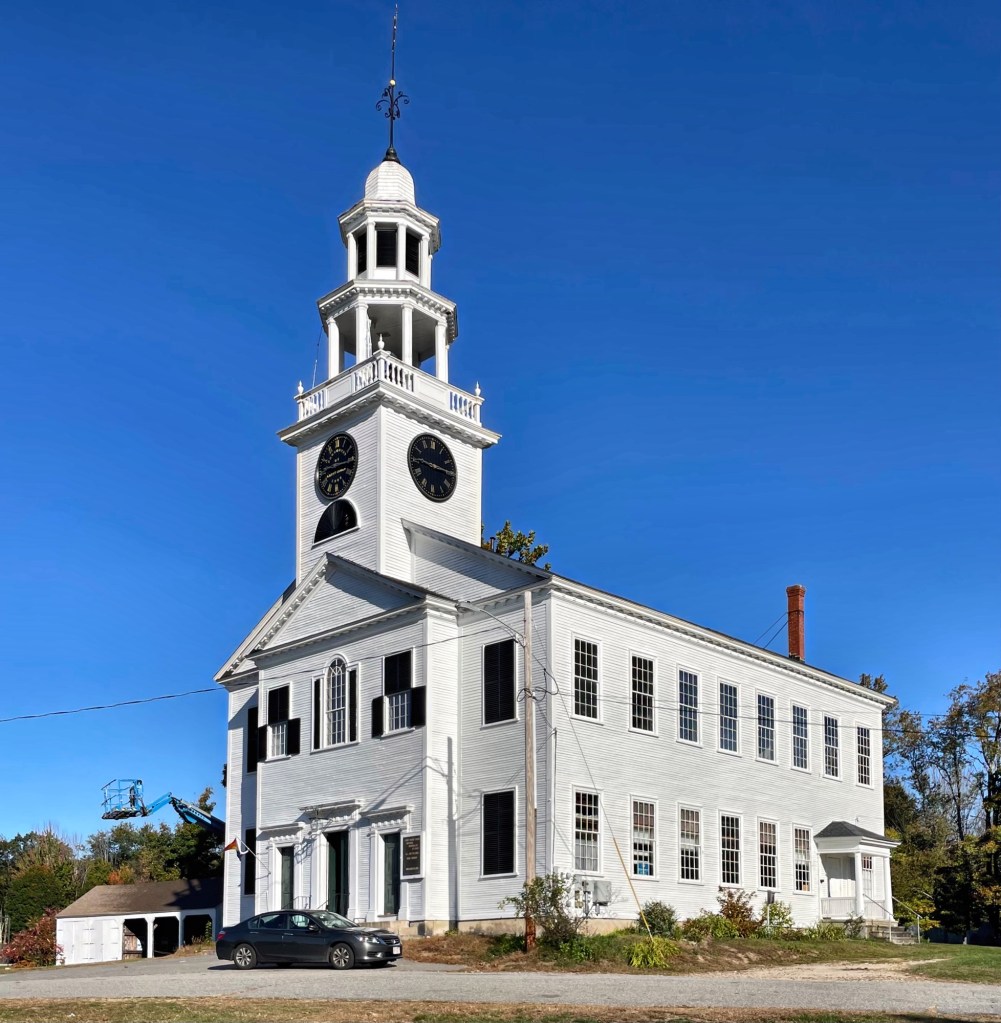
Welcome to Ashby, Massachusetts; a rural and historic town that was first settled in 1676 but due to the continued threat of native hostilities, permanent European settlement in the town did not occur until about 1750. The town incorporated in 1767 and was reputedly named for the abundance and quality of white ash trees found in the area by early settlers. Today, the town has just over 3,000 residents. At the center of the town village, the First Parish Church of Ashby stands as a significant Federal-period meetinghouse, and an integral piece of the town’s history. The present building was constructed in 1809, replacing an earlier structure from 1771. Carpenters for the building were Joseph Kendall and Darius Wellington of Ashby, who utilized plans from Asher Benjamin’s American architectural pattern book of 1797. Facing the town common, the church is a two-story gable front building with a three-stage tower including an octagonal open belfry rising from the pedimented front pavilion.
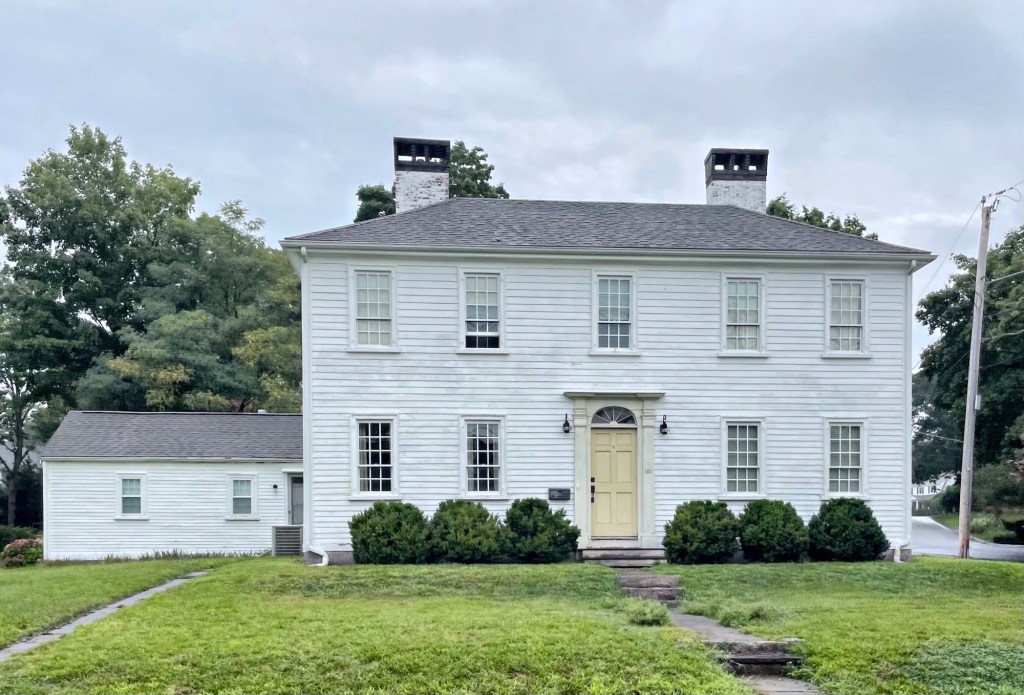
The Chickering House at 101 Walpole Street is significant as one of the oldest extant houses in Norwood, Massachusetts. Although local lore dates this house to 1781, it likely dates to 1807 (or was adapted from an earlier house) and was owned by Deacon Dean and Sally Guild Chickering, who farmed on the lot. Three generations of Chickerings farmed the land here until the early 20th century, when John D. Chickering, a local historian, sold much of the land for suburban development. The Federal style farmhouse remains as a vestige of the early, pre-suburbanization that Norwood is now known for.
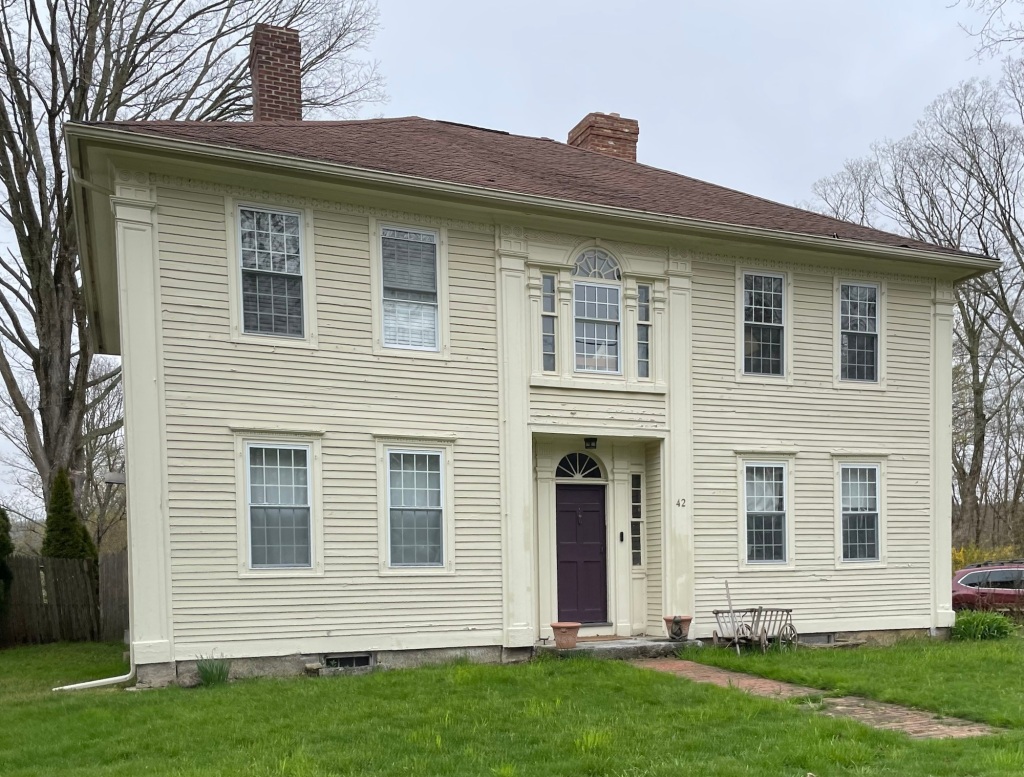
Chaplin, Connecticut was incorporated in 1822 and in that same year, this stately Federal style residence was built and operated as a tavern by Chauncey and Julia Gurley. The house in the late 19th century was used as a private school and residence and was later owned by Ruth E. Snow Bowden (1895-1983) known lovingly as “The Quilt Lady”. Ruth was one of the foremost quilt-makers in Connecticut and her Chaplin home, as a result, became known as The Quilt Shop. By the late 1900s, the tavern was converted to an inn, but closed years later from few bookings. The new owners have restored and maintained this charming old tavern back to its original appearance.
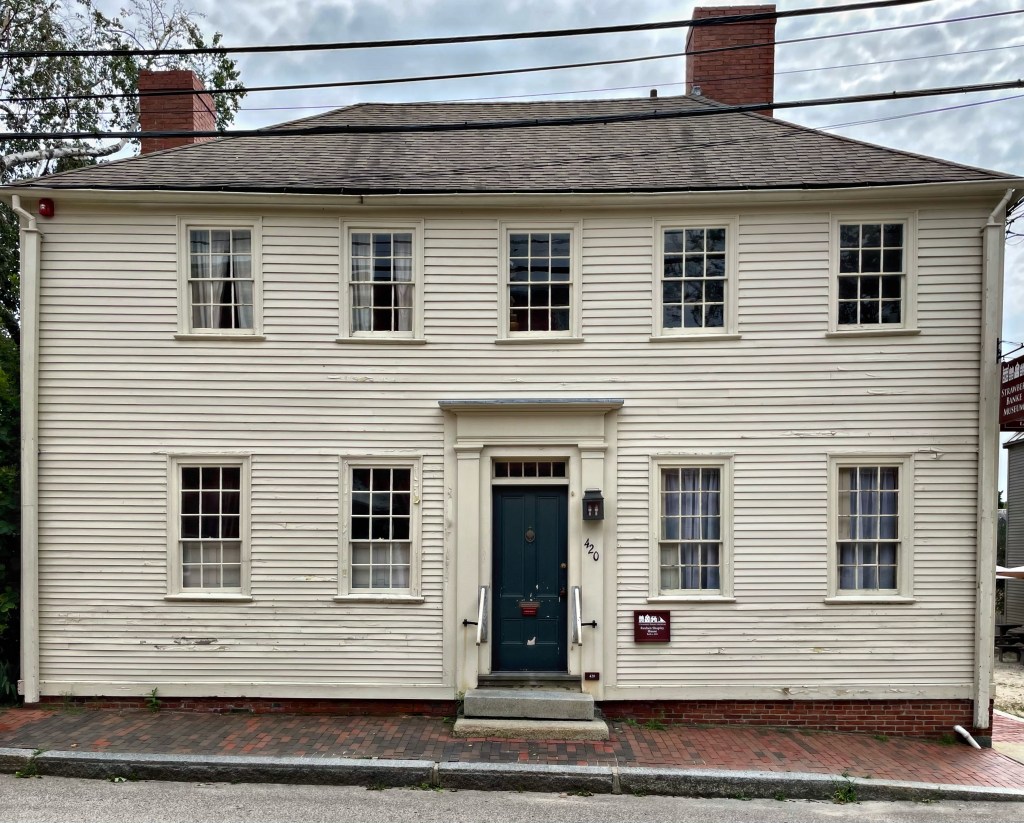
Captain Reuben Shapley (1750-1825) was a Portsmouth mariner, merchant, and shipbuilder born on the Isle of Shoals in 1750. He was married to Lydia Blaisdell Shapley, and they had one daughter, Nancy, who died in 1802 at the young age of 17. Shapley bought this house lot in 1790 and erected a barn or outbuilding on the lot, which was nextdoor to his main house. On the evening of August 13, 1811, a sailing ship owned by Captain Shapley, the Wonolanset, caught fire. According to Nathaniel Adams’ 1825 book, Annals of Portsmouth, the ship “had arrived from sea about an hour before, laden with hemp, cotton, molasses, naval stores and flour, and lay at Shapley’s Wharf.” Although townspeople tried to extinguish the blaze, the fire persisted, and they were forced to cut the vessel loose and let it drift safely out into the river and away from other vulnerable ships and warehouses. Captain Shapley’s loss was estimated at $12,000. After this, it appears Reuben got more involved in real estate, and either converted his old barn or built new, this house in 1813, Captain Shapley died in 1825, but the house continued as part of his estate until 1831. The house is now well-preserved and a part of Strawberry Banke’s campus in Portsmouth.
Many may not know this fact about Portsmouth, which shaped the city’s development for some of the formative years of the coastal town. The 1814 Brick Act was passed by the New Hampshire legislature after three devastating fires wiped out hundreds of closely-packed wooden buildings in the heart of the state’s only seaport. The act prohibited the erection of wooden buildings of more than twelve feet high in the downtown area which was the densest, it was effectively an early building code. The regulation helped change the look of the city, creating the red brick image Downtown that many identify today as Portsmouth. As a result, nearly all homes and buildings in the downtown area of Portsmouth were constructed of brick, largely in the Federal style, popular at the time. This home was constructed around 1815 as a wedding present for the South Parish’s minister, Reverend Doctor Nathan Parker, upon his marriage to Susan Pickering, the daughter of New Hampshire Chief Justice John Pickering and a descendant of the original John Pickering.
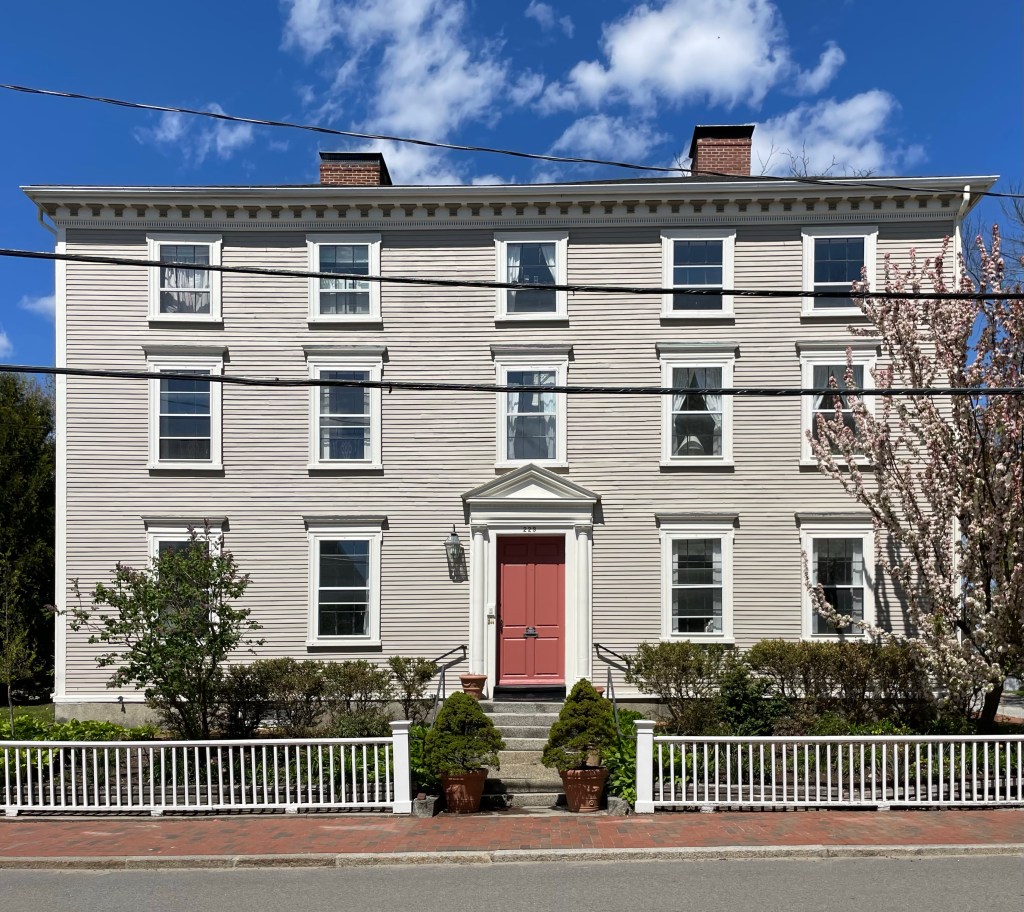
Another three-story Federal period house on Pleasant Street in Portsmouth, NH is this wood-frame example, known as the Haven-White House. The property was developed in 1799-1800 by Joseph Haven, a merchant who built the house across the street from his father’s residence. Joseph Haven occupied this house until his death in 1829. After his wife Sarah’s death in 1838, the house remained in the Haven family, though usually occupied by others, until 1898 when it was sold to Mrs. Ella White. The White family, which included a grocer, a City Councilman in the early 1900s; and a chiropractor, with the family occupying the house until 1981. This history of long ownership by only two families for nearly 200 years perhaps accounts for the survival of this important house with so few changes. As a result, the house was listed on the National Register of Historic Places in 1985, marking it as a nationally significant building.
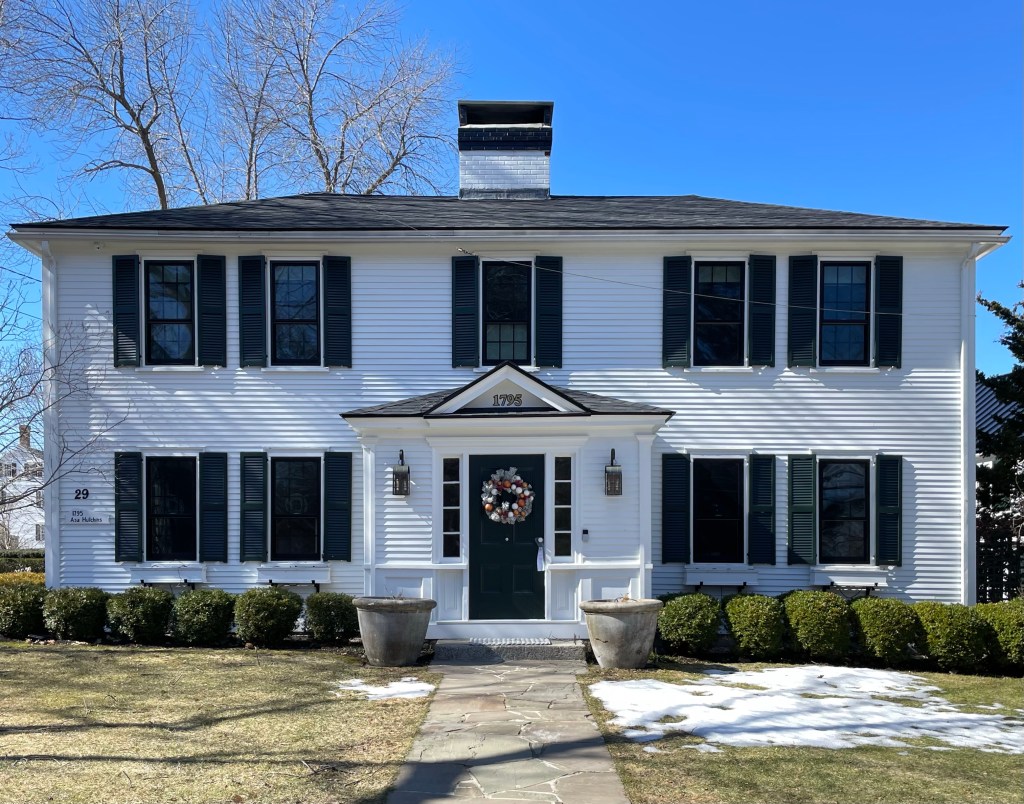
The village of Kennebunkport in Maine is a well-preserved enclave of Federal period houses built at the heyday of shipbuilding and maritime trade in the late 18th and early 19th centuries. Many sea captains and shipbuilders erected stately homes in the village, with high-quality design and woodworking inside and out. This Federal period home was built for Asa Hutchins (1769-1860) a blacksmith who was born in Portsmouth, New Hampshire and settled in Kennebunkport in the late 1700s. The house exhibits a central chimney a feature more common in Colonial-era homes, with a five bay facade and projecting entrance.


 Buildings of New England