The Amos Chase House and Mill are located in Weare, New Hampshire, on the banks of the Piscataquog River. The house is oriented facing the road, while the mill is behind it, on the bank of the river. The mill is the only surviving 19th-century mill building in Weare. The house was built about 1836 by Amos Chase, as was a mill. That mill burned in 1844; the present mill was built by Chase as a replacement a few years later. This mill was the only one in the town to survive the New England Hurricane of 1938, although its waterwheel was washed away. Amos Chase was a tool manufacturer and one of several members of a locally prominent family operating small mills in the town. His son later used the mill in the manufacture of baskets. The large Greek Revival style home has all the hallmarks of the style, from the pediment facing the street, to the pilasters at the entrance and corners.
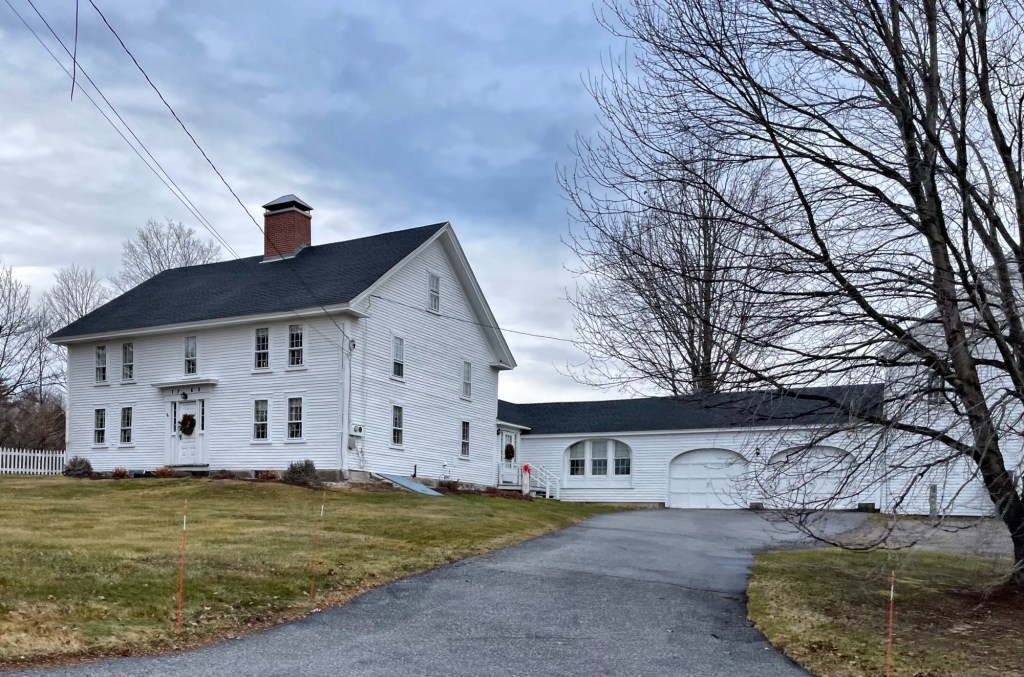
One of the oldest homes in Weare, New Hampshire is this large, Georgian farmhouse apparently constructed around 1767 by Samuel Bailey. Samuel’s father, Ebenezer Bailey, had purchased a property called “Lot 54, Range 1” in Weare, New Hampshire, which he then divided among his sons, Daniel, Samuel and Ebenezer Jr. for their own settlement in about 1767. Samuel received this lot in South Weare, upon which, the twenty-two-year-old and his wife established a farm and a family of at least eight children. Samuel died in 1824 and the farm was inherited by his son, Amos Wood Bailey, who continued operations here. Today, the large five-bay Georgian farmhouse is connected to a massive barn. It is a really spectacular property.
For the last cottage on Grindstone Neck, I present the stunning Whelen Cottage. Charles S. Whelen (1850-1910), a banker and philanthropist who served as one of the directors of the Gouldsboro Land Improvement Company and as one of several of its stock agents in Philadelphia, purchased a house lot for him and his wife Migonette Violett. The couple did not hire Lindley Johnson, like so many other cottage-holders did, but they worked with esteemed architect Wilson Eyre to design the home. The Whelens were typical of the type of person who chose to summer on Grindstone. While comfortably well off, they were not in a financial position to commission the sort of cottages built on an ever increasing scale in Bar Harbor. The property left the Whelen’s ownership in 1897, and the house was altered and enlarged in 1900. The large porte cochere, porch, and additional rooms added at this time by William Winthrop Kent, an alumni of H. H. Richardson’s office.
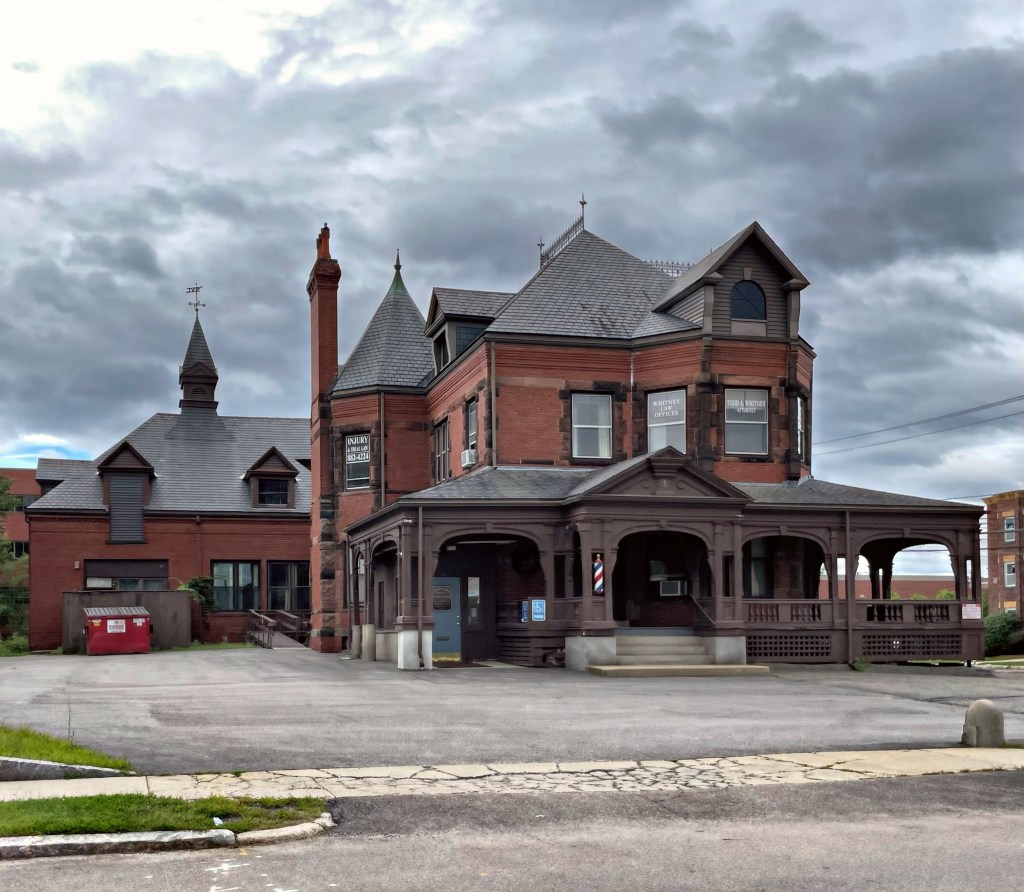
One of the finest homes in Nashua, New Hampshire is this stately brick and brownstone mansion at the corner of Main and Prospect streets. It was built for Charles Horace Burke (1850-1912) and his wife, Asenath Burke (1856-1943) in 1889 as one of the most up-to-date residences in the city. As a young man, Charles was known as “the busiest businessmen” in Nashua. He would become the president of the Nashua Iron and Brass foundry as well as the director of the Second National Bank. In 1878, he was the city’s tax collector and he served as Mayor from 1889 to 1890, soon after he had this estate built. As mayor, Mr. Burke was responsible for the building of the Soldiers and Sailors Monument in Abbot Square and the Court Street Police Station. As Mayor, Burke also improved the sewage system, streets, sidewalks, and highways of Nashua. He hired architect Charles J. Bateman to furnish the plans for the house, which would take over a year-and-a-half to build. Bateman would later be named City Architect for the City of Boston, designing schools, firehouses, and more during his time there in 1893-4 and 1898. The house is a high-style Queen Anne Victorian home of brick with brownstone trim. There is an intact former carriage house at the rear. The house was inherited by Charles and Asenath‘s only child, a daughter, Tena, in 1914. She sold it two years later to Dr. Augustus W. Shea and his wife, Lucy. When Lucy passed away in 1948, her daughter sold the property to the Nashua Medical Center. It has seemingly been used as offices ever since. The large corner lot and adjacency to a large medical center across the street have me worried that this property may be threatened in the future for redevelopment, here’s to hoping Nashua can preserve this significant and architecturally grand estate! Thank you to the Nashua Historical Society for assistance researching this post!
This house in West Acton is the last in this batch of Queen Anne style Victorian houses I’ll feature in the village. The dwelling was built in 1891 for a 31-year-old John Sherman Hoar, Jr. (1860-1954) and his new wife Minnie R. Hart. John was a master carpenter and built many of the Queen Anne style homes on Windsor Street and later Colonial Revival and Craftsman homes in the 1890s and 1900s himself. This was his own property which once included a workshop where he cut and manufactured many homes on the street. Today, the Hoar House has a cheery pink color scheme (which while not historically appropriate) brought a smile to my face when strolling by!
Another of Acton’s amazing old Queen Anne homes is the Edgar Hall House, an 1889 gem on Windsor Avenue. The house was built for Edgar Henry Hall and his wife Angelina who raised their daughter, Alice, in the home. Edgar and his brother inherited the family business from their father, Enoch Hall, and they produced wooden pails, tubs, clothing racks, and other wooden goods. The company employed over 30 workers in the early 20th century until it closed during the Great Depression. Edgar retired and relaxed from this stunning Victorian home until his death in 1954.
Walking the warren of tight streets and hidden alleys of Marblehead, Massachusetts, you are taken back centuries to a simple time, and of a town that has largely maintained its pre-automobile urban fabric. Many pre-Revolution homes still stand in town and have survived cycles of the coastal town’s prosperity and economic hardship, and the increased pressure of gentrification in more recent years! The Simon Bradstreet House sits right in the village and is a well-preserved Georgian-period home. The house was built in 1723 (earlier reports said in 1738) and it was later owned by Rev. Simon Bradstreet (1709-1771), who arrived to Marblehead to serve as the second minister of the Second Congregational Church a year prior. Reverend Bradstreet was the great-grandson of the last Bay Colony Governor of the same name. Chance Bradstreet, an enslaved African that was a subject of the “within these walls” exhibit at the National Museum of American History was born in this home in 1762. He was later sold to Abraham Dodge of Ipswich by Isaac Story, the third minister of the Second Congregational Church. Stories like this are necessary for us to remember that slavery was a huge part of New England’s economy historically.
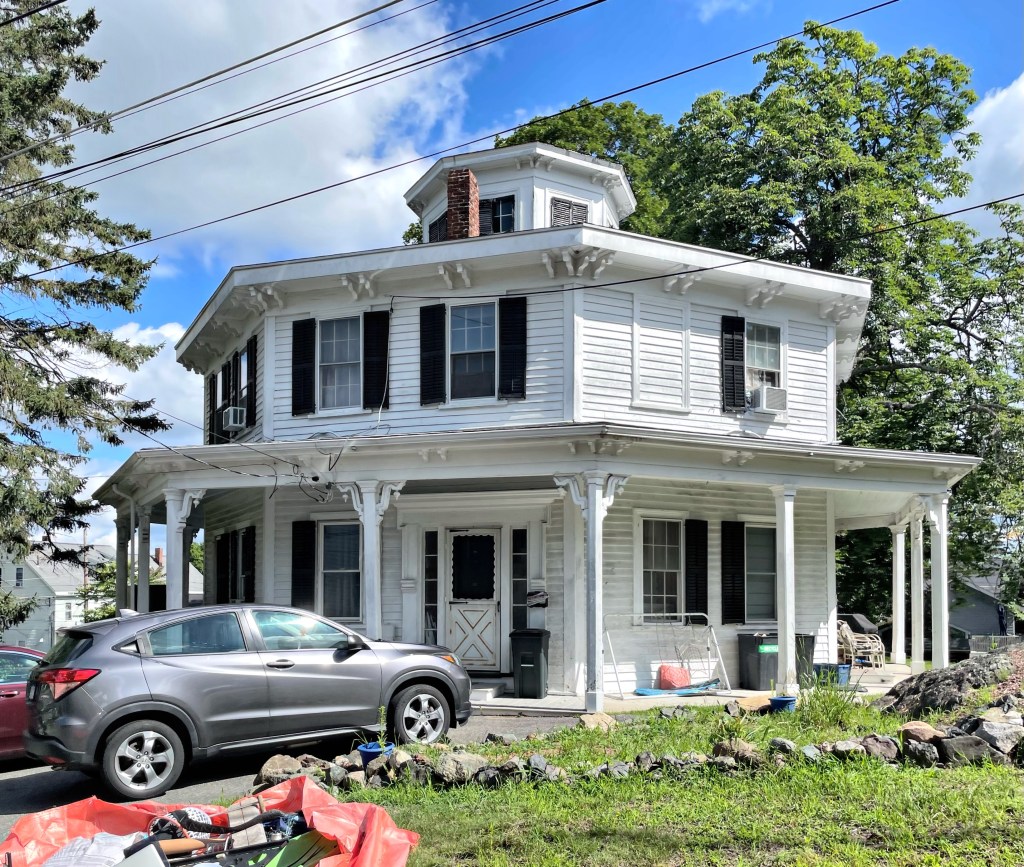
Oh the Octagon! The very rare Octagon house was a unique house style briefly popular in the 1850s in the United States and Canada. The style can generally be traced to the influence of one man, amateur architect and phrenologist Orson Squire Fowler. In his book, The Octagon House: A Home for All of 1848 (and reprinted with more photos in 1853), Fowler advocated for the shape’s benefits for buildings in that the octagon allowed for additional living space, received more natural light, was easier to heat, and remained cooler in the summer. These benefits all derive from the geometry of an octagon: the shape encloses space efficiently, minimizing external surface area and consequently heat loss and gain, building costs etc. Some were convinced and built Octagon houses, but the style and its brief period of popularity, died by the 1860s. This example in Stoneham, Massachusetts was built around 1850 for and by Enoch Fuller, a close personal friend of P. T. Barnum, founder of the Barnum & Bailey Circus. Fuller visited Barnum’s octagonal home in Bridgeport, Connecticut and he decided to construct an octagon house in Stoneham. The home was owned by Col. Gerrry Trowbridge not long after completion. The home was built with a fireplace in every room, a spiral, “flying” staircase, and a sweeping veranda.
The Holt House in Blue Hill, Maine, was built in 1815 by Jeremiah Thorndike Holt, grandson of Nicholas Holt who brought Blue Hill’s fifth family from Andover, Massachusetts in 1765. Jeremiah was one of the first to locate at the head of the bay, in what is now the center of Blue Hill village. He was an influential businessman who kept a store at what became known as the Pendleton House, engaged in shipping, and became the town’s second postmaster. After Jeremiah died in 1832, his widow turned the house into the town’s only inn and tavern. In 1851 their son, Thomas Jefferson Napoleon Bonaparte Holt (what a name!) and his family occupied the house. It stayed in the family for over a hundred years until the Blue Hill Historical Society bought the Holt House and made it their headquarters in 1970. The Holt House remains as a well-preserved Federal style home in this part of Maine.
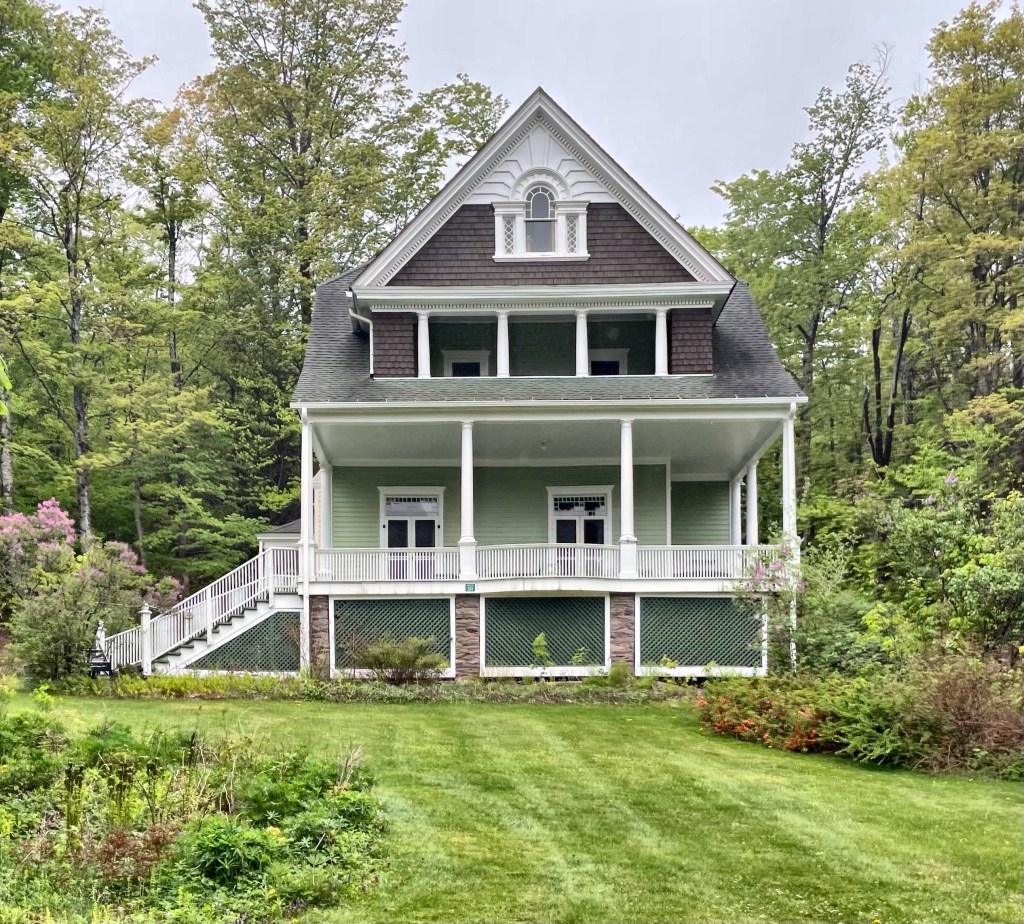
Hermann Esser (1845-1908) was born in Elbertfeld Germany and emigrated to the U.S. in the fall of 1866 and settling in Hoboken, NJ. On September 30, 1869, he married Bertha Michelmann of Hanover, Germany, who also emigrated to the U.S. years prior. In the states, Essen joined his old business partner Wilhelm J.D. Keuffel (also a German) and they ran the Keuffel & Esser Company, a scientific instrument manufacturing firm originally founded in New York City in 1867. Best known for its popularization of the slide rule, Keuffel & Esser was the first American company to specialize in the manufacture and sale of drafting and surveying tools. By the early twentieth century, it was one of the largest manufacturers of scientific instruments in the world. Their original store was located at 127 Fulton Street in Manhattan. Esser, with his wealth, decided to build a cottage in summer colony of Elka Park, New York, just north of Manhattan. The enclave was founded and has long been inhabited by wealthy German residents from New York City. This cottage was built for Mr. Esser in 1894, and is decidedly more Colonial Revival than many other cottages here. Esser only enjoyed a few summers here as he moved back to Germany in 1902, and died in 1908.





 Buildings of New England

