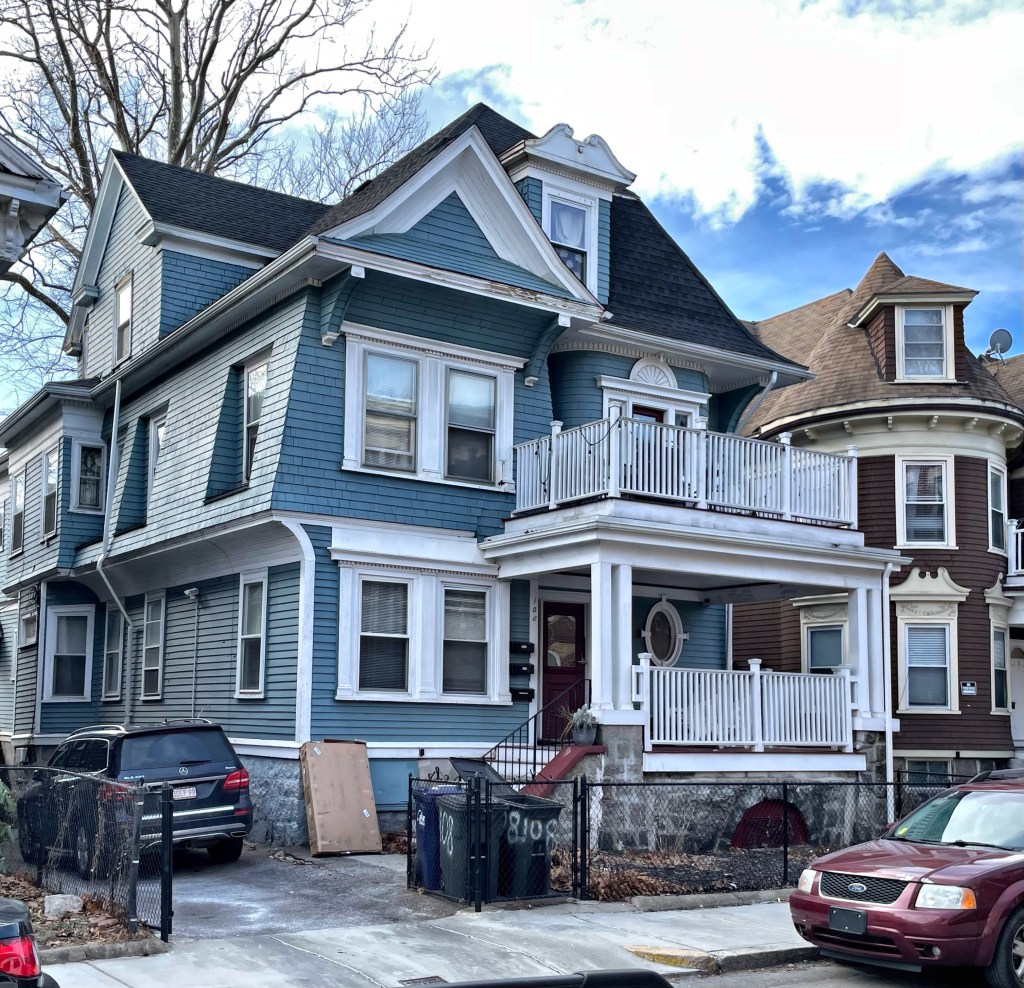
Giddings Homestead // c.1800

This old gambrel-roofed home sits on the beginning of Pautipaug Hill Road just outside the industrial village of Baltic, in Sprague, Connecticut. The house’s history is a little unclear, but it shows up on historic maps as being owned by W. Giddings. This appears to have been Walter Giddings (1788-1854). Walter may have built or inherited this property from his father Nathaniel, who died in 1809. Walter married Laura Lucretia Fillmore in 1811 and they had four children. Laura died in 1827 at just 37 years old and Walter remarried within a year to Lydia Lathrop Ladd. The property remained in the Giddings Family at least into the second half of the 19th century. It was later “Victorianized” with two-over-two windows, side and front porches, and a octagonal bay window. The home has been suffering from deferred maintenance for over 15 years (as far back as Google maps goes) and was listed for sale, so here’s to hoping this old beauty survives!

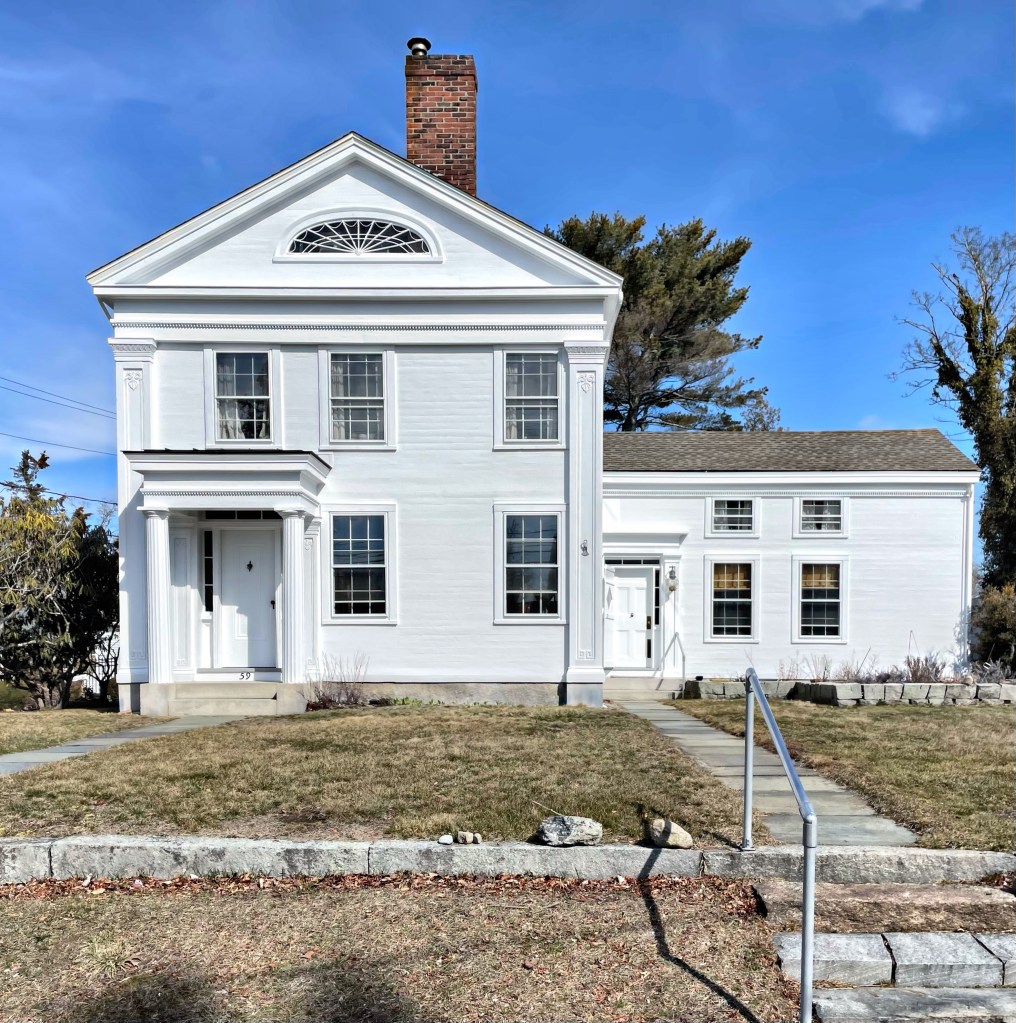
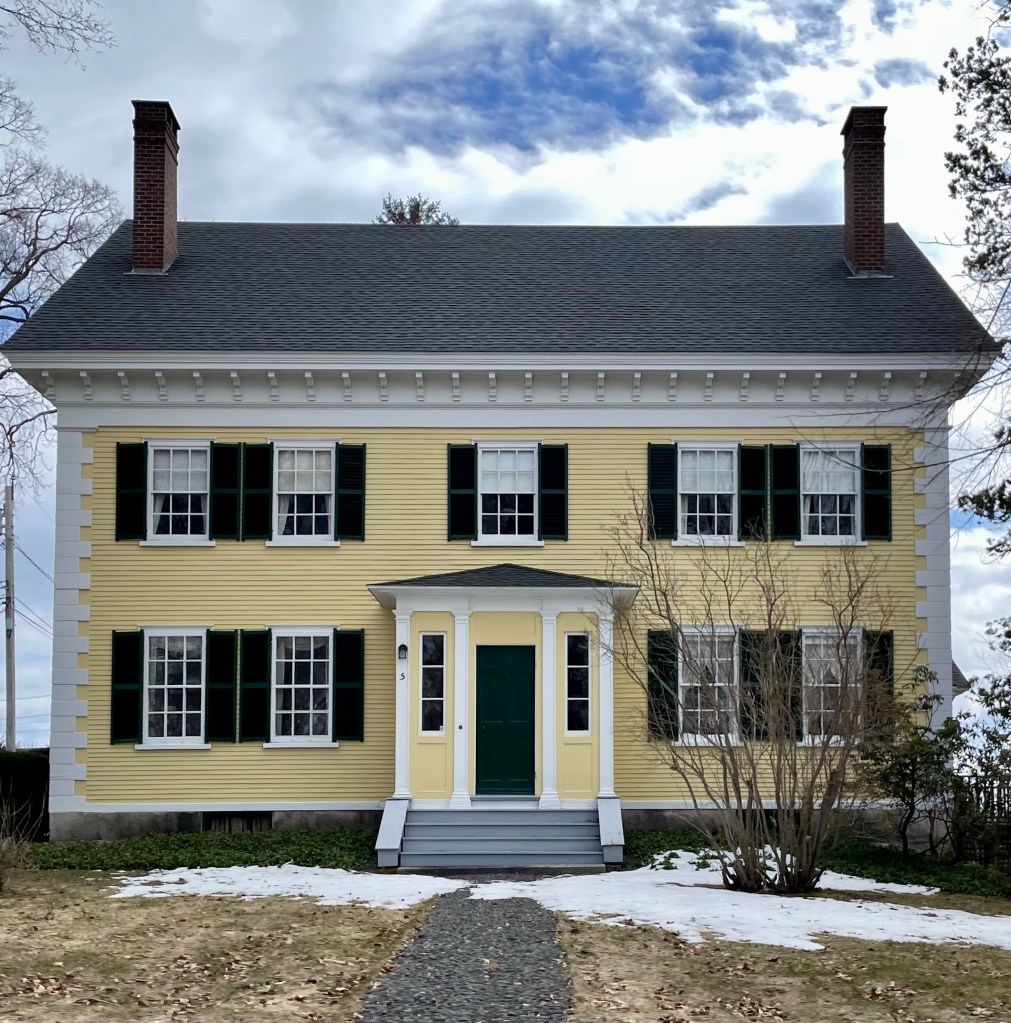
Dr. Ashbel Woodward House // 1835

The Ashbel Woodward House in Franklin, Connecticut was built in 1835, on land purchased by Doctor Ashbel Woodward, a prominent local physician, a year prior. Woodward, was a graduate of Bowdoin College, and he began practice in Franklin in 1829, serving as the town’s primary medical practitioner until his death in 1885. Though in his 60s at the outbreak of the Civil War, Woodward perhaps lent his greatest service to his country when he served as a battlefield surgeon and medical facilities inspector for the Union army. Besides his work in medicine, Woodward collected literature and numerous artifacts pertaining to Franklin’s past and eventually wrote a book detailing the town’s history. The Ashbel Woodward House is an excellent example of the Greek Revival architectural style in a five-bay form. Interestingly, there are semi-elliptical windows in the pediment gable ends on the side elevations, seemingly a nod to the Federal style that was waning out of style at the time. The property is in use today as a museum, documenting the life of Dr. Woodward and the people of Franklin, Connecticut.

Oliver Johnson House // 1905

Prairie style architecture is not nearly as common in New England as it is in the Mid-western United States. The style was almost always seen in early 20th century residential designs and is characterized by horizontality, low slope roofs, overhanging eaves, and open interior floor plans. This New England vernacular version of the Prairie style employs some Arts and Crafts influence with Tuscan columned porch and wood frame construction, rather than the more bulky and bold use of brick and stone. This residence sits on a busy state route in the sleepy town of Franklin, Connecticut. This house appears to have been built for Oliver Johnson who was about seventy by the time the house was built. Do you know of any other Prairie Style houses in New England?

Rev. Samuel Nott House // 1784

Reverend Samuel Nott (1754-1852) was born in Saybrook, Connecticut and did not have an easy beginning. When he was young, the family home burned, destroying all family possessions. Some years later on a business trip, he was beaten and robbed. At twelve years old, he began working for his father, later becoming a blacksmith by 16. For a while, young Nott lived with a Rev. Dr. Welsh of Mansfield. The older man had a profound religious influence on the young lad. At age 23, Nott entered Yale, but the college closed when British troops entered New Haven. In 1782, he married Lucretia Taylor and passed his examination for the ministry. A year before his marriage, he was invited to serve a parish in West Farms, now Franklin. He was apparently anxious to accept the position at the rural village, as the farmers attending the congregational church had fired their previous two pastors, he accepted the call regardless. During his tenure, he prepared more than 40 young men for college and schooled as many as 300 boys and girls in his home, some as boarding students. He was regarded as one of the most successful educators of the day. Education ran in his family as Samuel’s brother, Eliphalet Nott, would become President of Union College in Schenectady, NY for 62 years, from 1804-1866. Towards the end of Samuel’s life, in his 70s, his wife Lucretia, became an invalid, requiring care and finally passed in 1834. Three of his children also died. Nott passed away at 98 years old in this house, as a result of burns sustained from his own fireplace.

Samuel P. Tilton Cottage // 1880

One of the most well-designed and least-pretentious summer cottages in Newport is this charming dwelling on a dead end street. The Samuel P. Tilton Cottage was designed in 1880 by the prestigious firm of McKim, Mead & White as an idiosyncratic blending of Queen Anne and Shingle architectural styles. Mr. Tilton was a milliner (maker and seller of women’s hats) with stores in Boston and Paris, France. He had this cottage built to summer close to the nation’s wealthiest, likely marketing some hats at elaborate Gilded Age events. The facade is assertively Queen Anne with its massing and decorative panels, with shingled side elevation seemingly sprouting from the earth. The architectural terminology for these unique decorative panels is “sgraffito” where here, cement or plaster siding is set and adorned with shells, pebbles, colored glass, and pieces of coal into a cartouche design. The house is one of the finest in Newport, and shows that bigger isn’t always better!

Berkeley House // 1885

In 1885, a 28-year-old Leroy King (1857-1895) and his wife Ethel Rhinelander King (1857-1925) hired one of the country’s most prominent architects, Stanford White, to design a Newport home for their family. Leroy was the son of Edward King, a prominent local merchant, and upon his fathers death in 1875, inherited some of the $100+million dollar fortune he had amassed in today’s dollars. The corner lot at Bellevue and Berkeley avenues was purchased and work was underway on the new mansion. The house is a really interesting take on the Shingle style, but instead of cedar shingle siding, employs fireproof construction. A central hall, large gabled masses, picturesque window arrangements, and a spectrum of surface textures (here conveyed largely in natural stone and brick with flourishes of shingle and pebble dash work), align this house with McKim, Mead & White’s earlier efforts in this style. The interior has been meticulously preserved and maintained by the owners.

The Elms – Dining Room // 1899

The Dining Room of the Elms Mansion in Newport, Rhode Island, is represents the Gilded Age in all the best ways. The room sits just off the ballroom and like all of the other rooms in the summer residence of the Berwinds, it was designed by famed interior designer Jules Allard. The dining room was specifically to display a collection of early18th-century Venetian paintings purchased by Mr. Berwind from the Ca’ Corner estate in Venice (the Berwinds were avid collectors of 18th century French and Venetian paintings). The iconic coffered ceiling is not of wood, but of molded plaster, grained and painted to imitate oak. Each coffer is decorated with the winged lion of Saint Mark, the patron saint of Venice. Pour custom-made crystal chandeliers hang in the four corners of the room. At the end of the room is a stunning green marble, agate and onyx fireplace that is framed by a ceiling-high pediment supported by carved Ionic columns. Could you see yourself entertaining in this dining room?

Belair Gate Lodge // 1870

Located at the historic entry to Belair (last post), one of the largest estates in Newport, you would be greeted by this charming stone building, the Belair Gate Lodge. The building is symmetrically massed, 1½-story and built of rough-face-granite-ashlar, similar to the main house. This building can be classified as French Eclectic in style and was designed by Newport architect Dudley Newton, who also designed the 1870 Second Empire renovations to the main house at the same time for owner George Henry Norman. When the Belair estate was subdivided, the gate lodge was sold off as a separate unit, and is now a single family home, aka my dream home. There is something so enchanting about gatehouses!

Fosdick-Calder Double House // c.1745

This 2 ½-story, five-bay house was built for Benjamin Fosdick (1713-1801) and his family on Nantucket. After Benjamin died in 1801, the house was inherited by two of his surviving sons and they divided the house into two, creating a double-house for them and their own families. The symmetrical home was divided down the middle at the central chimney, and two front doors provided access to the two dwellings. The right section was once the home of Capt. William Calder, who escaped shipwreck at Cape Horn
on his first voyage at age 13. He later was captured by the British during the War of 1812, and escaped from Dartmoor Prison in England, making his way back to Nantucket. The double house has retained much of its original design since 1801 until the 1960s when the projecting entrance porch was added.

United Methodist Church of Nantucket // 1823

The United Methodist Church of Nantucket stands prominently at the top of Main Street on land was obtained from Peleg Mitchell in 1822. Construction on the site began in 1823 with the massive structure originally built with a pyramidal hip roof of enormous timbers brought to the island on whaling vessels. In 1840, the roofline was amended with the present gable roof, constructed over the original hip roof. The church is a highly significant example of Greek Revival architecture on the island and a more rare example of the temple-front form seen there. Deferred maintenance threatened the building to the point that in 1995, the building was listed as one of the most endangered buildings in Massachusetts. A restoration was undertaken funded by private contributions and the Massachusetts Preservation Project Fund, preserving the building for another 200 years.