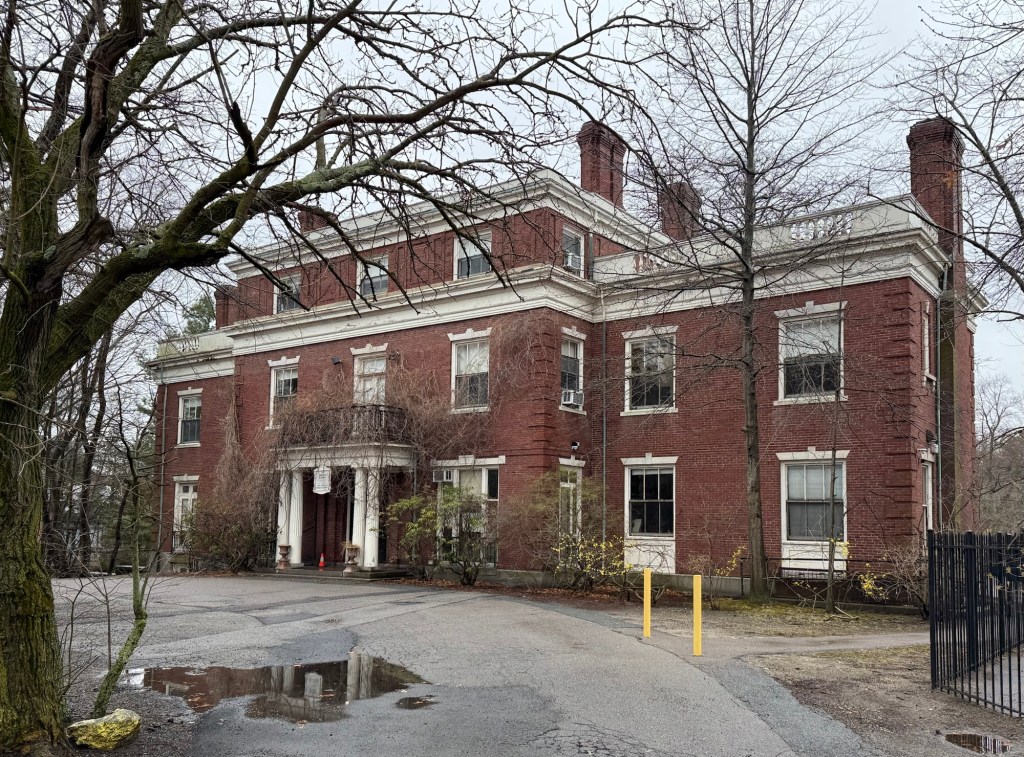
Frederick P. Fish Mansion – New England Hebrew Academy // 1902

One of the finest estates in Brookline can be found here in the Cottage Farm neighborhood, just steps from Boston and the Charles River. This brick mansion was built in 1902 for Frederick Perry Fish (1855-1930), a prominent lawyer who also served as president of American Telephone & Telegraph Corporation from 1901 to 1907. One of the leading patent attorneys of his age, representing such clients as Alexander Graham BellThomas Edison, and The Wright Brothers, by the time of his death he was believed to have appeared in more patent cases at the Supreme Court than any other lawyer. For his Brookline residence, Fish purchased an 1867 brick mansard-roofed home on the lot and hired the architectural firm of Winslow & Bigelow to ether modify the earlier home or demolish it and build entirely new. The result is this stately, three-story Neo-Classical mansion. Fish would die at his home in 1930, and the property would eventually be owned by the New England Hebrew Academy as a Jewish day school. While it is an institutional use, the facade is covered with climbing vines that are bad for the masonry and an asphalt paved front yard which detracts from the beauty of this estate. It appears to be near-original though, which is great to see!
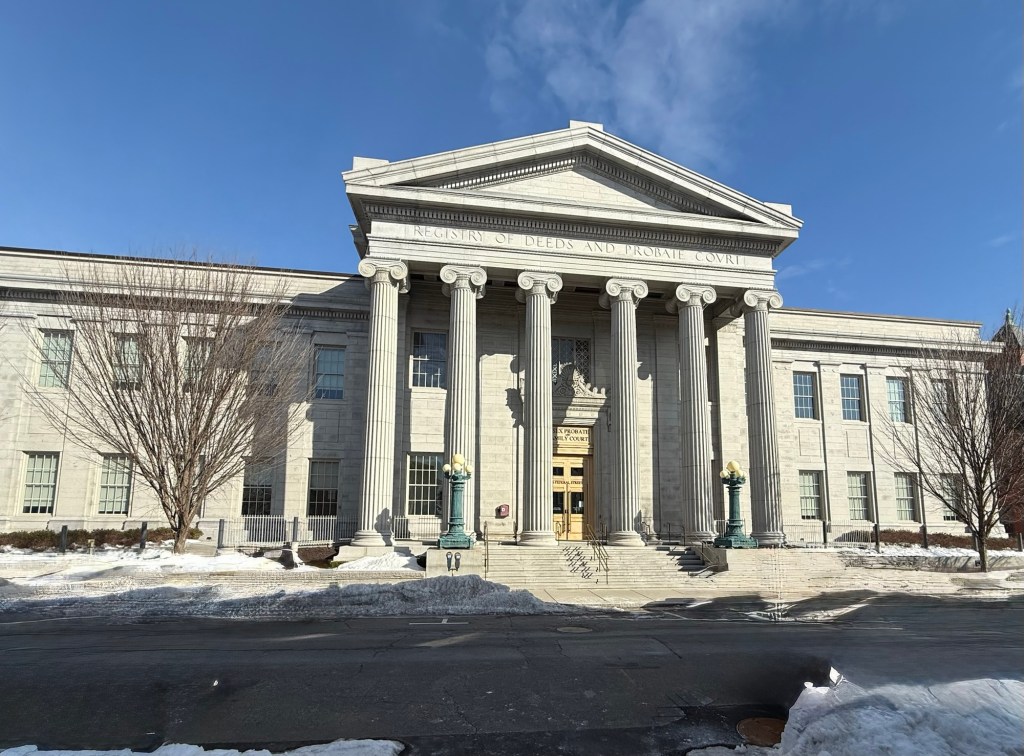
Essex County Registry of Deeds // 1909

The Essex County Registry of Deeds and Probate Courthouse on Federal Street in Salem, Massachusetts, was built in 1909 from plans by Boston architect, Clarence Blackall. The Neo-Classical courthouse adds to the rich tapestry of Civic buildings there, showcasing the ever-evolving tastes in architecture as the buildings become more contemporary as you move westward down the street. The two-story granite and cast-stone faced brick masonry building is cross-shaped in plan, consisting of a three-bay wide gable-end entrance with Ionic porch of six fluted columns supporting a dentilled entablature and pediment. The central bay within the entry porch contains a large double-door entrance with elaborate architrave and a scrolling pediment incorporating Classical motifs and a Greek god bust. The building underwent a massive restoration in 2017, and was renamed the Thaddeus Buczko Building after retired First Justice Thaddeus M. Buczko.

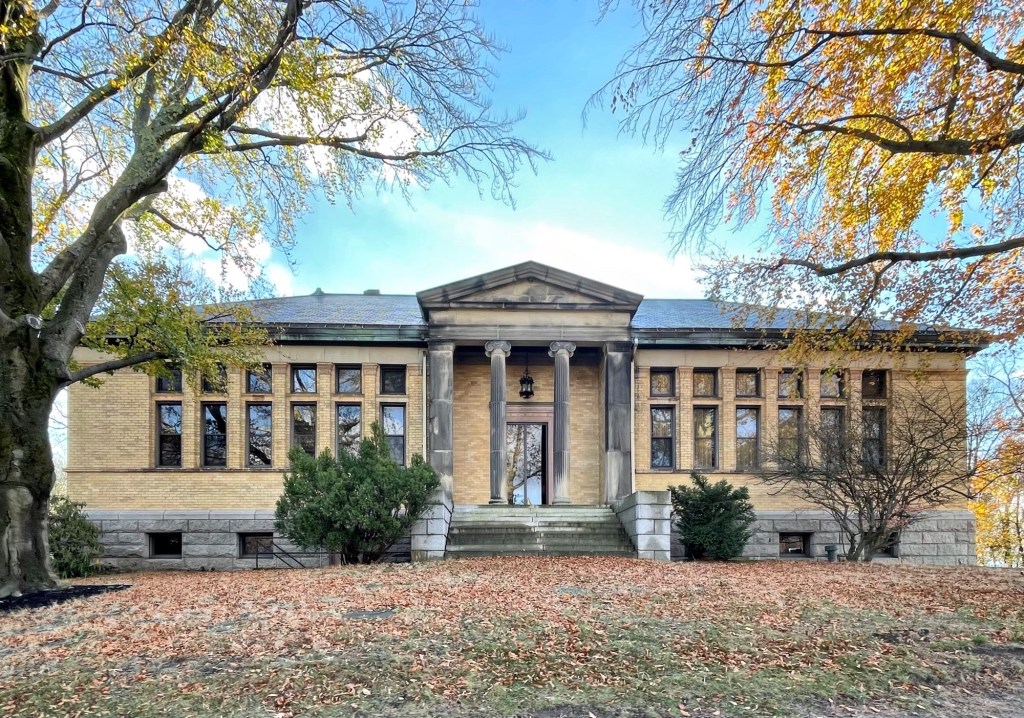
Hills Library – Andover Newton Theological School // 1895

The Hills Library is a formal building standing at the summit of Institution Hill, so-named as the home of the Newton Theological Institution (and most recently as the Andover Newton Theological School). The library was constructed in 1895 from plans by architects Henry H. Kendall and Edward F. Stevens of the firm, Kendall & Stevens. Designed in 1894 in the Neo-Classical style, the library has a stately portico in the Ionic order with a pediment above. The building is constructed of yellow brick with stone and terracotta trimmings with banks of vertical windows. The library would be added onto at the rear, with the main entrance later closed for an accessible entrance in a rear addition. The building is now known as the Hanns Sachs Memorial Library for the current owners and stewards, the Boston Psychoanalytic Society & Institute (BPSI).

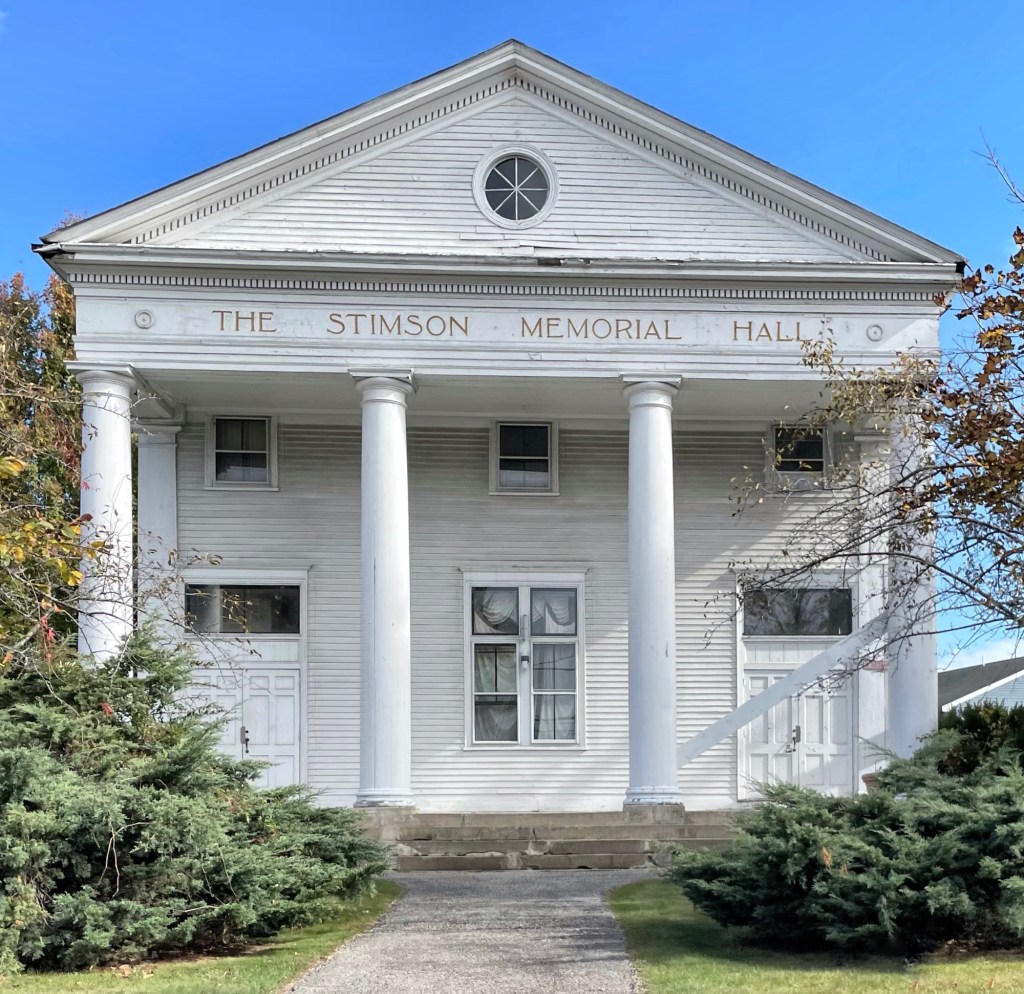
Stimson Memorial Hall // 1900

Stimson Memorial Hall is a historic, Neo-Classical building on Shaker Road in the center of Gray, Maine. Built in 1900, it served for many years as the town’s main public meeting space, and is a prominent landmark in the town center. The hall was built as a gift to the town, primarily through the efforts of Abbie Stimson Ingalls, who had moved to Cincinnati, Ohio with her husband, as a memorial to her late parents, Theophilus and Mary Stimson. The memorial hall was designed by Elzner and Anderson of Cincinnati, Ohio, and was built on land originally purchased by the local Universalist congregation. The upper level house the town library until the 1950s. The building was threatened in recent years, and as one of a handful of significant buildings remaining in the center of town, its preservation was important. It has some deferred maintenance but remains in good shape! Does anyone know what the building is/will be used for?

Maynard Estate // 1901

One of the largest summer estates in Ridgefield is this Neoclassical residence on Peaceable Street, which was built in 1901 for Effingham Maynard and his wife Helen. Maynard was a partner in Clark & Maynard, a New York publishing house. Local lore states that the Maynard Family hired New York architect Stanford White, to design this property, but no definitive proof could be located to substantiate that rumor. The Olmsted Brothers landscape architecture firm designed the grounds which were elaborate with gardens and outbuildings. The two unmarried Maynard daughters, Mary and Helen spent their summers here every year until their deaths in the 1950s.

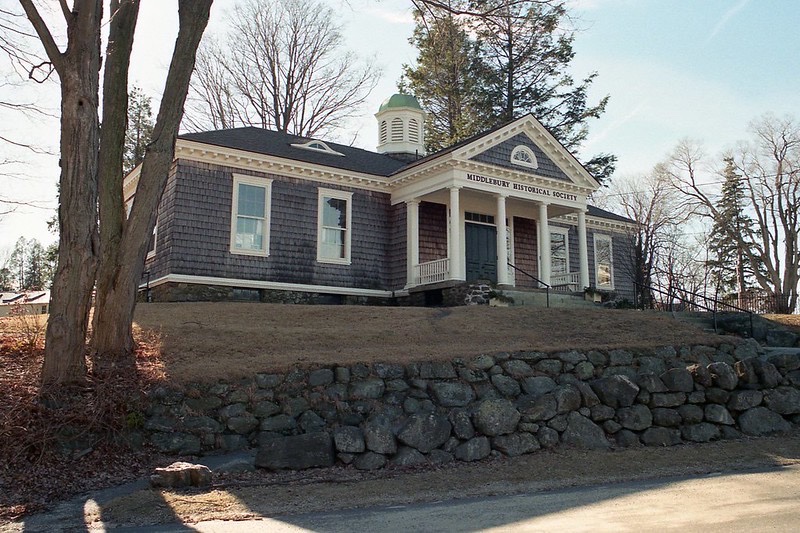
Former Middlebury Central School // 1898

Having the tall order of being a neighbor to the later Westover School, the town of Middlebury’s Central School still packs an architectural punch. The school was built in 1898, replacing the former Union Academy building also near the town green. The school building is Neo-Classical in style with a projecting pedimented portico supported by four columns. A cupola extends through the roofline and shingle siding add some charm to the small two-room school building. The former school later housed the Middlebury Public Library and is now occupied by the Middlebury Historical Society.

Robert Palmer Jr. House // 1907

Robert Palmer Jr. (1856-1914) was born in Groton, Connecticut as the son of Robert Sr., a prominent businessman and Deacon in Noank’s seaside village (his house was featured previously). Robert Sr. established the Palmer shipyard, which became the largest business enterprise in Noank. Jr. would later join his father’s business and did well for himself financially, eventually marrying and building this Neo-Classical mansion on Church Street in town. The company, under Sr. and Jr.’s leadership, built many seafaring vessels that were internationally renowned until the company closed in 1914 after the death of Robert Jr. This house is unique in town for the monumental two-story portico, Palladian windows at the first floor, and a projecting entry vestibule.

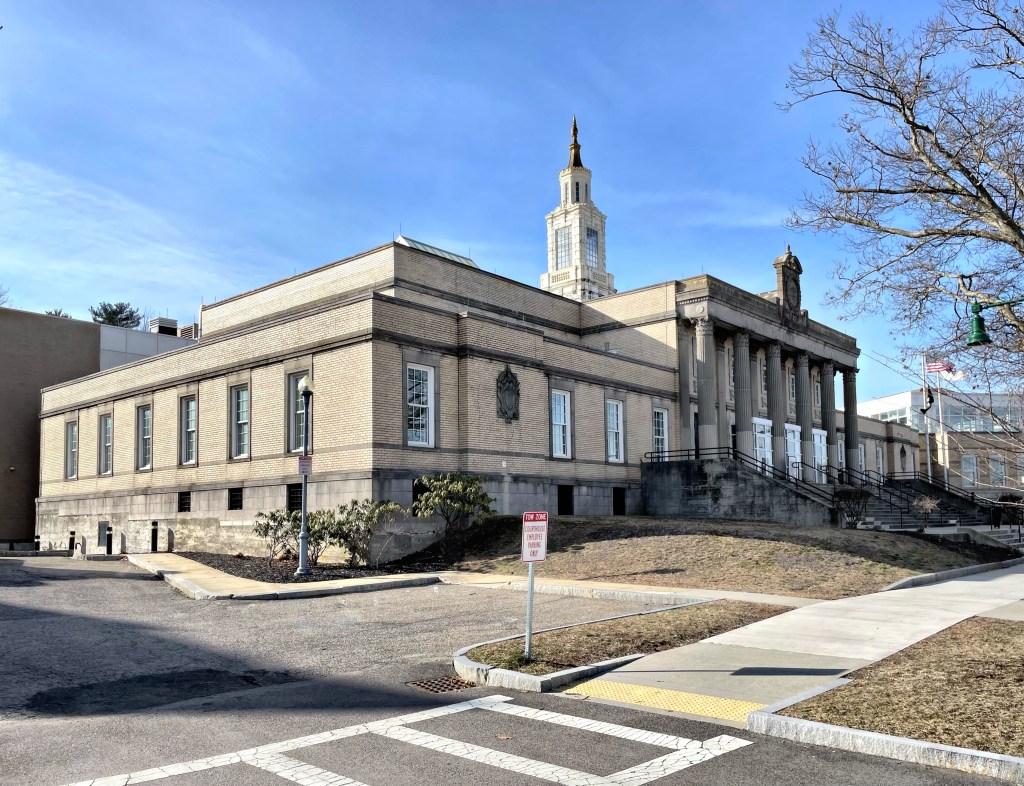
West Roxbury District Courthouse // 1922

Boston neighborhoods are very confusing, and how the West Roxbury District Courthouse came to be located in Jamaica Plain is just one example. The independent Town of West Roxbury was in existence from 1851 until 1874, a mere 23 years, bookended by its time as a section of the Town of Roxbury and being annexed into the City of Boston. West Roxbury originally included parts of the Jamaica Plain and Roslindale neighborhoods. Ultimately, West Roxbury became one of the city’s eight large districts and its municipal court division is served by this Neo-Classical style building. Built in 1922, the current West Roxbury Courthouse building on Arborway, was and still is, from a municipal court perspective as well as an historical perspective, in West Roxbury. The West Roxbury District Courthouse was designed by Timothy G. O’Connell and Richard Shaw of the firm O’Connell and Shaw who were best known for their ecclesiastical designs in New England, largely specializing in the Gothic and Arts and Crafts styles. Their design for the West Roxbury Courthouse remains one of their finest non-religious buildings and a departure from their traditional styles.

Lounsbury House // 1896

One of the (many) stately homes on Ridgefield’s Main Street, this massive Neo-Classical mansion is also among the most visited in Fairfield County. Lounsbury House was built in 1896 by former Connecticut Governor Phineas C. Lounsbury. While attending the 1893 Chicago World’s Fair, Governor Lounsbury was so taken by the Connecticut State Building that he built a replica to serve as his family home. The Connecticut State Building was designed by Waterbury-based architect, Warren R. Briggs at a cost of $112,000! Gov. Lounsbury loved this house, which he named “Grovelawn” until his death in 1925. After his death, his heirs were unable to maintain the massive home, and it started to decay. The Town of Ridgefield did not want to see the mansion demolished, and in an early example of historic preservation, the town purchased Lounsbury House in 1945. A school was built behind and nearly ten years later, the home was leased to the The Ridgefield Veterans’ Memorial Community Association. The home is now managed by a board and rented for weddings and community events.

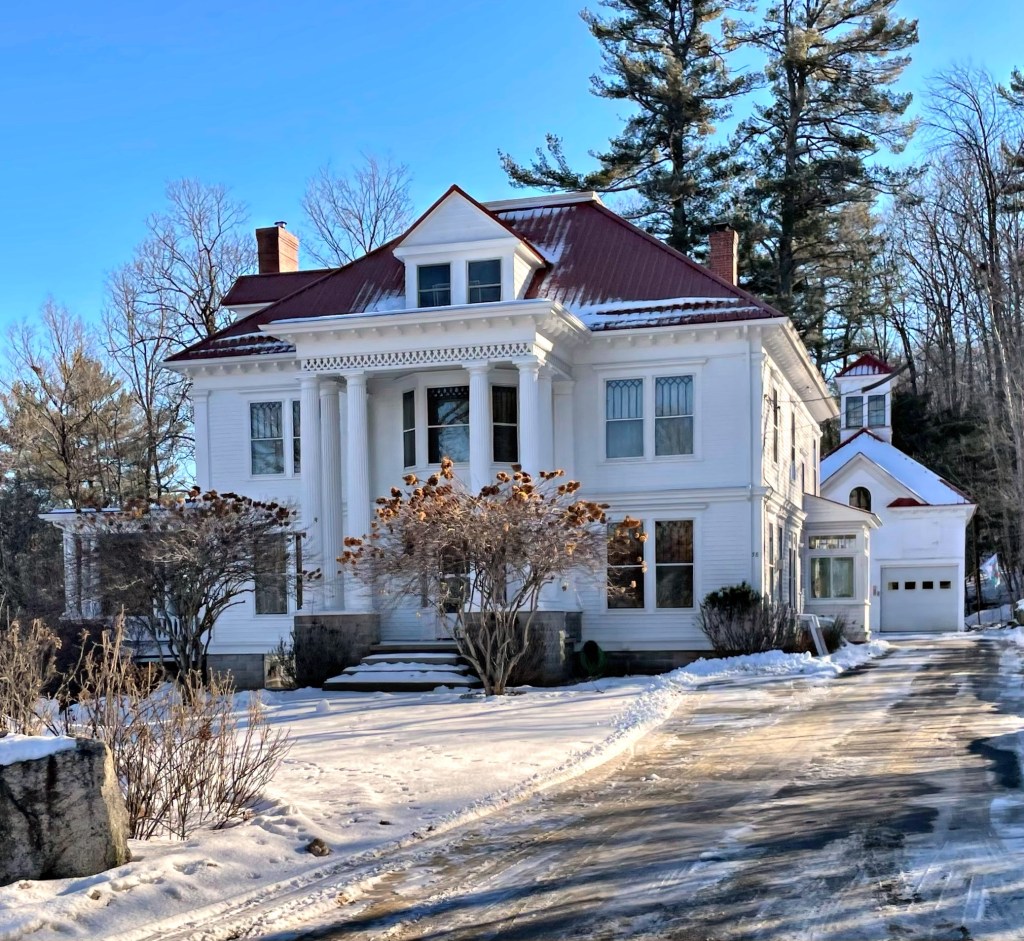
Edwin Cummings House // 1908

This two-and-a-half story mansion sits on a steep hillside overlooking Downtown Norway, Maine. The home was built in 1908 for Edwin Cummings, who appears to have been a son of Charles B. Cummings, who ran a profitable woodworking and carpentry firm in the village. Charles Cummings was the owner of the Evans-Cummings House (featured previously) and updated it to show off his carpentry skills. The house here is a great example of Neo-Classical architecture with the monumental columns to create a prominent portico. The home retains the original windows which really complete the facade!