Derby Line Border Station // 1932

Located on the border of Canada in the northern part of Vermont, Derby is a charming town named after Derby, in England.  Located in the region known as the Northeast Kingdom, the area has benefitted from timber, maple sugaring, hop vineyards, and dairy production in its history since it was settled in 1795. This border crossing is located between the villages of Derby Line, Vermont and Stanstead, Quebec, both of which are developed up to the border, and without the security and signage, you’d never guess they are different countries! The cross-border relationship was cemented in part by the construction in 1904 of the Haskell Free Library and Opera House (last post), which straddles the border and provides library services to both communities. This station was formally opened in 1932, when the main building was completed. It is one of several standardized inspection station layouts developed by the United States Treasury Department, and was the largest and most architecturally sophisticated of those built in Vermont in the 1930s. It was built as part of a program to improve border security developed to respond to increased use of the automobile, increased illegal border crossing, and smuggling related to Prohibition. After the 9/11 terrorist attacks, the border was secured and a new station directly on the border was built.

Haskell Free Library and Opera House // 1901

How many buildings do you know of that straddle two countries?! Well, here is one of the most iconic buildings in Vermont, the Haskell Free Library and Opera House of Derby. The building was gifted to the villages of Derby Line, Vermont and Rock Island, Quebec, by Martha Stewart Haskell and her son, Horace Stewart Haskell, who wanted to leave their mark on the town. The building was designed by James Ball of Rock Island, Quebec and is a high-style structure comprised of both a library and opera house for residents. Designed in a eclectic mix of Romanesque Revival and Classical Revival, there is a lot to look at from both countries! Some of the outstanding features of the building include the structural and ornamental use of granite, stained glass windows imported from Scotland, ornate fireplaces and rich woodworking on the library interior, and one of the most elaborate opera house interiors in a completely preserved condition in Vermont.

Samuel Read Hall House // 1831

Samuel Read Hall (1795–1877) was an American educator, who in 1823, started the first normal school, or school for training of teachers and educators, in the United States. He helped found the American Institute of Instruction in 1829, the oldest educational association in the U.S. He served as pastor in Brownington and Granby, Vermont from v 1846 to 1875 and would also become the principal and teacher at the Orleans County Grammar School in Brownington. He lived in this Federal style house in the village until his death. The Hall House is now a part of the Old Stone House Museum and Historic Village. Fun Fact: Samuel Read Hall is said to have been the earliest person to introduce the blackboard to the American classroom!

Cyrus Eaton House // 1834

Built in 1834 by Cyrus Eaton, a businessman who emigrated to Orleans County from Canada, this cape house blends Federal and Greek Revival styles under a charming roof. Mr. Eaton was a trustee of the Orleans County Grammar School in Brownington, Vermont and helped African American Alexander Lucius Twilight build the Old Stone House. Two of Eaton’s sons and one daughter enrolled at the school, located just nextdoor from their home. In 1971, the property was purchased from a private owner, and has since been part of the Old Stone House Museum and Historic Village’s gorgeous campus.

Athenian Hall – Old Stone House // 1836

Across from the Alexander Twilight House (last post) in Brownington, Vermont this massive stone structure which is possibly the first granite public building constructed in the state. Alexander Twilight (1795-1857) is reputed to be the first African American in the United States to graduate from college, where he was likely inspired by the large granite dormitories there (a private institution). Twilight served as headmaster of the Orleans County Grammar School, which due to its rural location, required many students to travel long distances for their education. As a result, they boarded with families in town, including with Twilight. Athenian Hall was built to accommodate the larger number of students attending the Grammar School. The building closed in 1859, two years after the death of Alexander. The building sat vacant for much of the late 19th and early 20th centuries until 1918, when the Stone House was put up for auction. A representative of the railroad in the state of Vermont bid on the structure with the hopes of using the granite stones for bridge abutments. Luckily for us, The Orleans County Historical Society outbid the railroad and won the auction. The building was opened as a museum in 1925 and is today part of the Old Stone House Museum and Historic Village.

Alexander Twilight House // c.1830

The highlight of the town of Brownington, Vermont is the Old Stone House Museum & Historic Village, a collection of amazing 19th century architecture set amongst the rolling hills of the Northeast Kingdom. One of the buildings in the village is this structure, the Alexander Twilight House. Alexander Twilight (1795–1857) was born in Corinth, Vermont, on September 23, 1795. He was raised by a fair-skinned mother, Mary Twilight, and a mixed-race father, Ichabod Twilight. Twilight entered Middlebury College in 1821 and graduated in 1823, possibly making him as the first person of color to graduate from an American college. Alexander Twilight accepted the call and moved to Brownington to serve as the town’s reverend.  He also served as headmaster of the Orleans County Grammar School.  To meet growing enrollment needs, he designed, raised funds for, and built the first granite public building in Vermont, Athenian Hall, which contained classrooms and a dormitory. He had this Federal style house built in the village, large enough to house some students in his home. Before building his Federal style home, he lived in a much smaller, vernacular home, which was added onto the rear of this home as an ell (later separated by the museum). Elected to the Vermont General Assembly in 1836, Twilight became the first African American to serve in a state legislature in the United States. In 1847, after conflicts with the Orleans County school administrators, Twilight moved to Quebec, Canada for five years, but then returned to serve as headmaster in Brownington.  He died on June 19, 1857 and is buried in the Brownington churchyard

Original Twilight House

T. C. Stewart House // 1843

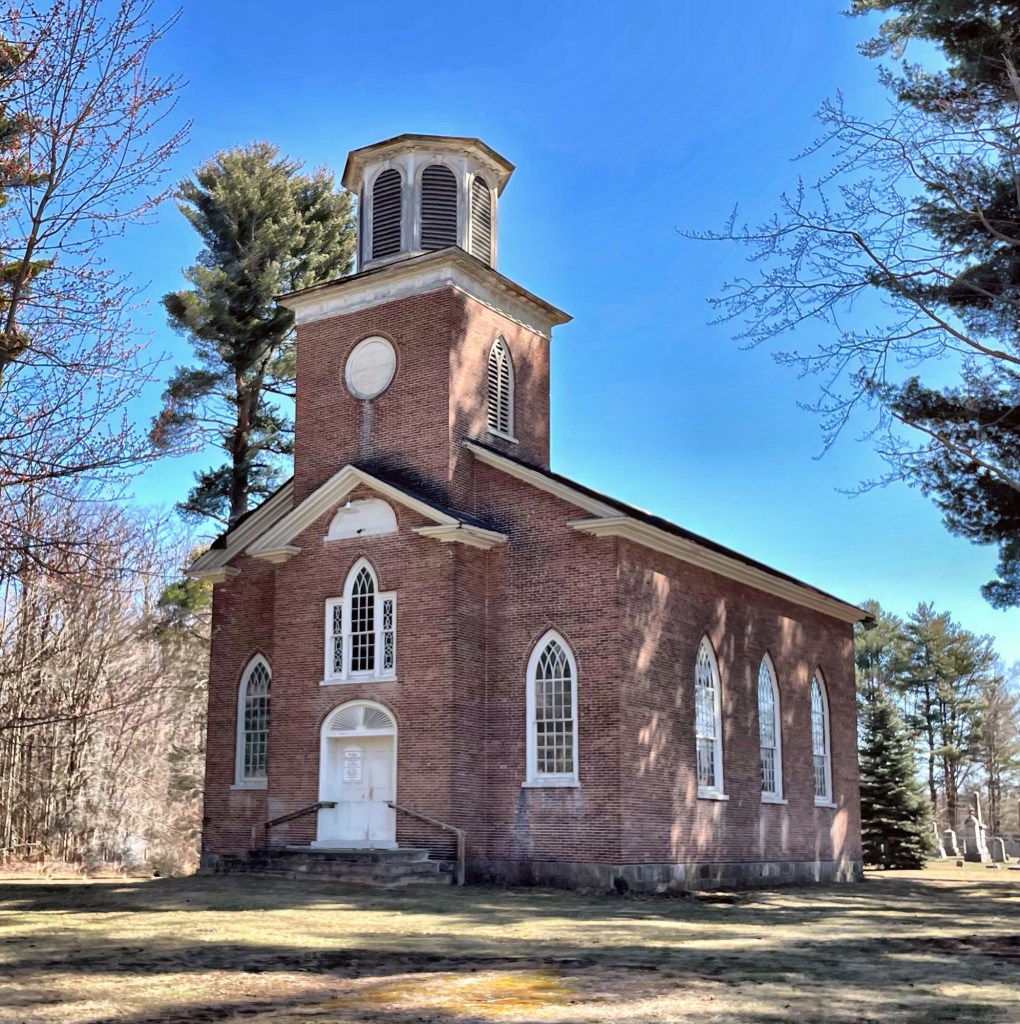
Welcome to Brownington, Vermont! This small, rural town sits in the Northeast Kingdom region of the state and was granted to Daniel and Timothy Brown in 1790, and named after their family. One of the first roads in Orleans County went through Brownington, connecting Greensboro to Derby. Brownington Village was once a stopping point for stagecoaches traveling between Boston and Canada. This Greek Revival style house was built in 1843 along the stagecoach route to Canada and was built for Thomas C. Stewart. Thomas Carlisle Stewart (1804-1865), an attorney and prominent member of town who was the son of Amherst Stewart, one of the town’s founders. The Stewart home has its gable end extending over the recessed front porch, reading like a temple-front home.

Bay Crest Cottage // c.1850

Located across from the Winthrop-Eckley Double House on Corne Street, this gorgeous Italianate style summer cottage is a perfect blending of stature and whimsy. The house was built around 1850 and owned by Charles B. Peckham. Built in the Italianate style, the symmetrical house stands three-stories with covered side entrances divided by a projecting two-story bay. The house exhibits broad, overhanging eaves and paired and ganged round arched windows. The property was known as “Bay Crest” and remains one of the unsung landmarks of the 1850s in Newport.

Winthrop-Eckley Double House // c.1855

Newport has no shortage of amazing architecture. From the grand Gilded Age mansions along the coast to the pre-Revolutionary Colonial houses, there are always new buildings to stumble upon and learn about. This charming stone double-house on Corne Street was built in the mid-19th century and had two owners by the 1870s, John Winthrop (1809-1886) and Julia Ann Eckley (1800-1874), a widow, who owned the smaller side. The stone cottage sits atop a raised basement with bold stone quoins at the corners. Dormers with delicate wood trim are at the roofline with the detail reflected in the porch on the Winthrop half. This double-house is one of the many “hidden” treasures in Newport’s warren of narrow streets.

Edgar-Wolfe-Moore House // 1864

At the head of Touro Park, this large home has stood since it was built in 1864 for Daniel Edgar of New York, who made it his summer home for eight seasons. It was designed by noted local architect, George Champlin Mason in the Italianate style and included a broad veranda, brackets, and other intricate details. In 1872, Edgar sold the property to Catherine Lorillard Wolfe, who occupied the house until 1883 when her property “Vinland” was completed on Ochre Point Avenue. In 1948, the house was purchased by Cornelius C. Moore, who remodeled the exterior in 1949-1950, removing its Italianate trim and replacing it with Neo-Federal detail we see today. The house was most-recently in use as the Touro Park Inn, but was recently purchased and is a single-family home.