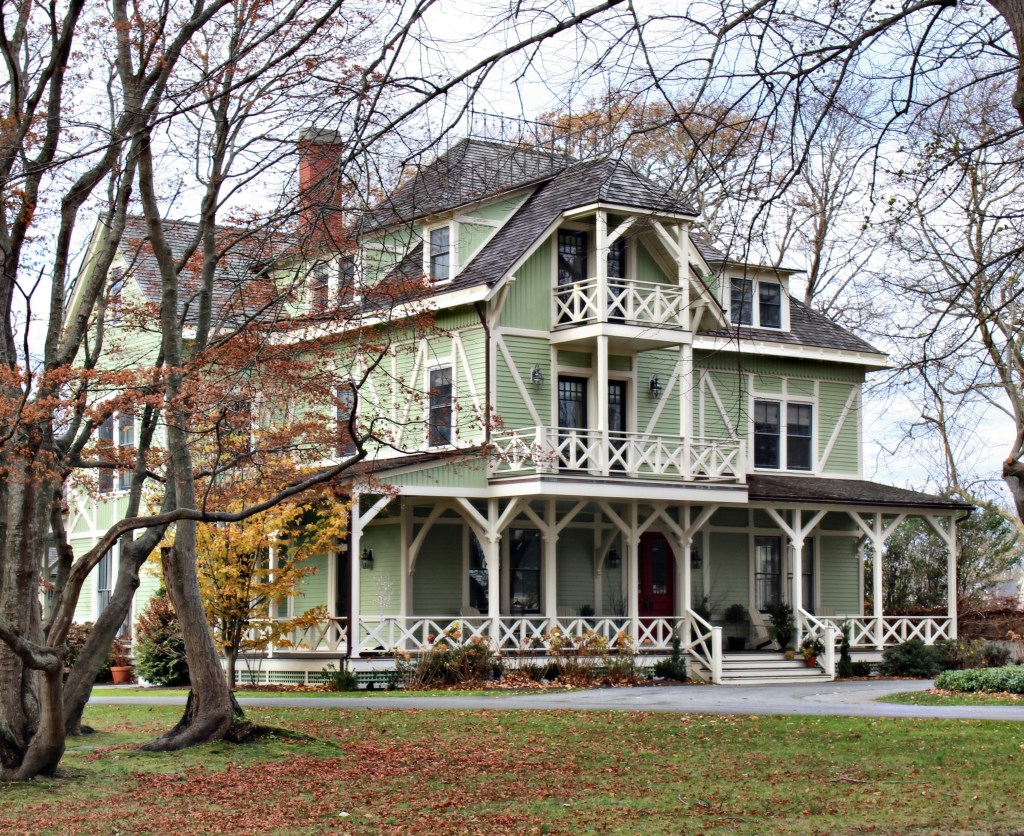
Hawley House // c.1865

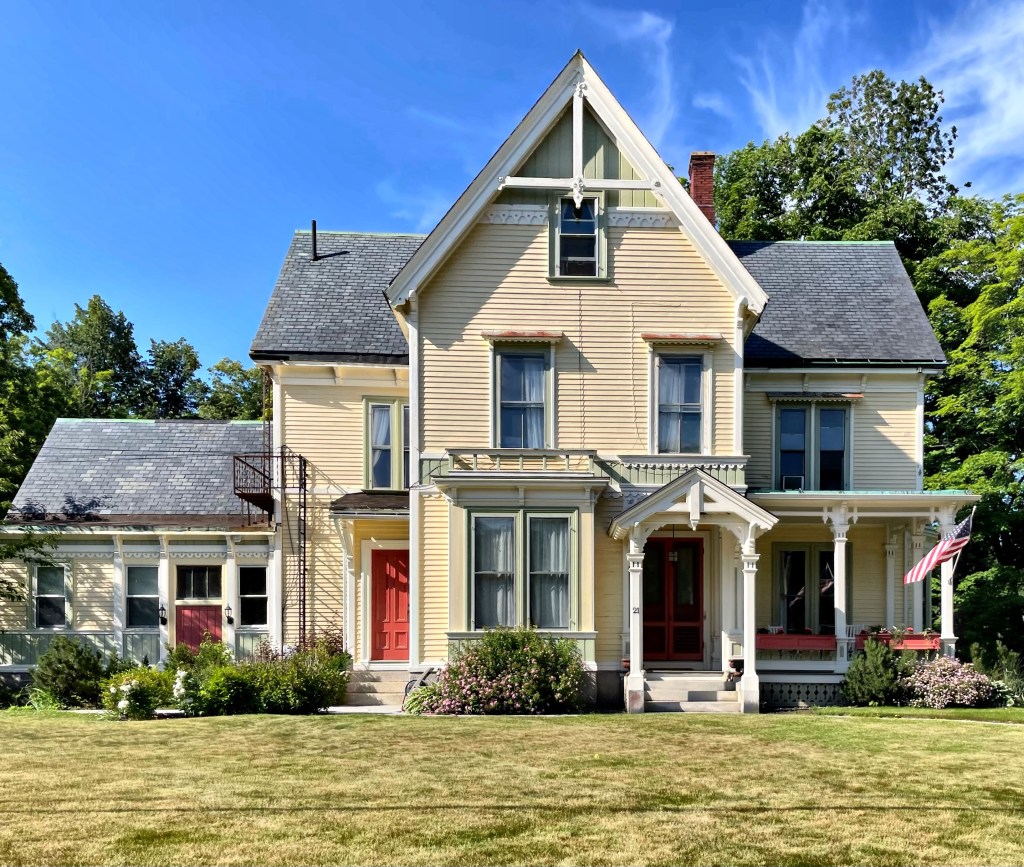
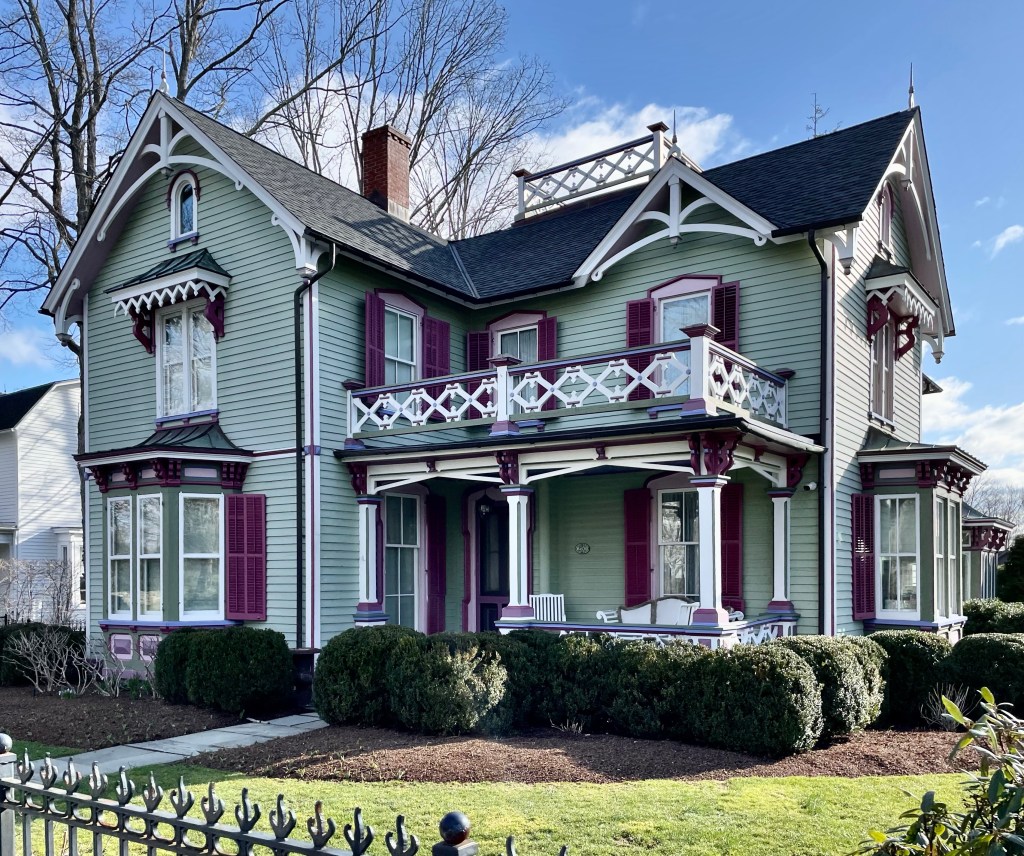
Located next to the Reverend Thomas Hawley House (last post), this gingerbread cottage on Ridgefield’s Main Street looks straight out of a fairy tale! The home appears to have been built around the Civil War (or a renovation of an earlier house) and blends Italianate and Gothic detailing elegantly under one roof. The home was built on land that was owned by the Hawley descendants and was occupied by a few members of the family until it sold out of Hawley ownership in the 20th century. The house was purchased in 2002 by Gregory and Valerie Jensen who restored the home. Mrs. Jensen is the founder of the Prospector Theatre, a non-profit cinema dedicated to providing a higher quality of life through meaningful employment to people with disabilities.

Lapham Woolen Mill // 1879

I have gotten a lot of requests recently to feature an old New England mill town, and I wanted to highlight a lesser-known one, so here is Millbury, Massachusetts! This gorgeous mill building was constructed between 1879-1919, impacted by over forty years of growth and design. The Lapham Woolen Mill is the largest and most intact 19th century industrial building in Millbury and sits in the middle of Bramanville, an industrial village in the town, off Singletary Brook, a branch of the Blackstone River. The Lapham Woolen Mill was built on the location of the former Burbank paper mills, which were in operation in Bramanville between 1775-1836. The Lapham Woolen Mill was started in the mid-1870s by Mowry A. Lapham, who oversaw the company’s growth after the Civil War, manufacturing clothing and other woolen goods. After Mowry’s death, the company’s pollution into the brook got the best of them and they disbanded, selling it. The mill was then purchased by Josiah and Edward Mayo, and their business partner Thomas Curtis. The group renamed the existing business the Mayo Woolen Company. The complex was occupied by Steelcraft Inc., a manufacturer of medical supplies, until recently. The building’s future was threatened until 2020, when a proposal to restore the old mill, and add new housing on the site was proposed. Fingers and toes are crossed to see this gorgeous building restored!

“Rest Haven” – “Le Chalet” // 1870

Bellevue Avenue in Newport is best-known for its massive summer cottages, many of which are built of stone and look more like art museums than a house. “Rest Haven” is one of the most stunning summer cottages in Newport and can stand toe-to-toe with the later mansions which neighbor it. The Stick style cottage was built in 1870 as a spec. house for merchant and financier John N.A. Griswold, who had his own cottage farther up the street (last post). Similar to his own house, he hired world-renowned architect Richard Morris Hunt to design the house, which was to be sold soon after completion for a profit to Anna Gilbert of New York, a wealthy widow who wanted to keep up with high-society in Newport. Anna Gilbert’s son, Charles Pierrepont Gilbert, was a New York architect who trained at the Ecole des Beaux Arts in Paris. He and his wife, Clara, summered at Resthaven until 1916. The home was likely renamed “Le Chalet” by a subsequent owner. The cottage was altered over the years, but restored a number of years ago by Newport Collaborative Architects and Behan Bros, and looks stunning!

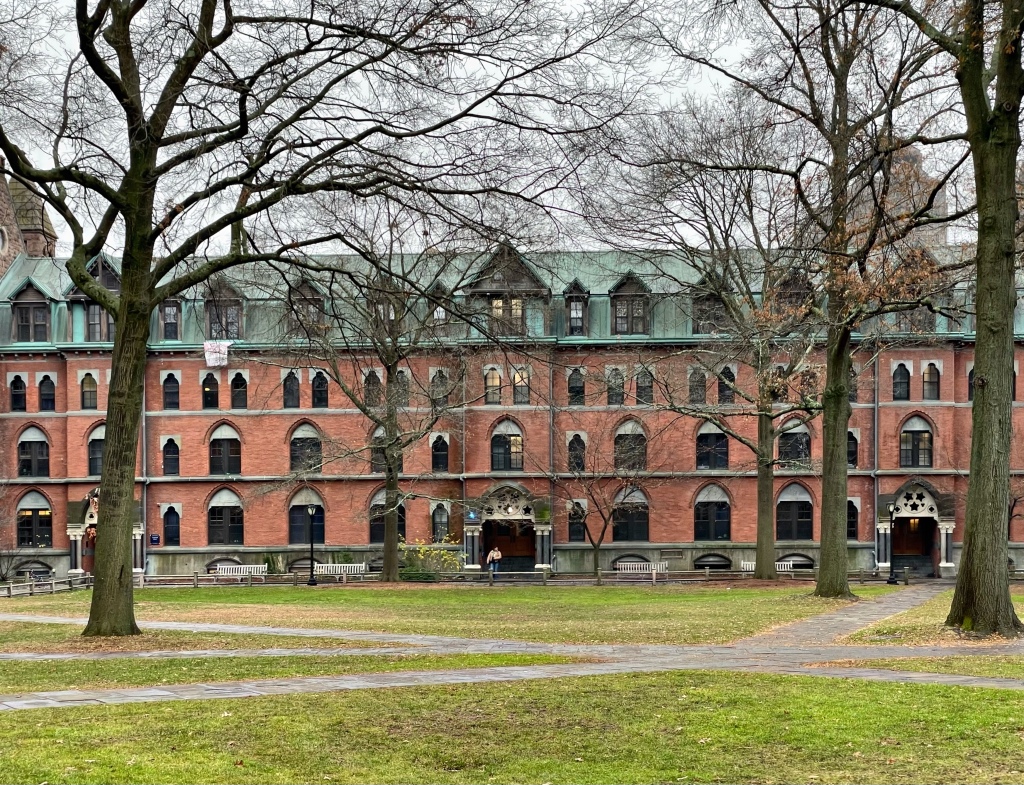
Unity Church Parsonage // 1878

Architects William Robert Ware and Henry Van Brunt designed this parsonage in Easton, Massachusetts for the Unity Church in town (featured previously). The Victorian Gothic house is constructed of polychromatic stone, wood trim, slate and copper roof surfaces, and terracotta finials. The architecture is very well-developed and stands toe-to-toe with the other architectural landmarks in town, just a short walk away.

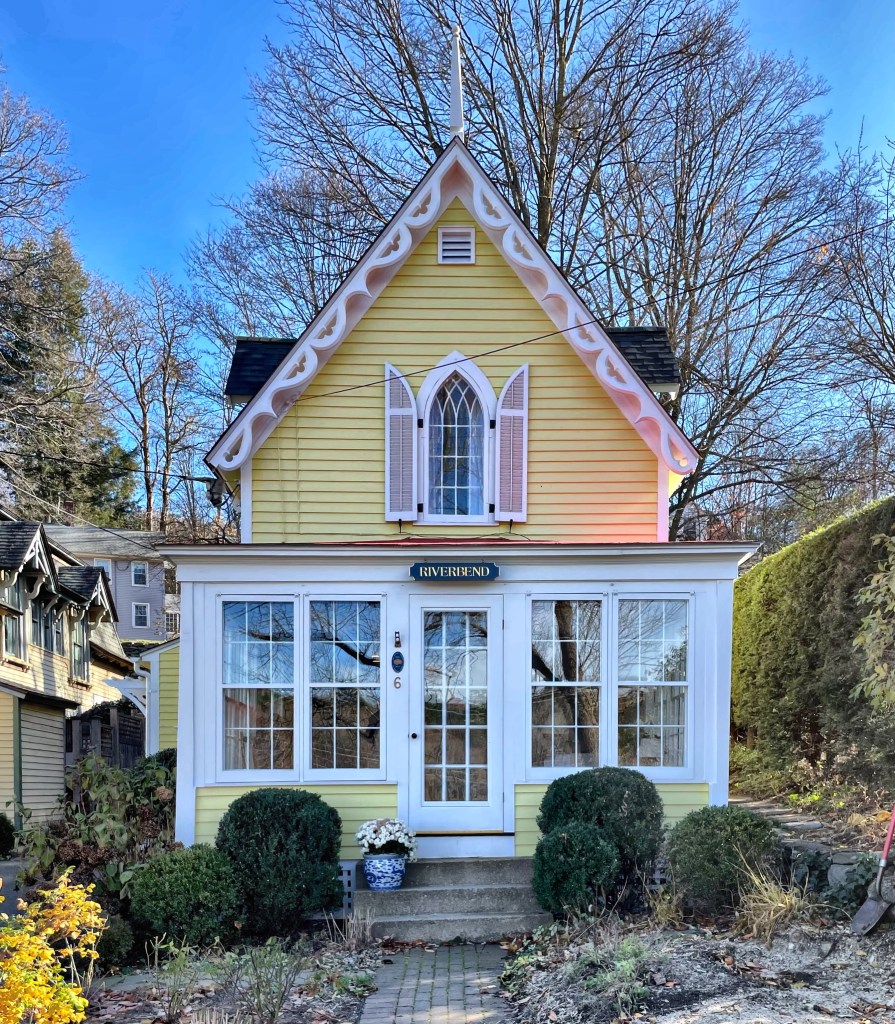
Riverbend Cottage // c.1860

No, this is not Martha’s Vineyard, it is Collinsville, Connecticut! Perched on a hill near the banks of the Farmington River, this quaint little Victorian cottage is one of the better-preserved examples of worker’s cottages in the former industrial village. I could not locate much on the house’s history, beyond that it may have once been part of a larger home, and moved to this site in the 20th century.

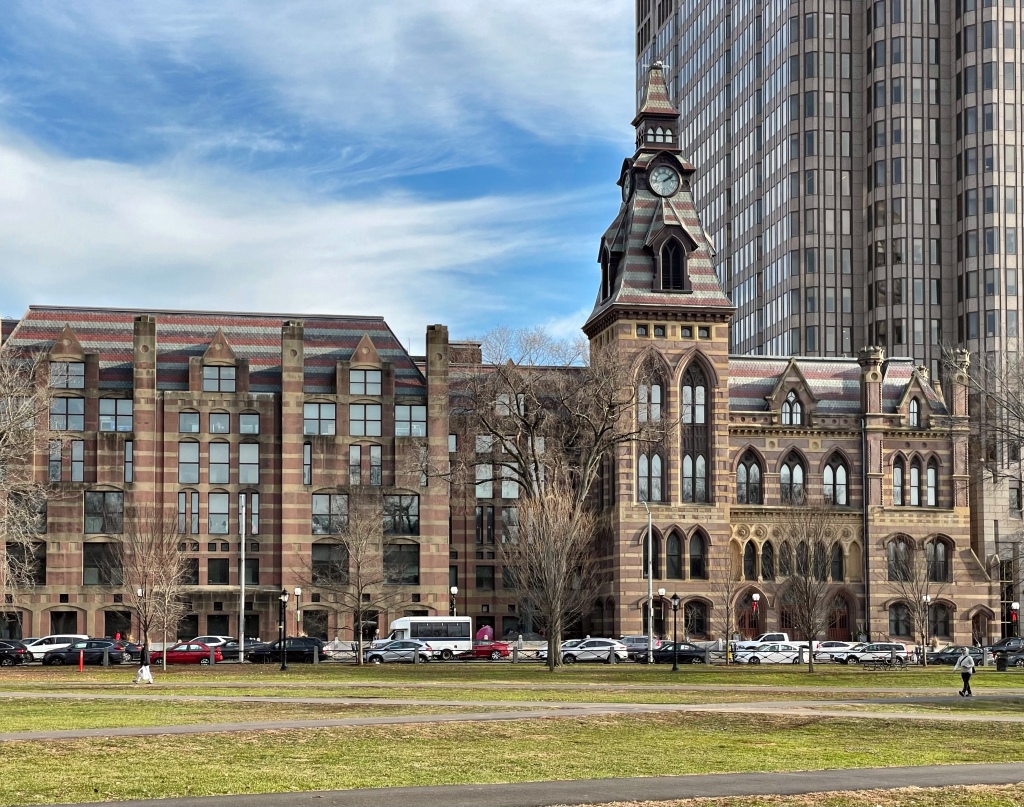
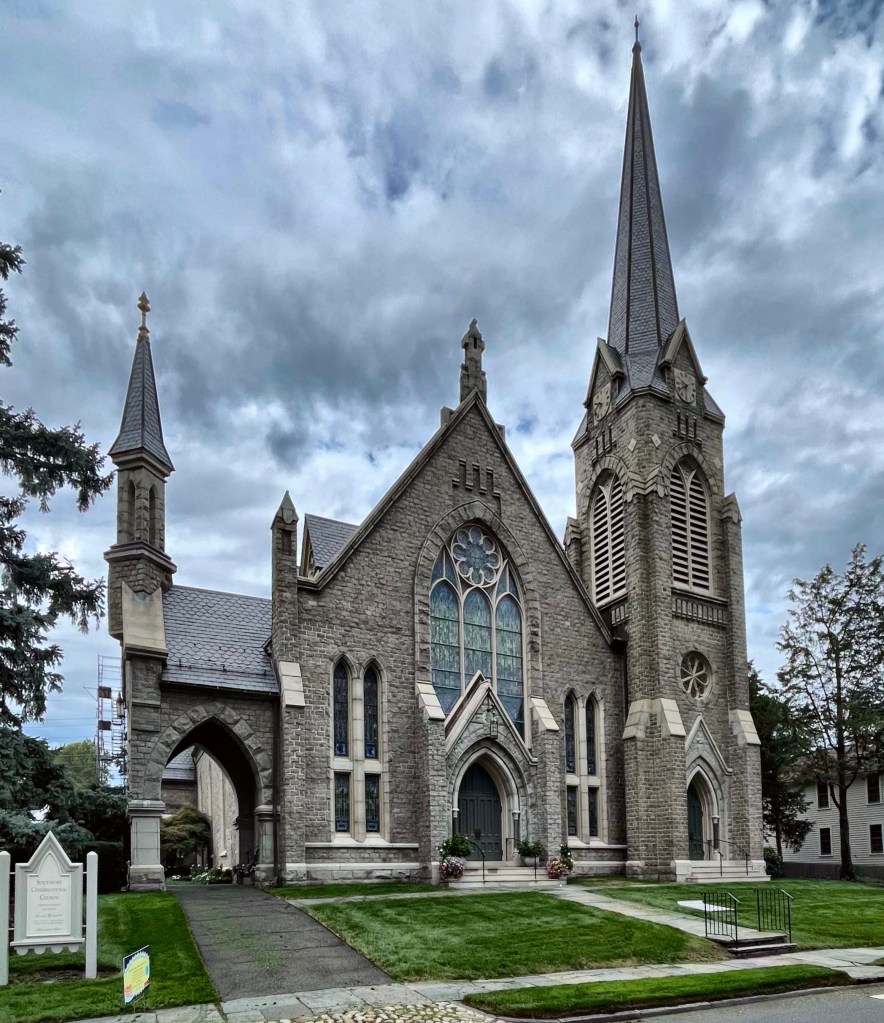
First Reformed Church, Schenectady // 1863

The First Reformed Church of Schenectady is the oldest congregation in the city. Founded by Dutch settlers, Schenectady’s first colonists, the first church lasted over a decade until it burned in the Schenectady Massacre in 1690, when a party of more than 200 French and allied Mohawk warriors attacked the unguarded community of Schenectady, destroying most of the homes, and killing or capturing most of its inhabitants. Sixty residents were killed, including 11 enslaved Africans. An expanding congregation after, outgrew its second and third buildings, replacing them with larger structures. The fourth was lost in Schenectady’s Great Fire of 1861, causing yet another building campaign. The present church building, an architectural landmark in Gothic design, was completed by the highly regarded Victorian-gothic architect Edward Tuckerman Potter in 1863. Potter is also known for his designs of the Nott Memorial Building (previously featured), in Schenectady, and Mark Twain’s home in Hartford, CT. A fire in the church gutted it in 1948, but the community at large banded together to fund the restoration efforts of the amazing architectural landmark.

Nott Memorial Hall // 1858

The 16-sided Nott Memorial Hall is one of America’s most dramatic High Victorian buildings, is the centerpiece of the Union College campus (and a major reason for my stop in Schenectady when driving through New York). Union was the first non-denominational institution of higher education in the United States, and the second college established in the State of New York. Eliphalet Nott became college president in 1804, and envisioned an expanding campus to accommodate a growing school. In 1806 a large tract of land was acquired to the east of the Downtown Schenectady, on a gentle slope up from the Mohawk River. In 1812 French architect Joseph-Jacques Ramée, equally skilled in landscapes and structures, was then hired to draw up a comprehensive plan for the new campus. Ramée worked on drawings for about a year, and construction of two of the college buildings proceeded quickly enough to permit occupation in 1814. The Union College campus thus became the first comprehensively planned college campus in the United States! As part of Remee’s plan for the campus, a round, Neo-Classic “pantheon” building was proposed at the center of campus (a prescendent for Thomas Jefferson’s plans for the University of Virginia just four years later). The building never materialized in Unions early days. Construction finally began on the building in 1858, based on designs by Edward Tuckerman Potter, grandson of President Nott, but apparently took nearly 20 years to complete due to the Civil War and funding issues. The Nott Memorial as completed, is 89 feet in diameter and capped with a ribbed dome. The dome is sprinkled with 709 small colored glass windows, making it one of the finest buildings on a college campus in the United States!

St. Andrews-by-the-Sea // 1876

In the mid-to-late 1800’s, Rye Beach on the coast of New Hampshire was a popular summer residences for wealthy families from New York, St. Louis, Chicago, and other mid-western cities. Church services were important to these summer residents who united together to build this chapel, which before its construction, had to go to services at the casino in the colony (not ideal). Generally, wealthy summer residents here brought their household staffs, who lived in the many hotels and boarding houses along the beach. Some of these servants and employees of the hotels were African-Americans, who used St. Andrew’s for their own worship services and meetings. The summer chapel was built in 1876, completed that next year and is one of the most stunning chapels I have seen in New England. St. Andrew’s was designed by the architectural firm of Winslow and Wetherell. It is a unique example of a small rural stone chapel embellished by wooden trim and owes much to both the Stick and late Gothic styles. English country parish churches clearly inspired the chapel’s design and the use of rubblestone construction (likely of stones that were taken from the site) makes the building pop! Oh and that rose window at the facade!

Tower Cottage // c.1880

Located in the Foss Beach section of Rye, NH, this Victorian summer cottage stands out among the later new construction of lesser detailed and quality late 20th century homes seen here lately. The home, known as “Tower Cottage” was built at the end of the 19th century and exhibits Victorian Gothic elements with a massive center tower. The steep wood shingle roof is punctuated by two rows of delicate dormers which add detail and views to the ocean. The massive wrap-around porch is also a must for such a prime location fronting the Atlantic Ocean!

St. Michael’s Episcopal Church // 1860

While I love the quintessential white, wood-frame New England churches that proliferate the region, the stone, Gothic churches always make me stop in my tracks; and this example in Bristol is no exception! St. Michael’s parish was founded in 1718 as one of the Rhode Island’s four colonial churches, funded and overseen from London. The first church, built in 1720, was ironically later burned during a British raid in 1778. It was replaced in 1785 by a plain wooden meetinghouse with funds from local residents and partitioners. In 1833, it was replaced by a wood-frame Gothic church which burned in 1858. Undeterred, the church hired New York City architects Alexander Saeltzer and Lawrence B. Valk, who designed the present brownstone Gothic Revival church. Just over a decade later, the church hired Worcester architect Stephen C. Earle, to design a chapel and parish house, across the street. The chapel building follows the Gothic Revival style, but with more Victorian flair, and is also constructed of brownstone to compliment the church. Together, the two structures transport you to the English countryside with their design and presence on the main street in town. What do you think of them?

“Seven Oaks” // 1873

When strolling around Bristol, Rhode Island, you are overloaded with gorgeous early 19th century house styles, primarily in the Federal and Greek Revival styles. Among these, one house (or should I say mansion) stands out as a flamboyant Victorian Gothic showpiece at the southern end of the downtown area. Built in 1873 for Augustus O. Bourn (1834-1925), the founder of the National Rubber Company (and from 1883 to 1885 governor of Rhode Island), “Seven Oaks” could go toe-to-toe with any house in the state. Bourn’s architect was James Renwick of New York, one of the most celebrated architects of his time. Before designing Seven Oaks, Renwick’s resume included: Smithsonian Institution Building, Washington, D.C.; St. Patrick’s Cathedral, New York City; and the Renwick Gallery, Washington, D.C.. Seven Oaks is a large, hip-and-cross-gable-roof Victorian Gothic mansion constructed of stone, with multiple towers and a slate roof capped with iron cresting.

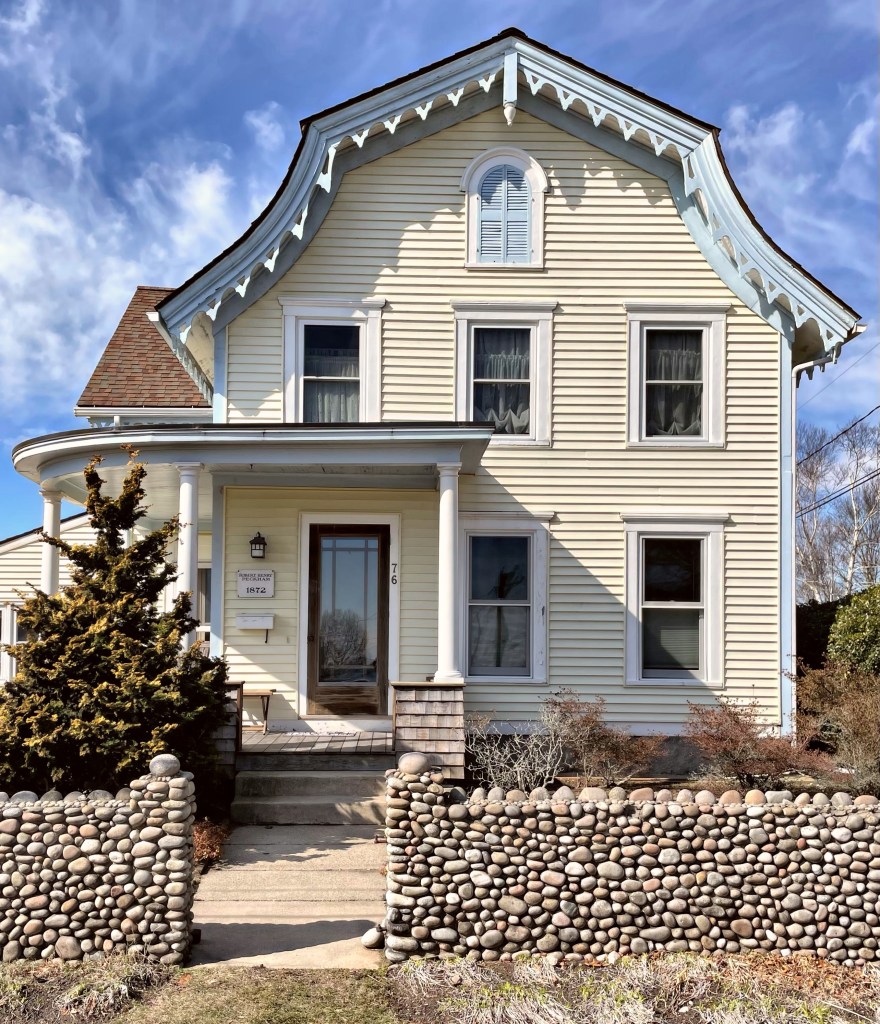
Parmelee House // c.1879

Located on the east side of the Town Common in Newport, NH, the Parmelee house stands out as a unique vernacular Stick style home. The home was built for Joseph Warren Parmelee (1818-1892), the grandson of original settlers of town, Captain Ezra Parmelee and Sybil Hill. He began his adult life as a merchant in Newport, before moving south to Charlestown, South Carolina in 1847. Joseph was forced back north at the beginning of the Civil War, and he lived in New York City until he finally relocated back to his hometown in 1879, which is likely when he built this home for his family. Upon returning, he became active in town affairs, and also pursued interests in history and poetry, creating a book of poems from his home. The Parmelee house retains much of its original detailing from the decorative bargeboards at the gable ends, large eyebrow window hoods at the second floor, and the interesting trapezoidal roof, possibly a vernacular nod to a mansard roof.

Moses Bulkley House // 1861

Constructed in 1861, this Victorian Gothic mansion in Southport, Connecticut, stands out amongst the many Classically inspired homes nearby. Designed by Bridgeport architects Lambert & Bunnell for Moses Bulkley (1796-1868), the house is designed on a cruciform plan, synonymous with the Gothic style. Expansive pointed gables trimmed with a gingerbread bargeboards, pointed arched windows, ogee arches trimmed with jigsaw tracery on the verandah, and a tall square tower topped with a steeply-pitched pyramidal roof are all seen in this beauty. If only it had a historically appropriate paint scheme to really make those details pop!

Unity Church of North Easton // 1875

The Unity Church of North Easton, Massachusetts looks like it could stand toe-to-toe architecturally with the large churches in major American cities. The church was a gift to the Unitarian Society in town, by Oliver Ames II, who hired renowned Gothic architect Henry Vaughan to design a chapel, worthy of the town’s wealth. The church contains various tablets and memorials to the Ames Family, with stunning stained glass windows by John LaFarge, recently restored by the church! Behind the grounds is the cemetery where many of the Ames family members are buried.

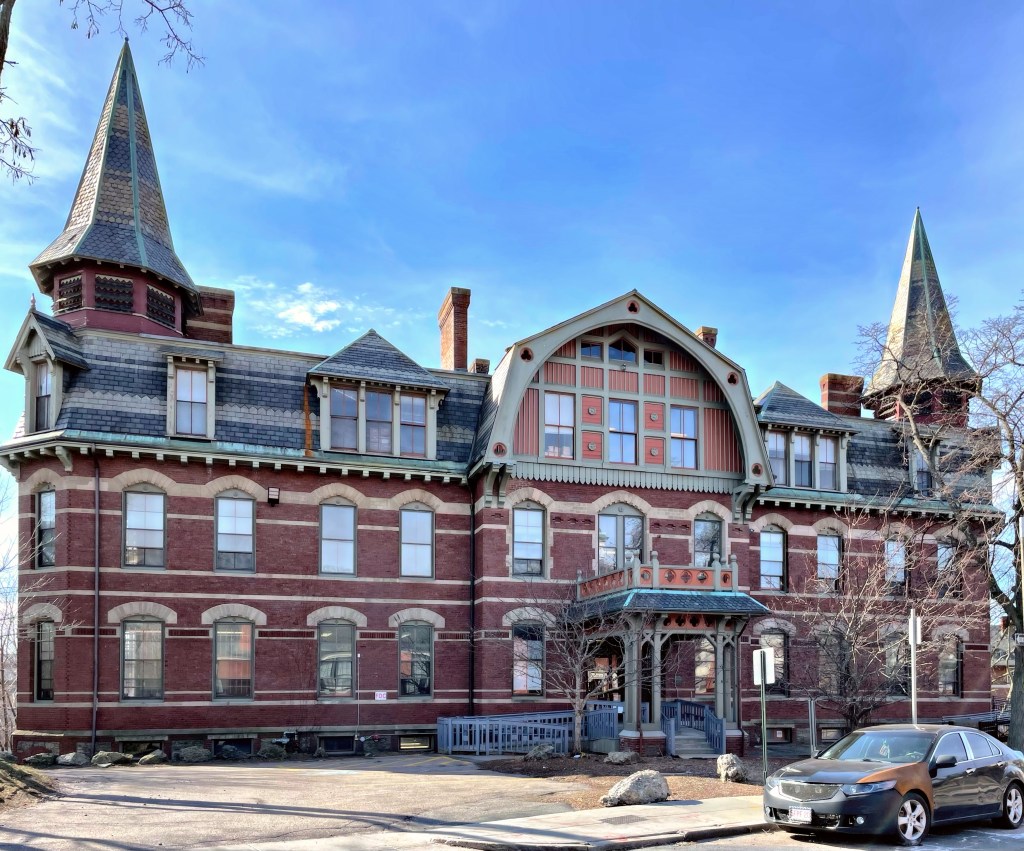
Jewett Apartments // 1882

For middle-class families in North Adams, some residents could afford to move out of workers housing but not yet afford single-family homes, the best option was for apartments. Seeing the demand for this housing type increase with the booming industrial development in town, businessman and real estate developer, Martin Crafts Jewett developed some of his land with a luxurious apartment building. This six-unit building has beautiful poly-chrome brickwork and corbeled chimneys, mansard roof with wall dormers, and flared turrets, typical of its architect, Marcus F. Cummings who also designed the Blackinton Mansion (now North Adams Public Library).