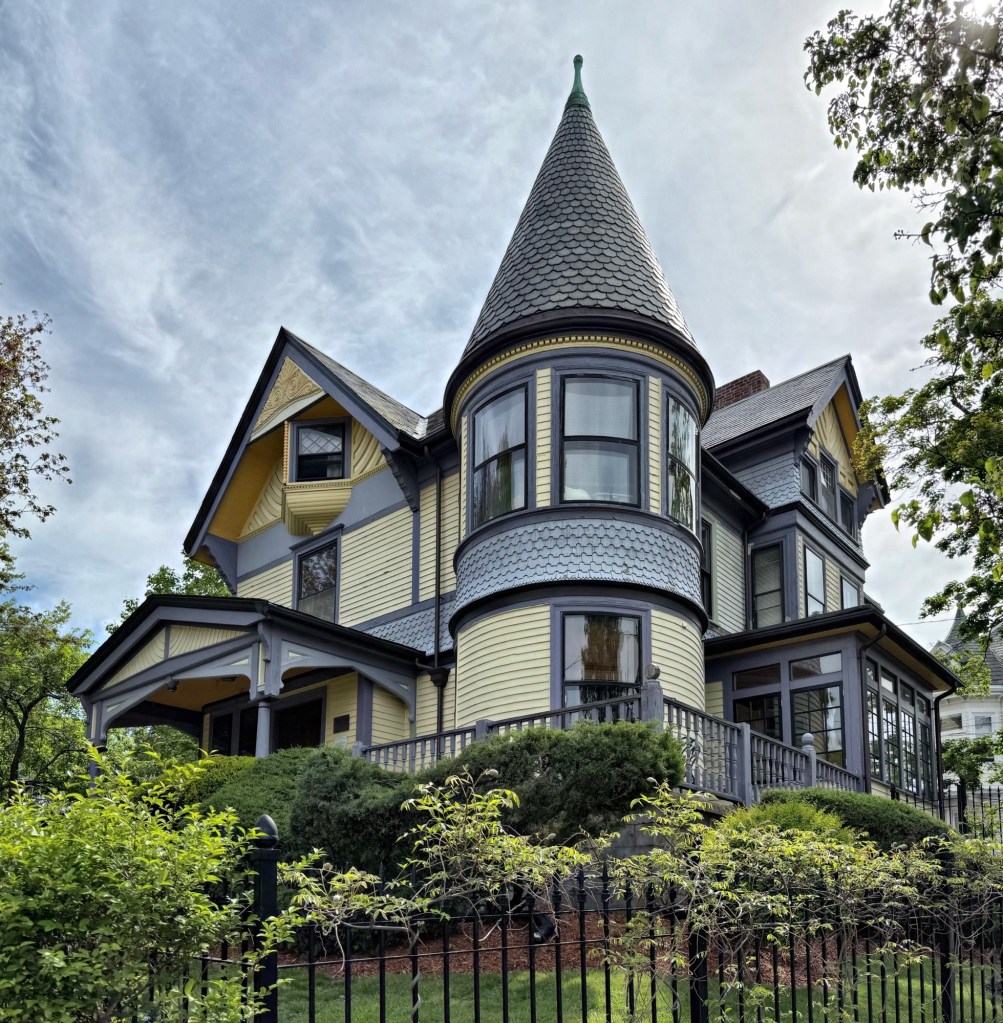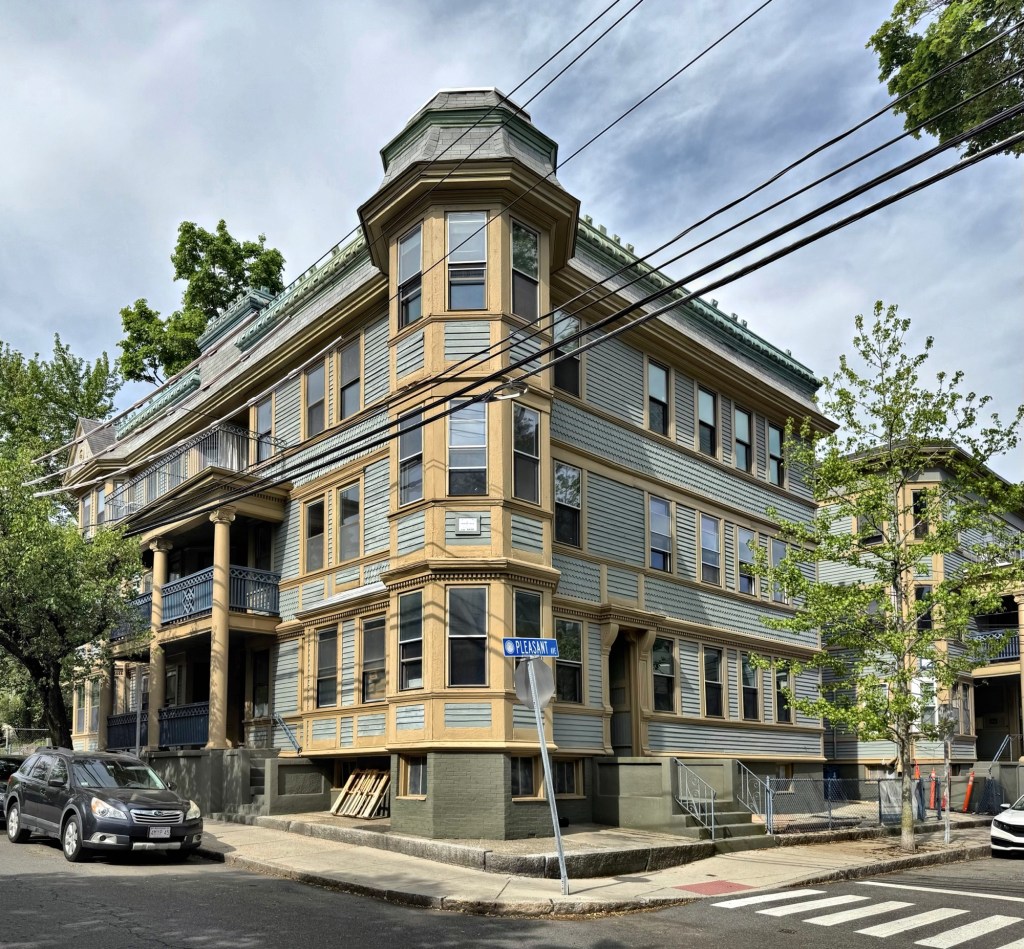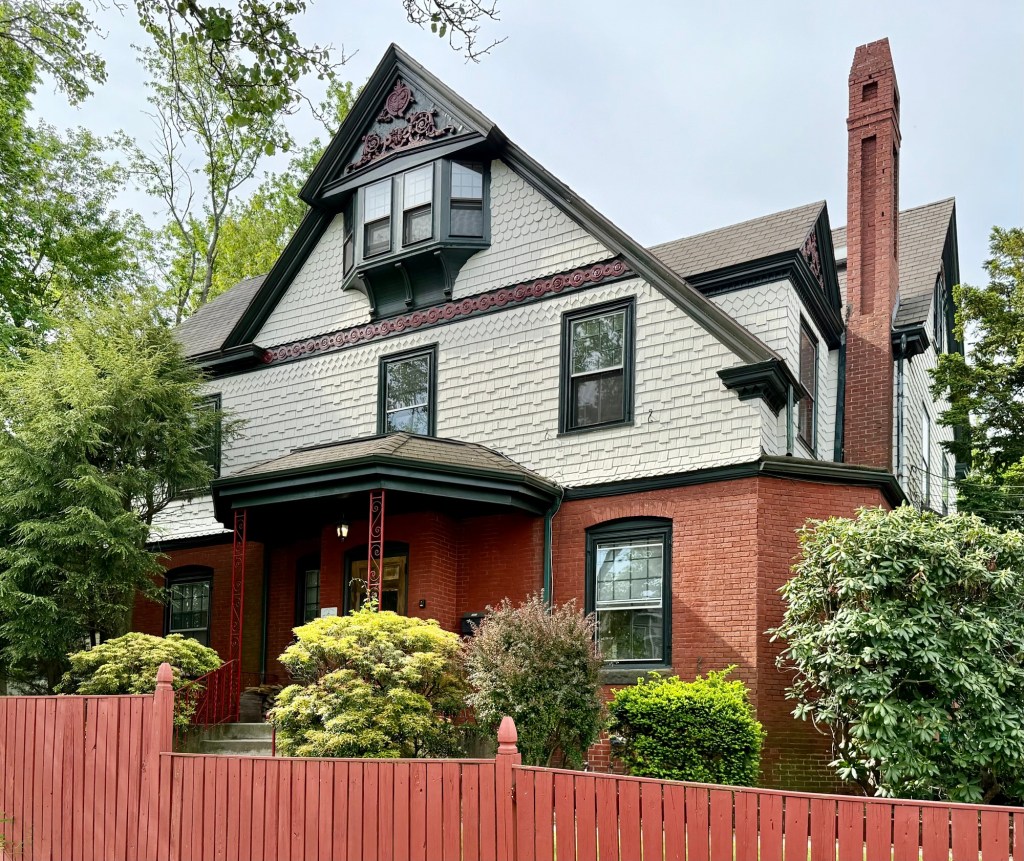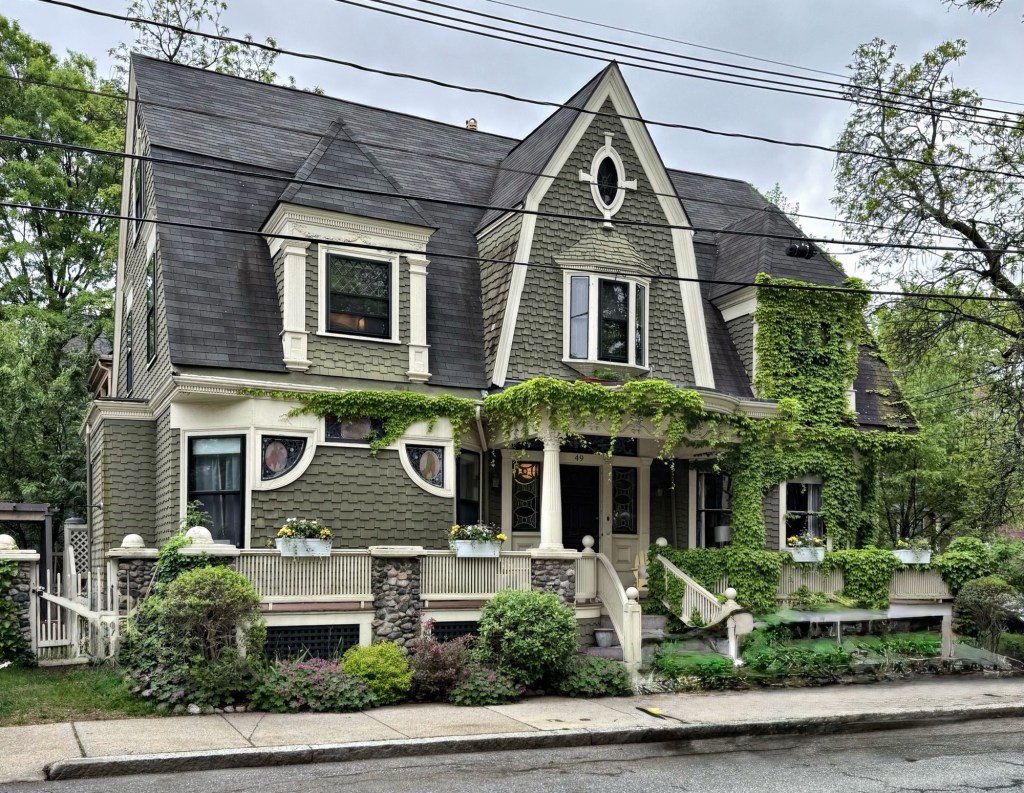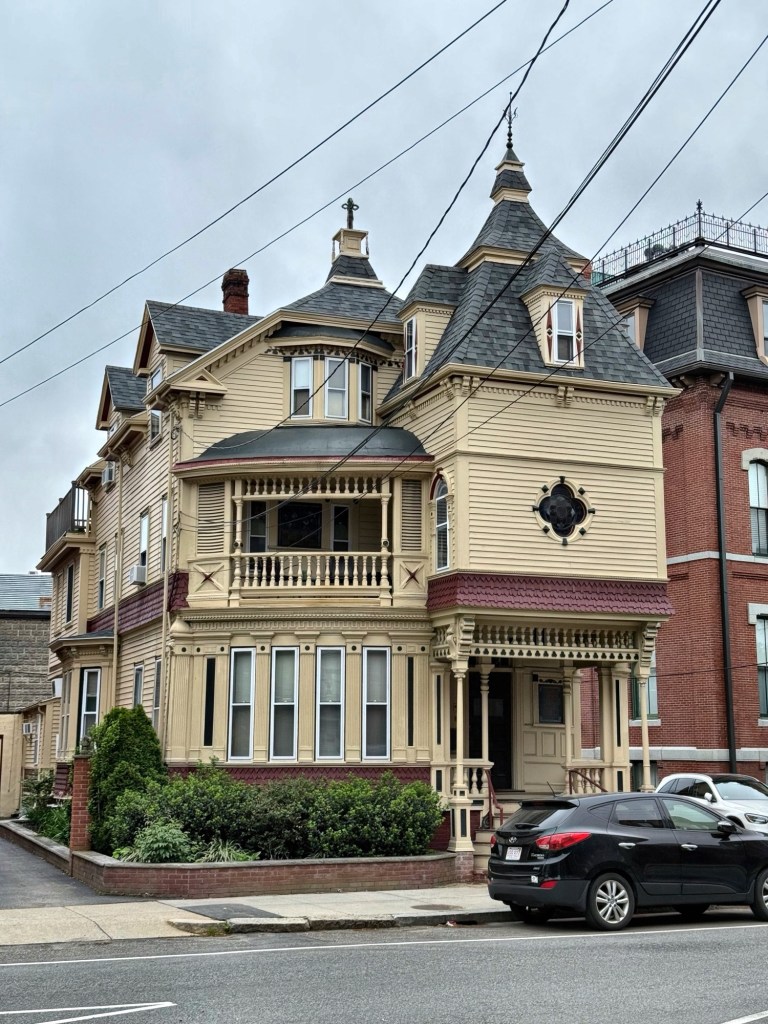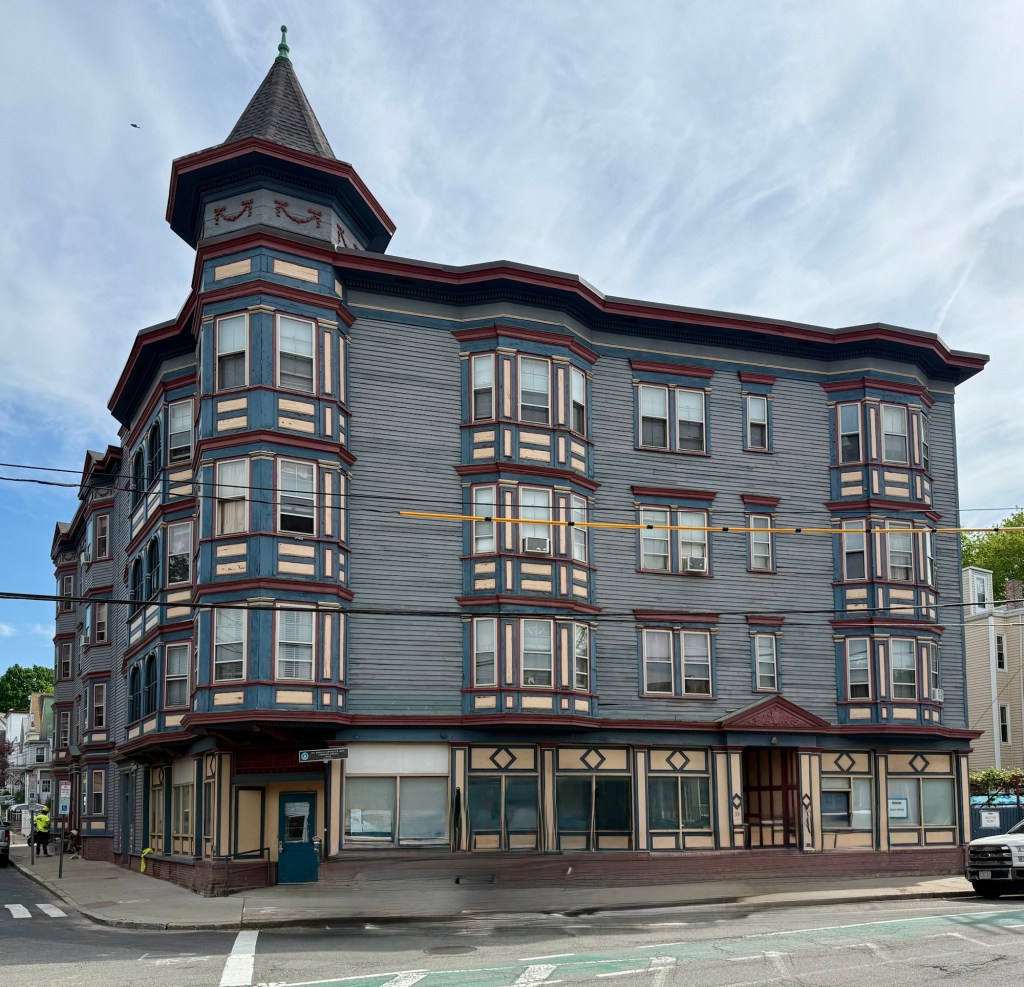
These two stunning apartment buildings were constructed in the early 1890s in the Prospect Hill neighborhood of Somerville. Known as the Hollander Blocks after their original owner, Theodore Clarence Hollander, the two apartment buildings are some of the finest in the Boston suburbs. Both detached buildings follow a traditional three-decker block massing and form, but are decorated with varied siding, two-story columned porticos, and elaborate cornice.
This charming, gambrel-roofed house at the corner of Vinal and Pleasant avenues in Somerville, Massachusetts, was built in 1894 from local developer H. W. P. Colson, and sold upon completion to Mrs. Laura (French) Haley. An architect could not be located. Laura Haley was recently widowed and lived in the house with her daughter, with her son purchasing the house next door. The Haley House is notable for its gambrel roof with gambrelled center gable, pilastered dormers, stained glass windows, and full-length porch with columns and rubblestone base. The well-preserved house blends Queen Anne and Colonial Revival styles under one broad roof. It is magnificent!
One of the most eccentric and architecturally unique houses in Somerville can be found on Bow Street, in the middle of the busiest commercial district of the city. This is the Dr. Edson F. Whitman House (often known as the E.C. Mann House), which was built around 1852 and long-occupied by Dr. Whitman until just before his death in 1900. The house was likely a modest, 1850s Italianate style residence with its gable facing the street. Over time, as business increased, Dr. Whitman expanded his house and practice, adding Victorian flair to the once usual house. An entry tower with pyramidal roof and final was added with quatrefoil window and Stick style porch, an angled two-story addition was also added to the facade with a second-story porch, and applied ornament and curiosities were added to the doctor’s office and residence through the 19th century. Luckily for us, the Dr. Whitman house has remained relatively unaltered for the next 125 years!
The Richmond Block on Bow Street in Union Square, Somerville, is a historic and architecturally significant mixed use building. Constructed in 1892 as one of the substantial wood-frame buildings in the western section of Union Square, the Richmond was designed by architect Aaron Gould for Mr. Charles Drouet, who developed the Drouet Block, a historic flatiron building just years later. Designed in the Queen Anne style, this building is noteworthy for its corner tower, octagonal oriel bay windows, sleeping porches on the side facade, and polychromatic color scheme to highlight the many architectural details on the block.
One of the most beloved houses in Somerville, Massachusetts is this beauty on Highland Avenue, known best for the unique assemblage of colorful found objects in the front yard, as a living museum. The residence was built in 1893 for William Y. Wadleigh, a wholesale grocer who operated markets all over the region. The house is an eclectic blending of Queen Anne and Colonial Revival styles with an asymmetrical plan and rounded corner tower taken from Victorian styles, along with a classical porch and swan’s neck pedimented dormers at the roof, clearly Colonial Revival in style. Today, the Wadleigh House is best-known for its owner, artist Martha Friend, who has preserved the house, and created an enchanting, ever-evolving installation outside and inside the residence. Sapphire City, an installation in the front yard, draws passersby in to see the assemblage of blue bottles and Dance Party, an assortment of animals at the porch roof, make the house a favorite in the neighborhood. It is houses and owners like this that make Somerville such a vibrant and great place to live and explore.
This lovely Queen Anne style home can be found on Highland Avenue in Somerville, Massachusetts. Built around 1890, the residence was built for Walter Saunders Barnes (1838-1931), a manufacturer with a paper box business in Boston. The property was sold in 1903 to Robert Luce (1862-1946), a prominent businessman and politician who founded the Luce’s Press Clipping Bureau before he was elected a member of the Massachusetts House of Representatives in 1899 and 1901–1908. He was elected the 42nd lieutenant governor of Massachusetts in 1912. After serving as Lt. Governor, Luce would spend the next decades in the House of Representatives. His Somerville house is a well-preserved example of the Queen Anne style and includes a steeply pitched hipped roof with gable and dormers, asymmetrical plan, porch with braced supports, and a half-round window in the gable.
The George F. Loring Houseon Highland Avenue in Somerville, Massachusetts, is an architect-designed house designed as the architect’s personal residence. While the architect specialized in the Richardsonian Romanesque and Colonial Revival styles, for his own home, George Loring crafted a free interpretation of seventeenth-century medieval architecture with a brick first story and upper floors overhanging and sheathed in cedar shingles. Loring trained in the office of Boston City Architect, George A. Clough, before establishing his own practice. By 1895, when he constructed this residence on Highland Avenue, Loring was in partnership with Sanford Phipps, specializing in the design of large single-family homes in the Boston metropolitan area.
In the mid-1880s, John Wales, a wealthy hardware dealer with offices in Downtown Boston, purchased house lots in the Cottage Farm area of Brookline from Amos A. Lawrence, and set out develop the site with two stately Victorian homes. This lovely home was first occupied by John’s son, George Wales and his wife, Mabel, the year of their marriage in 1885. While the architect is unclear, it is probable that the design can be attributed to architect William Whitney Lewis, who was hired by John Wales the year prior to design a stable near his home in an adjacent neighborhood. The house was rented by Wales and subsequent owners for years. The elaborate Queen Anne style house exhibits an asymmetrical plan with recessed entrance set within an arched opening, shinged and brick walls with a prominent chimney at the facade containing a decorative terra cotta panel, and the most unique stucco gables containing what appear to be terracotta balls in geometric forms. This house is a perfect example of what is so special about the Queen Anne style!
One of five houses built by developer Albert Jewell along Powell Street in the Cottage Farm neighborhood of Brookline, this residence stands out for its materiality and stately design. The house was designed by J. Williams Beal, an architect who trained at Massachusetts Institute of Technology and then worked for McKim, Mead & White before opening his own business. The house was first purchased from Mr. Jewell by Grace and Edwin Kramer, who worked as superintendent for R. H. White & Co., the large dry goods store in Boston. The next long-term owner was Harry B. Duane, a wealthy grocer. The Kramer-Duane House is unique for the stone veneer at its facade, gambrel roof covered in slate, and varied window styles including: bay windows, dormer windows, and an eyebrow dormer window at the roof.