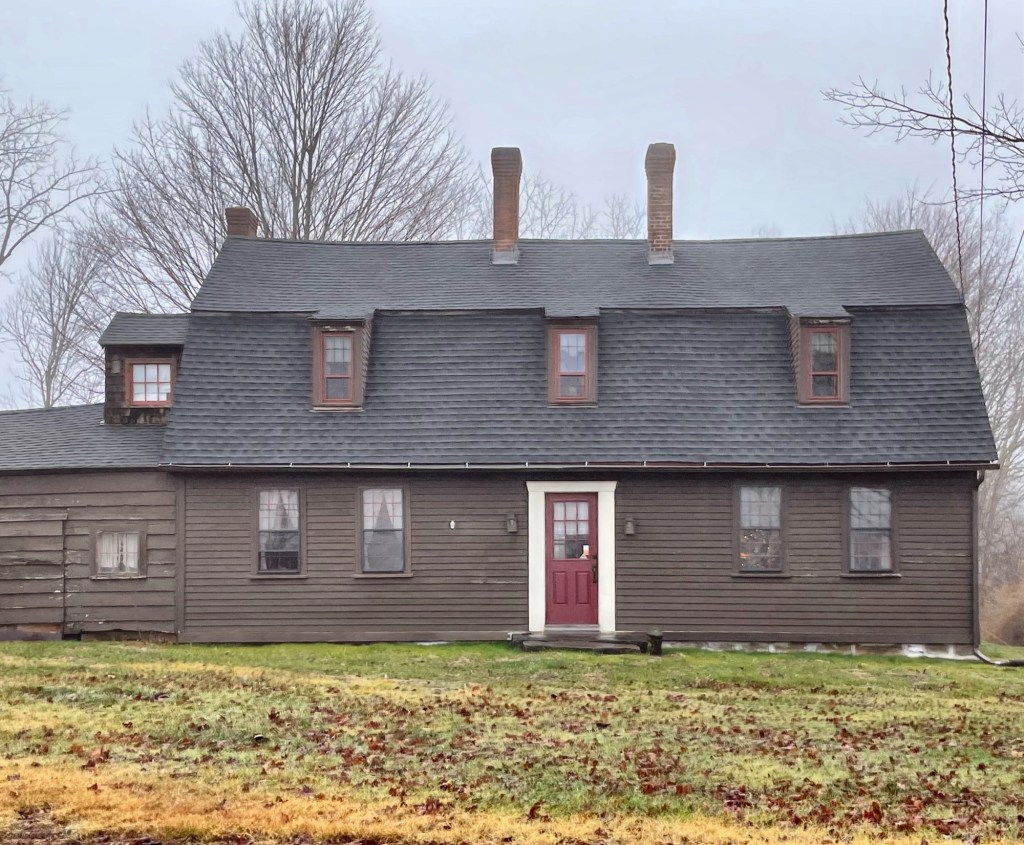
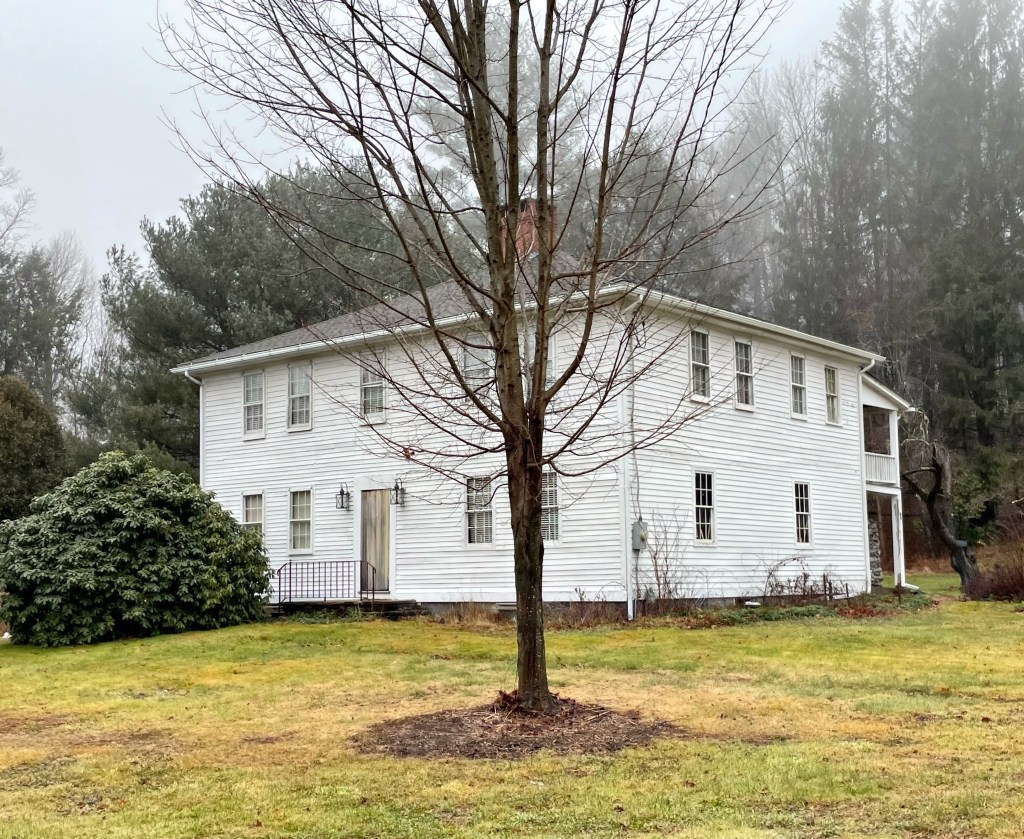
Known locally as the ‘Ye Olde Manse‘, this stunning Georgian cape house is located at the eastern edge of the town green in Willington, Connecticut. Thought to be the oldest extant house in the small, rural community, the gambrel-roofed homestead was possibly built by John Watson of Hartford, who was thought to have been an original proprietor of Willington, but was instead an assignee of George Clark who was. In the 19th century, the homestead operated as the congregational church parsonage. Today, the Georgian cape house with gambrel and saltbox roof is a single family home and has been lovingly preserved by centuries of stewards of this old manse.
Located in northern Willington, CT, this farmhouse on a quiet, country road, dates to before the Revolutionary War! David Lillibridge (1744-1831) of Exeter, Rhode Island, served from 15 to 17 in the French and Indian War, and manned Fort Stanwix. In 1767, when he was a lieutenant in his local militia, he converted, and entered the Baptist ministry. In 1777, he purchased a farm from Moses Holmes, but it is unclear if this residence was existing or if he built this large farmhouse. In Willington, David Lillibridge became a farmer-preacher, establishing a Baptist ministry here. The home remained in the Lillibridge family at least until the 1870s, when it was owned by Burnham Lillibridge. The Georgian saltbox residence is set back from the street and sits upon the bucolic rolling fields of the property.
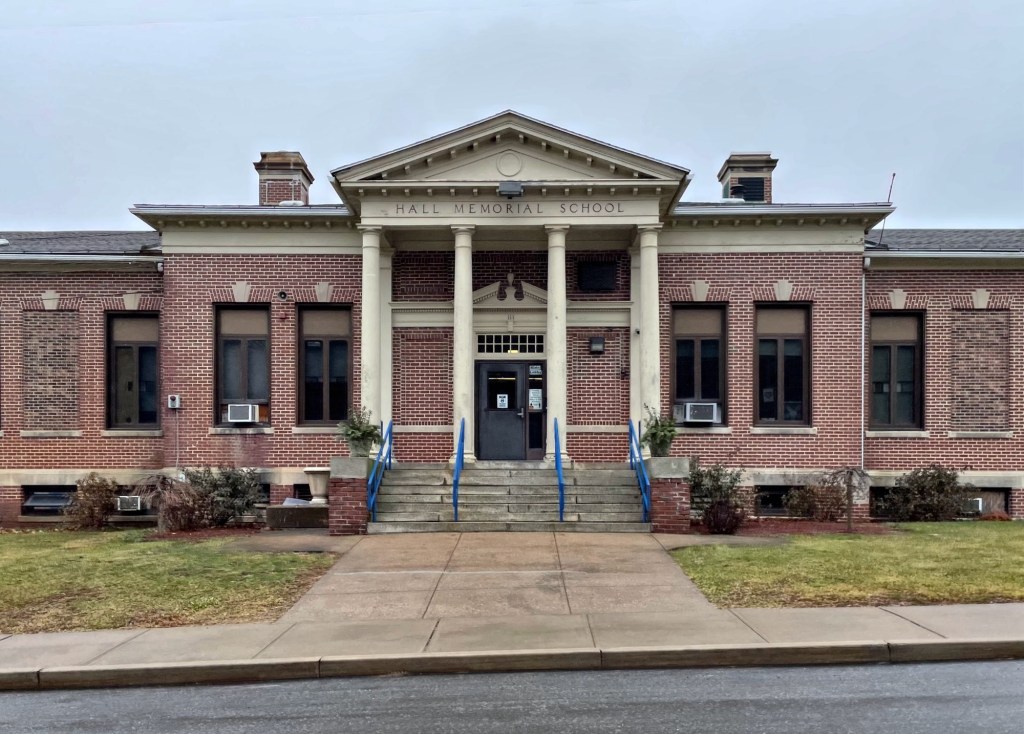
Located in South Willington, Connecticut, this Colonial Revival style school building was built to serve the mill village pupils, many of whom were first- and second-generation Americans who immigrated to the area to work at the local mill. In his will, William Henry Hall (1867-1922), the son of industrialist Gardiner Hall Jr., who established the business under his name, donated funds to the community to erect a new, suitable school building for the village. Beyond his work at his family’s business, William H. Hall served in the Connecticut House of Representatives in 1893–1897 and again in 1905, 1909, and 1911, and he was generous with his money throughout his life and in his will. For the Hall Memorial School, his heirs selected architect, Harry L. Sprague of Springfield, Massachusetts, who designed the one-story school built of brick and limestone trim and a tall, pedimented portico at the entry supported by four tuscan columns. The school has seen additions, but it retains much of its architectural integrity in the over 100 years of use as a public school.
Located between his family factory and the memorial church built for his late sister, the William H. Hall House in South Willington, Connecticut, is among the community’s finest Victorian residences built for a wealthy industrialist. William Henry Hall (1867-1922) was the son of industrialist Gardiner Hall Jr., who established the business under his name, which manufactured thread and spools, hiring hundreds of employees. After the death of his father, William Hall became the head of the company, but clearly was successful long before this as he had this stately Queen Anne style mansion built in 1896. Beyond his work at his family’s business, William H. Hall served in the Connecticut House of Representatives in 1893–1897 and again in 1905, 1909, and 1911, and he was generous with his money throughout his life and in his will. Hall served on the board of trustees of his alma mater, Wesleyan University, from 1912 until his death, with his estate donating $175,000 to Wesleyan to construct a chemical laboratory named in his honor. Closer to his home, his heirs partially funded the the Hall Memorial School in South Willington in his honor. The property remained in the family after his death, and in the 1980s, it became an assisted living facility, with large additions constructed, but the Hall House remains a great architectural landmark for the mill village.
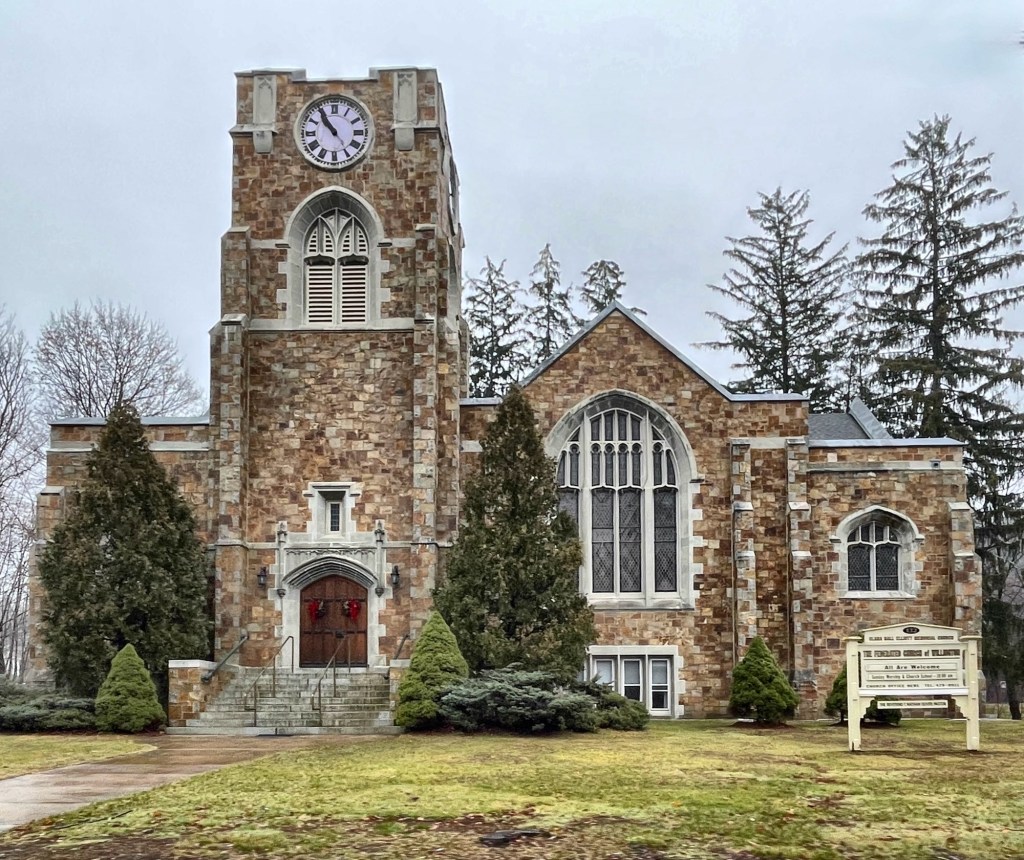
This handsome stone church in South Willington, Connecticut, was commissioned in 1909 by Gardiner Hall Jr., a terminally ill industrialist, in memory of his late daughter Clara, who tragically died in 1899 at the age of 30. The church was used by area residents, many of which included mill workers hired to work at Mr. Hall’s factory nearby and lived in mill housing just behind this church. Following the construction of this Memorial Church in South Willington, Baptist and Congregational Churches of Willington merged to form the Federated Church of Willington, which has worshiped at this location ever since. Neo-Gothic Revival in style, the church is constructed of multicolored random ashlar sandstone with limestone trim and features a corner clock tower with belfry, buttresses, stained glass windows, and limestone tracery. The church was designed by Boston architect, Thomas Marriott James and was completed by 1911.
In 1860, Gardiner Hall Jr. (1839-1915) founded a spool cotton thread business called the Hall & Manning Company, and later renamed the Hall Thread Company. The new business failed in a year with the onset of the Civil War and the accompanying shortage of cotton. During the war, in 1861, Hall designed and patented a machine for finishing thread and moved to South Willington, Connecticut, founding the Gardiner Hall Jr. Company. He had a three-story mill building constructed around 1862 where his small operation took off. In the following decades, the factory complex expanded rapidly, and machine, blacksmith, and bleach and dye shops were built on the property to increase production. Coinciding with this growth, Gardiner Hall built tenements, a boarding house and a community building for his growing workforce in the 1870s nearby. Before his death in 1915, Hall donated funds to erect a memorial church in memory of his daughter, and donated generously to his workers. His son, William Henry took over operations and was succeeded by his sister, Rosa Hall, until the factory closed in 1954. The industrial buildings were used for decades from various manufacturing companies and today are occupied by retail stores, a tattoo parlor, and event space, perfect adaptive reuse!
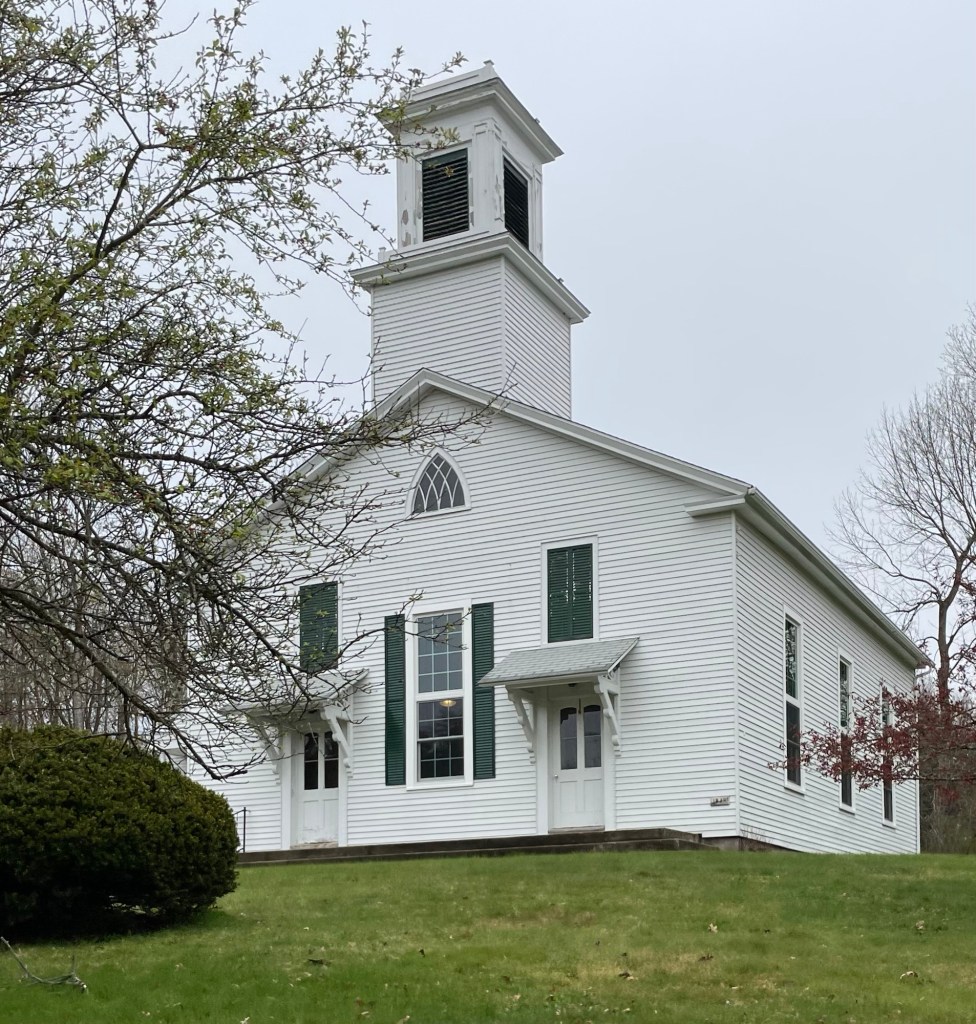
The small town of Union, Connecticut was established in 1734 and as with many towns at the time, religion and community were some of the first things to be codified when settling in a new area. The town’s publicly supported religion, Congregationalism permeated everyday life in Union. Even after disestablishment in 1818, the Congregational church continued as Union’s predominant religious organization well into the twentieth century. By 1841, the members built this edifice, the congregations second, on a hill overlooking the town’s modest green. The vernacular church features a Gothic lancet window, classical belfry, and later pent roof porches over the entrances on the primary facade.
Union, Connecticut is the smallest (by population) town in the state and it was the last Connecticut town east of the Connecticut River to be settled, largely because of its rough terrain and poor soil. The small town of under 800 residents was incorporated in 1734 and named Union, likely named after the fact that the new town was formed of a “union” of different sections of land which were left over when the boundaries of surrounding towns, though it is still speculation. Union erected this Town Hall building in 1847 which was fitting for the town’s small (and then-declining) population at the time. The one-story clapboard building is vernacular and lacks much adornment of other town halls and institutional buildings of the time period in nearby towns. Eventually, the town built a new city offices building and the small town continues to maintain the former building to this day and it houses the Union Historical Society.
Located on Tolland Turnpike in Willington, east of the Town Common, this temple-front Greek Revival home stands in an excellent state of preservation. The home was built for General Orrin Holt (1792-1855) in about 1840 after his work as a member of the Connecticut State House of Representatives 1830–1832, and in the Connecticut Senate in 1835 and 1836. He was re-elected as a Democrat to the Twenty-fifth Congress, serving until 1839. After leaving Congress, he served as Inspector General of the Connecticut State Militia, until his death in 1855. He likely built this home after leaving Congress in 1839, in his hometown. There is something about a temple-front home like this, they are so stately!
The Daniel Glazier Tavern is located at the west end of the Willington Green, an area showcasing great vernacular examples of Federal and Greek Revival architecture. The tavern was apparently built by Daniel Glazier as a stop along the route connecting Norwich, CT to Springfield, MA, where visitors could grab a bite to eat and/or stay the night to rest. Daniel’s son Isaac was the first tavern-keeper, followed by Daniel’s son-in-law Arial Eldridge until his death in 1849. The ballroom of the tavern had long been used in the winter months for town meetings, as he basement of the Town Meetinghouse, used for town meetings, lacked any form of heat. Since 2009, the property has been owned by the Willington Historical Society, who have restored the building.





 Buildings of New England