Brook Farm // 1894

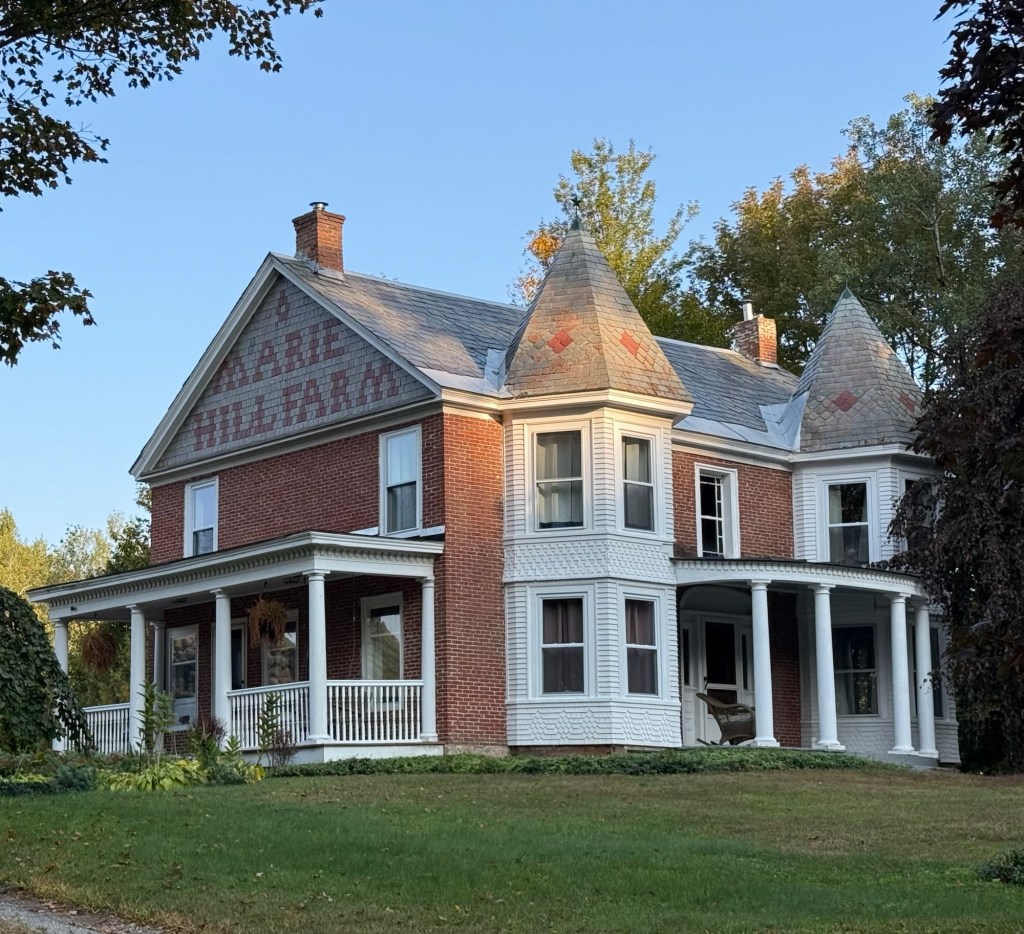
By the late 1800s, Vermonters had left the state in high numbers as agriculture began to sharply decline as a career path in New England, with many leaving to urban centers and manufacturing towns. Vermont politicians responded to the de-population with initiatives to encourage the redevelopment of existing farms by seasonal residents with money who could summer there to escape the hustle and bustle (and dirty air) of urban centers. Towns threw events like “Old Home” days with activities to entice affluent family members to return home and bring their money with them. After 1850, railroads made it easier for urban families to trade the heat and congestion of the city for the beauty of Vermont. One of these wealthy expats was James Hale Bates (1826-1901), who was born in Cavendish, Vermont, and moved to New York and worked in advertising, operating a major firm there. He retired in 1895, after the completion of Brook Farm one year earlier, a gentleman’s farm that he had built in his ancestral hometown of Cavendish. This massive Colonial Revival mansion was the centerpiece among sweeping fields and orchards contained by rustic stone walls. It is believed that Vermont architect, Clinton Smith, designed the estate house and many of the out-buildings on the site from the carriage and cow barns to the caretaker’s house and creamery. In recent years, the estate was operated as a vineyard, but it appears to be closed now. This is one of the hidden gems of Vermont and one of the most stunning Colonial Revival homes I have seen!

Atherton Farmstead // c.1840

This beautiful farmhouse in Cavendish, Vermont is located along a winding dirt road and has ties to one of the town’s original family’s. A home was built here in 1785 and changed hands numerously over the first few decades of its existence. The farmhouse that was built also served as a tavern for travellers along the newly laid out Wethersfield Turnpike. It is possible that the cheap land and rural character of the new town was appealing to some, but reality away from true commerce may have made many sell the farm after a few years, which could explain why the property was bought and sold so often early on. The property was purchased by Jonathan Atherton, a Revolutionary War veteran, farmer, surveyor and lawyer, who acquired large landholdings in Cavendish. In 1821, Jonathan Atherton was sued in court by his neighbor, Jedediah Tuttle for beating Tuttle’s wife Lydia. In order to finance the bonds, Atherton mortgaged all his real estate in Cavendish to his brother Joseph, and Elihu Ives, Jonathan Atherton Jr.’s father-in-law. Atherton St. lost the case and had to pay a fine. The property was eventually inherited by Stedman Atherton, the youngest son of Jonathan, who seems to have demolished the old homestead and constructed the present home on the site. The original dwelling was also the childhood home of Henry B. Atherton, a staunch abolitionist and soldier in the American Civil War, who later served as a lawyer and state legislator for New Hampshire, and his sister Eliza (Atherton) Aiken, a Civil War nurse who has been referred to as America’s own “Florence Nightingale”. The old Atherton farmstead was recently renovated.

Glimmerstone // 1845

What a treat it was to stumble upon one of the most beautiful homes in Vermont, and all the best houses have names! Glimmerstone is located in the small town of Cavendish, and is possibly the finest Snecked Ashlar constructed home in the state. The house was built in 1845 for Henry Fullerton, manager of the Black River Manufacturing and Canal Company mill in Cavendish. The stone used to build the house was quarried less than a mile away, and hauled to the site. The construction style consists of stone facing on either side of rubble fill, with slabs and snecks sometimes laid across the fill to provide strength, a method brought to the region by Scottish immigrant masons. The house’s design is by a local carpenter, Lucius Paige, and is based on designs published by Andrew Jackson Downing, who depicted many Gothic style designs in pattern books which were built all over the country. The house has had a number of owners after Mr. Fullerton died. During the prohibition era, Art Hadley, who would later become extremely wealthy as the inventor of the expansion bracelet, used the home as part of a rum running operation. Glimmerstone was purchased in 2010 by the current owners, who underwent a massive restoration of the home, converting it into a bed and breakfast, allowing the public to experience the property as well.

Joshua Parker Farmhouse // 1850

This house in Cavendish was constructed in 1850 by Joshua Parker and is an outstanding example of a gothicized snecked ashlar house. The house is in the Cape form and largely exhibits a more traditional cottage layout, but with the steep gable dormer, giving the home a distinctive Gothic feeling. The 1850 home replaced a late 18th century farmhouse, but in the iconic snecked ashlar construction. The farm grew over the subsequent decades, including a c.1900 snecked ashlar barn (not pictured), which is probably the last building of “Snecked Ashlar” construction erected in the State of Vermont.


James Spaulding House // c.1840

This Greek Revival cape house in Cavendish, Vermont sits along a rural road and is one of the few dozen examples of Snecked Ashlar buildings in this part of the state. In the early 1830s, skilled masons from Scotland settled in central Vermont to work on building projects there. A number of these builders, mainly from the Aberdeen area, were experienced in snecked ashlar construction, in which plates of stone are affixed to a rubblestone wall. This home was built for James Spaulding, and remained in the Spaulding family for generations, lovingly maintained as an excellent example of a Snecked Ashlar home in Vermont.

Cavendish Universalist Church // 1844

Oh Snecked Ashlar… the iconic vernacular building style that was seen in south-central Vermont in the middle of the 19th century. The Cavendish Universalist Church was built in 1844 by Scottish immigrant stonemasons who had moved to the area ten years earlier from Canada. These builders constructed houses, schools, and churches in Windsor County and nearby, using traditional building techniques they likely brought to North America from Scotland. This church in Cavendish was built under the leadership of Rev. Warren Skinner, an avid abolitionist and was part of the “above ground” railroad in Vermont. The church was decommissioned in the 1960’s from a shrinking congregation and was leased to the Cavendish Historical Society in the 1970’s. While work has been done to maintain the building, it is in need of repairs. In recent years, the Universalist Unitarian Convention of Vermont and Quebec has agreed to deed the building to the town of Cavendish on May 11, 2013. The structure has been restored, and apparently houses exhibition space inside.

Proctorsville Firehouse // 1883

Industrial villages like Proctorsville in Cavendish, Vermont, have always been susceptible to fire and complete destruction. As a result, many such villages erected firehouses or barns where apparatus (and sometimes horses) would be kept in case of emergency. The Proctorsville Volunteer Fire Department was formed in 1883, and this structure was built to house the fire apparatus and possibly a small apartment or living quarters above. Today, the building appears to be home to the Fire Society.

Pollard Block // 1895

Proctorsville Village (in present-day Cavendish, Vermont) was established in last decades of the 18th century along the Black River, where the slope allowed for suitable locations for small water-powered mills. The community grew slowly for the early part of the 19th century as farmers, craftsman and merchants established enterprises around the handful of small mills built along the river. The establishment of the Central Vermont Railroad through the village aided manufacturing expansion, and by the late 1800s, Proctorsville was home to many large mills. As employment in the mills grew, the local economy shifted from the barter economy of a farming community to a cash-based economy generated by wage employment. The general store was essential to this transition supplied the townspeople with essential goods via the railroad, and the major store in Proctorsville was the Pollard General Store. Don Carlos Pollard (1840-1921) was born in Plymouth, Vermont and opened his first store there under his father’s name. He moved to Proctorsville in 1860 and opened a general store in the village. The store was an immediate hit, and later managed by Don’s two eldest sons, Fred and Park out of a brick building. A fire destroyed the brick building in 1895, but construction began of a new building immediately that same year. The present wood-frame building exhibits the retail presence and early commerce in many small villages in New England. It blends Italianate and Classical Revival details with the bracketed eaves and one-story corner pilasters and dentils. Swoon!

Bailey’s Mills // 1837

Driving down the dirt roads of rural Vermont with no cell phone service can be a great way to explore, so imagine my delight when i drove past this stunning old building tucked behind a historic cemetery! The building was erected in 1835-1837 by Levi Bailey, a local entrepreneur and mill owner who, in 1794, in partnership with a George Betterley, purchased the mill site and proceeded to build a dam, for later development. Legend says, in 1808, he required the good will of David Hapgood, his next door neighbor, so he could buy more land in front of his proposed mill. But, in fact, Levi had so irritated Hapgood somehow, that he instead donated the coveted acre to the Town of Reading for use as a town cemetery, ensuring that Bailey could never control it. Thus a “spite” cemetery was laid out, the only one I am aware of! Underterred, Bailey erected over the next two decades the series of buildings to manufacture goods, the buildings we see today. Bailey’s Mills in Reading, Vermont, is actually three connected, 2 1/2-story, brick, Greek Revival style buildings with several attached wood frame appendages added over time. He lived in the building and a store was run out of the building for locals. The building is now home to the Bailey Mills Bed & Breakfast.

South Reading Schoolhouse // 1834

Continuing with the snecked ashlar buildings of Reading, Vermont, this schoolhouse is possibly the oldest extant such building in the state. Built in 1834, the South Reading Schoolhouse is located in a very rural village in Vermont, yet is very well preserved, showing the building much as it looked nearly 200 years ago. “Snecked Ashlar” describes a certain type of stonemasonry, brought over from Ireland and Scotland, in which a relatively thick rubblestone wall is veneered with large flat slabs of stone laid on edge. The slabs are tied, or “snecked”, to the rubblestone wall with “snecks”, small flat stones laid across the top edge of the slabs to tie them back into the rubblestone and produce a stable wall facing. It is particularly interesting to see such a large, two-story rural schoolhouse in the area, a testament to the importance of education, even for Vermont’s farming residents. The South Reading Schoolhouse was last used as a school in 1970. It is presently used as a community center for the village of South Reading and as a meeting hall for the South Reading Meeting House Association. A natural spring fountain can be found in the foreground of the schoolhouse today.

South Reading Union Meetinghouse // 1844

A very rare example of a snecked ashlar church, the South Reading Union Meeting House in Reading, Vermont remains in a great state of preservation, and a testament to innovative building styles seen in rural parts of New England. Built in 1844, the stone church was built by local stone masons based on the unique regional stone construction method. The church features a triangular stone in the facade which shows its construction date. There is something so stunning about stone churches..

Gilbert A. Davis Memorial Library // 1899

Reading Vermont’s public library building was built in 1899, by local resident Gilbert A. Davis (1835-1919). The building’s funds were furnished by Mr. Davis in his life, likely inspired by Andrew Carnegie’s fund which had libraries built in towns all over the United States. Gilbert Davis worked as a lawyer in Woodstock before moving back to Reading, Vermont to run his own practice. The library he funded is Neo-Classical in design in the form of a Greek Cross with intersecting gable roofs and with a monumental portico in the Ionic Order on the front facade. The charming library building is well-preseved and an excellent example of Vermonts beautiful small-town libraries.

Watkins-Lexington Farm // c.1835

Lexington Farm was built by Elisha Wright Watkins (1805-1886) in around 1835, and was operated as a dairy farm until the 1980’s. Today, the property consists of a snecked ashlar stone farmhouse, cow barn, horse barn and tractor barn, grouped together at the southern extremity of the village of Felchville (also known as Reading). The farmhouse and barns are situated next to a waterfall on a tributary of the Black River, and are surrounded by pastures, hayfields and extensive woodland. A couple decades after Watkins’ death, the property was purchased by Alonzo Goddard. It stayed in that family and was eventually willed to Errol Locke in 1923. Errol, by trade, wasn’t a farmer. He was a Harvard-educated man who graduated there in 1913. Eventually, he went to work for a company called General Radio, which was founded in Cambridge, Massachusetts, in 1915. He started as a clerk, and 37 years later, he retired as president. The company, by that time, had moved to Concord, Massachusetts, which we know, thanks to the important events of April 19, 1775, is not too far from Lexington, where Locke lived. He renamed the Watkins Farm, Lexington Farm, seemingly as a tribute to his home town in the Bay State. In 2009, the Hall Art Foundation began the process of converting Lexington Farm to museum-quality galleries. The former dairy farm’s location and existing structures were ideally suited for this purpose. After approximately three years of restoration, renovation and refitting, Lexington Farm was transformed to approximately 6,000 sq. feet of exhibition space.

Snecked House // c.1850

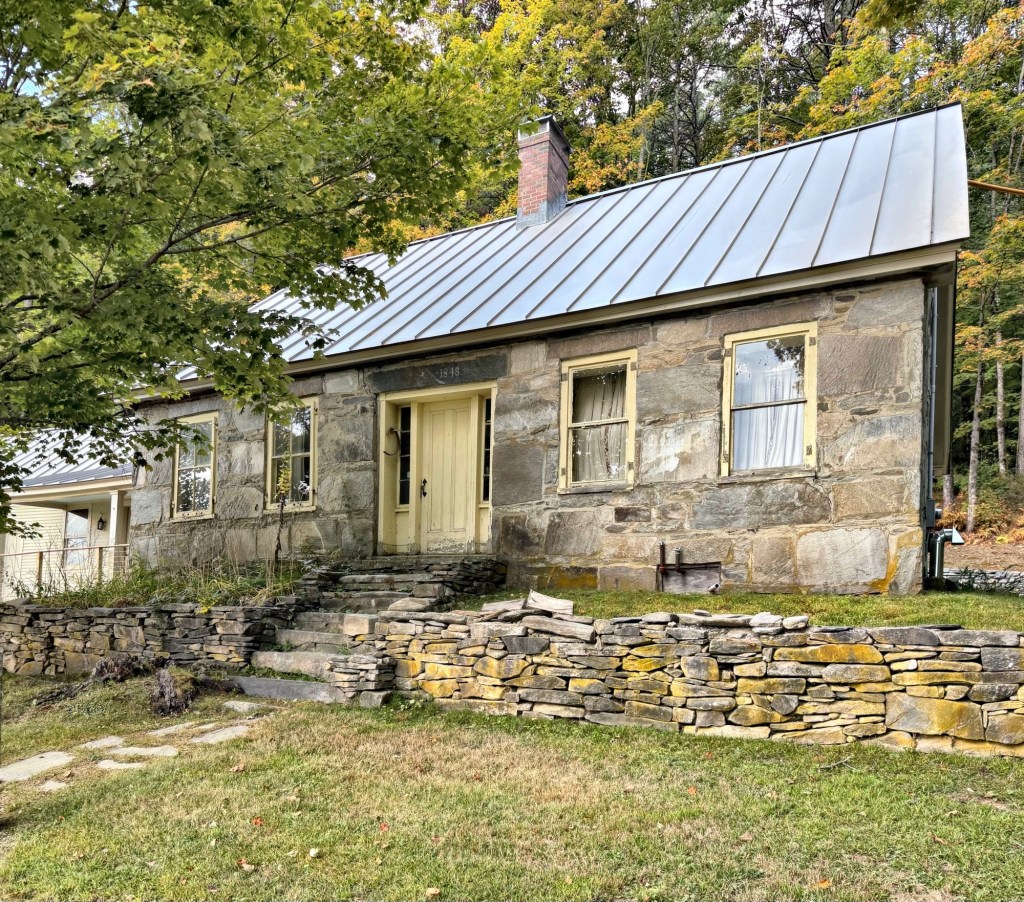
In the early 1830s, skilled masons from Scotland and Ireland came to central Vermont to work on building projects. A number of these workers, mainly from the Aberdeen area, and specialized in a specific building style in which plates of stone are affixed to a rubblestone wall. This method of bonding stonework is so prevalent in Scotland and
Ireland it has been referred to in some journals as ‘Celtic Bond’, but in Vermont, it is known as “snecked ashlar”. The mixture of stone sizes and colors produces a strong bond and an attractive finish. This home is a rare example in the state, which is estimated to have about 50 of these homes left. I could not locate any information on the owners of the home, but the house has seen better days, with the wooden front porch shifting away from the main house. Also, if you look closely, you can see the original wood shingle roofing breathing under the sheet metal roof!

Levi F. Hartshorn House // c.1853

This Greek Revival home in Reading, Vermont was built around 1853 for Levi Fay Hartshorn, and is an excellent example of a vernacular Greek Revival house in Central Vermont. Levi F. Hartshorn moved to Reading, Vermont and opened up a store, also built this home for his family. It appears that Mr. Hartshorn gifted the village one of his shops to be used as a local library, before the present building was constructed.