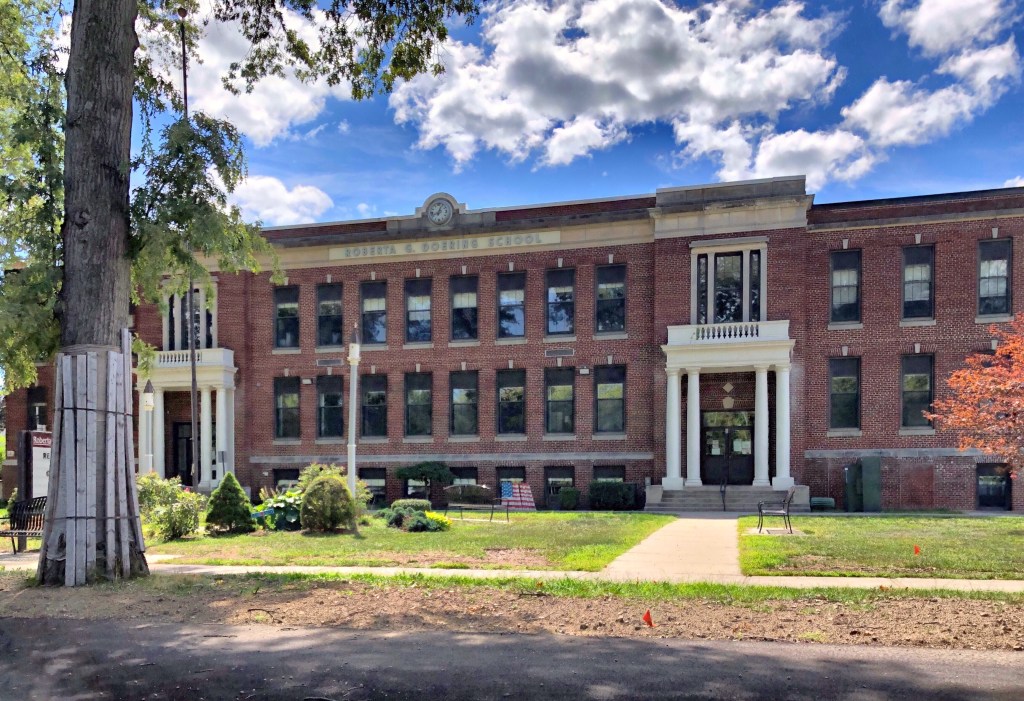
This stunning High School building in Agawam was built in 1921 as the town’s first high school. William Pynchon purchased land on both sides of the Connecticut River from the local Pocomtuc Indians known as Agawam, which included present-day Springfield, Chicopee, Longmeadow, and West Springfield, Massachusetts. The purchase price for the Agawam portion was 10 coats, 10 hoes, 10 hatchets, 10 knives, and 10 fathoms of wampum. Agawam and West Springfield split in 1800, with Agawam incorporating as a town on in 1855. The town stayed fairly rural until the 20th century with the proliferation of the personal automobile and suburbanization from the industrial and urban center of Springfield. This increase required a new, modern high school to be constructed in town. The building was converted to a middle school in 1972.
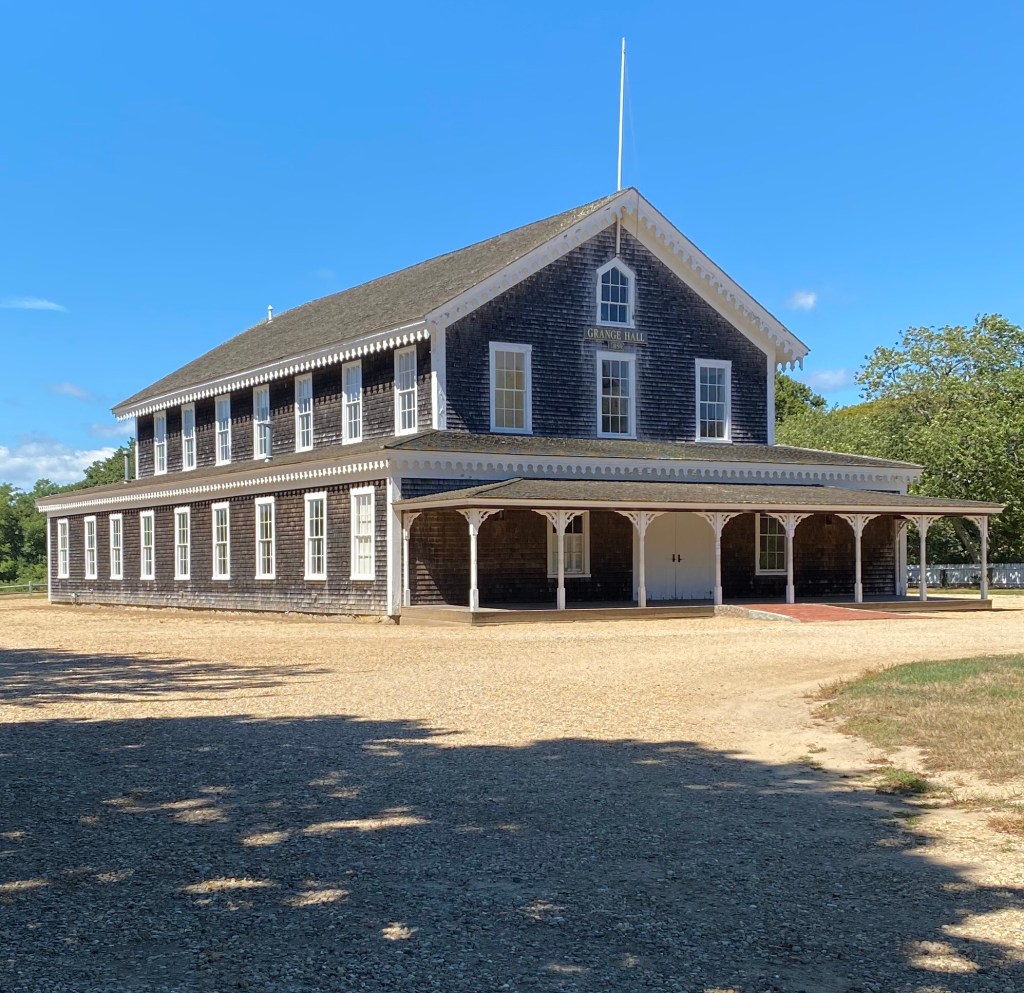
Constructed by the Martha’s Vineyard Agricultural Society at the crossroads of the island, this Grange Hall in West Tisbury on Martha’s Vineyard, is the center of agriculture and commerce for the Vineyard. Grange Halls are traditionally where farmers have gathered to learn new agricultural practices, develop strategic business partnerships, and barter for goods and services. The building was the hub of weekly farmers markets for decades and eventually owned by the Vineyard Trust in 1997, being restored soon after. The building is a vernacular Gothic Revival building with decorative bargeboard (gingerbread trim) and full-length porch.
In most Massachusetts cities and towns, habitual truants (children who stayed away from school) and juvenile delinquents had normally been committed to local almshouses and prisons. By 1873, state law updated policies to “humanize” the children and guide them on a better path. Habitual truants (age seven to fourteen), habitual absentees (age seven to sixteen), and habitual school offenders could be committed to a county truant school for a term of up to two years. At least one of these types of schools were found in each of Massachusetts’ counties, which seemed to get more crowded every passing decade. In the early 20th century, the outlook on shaping children’s growth changed and to reflect this, the truancy schools were renamed “Training Schools”.
The former Hampden County Truancy School in Springfield was outgrown and outdated. The county petitioned the state for a new school on open land, and a site was acquired in nearby Agawam. The choice of location was intended to provide a rural farm environment and to avoid the temptations of the city. The isolated location, surrounded by farmland, ensured that students could not easily walk away from the school to rejoin their friends and families. Despite the remote location, the Hampden County Commissioners report of 1918 noted that 36 boys still ran away from the training school a total of 69 times and that 5 were still at large at the end of the year.
Starting in the 1940s, the County Training Schools were seen as a waste of taxpayer money and many staff at these institutions were under-educated themselves to deal with emotional or social issues that some of the children exhibited. Many county schools were closed, with the Hampden County Training School closing in 1972.
The school building and grounds sat vacant for over a decade until funding was released to renovate the building for use as a police academy training center in 1984. The exterior of the building remained relatively unchanged during this time, and many of the original classroom spaces were left as found. The building served in this capacity for over twenty years until it was closed in 2005. In 2017, Soldier On, a private nonprofit organization that provides housing and supportive services for military veterans, rehabilitated the former school and now provides 51 permanent housing units here. The property was listed on the National Register of Historic Places (a report where much of this information came from) and was rehabilitated using Federal Tax Credits.
The Classical Revival-style Hampden County Training School was designed by the prolific Holyoke-based architect George Perkins Bissell Alderman. Alderman was well known throughout western Massachusetts and Connecticut for his monumental, classically derived designs for residences, schools, commercial blocks, civic buildings, and churches.
One of the most photographed buildings in North End is arguably this tenement block, built in 1895 at the corner of Prince and Salem Streets. As the North End continued to redevelop into a diverse immigrant community, tenement houses were constructed by those with the means, providing housing at low cost to those who arrived to Boston in the late 19th and early 20th centuries. Max and Etta “Ethel” Lebowich, Russian Jews, immigrated to Boston, settling in the Jewish quarter of the North End and opened up a dry goods store at the corner. The business did well, and the couple redeveloped their land and hired Swedish-born architect Charles A. Halstrom, to design the prominent apartment house. The Renaissance Revival building features massive pressed metal oriels and brick and stone construction. I am unsure if the oriels are truly copper, which would have been fairly expensive for a tenement building, or if they are pressed tin. Any insight would be much appreciated.
It is impossible to overstate the significance of the railroad in the 19th century to the industrial growth and economy of New England and American cities. In order to connect Boston and its ports to the Hudson Valley in New York, a western rail line was constructed in the southern part of Massachusetts but was not an ideal route. In response, businessmen and politicians began to envision a more direct rail line across Massachusetts, but with one problem: trains hate climbing mountains! Instead of going around Hoosac Mountain, a massive detour, engineers thought they could tunnel through it, and that’s what they did, creating the Hoosac Tunnel. The tunnel through Hoosac Mountain is just under 5 miles long. Its active construction period consumed roughly a quarter-century and cost at least $17 million in 1870s dollars – an enormous sum. The cost was paid in dollars and the lives of nearly 200 miners (many of whom suffered terrible deaths as you can imagine). The first train passed through the tunnel in 1875, with the eastern portal wall constructed in 1877 (seen here). By 1895, roughly 60% of Boston’s exports traveled through the tunnel. Since then, some small collapses and deferred maintenance have left their mark on the tunnel, though it is still in operation today!
For middle-class families in North Adams, some residents could afford to move out of workers housing but not yet afford single-family homes, the best option was for apartments. Seeing the demand for this housing type increase with the booming industrial development in town, businessman and real estate developer, Martin Crafts Jewett developed some of his land with a luxurious apartment building. This six-unit building has beautiful poly-chrome brickwork and corbeled chimneys, mansard roof with wall dormers, and flared turrets, typical of its architect, Marcus F. Cummings who also designed the Blackinton Mansion (now North Adams Public Library).
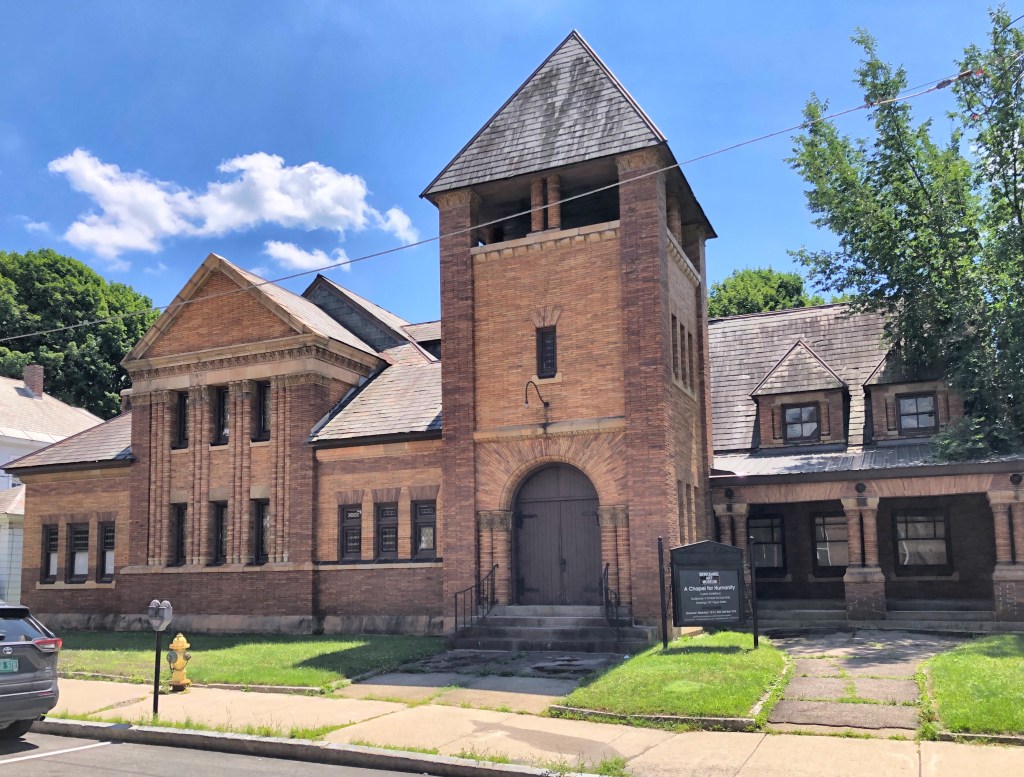
Tucked away off Main Street in North Adams you’ll find this charming little church. The Universalists were organized in North Adams in 1842, restoring an existing church near the Hoosic River. The congregation chose a site for a new church in 1852, and erected a white wooden chapel. It is unclear if the church was outgrown or a fire destroyed it, but the Unitarian society voted to build this church for a cost of approximately $25,000 in 1892. Architect Henry Neill Wilson of Pittsfield drew the plans, and the firm of Porter and Harnam of North Adams constructed the church. Due to the declining population in town in the mid-20th century, the church struggled and was sold to a private owner. The building began to decay by the 1970s and was later sold in 1996 to Barbara and Eric Rudd to house artist Eric Rudd’s installation entitled “A Chapel for Humanity”. The building is currently used as the Berkshire Art Museum Annex.
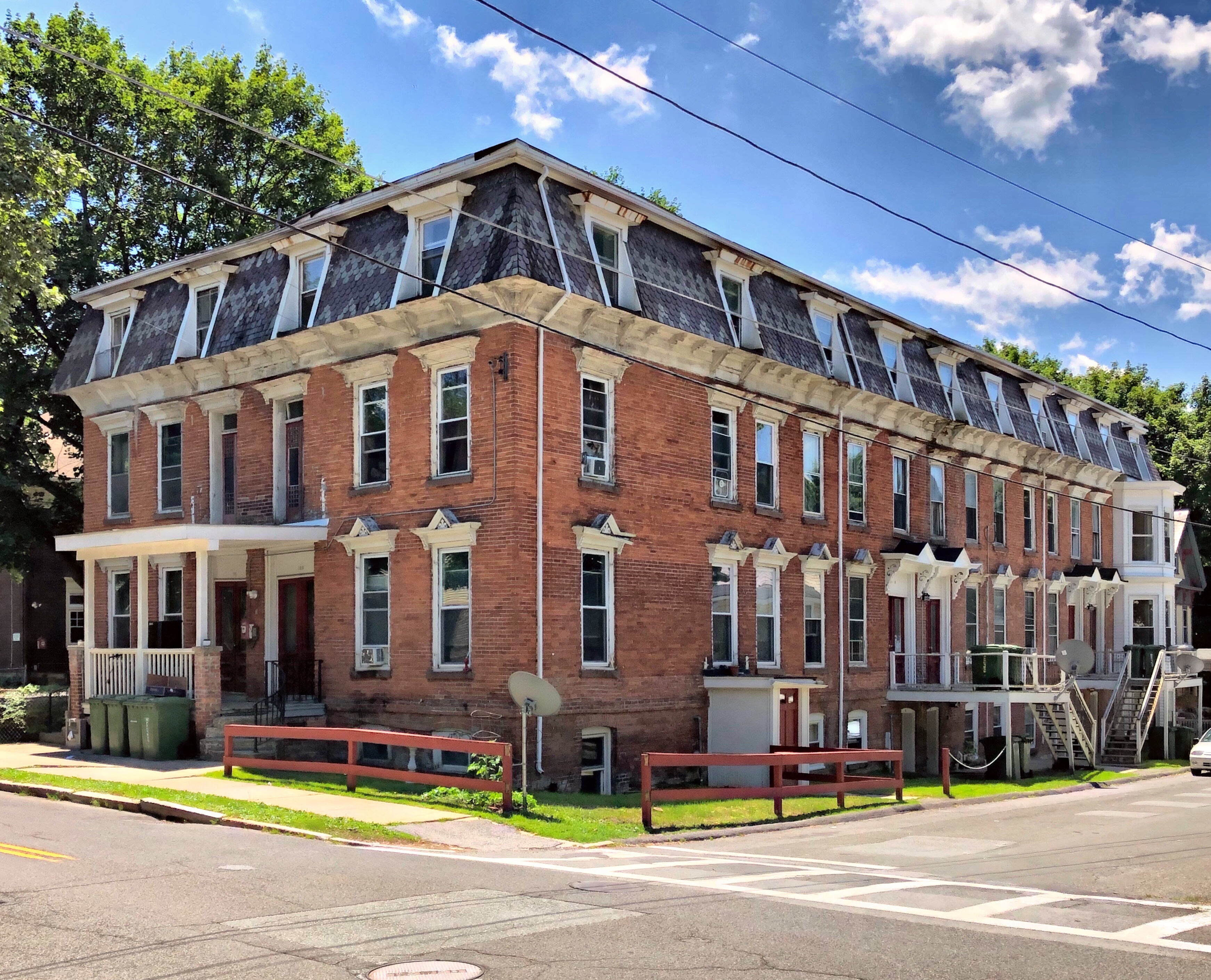
Industrial cities and towns all over New England drew in thousands of European immigrants looking for work. Due to the massive influx of workers and families, many towns and companies constructed tenement housing and other worker’s housing to provide living spaces close to factories and mills. This six-unit tenement house was built in 1872 and is a high-style Second Empire example of worker’s housing in North Adams. The use of brick, mansard roof, and window hoods was likely a concerted choice by the developers as they were located on a street lined by mill owners houses and the who’s who of North Adams.
This stunning Stick style house in North Adams was built for Charles Cutting (1850-1940), founder of the C. H. Cutting Company, a prosperous clothing company in town. The company started as a partnership between 20-year old Cutting and a Mr. Silsby, who retired just a year after co-founding the company. Cutting used his business connections to help establish other local clothing companies including the Bay State Clothing Company in Adams, the Orange Clothing Company in Orange, MA, and the Athol Clothing Company in (you guessed it) Athol. With his wealth, he had this amazing Victorian home built on East Main Street where he lived until his death in 1940.
This cottage on Ocean Ave in Oak Bluffs was built before 1880 for J.F. Riday, a manager at the American Mail and Export Journal at the Wesleyan Building on Bromfield Street in Boston. The quaint cottage was photographed shortly after it was built with Riday and two women (one likely being his wife) posing on the front porch overlooking the ocean. By the early 20th century, the home was owned by George and Corielle Evans, a couple from Mexico. They likely modified the home with the shingled siding and front porch with sheltered balcony above, while the original lancet windows and doors remained.
This charming little cottage in Oak Bluffs was built in 1876 for Charles N. Jones, a resident of Medford, MA who had a home built there in 1872. His family’s summer cottage on Martha’s Vineyard was designed by the Ripley Brothers, Alonzo and Walter, carpenters who lived in town and designed and built many of the charming little summer homes there. The home features a wrap-around porch, a covered balcony at the second floor, and pierced board balustrade and cornerboards. Oh, and the paint scheme is perfect!
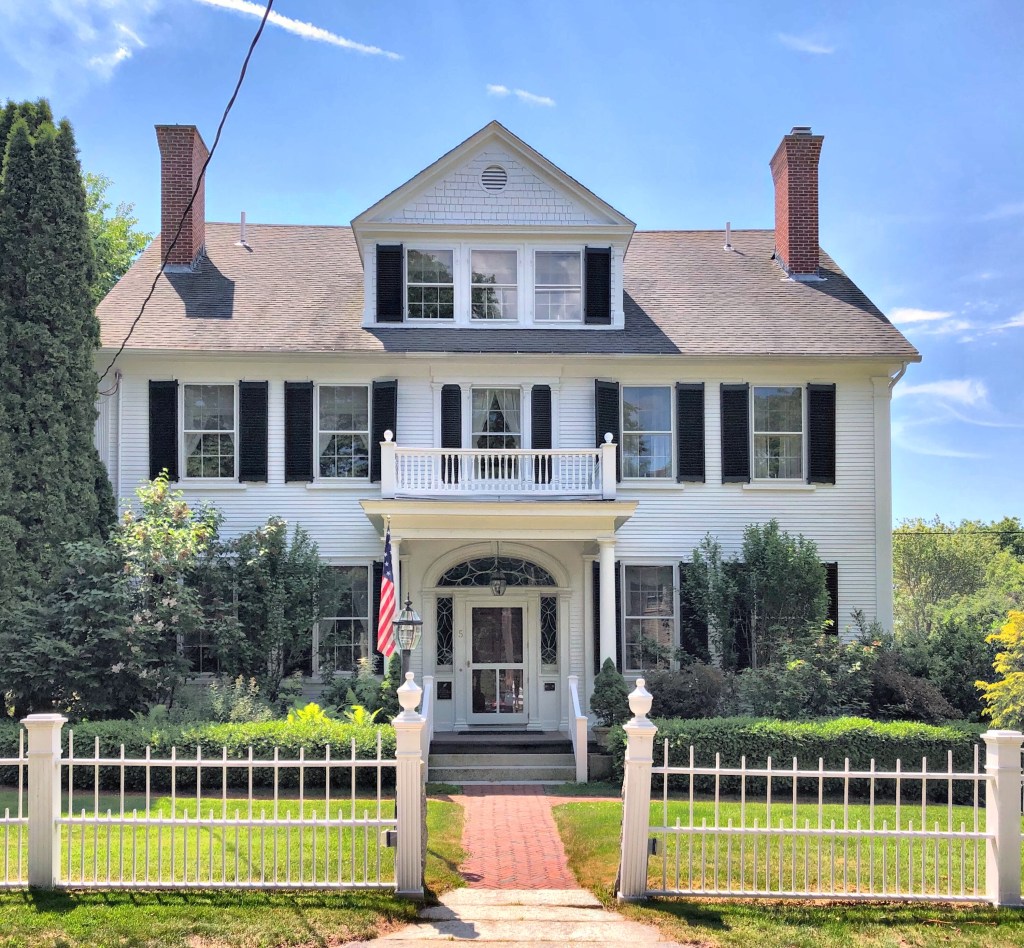
William Jefferds Jr. was born August 30, 1779 in Kennebunk. On October 25, 1802 he married Sarah (Sally) Walker who was born in Arundel on March 4, 1783. Twenty years later, in 1803, Captain Daniel Walker gifted his son-in-law, Captain William Jefferds, Jr., “80 square rods of land, with love and affection” on the lane leading to Walker’s Wharf (he also gifted land to his other son in law, Nathaniel Lord. In 1804 the 2-story, Federal-style building that now houses Captain Jefferds Inn was built as their private home.
Capt. Jefferds was a ship owner and captain in the West Indian trade; he later became a merchant in Kennebunkport. He and Sarah had 11 children, and their family was considered one of the most aristocratic in Kennebunkport. Following Sarah’s death at age 88 in 1871 (her husband had predeceased her in 1851), the household furniture was sold at public auction and the home sold outside of the family.
The house was a two-story hipped roof Federal style dwelling, somewhat outdated by the latter half of the 19th century. By the 1880s, the Agnew Family who owned it at the time, had the home remodeled with Colonial Revival detailing, including the portico and large central dormer. The home was eventually converted to an inn, and is known as the Captain Jefferds Inn.
Check the Inn’s website for more images and history!
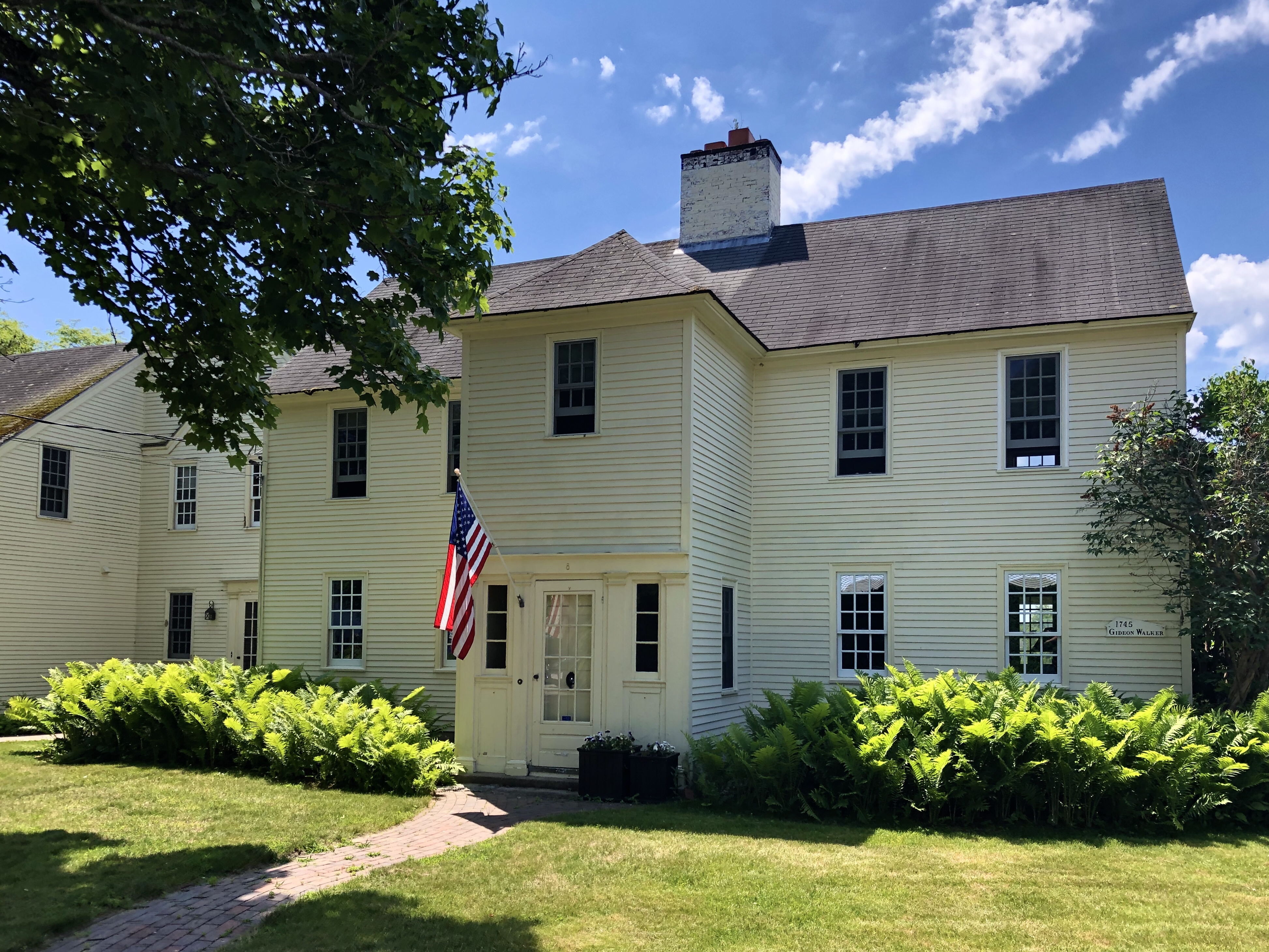
One of the older extant homes in Kennebunkport is the Gideon Walker Farmhouse, built in 1745. The home once sat on a larger parcel of land, on the outside of the village, which at the time, only had a handful of other homes nearby. At the time, the town was named Arundel, and was later renamed Kennebunkport, in reflection to its economy becoming one of shipbuilding and trade along the Kennebunk River. As the village population grew, the Walker land was sold off and developed for other large estates. The Georgian house featured a small, one-story projecting entry, typical of the period. In 1910, owner Anson McKim of Montreal, hired Portland architect John Calvin Stevens to update the home, which included the addition of the front entry’s second story and a large side addition approximating the size and location of the former barn which once stood there. The home has since been renovated a few more times on the interior and exterior, yet it still retains its historic integrity.
For those of you who follow me on Instagram or are just joining here, I wanted to share a little bit about myself..
I started on the mission to explore the New England area in 2018 with the aim to highlight the varied architecture, history and sites that make the region so special. My goal (a near impossible one) is to explore every city, town and village in the region. I grew up in the area and after beginning to work in the field, really wanted to showcase the history behind these picturesque places to light in a manageable format.
I started by Instagram in 2018 and have been shocked at the numbers of architecture nerds like myself! This blog is to pick up and continue the posts from Instagram. To see past posts, click on the Instagram link on the sidebar and scroll through!