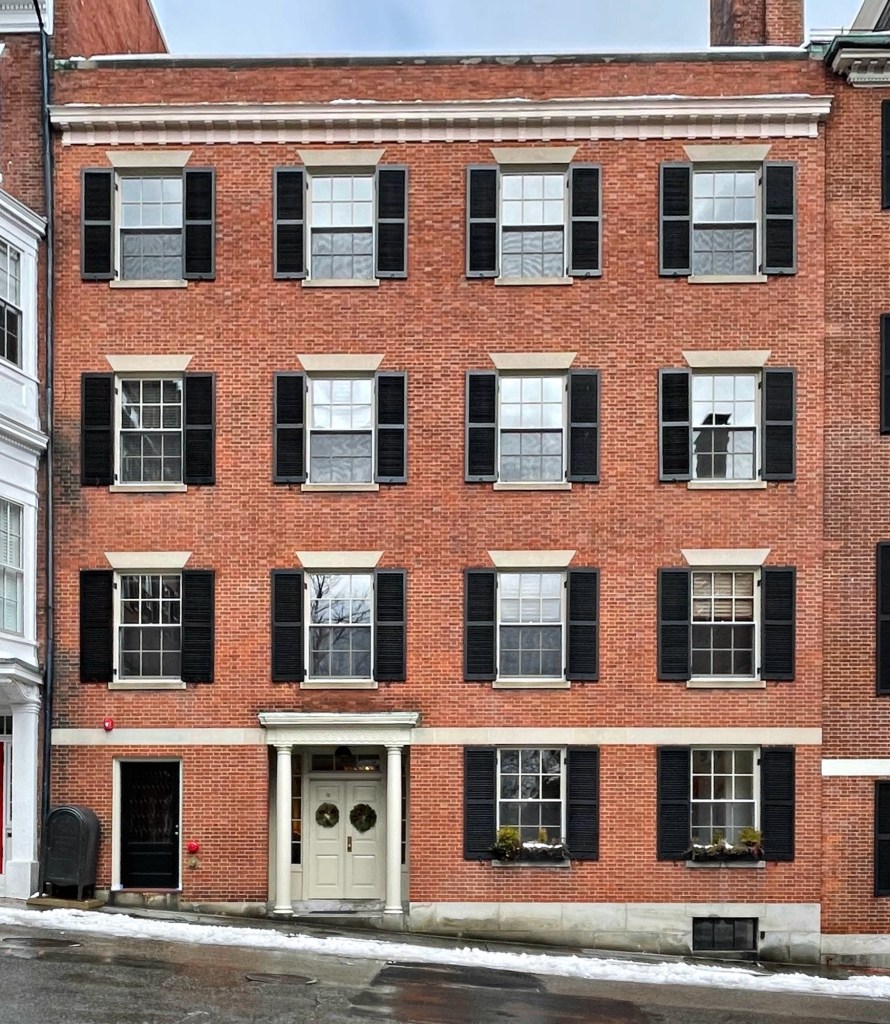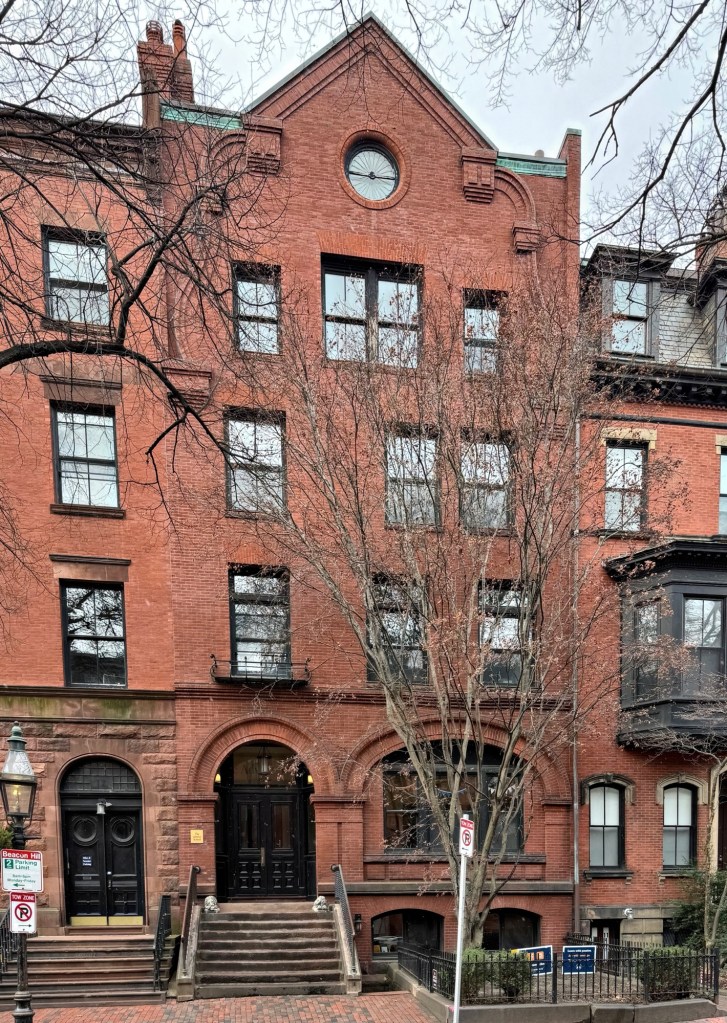
Rowe House // 1911

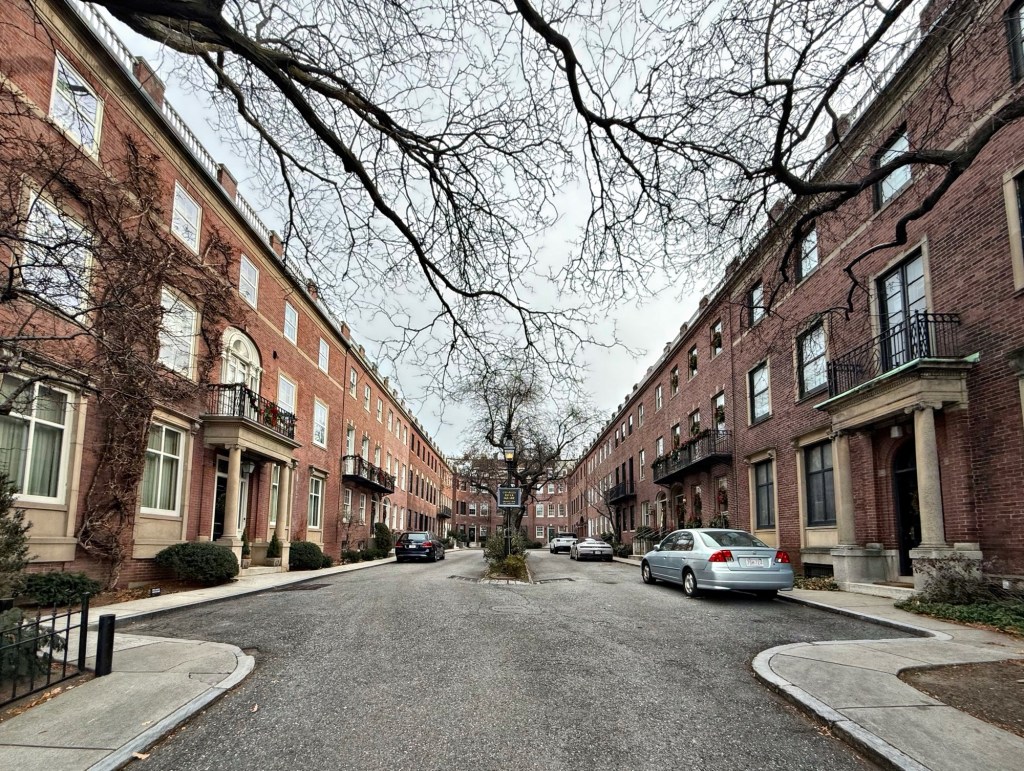
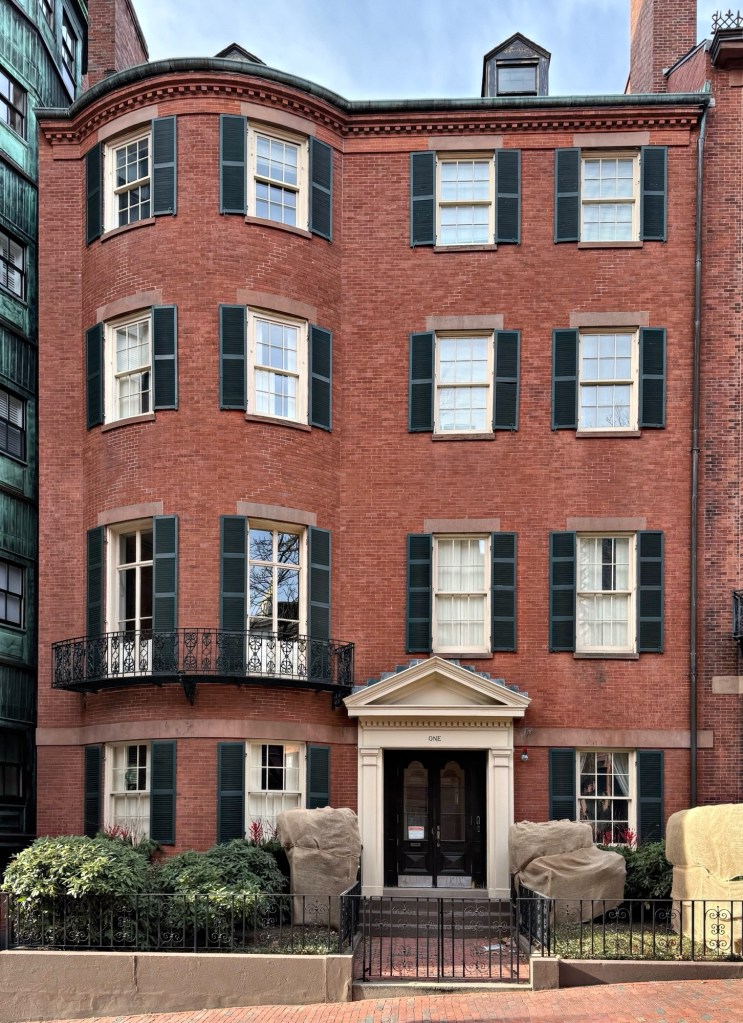
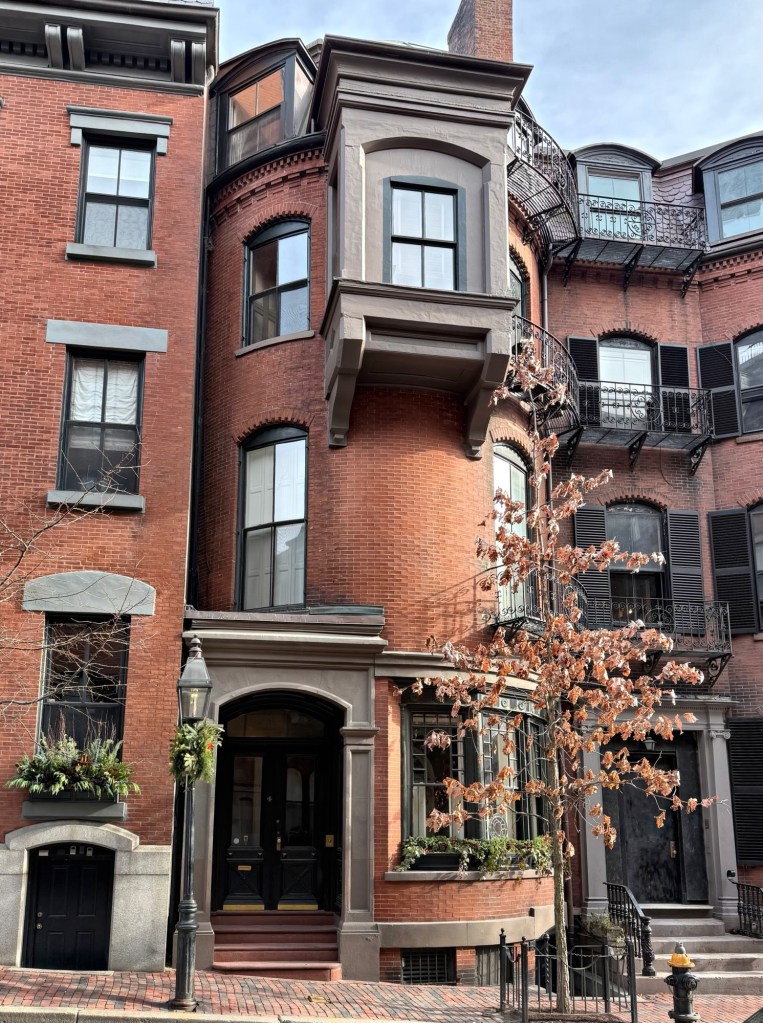
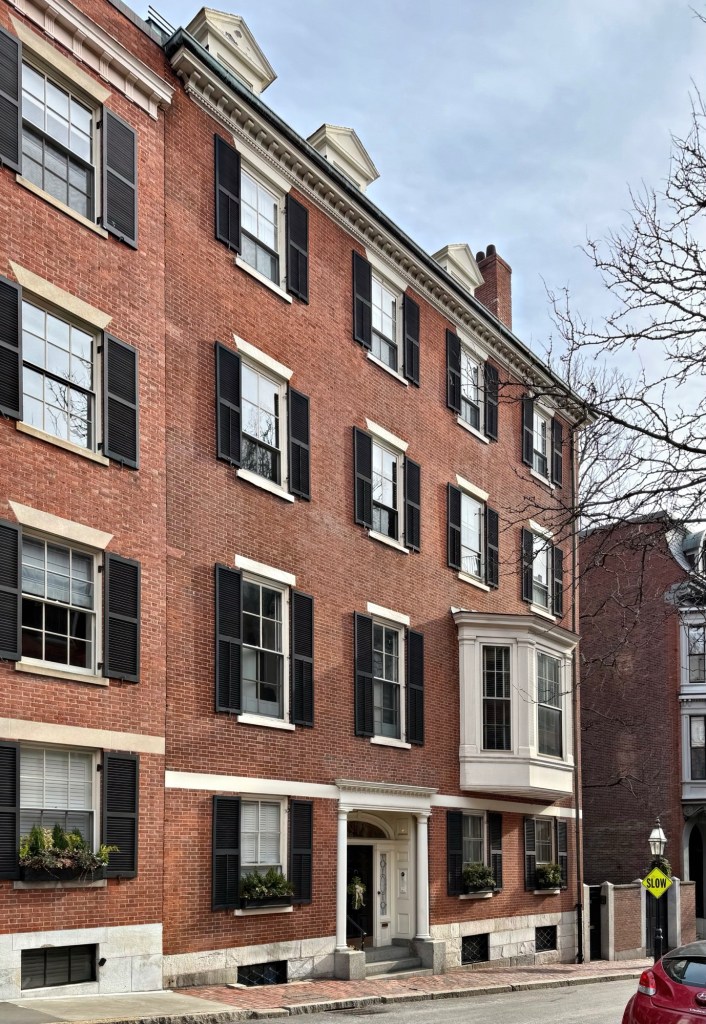
The Rowe House at 11 Mason Street is an over-the-top, and high-style example of the Colonial Revival style, showcasing the oversized proportions and scale that architects in the early 20th century followed when referencing Colonial American architecture. The house here was built in 1911 for Edward Prescott Rowe (1879-1936) and his wife, Eleanor Livingstone. Designed by the firm of Rowe & Keyes of Boston and New York, the commission was likely a relative of Mr. and Mrs. Rowe. The symmetrical house features a broad gambrel roof with Palladian windows in the side gable and central dormer at the facade, large pilasters breaking up the bays on the facade, a projecting Colonial Revival entry, and squat windows at the second floor terminating at the entablature above. The property even retains its Colonial Revival gateway.

Dana-Jewell House // 1872

This house at the corner of Freeman and Powell streets in the Cottage Farm area of Brookline, Massachusetts, was one of the first to be built on Sears family land in the years following the death of the family patriarch, David Sears. In 1871, Dennison Dean Dana (1827-1899) purchased land here from the Sears heirs and constructed this Italianate house with three-story square tower. Dana owned the house through the 1880s, and by 1893 it had been acquired by Albert L. Jewell, a real estate developer who added the large veranda and a two-story addition to the house, and would subdivide the property, developing fashionable houses along Powell Street to the south. The house (while clad in asbestos shingles since the 1960s) is an important early residence in the neighborhood which is today, dominated by late 19th and 20th century architecture.

Waitt and Bond Building // 1891

One of several late 19th-century industrial buildings in the North End, the Waitt & Bond Building stands on Endicott Street, looking over the scar on the landscape that is I-93. This six-story building was constructed in 1891 and is the oldest extant building in Boston associated with cigar manufacturers Henry Waitt (1842-1902) and Charles H. Bond (1846-1908), who started business in 1870. The business relocated from Saugus to Boston in 1873 and moved into this building upon its completion. Waitt & Bond produced handmade cigars with each employee hand-rolling over 300-a-day. The architect, Ernest N. Boyden, designed the building in the Panel-Brick and Romanesque styles with decorative brick panels, cornice, and arched detailing. Rooftop billboard signage (blight) was first added to the building in 1956, with increased visibility via the elevated John Fitzgerald Expressway (the Central Artery). By the early 1960s, Joseph Castignetti moved his men’s clothing store, Castignetti Brothers, to this location. In 2001, the building was converted into 28 loft-style condos, an early sign of the gentrification to come to the North End.

William Slattery Tenements // c.1893

It is not always the architect-designed, high-style buildings that give a place character. The North End is a neighborhood almost entirely built of working-class tenement housing, but its density, immigrant history, and vernacular, make it one of the most visited and unique in the city. Michael Slattery, an Irish-born teamster, and his son, William, a grocer, developed this handsome block of tenement housing on North Margin Street in the North End neighborhood of Boston. The row of apartments stands out for its elevated design elements, including the projecting metal oriels with decorative wreath and swag motifs, arched openings, and brick corbeling at the cornice. The apartments here were rented by the Slattery family until the mid-1920s when the buildings were sold to Italian-Americans who continued to rent the buildings to lower-income residents. There is something about the North End’s vernacular that is so charming.

Daniel T. Kidder House // 1884

This charming Shingle/Queen Anne style house is located on Sumner Street in Newton Centre, a street of fine suburban houses built for businessmen who commuted into Boston. This house was built in 1884 for Daniel Tufts Kidder (1852-1941), a glass dealer. Daniel got his start under the employ of Hills, Turner & Harmon, jobbers of plate, window and mirror glass, and manufacturers of mirrors, eventually working his way up to salesman and later as president of the consolidated company, Boston Plate and Window Glass Co. It is believed that Mr. Kidder used antique and imported glass in his home when it was built. The house remains well-preserved and characteristic example of the fanciful Victorian styles.

Kennard Estate // 1907

A significant house and grounds are tucked away, hidden off Dudley Road in Newton, Massachusetts. This is the Kennard Estate. Frederic Hedge Kennard (1865-1937) was born in Brookline and attended Harvard College. He did graduate work for a time at the Bussey Institution and the Lawrence Scientific School, and entered the employ of Frederick Law Olmsted, the noted landscape architect, with his office in Brookline. By 1906, he decided to open his own landscape architecture office, opening locations in Boston and Philadelphia. He would purchase this expansive wooded property, and had this house built by 1907. He laid out the grounds, creating paths and gardens on the property and planted native trees. It is unclear who designed the house, sadly. Mr. Kennard was also a noted ornithologist (an expert on birds) and would host visiting scholars at his home, walking the grounds and studying birds there. After his death in 1937, the property was inherited by his son, Harrison Eisenbrey Kennard, and ultimately willed to the City of Newton upon his death in 1982. Since then, Newton Parks and Recreation have maintained the house (though they could be doing more to preserve it), and opened the grounds as Kennard Park, a free public park comprised of wooded trails and streams.

Lovejoy Wharf // 2017

Photo courtesy of RAMSA

New buildings in Boston rarely are contextual and so often take no cues from their surroundings, but Lovejoy Wharf, one of my favorite 21st century buildings in the city breaks that mold. Completed in 2017, the contemporary building is clearly modern, but takes important cues in the design and materials to relate it to the surrounding industrial context surrounding the site. The Lovejoy Wharf condominium building was designed by the great Robert A.M. Stern Architects and incorporates red brick facades, stacked bay windows, and a glass curtain wall, which effortlessly blend old with new. A glass tower breaks free from the masonry mass at its corner, which leads into the denser, more modern West End buildings while the eastern side closely follows the old Schraft’s Candy Factory (now Converse Headquarters building) brick industrial style. Additionally, the developer, Related Beal, took a gamble by not including parking in the facility, hoping the unit owners would instead use local public transportation (or walk), it seems to have been a success and promotes healthy urbanism. What do you all think of this contemporary building?

Boston Flatiron – The Boxer Hotel // 1900

The interesting street-layout of the Bulfinch Triangle area of Boston created some oddly shaped triangular building lots which for decades, saw only small, modest wood-frame structures built upon them. By 1900, Boston’s own Flatiron Building (built two years before New York’s more iconic example) was constructed on this site and it has been an icon ever since. The structure was built by ownerCharles Pelham Curtis III (1860-1948), who was born in Boston and graduated from Harvard Law School and became a police commissioner and attorney in the city before moving into real estate development. He hired architect Stephen Codman to design this commercial block, which was rented out to local businesses and professional offices. The building has been home to a hotel for a number of decades, with a major renovation undertaken beginning in 2000, 100 years after the building was constructed. Three floors were added to the top of the original six-story, which are Modernistic in design with large expanses of windows within three center bays that align with the bays of the original building and which are defined by brick piers. The hotel today, The Boxer Hotel, perfectly blends the history of the building with modernity and style. What a gem of a building!

Dr. Jenks Apothecary Shop // c.1860

Who doesn’t love a good flatiron building?! This charming three-story with Mansard roof building is located in the Bulfinch Triangle district of Boston. The triangular-shaped building was built around 1860 as an apothecary shop for Dr. Thomas Leighton Jenks (1829-1899), a doctor who was born in Conway, New Hampshire, but left for Boston while still a teenager. When the Mexican-American War broke out in 1846 he enlisted in the Navy, where he served for three years in the hospital ward of the frigate U.S.S. United States. Upon returning from the war, Jenks attended Harvard Medical School, and wrote his thesis on Syphilis. Dr. Jenks apprenticed in a building on this site under Dr. Samuel Trull. He likely redeveloped or modernized the 1850s building, adding the mansard roof by the 1860s. During the Civil War, Dr. Jenks served as a front line surgeon. After returning home, he grew tired of the medical profession, and got involved with local politics. He was elected as an alderman, Massachusetts state representative, and in later years he earned appointments as Chairman of the Boston Board of Police, and Chairman of the Board of Commissioners of Public Institutions. He tragically collapsed and died in 1899 at a Boston courthouse. As a tribute to his birthplace, Dr. Jenks made a provision in his will for the funds necessary to build a public library in Conway, New Hampshire, which is still in use today. Somehow, the old Dr. Jenks Apothecary Shop has survived all this time as the city grows and changes all around it. The building saw life later as a restaurant and offices.

The Last Tenement // c.1870s

Originally built in the 1870s, and largely remodeled in the early 1900s, this charming building has been known locally as “The Last Tenement” of the old West End of Boston. Once part of an unbroken a row of 30 brick tenements along the east side of Lowell Street, this building typified much of the West End of Boston, a vibrant and dynamic immigrant neighborhood. Dwarfed by larger, modern apartment towers and highway off-ramps, this stand-alone building is a survivor, and should really be preserved! Here is a little history on The Last Tenement that I found. The building was originally built as a three-story residence just after the Civil War by furniture dealer, George M. Rogers. The building was rented to four families in the 1880 census, showing the diversity of the region with 20 people residing in the building of Irish, English, and German-Jewish backgrounds. At the turn of the century, an elevated rail line was laid out down Lowell Street. After WWII, the neighborhood would see a terrible demise, that has been widely told. City leaders effectively considered the vibrant immigrant neighborhood a slum, and in an effort to redevelop it to bring back middle-class families (and their tax dollars) handed much of the neighborhood to developers to start over, with little more than lip service for the displaced. This building, now with an address of 42 Lomasney Way, was occupied for some time by “Skinny” Kazonis, a low-level Mafia associate of the Angiulo Brothers, which was a leading gang in the North End until the Winter Hill Gang decided to run rackets in the area. The property sold, and residential units have been rented and the building maintained, with the assistance of a billboard for additional income for the owner. The Last Tenement showcases the strength and resilience of the old West End and will hopefully remain as a reminder of the vibrant neighborhood that was razed and replaced with mediocrity.