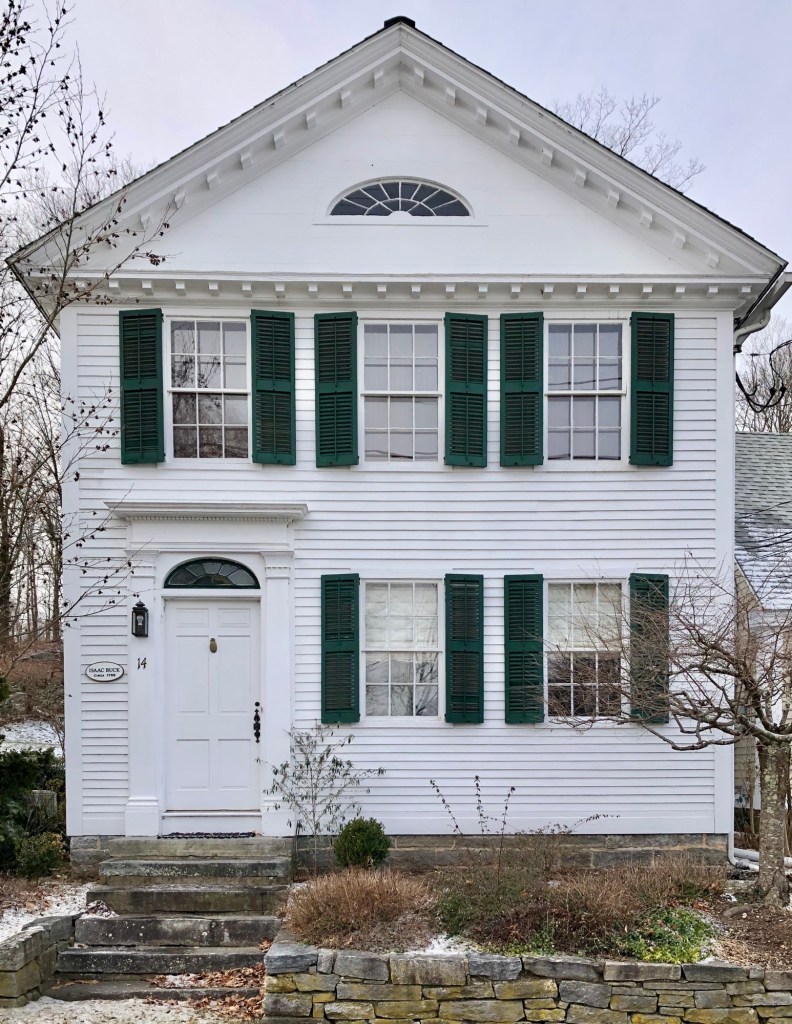
This beautiful Federal style side-hall house is located on Maple Street in Chester, Connecticut, and (at least a part of it) was built by 1755 by Isaac Buck, who deeded half of the property to his son, Justus, during his lifetime. In the early 1800s, the property was purchased by Joshua L’Hommedieu (1787-1880), a manufacturer, who had the property redeveloped or redesigned in the Federal style giving it the appearance we see today. The house has its gable end oriented to the street with an elliptical fan and dentil block detailing.
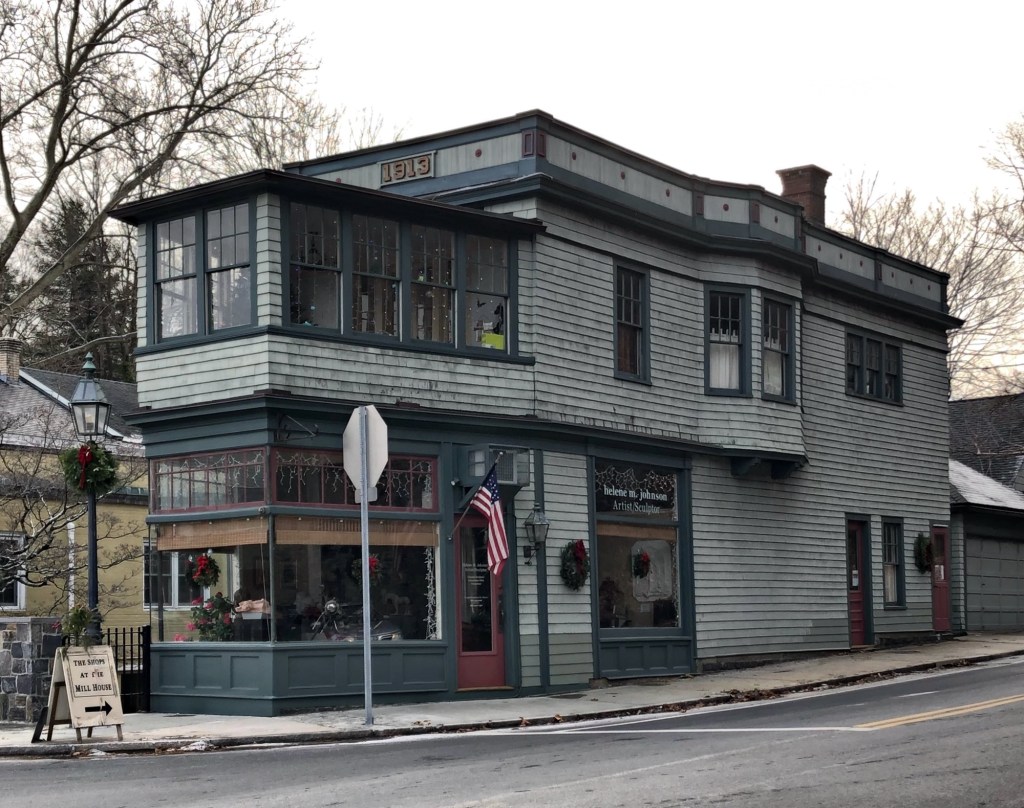
At the junction of West Main and Main Streets in Chester Village, Connecticut, this unique flatiron commercial building stands overlooking the Pattaconk Brook that cuts through the center of town. In 1913, this two-story block was built with ground floor retail and a second floor residence for owner, Elmer Pierce, who ran his pharmacy downstairs. By 1920, the building was owned by Jacob Feinstein, who raised his family on the second floor and had his clothing business, “Feinsteins” in the store below. Later, the retail space was occupied by Child Design, a wooden toy store, and after that, a lighting fixture store. Historic main street buildings are often incubators for small and local businesses, keep the chain stores near the highways!
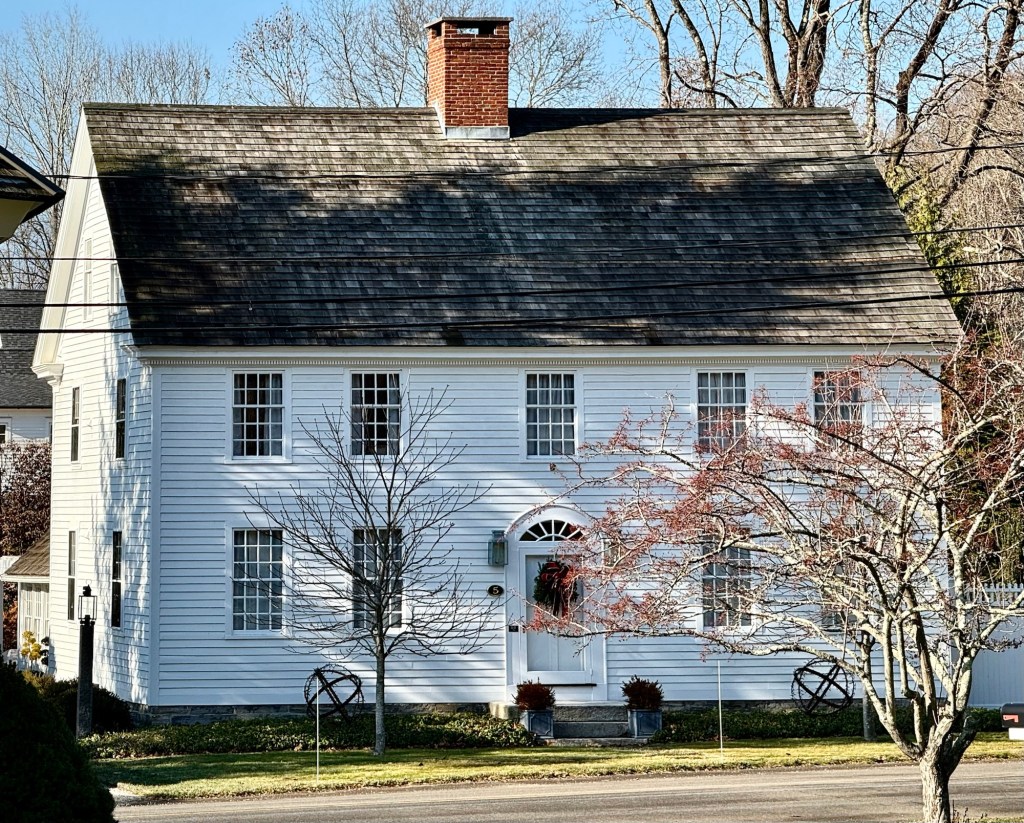
James Baldwin (1742-1818) lived in present-day Chester, Connecticut, and upon the outbreak of the Revolution, joined the forces of Capt. Richard Douglass’ company as a private and fought for liberty. Upon the conclusion of the war, Baldwin returned to Chester and had this house built facing the village green. The transitional late-Georgian and Federal style house has a center chimney and very simple trim with an elliptical fanlight transom over the central door. The house has a wood shingle roof, typical of the early houses of the time. Pvt. Baldwin died in 1818 and his property was inherited by his daughter, Lydia Baldwin Sawyer and her husband, David Sawyer, and later in the 19th century by their eldest daughter, Lucina Morgan, and her husband, Jonathan. The home has been meticulously preserved by the later owners, important as one of the early surviving homes near the village green.
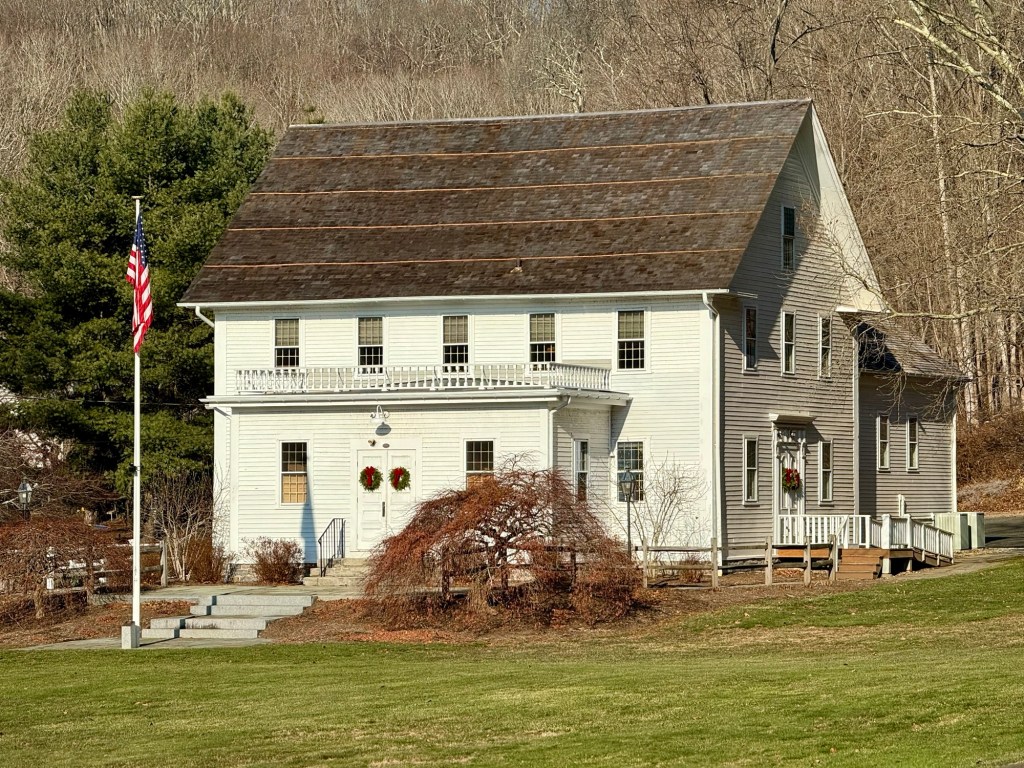
The Saybrook Colony was established in 1635 and covered a large geographic area near the mouth of the Connecticut River in Connecticut. This area was later subdivided into different towns after colonial era villages were established, each with their own church congregations. As was common in the colonial era, these divisions were centered on the establishment of separate church congregations. The Fourth Ecclesiastical Society of Saybrook in what is now the town of Chester, Connecticut, was established in 1742. As the town grew, this building was constructed in 1793 as Chester’s second meeting house and served as a church until 1846, when the third Meeting House was built. In 1847, the Town of Chester acquired this old meetinghouse and from that date until 1960, it was used as the Town Hall. In 1876, the old meetinghouse was renovated with a new, projecting main entrance added to the south side of the building when the Old Town Hall enjoyed its heyday as a theater and concert hall. The Old Town Hall witnessed many events under its roof, including hosting P.T. Barnum’s Tom Thumb, who performed here, as did musical events, high school proms, and school graduations. The building had become threatened following the construction of the new Chester Elementary School, which better-hosted events, in the 1960s. Luckily, in 1970, the newly formed Chester Historical Society acquired the building and restored it as a significant piece of the town’s rich history.
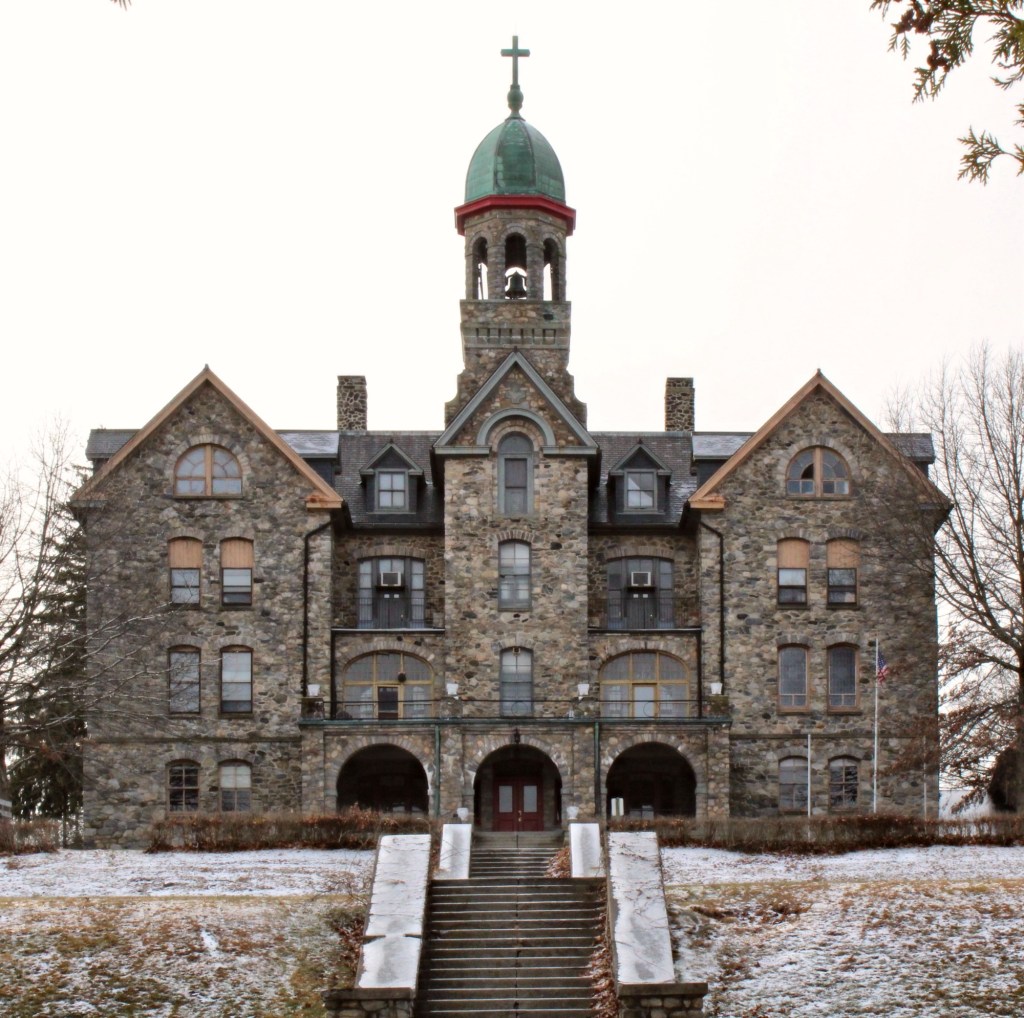
The former Mount Saint John School in Deep River, Connecticut, sits atop a hill on the western banks of the Connecticut River and is a visual landmark in every sense of the word. The school was founded by the Diocese of Hartford, who acquired the site in Deep River and began construction on the present building in 1907. Completed by 1908, the stone building (architect not known at this time), served as an industrial school for 100 boys in the Hartford region aged 8-16. The school, led by the Xaverian Brothers, was intended to educate troubled young men in the Catholic faith and learn working skills for a profession. The use changed numerous times throughout the 20th century, and ended up becoming the Mount Saint John School. Then under the Norwich Diocese, the school became known as the Mt. Saint John School. The school closed years ago and the historic building and surrounding campus’ future are uncertain.
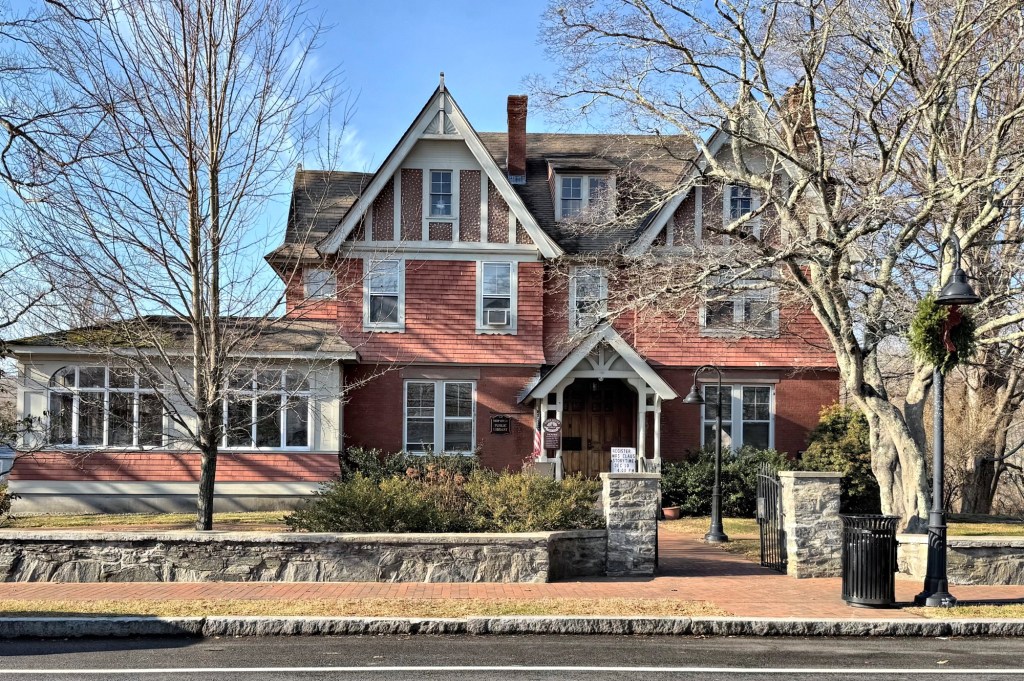
The finest extant Queen Anne Victorian-era house in the town of Deep River, Connecticut, is located on Main Street and since the 1930s, has been home to the town’s public library! How’s that for adaptive reuse?! This residence was built in 1881 for Richard Pratt Spencer (1820-1910), a local prominent businessman who lived to be 90 years old. Spencer lived here with his second wife, Juliana Selden, who was 32 years his junior, and three children until his death in 1910. When Spencer’s widow died in 1932, the heirs sold the property to the Saybrook Library Association (before the town renamed Deep River in 1947), which then, in turn, sold the building to the town for a small price in order to convert it into a library. Opened to the public in 1931, the Deep River Public Library has been preserved inside and out with historic fireplaces, woodwork, and features. The only notable change occured in 1995 when a children’s room addition was built to resemble an old porch. The library even retains the original pebbledash finish in the gables, a rare detail not commonly found in typical old houses of the period.
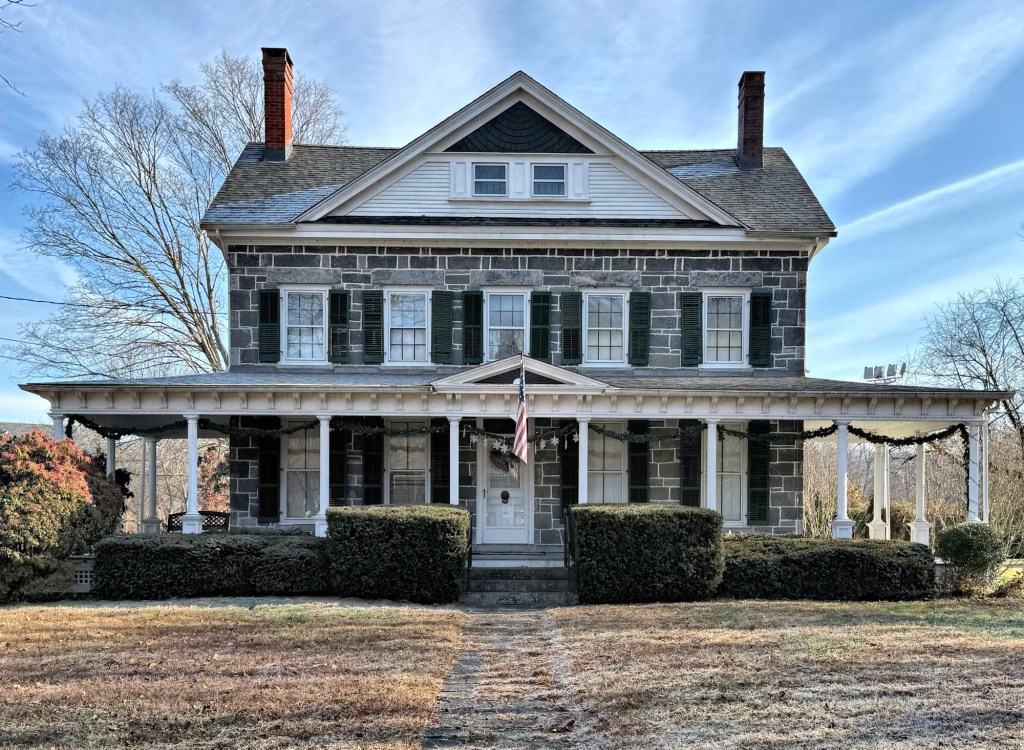
The Southworth House, also known as the Old Stone House, in Deep River, Connecticut, is a significant example of a stone, Greek Revival style house built for an important local family. The Southworth House was constructed in 1842 for Deacon Ezra Southworth (1803-1859) from stone harvested from one of the Southworth family’s quarries. Ezra was the son of local shipbuilder, Job Southworth who began building ships at the Deep River landing in the 1790s. Ezra Southworth branched off into manufacturing, becoming a partner and patent holder producing ink wells. His son, Ezra Job Birney Southworth (1844-1919), went into business with his father-in-law in shipping and served as a member of the State Legislature twice. In 1882, Ezra Jr. added the wooden ell onto the rear of the Stone House along with the wrap-around veranda and likely the rear barn as well. Ada Gilbert Southworth Munson was Ezra J. B. Southworth’s only child to live to adulthood and inherited the family home. She was a founding member of the Deep River Historical Society and bequeathed her family home to the Society in 1946, who have maintained the significant home here ever since.
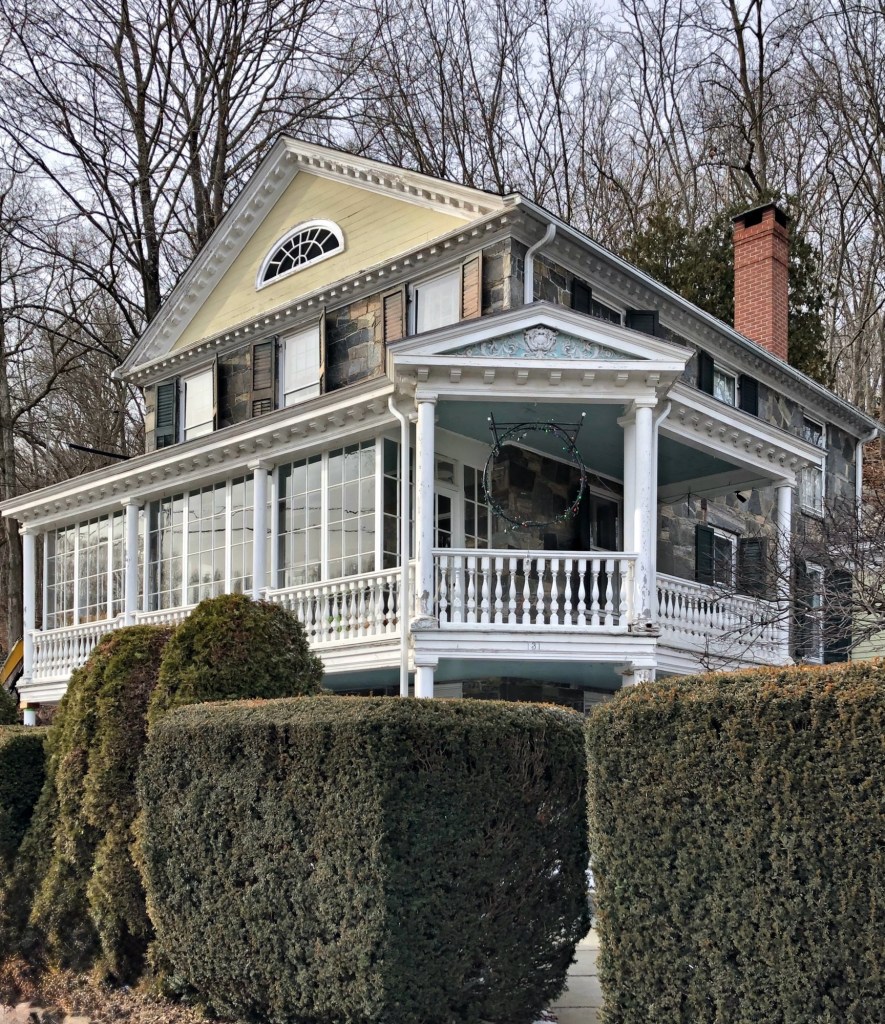
This Federal period stone house with a later Victorian-era porch, is located on Kirtland Street in Deep River, Connecticut, an area dominated by homes built for sea captains and ship builders in the 19th century. Calvin Williams (1785-1833) married Eunice Southworth of Deep River in 1809, and in 1820, built this stately home from granite from the Southworth family quarry. Captain Williams did not get to enjoy his home much as he was often out at sea commanding shipping vessels out of New York. Likely due to failing health, in 1832, Capt. Calvin Williams retired from the sea and returned to his home on Kirtland Street before he died in August of 1833. Federal style features of the house, like the elliptical fanlight and modillons in the gable and a fanlight over the main entry remain, while later alterations after his death include the spectacular enclosed porch from the late 19th or early 20th century.
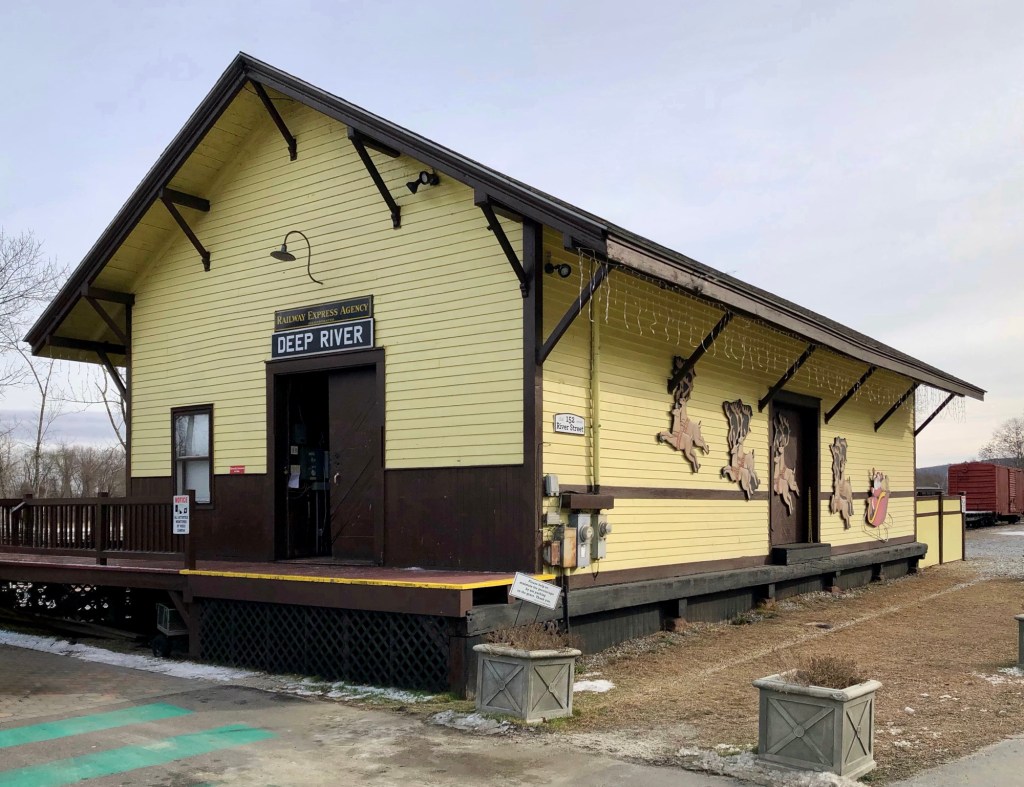
The Connecticut Valley Railroad opened for service in 1871, connecting towns along the Connecticut River between Hartford to Old Saybrook on the coast. This line carried passengers and freight between commercial and trade centers. The Deep River Station, which is sited along the banks of the Connecticut River, was built about 1915 by the New York, New Haven and Hartford Railroad, who had acquired the Connecticut Valley Line, as part of a government-mandated program to update aging railroad infrastructure. This station was originally built to serve both passengers and freight and showcases the dwindling usage of train service with the more vernacular and less ornate architecture compared to 19th century stations. Passenger service on the line was soon decimated by competition from the automobile, and ended in 1933. Freight service continued until 1961, when the New York, New Haven and Hartford Railroad went bankrupt. A portion of the former Connecticut Valley Railroad track was revived as a heritage railroad in 1971, connecting this station to the 1892 Essex Station via steam train!
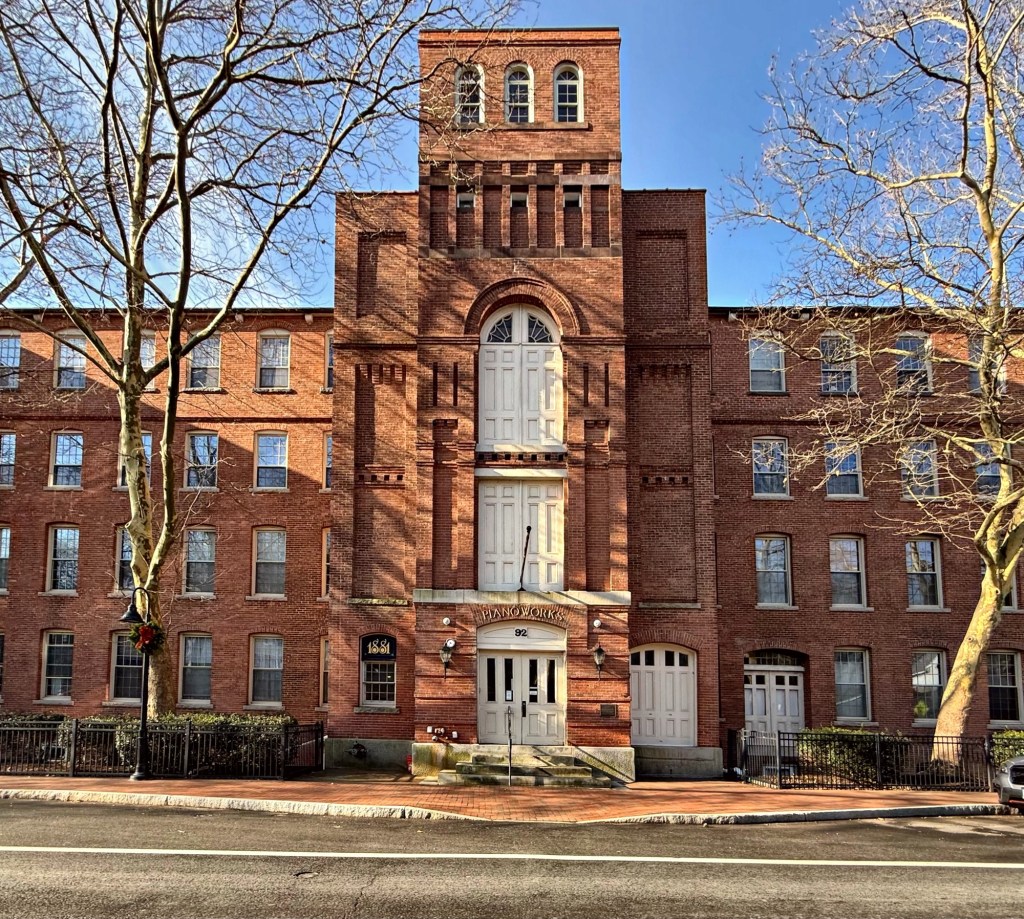
The Pratt, Read & Company Factory, located on Main Street in Deep River, Connecticut, was once the largest producer of ivory products in the world. The company was established in 1863, when Julius Pratt, George Read and their corresponding companies, merged to become Pratt, Read and Co. In 1866, the newly organized company built a new factory on this site. The business manufactured ivory combs, collar buttons, and toothpicks and specialized in the production of piano and organ keys. That factory burned in 1881 and as a result, over 160 employees were out of work. A year later, in 1882, the present factory was built of fireproof brick construction. The company, like many others, imported ivory from King Leopold’s Congo, where atrocities against indigenous people were common. The original Pratt, Read and Co. factory had an ornate pyramidal tower, which was removed in 1914. In 1936, the company merged with Comstock, Cheney & Co. and moved all operations to Ivoryton, CT. The Deep River factory was used for various manufacturing purposes throughout the rest of the 20th century until it was converted to condominiums as the appropriately named Piano Lofts.
 Buildings of New England