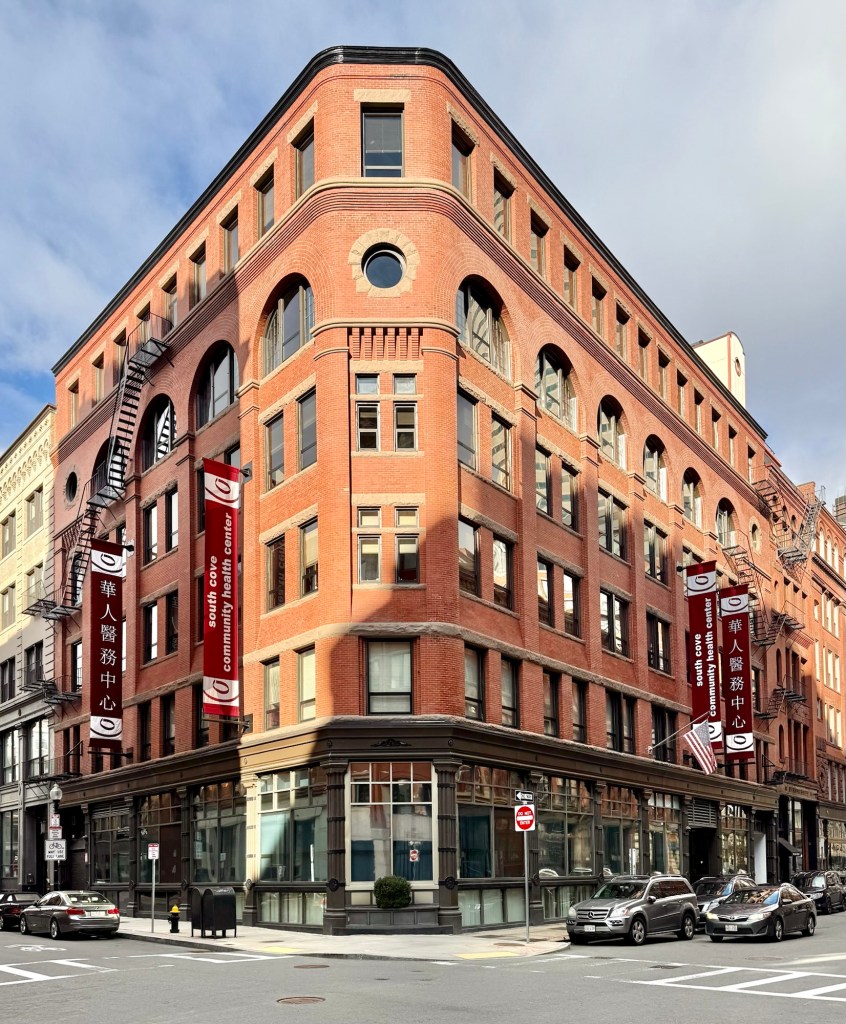
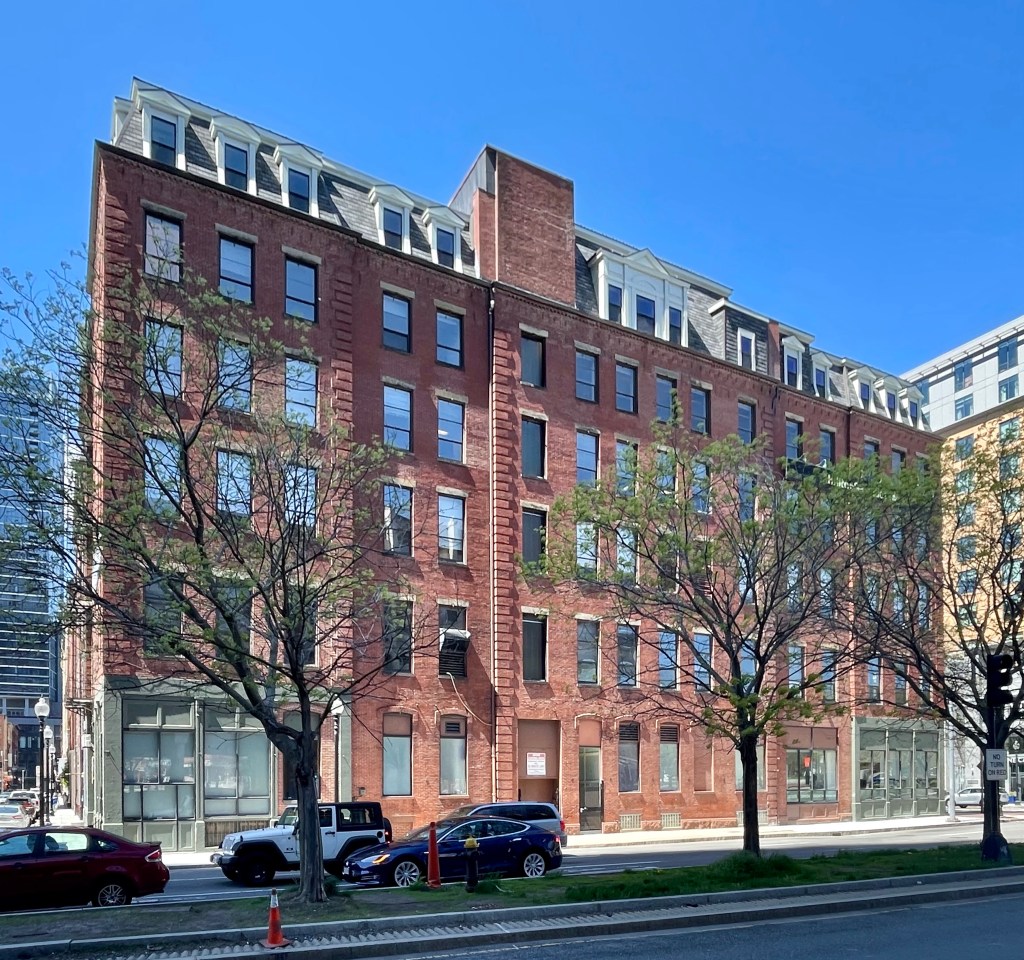
This impressive commercial block is prominently sited at the corner of Beach and South streets in Boston’s Leather District, a wonderful enclave of late 19th and early 20th century mercantile buildings, historically centered around the leather and shoe-making industries. Like many in this block, the building was developed by the Faxon Brothers, some of the major developers of this district and areas of Quincy. Also like many other buildings in the Leather District, the block was designed by 1886 in the Romanesque Revival style, constructed of brick and brownstone with a clipped corner and Syrian arches and an oculus window at the fifth floor. The building was designed by relatively unknown architect, John H. Besarick and today houses professional offices.
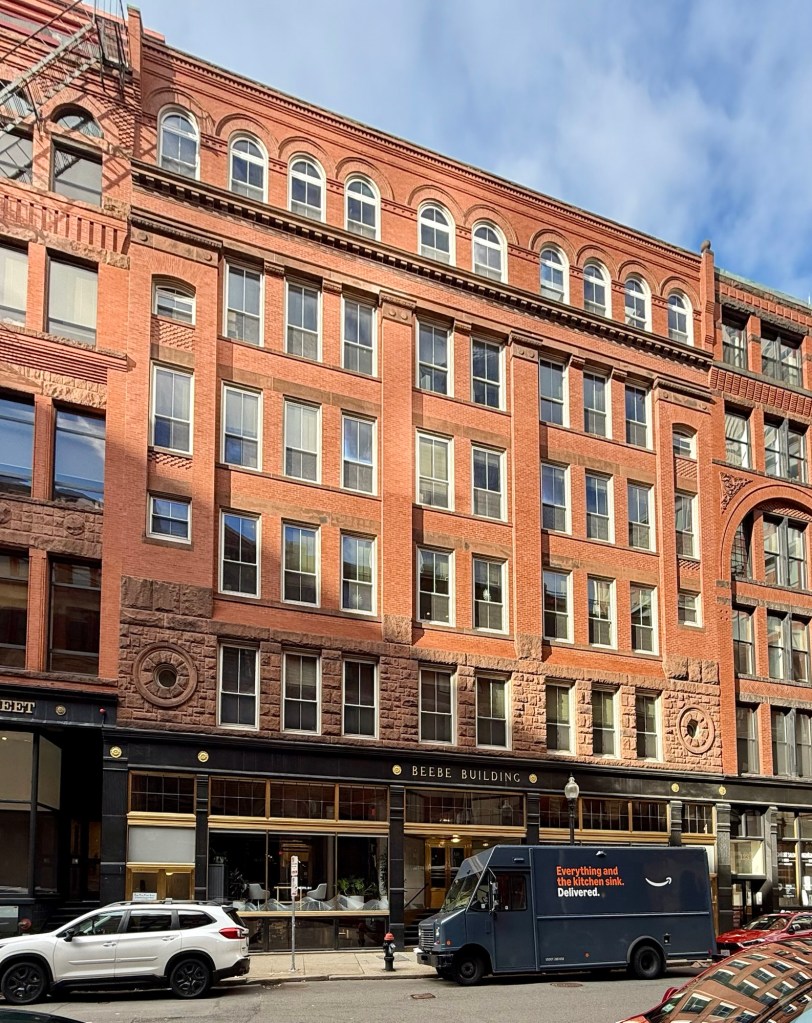
Located at 127-133 South Street in the under-appreciated Leather District of Boston, the 1886 Beebe Building is an excellent vestige of the leathergoods trade and commercial architecture of the late 19th century. This building was constructed by J. Franklin Faxon (1832-1912), a business owner who engaged in real estate development and built a number of commercial blocks in this part of Boston. Rand & Taylor, architects, designed the building in an effective blending of Classical and Romanesque styles with rock faced brownstone ashlar above the storefronts, oculus windows, and segmental arched openings on the top floor. The Classical detailing of the two-story brick pilasters and modillion cornice add to its complexity. The building was originally occupied by the Thomas E. Proctor Leather Company and was later purchased by leather goods company Lucius Beebe & Sons and the storefront was renovated by Hutchins & French in 1930. The building has since been known as the Beebe Building and has been well-maintained by subsequent owners.
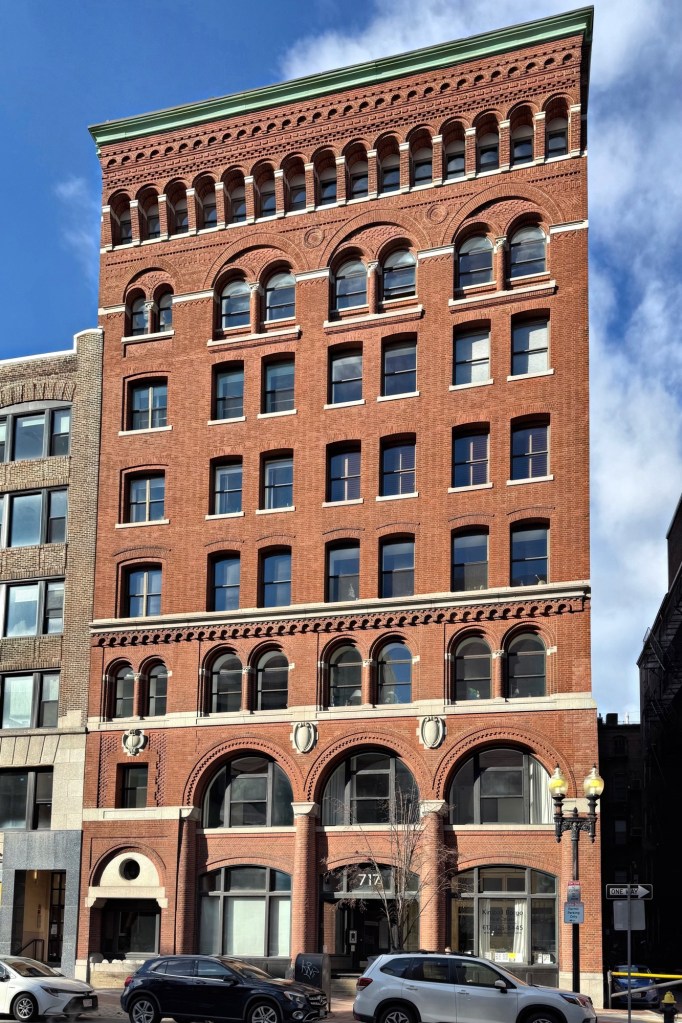
As far back as Colonial days, the boot and shoe industry was one of the State’s leading industries. Buyers came suburban towns to purchase supplies, and in the early 1800s, the larger manufacturers began to open offices and stores in Boston. Soon, most of the leading merchants had established places of business in Boston, by the late 19th century, many were located in the South Cove area, which became known as the Leather District. The Leather District is characterized today by large, brick structures with flat roofs and feature continuous floor levels, band courses, and cornice lines. This handsome brick building on Atlantic Avenue was built in 1901 for Charles G. Rice and the Heirs of Nehemiah W. Rice as a warehouse for the U.S. Leather Company. The building was designed by William Gibbons Rantoul, who studied architecture at Harvard, and apprenticed with Henry Hobson Richardson as a draftsman in the 1880’s before opening his own practice. In 1946, the subject property was purchased by Frank Einis, and the new tenants, Fur Merchants Cold Storage, Inc., used the building for the storage of skins and furs for manufacturing into soft goods. Architecturally, the building showcases the lasting influence of Richardson on architects and industrial buildings in Boston from the late 19th century into the early 20th century. The building can be classified as Romanesque Revival in style with its use of arches in the façade both structural and decorative, the Venetian arches at the 7th floor, as well as its arcaded corbelling over the 3rd level and at the cornice. I especially love the tall, engaged brick columns at the storefront, they are very unique!
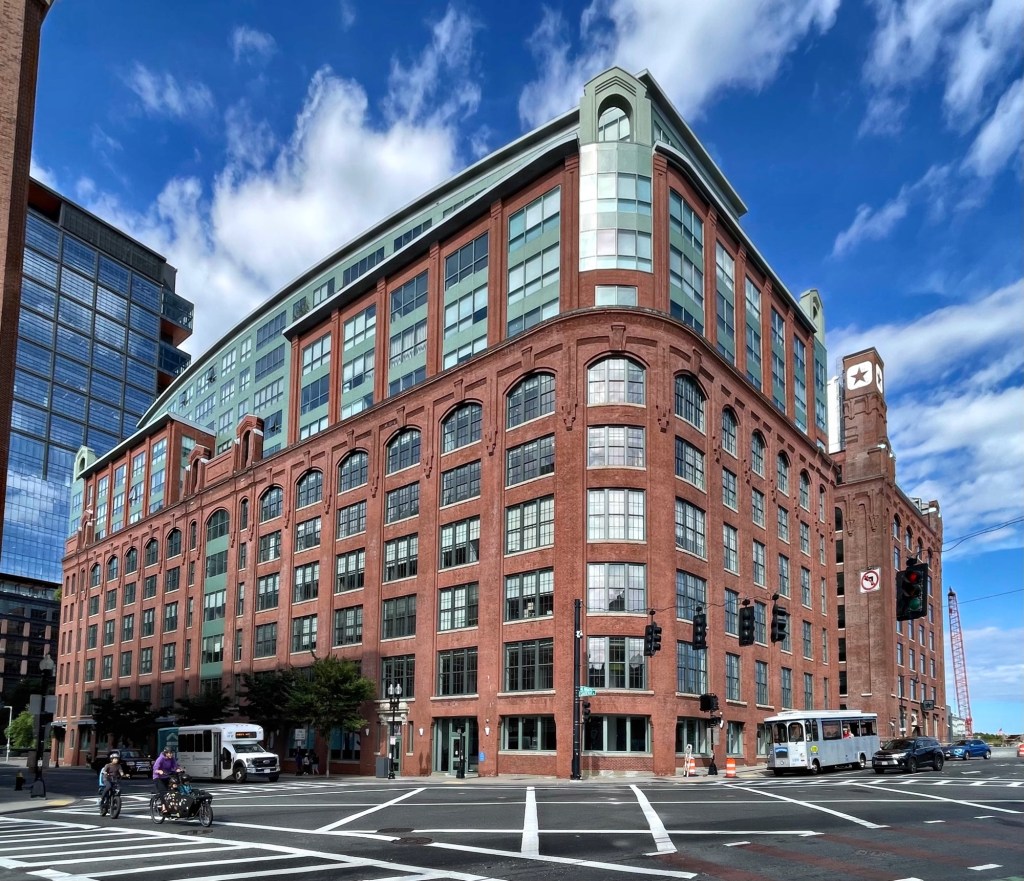
Originally constructed in 1906 for the Austin Biscuit Company, this building on Causeway Street serves as both a gateway into Boston from the north and as an excellent example of adaptive reuse with thoughtful additions. The massive structure, which was originally two separate but connected buildings are a significant example of the panel brick construction with Romanesque detailing. Part-owner of the site, Edmund Dwight Codman hired his brother, architect Stephen Russell Hurd Codman (1867-1944) and business partner Constant-Desire Despradelle (1862-1912) to design the building which was immediately rented out to the Austin Biscuit Company and the American Glue Company. When opened, the Boston Daily Globe wrote that it was “…a large new building of a thousand windows, a building which on fine days is flooded with sunshine and good air”. By the late 1900s, the building was altered and suffering from deferred maintenance, with an unknown fate. Luckily by 2001, the local architectural firm of Finegold Alexander, was hired to re-envision the building. They converted the two connected buildings into a unified mixed-use residential condominium and retail/office complex. The adaptive reuse of this building provided for 108 dwelling units in the top six floors (in the addition), offices on floors two through six, retail space on the first floor and garage parking in the basement. This is one of my favorite success stories in Boston architecture and historic preservation!
Who doesn’t love a good flatiron building?! This charming three-story with Mansard roof building is located in the Bulfinch Triangle district of Boston. The triangular-shaped building was built around 1860 as an apothecary shop for Dr. Thomas Leighton Jenks (1829-1899), a doctor who was born in Conway, New Hampshire, but left for Boston while still a teenager. When the Mexican-American War broke out in 1846 he enlisted in the Navy, where he served for three years in the hospital ward of the frigate U.S.S. United States. Upon returning from the war, Jenks attended Harvard Medical School, and wrote his thesis on Syphilis. Dr. Jenks apprenticed in a building on this site under Dr. Samuel Trull. He likely redeveloped or modernized the 1850s building, adding the mansard roof by the 1860s. During the Civil War, Dr. Jenks served as a front line surgeon. After returning home, he grew tired of the medical profession, and got involved with local politics. He was elected as an alderman, Massachusetts state representative, and in later years he earned appointments as Chairman of the Boston Board of Police, and Chairman of the Board of Commissioners of Public Institutions. He tragically collapsed and died in 1899 at a Boston courthouse. As a tribute to his birthplace, Dr. Jenks made a provision in his will for the funds necessary to build a public library in Conway, New Hampshire, which is still in use today. Somehow, the old Dr. Jenks Apothecary Shop has survived all this time as the city grows and changes all around it. The building saw life later as a restaurant and offices.
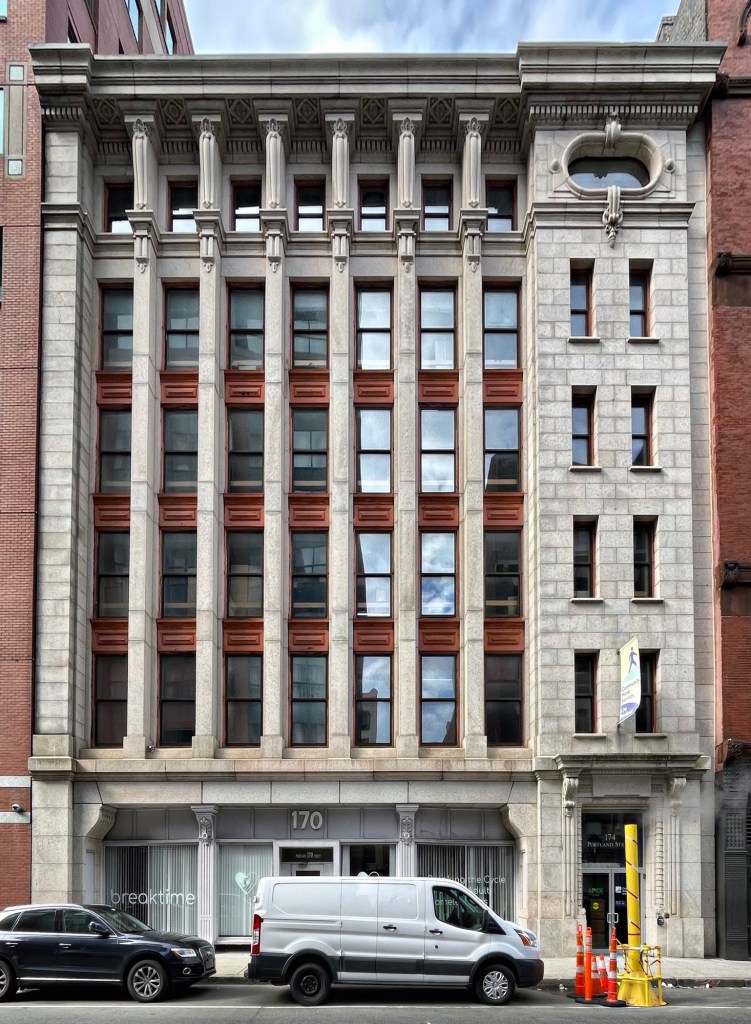
Nearly a decade after the heirs of Peter Bent Brigham and his wealthy estate erected the Peter B. Brigham building in the Bulfinch Triangle Historic District of Boston, they would again develop more of the block the trust owned, building this stately commercial building. Much of the Peter Bent Brigham Building was rented to the Heywood Brothers & Company and Wakefield Company, both furniture makers. Heywood Brothers was established in 1826, Wakefield Company in 1855, with both firms producing wicker and rattan furniture. The companies merged in 1897 and moved into this building constructed by the Brigham estate that same year. The building was designed in a unique version of the Beaux Arts and Classical Revival styles by relatively unknown architect Stephen Russell Hurd Codman (1867-1944), a first cousin of more famous architect and interior designer, Ogden Codman. Stephen Codman opened a firm with the French-born architect, Constant Desire Despradelle, designing some landmark buildings in Boston together. The Heywood Brothers & Wakefield Company Building on Portland Street is a distinctive granite-faced building standing six-stories tall with engaged box columns spanning four floors and dividing the bays of the facade.
The Bulfinch Triangle area just south of the TD Garden in Boston is a cohesive and historically preserved district of similar commercial and industrial buildings of the 19th and early 20th centuries. Somehow, the area has been preserved largely intact besides some sites serving as surface parking lots and some incompatible infill developments. Historically, the area was a tidal flat, before the land here was filled beginning in 1807, with Causeway Street as the northern boundary. The area’s namesake, architect Charles Bulfinch, designed the street layout for the landowners, and the area was filled with material taken by lowering Beacon Hill and Copp’s Hill. Development was fairly slow until railroad companies built depots in the area around present-day North Station, many of which connected the area to cities north of Boston. These new train lines boosted the value of the surrounding land, with manufacturers and developers building factories and hotels in the area. This handsome structure on Causeway Street was built in 1870 by William G. Means, a manufacturer who also invested in real estate in Boston. He commissioned architect Samuel J. F. Thayer to furnish plans for the apartment hotel in the Second Empire style with a mansard roof and window lintels of diminishing detail as the floors increase. In later years, the Arlington House Hotel changed hands and names, later known as the Eastern Hotel and Hotel Haymarket. Stay tuned for more Boston history in this series highlighting the North Station and Bulfinch Triangle district!
For the last on this series of Lost Boston buildings, I present this little-known landmark which was once neighbors to the Old State House. The Pagoda Building as it was named, was located on the corner of Washington and State Streets and was one of the tallest buildings on the street upon completion. The seven-story building of Quincy granite exhibited round arched windows and an interpretation of a belvedere at the roof which served as a penthouse. The building’s upper six stories were residential, including the spectacular Oriental penthouse at the top, with retail space at the ground floor. The architect was a recent immigrant from Britain named GeorgeSnell, who clearly made a name for himself, later entering a partnership with James R. Gregerson. The Pagoda Building, which was originally an early “skyscraper” in Boston was quickly surpassed in height and floor plate size and was deemed inadequate for such a prominent location. It was demolished by 1917.
Founded in 1835, Paine’s Furniture Company was at one time the largest furniture manufacturer and dealer in New England and had a nationwide business. The company was founded by Leonard Baker Shearer, who was joined in business in 1845 by John S. Paine, his son-in-law. Upon the death of Shearer in 1864, the name of the firm was changed to Paine’s Furniture Company. The company occupied a couple wooden and metal buildings on this site in the Bulfinch Triangle until a fire destroyed the complex. The growing firm took this opportunity to hire one of the most successful architect Gridley J. F. Bryant who worked with a colleague, Louis P. Rogers, to design the fire-proof building. The Second Empire style building with mansard roof was split into three sections with the rear two rented out to other companies, while Paine’s occupied the south-facing (main) facade. When Paine’s moved to their new building in the Back Bay, they sold this building and later alterations severely diminished the original design of the building. The current hodgepodge of alterations creates a mess of what was once an undeniable architectural landmark.
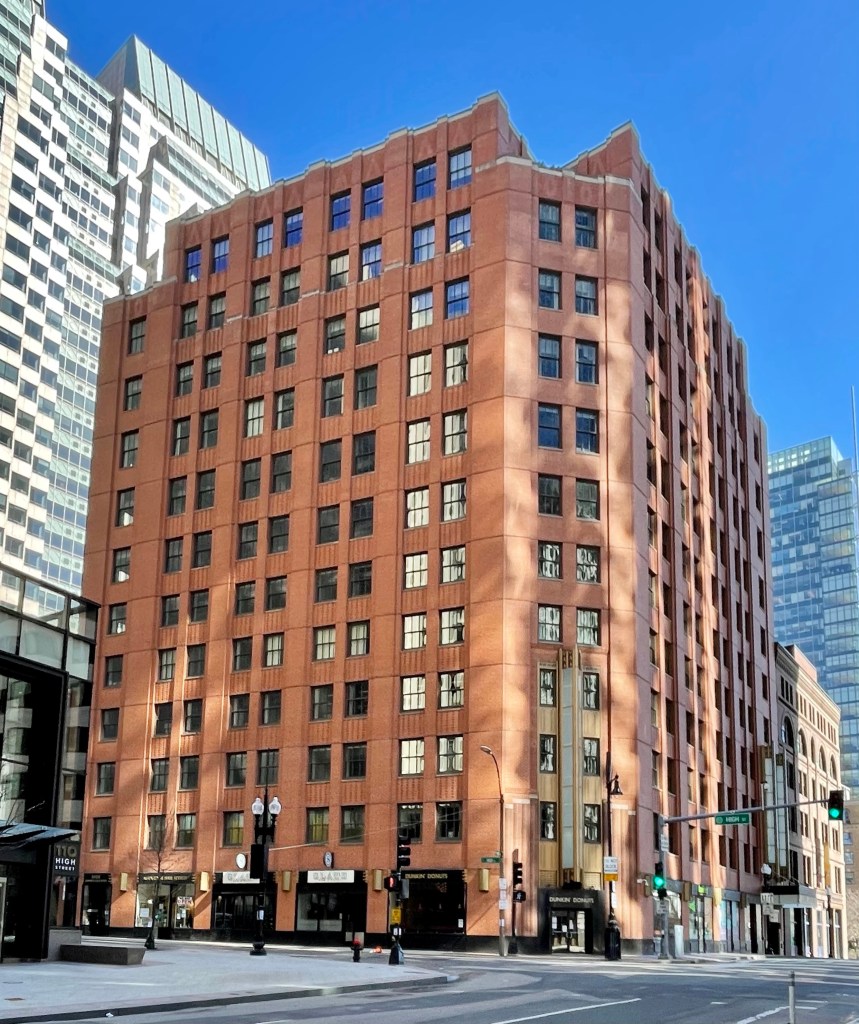
While Boston doesn’t have as many iconic Art Deco buildings as New York or Chicago, we do have some that pack a punch! Located at the southern end of Downtown Boston, the Western Union building at the corner of Congress and High streets served as a headquarters for the third district in Western Union’s eastern division. Western Union was founded in 1851, and ten years later, built the first transcontinental telegraph line. The company made a brief foray into the telephone field but lost a legal battle with Bell Telephone in 1879 and thereafter concentrated solely on telegraphy. In the 20th century, Western Union diversified its operations to include: leased private-line circuitry, a money order service, as well as telegrams and mailgrams. The company’s Boston building was designed at the same time as their New York City headquarters, designed by Ralph Thomas Walker, and the buildings are strikingly similar, just with the Boston building on a smaller scale. The building in New York is among my favorite Art Deco buildings ever, as the use of red brick in varied patterns creates such a stunning composition. Amazingly, in 2004, water infiltration behind the original brick façade of the Boston building necessitated the removal and replacement in-kind of the entire brick façade. The existing signage and light fixtures, designed in the Art Deco style were added at that time.
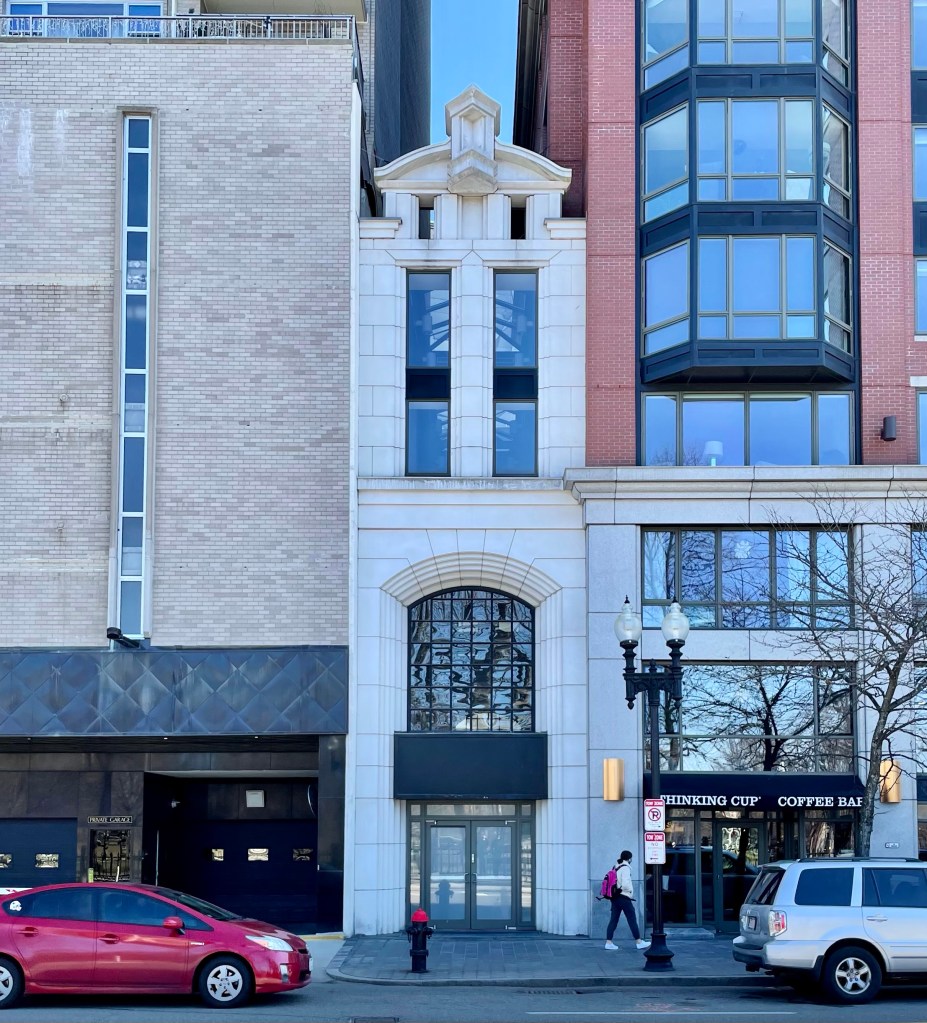
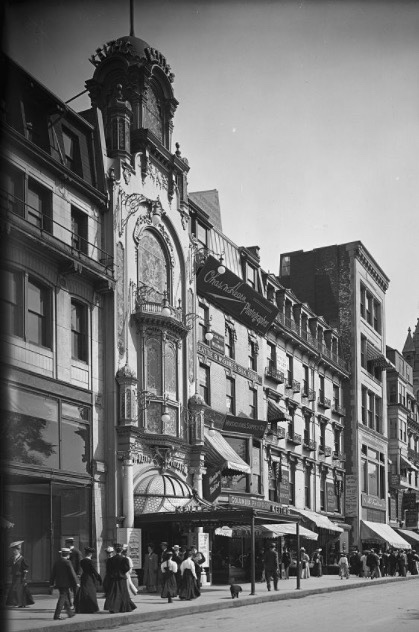
The other day, I was walking in Boston Common along Tremont Street, when I noticed this oddly ornate building wedged between larger, modern buildings. I HAD to investigate! The building was actually constructed as an arcade/covered walkway which ran to Mason Street behind, with a tunnel running under that street into the B.F. Keith’s Theatre. In 1892, Benjamin F. Keith and his business partner E.F. Albee purchased land off Mason Street, a scarcely trafficked street between the busy Tremont and Washington Streets in Boston’s Theater District, with the goal of creating the city’s finest vaudville theatre. The duo hired J. B. McElfatrick & Son, architects who specialized in theatres, to design the new B.F. Keith’s. Due to the site being wedged between two main streets, entrances were built off both Tremont and Washington with flashing lights and marquees, guiding patrons inward. The Tremont facade was especially grand so that B. F. Keith’s New Theatre could be advertised on, and approached directly from, Boston Common, with lights flooding the park. The theater opened in 1894 and was over-the-top with intricate details and sculpture all over, appealing to the city’s wealthy as a place to see the arts. Although it was primarily a vaudeville house during Keith-Albee’s ownership, famed inventor Thomas Edison demonstrated his new Vitascope movie projector here on May 18, 1896. This was the first projection of a movie anywhere in Boston. As live shows made way for motion pictures, the theater adapted, but suffered around the Great Depression when would-be patrons decided to save their limited money. In 1939, the theater was converted to a movie theater named the Normandie. The theater was demolished in 1952 for a surface parking lot to provide better service to the Opera House (originally B.F. Keith’s Memorial Theatre, confusing I know) and Paramount Theater. Today, all we have left of the once beloved B.F. Keith’s Theater is the small annex, which is virtually unrecognizable from historic images as most of its decoration and the top two stories were removed.
Ca. 1910 image courtesy of Boston Public Archives.
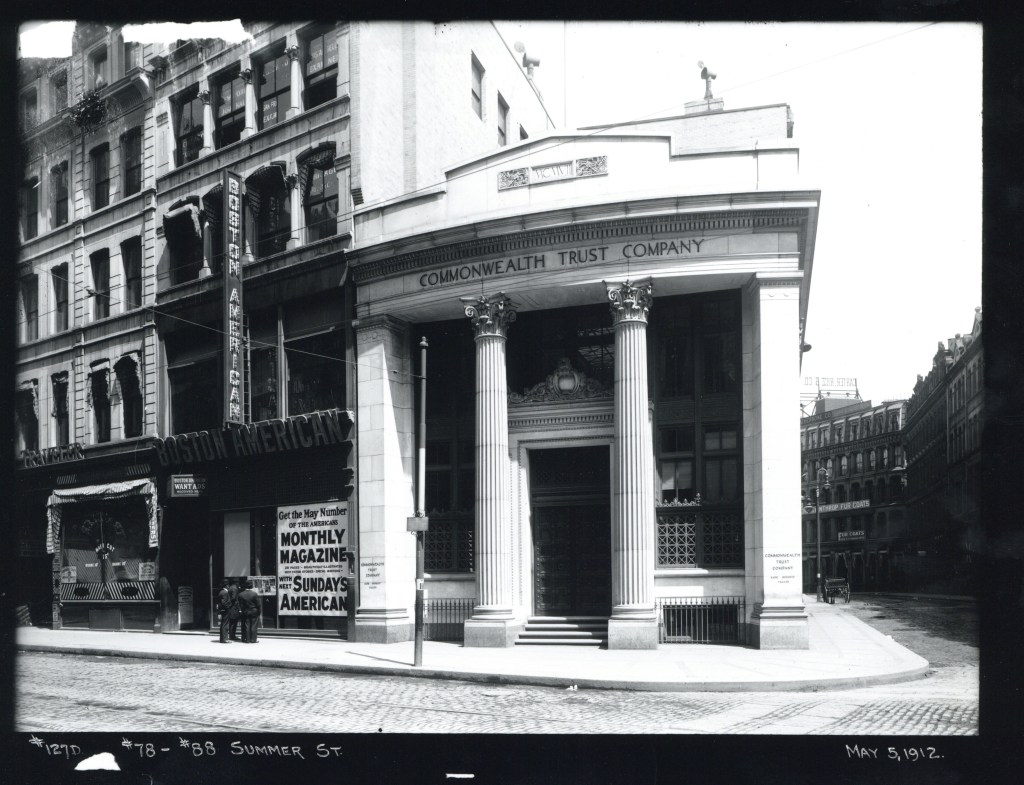
Located at the corner of Summer and Devonshire Streets in Downtown Boston, the Commonwealth Trust Company’s two-story marble banking house commanded the corner, despite its short stature. The building, completed in 1908, was constructed with Lee marble and decorated with ornate wrought and cast-iron grilles over windows. The building was designed by the architectural firm of Parker, Thomas & Rice in the Classical mode with large, fluted Corinthian columns and boxed corner pilasters framing the recessed center entrance, Corinthian pilasters ran along the side facade. At the inside, the building was coated with Cararra and Blanco marble with paneled oak offices. At the ground floor, offices and banking stations framed the outer walls, with the safety deposit boxes located on the second floor. The building was demolished by the 1970s and replaced with a one-story minimalist Modern building (I could not figure out why the former building was razed). The new building was demolished after a few decades with a larger building, better fitting the commercial district.