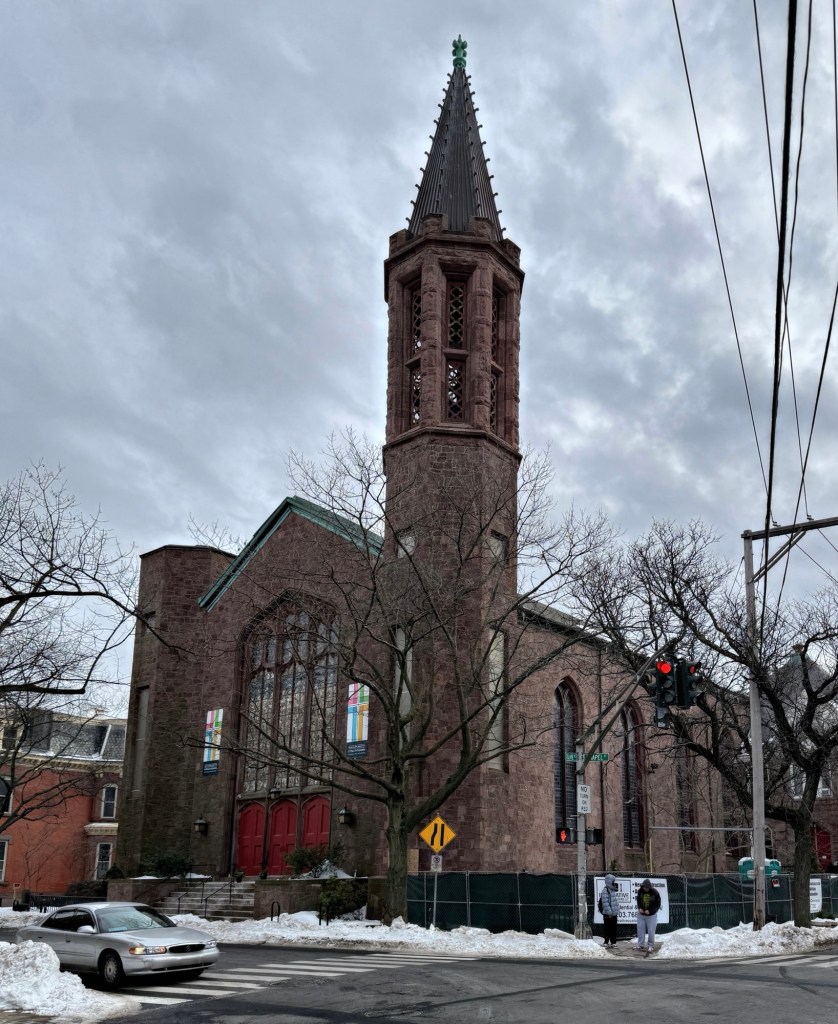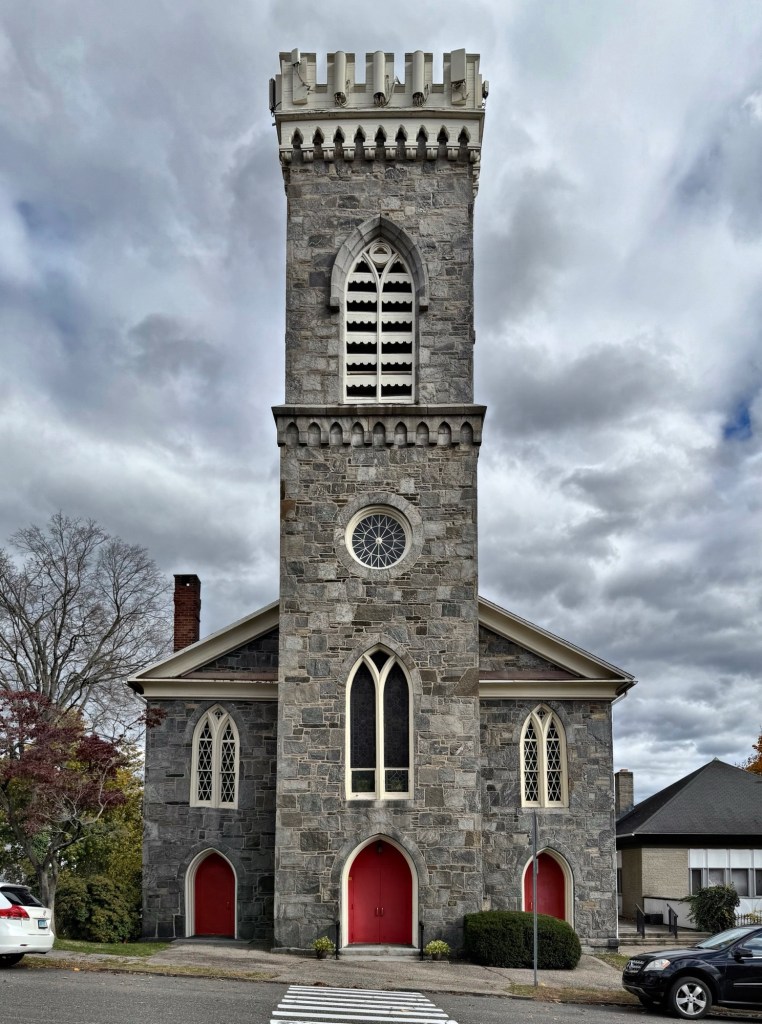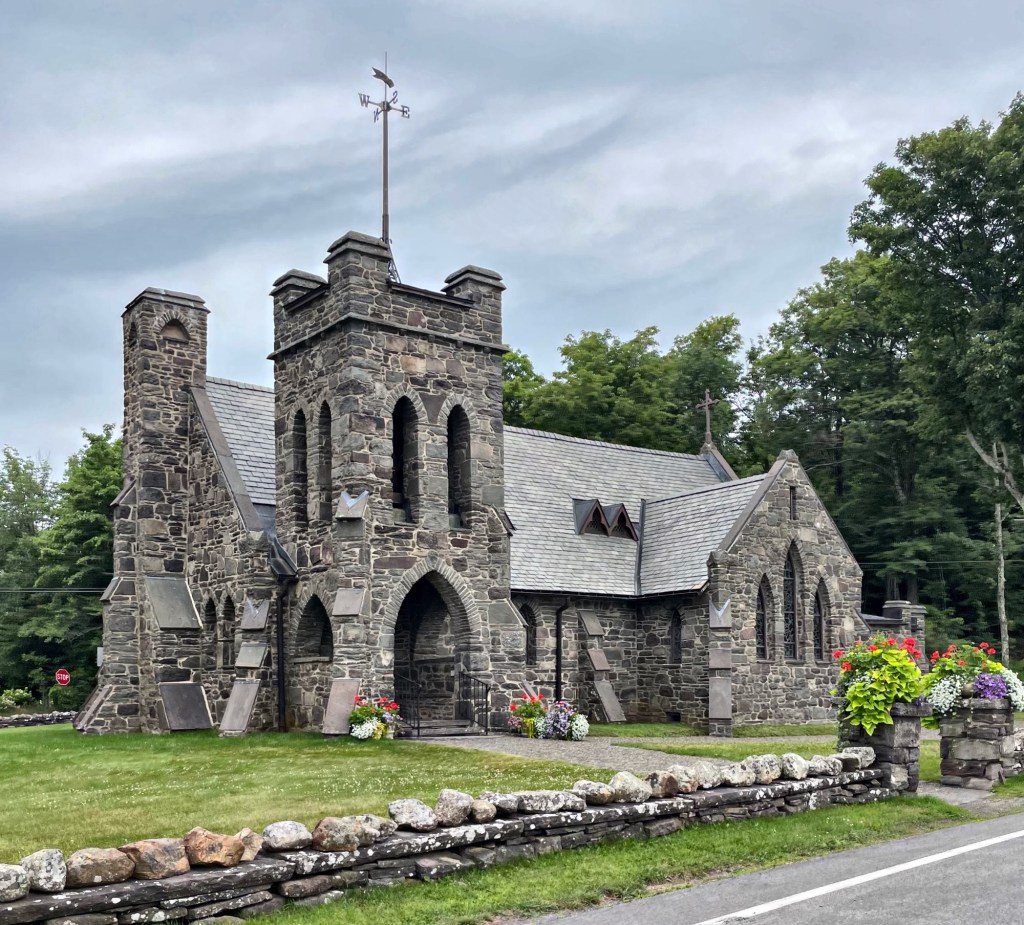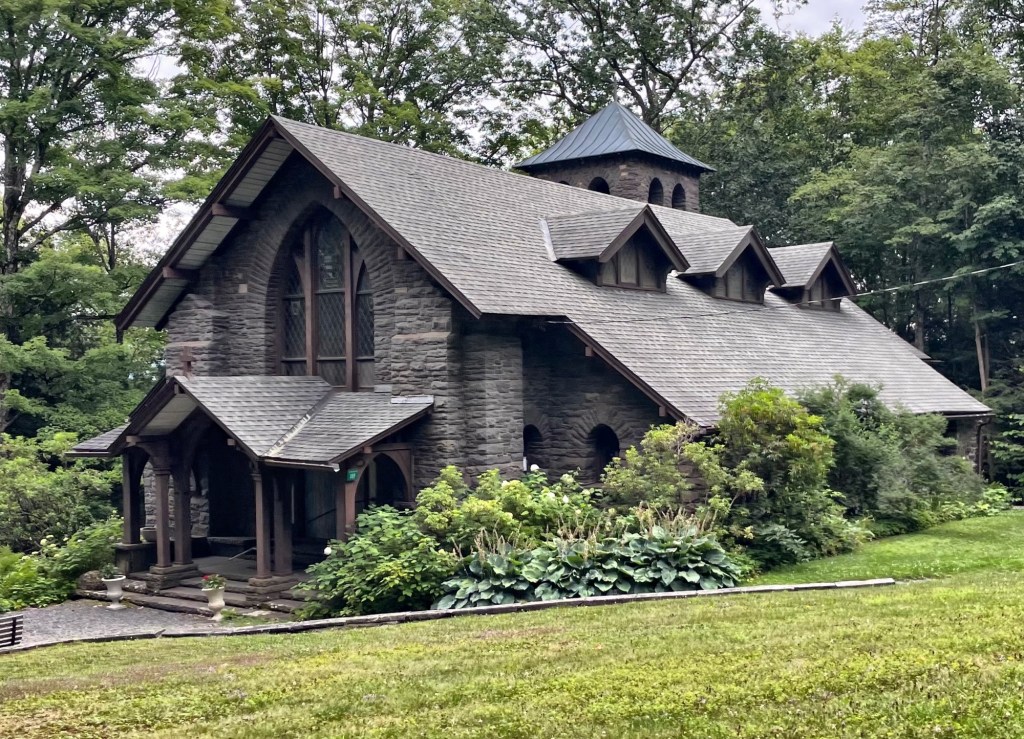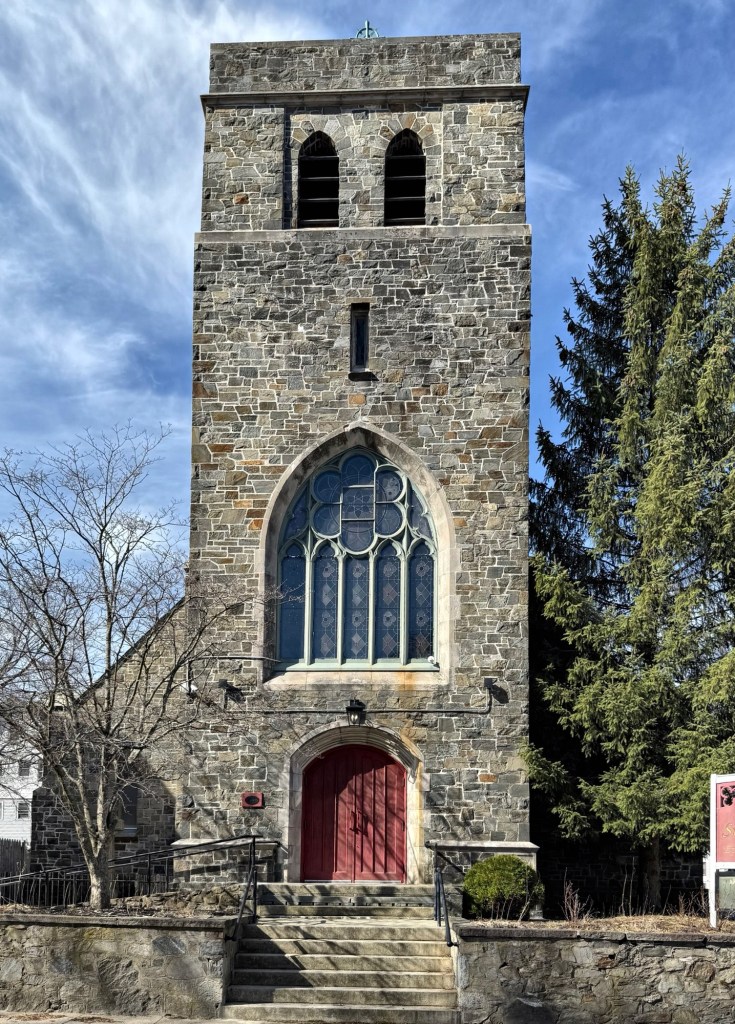
The Gothic Revival style Immanuel St. James Episcopal Church of Derby is a landmark example of the style in this part of Connecticut and serves as the eastern anchor to the Birmingham Green in town. The church dates to 1843 and was built by The stone church was was built by stonemason, Harvey Johnson and Nelson Hinman, a carpenter. The land for the church was donated by Sheldon Smith and Anson G. Phelps, wealthy industrialists in town. The building originally had a wooden steeple, which was replaced by the present stone belfry in 1853. The church merged with another area congregation, which together, have preserved this significant structure, though the communications antennae on the battlements on the belfry is unfortunate.
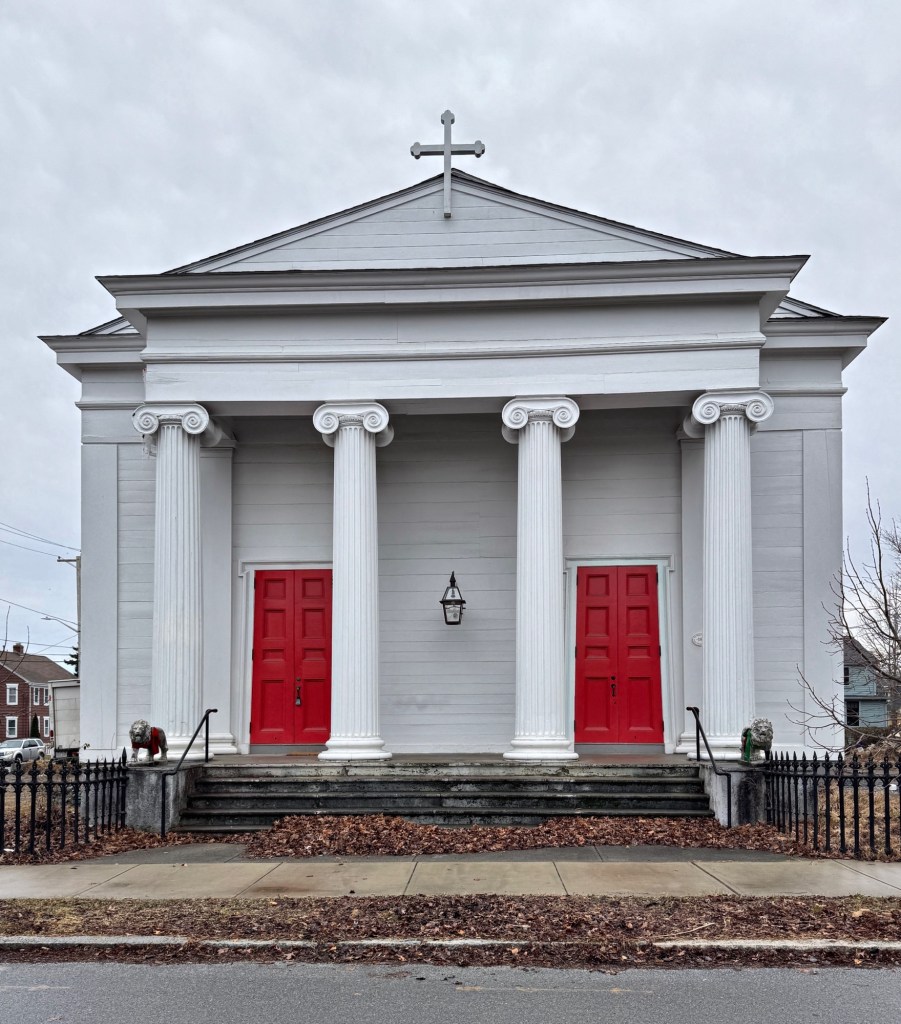
The old St. Stephen’s Episcopal Church in Providence’s Fox Point neighborhood is an architecturally distinctive Greek Revival style church building located on charming Benefit Street. The church had its beginnings in 1839, when the newly established congregation called on 29-year-old Francis Vinton to serve as their first pastor. The congregation funded this small church which broke ground in 1840, and before it was completed, Rev. Vinton resigned as Rector. The building, built of stone and covered in stucco, once had a spire and belfry above the main entrance. The congregation grew over the next decade and it was soon realized that a larger and more central church should be built for members, many of whom were wealthy residents with mansions surrounding Brown College. In 1860, the parish purchased a lot on George Street, and hired architect, Richard Upjohn to design the new church in the Gothic style. For reasons of location, and possibly social class, twenty-two men and women remained here at the less fashionable church and formed a new parish, the Church of the Saviour. The smaller, mission church with its stucco walls, remained until the property was sold in 1932 to house the Barker Playhouse, reputed to be the oldest continuously operating little theatre in the United States.
Onteora Park is one of many notable summer colonies in the Catskill Mountains that were developed in the late 19th and early 20th century. Onteora Park is located in Hunter, New York, and is comprised of a development of over 100 residential properties along with club buildings and the All Souls Church. The development of Onteora Park is largely credited to Ms. Candace (Thurber) Wheeler, one of America’s first woman interior and textile designers and co-founder of the Society of Decorative Art in New York City. In 1883, she and her wealthy brother, Francis Beattie Thurber, purchased land here with sweeping views of the Catskill Mountains, and built two summer houses for their respective families. By 1887, Candace Wheeler and her sister-in-law, Jeannette (Mrs. Francis B.) Thurber, decided to expand and develop their property as a vacation community of like-minded people dedicated to the arts. Years after the first cottages were built, Candace asked her son, Dunham Walker, an architect, to furnish designs for a community summer chapel. After the site had been secured, Canadian architect (and summer resident of Onteora) George Agnew Reid, was asked to put Mr. Wheeler’s plan into acceptable form and to supervise construction. The original wooden church was changed over to stone, all in a Victorian Gothic style. By 1910, the building was enlarged with the addition of the chancel and addition of transepts and possibly the square bell tower. At this time, the church was also electrified. Today, the church is lovingly maintained and open for the summer season and special ceremonies.
The Memorial Church of All Angels is located in the center of the summer colony of Twilight Park, found in the town of Hunter in the Catskill Mountains. The founding of the church began shortly after the colony was established in 1888, when two years later, the Rev. H. M. Baum from Evanston, Pa., an early visitor to the Park, realized the need for an Episcopal Church, and funds were raised to build a small chapel, known as the St. Paul’s Church. The church was foreclosed upon in a matter of years. In 1895, church services were again reinvigorated when the Rev. Henry Yates Satterlee, the first bishop of Washington, then the Rector of Calvary Church, New York, had taken the cottage of his cousin, the artist Walter Satterlee, for his summer home. He set out to establish a summer chapel for Episcopalians in Twilight Park, and he hired architectAlexander Mackintosh, to furnish plans for the church. The church opened in 1896, and it would be expanded in 1909 with an addition and porch and again in 1915 with the belltower. The church opens every summer for services and is one of the finest Episcopal chapels in the Northeast.
Tucked away in the middle of a residential neighborhood in the dense city of Central Falls, Rhode Island, this Neo-Gothic style church more closely resembles an English country church than one typically found in a dense, industrial city. This is the St. George’s Episcopal Church, located at the corner of Central and Clinton streets, and built for the local Episcopal congregation there in 1922. The church was designed by the Rhode Island architectural firm of Clarke & Howe and is built of rough-faced stone with limestone trim. The highlight of the design is the large central tower with lancet, stained glass window, and belfry.
The St. Peter’s Episcopal Church of Salem, is a landmark example of a granite, Gothic Revival church of the 19th century. The present church, which is constructed of Cape Ann granite, was the second church on the site built for local Episcopalians, replacing a wood-frame building constructed there 100 years prior. Designed by architect Isaiah Rogers, the Gothic church features a prominent entry tower with a quatrefoil window in each elevation, large lancet-arched windows in the tower and lining the sanctuary, and a crenelated parapet. When completed, St. Peter’s had Salem’s first church bell, an 1740 English bell that supposedly still graces the tower today and is said to be the oldest church bell in the United States! In 1871, the rear chapel was added to the building, from plans by George E. Harney. The chapel was built directly over the old parish cemetery, requiring some of the tombstones to be placed inside the chapel walls, while others were moved to the front of the church, creating a really unique “garden cemetery” in front of the church.
Possibly my favorite type of building in Maine are the historic Episcopal summer chapels that sprouted up along the coast in the late 19th and early 20th centuries. This is the All Saints by-the-Sea Episcopal Church of Southport, Maine, an island community with many summer residents. This church had its beginnings when Reverend John Thomas Magrath of Gardiner, Maine, would visit Southport in the summers and hold services for rusticators under the oak trees or in the cottage living room if the weather was poor. Eventually, a member of the congregation purchased a lot on the east side of Southport on the rugged coastline, and planning began for a chapel. In 1905, the chapel was designed by architect, Albert Hall in a rustic blending of the Shingle and Tudor styles. The building exhibits shingle siding with half-timbering, the original diamond-pane windows, and a large entry porch off the entrance.
Tucked away off Broad Street in the Danielson village of Killingly, Connecticut, you will find this charming and eclectic church building, long-occupied by the St. Alban´s Episcopal Church. Episcopalians began congregating in the town in the 1860s, and it would be in 1865, when an old academy building on this site was acquired and converted for use as an Episcopal church. By 1891, the relative prosperity of members of the church made it so a new church building was to be built on the site. Worcester-based architect Stephen C. Earle was hired to furnish plans for the new edifice which is eclectic with Victorian Gothic and Shingle style elements. The congregation appears to have either disbanded or merged with a nearby church as the building does not appear to be occupied.
In 1891, a proposal was made to build a summer Episcopal chapel, to be known as St. Christopher’s by the Sea, on Grindstone Neck in Winter Harbor, Maine. This project was supported by local area residents and by the summer community on Grindstone Neck. The construction of the church started in 1892, but it was not until August 6, 1893 that the first service was held in the chapel. The Rev. Julius Atwood, rector of St. James’ Church in Providence, Rhode Island, officiated and preached the first sermon. The church was designed by Lindley Johnson, a Philadelphia-based architect who also summered in a cottage on Grindstone Neck and designed other cottages in the colony. The Shingle style chapel is architecturally unique and rustic, a quality which is also visible at the interior, which is rustic in appearance with exposed beams and shingled walls.