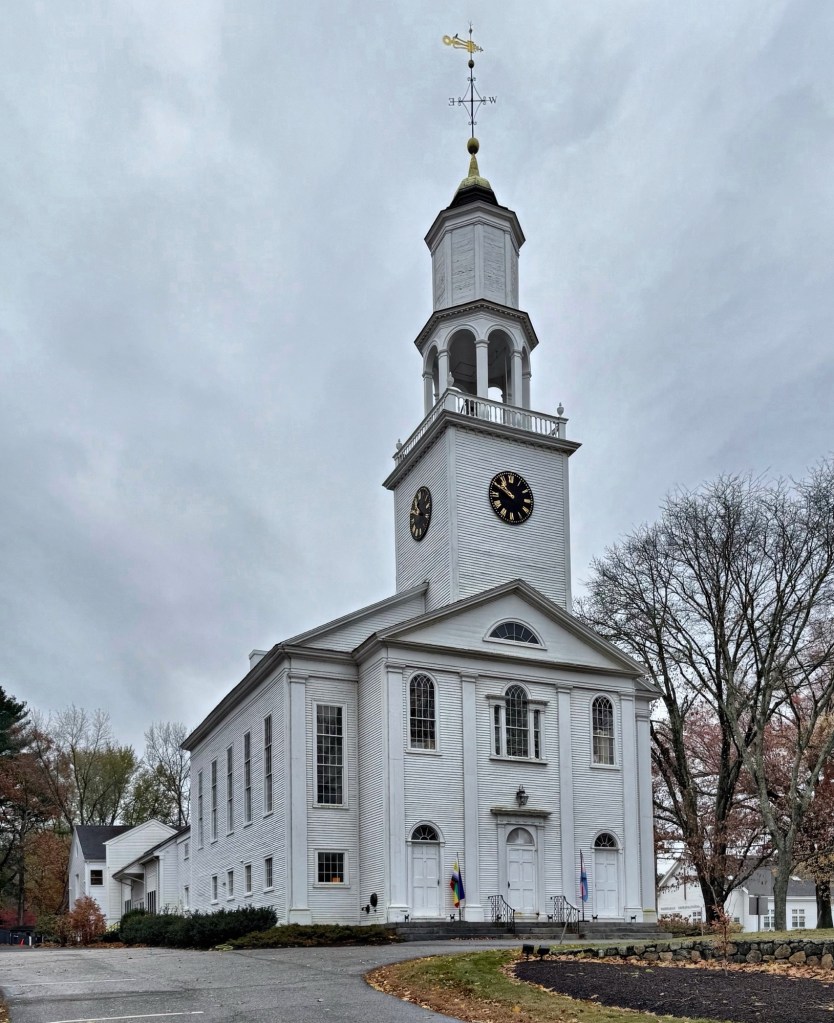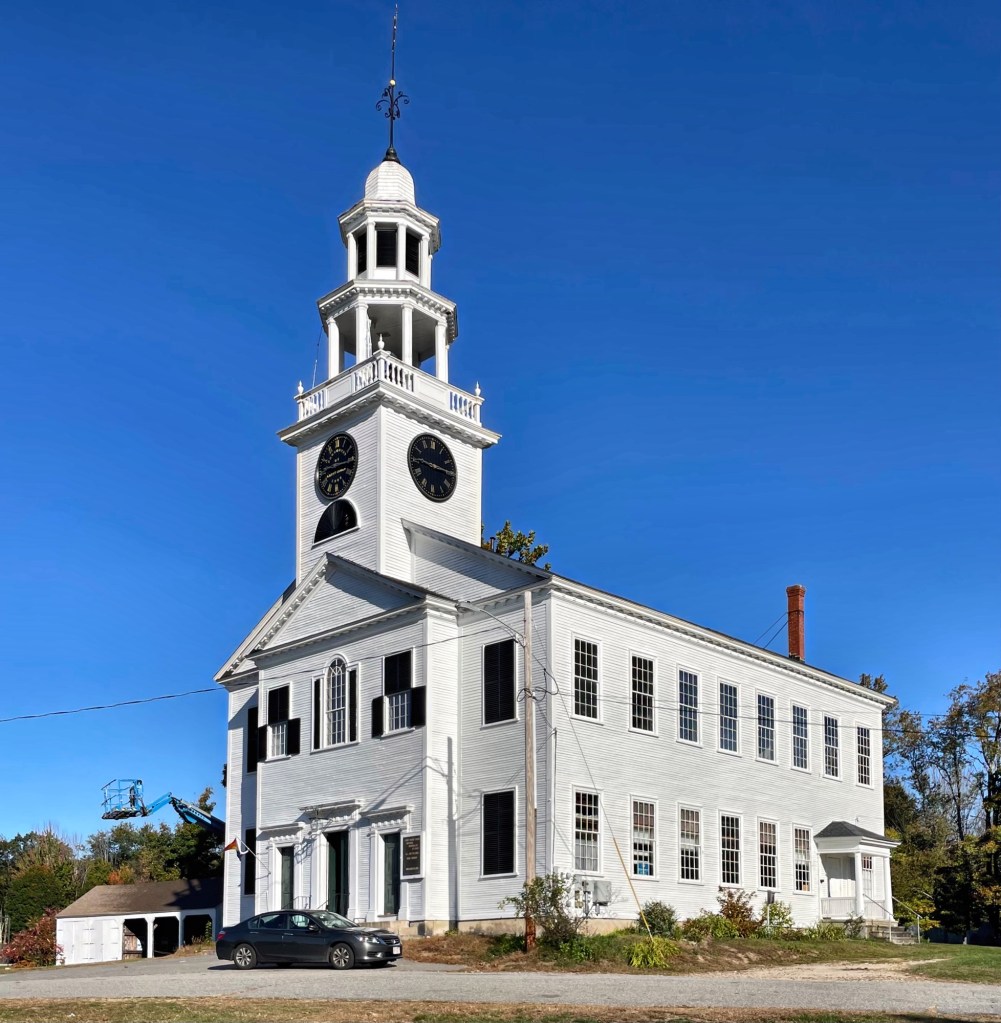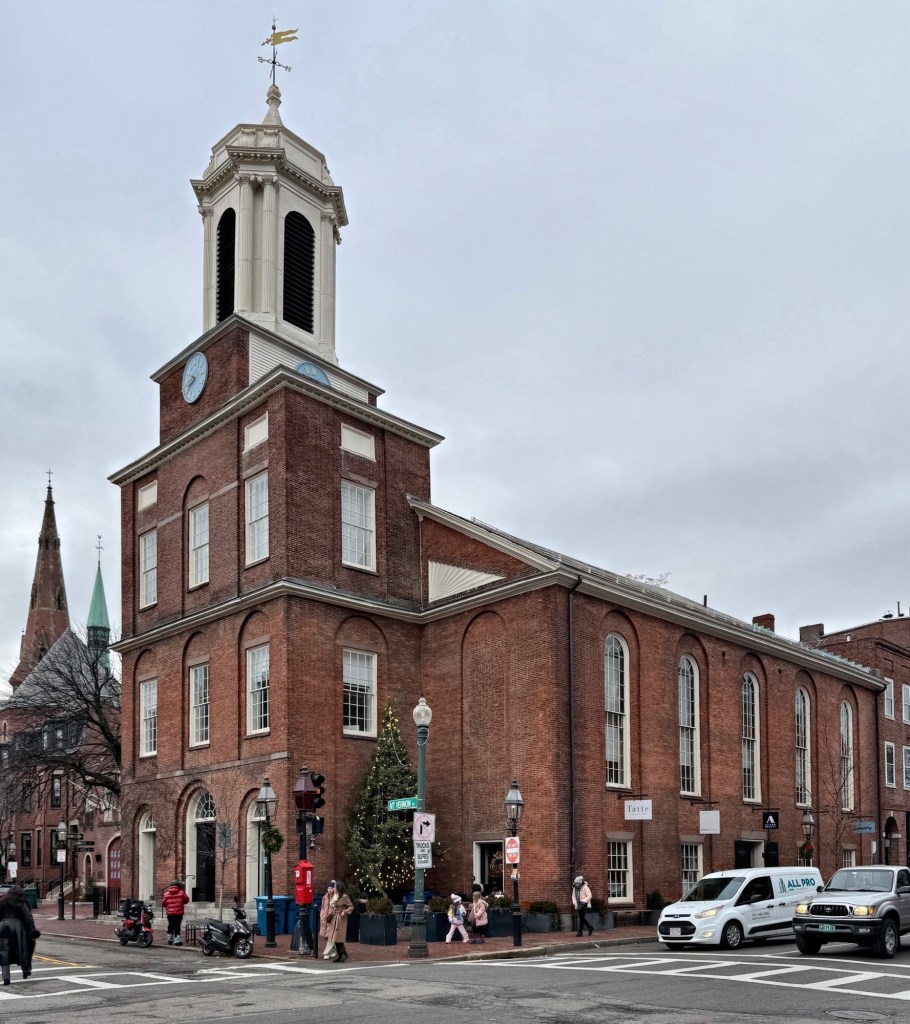
First Parish Church, Wayland // 1814

The First Parish Church of Wayland, Massachusetts, is an iconic church that displays the typical early 19th-century meetinghouse form with Federal-style elaboration. Built in 1814, the church is two-stories with a five-bay gabled-front structure with a projecting enclosed portico of three entrance bays, and a four-stage bell tower that rises above the façade. Today known as Wayland, the town was originally called East Sudbury, after it split away from the western parish in 1780. In 1835, members of town meeting voted to rename East Sudbury “Wayland” in honor of Dr. Francis Wayland, a temperance advocate, abolitionist, and then president of Brown University. The First Parish Church of Wayland was built by Andrews Palmer of Newburyport, who used an Asher Benjamin design. The bell was cast by Paul Revere and Sons and first lifted into the bell tower in 1814. The property also includes the historic, twelve-bay horse/carriage sheds where parishioners would “park” their horses and carriages while attending services.

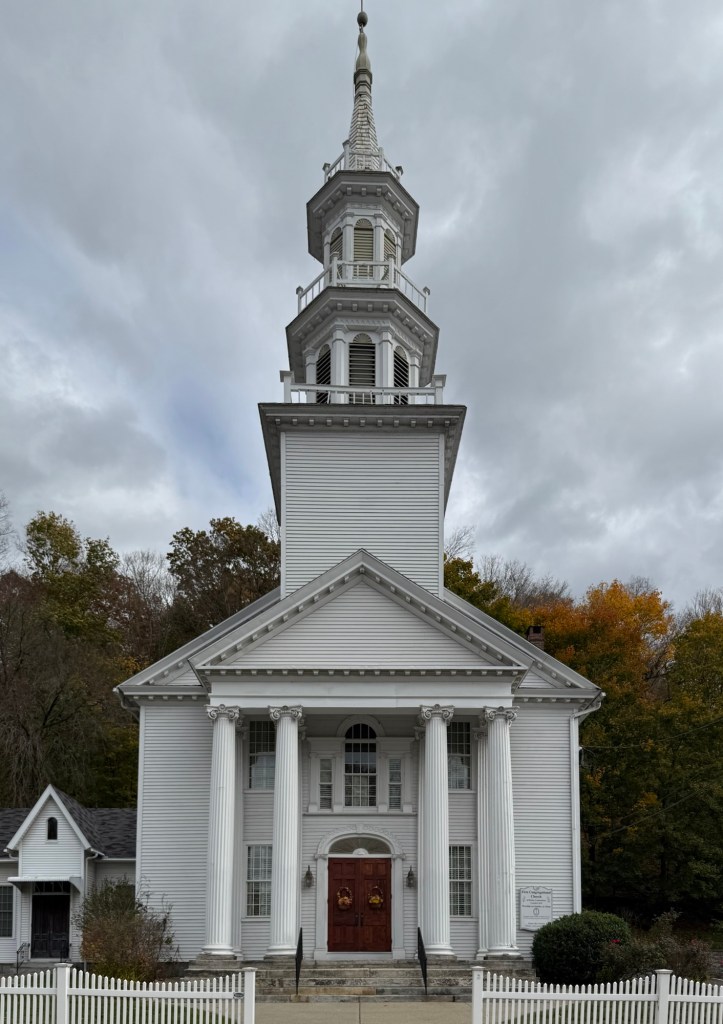
First Congregational Church of Derby // 1821

Derby, Connecticut was settled by colonists in 1642 as a trading post with local Native people under the name Paugasset. The community was eventually named after Derby, England, in 1675 and incorporated 100 years later in 1775. Like all communities in New England, it was required to have a meeting house, where religious services and town business would take place. Derby had its first meeting house built in 1681, a rustic, square structure which was eventually replaced with a new meeting house on “The Common”, now the East Derby Green. The building served its purpose for over 100 years, with sermons led by Rev. Daniel Humphreys (1706-1787) for 54 years. In that church, his son, David Humphreys (1752-1818) was baptized, he later became George Washington’s aide and most trusted general, later becoming the first presidential speech-writer. That meetinghouse was eventually outgrown, and the present Congregational Church of Derby was built on its present site on the eastern banks of the Naugatuck River in 1821. The Federal style church building was built by Williams and Barnum from Brookfield, who likely utilized plan books by Asher Benjamin for the finishes. The Congregational Church of Derby has watched as the commercial “downtown” of the city shifted to the other side of the river and has stood here for over 200 years as a landmark of “old Derby”.

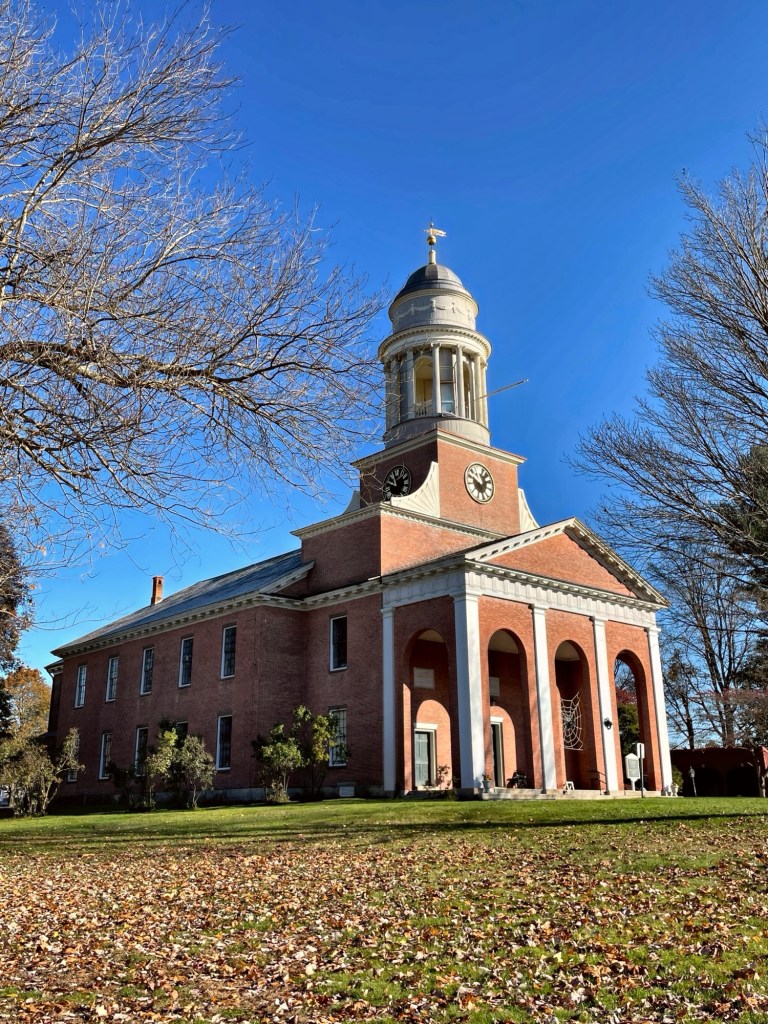
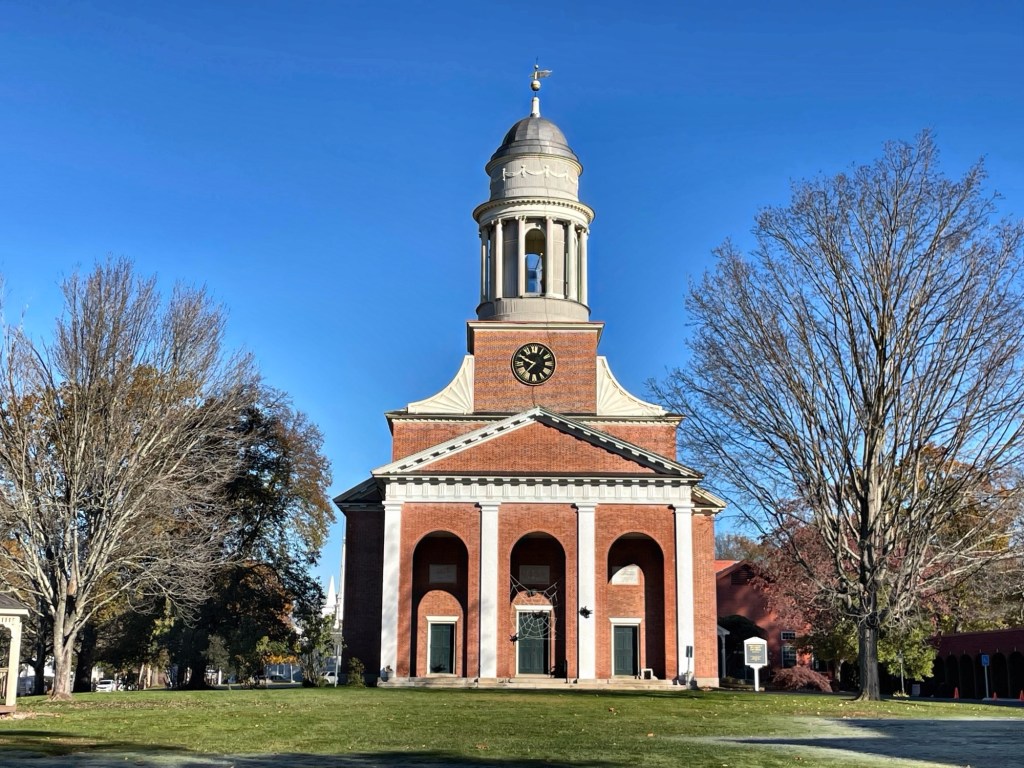
First Church of Lancaster // 1816

Built in 1816, the First Church of Lancaster is one of just two extant church buildings designed by famed American architect, Charles Bulfinch, and is said to be one of the finest churches in the Federal style in the United States. The fifth meetinghouse of the Unitarian First Church of Christ in Lancaster, this building was constructed of local brick, slate, and lumber from master-builder, Thomas Hearsey. Hearsey is said to have modified Bulfinch’s design, which had proposed one tall center arch flanked by two lower arches to reflect the unequal heights of the three vestibule doors behind them; instead going with three, identical arches. Other than this change, the church remains substantially as originally built, even without artificial lighting or central heat inside. Besides the iconic arched portico, the two- stage brick tower topped by a beautifully proportioned wood cupola surrounded by Roman Ionic columns, and fronted by a giant arcuated portico, is especially noteworthy. The congregation, which dates back to 1653 as a Puritan congregation was the first parish established in Central Massachusetts and remains active to this day.

Chester Congregational Church // 1828

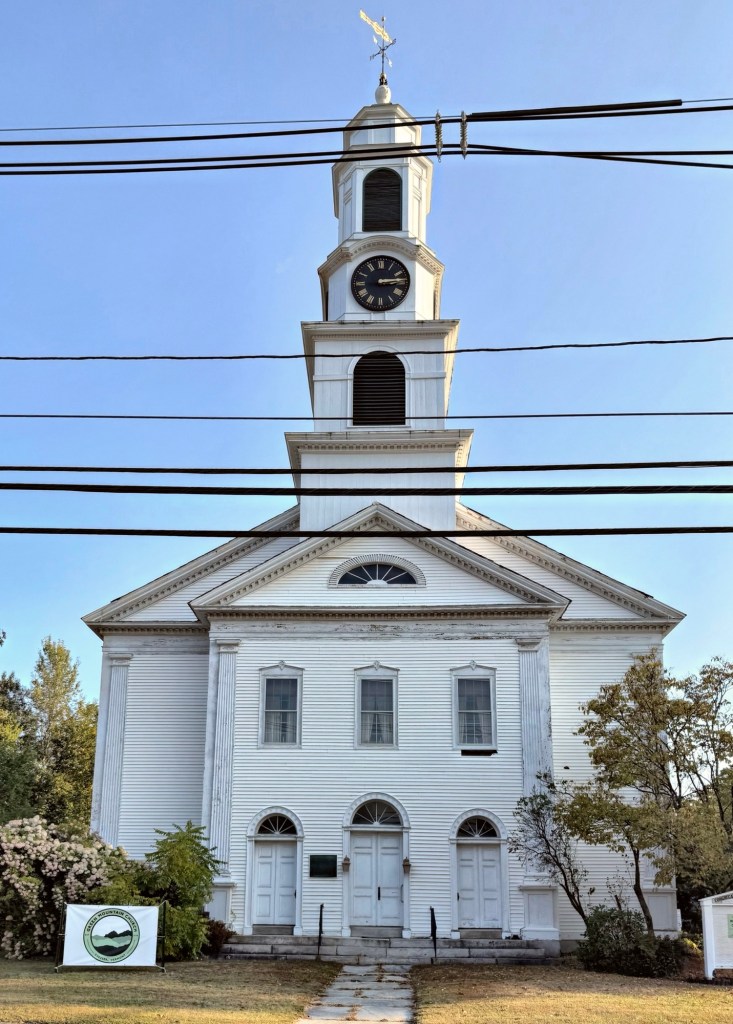
A significant landmark in Chester, Vermont, the Congregational Church of Chester is a sophisticated interpretation of ecclesiastical Federal architecture. Built in 1828, the soaring, five-stage clock-and-bell tower with bellcast cap and weathervane rises above a pedimented three-bay entrance pavilion with semi-elliptical fanlight, a common motif in the style. It is believed that local carpenters, Comfort Carpenter Dresser and his son, Charles Dresser, built the church, likely from planbooks for specific details. The church originally served as the Union Meeting House for Congregational, Methodist, and Universalist parishioners until around 1848, when other churches set off to build their own structures, after this, the Congregationalists remained here. Today, due to years of dwindling membership and a small population in the surrounding area, the church is “replanting” to reactivate membership and realign with community needs. Hopefully this significant church will be preserved in the future, possibly through preservation grants!

St. John’s Church, Portsmouth // 1807

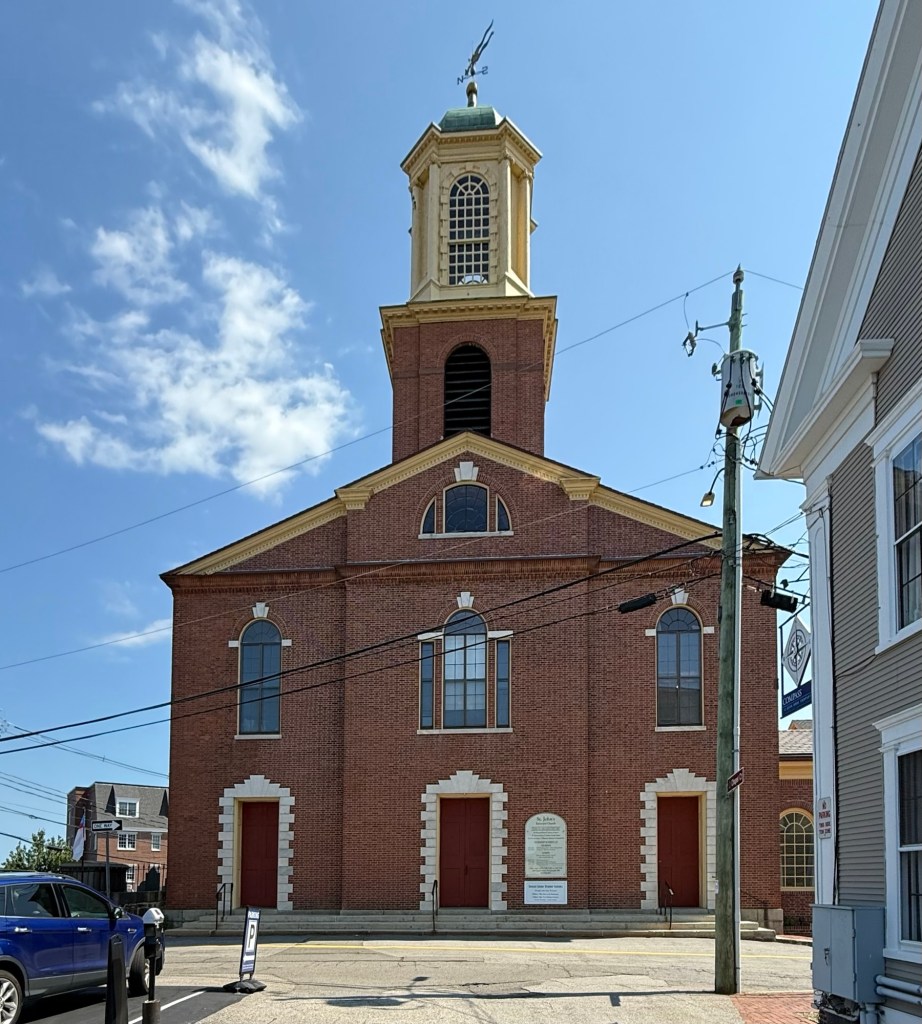
St. John’s Episcopal Church is located on Chapel Street, atop Church Hill near the historic commercial center of Portsmouth, New Hampshire. A church has been located on this site since 1732, when British Anglicans built Queen’s Chapel here. It was named “Queen’s Chapel” after King George II’s wife, Queen Caroline, who donated many fine gifts to help the new parish. The congregation increased in growth alongside the community until a tragic fire on Christmas Eve in 1806, which destroyed over 300 buildings in Portsmouth including the original wooden structure of St. John’s and most of its contents. The parishioners immediately began to raise funds to erect the present brick church, with its cornerstone laid in June 1807. The Federal style church was one of the first known buildings by architect-engineer, Alexander Parris, in the time before he moved to Boston, designing many iconic buildings there. St. John’s Church of Portsmouth stands as the oldest Episcopal Parish in New Hampshire and was individually listed on the National Register of Historic Places in 1978.

First Universalist Church of Salem // 1808

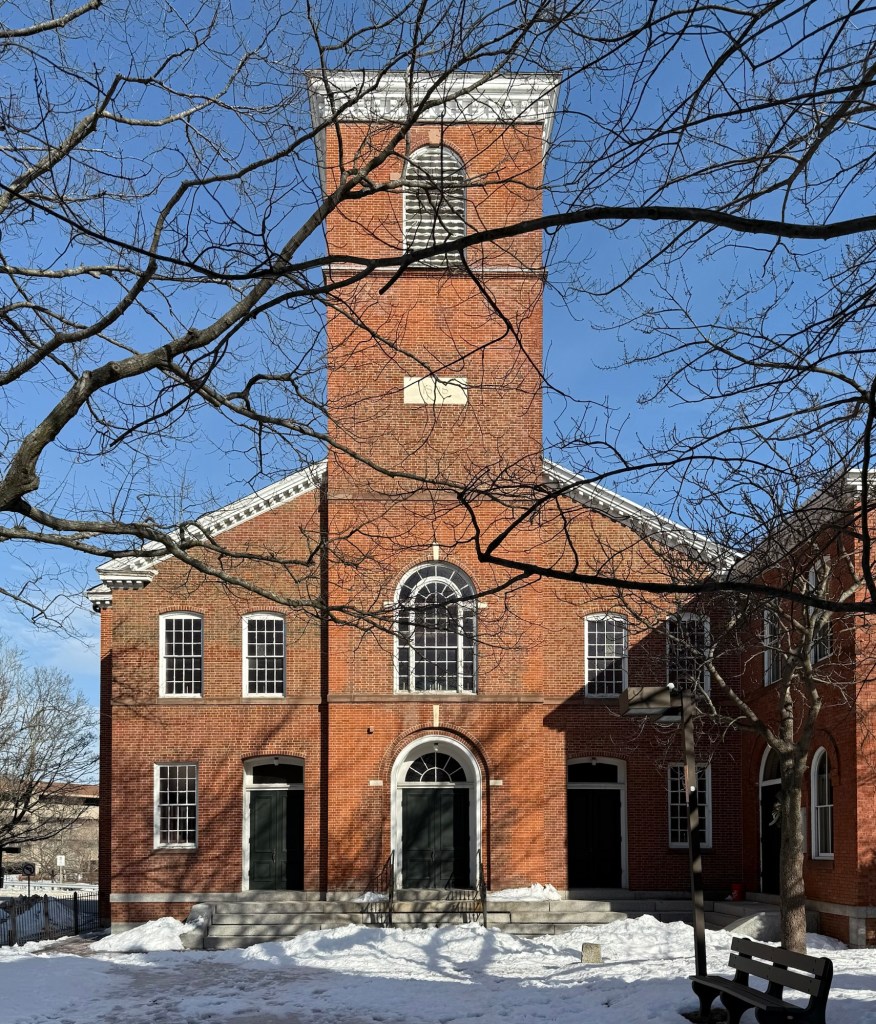
The First Universalist Church of Salem, Massachusetts, is a landmark example of a brick, Federal style church in New England. Tucked away within a network of Urban Renewal-era townhomes and backing up into a busy thoroughfare, the church is overlooked by many who pass behind its rear elevation, not knowing how special the building’s primary facade truly is! The church was constructed between 1808-1809 with early Church records showing that the interior carvings were done by Samuel McIntire, a Salem native, who was trained as a wood carver and later became an architect. It is unclear if any of McIntire’s work remains as numerous building modifications were completed throughout the 1800s; including a major exterior remodel in 1855 by architect Enoch Fullerchanging the appearance from Federal to Italianate. The church would again fall back to changing tastes in 1924, when they restored to an approximation of its original appearance by the office of R. Clipston Sturgis, a prominent Boston architect who specialized in Colonial Revival architecture. While the building’s significance is lessened by the urban renewal infill and streets surrounding it, the building remains one of the oldest in Salem and a significant architectural landmark in the city. 

North Cornwall Congregational Church // 1826

During the nineteenth century several small rural settlements dotted the landscape in Cornwall, Connecticut. In 1782, a group of “strict Congregationalists” seceded from the established Congregational church in town and constructed a “second” church in Cornwall Center. Following this, the town was divided into north and south parishes, with First Church built on the town center and the Second Church, this building, constructed in North Cornwall village in 1826. The North Congregational church is among the town’s finest Federal style buildings in the region and features three entrances with fanlight transoms and the bays of the facade are broken up by two-story fluted pilasters.

First Parish Church of Ashby // 1809

Welcome to Ashby, Massachusetts; a rural and historic town that was first settled in 1676 but due to the continued threat of native hostilities, permanent European settlement in the town did not occur until about 1750. The town incorporated in 1767 and was reputedly named for the abundance and quality of white ash trees found in the area by early settlers. Today, the town has just over 3,000 residents. At the center of the town village, the First Parish Church of Ashby stands as a significant Federal-period meetinghouse, and an integral piece of the town’s history. The present building was constructed in 1809, replacing an earlier structure from 1771. Carpenters for the building were Joseph Kendall and Darius Wellington of Ashby, who utilized plans from Asher Benjamin’s American architectural pattern book of 1797. Facing the town common, the church is a two-story gable front building with a three-stage tower including an octagonal open belfry rising from the pedimented front pavilion.

South Britain Congregational Church // 1825

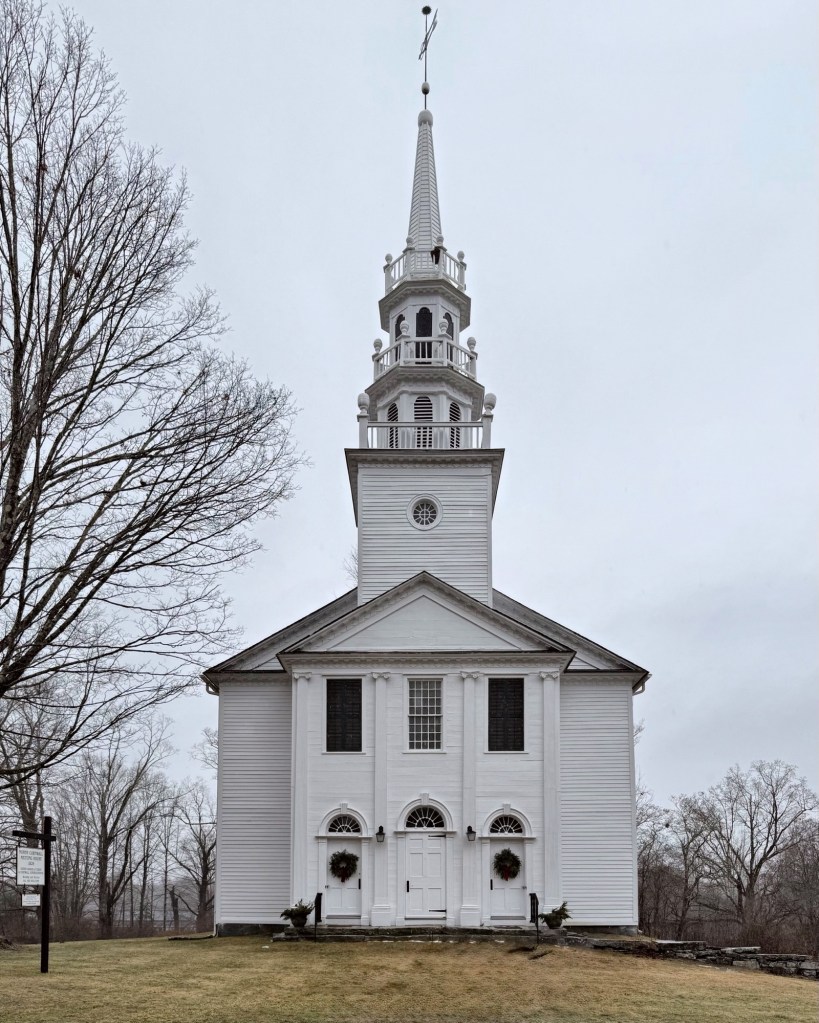
The South Britain Congregational Church in Southbury, Connecticut was built in 1825 and was originally known as the Meeting House of the South Britain Ecclesiastical Society. The congregation dates back to 1766 and its first pastor, Jehu Minor, a Yale educated minister from Woodbury, was chosen in 1768. Members met at the Moses Downs House before its first meetinghouse was built in 1770. When the pre-Revolution church building was deemed inadequate, funds were raised to erect a new house of worship. In 1825, boards and other usable parts from the old building were used to construct the present Federal style church that stands in the middle of the village today. History states that pulleys were attached to an ox cart to hoist the bell up the steeple which is by far the tallest structure in the neighborhood. It is an exceptional example of the Federal style, with beautifully balanced proportions, a front pavilion, fine detailing and an elegant three-story steeple. The church made more history when in on September 25, 1937, 178 acres of land in Southbury, Connecticut was purchased for the German-American Bund, intent on building a Nazi camp. Similar camps were popping up around the nation, in an effort to promote an anti-semitic and pro-Nazi agenda. Led by Reverend Lindsay, the pastor of the church, the townspeople quickly established a zoning commission whose first ordinance forbade land usage in the town for “military training or drilling with or without arms except by the legally constituted armed forces of the United States of America.” Stunting the proliferation of nazism in Connecticut before WWII. This is why Southbury is sometimes known as “The town that said no to the Nazis”.

Assonet Congregational Church // 1808

The Assonet Congregational Church, now the United Church of Assonet was originally known as the Town Church and was organized in 1704. In 1807, fifteen residents of town, all from prominent families, gathered to ‘‘manifesting the desire to enter into a Church estate.’‘ Land was deeded to the church in 1807, and the Federal style edifice was constructed the next year. Documentation on its construction is limited, with research stating, “we can only speculate on the construction of this beautiful Church
building. It is believed that Ebenezer Peirce (1777-1852) of Assonet and Middleboro was the master builder assisted by ship builders of the village. Mr. Peirce sent his sloop “Unicorn” to the Penobscot River region in Maine to procure most of the lumber.” The church is in great condition today, even retaining its bell, cast by Paul Revere, and original box pews. Sadly, in October 1910, the steeple was struck by lightning and the acorn top blew off. The 1880s clock was damaged but repaired. The steeple was re-installed or reconstructed, but deferred maintenance required the church to remove it and the Revere bell in the early 2000s until funding could be gathered to restore, nothing yet. What I wouldn’t do to see the original acorn top of this steeple again!