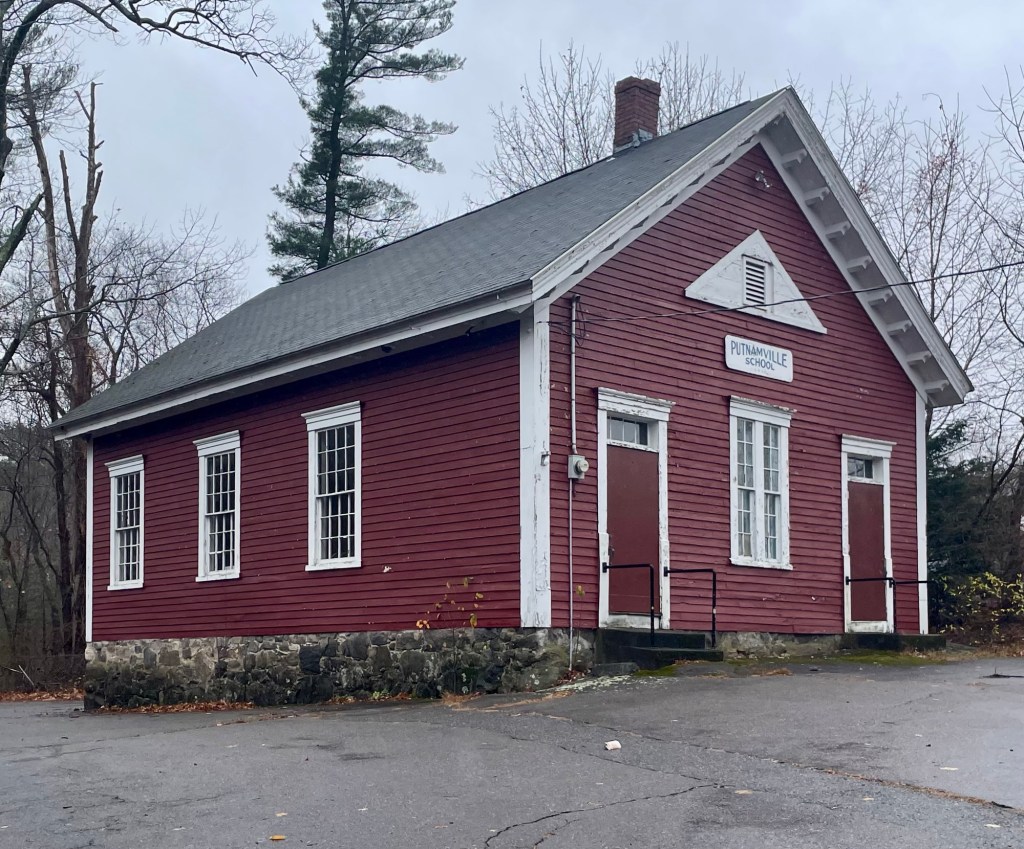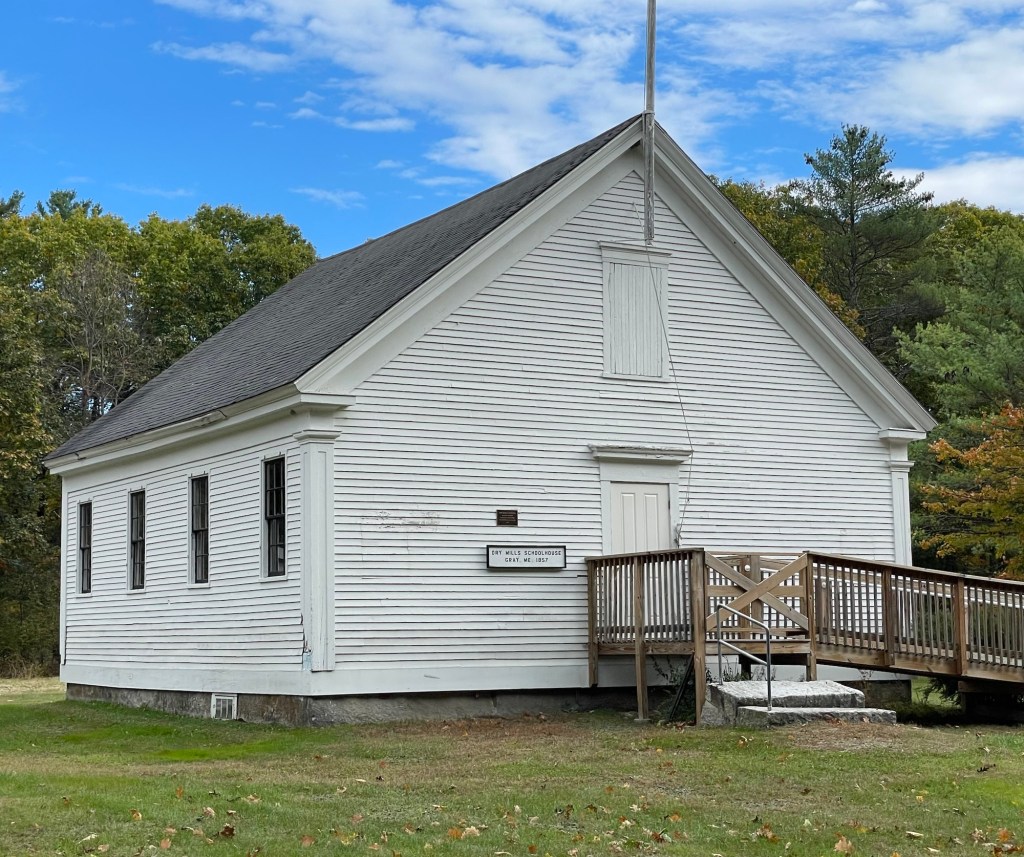
Dry Mills Schoolhouse // 1858

Before the use of automobiles for everyday use, the winding roads in towns all over New England were once lined by charming one-room schoolhouses, to educate children without forcing them to travel too long of distances (like many of our parents and grandparents who had to walk to school uphill both ways!) The Dry Mills School was built by 1858 and is the last one-room schoolhouse of twelve that were built in Gray, Maine. All of the others have  been sold by the town, converted into houses, and/or torn down.  The school was in operation from before the Civil War until it closed its doors to public education in 1958.  In the early 1990’s, at a cost of $12,000, the building and the original granite slab foundation were moved to their current location on the Maine Wildlife Park Road and has been restored to its original appearance thanks to local residents who advocated for the preservation of the building. The interior retains an original chalkboard, period wood stove and furnishings. Today, it is a living museum, attesting to the educational environment in the mid 1800’s and was listed in the National Register of Historic Places.

Old New Ipswich Center Schoolhouse // 1829

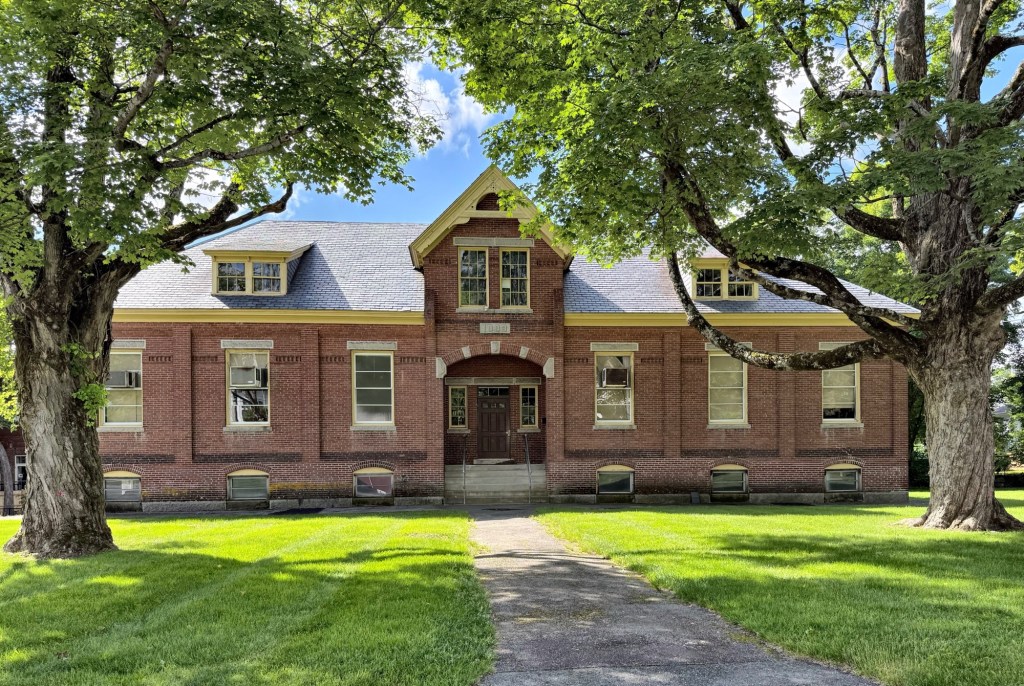
Presently owned and occupied by the New Ipswich Historical Society, this handsome brick building was originally constructed in 1829 as a schoolhouse for young students in town. The structure is located on Main Street and replaced wood-frame school that was located on the other side of the road. Almost immediately after it was built, the building and its location were heavily criticized as early as 1847. There were up to 92 pupils in its two rooms, both of which were accessed by a central entrance, causing those entering and leaving to disrupt both classrooms. Additionally, the closeness to the road caused noise and dust to enter the classrooms. The school closed in 1860 and was used for a time as a blacksmith shop before it was acquired by the New Ipswich Historical Society in 1939.

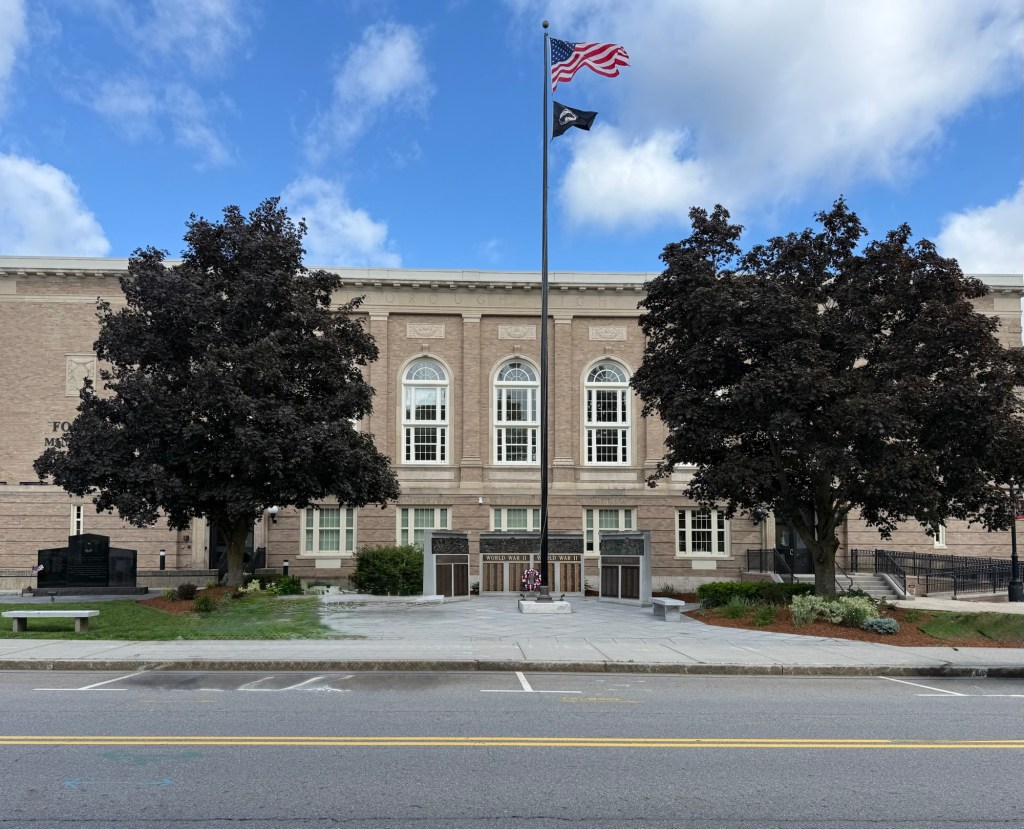
Lyman School – Ashby Town Hall // 1903

Originally built in 1903 as the central school for the town of Ashby, Massachusetts, the significant Colonial Revival style Lyman Building is one of the most significant and well-preserved buildings in the village. The building was designed by architect Henry M. Francis of Fitchburg and educated pupils in town from grades 1-12. The two-story, hip-roofed building displays a symmetrical facade with a central section displaying five arched upper story windows, flanked by two pediment-topped pavilions atop projecting, flat-roofed arched entrance vestibules with quoined corners. The symmetry of the original design was preserved when the identical side wings constructed in 1922. Ashby public schools merged with Pepperell and Townsend and this building was later converted to the town hall. I love when towns value their historic buildings and retrofit them for new uses!

Old Pierce School // 1855

Located in the heart of Brookline Village, the old Pierce School sits tucked away behind the Brookline Town Hall and other municipal and institutional buildings. The school was built in 1855 at a cost of $15,000 and later expanded in 1904 from plans by Julius Adolphe Schweinfurth, a prominent local architect. Julius had two brothers who also were architects:  A. C. Schweinfurth, who worked out of California and Charles F. Schweinfurth, out of Ohio. The Pierce School was named after Reverend John Pierce, noted pastor of the Walnut Street church during the mid 19th century. He and his wife, Lucy Tappan Pierce, were active leaders in the abolition movement in Brookline. The school was expanded a number of times until the 1970s, when the present Pierce Elementary School was built, in an unsympathetic Modern design that does little to enhance the busy street. As expected, the 1970s school will soon be demolished and replaced by a new, $212 million school. The old Pierce School will be incorporated into the new development.

Unity Village School // 1898

The town of Unity, Maine, was incorporated in 1804, and for most of the 19th century had small district schools for the education of its children. In 1894, the state enacted legislation that encouraged the consolidation of school districts in order to improve quality and building standards. The town, whose population and student enrollment had been declining, voted in 1898 to build this school, which effectively replaced four of its eight district schools. The Colonial Revival style schoolhouse was built by Joseph Sawyer of Fairfield, Maine. The Village School remained the town’s largest primary school until 1953, when increasing enrollment and school overcrowding prompted the decision to build a new elementary school.

Former Middlebury Central School // 1898

Having the tall order of being a neighbor to the later Westover School, the town of Middlebury’s Central School still packs an architectural punch. The school was built in 1898, replacing the former Union Academy building also near the town green. The school building is Neo-Classical in style with a projecting pedimented portico supported by four columns. A cupola extends through the roofline and shingle siding add some charm to the small two-room school building. The former school later housed the Middlebury Public Library and is now occupied by the Middlebury Historical Society.

Edith C. Baker School // 1937

At a time when many public school buildings around Boston were designed in the Art Deco or early Modern styles, the Edith C. Baker School in South Brookline went back to basics and represents a nod back to Colonial era design. The whitewashed red brick building was designed and built in phases as the neighborhood surged in population, tied in with the re-emergence of the economy after the Great Depression. The opening of the West Roxbury Parkway in 1919 and the Hammond Pond Parkway in 1932, both precipitated subdivision of the farms in South Brookline for residential development. The first section was completed in 1937 (what is shown in the photo) by plans from the local architecture firm of Kilham, Hopkins and Greeley, who also designed an addition just a year later for the un-forecasted growth in the neighborhood. More additions were added in the decades following WWII, thankfully just as additions and not a scraping of the site which seems to be all the rage now. The school was named as a tribute to Edith C. Baker, a longtime member of the Brookline School Committee from 1900 to her death in 1942.