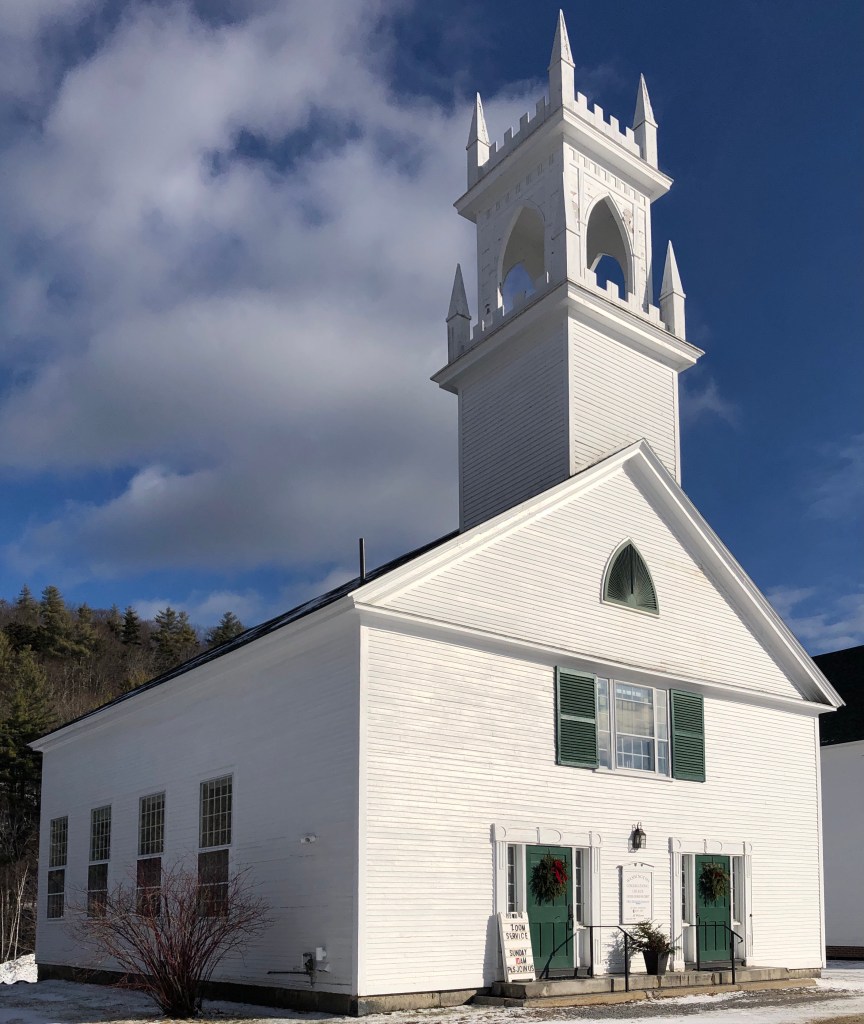
Located adjacent to the Washington Meeting House and Central Schoolhouse on the Washington, New Hampshire Town Green, the Washington Congregational Church perfectly compliments the collection of vernacular buildings here to create a very cohesive, three-building historic district. The church is dominated by a Gothic-inspired two stage square tower adorned by pointed pinnacles and crenellation. The building, constructed in 1840, is a great example of a Gothic Revival vernacular church building in rural New Hampshire and has been well-maintained over the years. In 1960, a fire in the church resulted in several thousand dollars worth of damage. A full basement was built under the church in 1985 to provide space for Sunday School classes and events. The simple arched sanctuary has remained in keeping with the original interior design, and features wide board wainscoting and wooden pews, taken from the old Meeting House.
The South Congregational Church in Newport, NH, is located (as its name suggests) south of the commercial and civic heart of downtown Newport. The church congregation was founded in 1779 and grew substantially in the early 19th century. The church’s location, outside the present downtown, is the result of a long-running dispute within the town of where its civic heart should be located, to the north or south of the Sugar River. The consequence of this disagreement resulted in the placement of the Baptist church at the town common (north of the present-day commercial downtown), and the placement of this church here. The resulting development to the north of the river left this massive, brick Federal style church towering over the small working-class homes, with a majority of the town’s other significant Federal buildings built years later, like the Eagle Hotel and Old County Courthouse to the north of the river. The 1823 church is thought to have been designed by Elias Carter, who designed many Federal-era churches in the New England area.
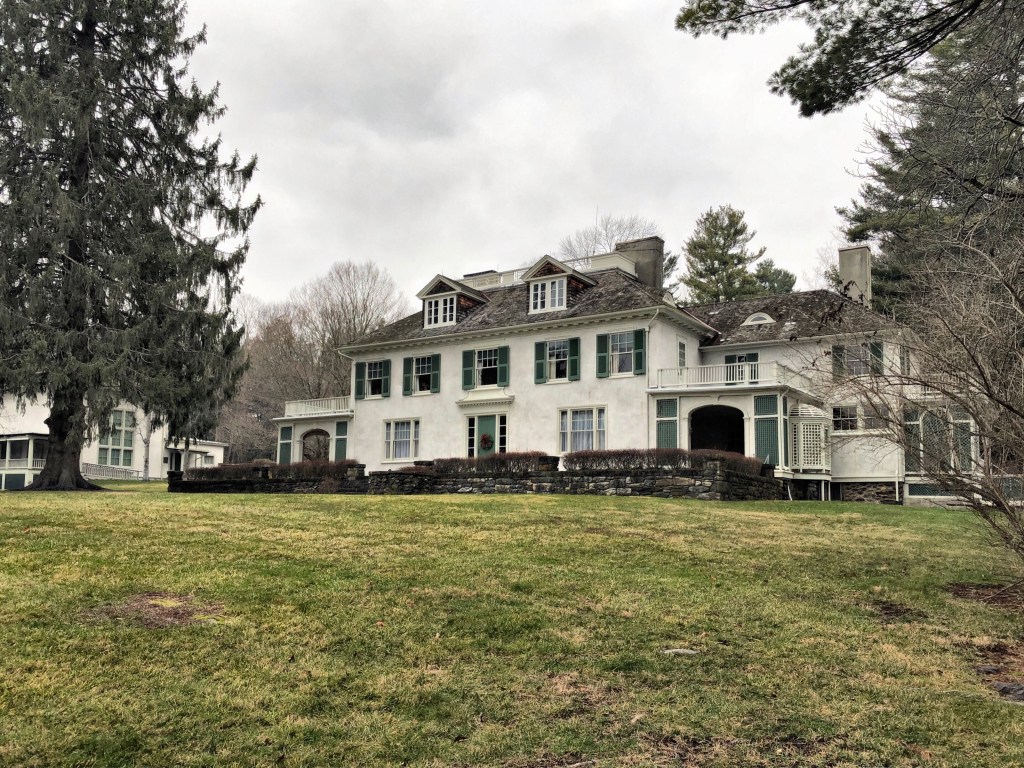
Chesterwood is the former summer home, studio and gardens of American sculptor Daniel Chester French (1850–1931), who is best known for creating two of our nation’s most powerful symbols: the Minute Man(1871–75) at the Old North Bridge in Concord, Massachusetts, John Harvard in Harvard Yard, and Abraham Lincoln (1911–22) for the Lincoln Memorial in Washington, D.C. Daniel Chester French was one of the most successful artists of the late 19th and early 20th centuries, producing more than 100 works of public sculpture. In the fall of 1895, he and his wife drove by horse and buggy and discovered the resort town of Stockbridge. They returned the next summer and purchased the Marshall Warner farm from the family who had purchased the land from Mohican Native Americans. The French family and two maids moved into the white clapboard farmhouse the next summer. To ensure that his summer would be productive as well as restful, he improvised a studio in the barn. He asked his friend and colleague, architect Henry Bacon, to design a studio for him (Bacon would later work with French on the Lincoln Memorial). Soon, in spite of renovation, the original farmhouse was deemed inadequate and French commissioned Bacon to design a residence, completed in 1901. The family owned the home for decades, even after Daniel Chester French’s death. Much of the credit for Chesterwood’s preservation and metamorphosis from summer retreat to public site belongs to Margaret French Cresson (1889–1973), the sculptor’s daughter. After her parents’ death, she maintained the property and began to use it year-round, assembled the work of her father, and established the estate as a historic site of the National Trust for Historic Preservation.
Ca. 1910 image courtesy of Boston Public Archives.
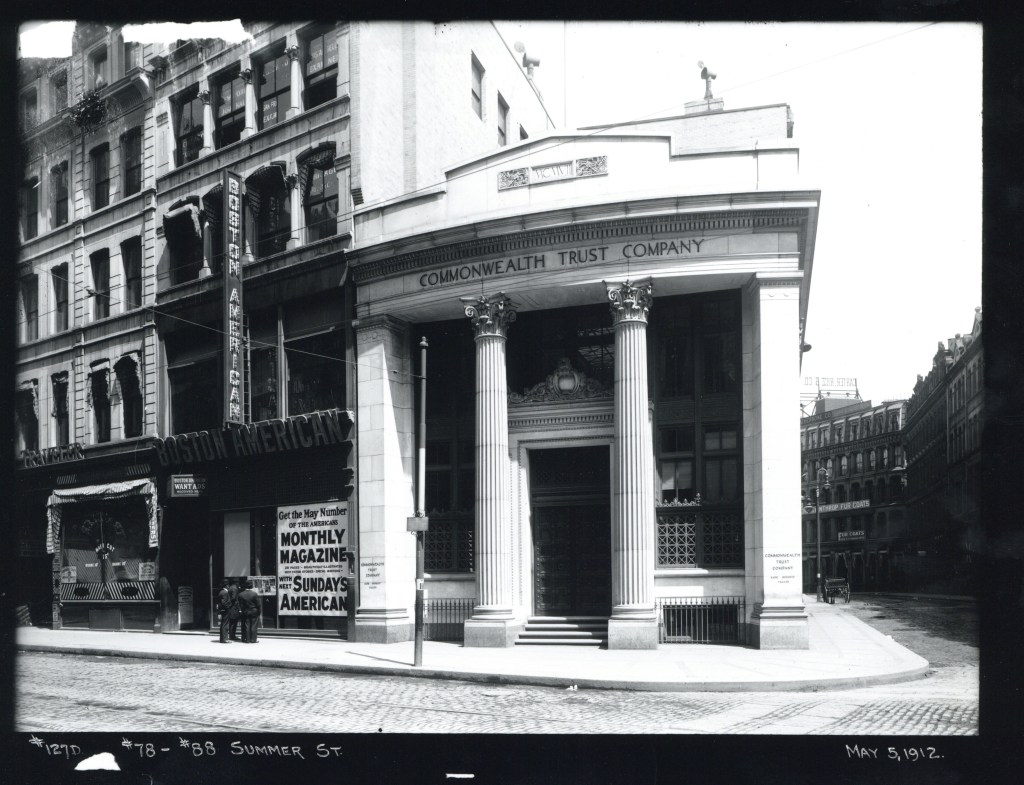
Located at the corner of Summer and Devonshire Streets in Downtown Boston, the Commonwealth Trust Company’s two-story marble banking house commanded the corner, despite its short stature. The building, completed in 1908, was constructed with Lee marble and decorated with ornate wrought and cast-iron grilles over windows. The building was designed by the architectural firm of Parker, Thomas & Rice in the Classical mode with large, fluted Corinthian columns and boxed corner pilasters framing the recessed center entrance, Corinthian pilasters ran along the side facade. At the inside, the building was coated with Cararra and Blanco marble with paneled oak offices. At the ground floor, offices and banking stations framed the outer walls, with the safety deposit boxes located on the second floor. The building was demolished by the 1970s and replaced with a one-story minimalist Modern building (I could not figure out why the former building was razed). The new building was demolished after a few decades with a larger building, better fitting the commercial district.
Grand architecture in New York is not just limited to commercial buildings, churches and offices, even civic buildings here can go toe-to-toe architecturally with any in the world! On the border of the SoHo neighborhood, the former New York City Police Headquarters showcases the unity of the five boroughs into the City of New York in 1898, a city in need of a large and centrally located Police HQ. The firm of Hoppin & Koen was hired to design a large structure, fitting to represent the largest police force in the country and the five boroughs it represents. The grand Beaux-Arts building makes a statement with its perfect proportions, expanses of rusticated limestone and granite, and the massive central dome at the roof. The New York City Police Department relocated in 1973 to the larger One Police Plaza building, and the former headquarters was vacant for a decade until the early 1980s when the property was purchased by developers and converted to condominiums.
Thanksgiving in the days of Covid-19 will be different in more ways than one. A notable loss will be the absence of the annual Macy’s Thanksgiving Day Parade in New York, which has been a national pastime broadcast on televisions for millions of Americans every year. The six-mile route through the city, giant balloons and all, would end at Macy’s Herald Square, the flagship store of the department store chain. The building (one of the largest stores in the world) was completed in 1902 and its 2.5 million square feet of space, occupy an entire city block. The building was designed by Interestingly, in 1900, a small five-story building on the corner of 35th and Seventh was purchased by Robert H. Smith in 1900 for $375,000 ($11.5 million today). The idea had been to obstruct Macy’s from becoming the largest store in the world. It is largely supposed that Smith, was acting on behalf of Siegel-Cooper, which had built what they thought was the world’s largest store nearby in 1896. Macy’s ignored the tactic and built around the building, which now carries Macy’s “shopping bag” sign by lease arrangement! Oh, and Macy’s even hired the same architect for their department store that Siegel-Cooper used for their building, Theodore de Lemos, adding insult to injury. A great example of a spite building!
1908 image of Macy’s Herald Square courtesy of LOC.
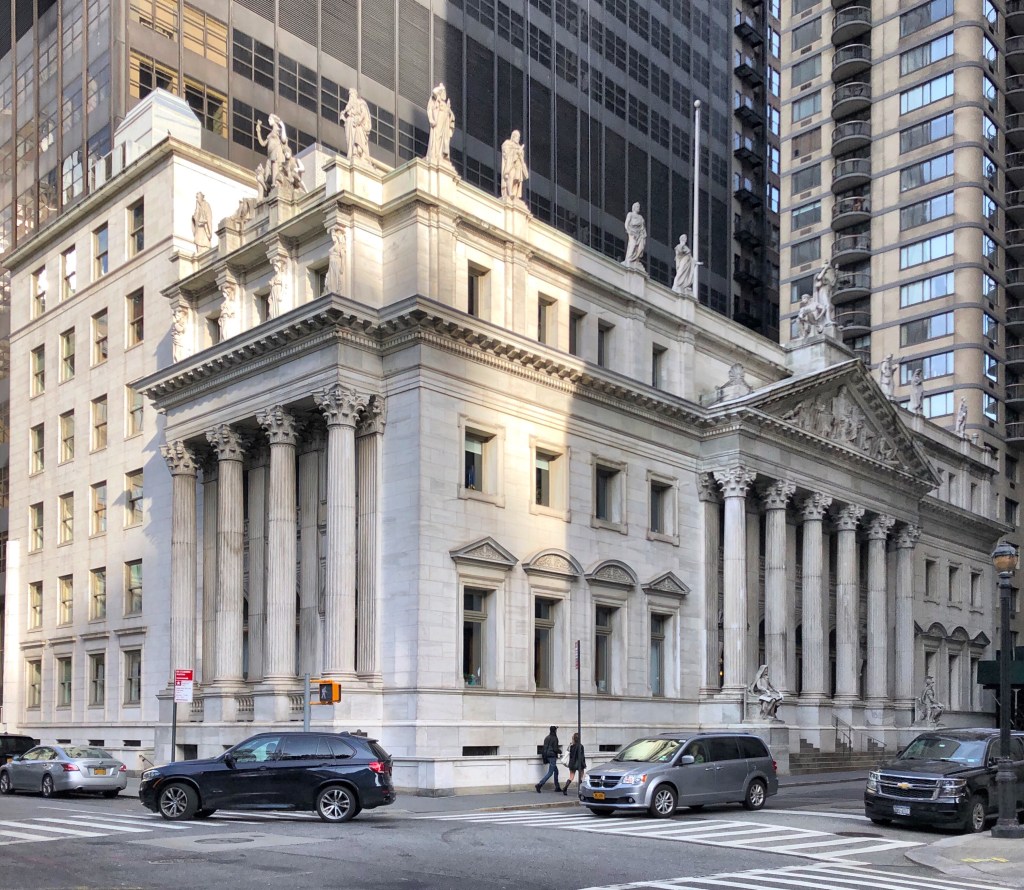
Distinguished for its classic beauty, this small marble courthouse expresses the best of Classical tradition, in its columned portico and fine sculptures adorning it. Located at the edge of Madison Square Park, the building was constructed between 1896 and 1899 to serve as a courthouse for the Appellate Division of the New York State Supreme Court. The marble Classically inspired Beaux-Arts courthouse, was designed by James Brown Lord and is considered to be an excellent example of the City Beautiful movement, which sought to introduce monuments and beautification to American cities. Of the nearly $650,000 spent on the building, 25 percent was spent on sculpture, a huge sum at the time. Sixteen sculptors – sponsored by the National Sculpture Society and among of the most esteemed of the day – worked on the thirty 12-foot marble statues on the facade, the most ever to work on a single building in the United States. Sculptures by Daniel Chester French, Charles Henry Niehaus, Karl Bitter, and more adorn the balustrade and entrance steps. Additionally, four caryatids sculpted by Thomas Shields Clarke on the Madison Avenue front, showcase a rare feature not typically seen in American architecture, representing the four seasons.
In 1953 a $1.2 million restoration of the facade was undertaken by the Department of Public Works during which the huge marble statues were removed and cleaned. It was at this time that the general public first realized one of the lawgivers was Mohammed. Representatives from Pakistan, Egypt and Indonesia petitioned the State Department to destroy the statue rather than restore it, citing Islamic canon that forbids the depiction of human beings in painting or sculpture.When the statues were replaced in 1955, each was moved over one spot to fill in the void where Mohammed had stood. Today one empty pedestal remains.
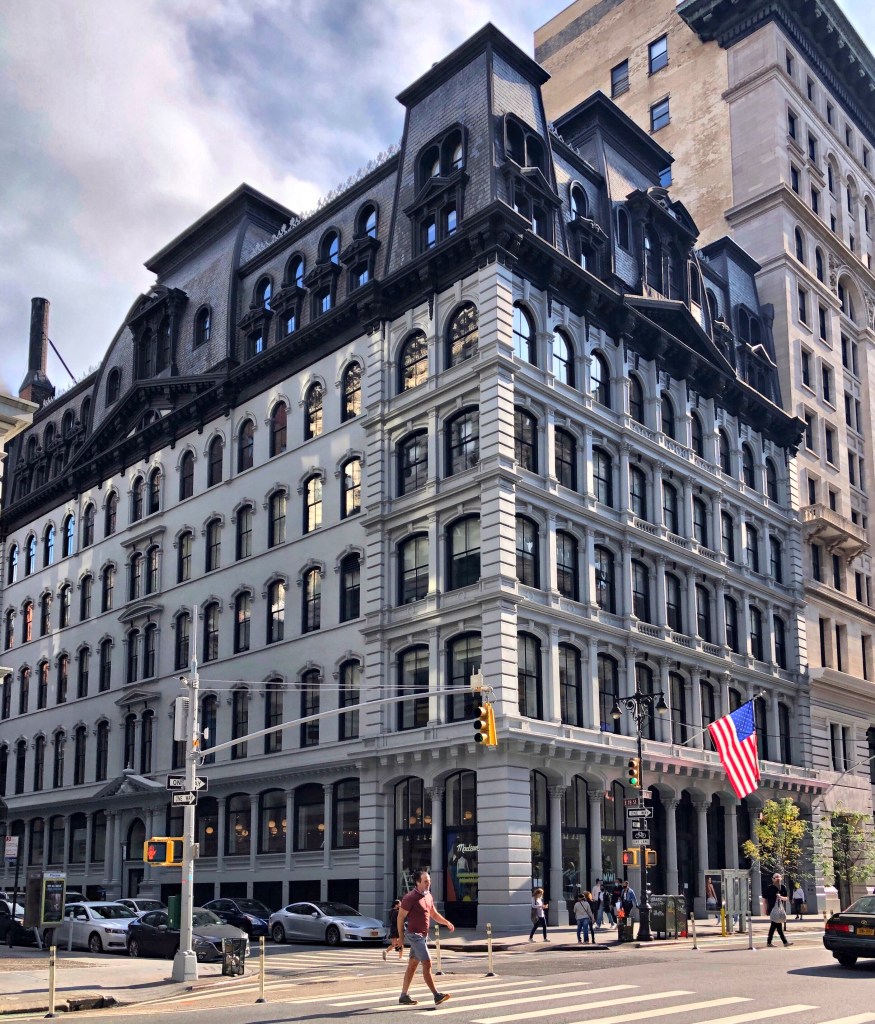
This seven-story department store building was designed by (extremely underrated) architect Griffith Thomas in 1868 for the prominent dry-goods company of Arnold Constable & Company. ‘The Palace of Trade’ as it became known as, is located at the corner of 5th Ave and 19th Street in Manhattan, the stunning Second Empire building is faced in marble, brick, and cast-iron, features stacked arch orders and a prominent, two-story, pavilioned mansard roof. Arnold Constable & Co. was founded by Aaron Arnold, an immigrant from the Isle of Wight, who opened a small dry goods store in the city in 1825. As the business prospered he moved into larger quarters numerous times. In 1842, James Constable, an employee, married Arnold’s daughter Henrietta and was subsequently made a partner. From this, the company was renamed Arnold Constable & Co. In its heyday, Arnold Constable & Co. was the largest dealer to the elite in New York City, supplying the latest fashions to a clientele that included the leading families in the city. The company continued expansion through the 20th century but struggled later with its suburban model. The building was sold and operated as a New York Public Library Branch for some years.
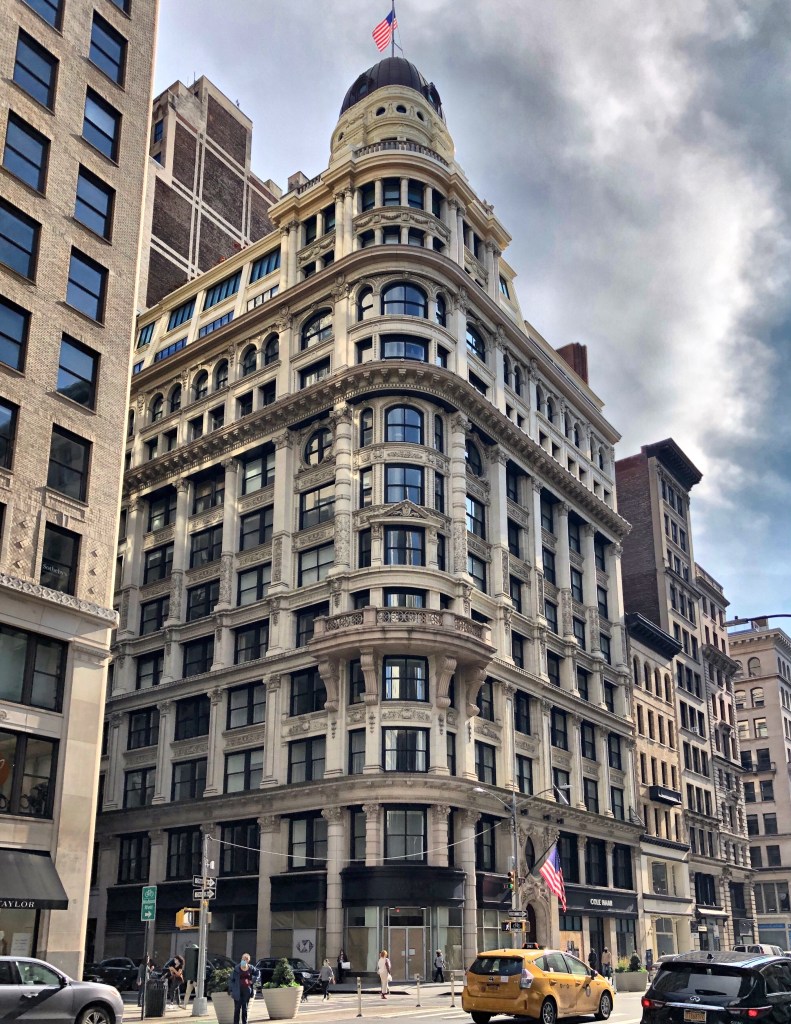
This stunning Beaux-Arts store and loft structure, is located on a prominent corner site at 5th Ave and 21st Street in Manhattan. The structure is faced in limestone and terra cotta and was constructed in two phases. The original three southern bays (on the right side of the image) on 5th Avenue were designed by prominent architect Robert Maynicke for real estate developer Henry Corn. In 1899, two years after its completion, architect Henry Edwards Ficken designed an addition to the north wrapping around and running along 21st Street. The addition continued the richly embellished facade and supplemented it with a twelve-story, curved corner bay which is crowned by a dome. The building appears to have been constructed without a major tenant, and many companies utilized the iconic space including: the Merchant Bank of New York, Park & Tilford’s, a fancy grocer, and lace companies. In the mid 20th century the building suffered from deferred maintenance until 2005 when the building was restored and converted to 38 apartments (including one utilizing the dome)!
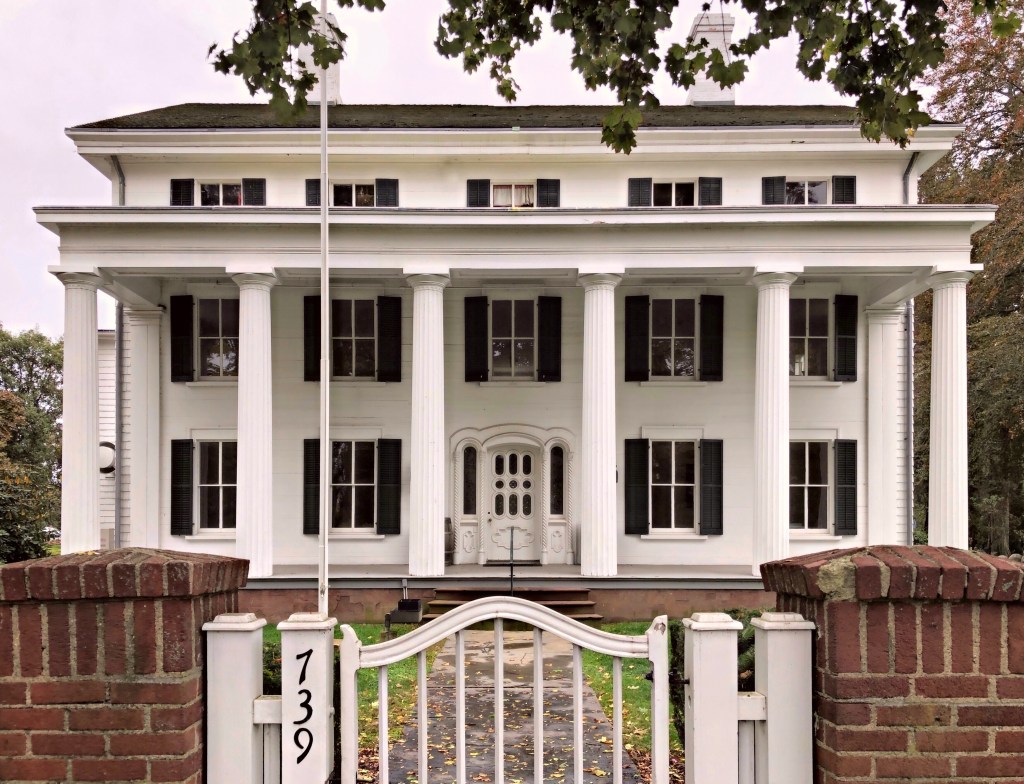
Charles C. Perry (1795-1870) was a wealthy nineteenth-century shipowner and sea captain and a prominent figure within Southport’s community. After his father’s death in 1814, when Charles was just 25, he inherited a large sum of money from his father’s will and followed his footsteps as a career. Miah Perry’s will stipulated that in order to keep the family together, members were to reside at the family home for five years from his death if neither of the daughters married; “but in case they remain unmarried at the expiration of five years…my estate shall not be divided until eight years from my decease unless one of the said daughters should marry…partition may be immediately thereafter made.” Talk about pressure to get married!
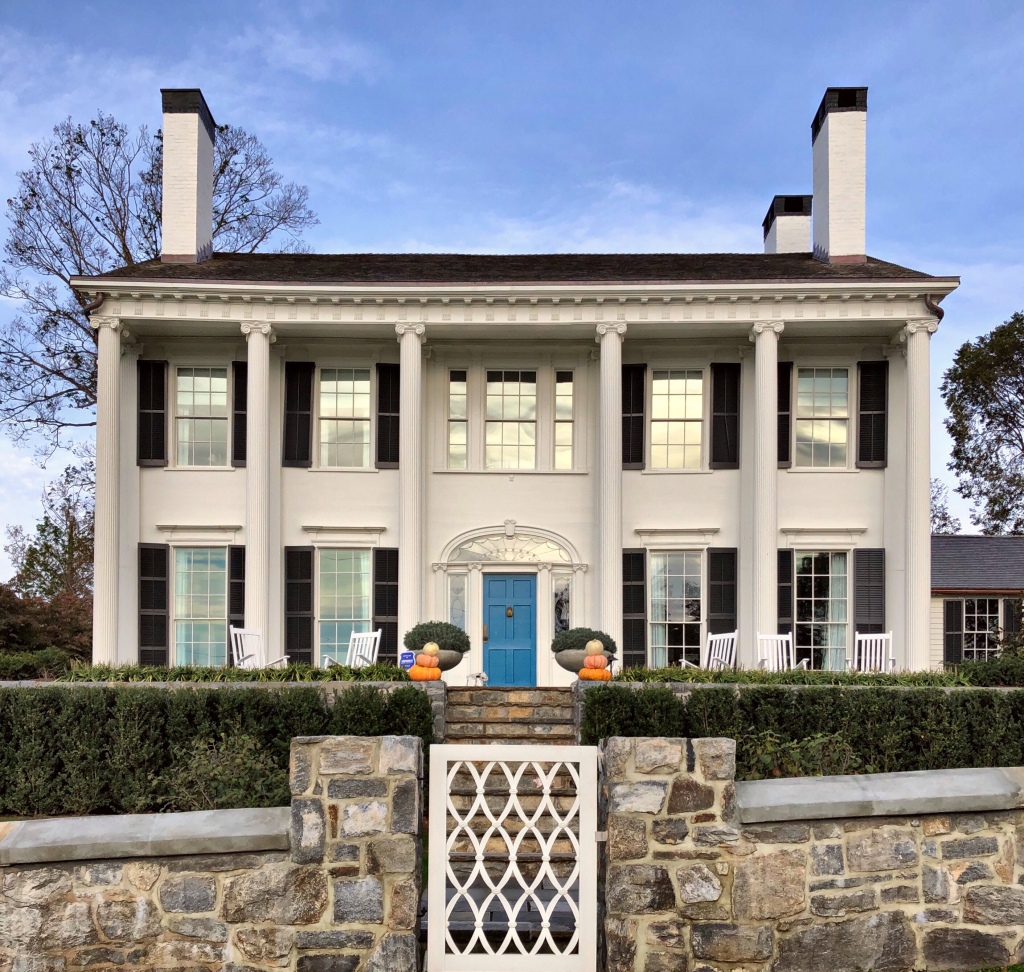
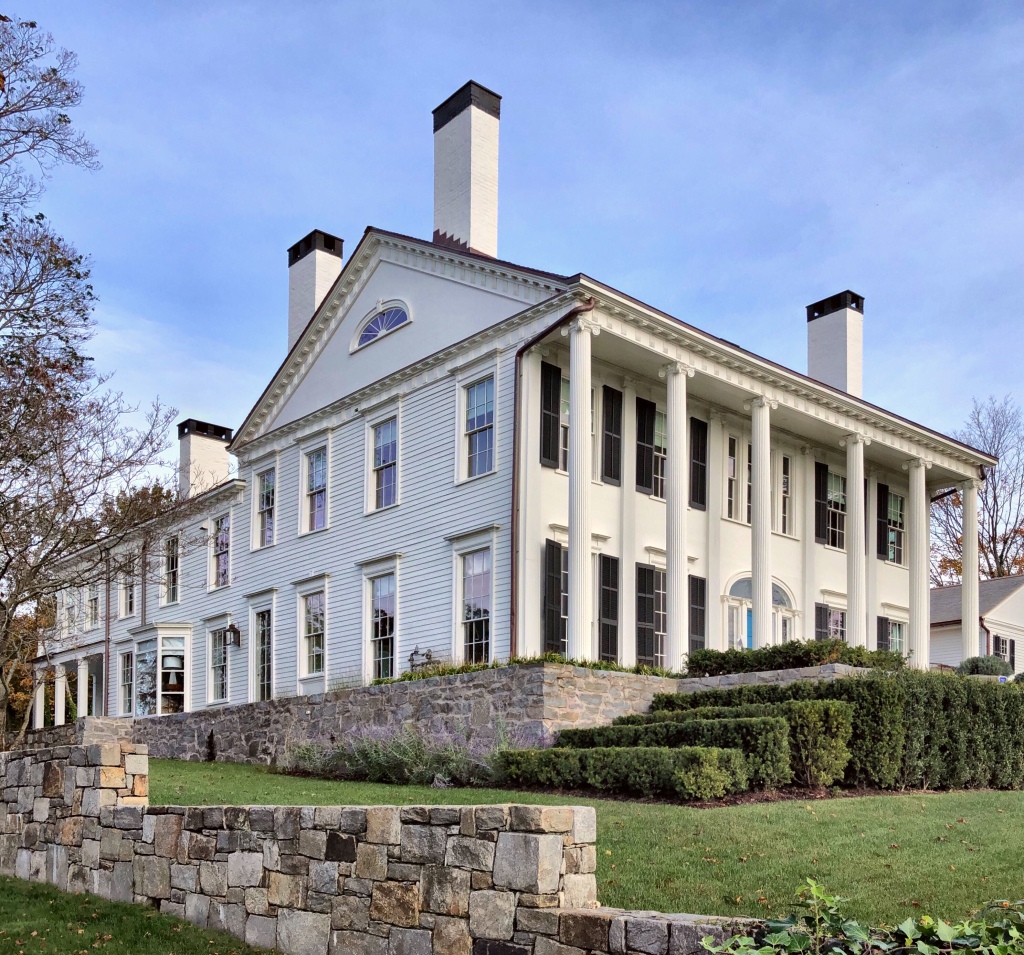
It is unclear if any daughters got married before, (Julia, one daughter died in 1821 at 22 years old). That same year, Charles Perry seemingly got his part of the inheritance and acquired the land upon which this house stands. He was then twenty-six years old and unmarried. He appears to have built it later as a blending of the Federal and Greek Revival styles, perfectly complimenting each other.
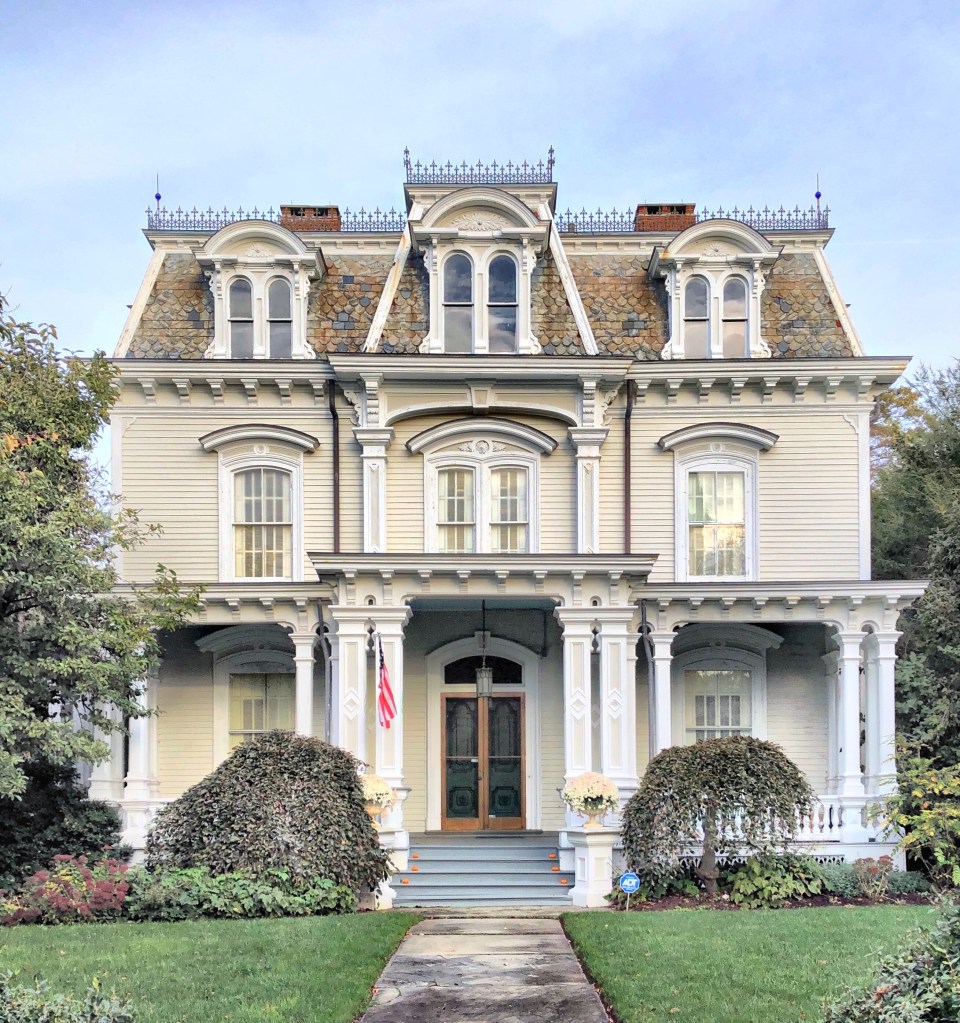
Mrs. Mary Pomeroy, the widow of one of Southport’s industrious and wealthy shipping merchants, Benjamin Pomeroy, built this large residence for herself and her daughters, soon after her husband’s death. Mr. Pomeroy was a merchant who also served as a Senator. In 1866 with ailing health, he took a doctor on a private ship to try various remedies in the West Indies, to no avail, he died at 48 years old. Ms. Pomeroy appears to have taken the money her and her husband had saved and built a large mansion to cement her position in town as the most eligible bachelorette in town. While she never remarried, she sure showed the town what good taste looks like! The facade of the Pomeroy house is symmetrical with a projecting three-story central pavilion, all surmounted by a mansard roof with cresting. Rounded dormers with twin round-headed windows pierce the roof’s multicolored slate surface, making this Second Empire house one of the nicest in a town full of historic homes!
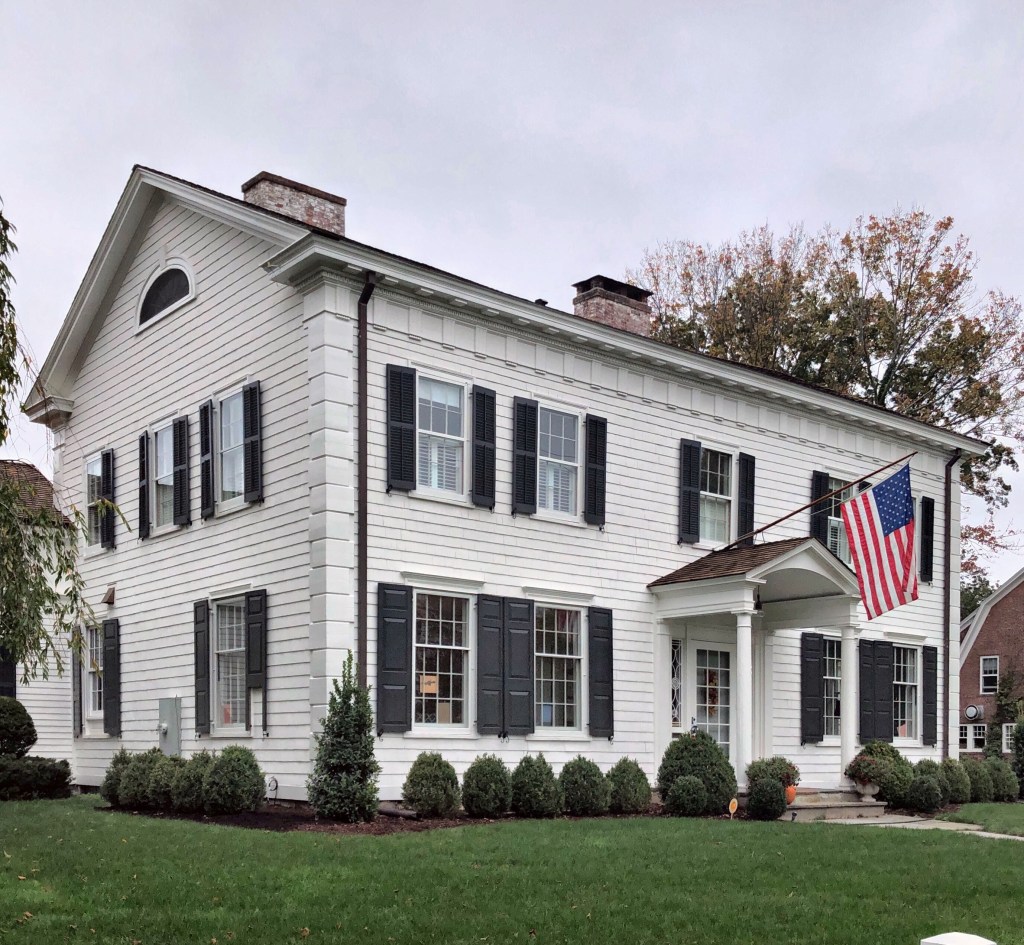
Walking around Southport Village in the town of Fairfield, Connecticut, transports you to an early-mid 19th century town with large Federal and Greek Revival homes overlooking Southport Harbor and the Long Island Sound. This home on Westway Road was built around 1830 for Augustus Jennings (1814-1886), the son of Captain Abraham Gould Jennings. Augustus became a carriage maker in Southport before founding Jennings Brothers, a paper manufacturing company; which in 1867, began to produce Japanese paper products. The Jennings House was originally located near the Pequot Library, but was relocated in 1899, which was likely when the central shingled gable at the roof with Palladian window was added.
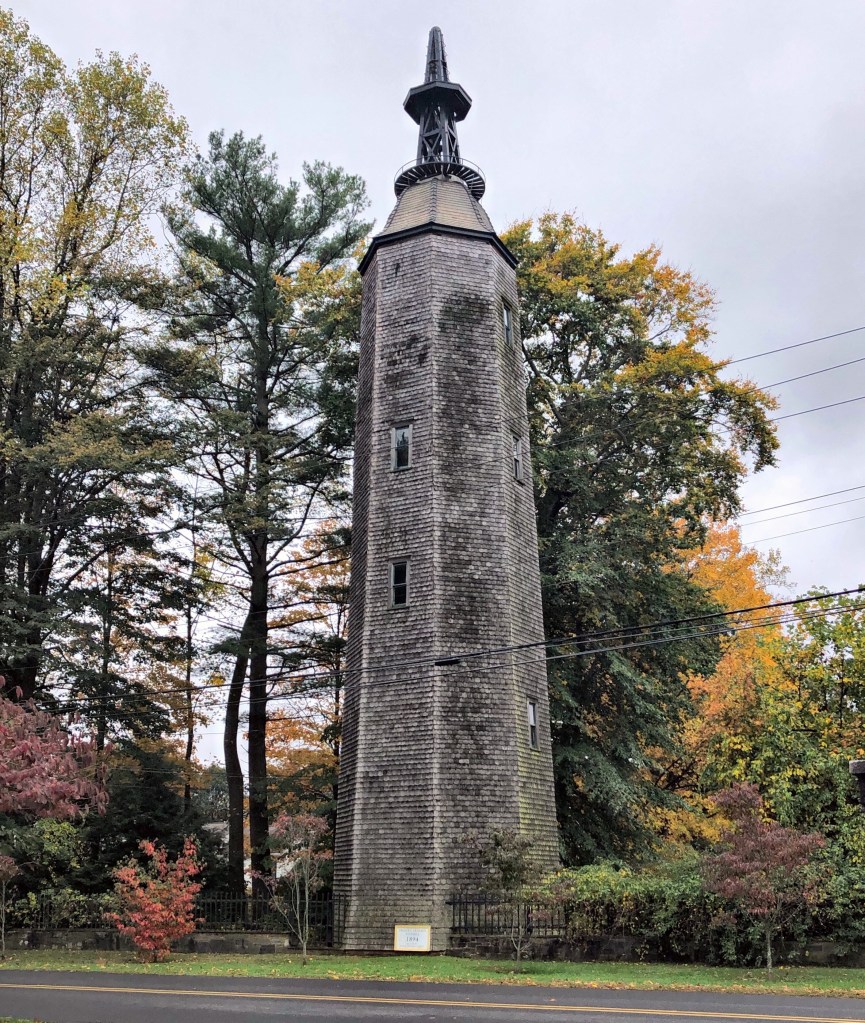
Located in a more rural part of Fairfield, Connecticut, I drove past this massive tower just off the road. Intrigued, I doubled back to find out what it was, and learned it was once a windmill! The over eighty-foot tall shingled tower was constructed in 1894 as part of a large country estate. Frederic Bronson (1851-1900) was a prominent, gilded age lawyer in New York City. He accumulated massive wealth representing many elite families, eventually becoming a member of the “Four Hundred”, a list of the 400 most powerful (rich and connected) people of New York society. In the early 1890s, Bronson constructed a summer estate in Fairfield, CT, known as Verna Farm. A part of this estate the windmill which pumped water from a well 75 feet below ground into a 7,500-gallon wooden storage tank inside the tower. The estate eventually became the Fairfield Country Day School, and the windmill (no longer in use) was gifted to the town. Eventually, it was leased by Sprint, and the telecommunications firm restored the windmill and installed a cellphone tower in its interior.
Originally built in 1775, the first iteration of the Burr Homestead, home of Thaddeus and Eunice Burr, which actually saw the marriage of John Hancock, President of the Continental Congress, to Dorothy Quincy. Thaddeus was the cousin of the famous Aaron Burr, Jr., who was the 3rd vice-president of the United States alongside Thomas Jefferson as President. Aaron Burr Jr. is best-known today through his portrayal in the popular play “Hamilton,” where he shoots Alexander Hamilton in a duel. The house was rebuilt in 1794 in its former location in Fairfield, Connecticut after a fire by the British in Fairfield destroyed the first. The home was willed to Thaddeus’ son General Gershom Burr, who eventually sold the mansion to Obadiah Jones. Mr. Jones updated the home by, ““taking out the dormer windows and lifting the roof, taking away the porch and building the broad veranda with its lofty massive fluted columns”. The home was eventually gifted to the Town of Fairfield and is presently maintained by the Fairfield Museum and History Center.
At the beginning of the 19th century, Fairfield, Connecticut was slowly recovering from its destruction by the British at the end of the Revolution. By around 1800, a member of the DeForest family appears to have built this home, across from the Town Common, overlooking the recently completed Fairfield County Courthouse. Before the American Civil War, the home was significantly altered, with a central pavilion, new round arch windows, and a full-length front porch, showcasing early Victorian-era desire for detail. The house changed hands several times over the next century, at one point becoming a boy’s school from 1891 to about 1909. In 1930, the house was renovated by architect Walter Bradnee Kirby, who restored the home back to its Colonial past, showing how the pendulum of architectural tastes can change back-and-forth with every passing generation.




 Buildings of New England