Joshua Silvester House // 1857

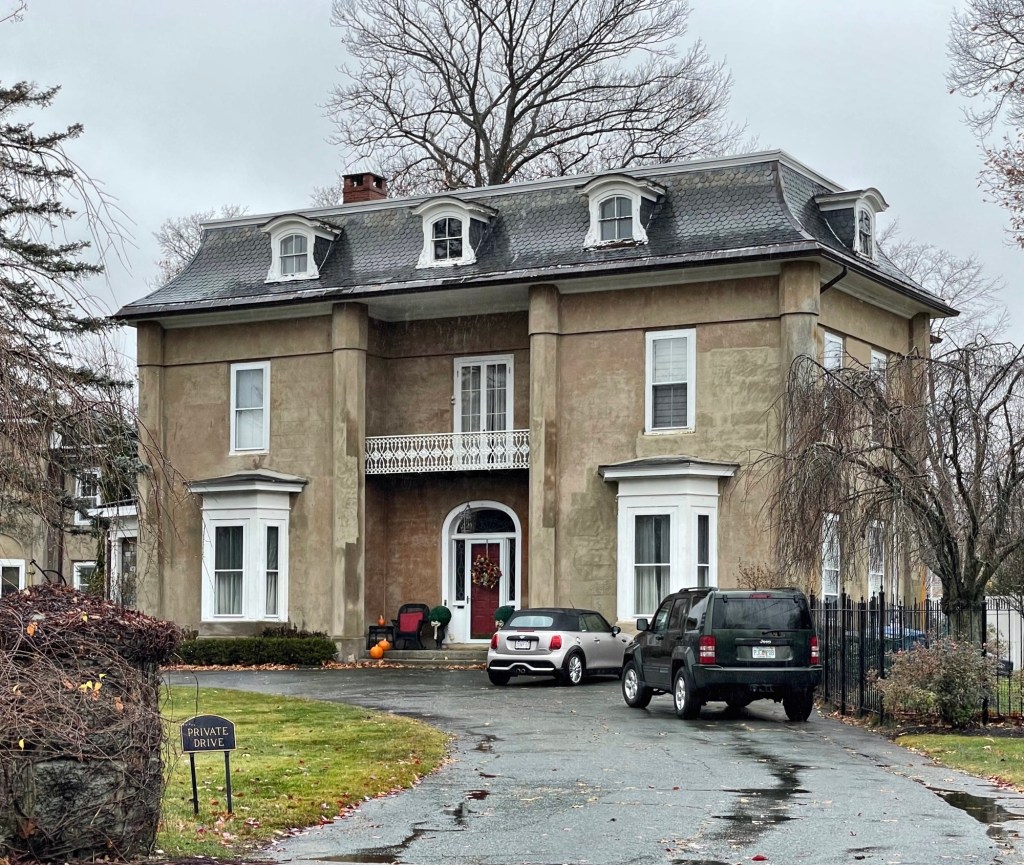
This large house sits on Peabody Avenue in Danvers, Massachusetts, and is thought to be the oldest house built of cement in the United States! Joshua Sylvester Silvester (1803-1888), the house’s original owner, was born in Wiscasset, Maine, and began working in the shoemaking business, expanding his products in England, taking many business trips there. While in England, he is said to have particularly admired Charles Dickens’s estate, Gad’s Hill, and modeled his Danvers home after it. Joshua Silvester not only designed this house, but directly supervised its construction which is of hand-poured cement/stucco by two masons imported to town to work on the house. The fifteen-room residence with octagon-shaped barn was complete by 1858. In 1880, the property was purchased by Isaac B. Howe of Clinton, Iowa. Howe was a civil engineer who had helped to lay out the Transcontinental Railroad and had been superintendent of the Iowa division of the Chicago and Northwestern Railroad. Howe died within a year of moving to Danvers,
but his family continued to live in the house for many years.

Nelson House // 1797

This residence sits on the historic Elm Street in Georgetown, Massachusetts, and is one of the best late-Georgian style dwellings in the town. The house was built in 1797 for Nathaniel Nelson (1767-1853), a banker who worked in Newburyport, just years after his marriage to Sally Chaplin. Nathaniel descended from Thomas Nelson (1615-1648), who was among the twenty families who had come to the New World in the winter of 1638 with the Puritan cleric Ezekiel Rogers (1590-1660). With Rogers most of these families settled at Rowley, incorporated in 1639 with Georgetown later setting off from Rowley, creating their own town in 1838. Nathaniel and many of his family worked as tanners, preparing the skins of animals into leather, and had shops in the area. Mr. Nelson was such an esteemed member of society, that when the War of 1812 broke out, he was asked to store money and gold from Newburyport in his basement, away from the coast, hiding it from the British forces. After successive ownership, the residence was purchased in 1936 by Everett A. and Mary A. Spaulding. A Georgetown native, Everett Augustus Spaulding made colonial revival furniture under the corporate name Spaulding Colonial Reproductions. The residence remains in spectacular condition, with its large central chimney, symmetrical façade, portico, and hipped roof punctuated by pedimented dormers.

Dickinson–Pillsbury House // c.1700

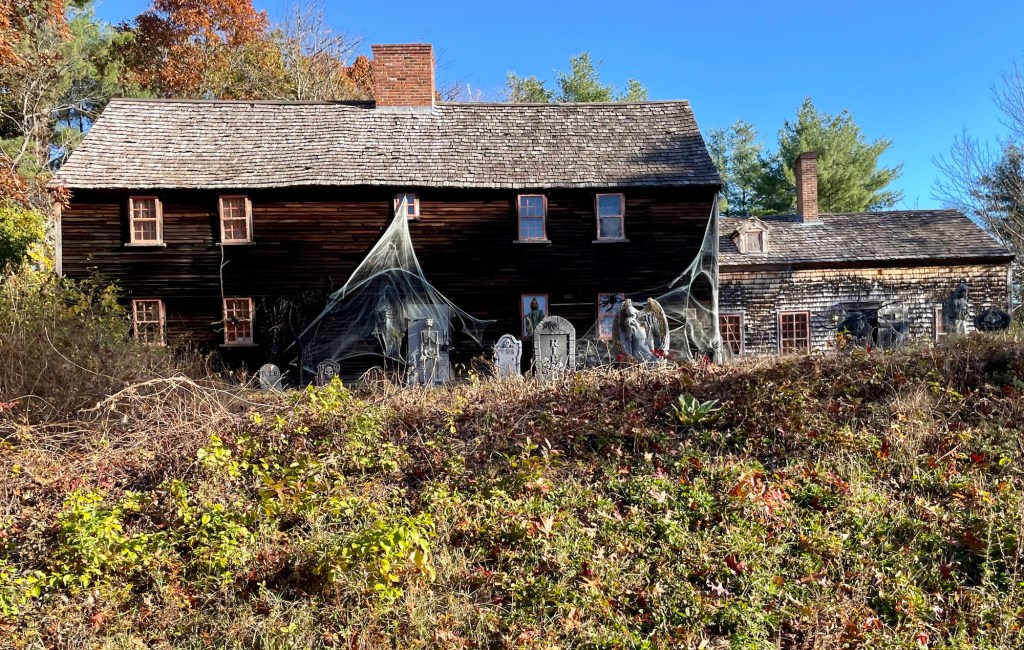
The Dickinson-Pillsbury House is believed to be over 320 years old and is significant as a well-preserved example of a First Period house in good condition. Located on Jewett Street in Georgetown, Massachusetts, the house was seemingly built before 1700 by James Dickinson Sr. or James Dickinson Jr. and was inherited by Samuel Dickinson (1754-1841). The house is notable for being the home of War of 1812 veteran and inventor Paul Pillsbury, who purchased the property about 1801. His inventions included devices for pegging shoes, milling bark off tree sections, and stripping kernels from ears of corn. Paul Pillsbury and his wife Elisabeth Frink had a family of seven sons and one daughter. Paul Pillsbury was also the uncle of abolitionist Parker Pillsbury and the great-uncle of attorney Albert E. Pillsbury who drafted the bylaws of the NAACP. What an incredible family! The house is well-preserved and a great example of a First Period residence from the 17th century.

Adams Hall // c.1828

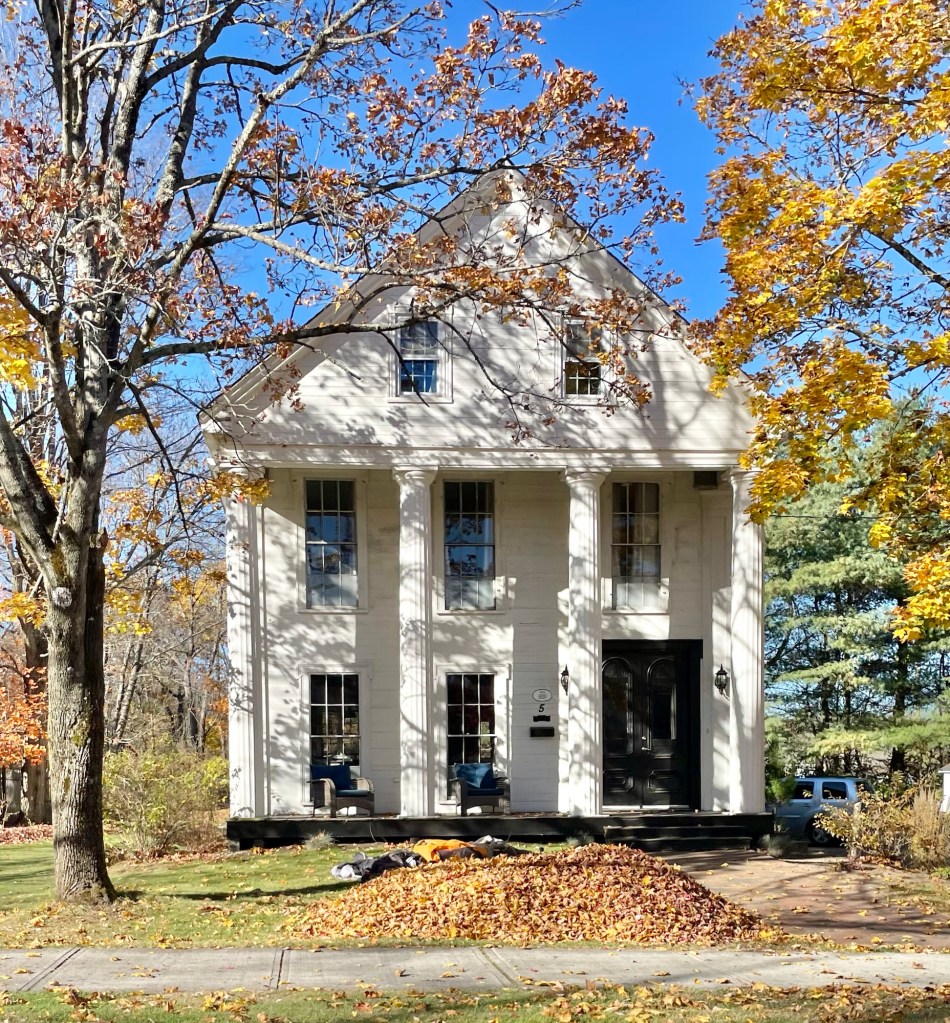
According to local histories, this significant Greek Revival style property on Elm Street in Georgetown, Massachusetts, was owned by Josiah Adams (1757-1852), a farmer, a Revolutionary War veteran, and a fourth-generation descendant of the immigrant Robert Adams, who arrived here from Devonshire, England by about 1629. In March 1849, the town’s Congregational Society purchased Adams Hall for eight hundred dollars to house the church vestry, which remained in the building for forty-one months until a new building was built for that purpose next door. Later, Adams Hall was owned by Moses Tenney (1808-1903), operator of a prosperous saw mill in Georgetown, and served at one time in the state senate. The structure retains its significant temple-front with four, two-story Doric columns supporting the portico. Also special on this residence is the use of flush-board siding and the oversized first floor windows.

Moody-Hall House // 1830

Transitional Federal/Greek Revival style houses are among my favorite. You can see the emergence of Classical architecture blending with American architecture with features of both styles, which work well together. This example can be found on Elm Street in Georgetown, Massachusetts. The dwelling appears to have been built for Dr. George Moody, one of four physicians in Georgetown in 1840, who began his practice in town in 1830. In his first years there, he oversaw patients during Typhus and Dysentery outbreaks and was credited with having determined that a high sulphur content in the local water supply accounted for the increased cases. Dr. Moody died in 1866, and his widow continued to live in the house until her death in 1880, after which it was sold to Mrs. Charlotte Sawyer Hall, the widow of local shoemaker Seth Hall.

Nathaniel C. Allen House // 1793

The Nathaniel C. Allen House is a two-story Federal style residence located in New Gloucester, Maine. The house was built in 1793 by Shubael Marsh, a local builder (and father of Shubael Jr. (1797–1867), who moved to Texas with Stephen F. Austin) and sold to Nathaniel Coit Allen, an early settler in New Gloucester, who served as a General during the American Revolution. The property was purchased by Col. James Madison Thompson, then owner of the Glen House, an early White Mountains hotel in New Hampshire, who renovated the home by replacing the central chimney with two narrow ones and raised the ceilings and introduced Victorian interior woodwork. A subsequent owner added large Colonial Revival porches on the front and side entrances along with a new entry. The house showcases the changing tastes from Federal style to Victorian back to traditional tastes.

Morrill House // c.1830

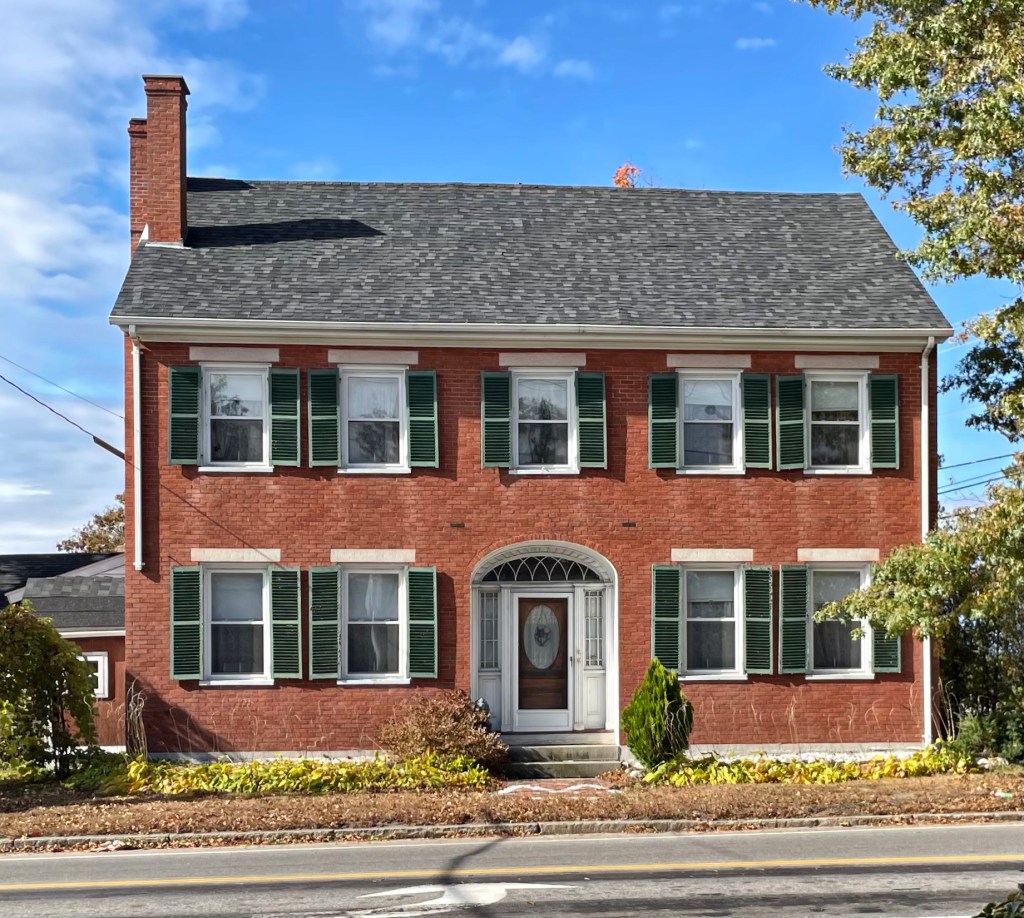
This stunning brick Federal style home sits in the center of Gray Village in Maine. The house dates to the early 19th century and was long-owned by members of the Morrill Family, seemingly first by William C. Morrill and remaining in the family for generations. The residence is a high-style example of the Federal style with recessed elliptical entrance with fanlight transom and sidelights with a Victorian-era front door. The house was likely built by a local mason or housewright who employed the designs of a Federal style plan book for the architectural detailing at the entry.

Samuel Perley House // c.1784

Built around 1784 for Reverend Samuel Perley, this Federal style home is one of the finest in the town of Gray, Maine. Samuel Perley (1742-1830) was educated at Harvard College and while there, met and befriended John Adams, who would later become the second President of the United States. The two maintained a lifelong friendship. Perley came to Gray in 1784 as a pastor of Gray’s first church. He likely had this house built at the time or purchased an existing house and updated it and the house is said to have Moses Eaton stencilling inside. At one point, Rev. Perley and his wife lived on one side of the house while his son Isaac, his wife, and their twelve children lived on the other.

Sewall-Scripture House // 1832

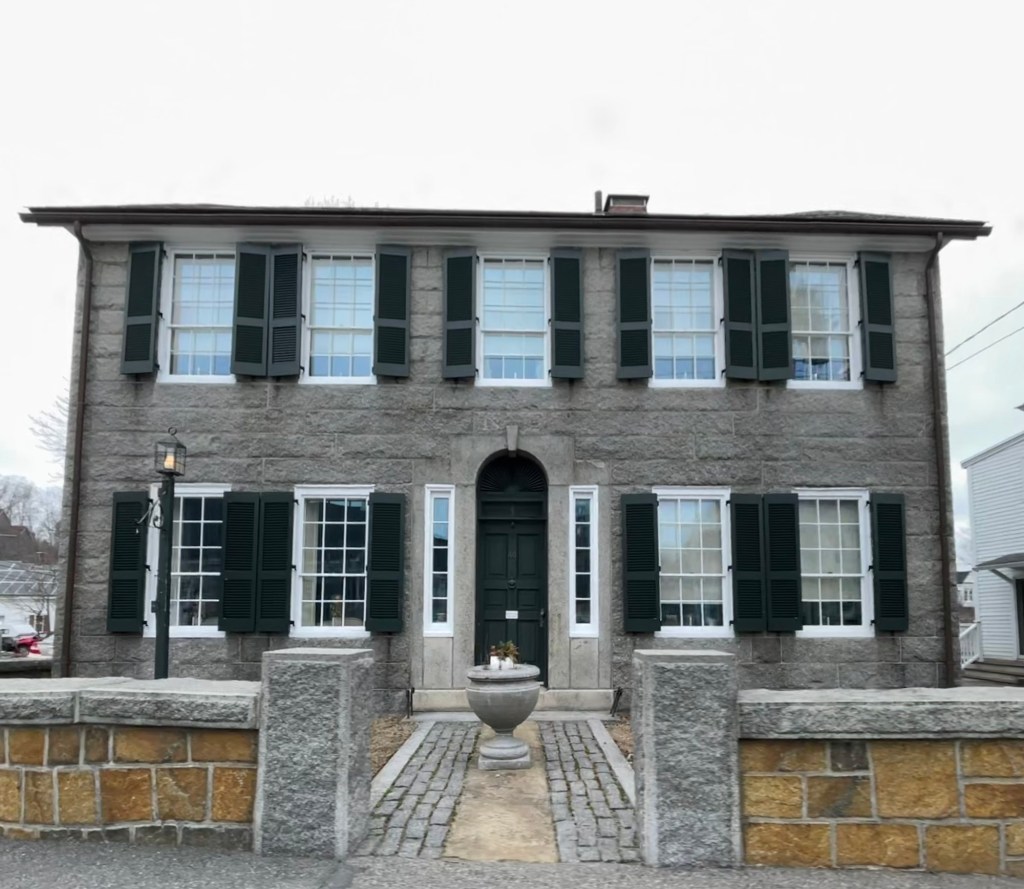
Levi Sewall (1805-1880), a native of Maine, built this stunning granite Federal style house in Rockport, Massachusetts in 1832 in preparation for his marriage to Mary Ann Robards. The granite blocks used to build the house were hauled by oxen from Sewall’s own quarry in Pigeon Cove, which is said to have produced stone of excellent quality. Sewall was one of the towns earliest entrepreneurs in the granite business and did quite well, supplying the building material to many of the region’s buildings in the mid 19th century. The property was inherited by Levi and Mary’s son-in-law, Frank Scripture, who took over the family business. Levi Sewall’s descendants occupied the Sewall-Scripture House until 1957, and ever since, it has been home to the Sandy Bay Historical Society and Museum.

Lord Mansion // 1822

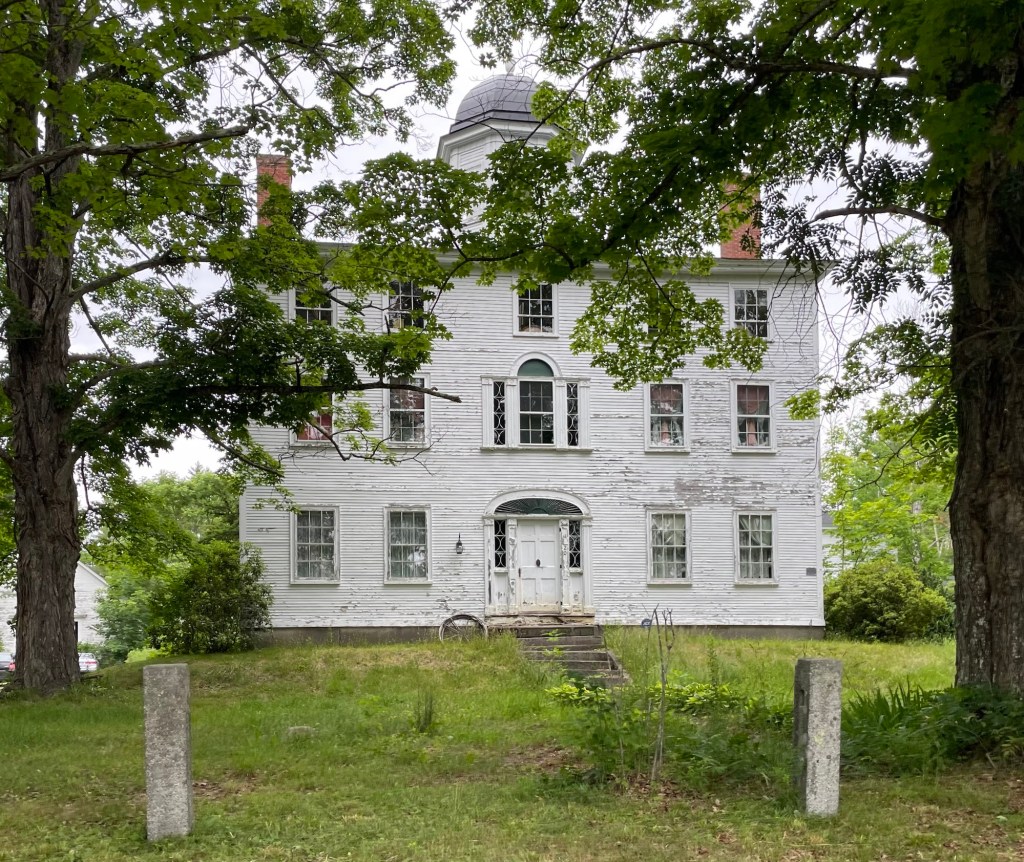
Isaac Lord (1772-1838) was born in Maine, but would spend much of his time transforming the small town of Effingham, New Hampshire. Isaac married the love of his life, Susanna Leavitt in Exeter in 1793 and the couple moved to Effingham, living and working in a tavern he built. Isaac prospered as an innkeeper, merchant, farmer, and entrepreneur, becoming Effingham’s wealthiest citizen, making the village he owned buildings to be called Lord’s Hill in his name. From 1818 to 1822, Isaac and Susanna lived in Portland, but he was ridiculed for “having money but no culture”. Growing tired of the city, he decided to return to Effingham. Mrs. Lord found the village too quiet and longed for the social life to be had in Portland, Maine. To convince his wife to remain with him, Isaac promised her a mansion that rivaled the homes in wealthy seaports like Portland and Portsmouth and began working on his mansion in Effingham in 1822. After years, the massive estate was completed, but Susanna remained in Portland. A heartbroken Isaac moved into the large mansion and continued business until his death in 1838. The Isaac Lord House consists of a three-story main block with a grand cupola on its roof and a three story ell to its rear. Stables and a carriage house are also on the lot today. I would do anything to see the inside of this beauty!