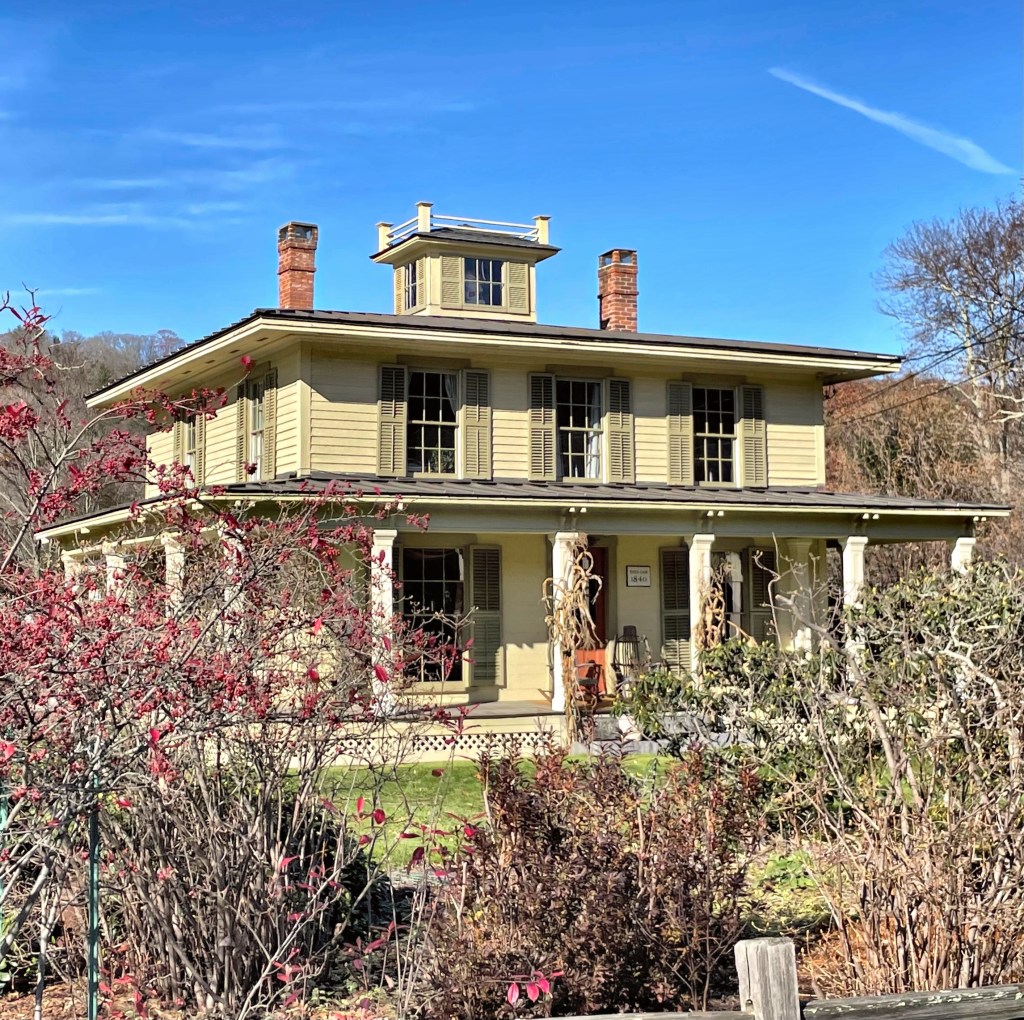
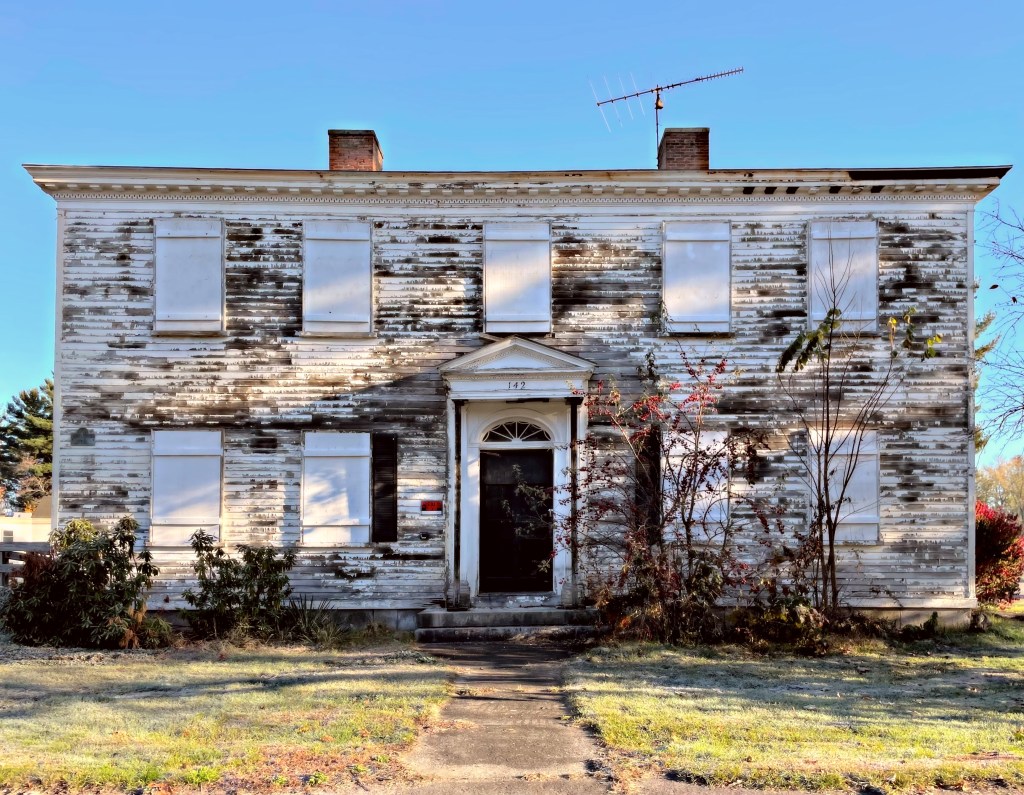
Built in 1840 for Titus Case, this old house looks very different than it would have been when first constructed. The house was originally Greek Revival in style, probably with a gabled roof, common of the region and style. Case died in 1845, and the home was later purchased by Jeremiah Crowley who ran the Canton Creamery nearby. After the Civil War, he “modernized” the house in the then fashionable Italianate style, with a low-sloped roof with overhanging eaves, large brackets, a cupola, and a wrap-around porch.
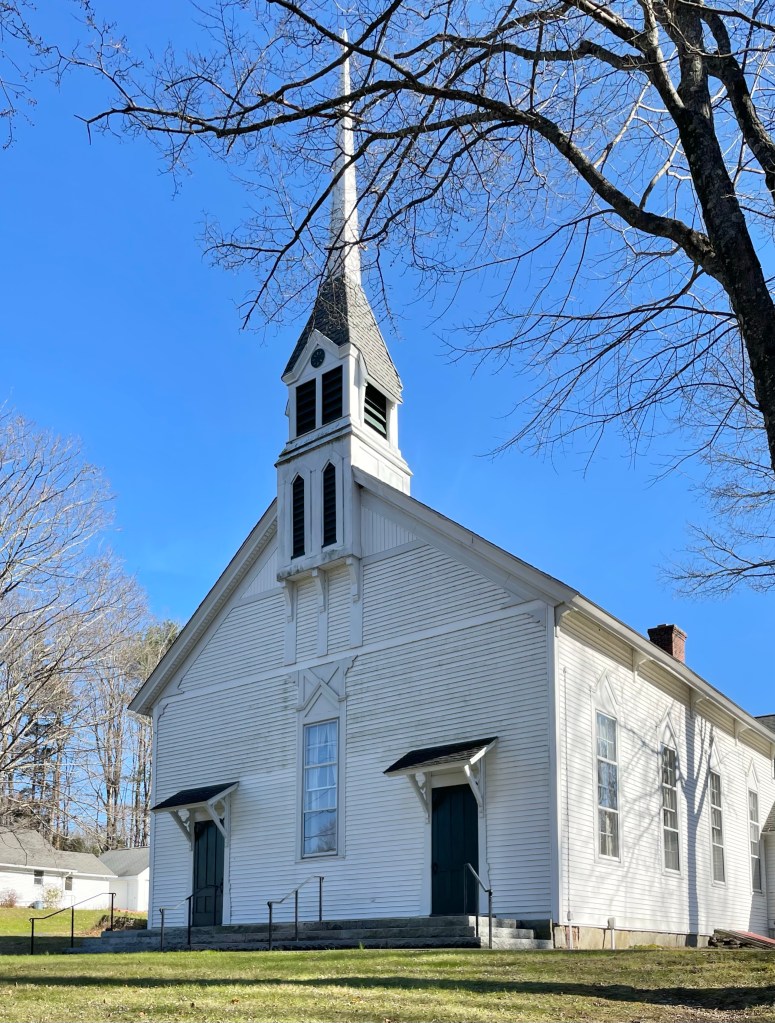
This modest country church in North Canton Village, CT is a fine example of a restrained Stick style church building. The simple plan, steeply pitched roof, adorned woodwork trim to resemble the bracing underneath, and the central spire all work together to create such a beautiful architectural composition. The building was constructed in 1871, and formally opened for its first service one year later.
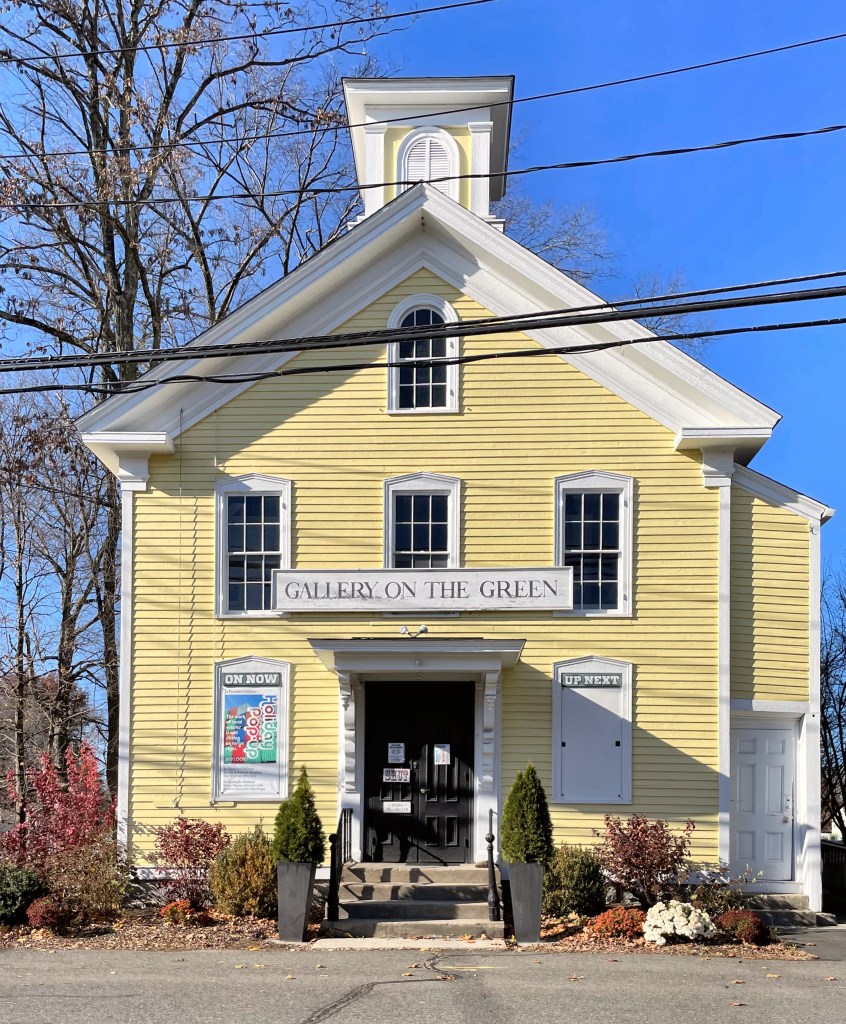
Canton, Connecticut, the only town in the state named after a city in China! The land which we now know as Canton had long been inhabited, specifically by the Wappingers, a group in the larger Algonquin speaking tribes. Canton was incorporated out of Simsbury in 1806, and named after the City of Canton in China (now known as Guangzhou), though I am not sure why. The town quickly developed two main villages. Collinsville sits on the Farmington River and its power was harvested for industry; while the center village grew differently as an agricultural village of farms. At the center of town sat a green for civic and town functions and gatherings. The town constructed a school here as far back as 1759, when the rural village was still a part of Simsbury. This is the fourth building on the green and it was built in 1872, and can be classified as Italianate in style. The building was occupied as a school until 1949, and it was used for other city uses until 1971, when the building was rented to the Canton Artist’s Guild and the building was renamed Gallery on the Green. The building remains community-focused and holds exhibits of local artists! Much of the rest of Canton Center lost all of its bucolic charm when the main road became commercialized, prioritizing speeding cars over a walkable village.
The Newhall-Lane House (could be the home of many wives) was built in 1809 by Pliny Newhall, a bricklayer. He purchased the land here at a prominent crossroads in Lancaster in 1808 from his employer who owned a brickyard across the street. At a previous home in town, Newhall’s wife Patty died giving birth to their son, at just 23 years old. Their son also died during childbirth. He remarried and had a full family to grow into the couple’s new house. They relocated to Lincoln and the home was sold to Captain Anthony Lane, who was the son of Deacon Jonas Lane, an important figure in Lancaster town history. Jonas had four wives, outliving three of them. Captain Lane himself, was married twice while living in this house; he had no children from either marriage. Although he was a talented craftsman and cabinetmaker, Captain Lane listed his occupation as farmer. The house is significant architecturally, as a fine example of Federal style architecture in Lancaster . Its sophisticated design is reflected in the graceful entrance. One of the unique features of the house is the pedimented gable of the facade which in combination with the narrow plan of the house, creates a delightful massing in this distinctive combination of Greek Revival and Federal styles.
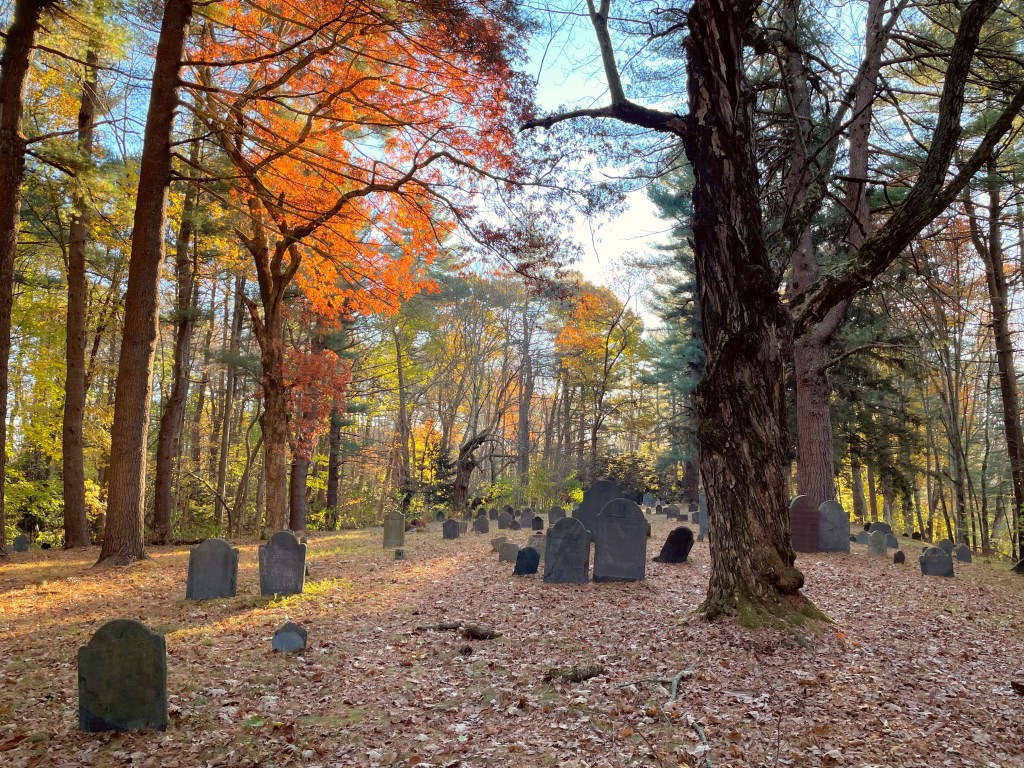
I know.. I know.. It’s not a building, but I couldn’t help myself but to find this hidden cemetery and take some photos! Tucked way off a street, across railroad tracks and down into a grove of trees, I came across this Colonial-era cemetery known as the Old Settlers’ Burying Ground. Established by 1674, it is the town’s oldest formal cemetery with gravestones dispersed, both standing up to the heavens and seemingly jutting out of the ground like crooked teeth. The Old Settlers’ Burying Ground contains approximately 196 stones and an estimated 230 burials. The stones in the cemetery reflect the continuum of headstone iconography popular from the 17th through 19th centuries, depicting winged death’s head, soul effigy, heart, hourglass, skeleton, and cherubs, to name a few. The cemetery is thought to possibly have unmarked graves of the colonists who were killed during the Lancaster Raid, the first in a series of five planned raids on English colonist towns during the winter of 1675 as part of King Philip’s War. Metacom, known by English colonists as King Philip, was a Wampanoag sachem involved in leading and organizing Wampanoag warriors during the war. The tension that led to these raids began from the decline in the fur trade due to overhunting, the decrease in the native population due to European-derived diseases, and the invasion of English livestock on native land. According to one estimate, at least fourteen Lancaster inhabitants died and twenty-three were captured and taken as prisoners, some of those 14 are likely buried here in unmarked graves.
Located in Lancaster, Massachusetts, the Thomas Safford House has stood for over 220 years, but is slowly decaying. Built in 1799 for Thomas Safford, a baker, the house is an excellent example of a Federal-style homestead that appears much like it did when built (besides the neglect). After two subsequent owners, the property was purchased in 1890 by Pauline Revere Thayer, a direct descendant of Founding Father, Paul Revere. Pauline added a large wrap-around porch and balcony to the house, which served as a vacation home for working girls from Boston. She appropriately named the house “Goodrest” where the girls could enjoy their summers, without working in poor conditions. After she died in 1934, the property was acquired by the Commonwealth of Massachusetts as the residence for the head of the Lancaster Industrial School for Girls. The Lancaster Industrial School for Girls was a reform school and the country’s first state reform school for girls, opening in 1856. This school paved the way of social reform, moving away from child imprisonment for “delinquents” towards a correctional paradigm. This was in part achieved because of the observed benefits of environmental change in children, as well as the importance of education. The bucolic, open-air setting was believed to be beneficial for childhood development, compared to a prison setting common before-hand. In 1935, the Safford House was restored to the original appearance, and the porches removed. The State of Massachusetts owns this house and the rest of the severely deteriorating buildings on the campus. It is a shame to see such significant buildings intentionally left to rot.
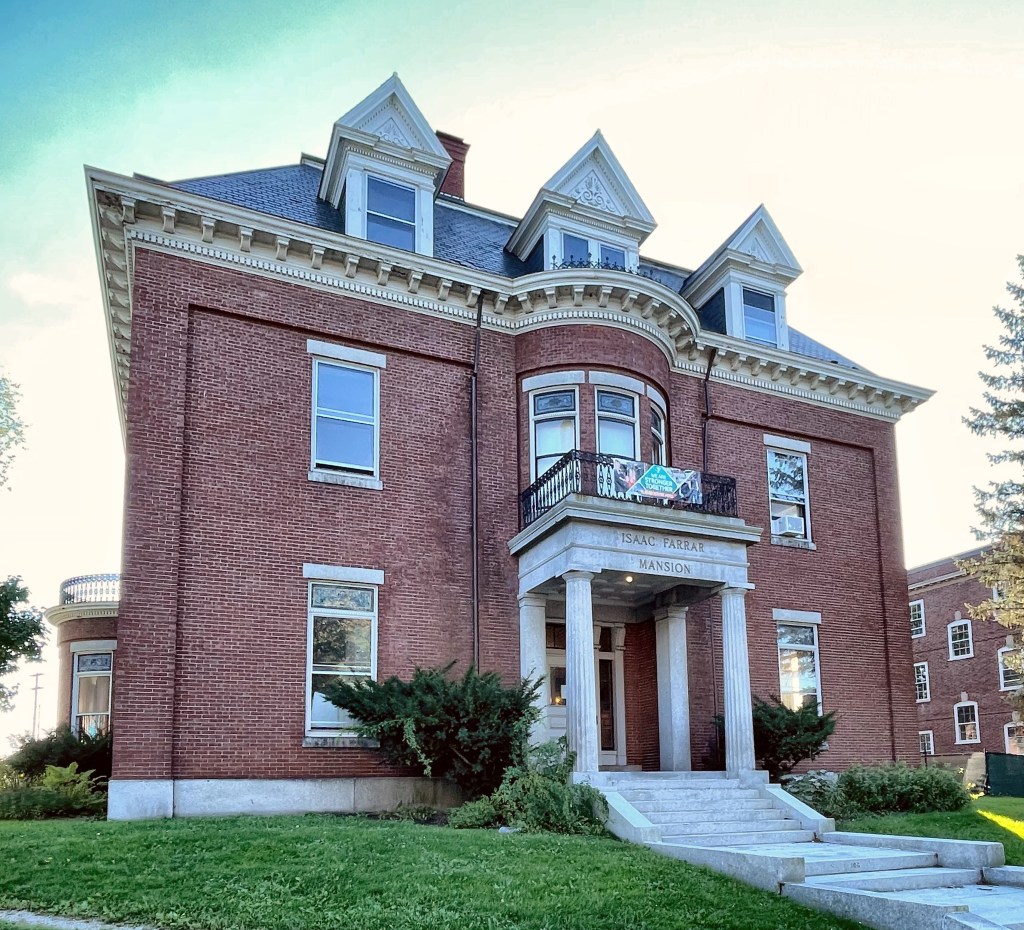
The Isaac Farrar Mansion in Bangor, Maine not only looks gorgeous, it is significant as the one of the first known works of architect, Richard Upjohn. It is important because it shows that English-born Upjohn, who is best-known for launching the popularity of the Gothic Revival style in the United States, began his career by building in the Greek Revival style, the traditional style of the time. This mansion was designed for Isaac Farrar, a lumberman and merchant, and later, President of the Maritime Bank of Bangor. Charles B. Sanford, who lived in the house from 1865-1878, was proprietor of the Sanford Steamship Lines. The home had a few more subsequent owners until 1911, when it was acquired by the University of Maine Law School, which used it as a residency until 1929. It was soon after purchased the Bangor Symphony Orchestra, who renamed it “Symphony House”, and operated the Northern Conservatory of Music on the premises, also hosting the music branch of the Bangor Public Library. In 1972 the school closed, and the symphony sold the building the following year to the local YMCA, which now uses it as an exhibit and reception space. While some aspects of the house look to be from the early 20th century, it retains much of the Greek Revival design by Upjohn. Talk about a full history!
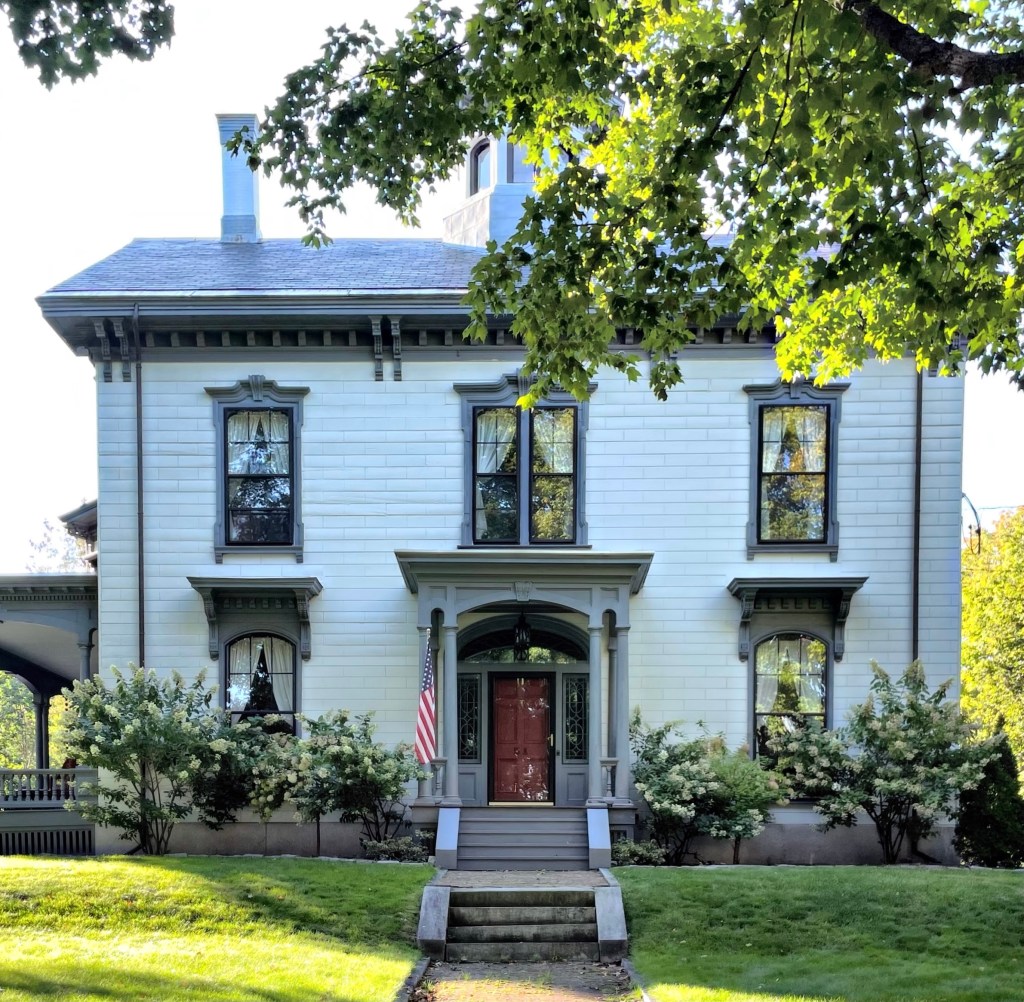
The neighbor to the iconic Thomas Hill Standpipe (last post), this pre-Civil War Italianate mansion predates the water tower and has long been one of the most grand homes in Bangor, Maine. The house was constructed in 1857 for Joseph W. Low, a businessman and trustee of the Bangor Savings Bank. The house he had built is one of eastern Maine’s outstanding Italianate residences, designed by Boston architect Harvey Graves, who was born in Maine. Soon after the Civil War, Graves moved west to California, likely seeking additional wealth from the spurned from the success of the Gold Rush. He appears to have lived out the remainder of his life out west, giving his family in Maine this home. The house exhibits flushboard siding with scored wood to resemble ashlar masonry, gorgeous window hoods and mouldings, and a large belvedere at the roof, which would have provided sweeping views of the Maine frontier when built, atop one of the highest hills in Bangor.
Constructed in 1811 as a guest house for the Canterbury Shakers, this beautiful structure follows the Georgian, center-hall residential floor plan constructed in the Federal period. Shaker records indicate that in 1849, the building was converted to an infirmary and the next year, the roof was tinned and the portico over the front door, called a “jet” by the Shakers, was added. After 1892, the first floor housed the nurses’ quarters, pharmacy, nurses’ sitting room and office and the dentist’s office. Upstairs, the patients’ rooms were fitted with lavatories and running water. The attic was used to store medical supplies and as a mortuary. All for the growing Shaker community here. Following the death of the last nurse in 1937, the building ceased to be used as an infirmary and was used as living quarters for sisters.
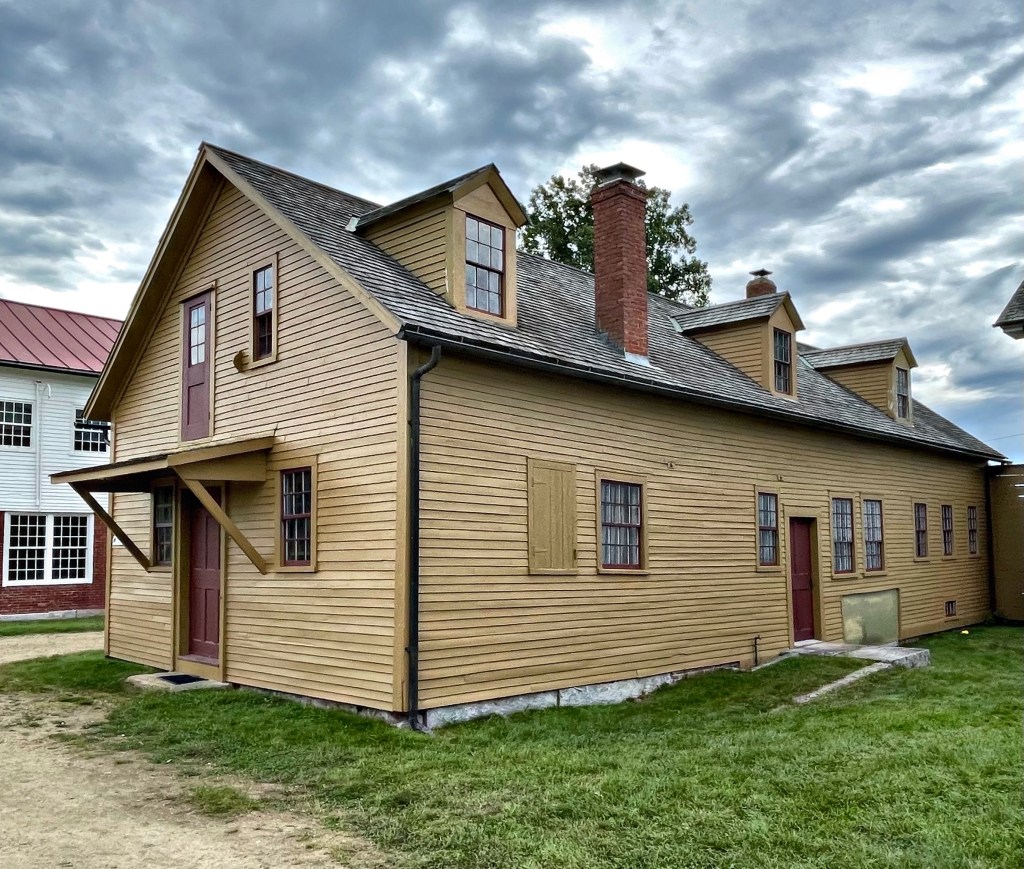
The original purpose served by this small clapboard building in the Canterbury Shaker Village, built in 1837 and measuring just 12 x 25 feet is subject to some debate, although it was definitely used as a drying house. Early writings indicate it was built as an apple-drying house while others state that the original purpose was to dry lumber. The present off-center gable-roofed cupola on the gable roof served as a ventilator. In 1865, the building became the headquarters of the bee keepers of the local Shakers.
When Benjamin Whitcher donated his farm for the beginnings of a utopian Shaker community, the land and buildings became the catalyst for the next 200 years of Shaker life in the community. It is known that Benjamin Whitcher constructed his farmhouse sometime between 1775 and 1782. With the arrival of the first Shakers in 1783, Whitcher allowed families to reside on the farmland, with the 1790 Census counting 35 people on the Whitcher property. This structure was one of the original structures on the old Whitcher Farm, and is possibly the oldest extant building in the Shaker village today. The building was moved to its present location in 1841 and was used for distilling sarsaparilla syrup for medicinal purposes by members of the community.
The marriage of Anna Perkins Pingree to Joseph Peabody in 1866 was a merging of two of the most influential and wealthy families of Salem, Massachusetts. The marriage however did not meet the mark, as the couple eventually had a large falling-out after purchasing a mansion in Boston’s Back Bay neighborhood in 1877. In her time away from her estranged husband, Anna became heavily involved in the arts, collecting hundreds of paintings and decorating her homes in Boston, Ipswich, and her new summer cottage in Bar Harbor. In 1896, she had her Bar Harbor cottage built on West Street, a road of substantial summer homes right next to downtown. The Colonial Revival “cottage” sits on the waterfront of Frenchman Bay and has only 12 bedrooms and 7 bathrooms, in 12,500 square feet.
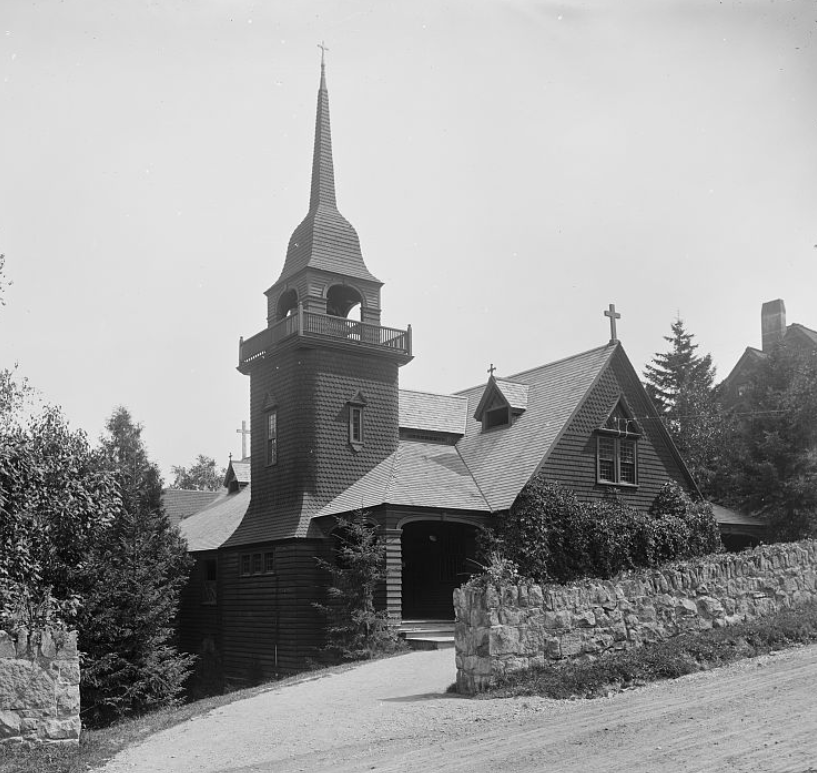
As wealthy citizens from cities like Boston, Philadelphia and New York, began building summer cottages on Mount Desert Island in Maine, an influx of carpenters and tradespeople from Ireland followed to construct and work on them. Realizing this, cottager DeGrasse Fox along with Brooks White of Philadelphia, donated land for a new Catholic church building. Maine architect, William Ralph Emerson, donated plans for the church. A masterpiece of Shingle style design, the church, which seated 300 people, was deemed too small for the growing village’s summer congregation. A new, stone church was built closer to town (featured previously). The spire and belfry resemble another church Emerson designed in Beverly, MA, St. Margaret’s Catholic Church. Sadly, St. Sylvia’s burned down in 1909.
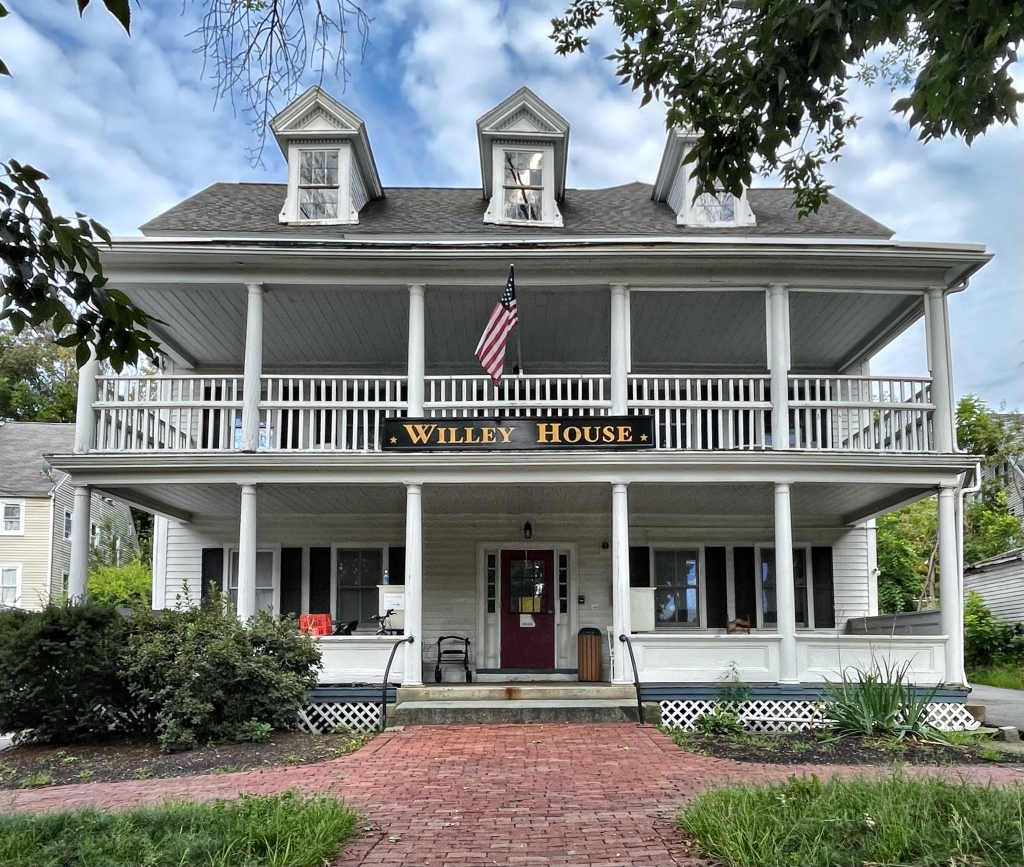
Originally an old tavern/inn, this wood-frame building in Newmarket, NH, was built for a member of the Rundlett Family who settled in town from nearby Portsmouth. The old building was known as Rundlett’s Tavern for a number of years, later renamed the Washington House, and eventually Silver’s Hotel by 1870. Under owner Joseph B. Silver, the Federal style building was updated with Victorian-era flair, marketing to visitors of town who had business with the Newmarket Manufacturing Company across the street. After Silver died in 1898, the building was purchased by George H. Willey and renamed the Willey Hotel/Willey House. He oversaw renovations in the 1920s to give it the Colonial Revival appearance we see today. The building is now apartments.
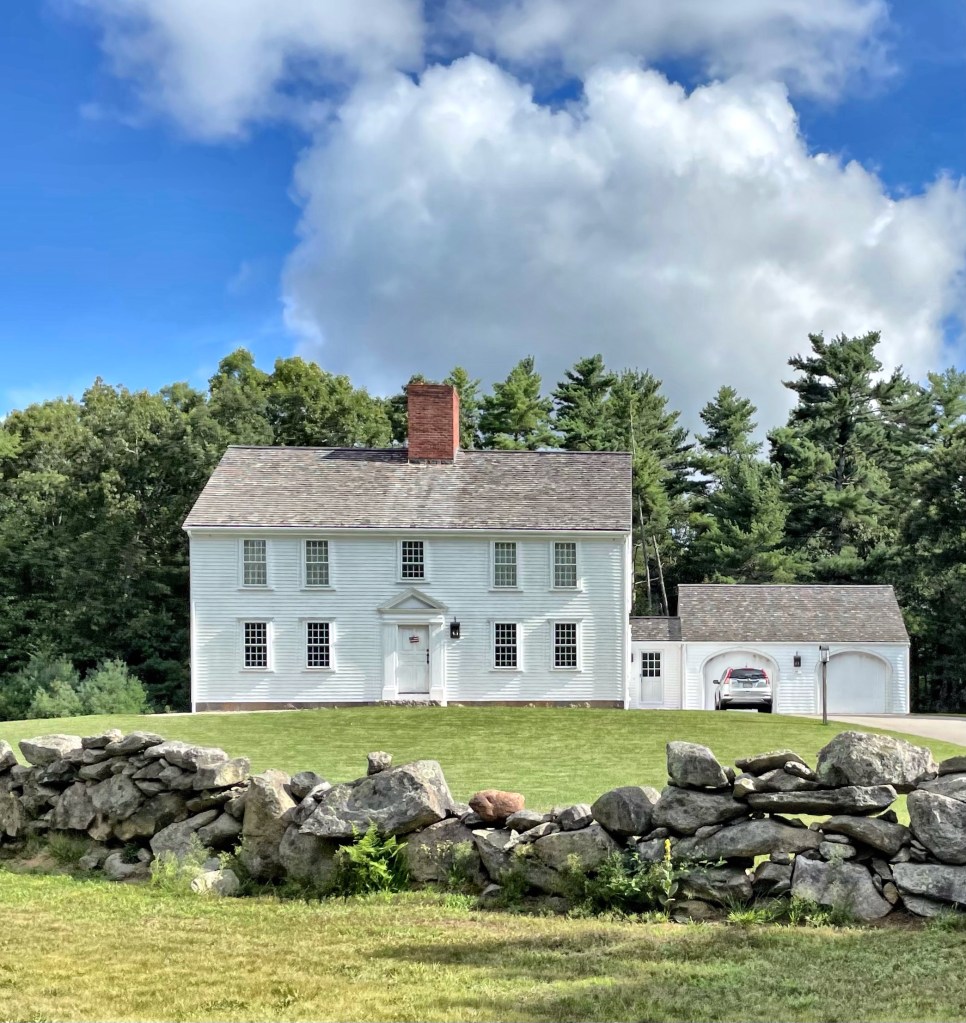
My favorite Georgian style house in Rochester, MA is the Delano-Clapp House set far off the street, behind a stone wall. The house was built in 1735 for Jonathan Delano, a weaver. Jonathan’s son, Jonathan, Jr., sold the house and land to Ebenezer Clapp, in 1755. The property remained in the Clapp Family for nearly 250 years, when it sold out of the family in 1990. This house is testament to the fact that you can find great architecture in every corner of New England!