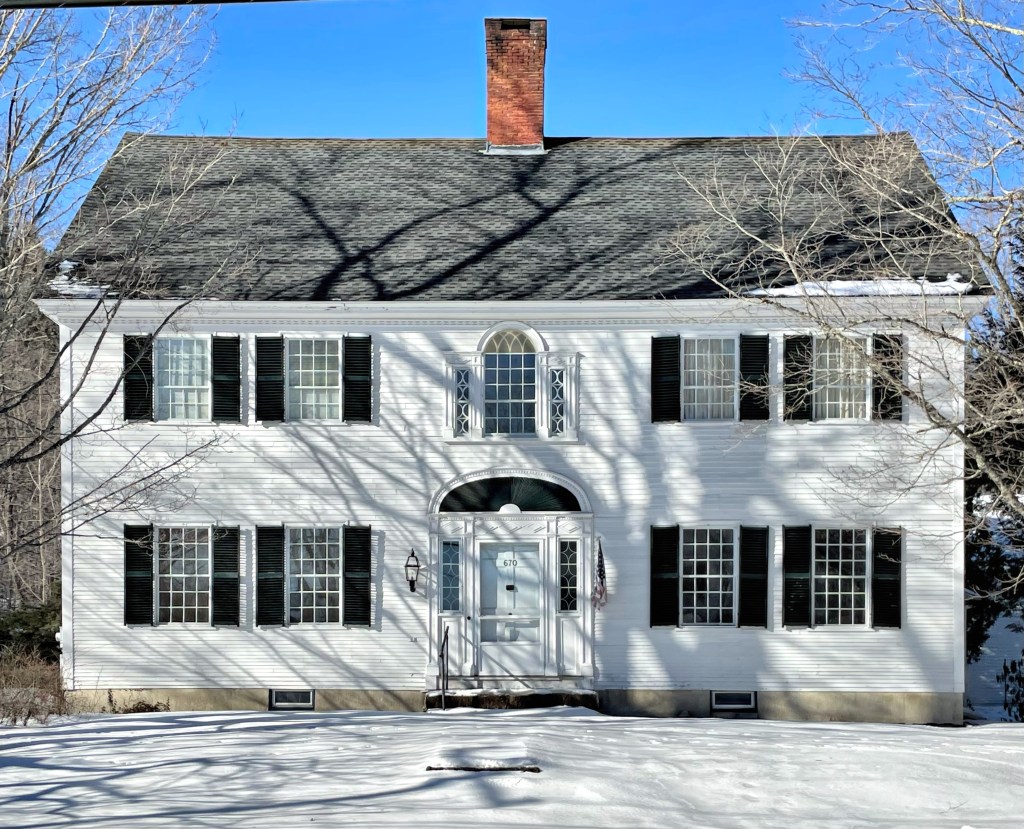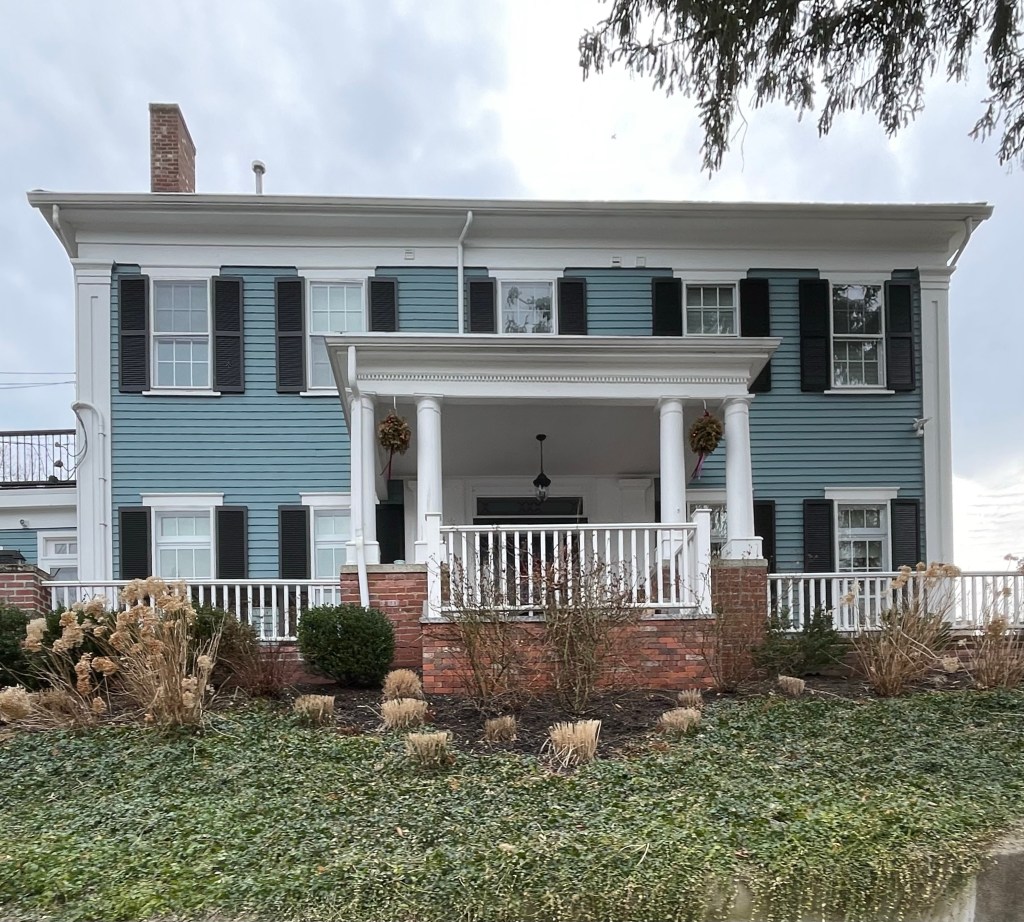
Jacob Weld Seaver House // c.1850

In 1849, Jacob Weld Seaver (1820-1914) married Sarah Abby Weld and built this Greek Revival home, perched on a hill near the burgeoning Forest Hills Cemetery. The property originally extended all of the area of Orchardhill Road and the dead end streets that extend off of it, and included a stable, caretakers cottage, and at least two rental properties (this house may have been one of them). Jacob Seaver grew up in the neighborhood and attended Harvard, graduating in 1838. He became involved with the drygoods business and must have met his future wife from her father George F. Weld, who was a commission merchant in Boston. He went on to become the director of the Second National Bank of Boston, commuting into the city from the Forest Hills station. In the early 20th century, Seaver sold this property to a Thomas Minton, who subdivided some of the lot and built houses on the estate.
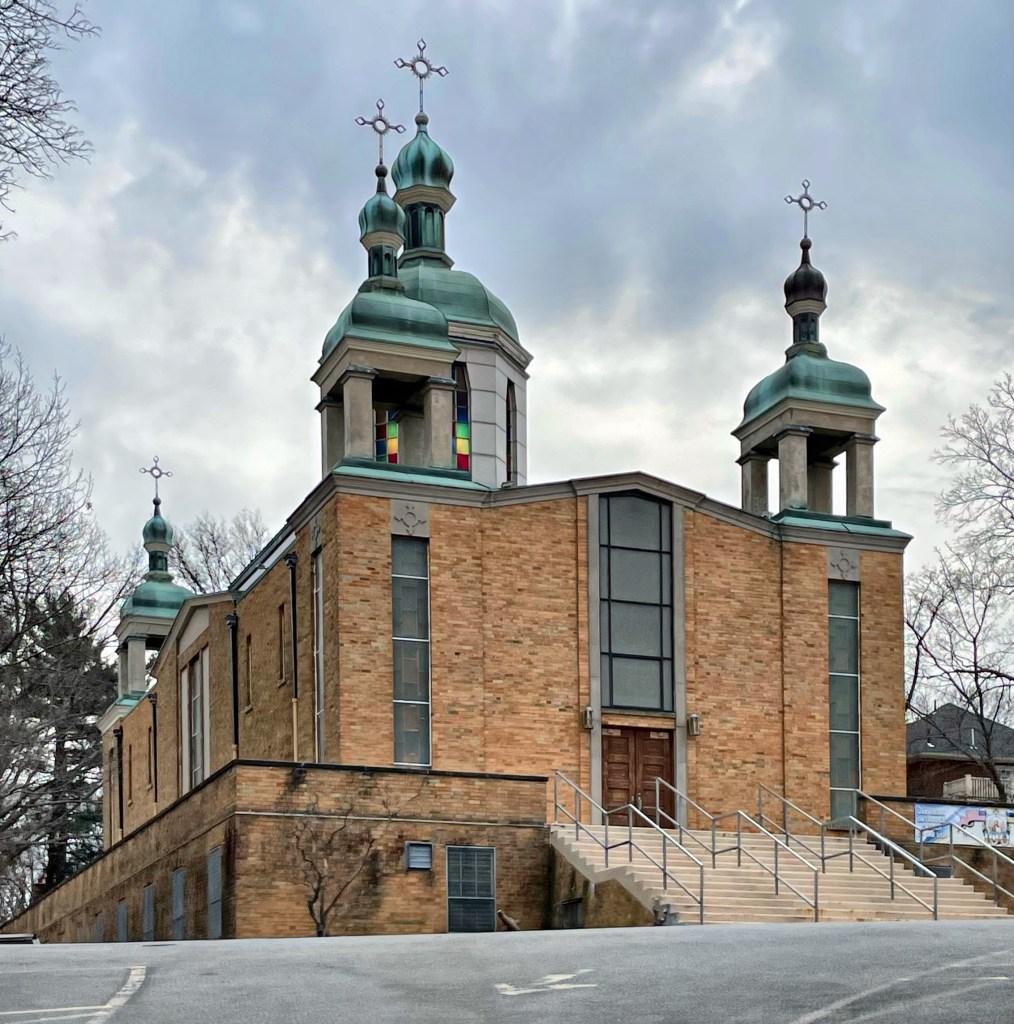
St. Andrew Ukrainian Orthodox Church // 1958

I typically do not connect my posts to current events, but I really wanted to take time to highlight the strength and fortitude of the Ukrainian people fighting to preserve their home and democracy around the globe. Closer to home, a growing Ukrainian community in Boston in 1956, decided to erect a new church in the Forest Hills section of Jamaica Plain. Land was acquired and a blessing ceremony was attended by members of the church, the architect, and Reverend John Theodorovich; the head of the Ukrainian Orthodox Church of America, who was born in Ukraine, and served at chaplain with the Army of the Ukraine National Republic in the war against Russia in 1919-20, before eventually moving to North America. The architect, John Kodak, was a Toronto-based architect of Ukrainian descent who ended up in Canada after fleeing from his home to escape communist rule from the USSR. This church is a Modernist interpretation of the iconic St. Andrew’s Church in Kiev, Ukraine, with its onion domes surmounted by crosses. The church, like many others, is holding prayers for Ukraine and is coordinating donations and aid to the Ukrainian people and related charities.

Knight Library // 1912

Prior to 1899, the Ladies Sewing Circle of Waterford carried on a lending library at the Ambrose Knight store, run by Sarah and Carrie Knight. Interest in the library grew and more room was needed for books. The Knight sisters began construction of a stone building, but both died only a few weeks apart in August 1911 during its construction. The building was completed in 1912. On Oct. 1, 1937 a fire destroyed parts of the library and other nearby buildings. In early 1938, the library’s second floor was reconstructed in the new Dutch Colonial style, giving the library a very different look.

Bear Mountain Grange Hall // 1844

This large wooden building in Waterford, Maine, looks much like a church, because it was built as one in 1844! The building was constructed as a Universalist Church just over a decade after a local Universalist Society was formed in the area in 1830. In the subsequent decades of the church’s founding, dwindling membership by the time of the Civil War required the group to sell the building to local businessmen. The town rented a space in the building which used a floor as a school, after an additional floor was added to the base, giving the building the vertical appearance it has today. in 1896, the Bear Mountain Grange purchased the building as a meeting hall, allowing the school to operate in the building (an arrangement that lasted until 1949)! The building has seen better days, but besides the chipping paint and some wood-rot, it retains the original windows and has been relatively un-altered!

Ambrose Knight House // c.1810

The most architecturally significant example of the Federal style in Waterford, Maine, is this c.1810 home built for Ambrose Knight, who operated a store in town. The high-style Federal home features a well-proportioned fanlight over the entrance with a Palladian window above, all with geometric moulding. The home was likely built by a housewright who employed designs from Asher Benjamin’s pattern books for builders, as the high-style features and Palladian windows are uncommon in this part of Maine.

Dr. Leander Gage House // 1817

Dr. Leander Gage (1791-1842) came to Waterford from Bethel, Maine in 1817. He erected and lived in this Federal style house which overlooks much of the South Waterford village. Gage was a prominent medical practitioner in town and involved in local politics as a moderator at town meetings and as a school committee member until his death. The home has a Federal style stable and 1840s barn attached and had remained in the Gage family until at least the 1980s.

Waterford Odd Fellows Hall // 1904

Built soon after a massive fire destroyed much of North Waterford Village in Maine, the Iocal order of Odd Fellows decided to rebuild, constructing this building for their members. Though active for several decades after the building was reopened, an aging and dwindling membership forced this chapter to merge with the Odd Fellows of nearby Norway, Maine. After, this building was occupied by the Daughters of Rebekah, an auxiliary group of the IOOF for women until 1973 when it was donated to the recently formed Waterford Historical Society. The society has since moved, and listed the building for sale in 2020 for just $10,000!!

North Waterford Congregational Church // 1860

The Town of Waterford, Maine was created as the result of a 1774 grant made by the General Court of Massachusetts to the descendants of a company of Massachusetts soldiers involved in a 1690 expedition against the French in Canada, leading to the Battle of Quebec. The land was surveyed in 1774; in spring of 1775, David McWain of Bolton, Massachusetts arrived with his dog at a lot he bought for $40. He cleared land and built a log cabin, returning to Bolton for two winters until he settled permanently at Waterford in spring of 1777. The town grew around agriculture and industry with sawmills built at streams to manufacture the region’s abundant timber into lumber. The town later became more of a resort area in the early 20th century, with urban-dwellers flocking to the area to take in the fresh air and natural scenery.

This church in North Waterford is located in a more rural part of the town, and was constructed in 1860 by a group of local residents from designs by Maine architect Thomas Holt. The Italianate influence is evident from the round-arched windows set in a recessed arch and a bracketed cornice. The steeple looks to be more contemporary and slightly turns, giving it a really interesting presence.

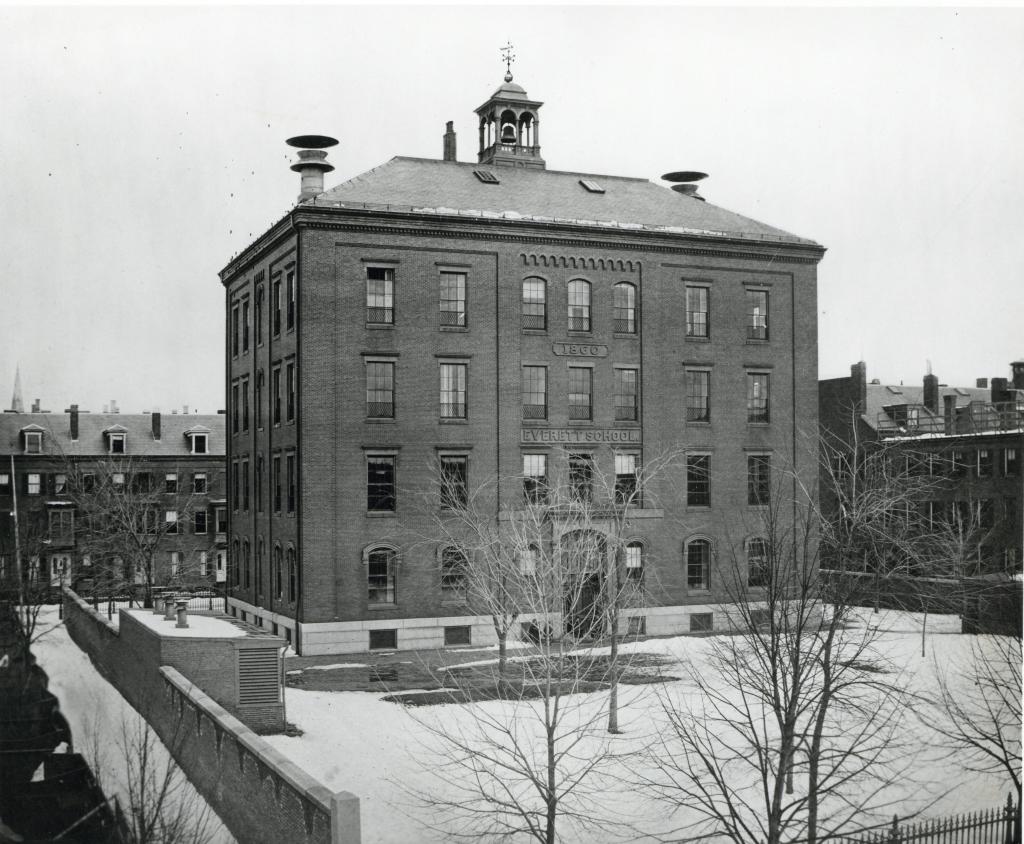
Everett Schoolhouse // 1860-1965

c. 1910 image courtesy of Boston City Archives.

The Everett Schoolhouse opened in 1860 as Boston’s most modern school at the time, serving students in the South End and Roxbury. The school was located on Northampton Street, just off Tremont Street, and stood four stories with lawns surrounding it. The building was architecturally beautiful, with brick walls and stone trim and basement, large double-hung windows, and a slate roof capped by a bell tower. The building was so special, the opening ceremonies were documented in the New York Times in 1860. The school was named after Edward Everett (1794-1865), a Boston-native who served as a U.S. Senator, the 15th Governor of Massachusetts, Minister to Great Britain, and United States Secretary of State. He also taught at Harvard University and served as its president. My favorite tidbit of history on Edward Everett is that he was a great orator, and was the featured speaker at the dedication ceremony of the Gettysburg National Cemetery in 1863, where he spoke for over two hours—immediately before President Abraham Lincoln delivered his famous two-minute Gettysburg Address! The Everett Schoolhouse in Boston saw thousands of children graduate before a fire on the top floor of the building in 1965 and subsequent water damage from fire hoses necessitated its demolition.

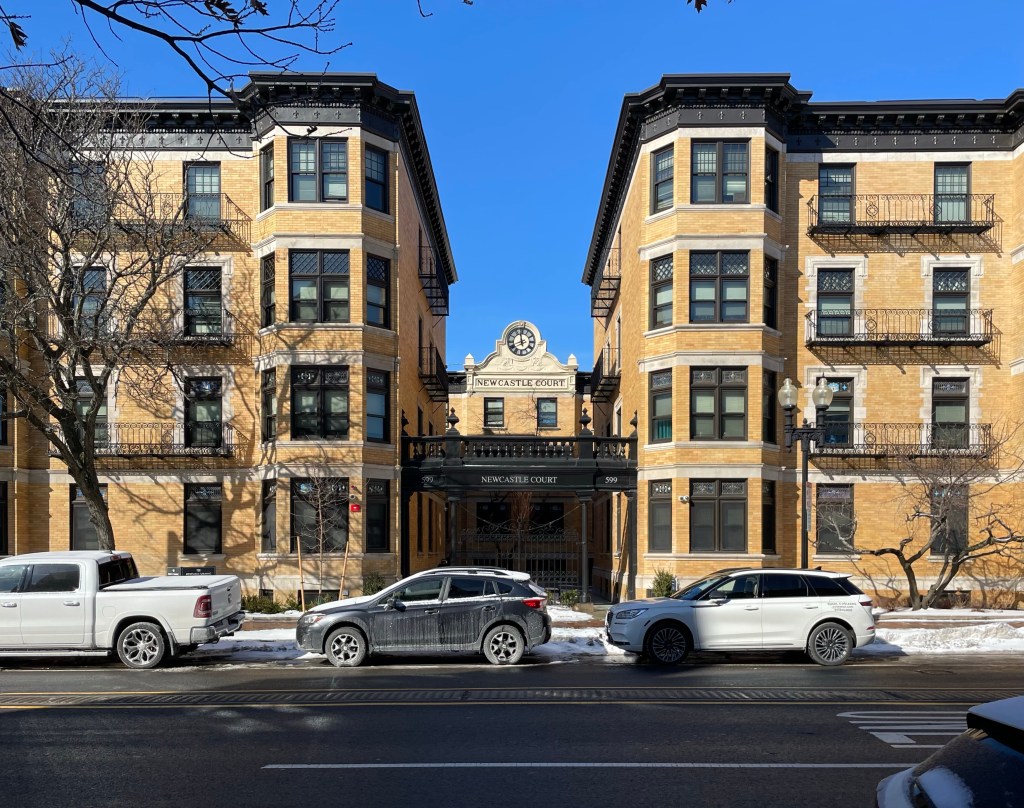
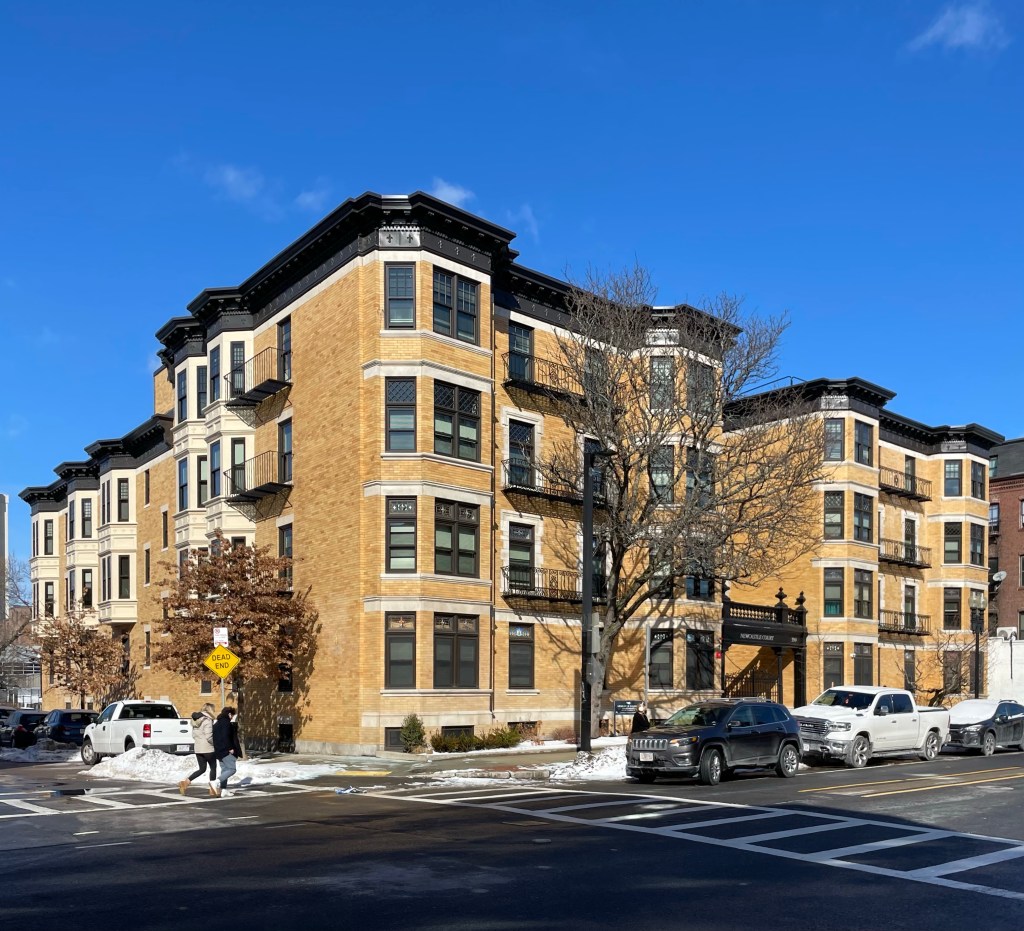
Newcastle Court // c.1907

Newcastle Court in Boston’s South End/Lower Roxbury neighborhoods is one of the finest apartment buildings in the city built in the early 20th century. The complex is U-shaped with a central courtyard off Columbus Street, to provide air and natural light in all bedrooms and units of the building. Newcastle Court was built by builder/developer Israel Nesson, who was credited as building the first fireproof apartment building in the city. Nesson and his family built and owned apartment buildings all over Boston and Cambridge, and operated many of them as landlords with massive real estate holdings. Newcastle Court stands out for the garden courtyard set behind the gate. At the back of the courtyard, the building has a raised parapet at the roof, which encompasses a clock. Many of the units retain the original stained glass windows, which are AMAZING!