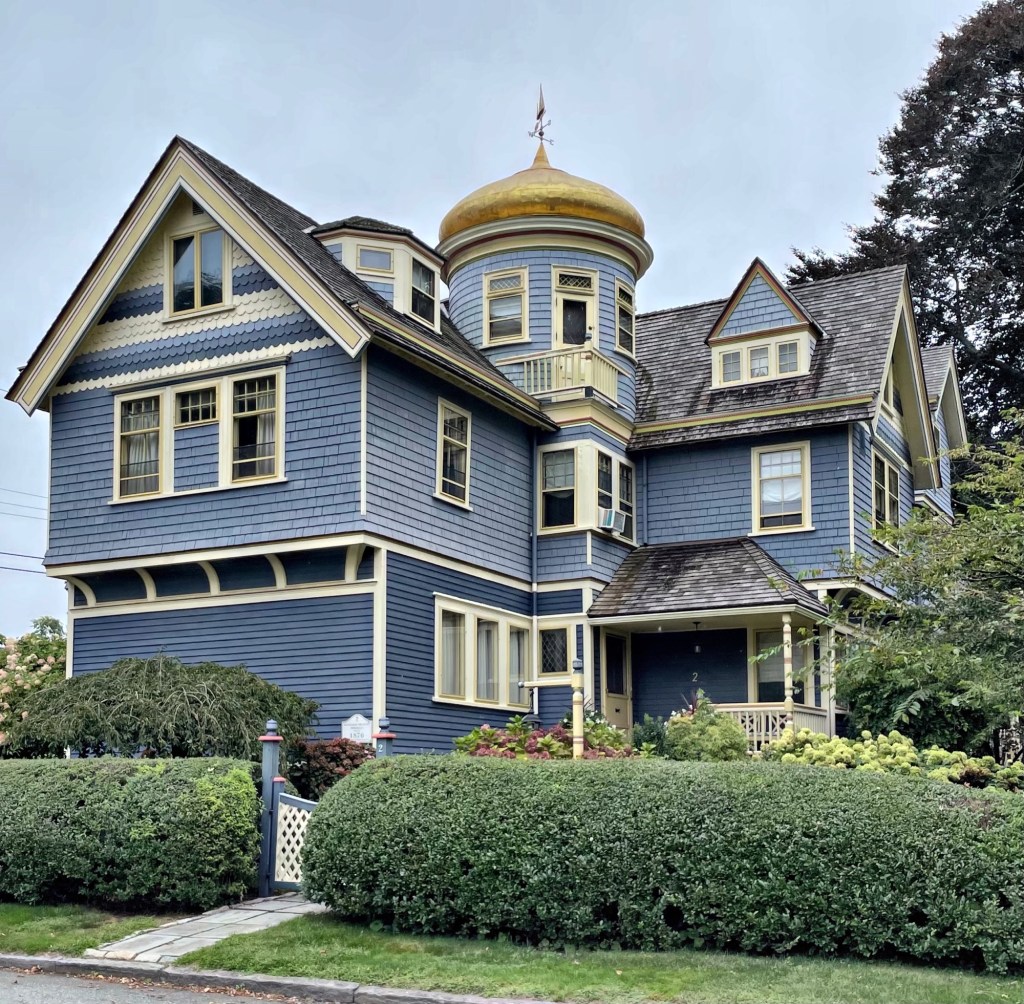
Katherine Prescott Wormeley House // 1876

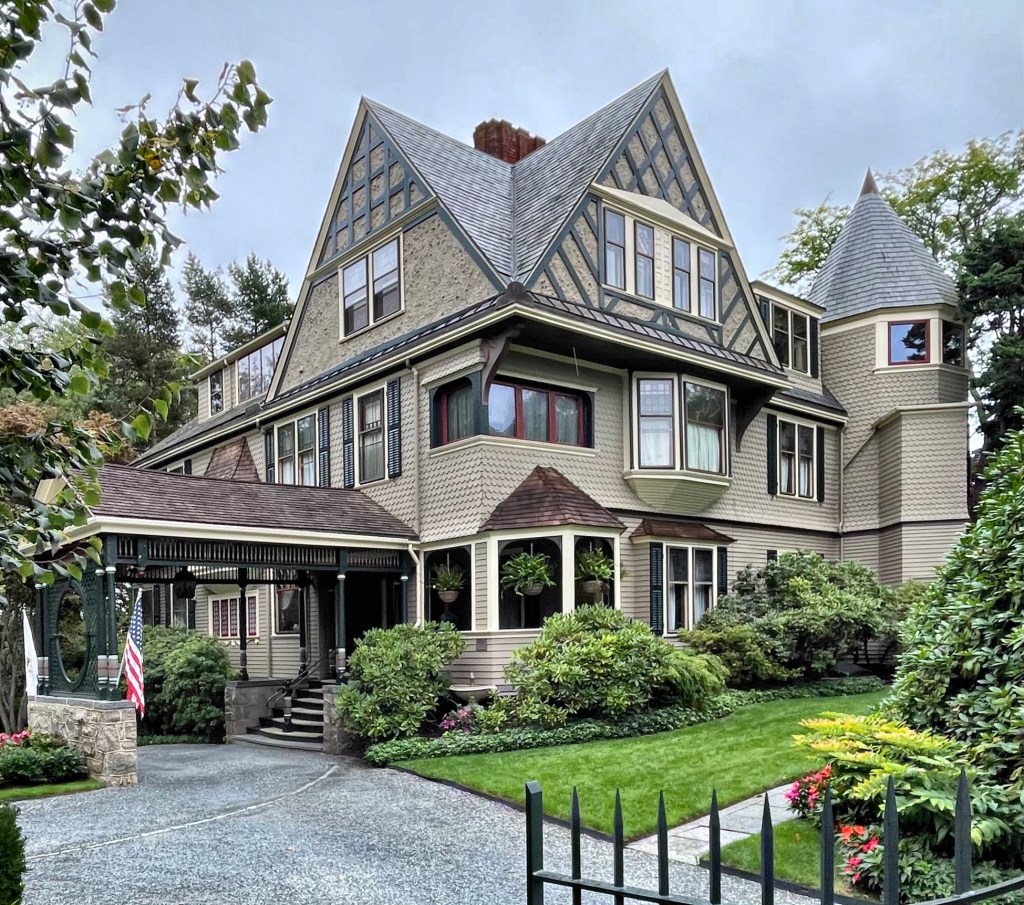
The Katherine Prescott Wormeley House is an eclectic and eye-catching Queen Anne architectural landmark on Red Cross Avenue in Newport, Rhode Island. Boston-based Katherine P. Wormeley (1830-1908), a native of England, served as a nurse for the Union Army during the Civil War and was one of the best-known translators of French literature into English. She built this double-house at a cost of $7,000 and rented another unit in the home for additional income. The Wormeley House is one of Charles Follen McKim’s early, independent works after working in the office of H. H. Richardson but before forming his own firm with William Rutherford Mead in 1877. Just years after she moved in, Ms. Wormeley in 1882, hired McKim, who was now under the firm, McKim, Mead & White to update and enlarge the home. By 1893, Wormeley had moved to New Hampshire and sold the house to Elizabeth Cabot Hayden and Dr. David Hyslop Hayden. The golden onion dome roof at the tower is a real treat!
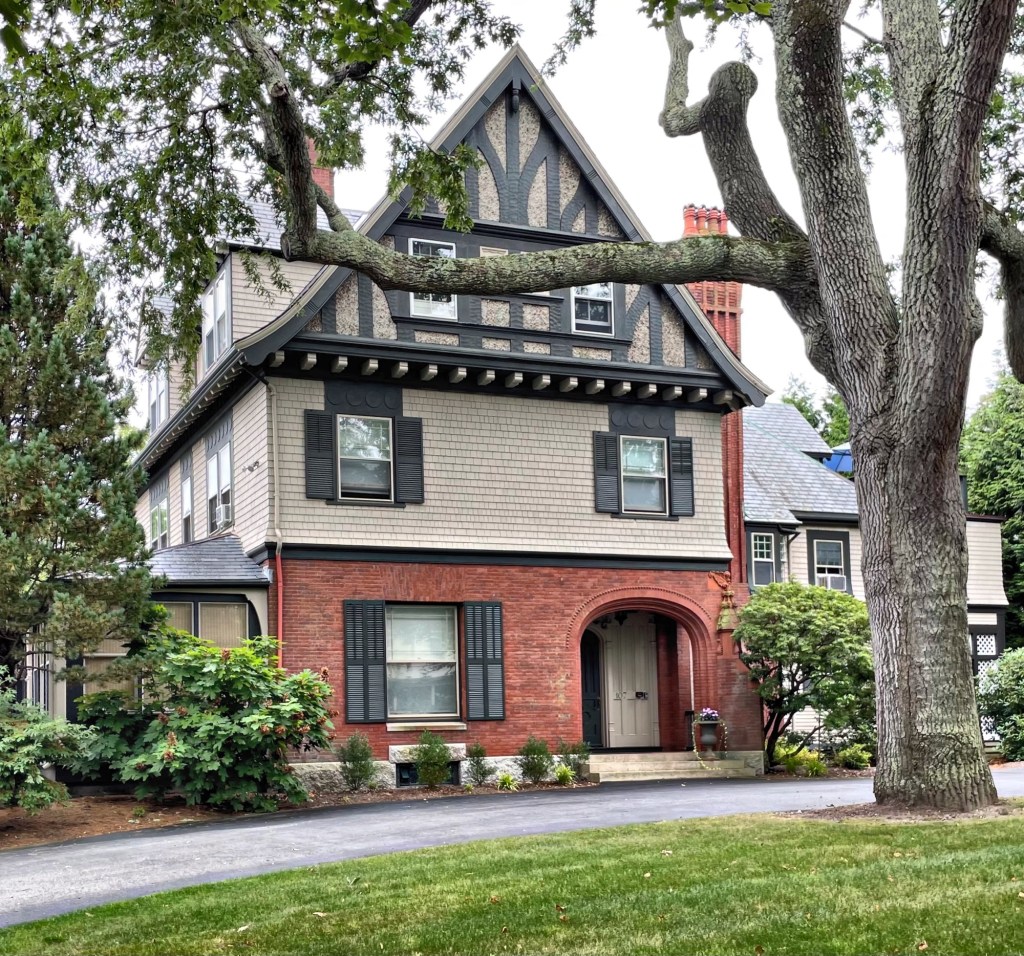
Oakwold Cottage // 1883

Oakwold, a stunning Queen Anne residence on Old Beach Road in Newport, Rhode Island was supposedly built on speculation and purchased by Augustus Jay (1850-1919). Mr. Jay was born in Washington, D. C., the son of Peter Augustus Jay and Josephine Pearson Jay. Augustus Jay graduated from Harvard College in 1871 and from the Columbia Law School in 1876, and worked as a diplomat. His wife was Emily Astor Kane (1854–1932), a daughter of DeLancey Kane and Louisa Dorothea (née Langdon) Kane. Emily was a descendant of John Jacob Astor. The “cottage” was named Oakwold, and was designed by architect Clarence Sumner Luce, who designed many summer residences in Newport, and specialized in the Queen Anne style. Particularly noteworthy in the design of Oakwold are the brick first floor with entrance within a recessed arched opening and pebble-dashed and half-timbered gable ends.

Rosevale // 1876

“Rosevale” was built in 1876 as a summer residence in Newport, Rhode Island, for couple, Grace Sears Rives and William Cabell Rives. Grace was the daughter of David Sears of Boston, who developed the Longwood neighborhood of Brookline; and William was the son of William C. Rives Sr., a Virginia congressman and Senator. The High Victorian Gothic mansion was designed by the Boston architectural firm of Peabody & Stearns who formed their practice just years earlier. The house was enlarged in 1881 by architect George Champlin Mason, Sr. The stonework of the lancet windows, the large octagonal tower, and the carved moldings give the relatively boxy home a more ecclesiastical feeling. The estate retains its original siting, at the middle of a large lot between Red Cross and Rhode Island avenues, which has thus far resisted infill housing on the estate. For years, Rosevale has been occupied as a funeral home, but it appears to have sold a couple years ago.

Bethshan Cottage // 1884

Bethshan Cottage is one of Newport’s (many) “hidden” gems that gets far too little attention from publications! Located on Gibbs Avenue, down the block from Eveherdee and William Barton Rogers‘ summer cottage, “Morningside”, Bethshan was built in 1884 on land purchased by Major Theodore Kane Gibbs. Theodore was the son of William C. Gibbs, the 10th Governor of Rhode Island, and served in the Union Army during the American Civil War, mustering out as a Major in 1870. Newport-based architect Dudley Newton designed this cottage for Gibbs, which blends nearly every major architectural style of the late 19th century under one, beautiful gambrel roof. The red granite stone walls, red brick trim, red fish-scale slate roof, even the rust-colored mortar, all work together to create a lovely composition, unlike anything else seen in Newport. According to Newport’s Assessor, the house is presently an apartment house.

Eveherdee Cottage // c.1889

This Queen Anne style “cottage” is located on Gibbs Avenue, one of the lesser-visited streets for house-stalking in Newport, Rhode Island, but wow is she something! The summer cottage here was built by 1890 for Ogden Hoffman Burrows, a merchant who went into business with his father and brother in San Francisco, shipping goods from East Asia to America. He purchased two adjacent lots here on Gibbs Avenue in 1884 and 1889, having this house built as a summer residence, where he could mingle with other wealthy neighbors. The Queen Anne style house was reportedly designed by local architect, John Dixon Johnston, who incorporated all the hallmarks of the style: varied siding types and materials, turned post porte-cochere, applied ornament, and complex, asymmetrical form. Burrows would sell this house by the turn of the 20th century. Later owners, Herbert E. Stride and Daisy Thompson Stride, who would reside here with Daisy’s mother, Eve. The Stride’s named the home “Eveherdee” an amalgamation of their individual names: Eve (Eveline), Her (Herbert), and Dee (Daisy). The home was most recently owned by television producer, Vin Di Bona, who restored the house to its grandeur we see today.

Littlefield-Van Zandt House // 1836

In the late 1830s, Captain Augustus Littlefield (1803-1878) purchased a house lot on Pelham Street in Newport, Rhode Island and commissioned housewright John Ladd to design and build his new residence. Littlefield reportedly asked his Ladd to design an “authentic copy of an Italian Villa” he had seen during a trip in southern Italy. The result is a more traditional Greek Revival, temple-front house with a portico supported by four monumental columns with capitals that combine Corinthian and Egyptian lotus motifs. The minimal Italian Villa detail can be seen in the bracketed cornice and in the pediment. Built around 1836, the house remained in Littlefield’s possession until his death in 1878. The property was purchased by Charles C. Van Zandt, attorney and later the 34th Governor of Rhode Island. Gov. Van Zandt died in 1894 and was interred at Island Cemetery in Newport. The Littlefield-Van Zandt House remains a significant early, high-style Greek Revival house in the state and one with a great state of preservation.

Stephen S. Albro House // 1876

Stephen Stedman Albro (1817-1895) was born in Newport, Rhode Island, the son of James and Rhoda Albro. After attending local schools, he entered into a mason’s trade, eventually starting his own contracting business. He split his time as a contractor and as a Deacon of a local Baptist Church. He was engaged in local politics, serving as a alderman for Newport and even was a director of the National Exchange Bank in Newport for some years. He built this home on Green Street after his marriage to his second wife, Emma, possibly designing and constructing the house himself. The Albro House is a stunning example of a late-Italianate style dwelling with later Queen Anne/Colonial Revival embellishments. This is a special house!

Billings Coggeshall Double House // c.1784

This unique double-house on Mill Street is stopped me in my tracks when strolling around Newport. The two-family house was built around 1784 by Billings Coggeshall (1733-1810) and is unique architecturally as it is comprised of two houses, each with its own separate pedimented entry, into a single lengthy block. Both houses have interior chimneys and are just one-room deep! When urban renewal hit Newport in the second half of the 20th century, traffic patterns and revitalization of the waterfront were top of mind (not necessarily slum clearance and wholesale redevelopment of neighborhoods like in Boston). To bring traffic into the downtown shopping area, Memorial Boulevard was laid out by 1969, and the Newport Restoration Foundation was integral to saving this building from the wrecking ball, as it was in the path of the new road. As luck would have it, an area around Trinity Church was cleared to establish Queen Anne Square, a town common-like park in the center of town. To provide the quintessential “New England charm”, many historic buildings were relocated to line the square, including this house. When the Billings Coggeshall House was moved here, it replaced a gas station, and it was given an even longer side addition with breezeway, providing screened parking and a rear addition for offices. Here’s to preservation!

Newport Telephone Building // c.1897

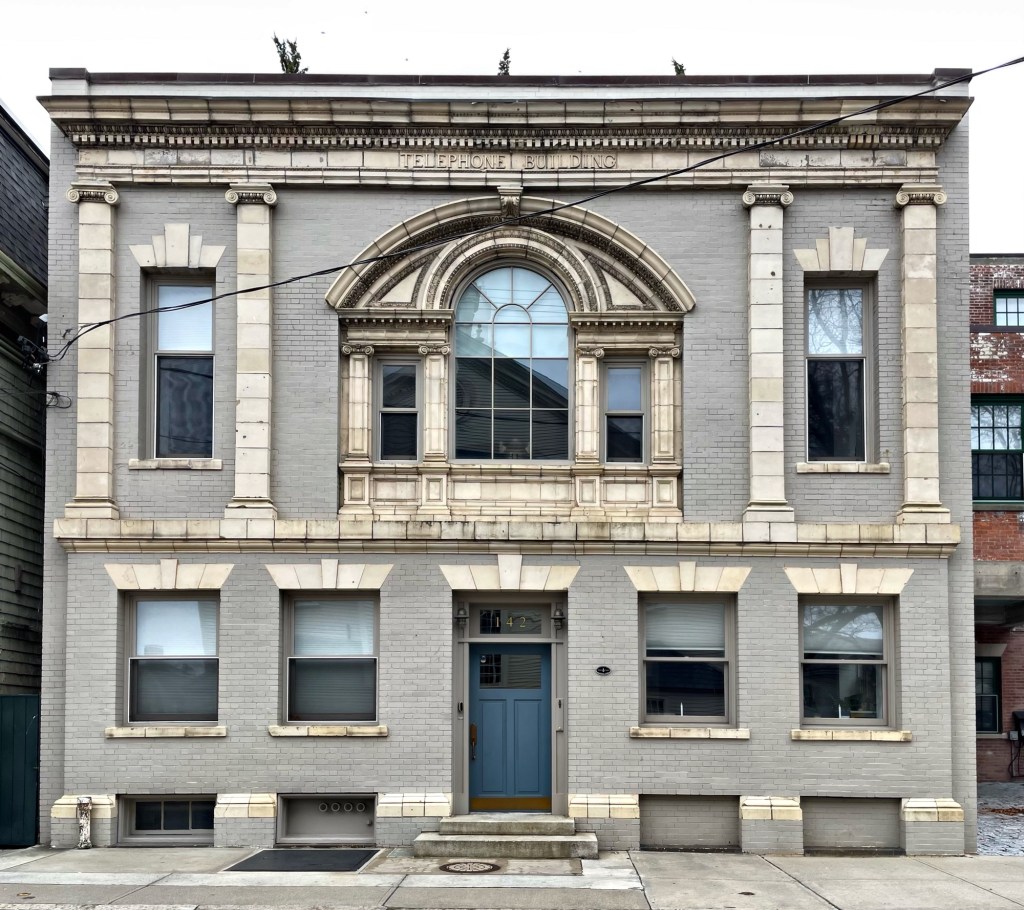
Before the days of virtual meetings, texting, and calls by cellphone, residents of towns and cities all over New England needed central telephone exchanges to connect them to those who they were trying to reach. Telephone exchange buildings were typically located in downtown areas and were often architectural statement-pieces by telephone companies. This example in Newport, Rhode Island, is located just behind Trinity Church and was designed around 1897 by the firm of Perkins & Betton of Boston. The building is constructed of brick (now painted) with terracotta trim details, which really pop. The oversized Palladian window with arch, pilasters, and cornice are all terracotta installed by the Waldo Brothers, contractors. The building was converted to residential use and was sold for $2.5 Million in 2020.

Woodbine Cottage // 1873

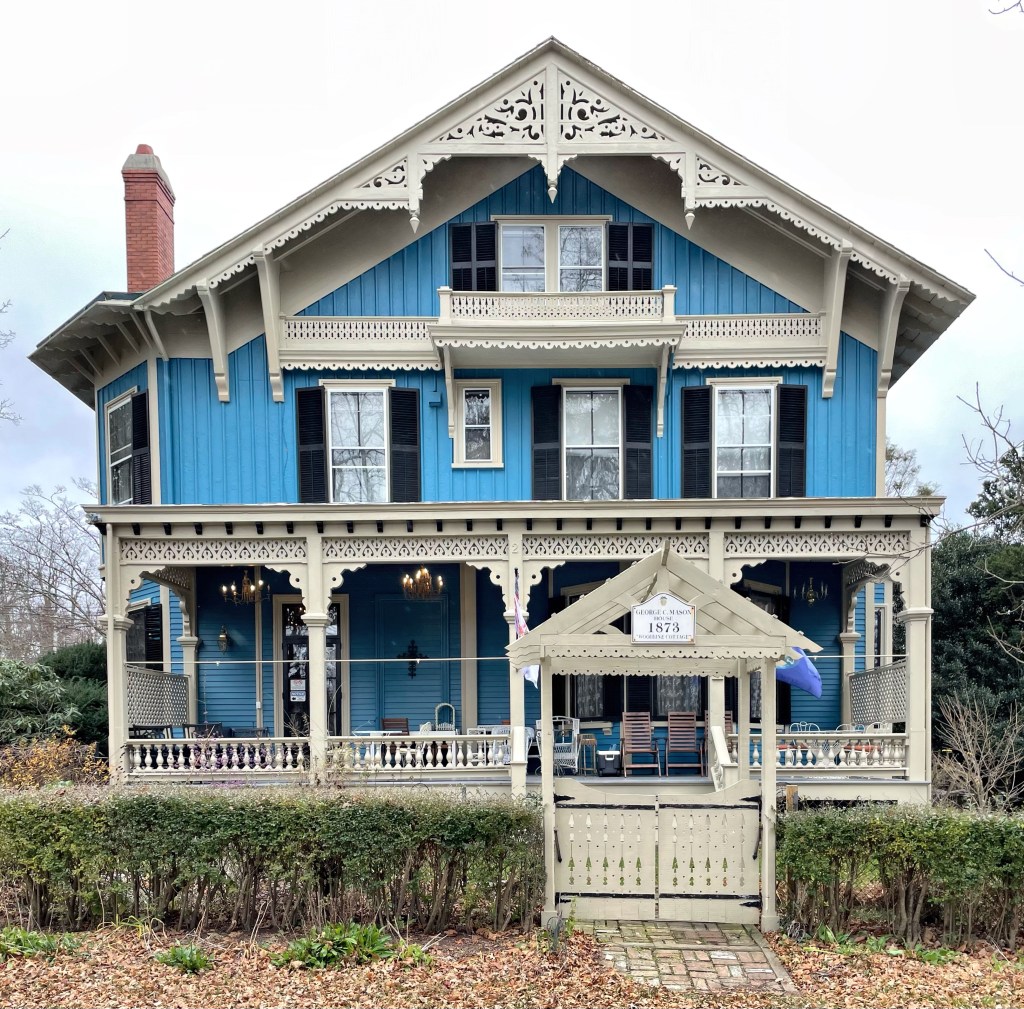
George Champlin Mason (1820-1894) can be credited as one of the most influential people who helped make Newport what it is today. He was born in the old Colonial town in 1820 and after a brief period working in New York City in dry goods, he traveled to Europe in his twenties to study art in Rome, Paris, and Florence, specializing in landscape paintings. Mason spent the 1840s trying unsuccessfully to make a living as landscape painter and published Newport and Its Environs, a collection of 11 engravings of his landscape views of Newport that is one of the earliest books about Newport to showcase its potential as a vacation destination. In 1851, Mason switched professions and became part owner and editor of the Newport Mercury newspaper. He often wrote on architectural subjects. In around 1858, he took his love for art and architecture and became an architect/developer, just as Newport was seeing early stages of development as a summer colony. He was hired by some early summer residents to design their homes, and did not disappoint, gaining notoriety all over the northeast. His son George C. Mason, Jr. (1849-1924), followed in his father’s footsteps and is said to have been the first professional architectural preservationist in the United States. George Sr., built this house as his primary residence in 1873, a stunning and rare example of Swiss Chalet architecture in New England, notable for the use of pierced bargeboards, board-and-batten sheathing, and cut-out railings. The property also included a charming stone English Revival tower in the rear yard, built in the 21st century as a workshop for the previous owners. How cool!

Samuel P. Tilton Cottage // 1880

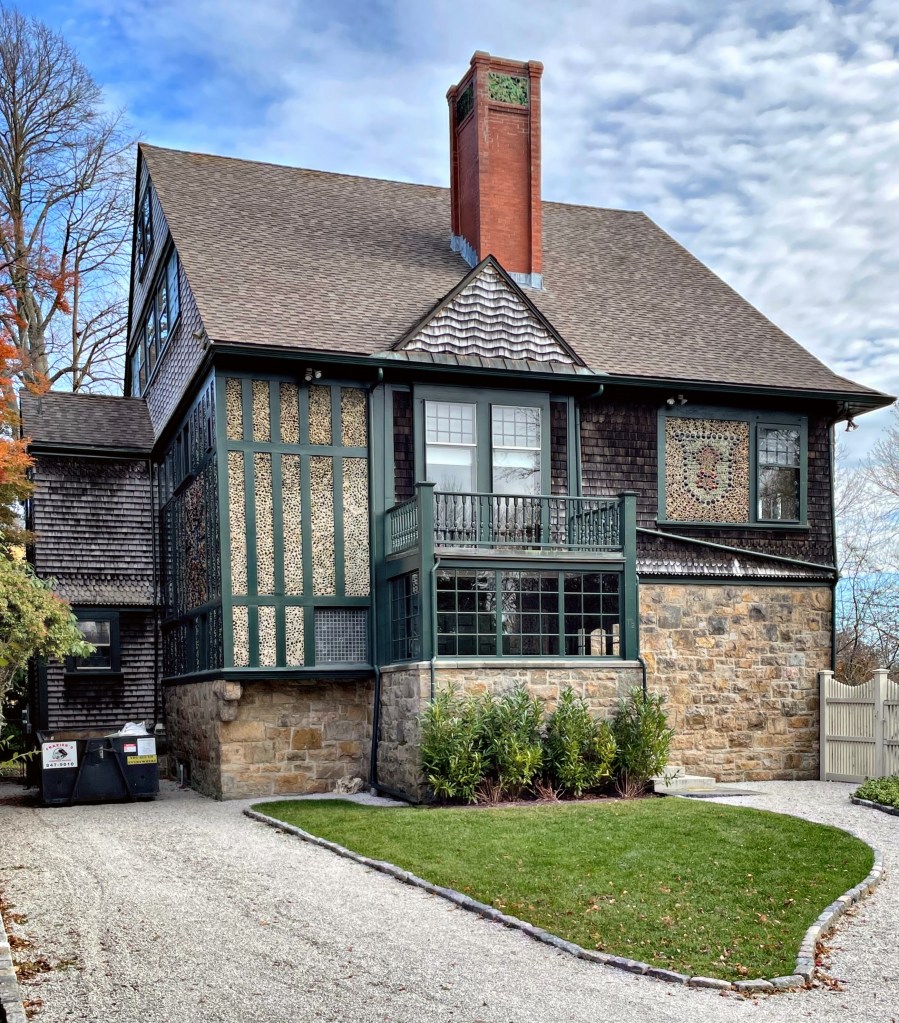
One of the most well-designed and least-pretentious summer cottages in Newport is this charming dwelling on a dead end street. The Samuel P. Tilton Cottage was designed in 1880 by the prestigious firm of McKim, Mead & White as an idiosyncratic blending of Queen Anne and Shingle architectural styles. Mr. Tilton was a milliner (maker and seller of women’s hats) with stores in Boston and Paris, France. He had this cottage built to summer close to the nation’s wealthiest, likely marketing some hats at elaborate Gilded Age events. The facade is assertively Queen Anne with its massing and decorative panels, with shingled side elevation seemingly sprouting from the earth. The architectural terminology for these unique decorative panels is “sgraffito” where here, cement or plaster siding is set and adorned with shells, pebbles, colored glass, and pieces of coal into a cartouche design. The house is one of the finest in Newport, and shows that bigger isn’t always better!

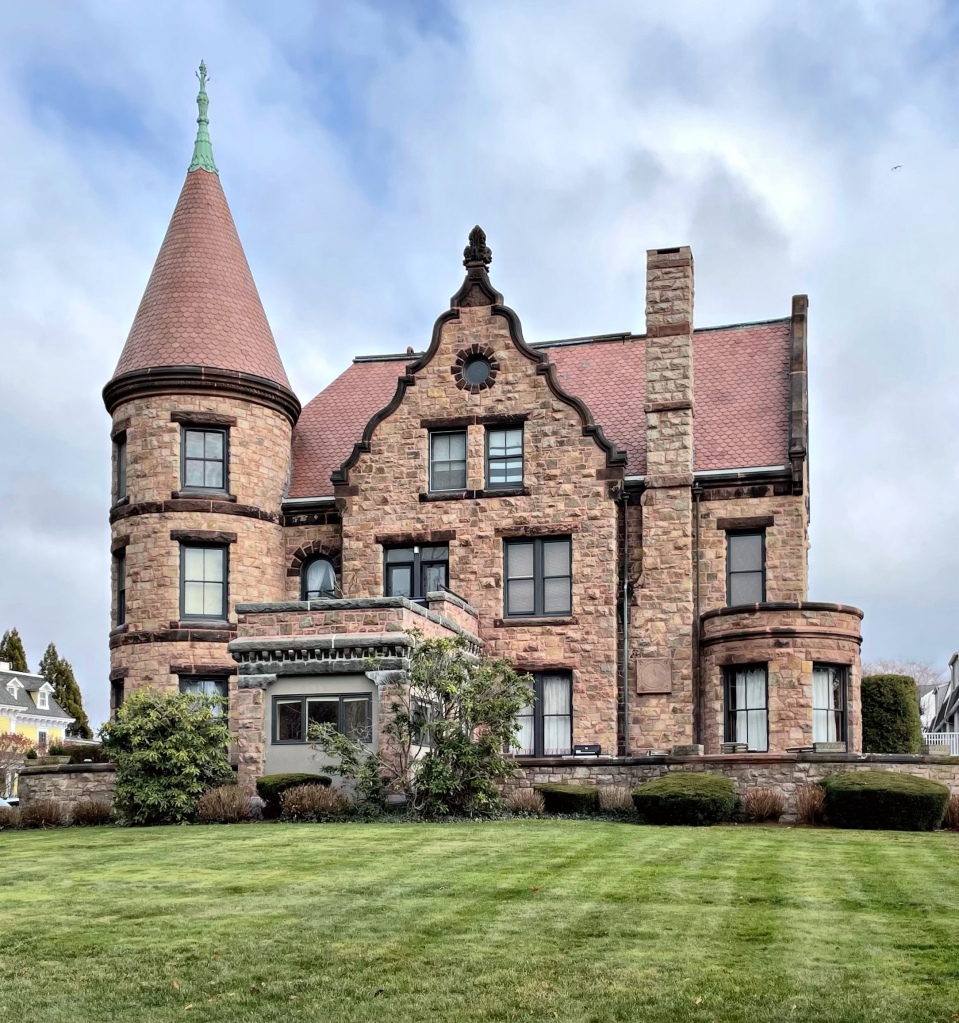
De La Salle // 1884

The Weld family has long been a prominent family in Boston, with ancestors dating back to the 17th century in New England. One of these men was William Fletcher Weld, a merchant, later making investments in railroads and real estate. By the time of his death in 1881, he had an estate of approximately $20 million, or more than half a billion in today’s dollars, and he left nearly all of it to his family. His eldest son, William Gordon Weld II, received a large inheritance and he began construction on this summer “residence”cottage” in Newport. The house was designed by local architect Dudley Newton, who had the estate built of locally-quarried granite. Architecturally, the dwelling is eclectic in style with Dutch Renaissance gables with conical roof forms seen typically in Queen Anne and Romanesque buildings. Weld spent his summers here for over a decade until his death in 1896. His widow Caroline, summered in the mansion until her death in 1918. By this point, Newport was beginning to fall out of favor as a wealthy resort community, and the many Gilded Age mansions were increasingly viewed as costly white elephants from a previous era. This property was sold by the Weld family in the early 1920s and became the De La Salle Academy, a Catholic school for boys, and remained in use until it closed in the early 1970s. After the school closed, the mansion was converted to condominiums and some townhomes were built on the expansive property.

“Snug Harbor” – Charles H. Baldwin Cottage // 1877

One of the finest Queen Anne style residences New England is this 1877 summer cottage, named “Snug Harbor”. The mansion was designed by architects William Appleton Potter and Robert Henderson Robertson for Charles H. Baldwin, a prominent admiral in the United States Navy. The design utilizes a brick first floor with shingle siding above, a high cross-gabled roof, panels and half-timbering, asymmetrical form, and a porte cochere at the entry. Later owner Arakel Bozyan, painted the entire exterior a deep red color and renamed the house “Gamir Doon”, Armenian for “Red House”. The house was restored back to a traditional color scheme and sold in 2020. The interiors are STUNNING!

Berkeley House // 1885

In 1885, a 28-year-old Leroy King (1857-1895) and his wife Ethel Rhinelander King (1857-1925) hired one of the country’s most prominent architects, Stanford White, to design a Newport home for their family. Leroy was the son of Edward King, a prominent local merchant, and upon his fathers death in 1875, inherited some of the $100+million dollar fortune he had amassed in today’s dollars. The corner lot at Bellevue and Berkeley avenues was purchased and work was underway on the new mansion. The house is a really interesting take on the Shingle style, but instead of cedar shingle siding, employs fireproof construction. A central hall, large gabled masses, picturesque window arrangements, and a spectrum of surface textures (here conveyed largely in natural stone and brick with flourishes of shingle and pebble dash work), align this house with McKim, Mead & White’s earlier efforts in this style. The interior has been meticulously preserved and maintained by the owners.

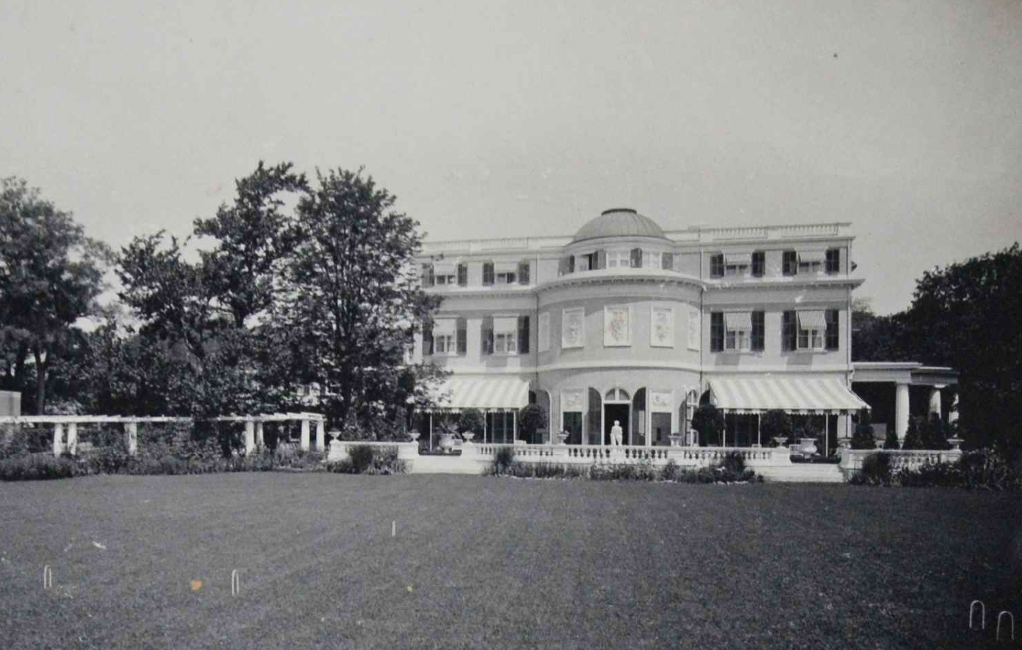
Villa Rosa // 1900-1962

Built as the summer residence of Mr. Eben Rollins Morse and Mrs. Marion Steedman Morse of Boston and New York, Villa Rosa was one of the finest summer cottages in Newport. The property was purchased by Mr. and Mrs. Morse, which originally included three, large estates two of which were featured previously. Mr. Morse was a stockbroker and investment banker, and the couple lived on Commonwealth Avenue in Boston, maintaining a summer home in Beverly, Massachusetts. In 1900, the couple hired Ogden Codman, Jr., a society architect and historian from Boston, to design a townhome in New York (their new permanent home) and Newport, where they could summer with other wealthy New Yorkers. Their cottage, Villa Rosa, was a huge statement, likely to insert themselves into the high-society of Newport summers. Oriented to the south, rather than to Bellevue Avenue, the house took maximum advantage of its long narrow setting. The exterior of the house was covered in pastel pink stucco offset with white bas-relief panels and was crowned by a copper dome. The heart of the house was the green trellised circular Music Room or Ballroom, the first room in the United States to incorporate lattice design as a decorative scheme. The property was eventually sold for $21,500 to E.A. McNulty, a Rhode Island contractor. Ogden Codman’s masterpiece was demolished in December of 1962 and an apartment complex built on the site in 1965. Townhouse condominiums replaced the gardens in the 1970s and the gateposts, a final vestige, were cleared in 2004.

Image courtesy of Newport Historical Society.