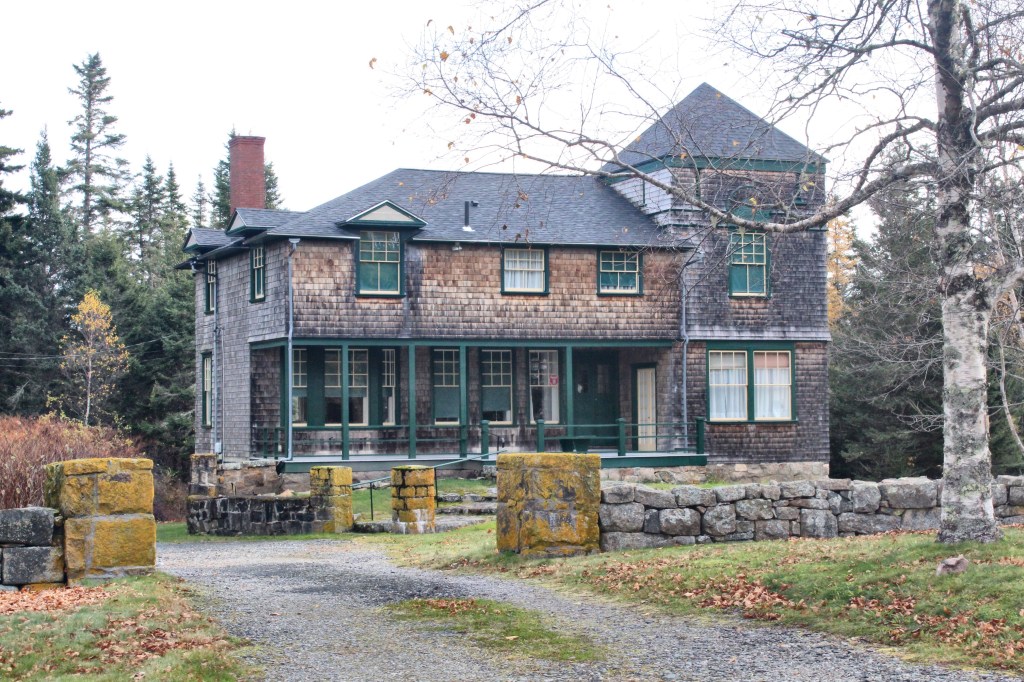
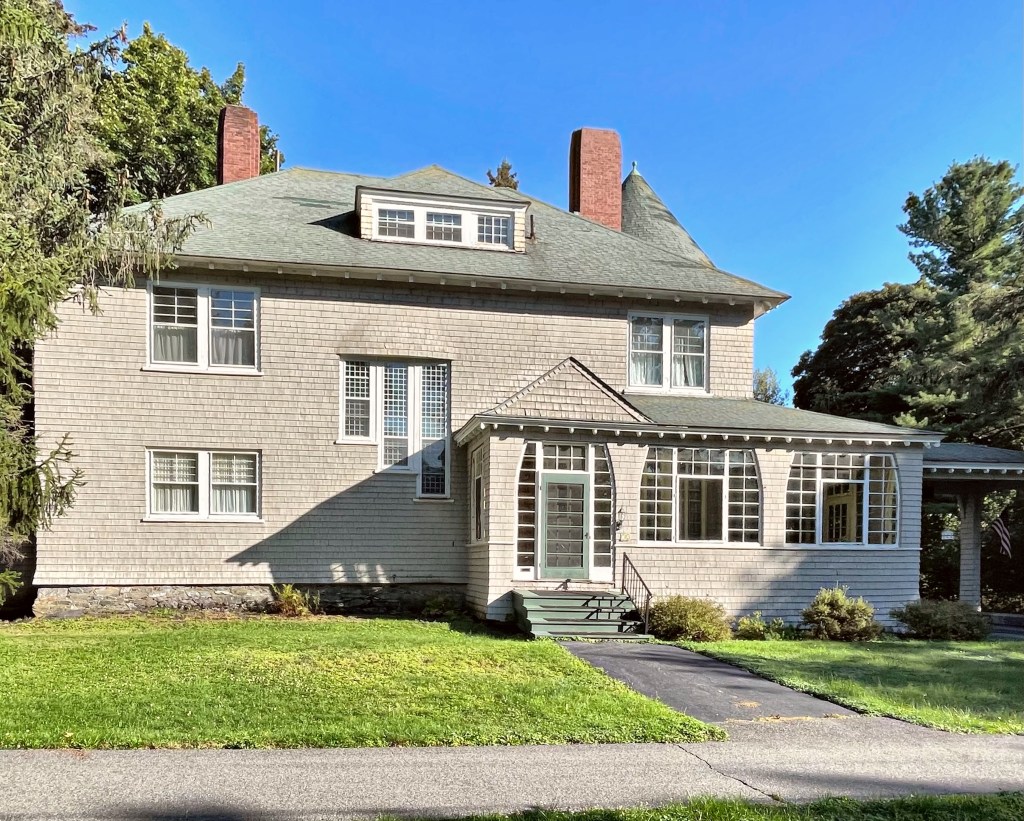
In 1891, Laura Denby McCrea, a wealthy widow based Philadelphia, sought to maintain her social standing all year by building a summer cottage on Grindstone Neck, a summer colony in Winter Harbor, Maine. She was one of the first to build a cottage here, and she hired renowned architect Wilson Eyre to furnish plans for the rustic home. The Shingle style house is dominated by its massive gambrel roof and was historically clad entirely with wood shingles (asphalt shingles have since replaced cedar at the roof).
One of my (many) favorite cottages in the Grindstone Neck summer colony of Winter Harbor, Maine, is this pleasing shingled home, built in 1891 for John Jacob Ridgway. Ridgway lived in Philadelphia and worked as an attorney and president of a real estate investment company after sometime as serving as Philadelphia’s Sheriff. For his summer retirement home, he hired the colony’s staff architect, Lindley Johnson (a name I have been repeating on here a lot lately). The Shingle style cottage has a recessed porch, square corner tower with pyramidal roof, and dormers that project over the eaves. I love to see these old rustic cottages with weathered wood siding and deep green trim!
Lucius S. Landreth, a Philadelphia attorney had this cottage built on Grindstone Neck in Maine around 1892 for his family. The cottage, like so many in the colony, was designed by architect Lindley Johnson in the Shingle style. The house is so perfect with its gambrel roof which is covered with cedar shingles all the way down to the stone foundation.
Men from Philadelphia and New York gathered to establish the Gouldsboro Land Improvement Company in the late 1880s with the goal to develop an alternative, more quiet summer colony to rival Bar Harbor on Mount Desert Isle. Two of the early investors (and summer residents) were J. Bonsall Taylor and Carter Berkeley Taylor, brothers from Philadelphia. John Bonsall Taylor’s cottage (last post) and this cottage, built for C. B. Taylor, were constructed around 1891-2 and are typical examples of upper-middle-class summer cottages in Winter Harbor. Philadelphia architect Lindley Johnson designed John’s cottage, so it could be hypothesized that he was also architect for C.B. Taylor’s here. The house as originally built was enlarged in the early 20th century, but maintains the rustic quality and charm that so many of these Shingle style cottages possess. And that red trim really pops!
John Bach McMaster (1852 –1932) was born in Brooklyn, New York to a rich plantation owning father and mother who ran operations in New Orleans until the outbreak of the Civil War. After this, John graduated from the College of the City of New York in 1872, worked as a civil engineer in 1873–1877. Falling in love with the field of American History, he switched careers and in 1883, became professor of American history in the University of Pennsylvania. McMaster is best known for his History of the People of the United States from the Revolution to the Civil War (1883), a valuable supplement to the more purely political writings of earlier years. The book was a huge success and John was able to purchase house lots in the newly established Cape Arundel Summer Colony in Kennebunkport, Maine, a colony populated by many wealthy Philadelphians for summer homes. He first appears to have built “The Kedge”, a chunky, but beautiful cottage on a cliff. McMaster would also have this larger cottage built by the turn of the 20th century, which in design, appears to be a more eclectic Shingle style dwelling. Just a stone’s throw from the Atlantic, the house features continuous cedar shingle siding, sweeping porches to provide views of the ocean, a prominent chimney, and Colonial-inspired fanlight motifs.
These two similar houses in the Cape Arundel Summer Colony in Kennebunkport, Maine, were built in 1889 for Prosper Louis Senat (1852–1925) and his wife Clementine. Prosper was a well-known artist from Philadelphia, who would summer in Kennebunkport and traveled the world with Clementine, painting landscapes and seascapes. Senat and his wife lived in one cottage and likely rented the other to family and friends when visiting town. His studio was built on a nearby street and is extant. Tower cottage (greenish-grey) was renamed Shady Oak Cottage in the 20th century. Both cottages were built by George Gooch, a local contractor from plans by an unknown architect and feature bay windows, short towers, smaller windows, and continuous shingle siding.
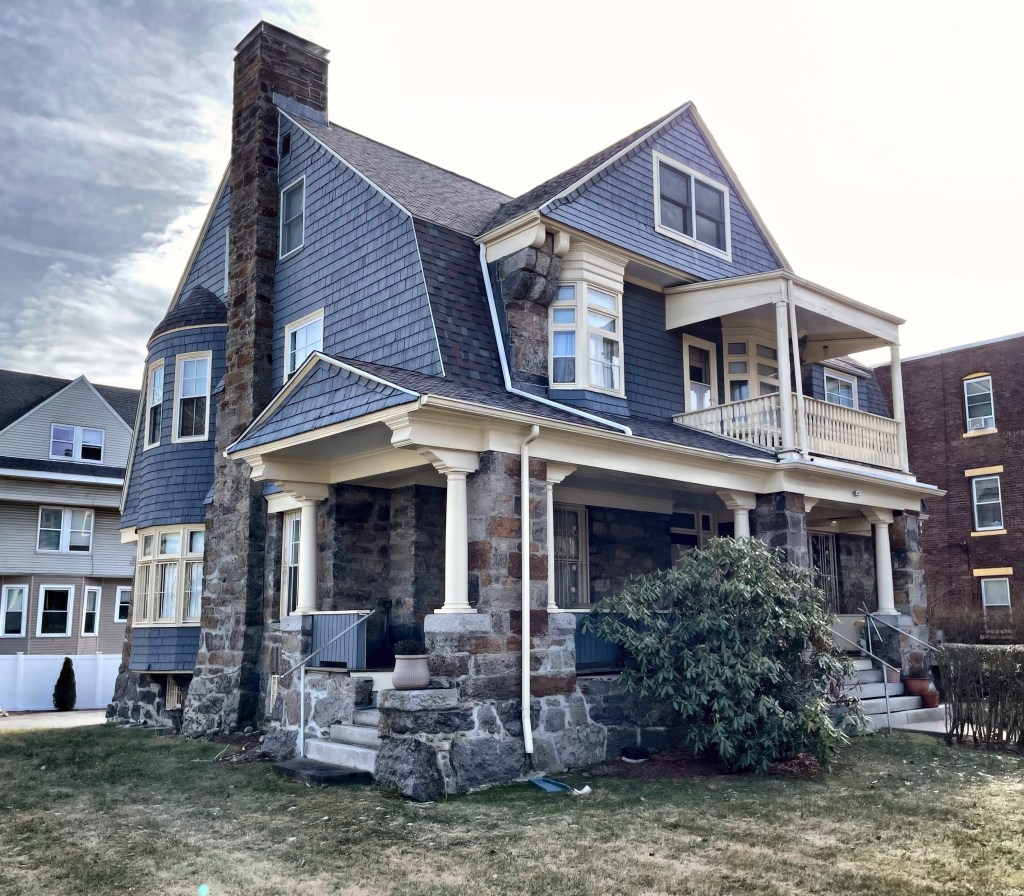
Roxbury is not well-known for its Shingle style architecture, but this example might change that! This dwelling was built around 1895 by the heirs of Horatio Harris on family land that was subdivided for house lots at the end of the 19th century. The expansive Harris estate was developed, largely on speculation and included some amazing single family homes, rowhouses and multi-family dwellings. This Shingle style home appears to have also been built on speculation and was owned by the Harris heirs for some time. The property was occupied for some time by Peleg E. Eddy and his wife Caroline in the earliest years of the house’s existence. I could not locate the architect, but it could be estimated as a design by J. Williams Beal, a local architect who was commissioned to design the nearby Harriswood Crescent development for the Harris family. The design features a Roxbury puddingstone first floor and chimney which contrast elegantly with the shingle siding.
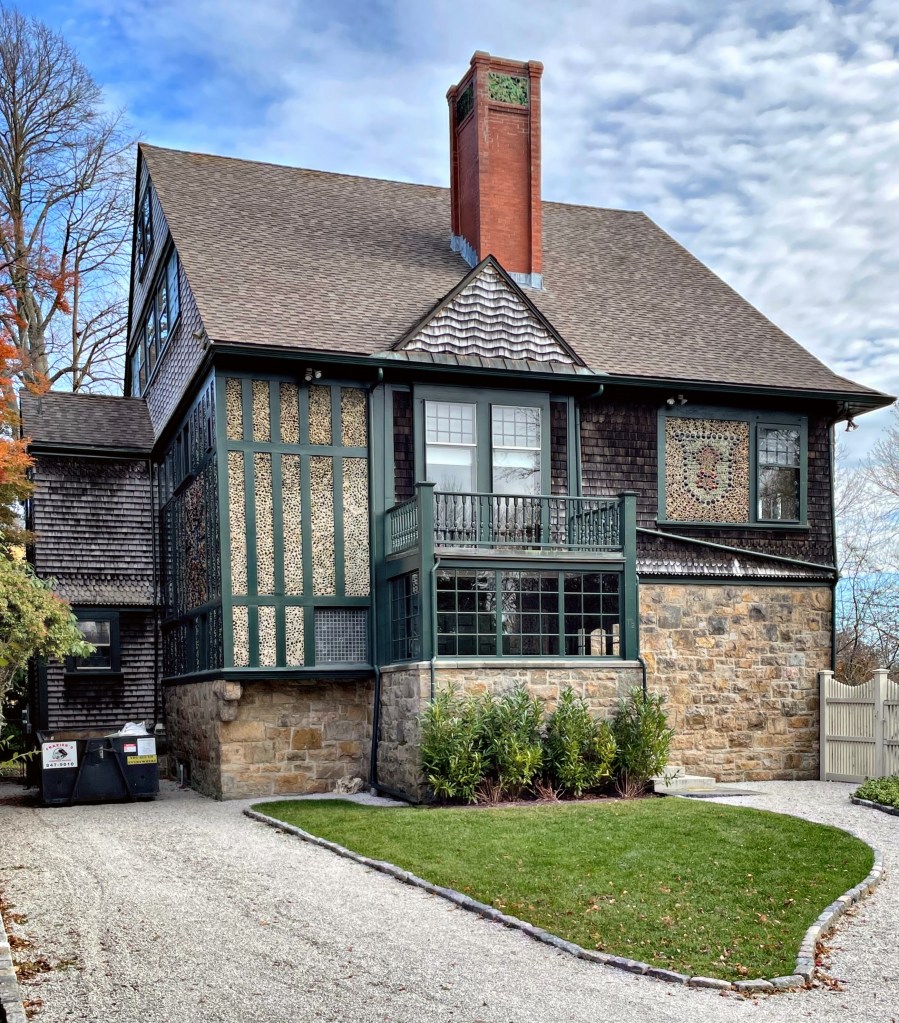
One of the most well-designed and least-pretentious summer cottages in Newport is this charming dwelling on a dead end street. The Samuel P. Tilton Cottage was designed in 1880 by the prestigious firm of McKim, Mead & White as an idiosyncratic blending of Queen Anne and Shingle architectural styles. Mr. Tilton was a milliner (maker and seller of women’s hats) with stores in Boston and Paris, France. He had this cottage built to summer close to the nation’s wealthiest, likely marketing some hats at elaborate Gilded Age events. The facade is assertively Queen Anne with its massing and decorative panels, with shingled side elevation seemingly sprouting from the earth. The architectural terminology for these unique decorative panels is “sgraffito” where here, cement or plaster siding is set and adorned with shells, pebbles, colored glass, and pieces of coal into a cartouche design. The house is one of the finest in Newport, and shows that bigger isn’t always better!
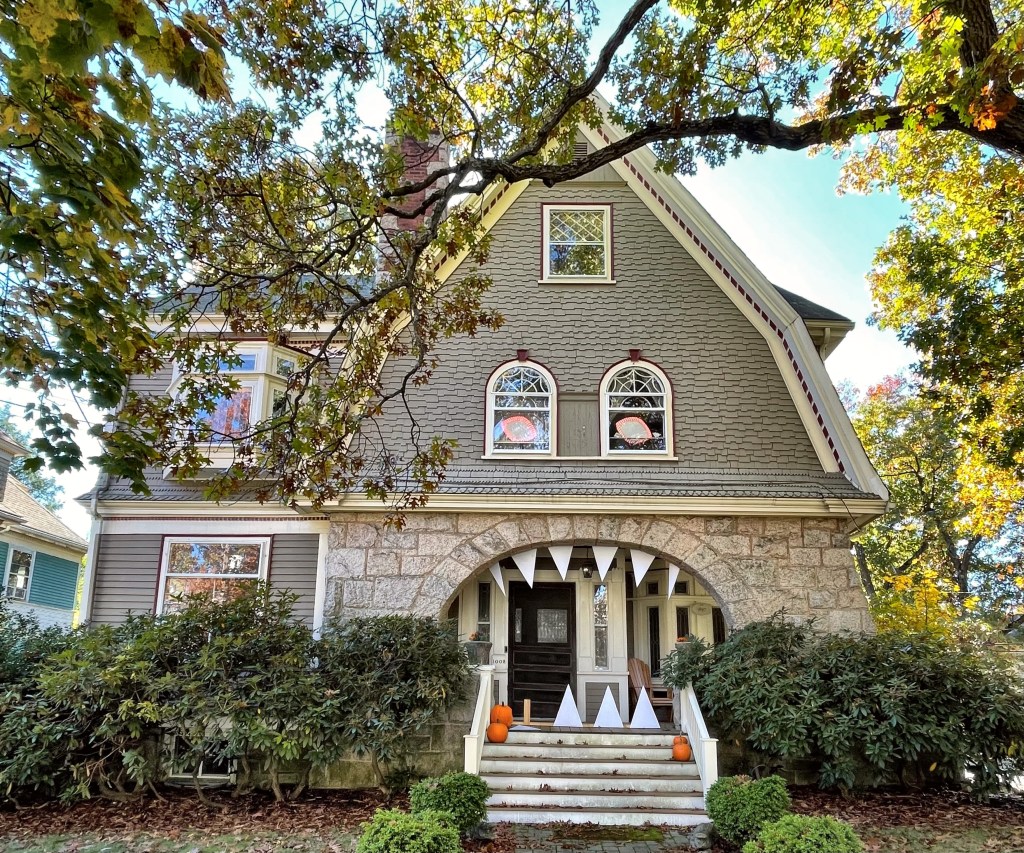
Happy Halloween! To celebrate I wanted to feature one of the more creatively decorated houses in the Boston area, which blends spookiness with architecture! This is the Barrows-Goddard House, so named after its first two owners. The house is located in Newton and was built in 1898 as an eclectic Queen Anne/Shingle style home. The original owner was Joseph Barrows, who developed the property and sold it within a year, relocating to a new home on a less busy street. The property was owned next by Christopher Goddard, an insurance agent with offices in Boston. Architecturally, the gable roof of the main block is intersected by an over-scaled gambrel cross-gable clad in patterned cut wood shingles. The focal point of the design is the Syrian-arched entrance porch of coursed, dressed fieldstone which this time of year, eats trick-o-treaters!
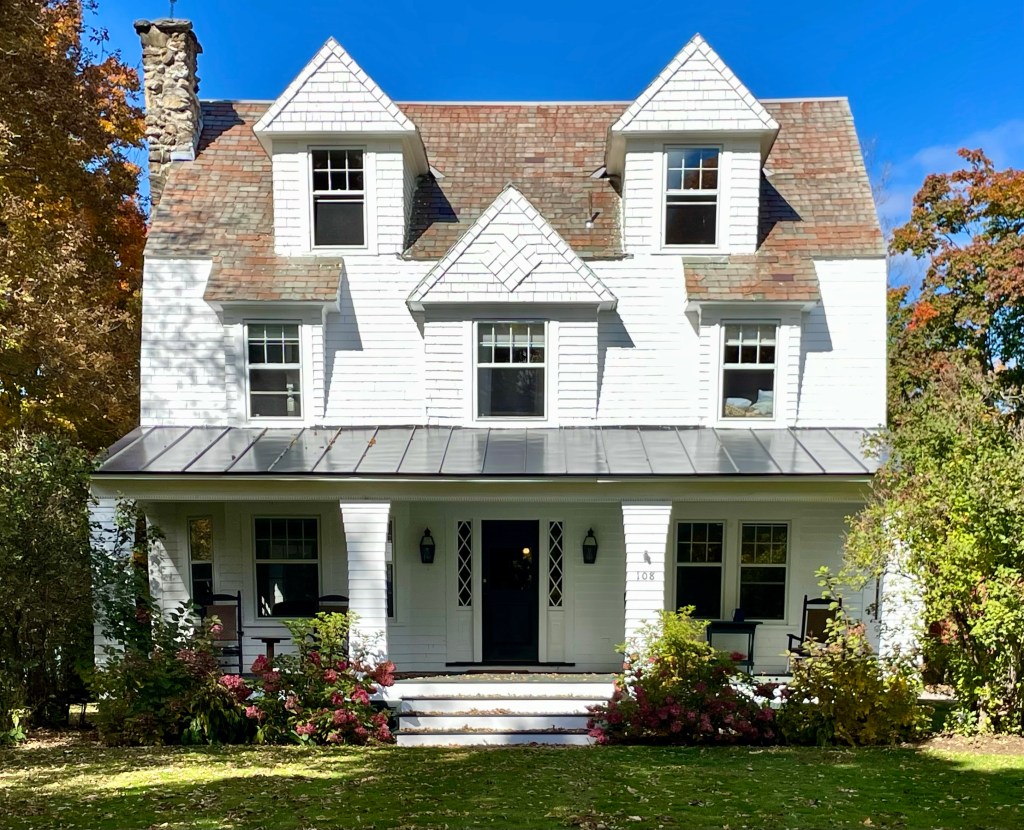
The former Dorset Methodist Church sat on this property from about 1840 to 1900 until they merged with the United Church of Dorset. A Philadelphia physician, Dr. John Herr Musser (1856-1912), built this vacation home in 1906, and passed away just six years later. His widow Agnes Harper Musser (1856-1941) and their children continued to vacation here until after WWII. The home is a rare example of the Shingle style in Dorset and was painted the bright white to fit in with the more traditional New England village vibe, but it would be better-suited with a period- and style-appropriate paint scheme. The home is now offered for short-term/vacation rentals.
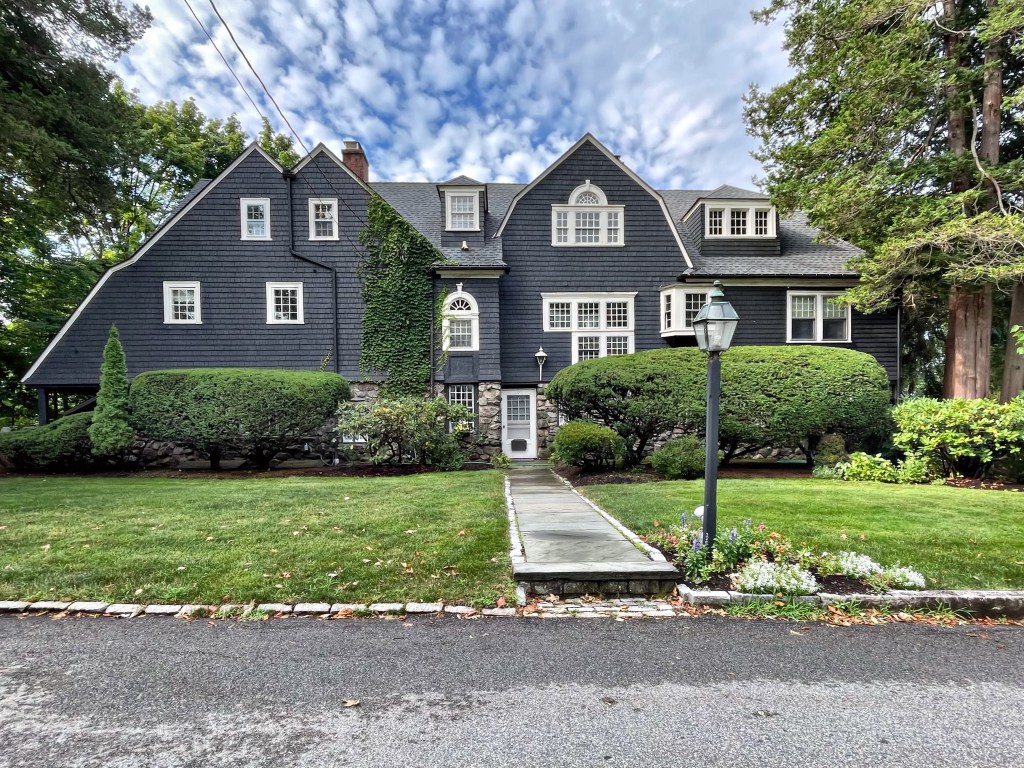
Located on a dead end street in Waban, you’ll find this stunning Shingle style property, which rambles on forever! The house was built in the first decade of the 20th century and blends the Shingle style with the ever-popular Colonial Revival style. I could surprisingly not locate the architect for the house, but I’d guess that it was designed by the architectural firm of Longfellow, Alden, & Harlow, the last of which, Alfred Branch Harlow, shared a last name with the original owner of the home, Arthur Brooks Harlow. (And the same last name as Louis K. Harlow, an artist who lived one street away in a similar style home). I am not sure if these two were related, but thats my hunch. If anyone wants to do more digging on this and share the story with me, I’d be so grateful!
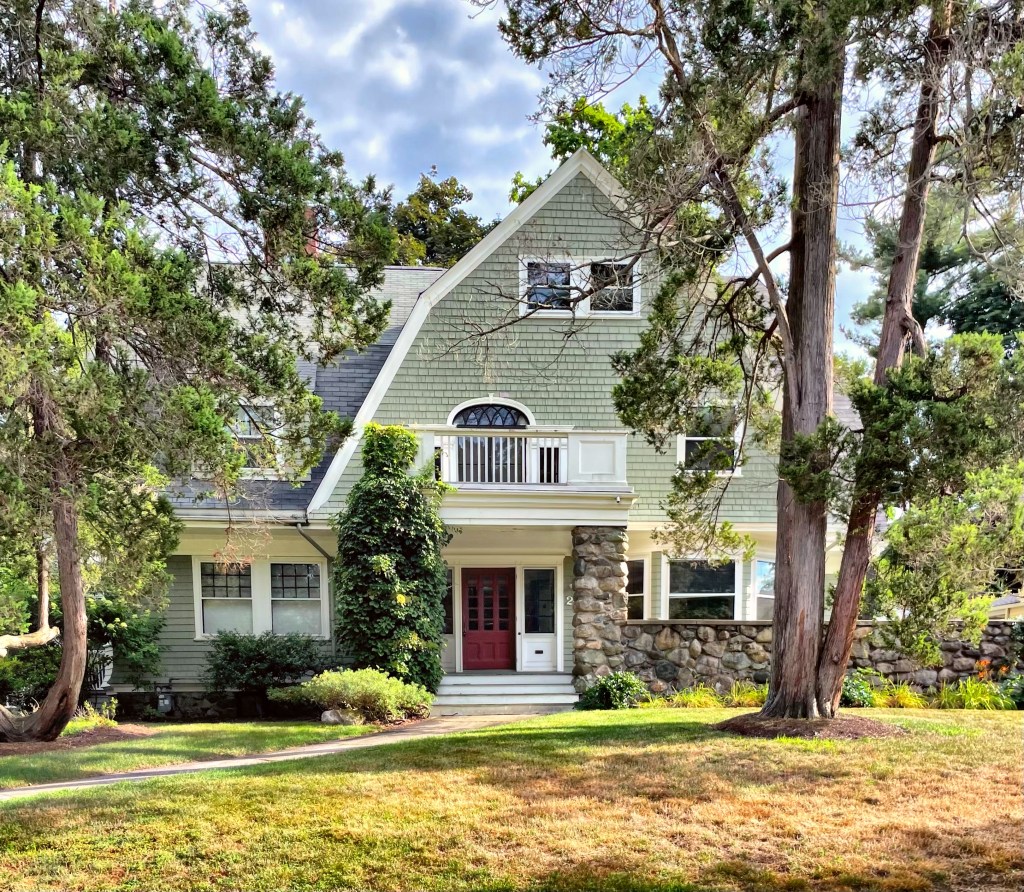
Benjamin H. Davidson, a wool merchant had this stunning property built in Waban for his family in 1897. Benjamin and his architect envisioned a large, Shingle style mansion, set back off the street. The house obviously exhibits shingle cladding along all surfaces including stone piers coming up from the ground at the porch, giving the house an organic feeling. The design also includes a large stairhall Palladian window, which is obscured from the street by a balustrade.
Located on a hillside in rural Dummerston, Vermont, you will find Naulakha, one of the most significant properties in the region. Naulakha (pronounced now-LAH-kuh) was built in 1893 for Rudyard Kipling an english journalist and author born in British India, an upbringing which inspired much of his professional work. In 1892, Kipling married Caroline Balestier, who was born into a prominent New England family. The couple honeymooned in Vermont near Carrie’s family home. The couple would settle in Vermont in a cottage which was soon outgrown, leading the couple to buy 10 acres of land from Carrie’s brother Beatty Balestier and built their own house. The new Shingle-style home they had built was named Naulakha after a book written by Rudyard and Caroline’s late-brother Wolcott. Kipling wanted a home that merged the distinctive qualities of the Indian bungalow with those of the American Shingle Style and he worked closely with his architect, Henry Rutgers Marshall of New York City, a Balestier family friend to achieve this.
The rectangular mass of the home parallels the contours the hill upon which its sited, and sits atop a raised fieldstone basement salvaged from stone walls on the property. From the home, Kipling wrote some of his most influential work, including the Jungle Books (1894, 1895), Captains Courageous (1896,The Seven Seas (1896), and The Day’s Work (1898). Sadly, the Kipling’s moved out of Naulakha after just a few years, largely from familial disputes with Caroline’s brother, Beatty. The family removed to England where they settled, though Rudyard always mentioned how much he missed his secluded life in Vermont. The property was then purchased by the Holbrook family, who made slight modifications to the property, but all maintaining the original design and feeling. In 1992, the British-based Landmark Trust acquired Naulakha as its first American building, later creating the Landmark Trust USA to maintain the property and more. The Landmark Trust USA rents out Naulakha and the adjacent carriage house for short-term rentals to provide revenue for maintaining these properties.
For more on my stay at the absolutely stunning Kipling Carriage House, check out my later blog post here.
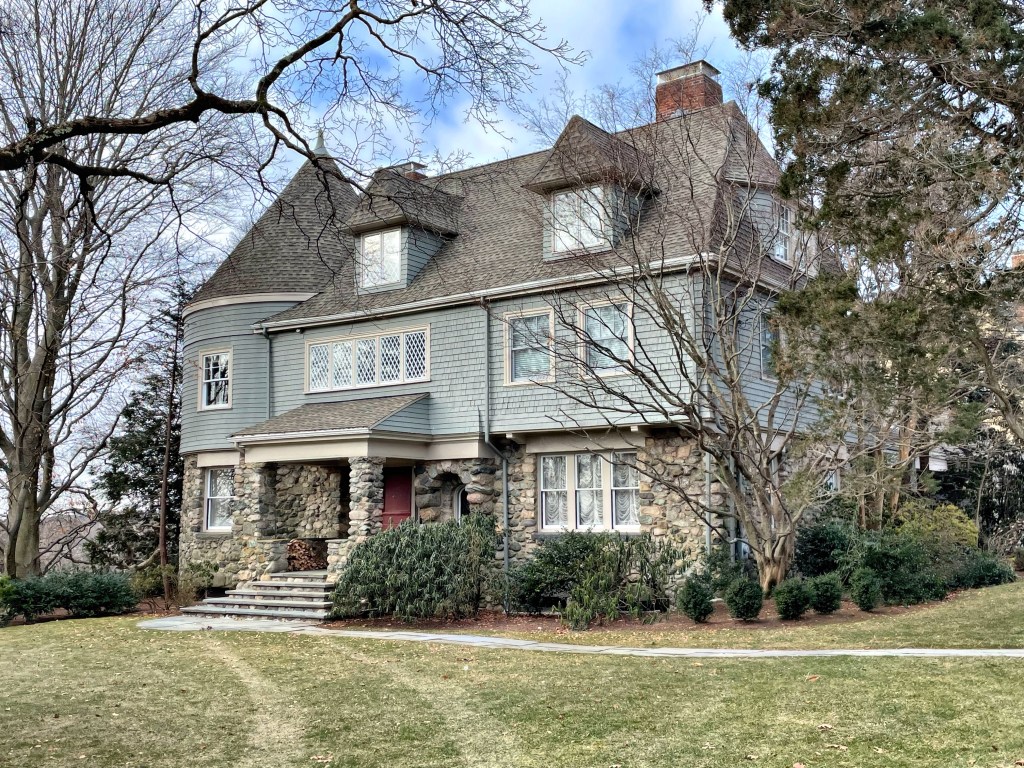
One of the best houses in Waban Village in Newton is this absolutely stunning Shingle style/Queen Anne home perched high on Moffat Hill. This house was built in 1888 for Louis K. Harlow, who began his career as a professional artist in 1880 and traveled Europe to study the work of prominent painters. Back in the Boston area, Harlow painted nature and landscapes and produced etchings that were shown in the Boston Art Club and sold worldwide. He later got into poetry and published multiple works. Harlow hired the firm of Longfellow, Alden, and Harlow, to design this country retreat. I assume there is a relation between Louis K. and the architect Alfred Branch Harlow, but I would love to find out the connection! The design is quintessentially Queen Anne, with the asymmetry, complex roof form, varied siding types, and diamond window sashes. The shingled second floor overhangs the fieldstone first floor which to me, evokes the Shingle style where the house seems to have grown out from the earth. I can only imagine how spectacular the interior is!
Frederick Parkhurst (1864-1921) was born in the small Maine town of Unity and attended local schools. He moved to New York to attend Columbia Law School, receiving his degree in 1887. Soon after, he was admitted to the Maine bar. Frederick moved back to Maine and joined his father in a leather goods business in Bangor, of which he later became president. He served on the Bangor City Council and later in the Maine House and State Senate. With his wealth and connections, he purchased a large house lot on West Broadway, then the most exclusive street in town, and hired local architect Wilfred Mansur, to design a Shingle style home for his family. During World War I he led the Liberty Loan effort and in 1920, was elected Governor with the largest margin in Maine history, moving to the State Capitol, Augusta soon after. Parkhurst served less than a month when he died on January 31, 1921.