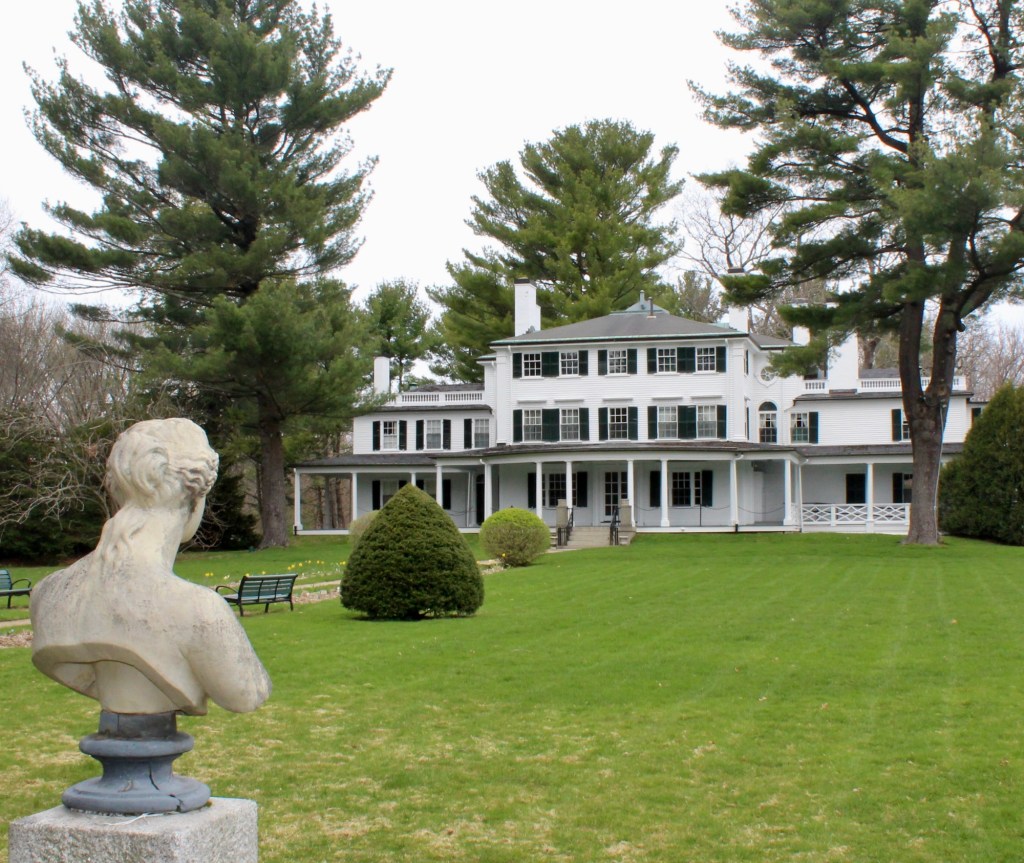
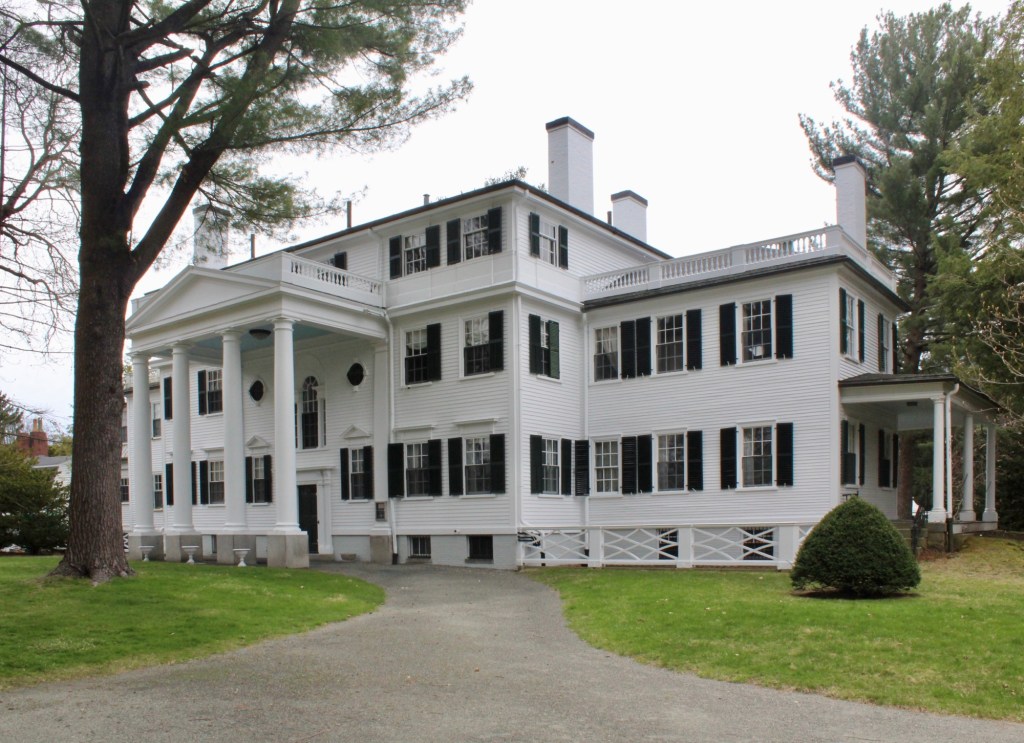
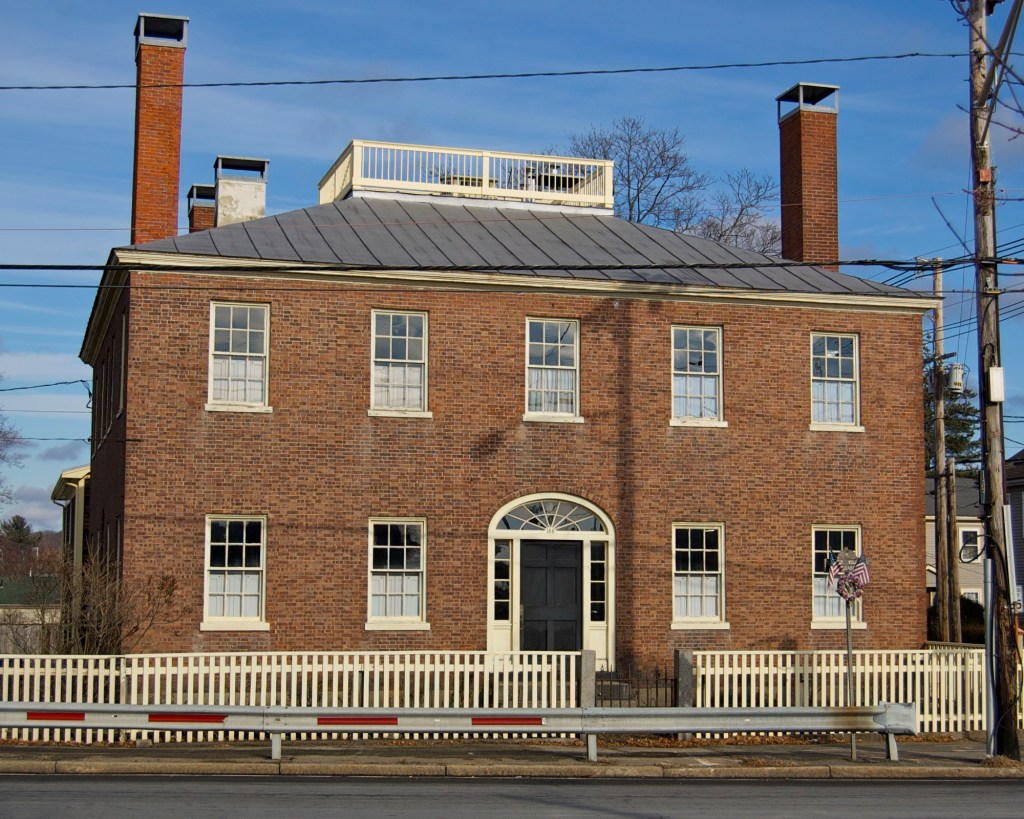
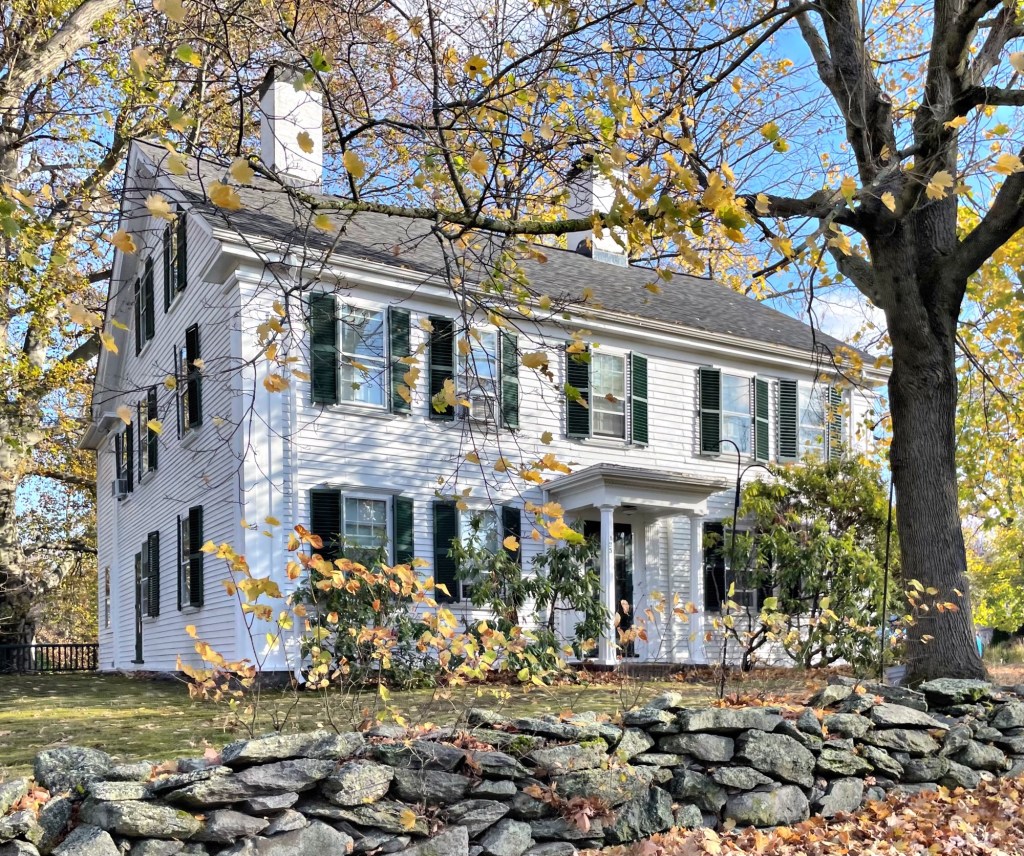
Edgerly-Hawthorne House // 1824

The Edgerly-Hawthorne House on Mall Street, near the Salem Common, is one of the most significant residences in Salem, Massachusetts. The Federal style residence was built in 1824 for Peter Edgerly, who ran a teamster/trucker or distribution company in Downtown Salem. After a decade, Peter became insolvent and the property was sold to Joseph Leavitt, a wealthy property owner in Salem. This house is best-known as the place where Salem-born Nathaniel Hawthorne and his family, lived from 1847 to 1850, and where he wrote The Scarlet Letter. It was in the room closest to the street, on the third floor, that Hawthorne sat at his desk and wrote the American masterpiece of fiction. After publishing The Scarlet Letter, Hawthorne moved to the Berkshires and then back to Concord, Massachusetts, never to live in Salem again. In c.1906, the Edgerly-Hawthorne House was photographed by the Detroit Publishing Company highlighting some landmarks in town. The house looks nearly identical from when it was built over 200 years ago!

Tavern Club // c.1819

This is your reminder to get lost and explore your city or town. Tucked off Boylston Street sits Boylston Place, a short, dead-end way that is passed by thousands every day, many not knowing about the little enclave of surviving 19th century buildings there. This Federal period house was built in the 1810s for Beza Tucker (1771-1820), who rented the home to boarders until his death in 1820. Tucker bequeathed the house to the American Society for Educating Pious Youth for Gospel Ministry, a nationwide association formed in 1815 with the goal of providing financial support to men seeking a theological education. The Society sold the house in 1834 to Reverend Nehemiah Adams, when he became pastor of the Essex Street Church in Boston. Since 1887, the building has been the home to the Tavern Club, a venerable Boston social and dining club that was invite-only. Presidents in the early years included William Dean Howells, Charles Elliot Norton, Henry Lee Higginson. Inside, the eclectic English pub/Colonial interior with its cozy atmosphere included dining rooms, sleeping accommodations for guests, and a small theatre for annual club productions. The Tavern Club is still in operation and maintains the building today. I can only imagine how great the interior is!

Edgar Allan Poe Birthplace // c.1805-1965

Courtesy of BPL archives

Famed author Edgar Allan Poe was born in this house on Carver Street in Boston, Massachusetts, on January 19, 1809, the second child of American actor David Poe Jr. and English-born actress Elizabeth Arnold Hopkins Poe. His father abandoned the family in 1810 and his mother died a year later from pulmonary tuberculosis. He would be adopted by John Allan, a merchant and slaver in Richmond, Virginia, his adopted family gave him the name “Edgar Allan Poe”. He would live a somewhat nomadic life, moving around often to cities all over the East Coast until his death in 1849 in Baltimore. Although it was his birthplace, Poe’s troubled early childhood likely contributed to his disdain for Boston, where he often referred to Bostonians as “Frogpondians,” after the frog pond on Boston Common, though as an insult. The poet’s seminal work The Raven was published in January 1845 to widespread success. Several months later, Poe was invited to read at the Boston Lyceum with the support of James Russell Lowell, a Harvard professor and editor of The Atlantic Monthly. It did not go well. His childhood home on Carver Street would be razed by 1962 and is presently a surface parking lot for an electrical substation. The city would honor its macabre author by renaming an alley off Boylston Street, Edgar Allan Poe Way, and in 2014, the City commissioned a public statue titled, “Poe Returning to Boston“. Designed by Stefanie Rocknak, the statue depicts Poe walking, facing away from the Boston Common. His figure is accompanied by an oversized flying raven; his suitcase lid has fallen open, leaving a “paper trail” of literary works embedded in the sidewalk behind him.

First Congregational Church of Chicopee // 1825

The First Congregational Church Society of Chicopee was organized as the Second Church of Springfield in 1751, when residents of land today known as Chicopee and Holyoke (then a part of Springfield) sought a parish church closer to their homes. Before Chicopee officially split from Springfield in 1844, the Second Church of Springfield built this Federal-Greek Revival style church building in 1825. Shepherd and Whitmarsh, prominent builders of Springfield were hired to erect the church. Both were trained under architect, Isaac Damon, thus the close resemblance to his designs for this church in Chicopee. The clapboard structure is simply designed but holds strong proportions and symmetry. The church has a four-columned portico with Ionic columns and a two-story square tower containing the belfry, blind octagonal stage with molded trim above, all capped by a dome surmounted by a weathervane. While the church now has replacement windows and plastic, ill-fitting shutters, the building is in great shape and tells the story of the early days of the development of Chicopee from sleepy parish town to industrial city.

Barnes-Kellogg House // 1809

The main village in Cornwall, Connecticut, looks like a postcard. Mature trees and beautiful, historic homes line the bucolic streets with sweeping views of the Litchfield Hills in the distance; it is what many envision when they think of “New England charm”. This stately Federal style mansion is sited deep on its lot beyond a field and dates to the first decades of the 19th century, it is the village’s grandest early home. The house was built for Amos Barnes, but supposedly remained unfinished when he died suddenly. Barnes’ widow sold the property to the local Foreign Mission School as a dormitory for students. The school’s (in my opinion, problematic) mission was to educate students of non-Christian cultures, including Native Americans, East Asian, and Hawaiian pupils, for them to become missionaries, preachers, translators, teachers, and health workers in their native communities in the Christian faith. These types of programs furthered the erasure of other cultures and promoted Christianity in all corners of the world, but I digress. In 1826, this home was acquired by Frederick Kellogg, the long-time town clerk and Judge of Probate, who owned the property
until his death in 1891.

John Northrop House // c.1814

Cornwall’s Foreign Mission School, which began operations in 1817, was virtually unique in the United States, educating both Native Americans and young men from around the globe, including Hawaiian, Bengali, and Japanese. The school was created for the purpose of educating youths of “heathen” nations, to convert them to Christianity, educate them, and train them to become preachers, translators, and teachers back in their native lands. The problematic nature of the school’s seemingly forced assimilation, causing the erasure of cultures, paired with the disdain for foreign students in town lead to much animosity towards the school in Cornwall. The tension reached a head when in 1824, John Ridge, a student at the Foreign Mission School and the son of a Cherokee leader, began a courtship with Sarah Northrop, the white daughter of the school’s steward. A year later they married. Additionally, in 1826, another Foreign Mission School student, Elias Boudinot (John Ridge’s cousin), fell in love with a young Cornwall girl named Harriet Gold, they married in 1826. These marriages were generally opposed to and racism caused support for the school to dissolve, closing by 1827. This c.1814 house was the home of John Northrop, the father of Sarah Northrop, and steward to the Foreign Mission School. The family home, seen here, was also used to house some students while they attended the school. The Northrop House remains one of the few extant buildings with direct ties to this school. The house is one of 65 National Historic Landmarks in Connecticut.

North Cornwall Congregational Church // 1826

During the nineteenth century several small rural settlements dotted the landscape in Cornwall, Connecticut. In 1782, a group of “strict Congregationalists” seceded from the established Congregational church in town and constructed a “second” church in Cornwall Center. Following this, the town was divided into north and south parishes, with First Church built on the town center and the Second Church, this building, constructed in North Cornwall village in 1826. The North Congregational church is among the town’s finest Federal style buildings in the region and features three entrances with fanlight transoms and the bays of the facade are broken up by two-story fluted pilasters.

Birdsey Hall // c.1804

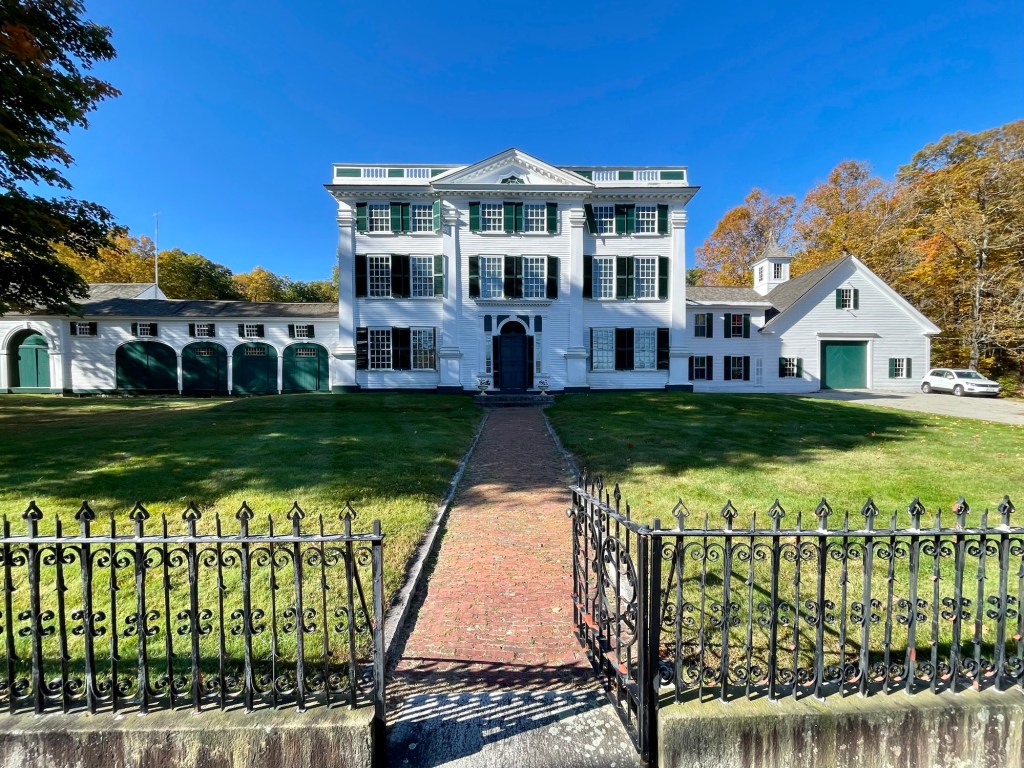
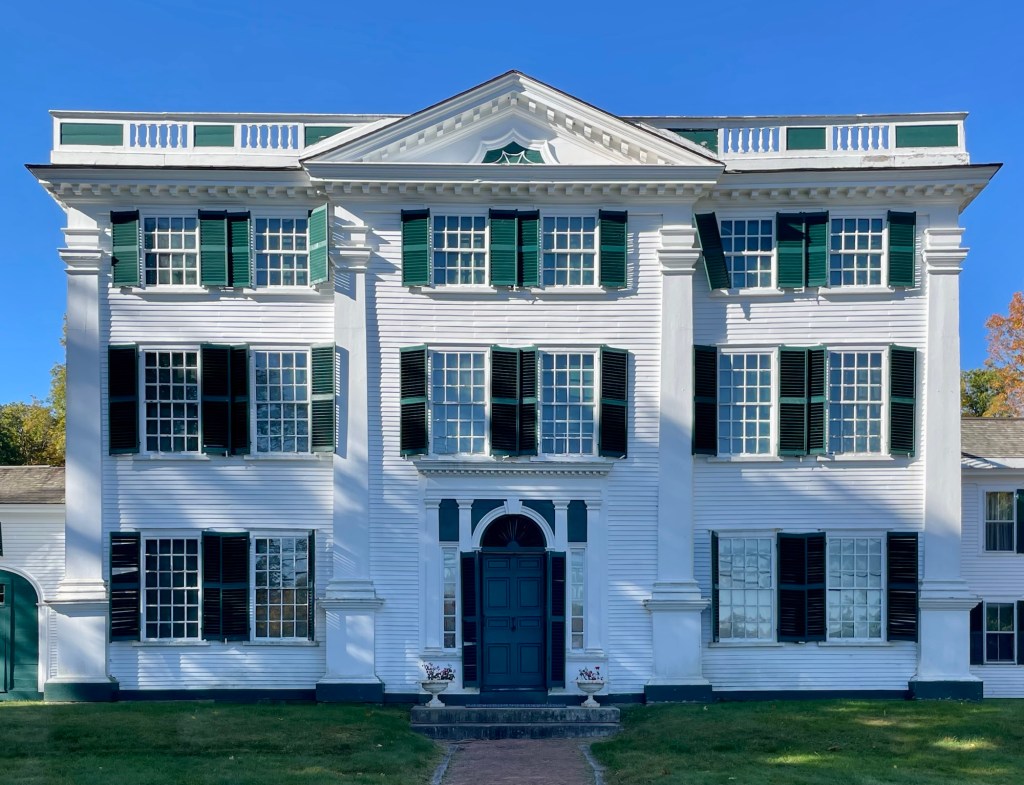
Built circa 1804 in the form of an English country estate house, Birdsey Hall stands as the finest property in the town of Goshen, Connecticut. The residence was built for Birdsey Norton (1763-1812), a wealthy cheese merchant who was said to have been inspired to build a country estate after travelling the American south on business. The high-style Federal/Adamesque mansion features expansive grounds bounded by brick walls and Victorian gardens. The property was later owned by Fred Favorite and Robert Devoe, friends of Liberace, who operated an antique store. Birdsey Hall remains one of the finest Federal estates in Connecticut.

Thompson-Sperry House // 1803

In 1803, General David Thompson (1766-1827) and his wife, Sybil (Norton) Thompson, moved into this recently completed Federal style residence on North Street, the main road through Goshen Village, Connecticut. David Thompson was a merchant and partner in the firm Wadhams & Thompson, occupying a store nearby the Congregational Church. Business partners David Thompson and David Wadhams built near-identical houses across the street from each other, though the Wadhams house has since been gut renovated and lost much of its original fabric. The Thompson House stands out for its Palladian second-story window, glazed with interlacing arcs. The property was owned at the end of the 19th century by Albert Sperry, a Civil War veteran.

Goshen Congregational Church // 1832

The town of Goshen, located in Litchfield County, is located in the northwestern part of Connecticut was first settled by European colonizers in 1738, with the town incorporating a year later. The community was named after the Land of Goshen, a part of ancient Egypt in the Bible. Goshen primarily grew as rural and agricultural in character, with limited industry and commercialization compared to other nearby towns. The town center village was home to the Congregational Church as far back as 1750. In 1832, the present Congregational Church was built from plans by Benjamin E. Palmer, a carpenter-builder who also built the Windham County Courthouse in Brooklyn, Connecticut. The church blends both Federal and Greek Revival styles, and Palmer likely took inspiration from Asher Benjamin’s design guidebooks. The church retains much of its original character even with the altered steeple, porte-cochere, and conversion of three-door facade to a single-entrance in 1894.