Dexter Asylum // 1828-1958

C.1958 photo before demolition. Courtesy of Library of Congress.

Built in 1828, Dexter Asylum was a “poor farm,” an institution housing the indigent, elderly, and chronically unemployed, located in the East Side of Providence, Rhode Island. Poor farms were common before the introduction of Social Security and welfare benefits in the United States, considered a progressive method for dealing with poverty. Ebenezer Knight Dexter (1773-1824) was a wealthy mercantile trader in Providence, who in 1800, built Rose Farm, a gentleman’s farmhouse on what was then, the outskirts of Providence. Upon his death in 1824, he bequeathed to the town 40-acres of the farmland to the north for use as a poor farm or almshouse site. The building was completed by 1828 and was originally three stories, and later expanded with a mansard roof and dormers sometime later in the 19th century. Dexter also stipulated that a stone wall would surround the site, and parts of it remain to this day. As with many poor farms and almshouses of the period, residents worked farmland and cared for pigs and a herd of dairy cows; they lived in this large building, strictly segregated by sex. Residents were essentially inmates, indentured for periods of six to twelve months, and could not leave the property without a ticket of permission. In the interwar period, “inmate” population there declined and changing views on how to assist the poor caused the City to abandon the facility. After decades of legal troubles and stipulations of the Dexter will, in 1956, the plot was auctioned off, and Brown University purchased the site. The grounds are now used by some of the Brown University athletic facilities. The city set aside the money from the sale to create the Dexter Donation, which gives annual grants to assist the city’s poor, providing an enduring legacy of Dexter’s Asylum.

Rose Farm – Ebenezer Knight Dexter House // 1800

When Ebenezer Dexter built this country retreat in 1800, it stood at the eastern edge of settlement in Providence, Rhode Island. Several of the city’s wealthy residents maintained country seats on the then rural outskirts of the city, but Rose Farm is the only remaining gentleman’s farmhouse from the period in this part of the city, surviving over two centuries of development pressure and economic recessions. The house stands out amongst a neighborhood of mid-to-late 19th century residences, for its refined form and simple symmetry. Rose Farm is a wood-frame dwelling with brick end walls and exceptionally tall chimneys at the hipped roof, which once had two levels of a decorative balustrade. Ebenezer Knight Dexter (1773-1824), was a businessman and philanthropist, who left the bulk of this farmland to establish a home for the poor, Dexter Asylum, on land to the north. John Stimson bought the farmhouse and surrounding land in 1837 and the property directly surrounding the farmhouse was later subdivided with large residential lots, with the neighbrohood filling-in by the late 19th century.

Derby Summer House // 1793

The Derby Summer House sits on the Glen Magna Farms property in Danvers, Massachusetts, and is a rare and excellent example of a formal 18th century garden house in the Federal Style. The structure was built in 1793-94 by Samuel Mclntire, the noted craftsman-carpenter of Salem, on the country farm of Elias Hasket Derby in South Danvers. The Derby Farm was sold off by the family, but in 1901, Mrs. Ellen Peabody Endicott, a descendant of the original owners, bought the Derby Summer House and transported it to Glen Magna Farm, their own summer residence. A shopping center now occupies the original location of the Derby Farm. Inside the structure on the first floor, there are two small rooms which are divided by a central hall that extends through the structure. The steps and vestibule at this level are surfaced in white marble. The second floor, where tea was served, was decorated in an Oriental manner. A wood parquet floor, dating from the first decade of this century is still in place. The structure with its carved figures has been studied and replicated by architects and historians for decades, but nothing beats the original.


Glen Magna Farms // c.1790

Glen Magna Farms is a historic estate located in Danvers, Massachusetts, and it is one of the lesser-known historic properties of this stature. During the War of 1812, Joseph Peabody, the wealthiest Salem shipping merchant of his day, bought a 20-acre Danvers farm with a dwelling house. The c.1790 house was likely updated at this time in a higher example of the Federal style, and used as a summer residence the family would escape to during the warmer months. Peabody purchased additional property and Glen Magna grew to over 130-acres. William Crowninshield Endicott, who served as Secretary of War during the Grover Cleveland administration, married Ellen Peabody, granddaughter of Joseph Peabody in 1859. The couple would inherit Glen Magna and later hire the firm of Little, Browne, and Moore in the 1890s to renovate the mansion and update the gardens. Ellen Peabody Endicott would also have the Derby Summer House added to the grounds by 1901. In 1963, the Danvers Historical Society purchased the house and eleven acres of surrounding gardens which they painstakingly restored to their early 20th century condition. Glen Magna can now be rented out for weddings and other events!

Fowler House // 1809

Photo courtesy of Wikimedia commons.

The Fowler House is located in the Danversport section of Danvers, Massachusetts, and is one of the town’s few brick Federal period homes. The residence was built in 1809 by builders Levi Preston and Stephen Whipple for Samuel Fowler Jr., an early Danvers industrialist and landowner in this part of town. The property was passed down through generations of the Fowler family and ultimately acquired by the Society for the Preservation of New England Antiquities (SPNEA, now known as Historic New England) as their second property acquisition in 1912. Uniquely, Historic New England granted life occupancy of the house to the two unwed Fowler sisters, who had resided here, even as it was converted into a museum. When bought by SPNEA, some members were concerned that the Fowler house was not grand or architecturally interesting enough to warrant its acquisition, Samuel Appleton, the founder, stated, “As might be expected, the Fowler home reflects the simple tastes of its owner. As seen from the square the house is as severely simple as it could be. It depends for its effect on its very simplicity and admirable proportions. The principal features of the house may be said to be simplicity, good taste, solid construction, splendid preservation, and homogeneity.” The property was eventually sold by Historic New England to a private owner, but a preservation easement by the Society ensures its preservation for the future. The Fowler House was recently listed for sale, and the property retains many historical features, including original ca. 1810 wallpaper in the main two-story entry hall and a large hearth in the main kitchen, its original floors, plaster, woodwork and other features.

Farwell Hall – Andover Newton Theological School // 1829

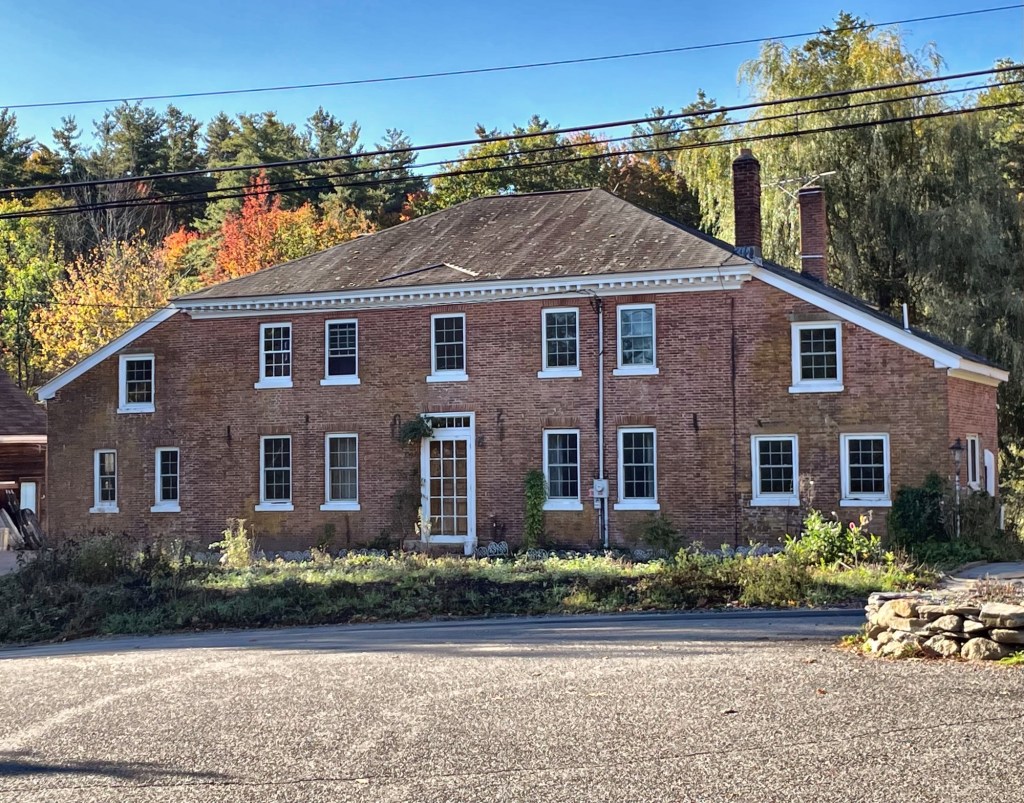
The Newton Theological Institution, a school originally founded for the Baptist ministry, opened on Institution Hill in Newton Center in 1825. The 40-acre campus started with six buildings, including this one, Farwell Hall, built in 1829. Farwell Hall is the oldest extant building on the campus today and is named after benefactor and early founder of the school, Levi Farwell. The brick building began as a late-Federal-designed building with a classic Federal Style window fenestration and Adamesque brick arches on the first story side elevations, but the formerly Federal style building was modernized in 1871 with the addition of a fourth floor via a mansard roof, and a more recent, unfortunate altered entry with projecting roof. After the Andover Newton Theological School sold their campus, the building has since been home to an assisted care facility.

Jackson-Richards Farmhouse // c.1768

This historic home at the edge of Newton Centre is believed to have been built by 1768 by Abraham Jackson, a descendant of one of the earliest settlers in what would become Newton. Abraham took out a mortgage on three acres of land and woodlands, a dwelling house and barn. In 1782, the property was acquired by Aaron Richards (1750-1823), a Revolutionary War veteran and carpenter, who likely modified the residence into the Federal style form and design we see today. Aaron Richards would farm the land here until his death. The farmhouse would be bought and sold and the property subdivided in the 19th and 20th centuries, diminishing the farm and woodland which once surrounded the residence. For a period after the Civil War, the property was owned by the Boston Children’s Aid Society as a Girl’s Home, used as a boarding house to raise orphaned girls from the Boston area, teaching them skills to increase their hopes of adoption or moving out on their own. The property was reverted to a residence by the 20th century and is significant as one of Newton’s few extant 18th-century farmhouses.

Spofford-Root House // c.1830

The Spofford Family was one of the earliest to settle in present-day Georgetown, with the earliest enclave of homes built along Andover Road in the western part of town. A few generations later, subsequent family members would built in the town center, taking advantage of the growing commercial and business community. This Federal period home (with later alterations) was built around 1830 for Greenleaf Spofford (1801-1887) the same year as his marriage to Emily Willmarth. The couple would move out of town and sold the home to Dr. Richmond Barbour Root (1846-1930),  the second of a highly respected, three generation family to practice medicine in Georgetown. The overlay of machine-sawn Stick Style decorative porch, bracketed cornice and bay windows were likely added by Root sometime after the Civil War. Unlike most owners of Federal and Greek Revival-style dwellings, Dr. Root may have held a valid professional interest in appearing as up-to-date as possible with a “modernized” home that also served as the site of his office and consulting rooms.

Moody-Hall House // 1830

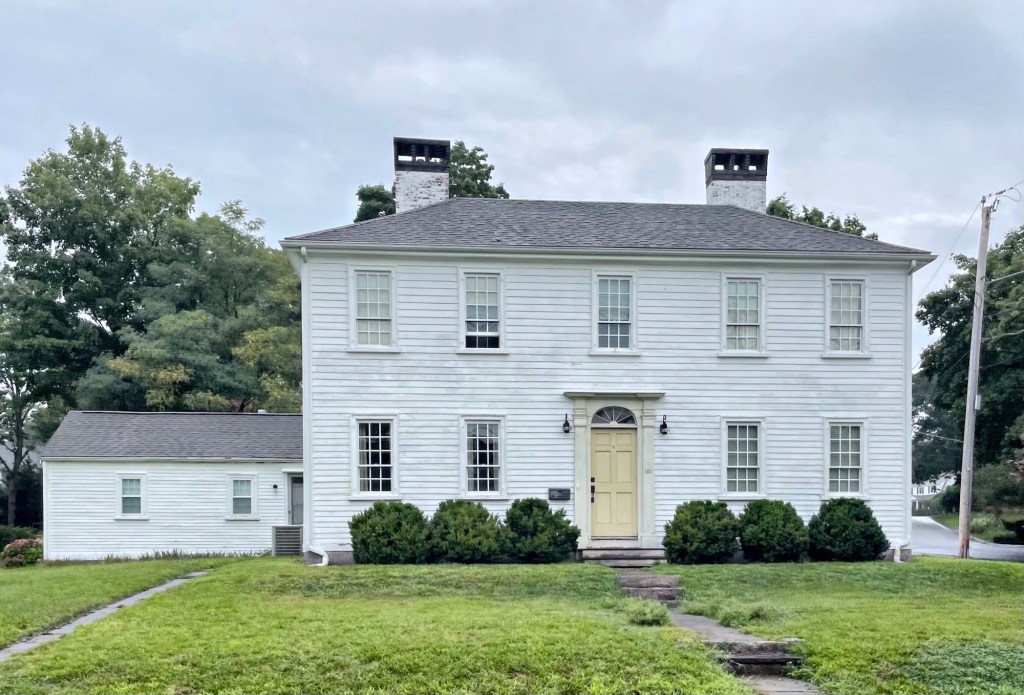
Transitional Federal/Greek Revival style houses are among my favorite. You can see the emergence of Classical architecture blending with American architecture with features of both styles, which work well together. This example can be found on Elm Street in Georgetown, Massachusetts. The dwelling appears to have been built for Dr. George Moody, one of four physicians in Georgetown in 1840, who began his practice in town in 1830. In his first years there, he oversaw patients during Typhus and Dysentery outbreaks and was credited with having determined that a high sulphur content in the local water supply accounted for the increased cases. Dr. Moody died in 1866, and his widow continued to live in the house until her death in 1880, after which it was sold to Mrs. Charlotte Sawyer Hall, the widow of local shoemaker Seth Hall.

Jacob Randall House // c.1796

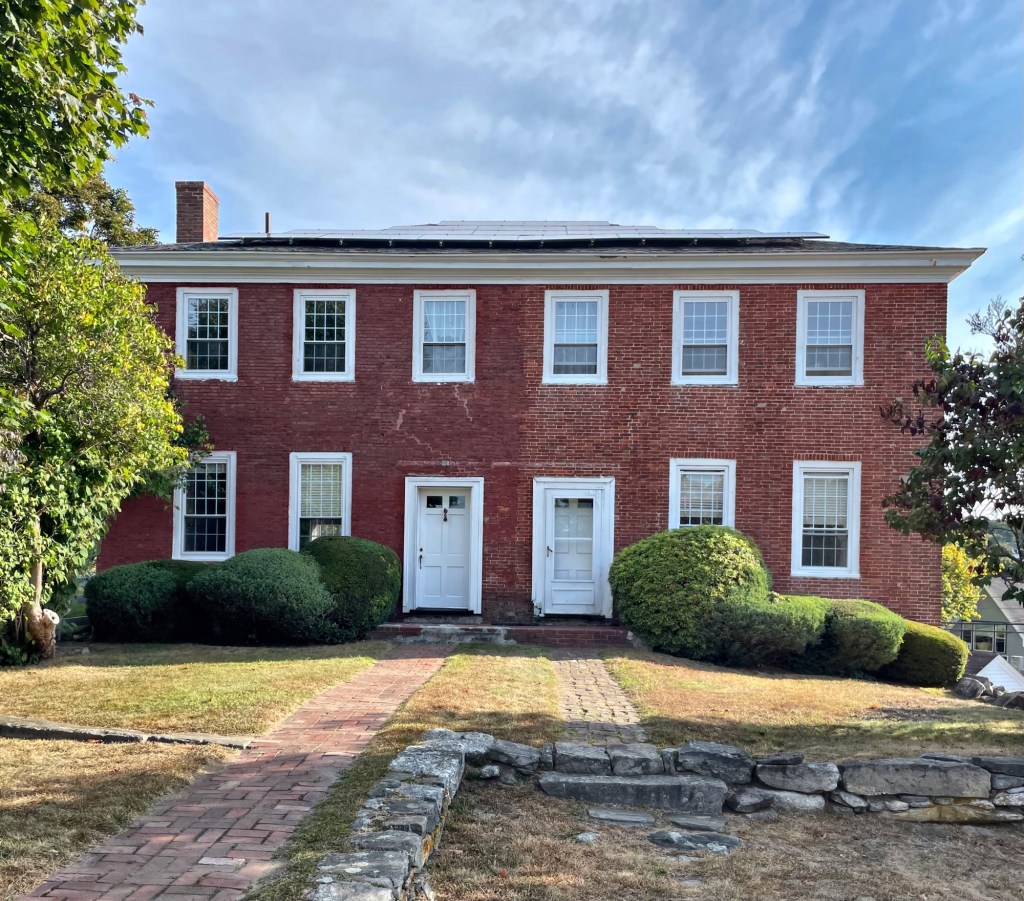
The Jacob Randall House on Lawrence Road in Pownal, Maine was built about 1796 and is a fine example of Federal period architecture executed in brick in the town. Built for Jacob Randall (1771-1829) a native of Weymouth, Massachusetts, who purchased over 100 acres of land in town, and had this house built sometime after. His property spanned the nearby Chandler River, upon which he established a sawmill and gristmill. When Pownal was incorporated in 1808, Randall was one of its first town selectmen, a seat he held nearly continuously until his death in 1836. The house is five bays wide, with its entrance in the central bay, recessed with a fanlight.