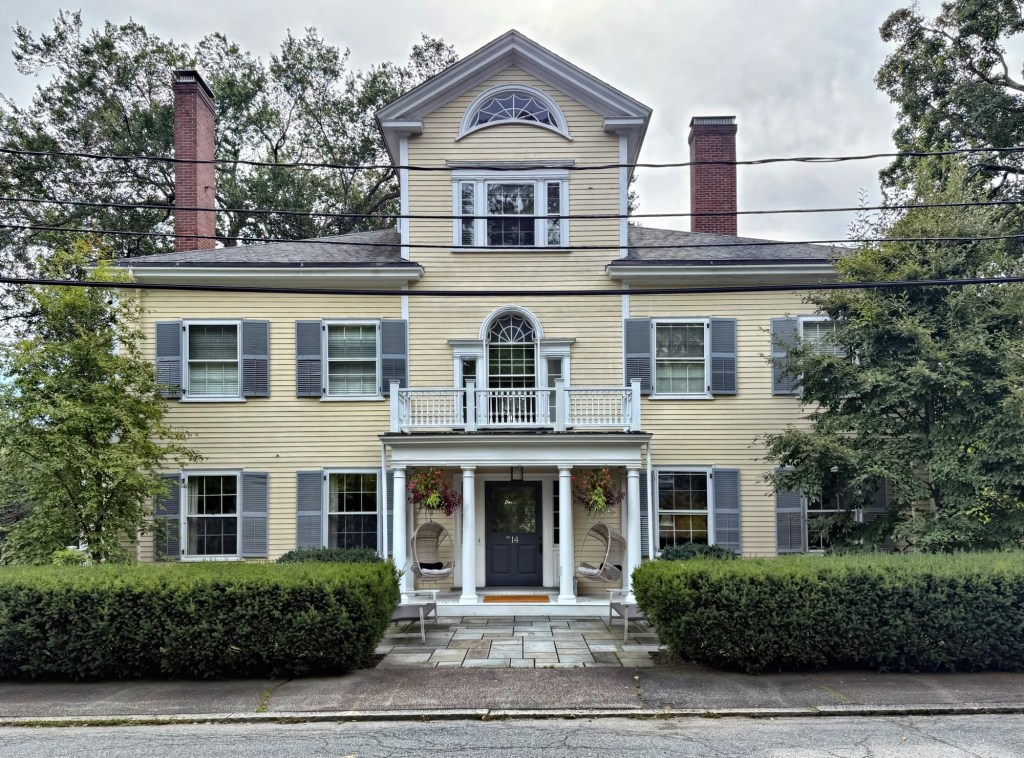
Thomas Aspinwall House // 1896

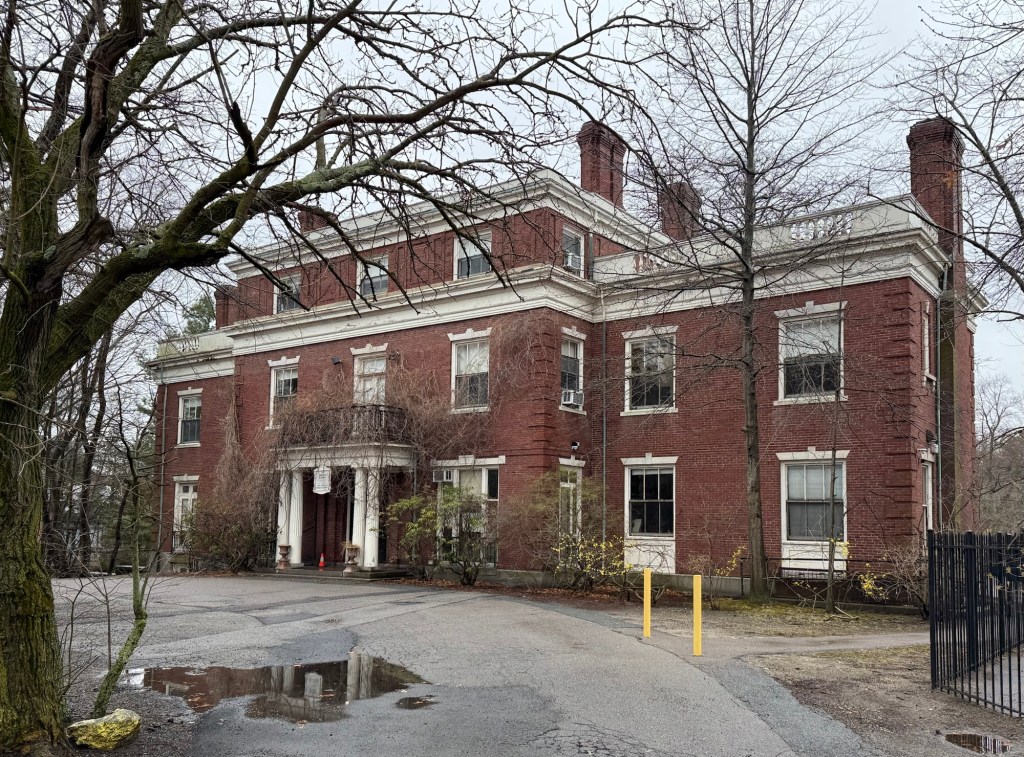
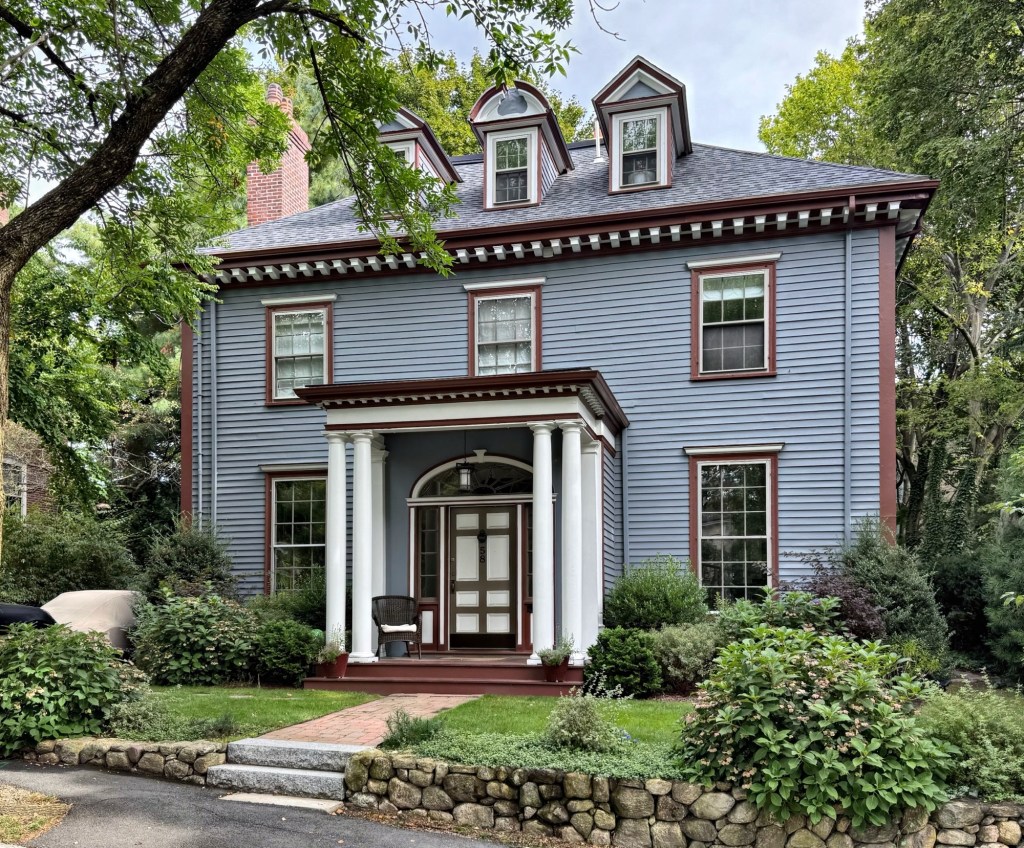
The Thomas Aspinwall House at 14 Hawthorn Road in Brookline was constructed in 1896 by architects, Ball & Dabney. The stately home was built for Thomas Aspinwall as a near copy of his great-grandfather’s 1803 Federal style house on Aspinwall Hill, the William Aspinwall House. Both residences feature a four-tier central bay with Palladian and lunette windows with a columned portico at the entrance. His grandfather, Dr. William Aspinwall graduated from Harvard in 1764 and studied medicine in Connecticut and in Philadelphia before beginning his medical practice in his hometown. He was one of the Brookline men who marched west and fought British troops as they retreated from Lexington and Concord in April 1775. He was put in charge of a hospital in Jamaica Plain during the Revolutionary War and later ran a hospital for smallpox victims in Brookline. His 1803 Federal style home was demolished in 1900 as the Aspinwall Hill area of Brookline was developed, but luckily, a replica remains on the other side of town, here on Hawthorn Road!
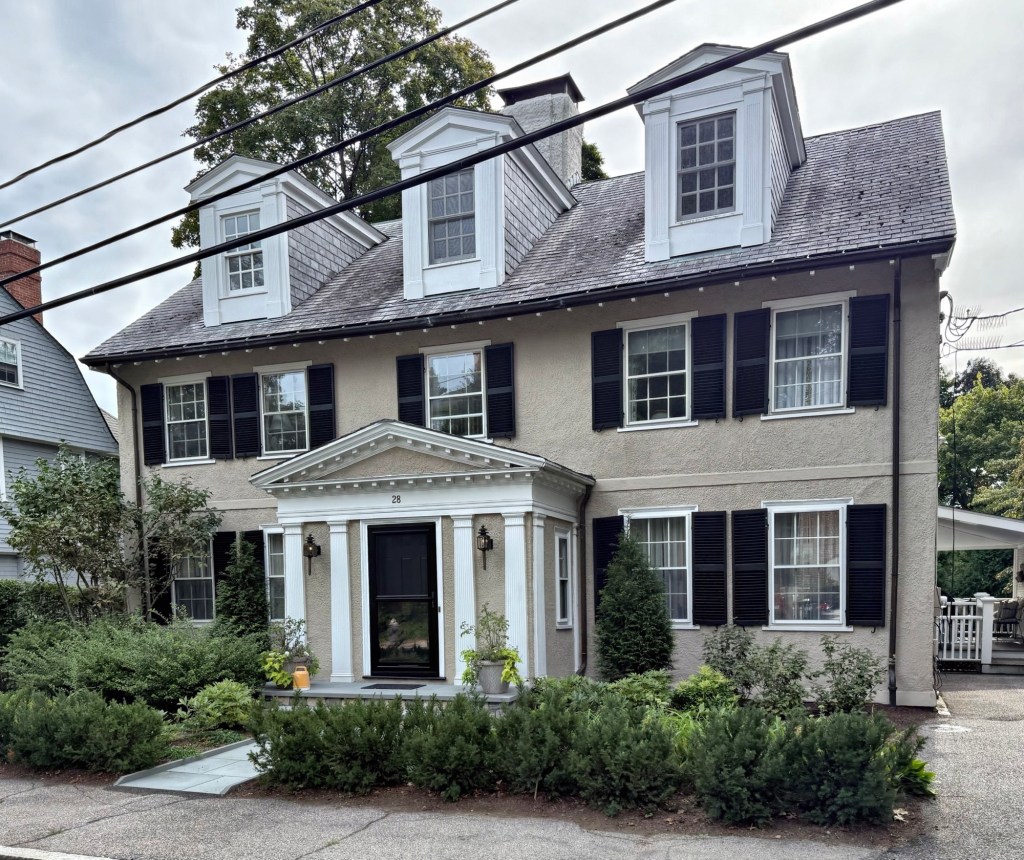
William & Sara Warren House // 1911

Built in 1911, this Colonial Revival style house rendered in stucco, is located at 28 Hawthorn Road in the Pill Hill neighborhood of Brookline, Massachusetts. The residence was built for William Marshall Warren (1865-1953) and his wife, Sara Shields Warren (1874-1964) from plans by the firm of Gay & Proctor. William M. Warren served on the faculty at Boston University as Professor of Philosophy and later as Dean of the College of Arts and Sciences, promoted by his father, William Fairfield Warren, who was President of the University. The Warren House features a symmetrical five-bay facade with central entrance within a projecting pedimented vestibule framed by four pilasters. The pilasters are replicated in the three dormers at the roof, set below the central chimney.

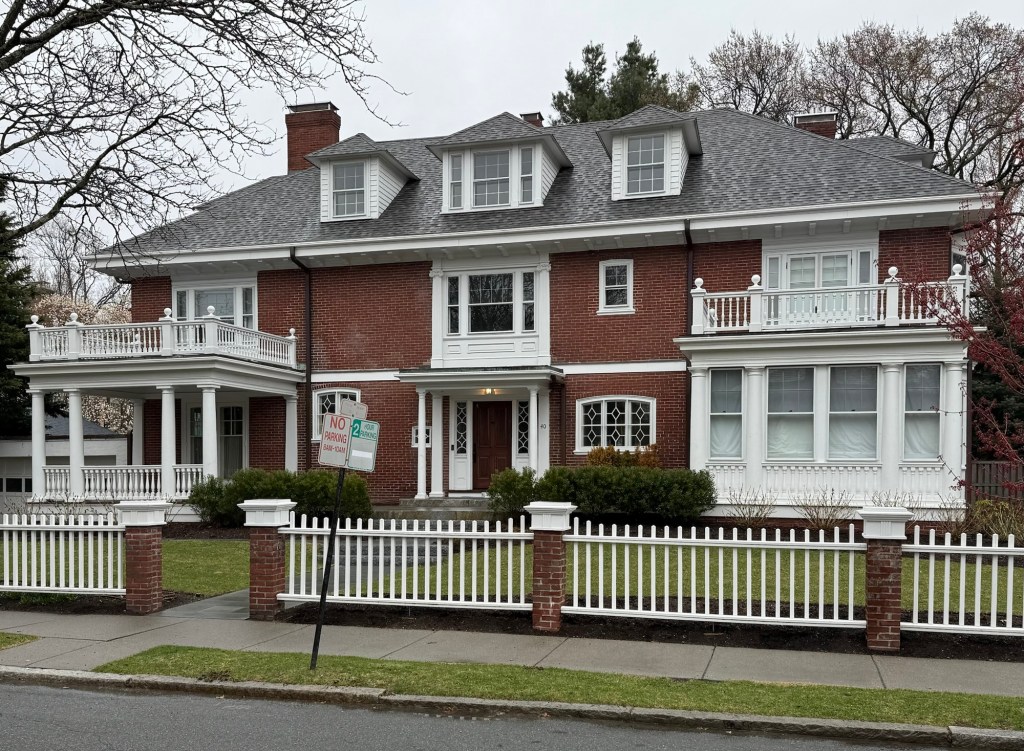
Russell-Hayes House // 1899

The Russell-Hayes House at 58 Allerton Street in Brookline, Massachusetts, was built in 1899 in the highly popular Colonial Revival style for Mr. and Mrs. Russell. Francis Henry Russell (1832-1919) was born in Plymouth and married Elizabeth Stevens (1835-1922) of Lawrence, and had one daughter together. Francis attended Harvard College and eventually worked as the Treasurer of the Bates Manufacturing Company, doing well enough to purchase a house lot in the fashionable “Pill Hill” neighborhood of Brookline to build his home here. Mr. Russell hired Plymouth-born architect, Joseph Everett Chandler, to design his suburban residence for himself, his wife, and daughter. After the death’s of Francis (1919), Elizabeth (1922) and their unmarried daughter, Mary (1926), the property was purchased in 1927 by African American musician, Roland Hayes. Just years prior to purchasing this stately home in Brookline, Roland Hayes performed abroad in Europe, even a private performance for King George V and Queen Mary at Buckingham Palace. He returned to the United States of America in 1923 and made his official debut on November 16, 1923, in Boston’s Symphony Hall, which received critical acclaim. He was the first African-American soloist to appear with the Boston Symphony Orchestra, who would later hire him, with a reported salary of $100,000 a year. Roland and his family lived in this house for 50 years until his death in 1977. His legacy lives on here with a plaque in front of the home, and a public school named after him.

Irving-Strauss Mansion // 1906

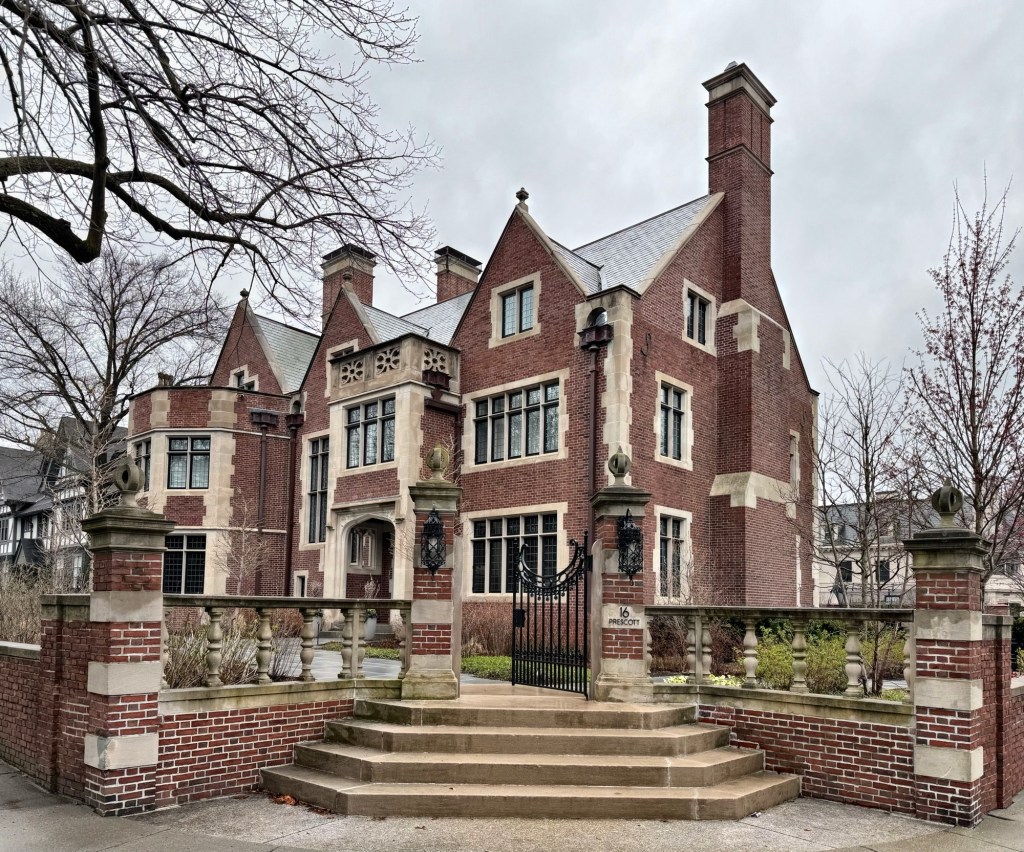
This unique Tudor Revival style house in the Cottage Farm neighborhood of Brookline was built in 1906 for Irving J. Sturgis (1873-1924), a banker and broker originally from Michigan. Architect Joseph Everett Chandler, specialized in the Colonial Revival style and historic restorations, but was clearly adept at other styles as evidenced in this stately manor for Mr. Sturgis. After WWI, the property sold to Mr. Leon Strauss, who worked in dry goods. The Irving-Strauss mansion is constructed of brick with cast stone trim and features classic ornamentation seen in the Tudor Revival style. Steeply pitched gable roofs have stone
coping, metal windows are casement or fixed with small pained lights and are framed in cast stone trim. Framing the entranceway is a brick and stone gateway, of which, a garden wall extends around the property, with a stately garden gate surmounted by stone finials displaying the flair of the style.

Curtis House – Boston University Children’s Center // 1904

Built in 1904 as one of the finest Tudor Revival style residences in the Boston area, this residence in the Cottage Farm neighborhood of Brookline showcases all of the important elements of the iconic architectural style. The residence was built for Harry and Carrie Curtis, with Mr. Curtis being a partner with Curtis & Sederquist, bankers and brokers, with offices on Congress Street in Boston and in New York City. The couple hired architects Howard B. Prescott and William Sidebottom of the firm, Prescott & Sidebottom, to design the house. Rectangular in plan with massing enlivened by numerous cross gables and dormers, the house is decorated with exterior walls covered with wood shiplap at first story and half-timbered stucco at second story. The property was sold to Helen and Edward Mills by 1913. Mr. Mills was president and treasurer of the Edward C. Mills Leather Company. By 1931, the residence was owned by Erland F. Fish (1883-1942), a prominent lawyer and politician as well as the son of Frederick Fish, who owned the house across the street. Boston University purchased the property in 1964 as part of their institutional expansion into this neighborhood. Originally used as an alumni house, it later became the location for the Department of African American Studies. After an extensive expansion and restoration by Studio MLA (now Ashley McGraw Architects) and Kaplan Construction, the Tudor mansion is now a children’s daycare for Boston University faculty, staff, and graduate students.

Frederick P. Fish Mansion – New England Hebrew Academy // 1902

One of the finest estates in Brookline can be found here in the Cottage Farm neighborhood, just steps from Boston and the Charles River. This brick mansion was built in 1902 for Frederick Perry Fish (1855-1930), a prominent lawyer who also served as president of American Telephone & Telegraph Corporation from 1901 to 1907. One of the leading patent attorneys of his age, representing such clients as Alexander Graham BellThomas Edison, and The Wright Brothers, by the time of his death he was believed to have appeared in more patent cases at the Supreme Court than any other lawyer. For his Brookline residence, Fish purchased an 1867 brick mansard-roofed home on the lot and hired the architectural firm of Winslow & Bigelow to ether modify the earlier home or demolish it and build entirely new. The result is this stately, three-story Neo-Classical mansion. Fish would die at his home in 1930, and the property would eventually be owned by the New England Hebrew Academy as a Jewish day school. While it is an institutional use, the facade is covered with climbing vines that are bad for the masonry and an asphalt paved front yard which detracts from the beauty of this estate. It appears to be near-original though, which is great to see!

Benjamin and Almira Pitman House // 1900

Benjamin Franklin Keolaokalani Pitman (1852-1918) was born in Hilo, Hawaii, to parents Benjamin Pitman, a Salem businessman, and Kinoʻoleoliliha, high chiefess in the Kingdom of Hawaii. After the sudden death of Kinoʻoleoliliha, Benjamin Pitman Sr. remarried and sent his children to attend schools in Boston. Benjamin F. K. Pitman would meet and marry Almira Hollander Pitman (1854-1939), a suffragist who was instrumental in working for women’s suffrage in Hawaii. The couple purchased a house lot in the exclusive Cottage Farm neighborhood of Brookline, and hired architect Edwin J. Lewis, to design a home for their family. Early atlas maps and photos show that the house was originally clapboarded on the front and rear elevations with large brick end walls containing the chimneys. The facade was given a brick veneer sometime in the 20th century. After Benjamin died in 1918, Almira had a small gambrel-roofed cottage built in the rear yard for her son to live in. The residence is one of the finest Colonial Revival style homes in the area.

Frederick Sears Cottage // 1851

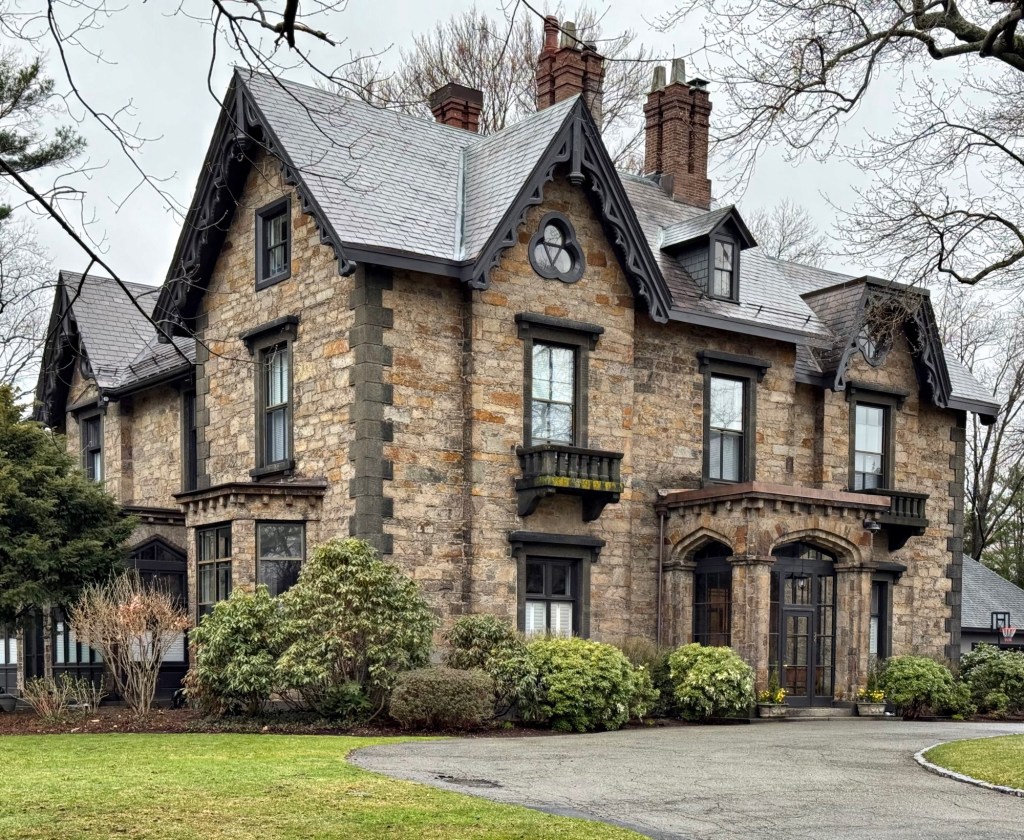
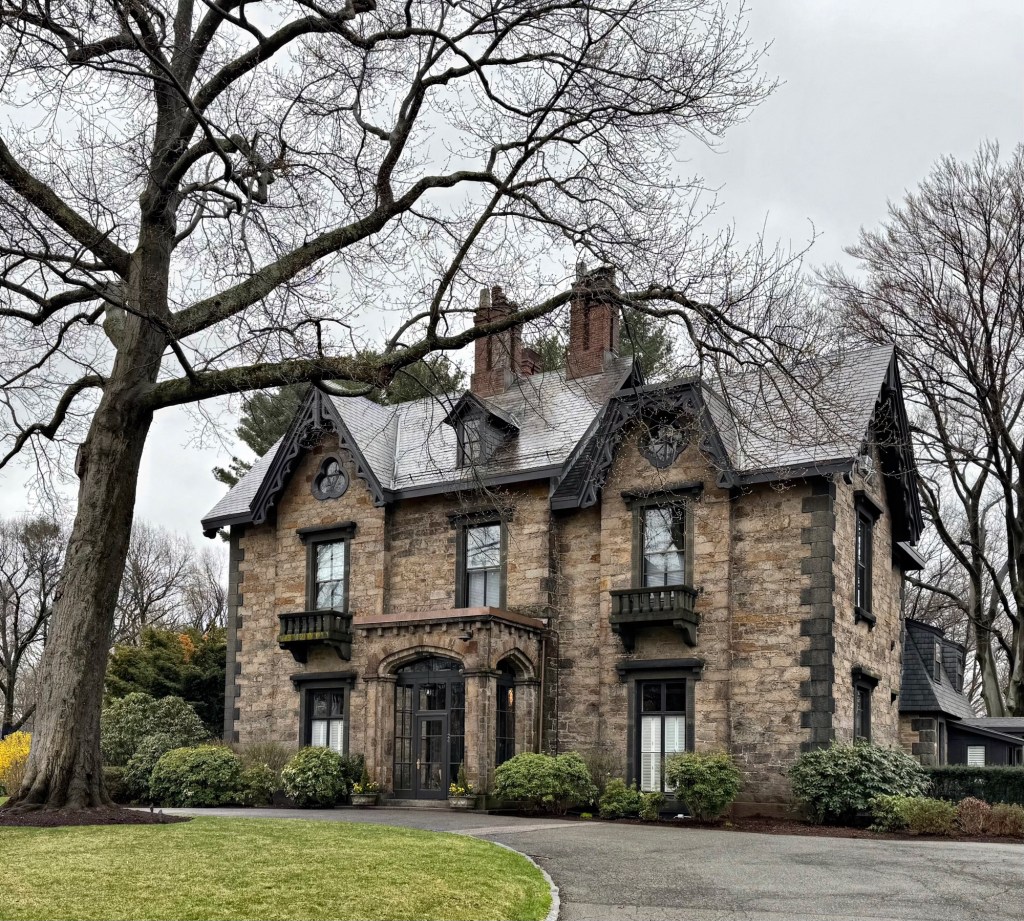
The Frederick Sears Cottage in the Cottage Farm neighborhood of Brookline, Massachusetts, is significant as one of the major surviving examples of Gothic Revival domestic architecture in the Boston area. In 1849, wealthy Bostonian, David Sears (1787-1871) laid out parks and squares in the Cottage Farm neighborhood, and built houses for himself and his children. His own house, erected in 1843, was the oldest, soon followed by houses for his four daughters, Ellen d’Hautville, Harriet Crowninshield, Anna Amory, Grace Rives, and son, Frederick. The Frederick Sears Cottage is the only surviving Sears residence in the Cottage Farm neighborhood. Frederick Sears‘ cottage was built in 1851, though he did not occupy the house long, as just three years after he and his wife married in 1852 to move into this home, Marian died. The house was inherited by Frederick Sears Jr. , and was acquired by Boston University in 1960, who began to expand into this neighborhood. They maintain the significant property very well. The Sears Cottage is an excellent example of the Gothic Revival style in stone with scalloped vergeboards, quatrefoil motifs, corner quoins, and projecting entry. The house is constructed of Roxbury Puddingstone and is said to have been designed by George Minot Dexter.

Joseph and Jane Cotton House // c.1905

As the heirs of Amos A. Lawrence began subdividing and selling off desirable house lots in the Cottage Farm neighborhood of Brookline in the 20th century, we can see a visual representation as to the ever-changing architectural tastes of wealthy residents, from Colonial Revival to Tudor Revival. This residence, the Joseph and Jane Cotton House, was built adjacent to the Amos A. Lawrence Cottage, and is an excellent example of a Colonial Revival style brick home. The property was built for Joseph Hall Cotton (1869-1919), treasurer of the American Tube Works, and his wife, Jane Eaton Cotton. The couple remained in the home for about a decade until they relocated to the Back Bay neighborhood of Boston. The architectural firm of Chapman & Frazer, esteemed suburban architects, designed the house as an elongated rectangle with projecting columned porches on the first floor, pilastered entrance and window above, and hipped roof with overhanging eaves and shed dormers, a nod to the Arts and Crafts style.

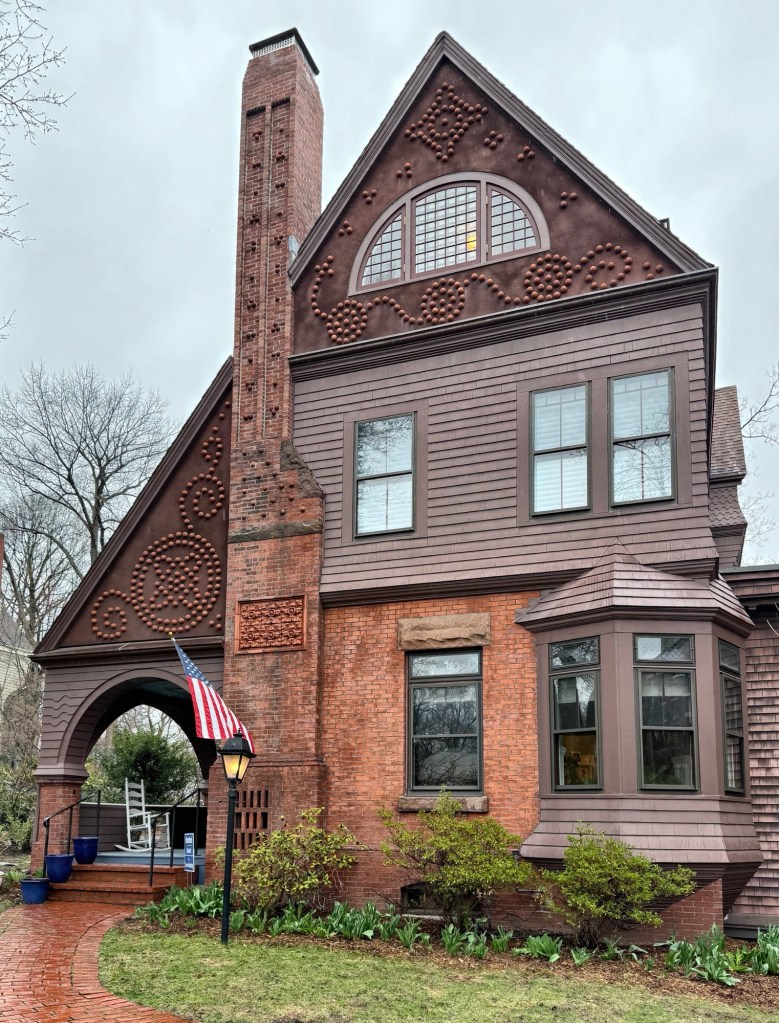
John Wales House // c.1885

In the mid-1880s, John Wales, a wealthy hardware dealer with offices in Downtown Boston, purchased house lots in the Cottage Farm area of Brookline from Amos A. Lawrence, and set out develop the site with two stately Victorian homes. This lovely home was first occupied by John’s son, George Wales and his wife, Mabel, the year of their marriage in 1885. While the architect is unclear, it is probable that the design can be attributed to architect William Whitney Lewis, who was hired by John Wales the year prior to design a stable near his home in an adjacent neighborhood. The house was rented by Wales and subsequent owners for years. The elaborate Queen Anne style house exhibits an asymmetrical plan with recessed entrance set within an arched opening, shinged and brick walls with a prominent chimney at the facade containing a decorative terra cotta panel, and the most unique stucco gables containing what appear to be terracotta balls in geometric forms. This house is a perfect example of what is so special about the Queen Anne style!