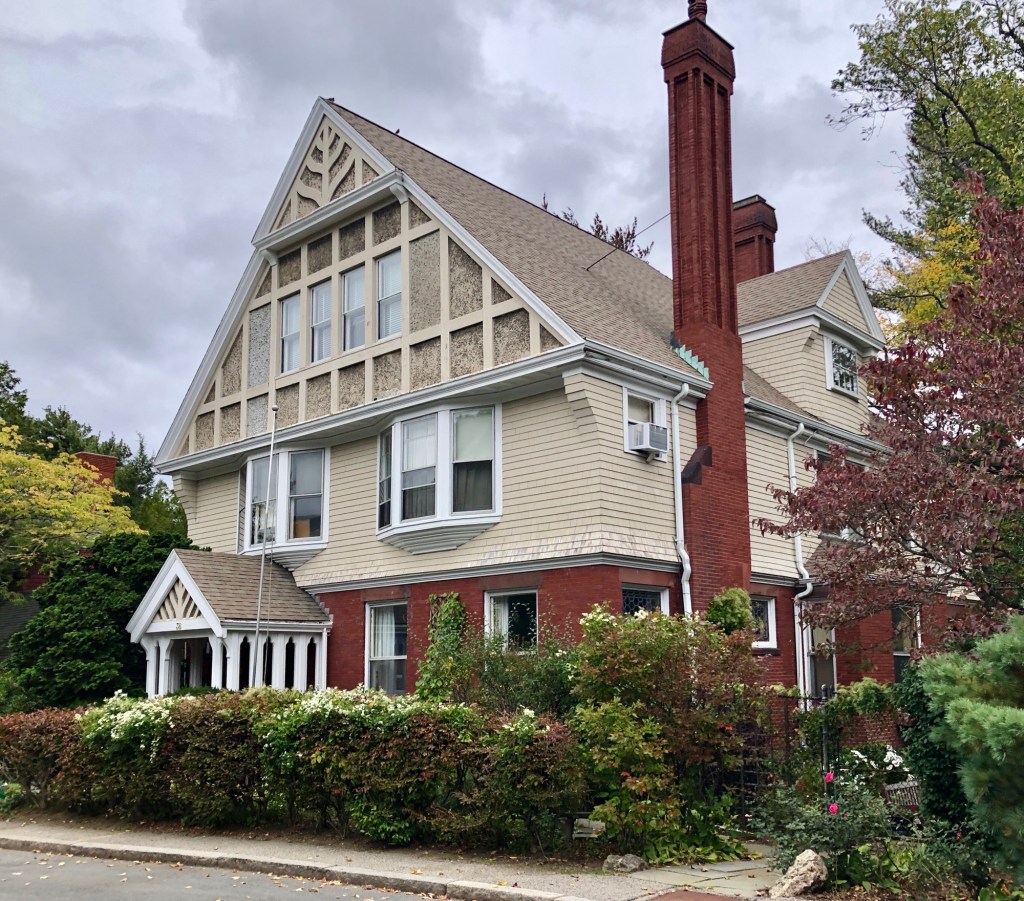
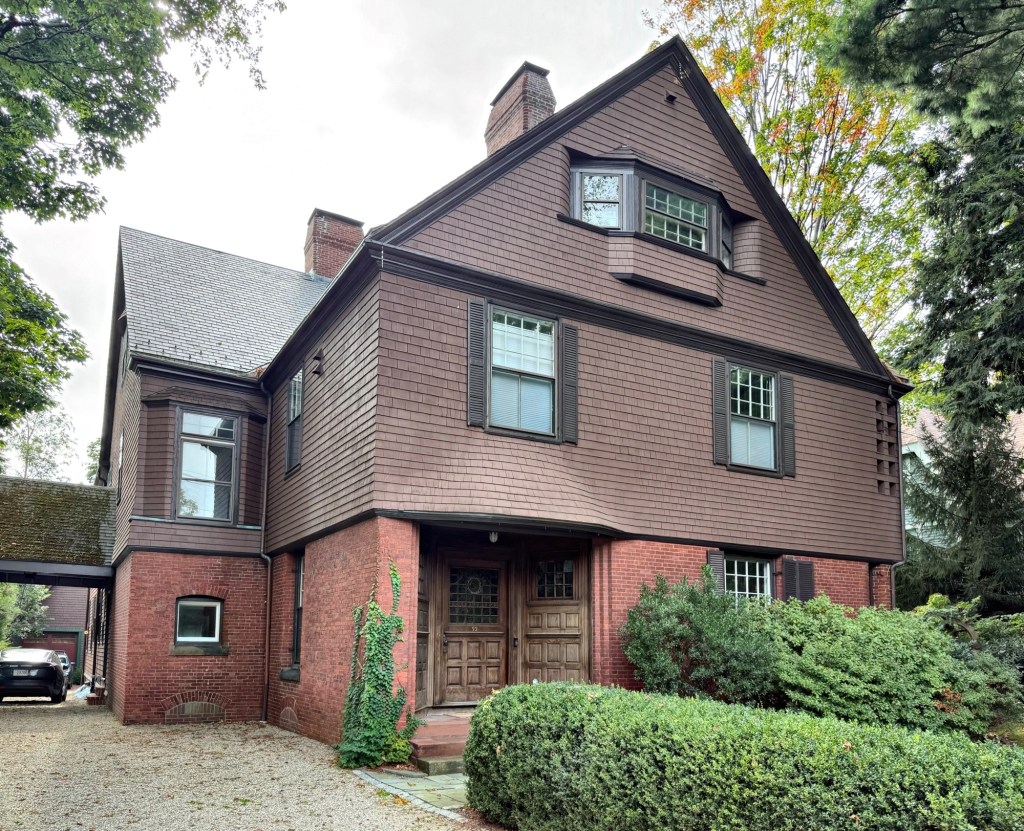
The Charles Torrey House at 36 Edgehill Road in Brookline, Massachusetts, is a great example of a Queen Anne style residence in the Boston suburbs. The stately home was constructed in 1889 for Charles Torrey, an artist who specialized in nautical scenes. The house is unique for its brick first floor, shingled second and stucco with half-timbering in the gable, a feature that suggests the renewed interest in English medieval motifs. The architect for the Queen Anne style home could not be located, but it appears to be from a more prominent Boston-area firm of the late-19th century. The house is currently (2025) undergoing a renovation.
The house at 44 Edgehill Road in Brookline, is a brick Queen Anne style residence built for Moorfield Storey (1845-1929) by architect and neighbor, Robert Swain Peabody, who was Moorfield’s friend and college roommate. Both Peabody and Storey would later move in the early 20th century to the Fenway in neighboring houses, also designed by Robert S. Peabody. Moorfield Storey was a president of the American Bar Association and the president, for most of its existence, of the Anti-Imperialist League, an organization founded to oppose the annexation of the Philippines as a colony and to support free trade and the gold standard. Storey consistently and aggressively championed civil rights, not only for African Americans, but also for Native Americans and immigrants. He opposed immigration restrictions, and supported racial equality and self-determination. He would become the first president of the National Association for the Advancement of Colored People (NAACP), from its founding in 1909 until his death in 1929. The Storey House in Brookline is a well-preserved and early example of the Queen Anne style, that would dominate architectural tastes for the following decades.
This handsome shingled Queen Anne style home on Allerton Street in Brookline, Massachusetts, is part of the reason why the “Pill Hill” neighborhood gets its name. The residence was built in 1888 for Mr. Sumner Flagg, likely as an investment property as the neighborhood developed into one of the finest in the Boston area. An early resident here was Judith Motley Low (1841-1933), founder of the Lowthorpe School of Landscape Architecture, which was the first school intended solely to prepare women as landscape professionals in a field dominated by men. In 1945, the Lowthorpe School merged into the Rhode Island School of Design and became the basis of RISD’s Landscape Architecture Department. Another prominent resident of the house in the 20th century was Dr. John Rock (1890-1984), a physician and scientist who worked nearby at the Massachusetts Hospital for Women. As a Catholic doctor, John Rock is best-known for two groundbreaking medical discoveries in women’s health: the birth control pill and in-vitro fertilization. Dr. John Rock and his lab technician, Miriam Menkin, were the first researchers to fertilize a human egg outside of a human body in February of 1944, this research was compounded and later led to in-vitro fertilization as we know it today. Additionally, while running his clinic, Dr. Rock encountered a number of women bearing unwanted children that they could neither afford financially nor handle physically. Rock observed numerous women who, after giving birth to multiple children, had prolapsed uteri, malfunctioning kidneys, and were prematurely aging. In 1952, Rock was recruited to investigate the clinical use of progesterone to prevent ovulation. Enovid, the brand name of the first pill, was approved by the U.S. Food and Drug Administration (FDA) and put on the market in 1957 as a menstrual regulator. In 1960, Enovid gained approval from the FDA for contraceptive use.
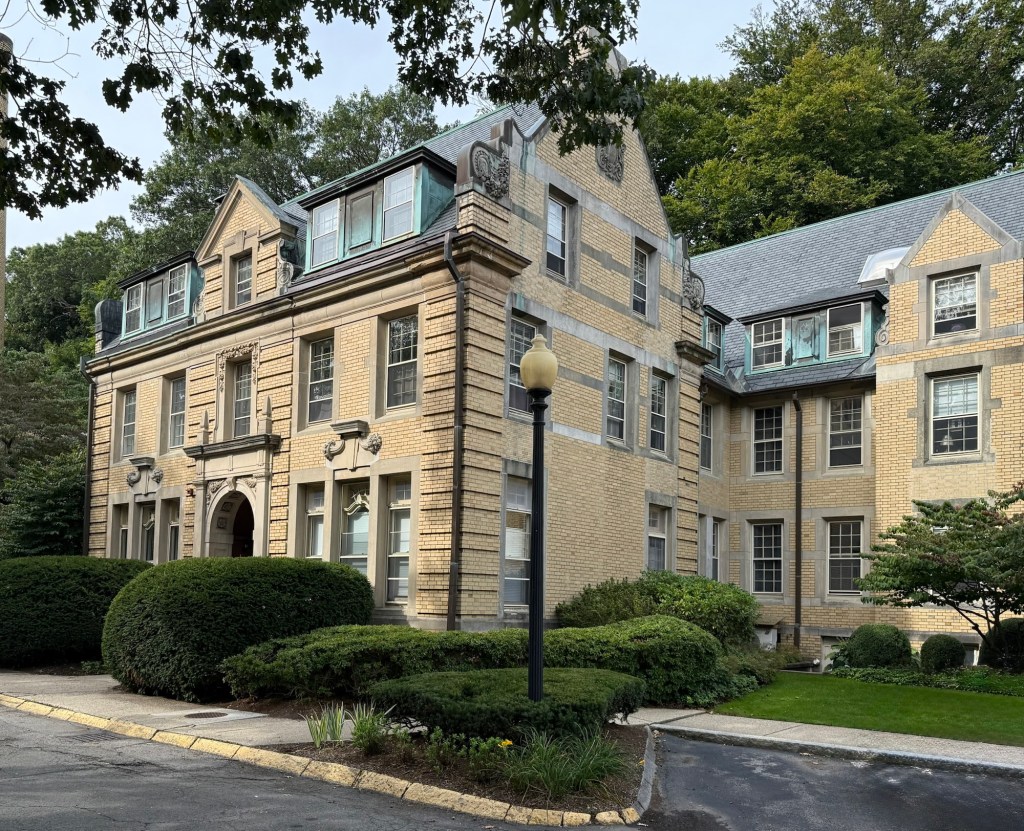
Located behind the former Boston Free Hospital for Women in Brookline, this charming yellow brick building employs materials and design elements of its neighbor, but was designed and built by different architects nearly a decade later. Built in 1908 as a nurse’s residence this handsome building was crucial to the expansion and growth of the women’s hospital here, providing much-needed living space for employees of the hospital who worked around the clock to provide some of the highest-quality medical care in the Boston area. Designed by the firm of Coolidge & Carlson, the nurse’s residence employs intricate limestone detail
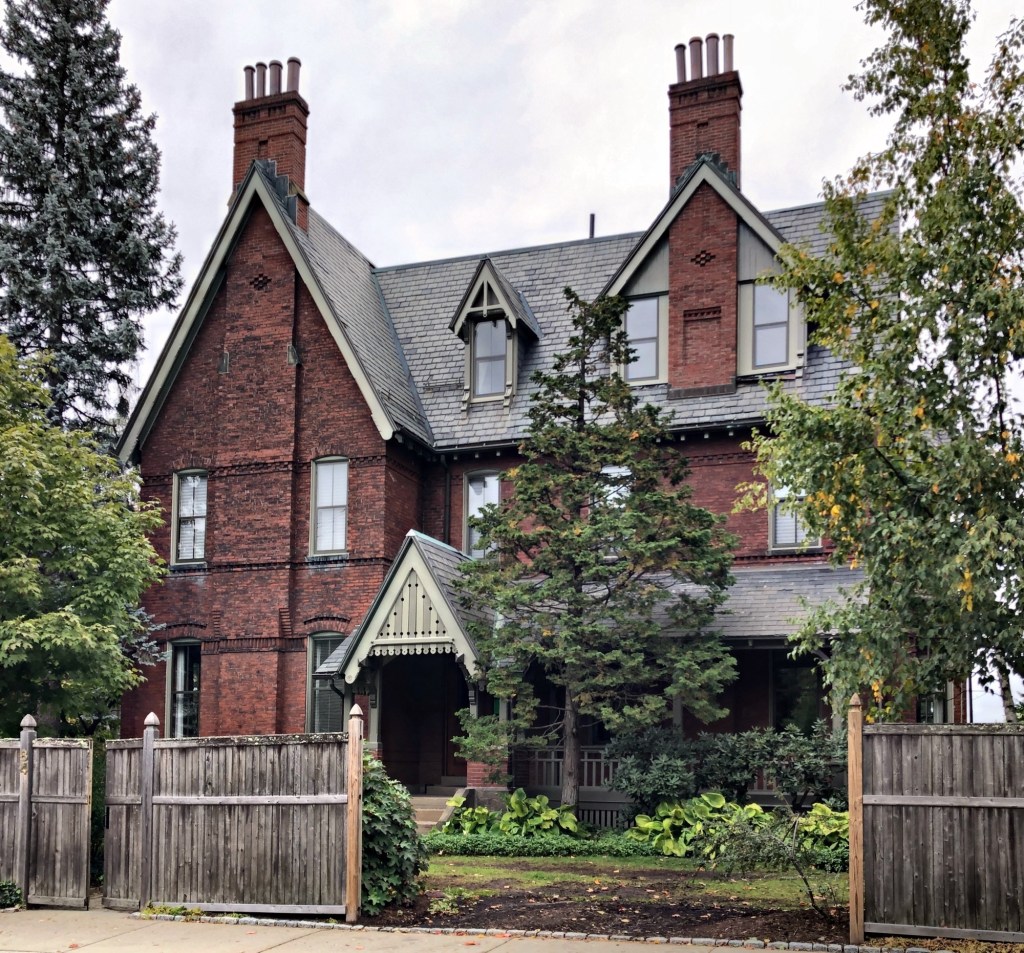
The John Runkle House on High Street, is one of the most interesting houses in Brookline. Built in 1875 for educator John Daniel Runkle (1822-1902), the brick residence excellently blends early Queen Anne form and flourish with Victorian Gothic design elements all with Stick style entry porches and dormers. John D. Runkle was a noted mathematician wholater became the second President of the Massachusetts Institute of Technology from 1868 until 1878. This occurred before MIT moved over the Charles to Cambridge, so President Runkle would not have traveled far to the Institute when located in the Back Bay. The Runkle House was designed by the architectural firm of Weston & Rand with an irregular plan of elaborate belt courses in the brickwork that is set against the extremely steep slate roof with tall prominent chimneys and corner turret. Sadly, the residence is largely obscured by a tall wooden fence, but I caught it on a good day that a panel was down.
One of the many great Queen Anne/Shingle style homes in Brookline is this residence at 92 High Street built for Thacher Loring (1844-1928), president and treasurer of the National Dock and Warehouse Company, of Boston, founded by his father, Elisha Thacher Loring. For their Brookline home, Mr. Loring hired architect, William Ralph Emerson, one of the great architects who mastered the Shingle style of architecture. The Loring Family lived here until the early 1900s, when they sold the property and moved to the Back Bay in Boston. The property was purchased by John Henry Sherburne (1877-1959), who lived here with his family for over sixty years. John Sherburne was an attorney, politician, and military officer who served during the Pancho Villa Expedition, World War I, and World War II and attained the rank of brigadier general receiving numerous military awards, including the Silver Star and Purple Heart. During WWI, he commanded the U.S. Army’s first “negro” artillery battalion in France. After the war he testified before Congress about orders that pointlessly sent hundreds of U.S. soldiers from other units “over the top” to their deaths on the morning of November 11, 1918, when the armistice hour was already known. Following his World War I service, Sherburne advocated for civil rights for African Americans, including support for anti-lynching laws and from 1926 to 1931, he served on the board of trustees for Howard University. The Loring-Sherburne House is significant for its residents and for its architecture, including the use of brick and shingle siding, and the show-stopping recessed panel-wood entry with bulging shingles above.
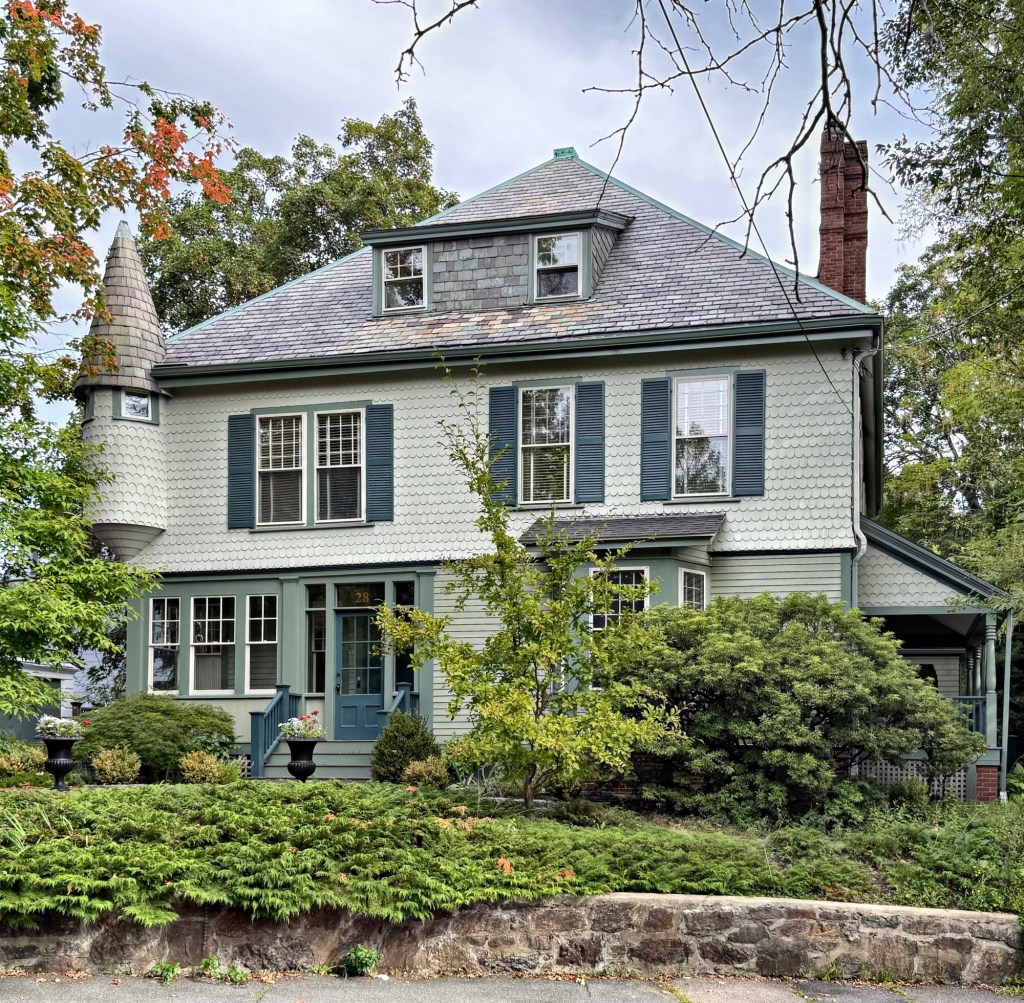
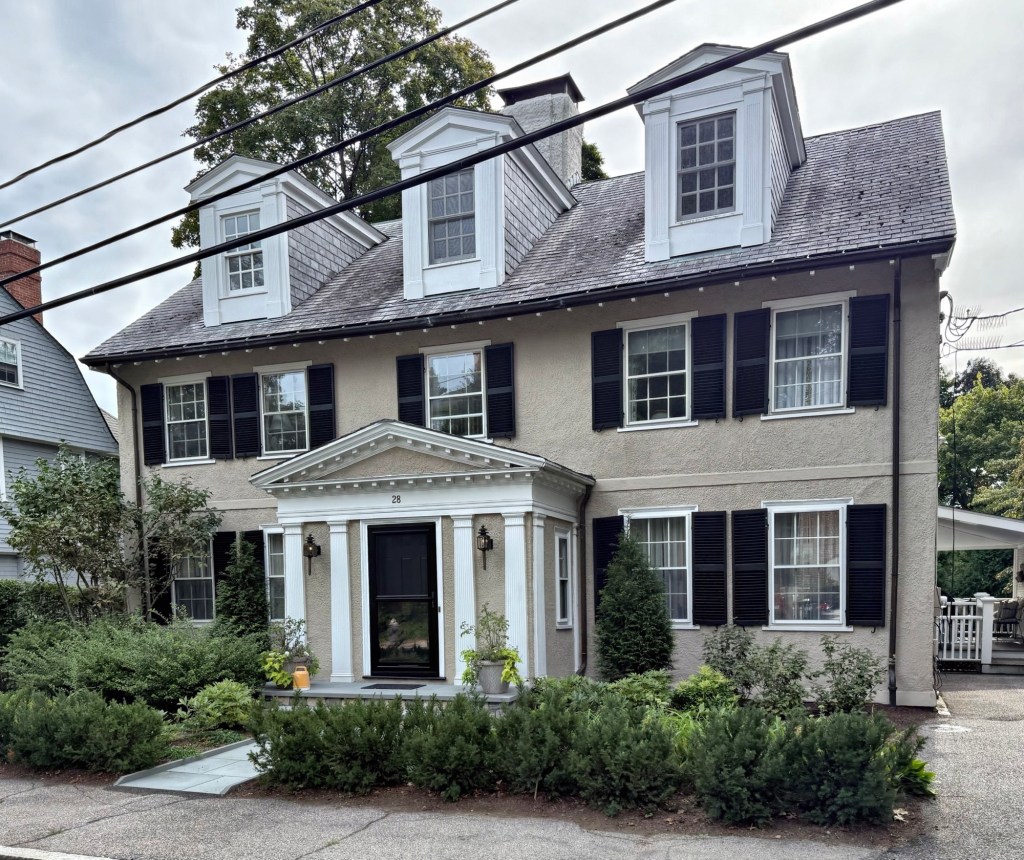
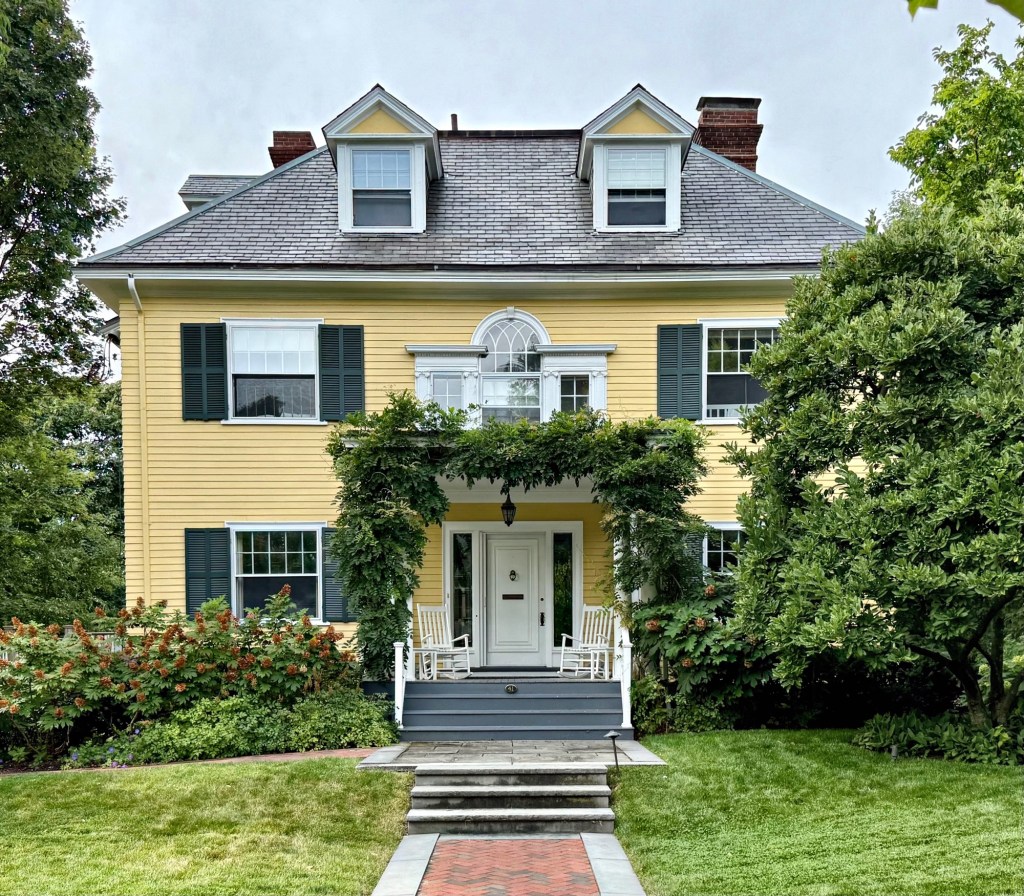
Built in 1911, this Colonial Revival style house rendered in stucco, is located at 28 Hawthorn Road in the Pill Hill neighborhood of Brookline, Massachusetts. The residence was built for William Marshall Warren (1865-1953) and his wife, Sara Shields Warren (1874-1964) from plans by the firm of Gay & Proctor. William M. Warren served on the faculty at Boston University as Professor of Philosophy and later as Dean of the College of Arts and Sciences, promoted by his father, William Fairfield Warren, who was President of the University. The Warren House features a symmetrical five-bay facade with central entrance within a projecting pedimented vestibule framed by four pilasters. The pilasters are replicated in the three dormers at the roof, set below the central chimney.
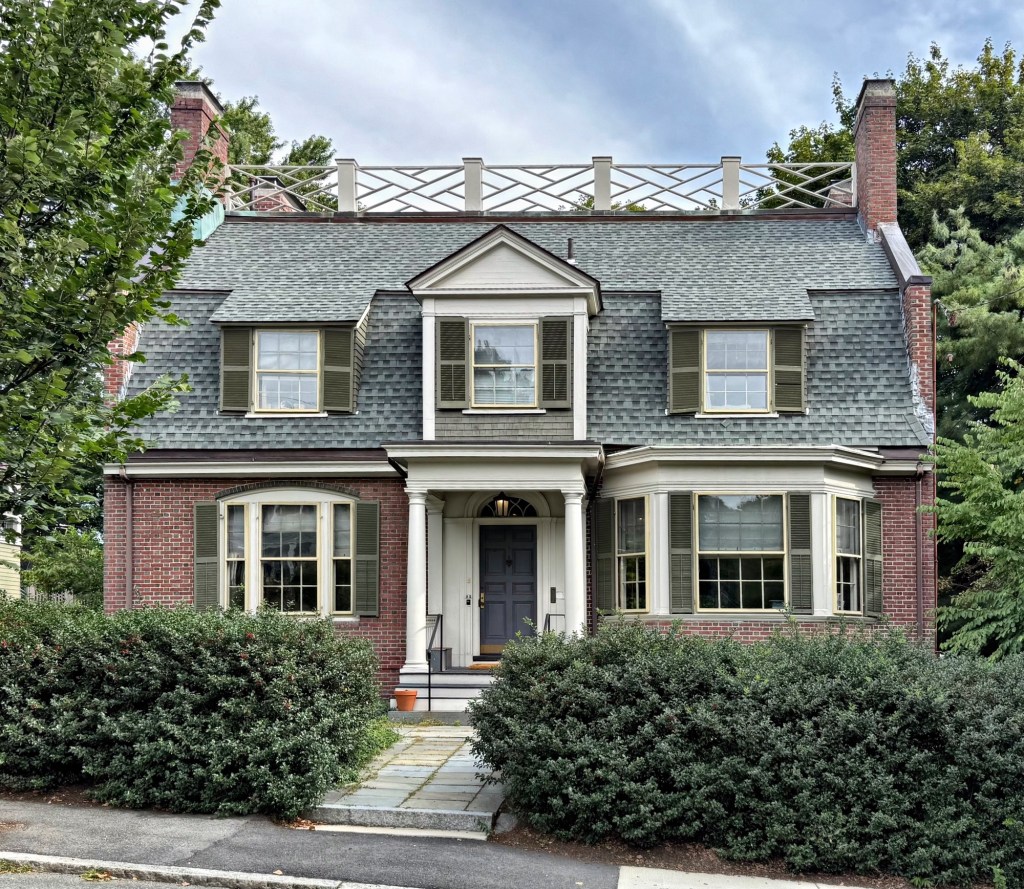
The Charles P. Ware House at 52 Allerton Street in Brookline, shows us that a house doesn’t have to be a mansion to make a statement! Built in 1894 from plans by architect, Henry Forbes Bigelow, this charming Colonial Revival cottage is notable for its brick construction with gambrel roof and brick endwalls rising as parapets. The home was built for Charles Pickard Ware (1840-1921) and wife, Elizabeth Lawrence (Appleton) Ware, who lived here until their deaths. Charles P. Ware was an educator, music transcriber, and abolitionist, who served as a civilian administrator in the Union Army, where he was a labor superintendent of freedmen on plantations at Port Royal, South Carolina during the Civil War. At one of the freedmen plantations, Seaside Plantation, Ware transcribed many slave songs with music and lyrics, publishing many in Slave Songs of the United States, which was the first published collection of American folk music. After Charles and Elizabeth Ware died in 1921 and 1926, respectively, the property was inherited by their son, Henry Ware, who was an attorney.
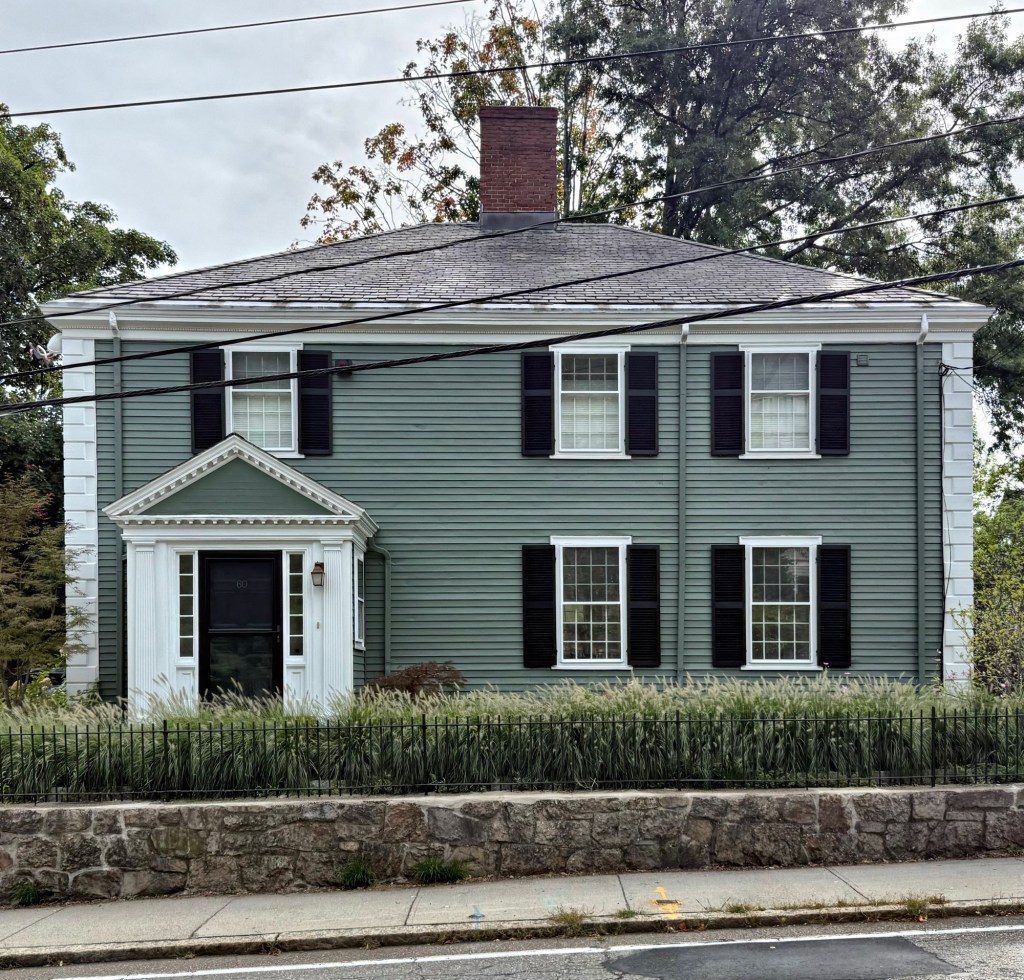
Built in 1928 as an accurate reproduction of an 18th-century residence the Codman-Gillet House at 60 High Street in Brookline is significant architecturally in the Colonial Revival style but also as a preserved house by the architectural firm of Howe, Manny and Almy. Lois Lilley Howe and Eleanor Manning were among the first women graduates of the M.I.T. School of Architecture, and the firm was joined in 1926 by Mary Almy. Their firm was the first all-woman architecture practice in Boston and the second in the U.S. Howe was the first woman elected a Fellow of the American Institute of Architects. The house was built for William Coombs Codman, a trustee of various real estate trusts, and was likely rented or sold for investment. The first long-time owner/occupants of the residence were Mr. and Mrs. Fernand Gillet and who both taught at the New England Conservatory of Music. Fernand was the principal oboist of the Boston Symphony Orchestra from 1925 to 1946. The Codman-Gillet House features many traditional Colonial Revival elements including: the corner quoining, window trim, a pedimented projecting entrance, and hipped roof with large central chimney.
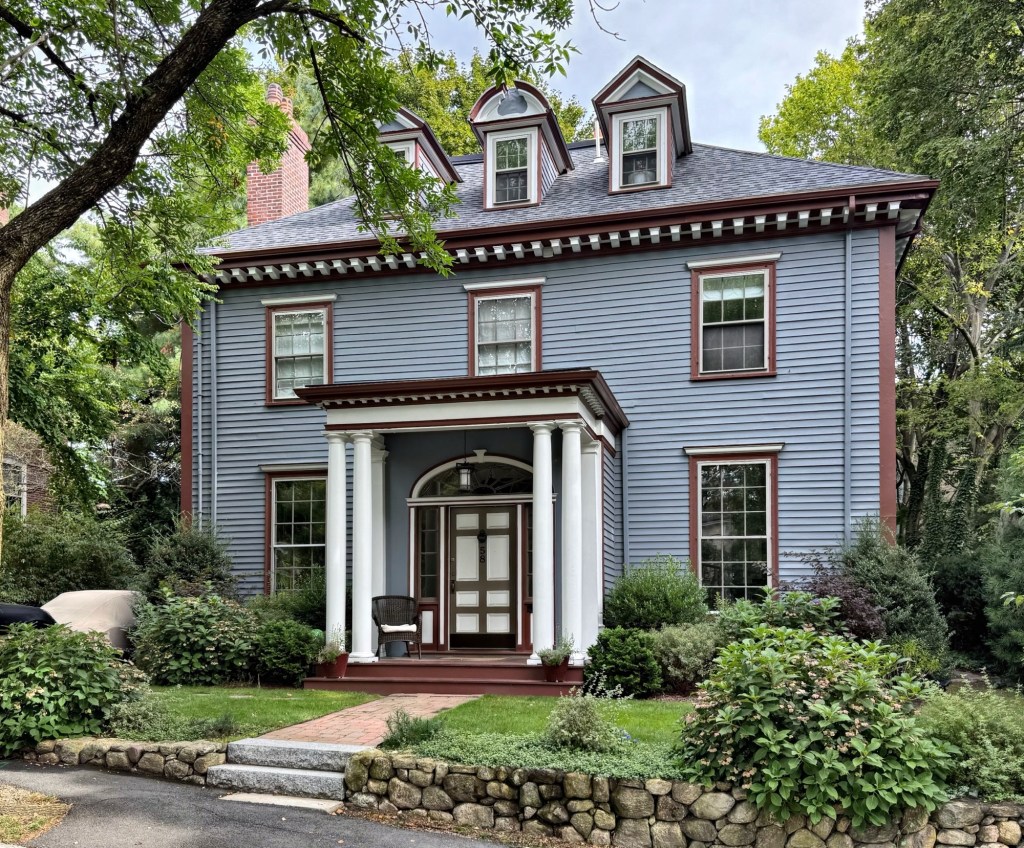
The Dana House at 41 Allerton Street in Brookline, Massachusetts, is one of many stately suburban residences designed in the Colonial Revival style here. Built in 1896 for Ms. Julia Hurd Dana (1825-1914), a widow of James Dana, who was a Mayor of Charlestown between 1858-1860, before it was annexed to Boston. The Dana House was designed by the important architectural firm of Chapman & Frazer, who specialized in higher-end suburban housing at the turn of the 20th century. Julia Hurd Dana was the daughter of William Hurdof Charlestown, and after her husband’s death, moved to Brookline in this new home with her daughter, Mary. The residence is notable for its ample setback from the street, providing a front yard garden, hipped roof of slate with pedimented dormers, and palladian window over the portico which is now covered in crawling ivy.
The Russell-Hayes House at 58 Allerton Street in Brookline, Massachusetts, was built in 1899 in the highly popular Colonial Revival style for Mr. and Mrs. Russell. Francis Henry Russell (1832-1919) was born in Plymouth and married Elizabeth Stevens (1835-1922) of Lawrence, and had one daughter together. Francis attended Harvard College and eventually worked as the Treasurer of the Bates Manufacturing Company, doing well enough to purchase a house lot in the fashionable “Pill Hill” neighborhood of Brookline to build his home here. Mr. Russell hired Plymouth-born architect, Joseph Everett Chandler, to design his suburban residence for himself, his wife, and daughter. After the death’s of Francis (1919), Elizabeth (1922) and their unmarried daughter, Mary (1926), the property was purchased in 1927 by African American musician, Roland Hayes. Just years prior to purchasing this stately home in Brookline, Roland Hayes performed abroad in Europe, even a private performance for King George V and Queen Mary at Buckingham Palace. He returned to the United States of America in 1923 and made his official debut on November 16, 1923, in Boston’s Symphony Hall, which received critical acclaim. He was the first African-American soloist to appear with the Boston Symphony Orchestra, who would later hire him, with a reported salary of $100,000 a year. Roland and his family lived in this house for 50 years until his death in 1977. His legacy lives on here with a plaque in front of the home, and a public school named after him.
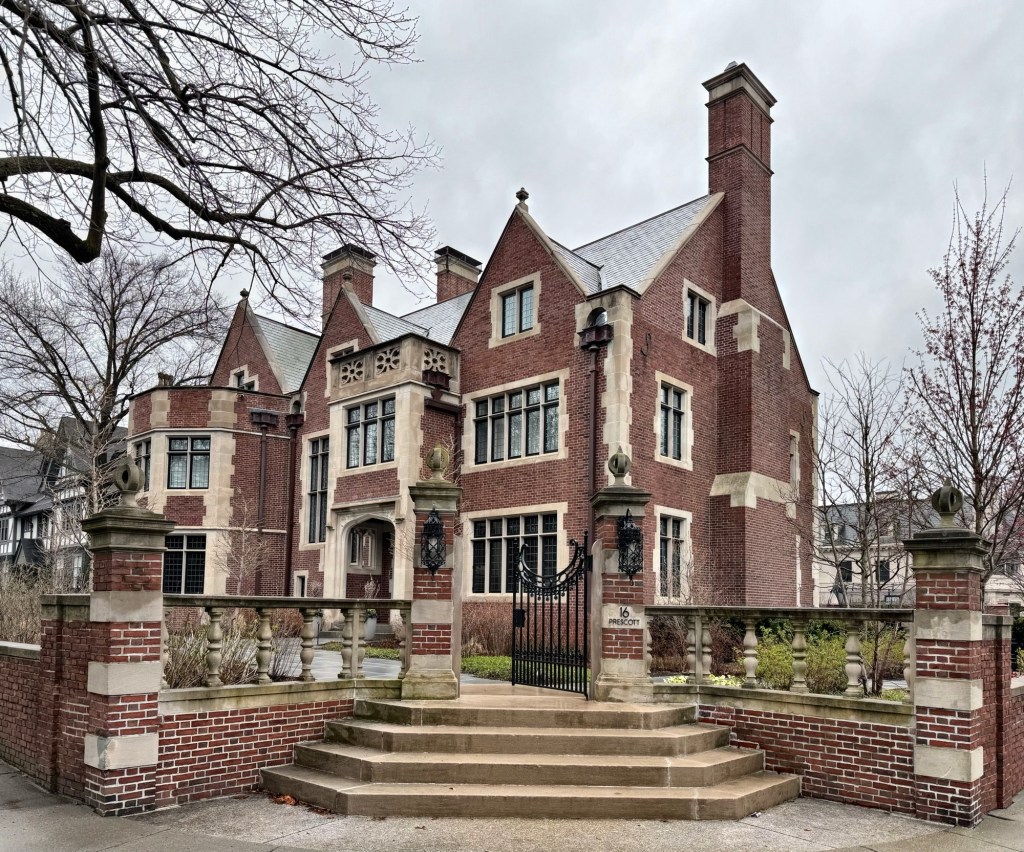
This unique Tudor Revival style house in the Cottage Farm neighborhood of Brookline was built in 1906 for Irving J. Sturgis (1873-1924), a banker and broker originally from Michigan. Architect Joseph Everett Chandler, specialized in the Colonial Revival style and historic restorations, but was clearly adept at other styles as evidenced in this stately manor for Mr. Sturgis. After WWI, the property sold to Mr. Leon Strauss, who worked in dry goods. The Irving-Strauss mansion is constructed of brick with cast stone trim and features classic ornamentation seen in the Tudor Revival style. Steeply pitched gable roofs have stone coping, metal windows are casement or fixed with small pained lights and are framed in cast stone trim. Framing the entranceway is a brick and stone gateway, of which, a garden wall extends around the property, with a stately garden gate surmounted by stone finials displaying the flair of the style.
Built in 1904 as one of the finest Tudor Revival style residences in the Boston area, this residence in the Cottage Farm neighborhood of Brookline showcases all of the important elements of the iconic architectural style. The residence was built for Harry and Carrie Curtis, with Mr. Curtis being a partner with Curtis & Sederquist, bankers and brokers, with offices on Congress Street in Boston and in New York City. The couple hired architects Howard B. Prescott and William Sidebottom of the firm, Prescott & Sidebottom, to design the house. Rectangular in plan with massing enlivened by numerous cross gables and dormers, the house is decorated with exterior walls covered with wood shiplap at first story and half-timbered stucco at second story. The property was sold to Helen and Edward Mills by 1913. Mr. Mills was president and treasurer of the Edward C. Mills Leather Company. By 1931, the residence was owned by Erland F. Fish (1883-1942), a prominent lawyer and politician as well as the son of Frederick Fish, who owned the house across the street. Boston University purchased the property in 1964 as part of their institutional expansion into this neighborhood. Originally used as an alumni house, it later became the location for the Department of African American Studies. After an extensive expansion and restoration by Studio MLA (now Ashley McGraw Architects) and Kaplan Construction, the Tudor mansion is now a children’s daycare for Boston University faculty, staff, and graduate students.
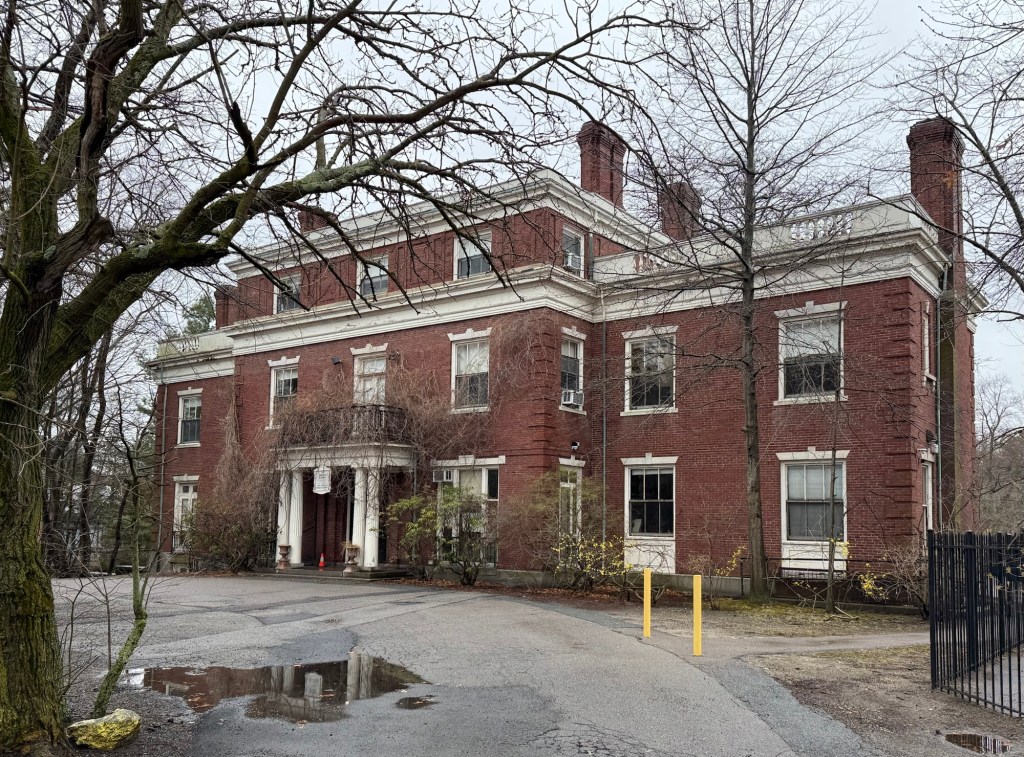
One of the finest estates in Brookline can be found here in the Cottage Farm neighborhood, just steps from Boston and the Charles River. This brick mansion was built in 1902 for Frederick Perry Fish (1855-1930), a prominent lawyer who also served as president of American Telephone & Telegraph Corporation from 1901 to 1907. One of the leading patent attorneys of his age, representing such clients as Alexander Graham Bell, Thomas Edison, and The Wright Brothers, by the time of his death he was believed to have appeared in more patent cases at the Supreme Court than any other lawyer. For his Brookline residence, Fish purchased an 1867 brick mansard-roofed home on the lot and hired the architectural firm of Winslow & Bigelow to ether modify the earlier home or demolish it and build entirely new. The result is this stately, three-story Neo-Classical mansion. Fish would die at his home in 1930, and the property would eventually be owned by the New England Hebrew Academy as a Jewish day school. While it is an institutional use, the facade is covered with climbing vines that are bad for the masonry and an asphalt paved front yard which detracts from the beauty of this estate. It appears to be near-original though, which is great to see!
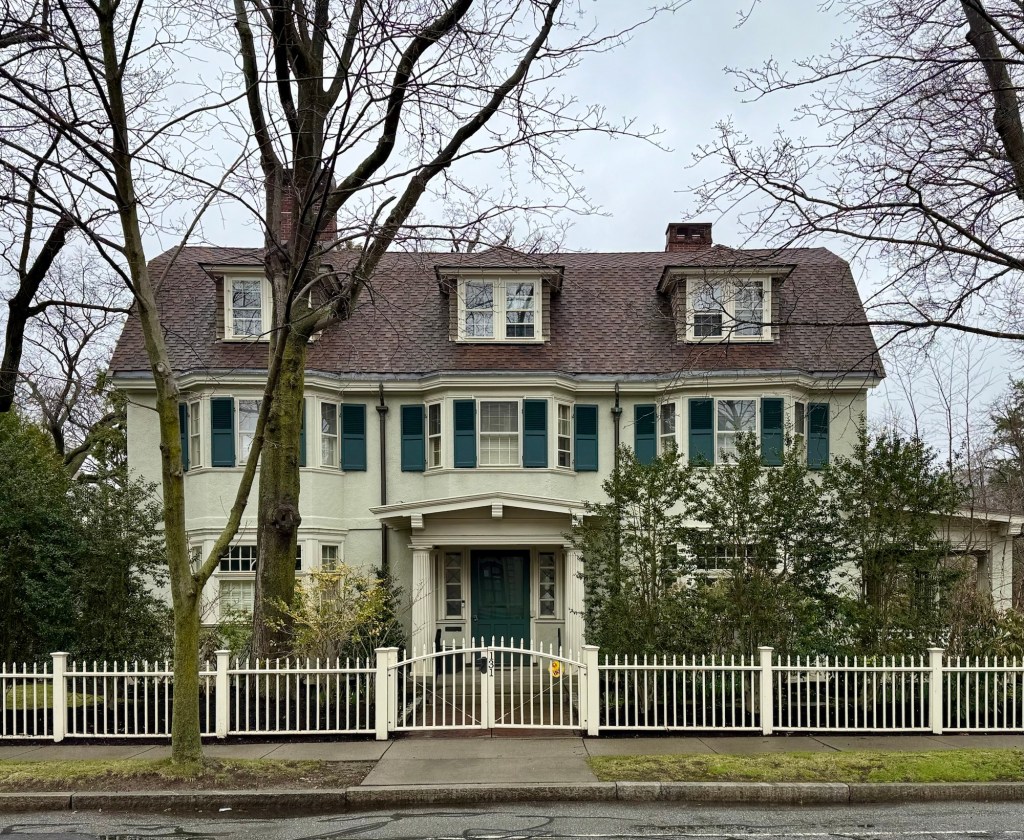
In 1902, Francis Bryden Dana (1865-1917) began construction on his home here in the Cottage Farm neighborhood of Brookline, Massachusetts. Francis was a member of the wealthy Dana Family and as a young man, attended the Boston Latin School and Harvard College. He became the president of the Dana Hardware Company of Boston. For his Brookline residence, Dana hired the exclusive architect, William Gibbons Rantoul to design the house which blends Arts and Crafts and Colonial Revival styles. The use of stucco siding, shed dormers, and portico with low sloped roof revealing exposed rafters falls squarely within the Arts and Crafts style; while the symmetrical facade, gambrel roof, and projecting octagonal bays are reminiscent of the more traditional New England Colonial Revival style.