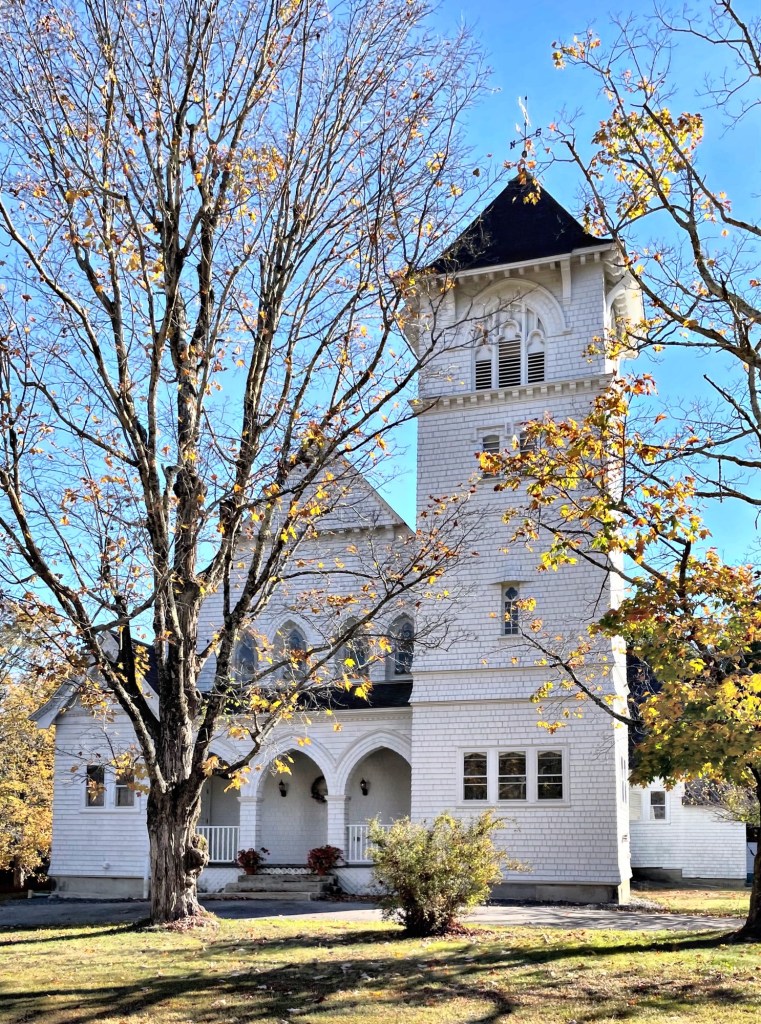
The New Ipswich Congregational Church was built in 1903, replacing the former 1813 Meeting House on the site, the fourth in the town, which stood here until a fire caused by lightning destroyed it in 1902. Interestingly, the design is more Victorian than Colonial Revival, which makes this church stand out amongst the village dominated by Georgian, Federal and Greek Revival style residences. The present building blends the Shingle style with Gothic elements with the tracery at the belfry and lancet windows. The architects were Gay & Proctor of Massachusetts who created a statement building with iconic tower that has been well-preserved by the congregation ever since.
Combining Greek and Gothic revival styles, the 1835 Ashby Congregational Church in Ashby, Massachusetts, is a significant building showcasing the transitional tastes of ecclesiastical architecture in 1830s New England. The church had its beginnings in 1818, when a group of church members disillusioned to the current teachings separated from the town’s Unitarian roots and the accompanying meeting house, the First Parish Church. In 1820 a church for the Congregationalists was built on the opposite end of the town common. In 1835 it was sold and this, the current church building was constructed on a new site facing the Common. The original 1820 church building became the Ashby Academy and is now a Grange Hall. The design of the Ashby Congregational Church shows the leaning towards Gothic detailing wit its prominent pointed arch detailing, yet retains some traditional Greek Revival features like the two-story pediment and pilasters at the belfry.
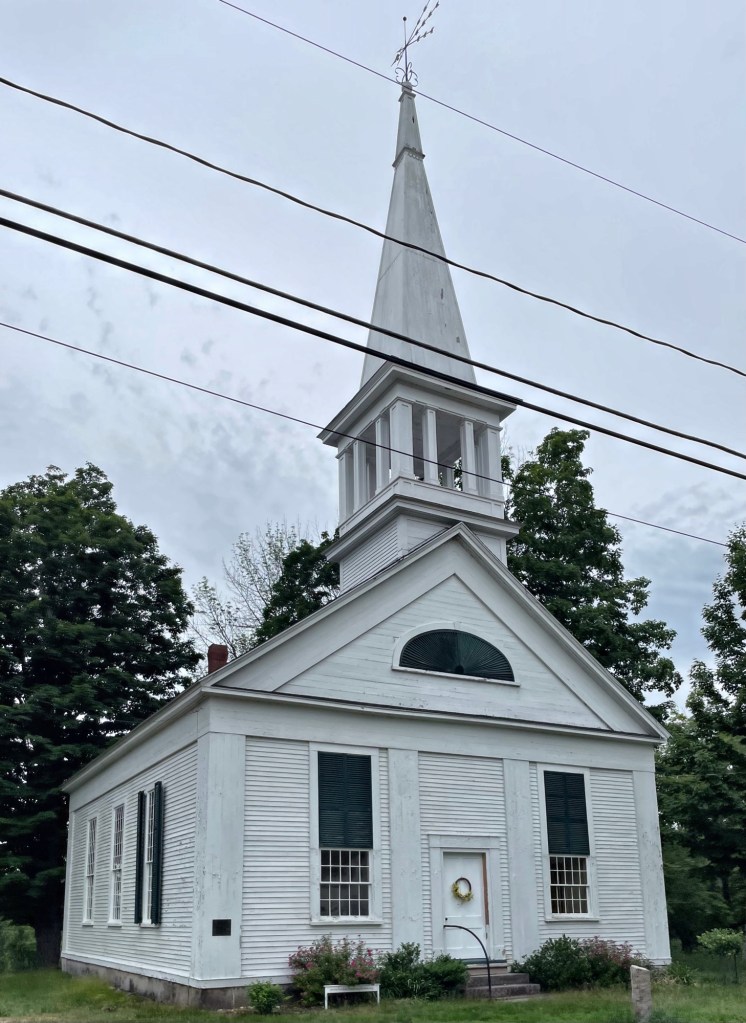
The location of the Effingham meetinghouse in New Hampshire was a controversial question in the 1790’s, with the villages of Lord’s Hill and Drake’s Corner both vying for the town’s most important public building. After several votes and repeals of votes, the Town’s voters in 1798, chose a committee of hopefully disinterested men from other towns and instructed them to settle on the location. The committee recommended Lord’s Hill, and in June, the Town voted to accept that location. The contract for the meetinghouse was awarded to Isaac Lord, a local landowner and operator of a tavern and store, who promptly erected the building the same year. In its original form, the building had the traditional meetinghouse plan, with its main entry in the long southeast side and a belfry at the northeast end. In 1845, the meetinghouse, by then the property of the Congregational Church, was thoroughly remodeled in the Greek Revival style, what we see preserved today.
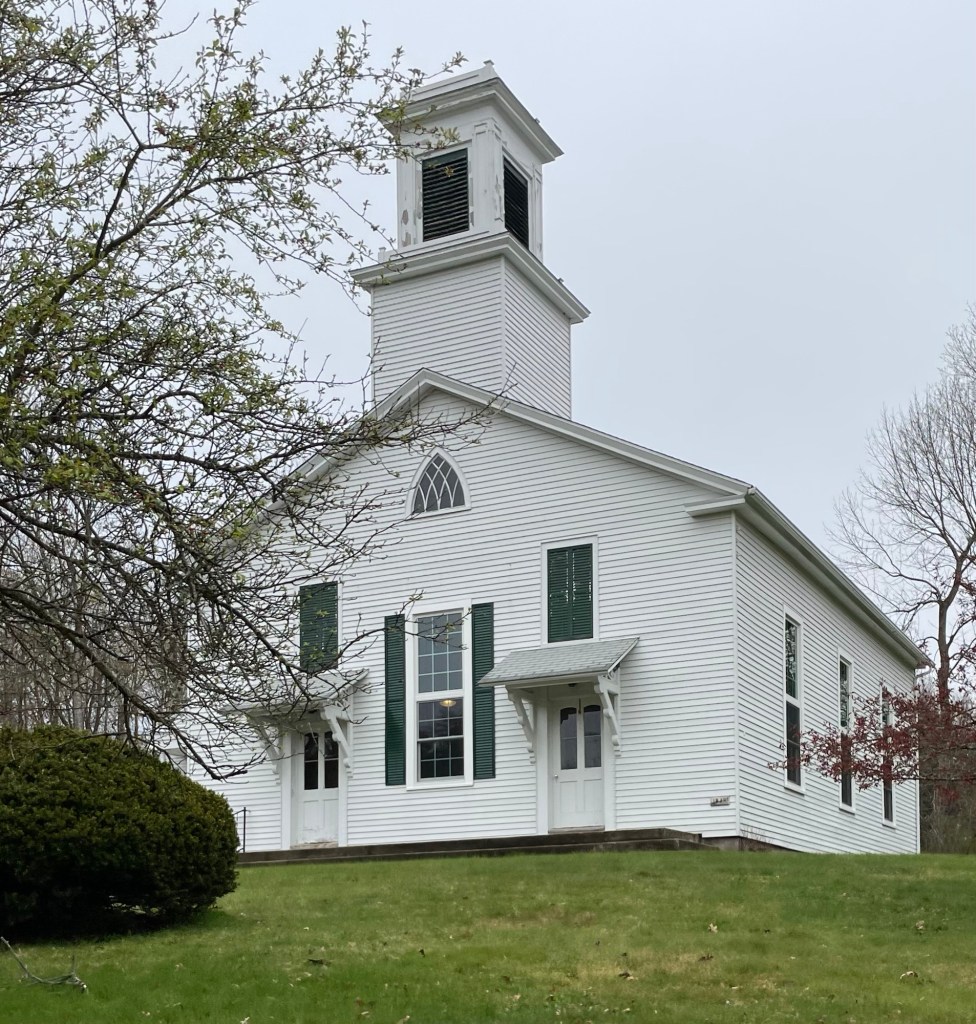
The small town of Union, Connecticut was established in 1734 and as with many towns at the time, religion and community were some of the first things to be codified when settling in a new area. The town’s publicly supported religion, Congregationalism permeated everyday life in Union. Even after disestablishment in 1818, the Congregational church continued as Union’s predominant religious organization well into the twentieth century. By 1841, the members built this edifice, the congregations second, on a hill overlooking the town’s modest green. The vernacular church features a Gothic lancet window, classical belfry, and later pent roof porches over the entrances on the primary facade.
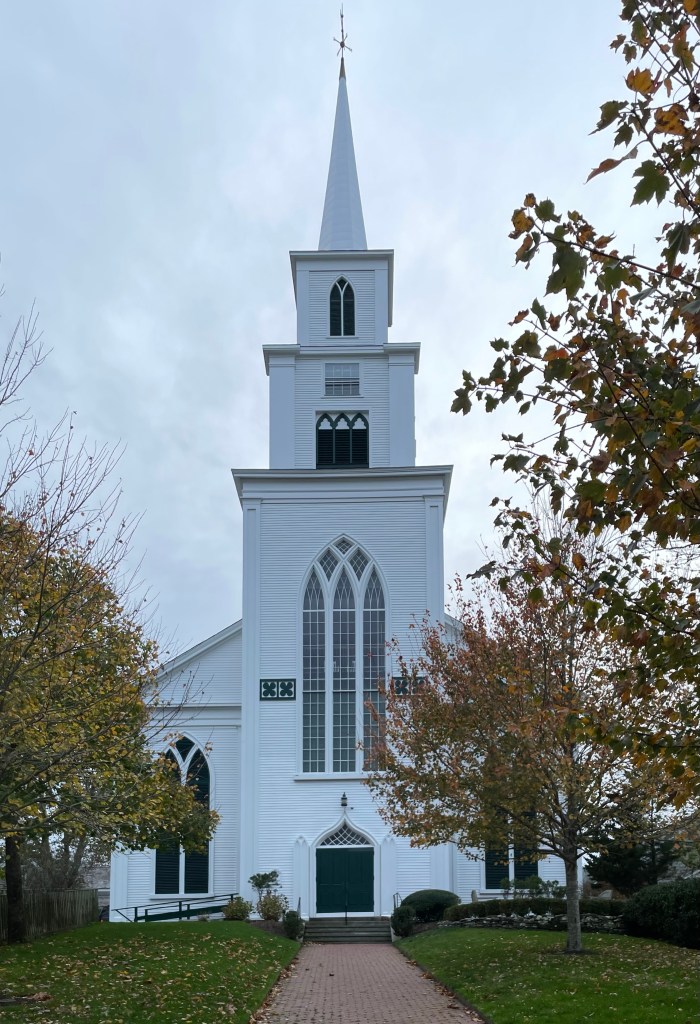
Located on a fairly quiet street on Nantucket Island, you will find the Second Congregational Meetinghouse of Nantucket, towering over the rows of historical homes nearby. Erected between 1808-1809, the church was constructed to house Nantucket’s growing population of Congregationalists on land formerly occupied by a dwelling house and barn. The bell was brought from Lisbon, Portugal, in 1812 by Captain Thomas Cary, was placed in the square belfry in 1815. The Great Fire of 1846, combined with the collapse of the whaling industry, brought hard times to the island. The congregation found itself unable to support a minister, and for the next forty years the church struggled on the brink of financial collapse. The building and its congregation persevered and the building is both an architectural and cultural landmark to the charming island community.
Welcome to Mansfield, Massachusetts! Located in the southeastern part of the state, this very suburban town is often overlooked in terms of architecture, but there are definitely some great buildings to discover. This is the Orthodox Congregational Church of Mansfield, an 1839 edifice at the town’s South Common. The congregation was established in the 1730s and followed strict Congregationalist beliefs, which were at odds with the growing tide of Unitarianism which was becoming a dominant belief in the Commonwealth by the early 1800s. The differences came to a head when the Anti-Slavery Riot of 1836 occured. Factions of local pro- and anti-slavery residents fought when Charles C. Burleigh, Secretary of the American Anti-Slavery Society, was invited, with the consent of the parish committee, to lecture in the meeting-house. This difference of theological taste as well as a difference of opinion on the idea of slavery led, in 1838, to the forming of a new society, the Orthodox Congregational Society, who built this church soon-after. While the split-off congregationalists were “behind the times”, among the separatists were Hermon Hall and Deacon Otis Allen, secretary and president of the Mansfield Anti-Slavery Society. This church was completed in 1839, and was altered and enlarged in the 1850s and 1870s.
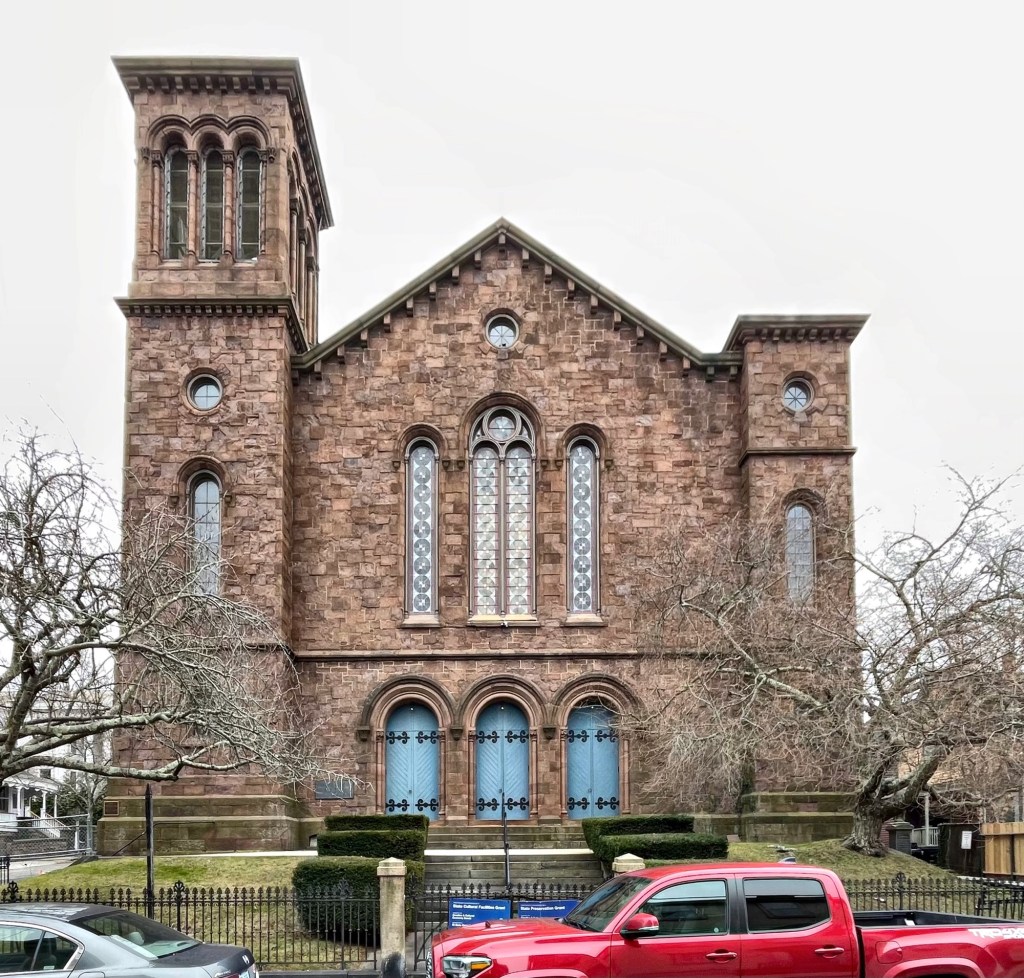
The Newport Congregational Church on Spring Street was built between 1855-1857 and serves the United First and Second Congregational parishes of Newport whose history began in the late 17th century. The building, designed by Joseph C. Wells a New York City architect, and redecorated on the interior in 1880 by John LaFarge, is an interesting and well-preserved example of the Romanesque Revival, brownstone churches of the mid 19th century. LaFarge had recently completed work on H. H. Richardson’s landmark Trinity Church, Boston, and sought to provide a more elaborate interior than he was able to in Boston. He produced twenty stained glass windows and a series of murals, which today, represent the only fully integrated ecclesiastical interior he produced. The congregation has shrunk in recent years and moved to nearby Middletown, but it’s vestry was committed to the preservation of La Farge’s work. The LaFarge Restoration Fund was established and since the 1990s, the nonprofit has spent $3 million on glass and mural restoration, architectural stabilization and systems upgrades for their former building. The building is used occasionally as an arts center.
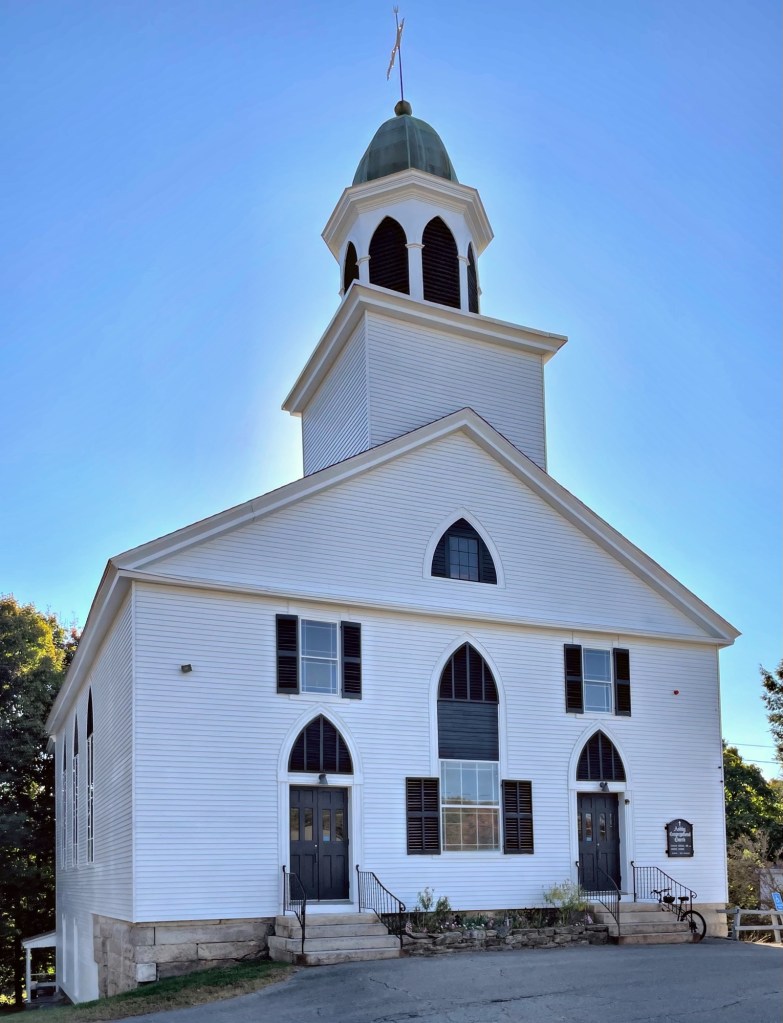
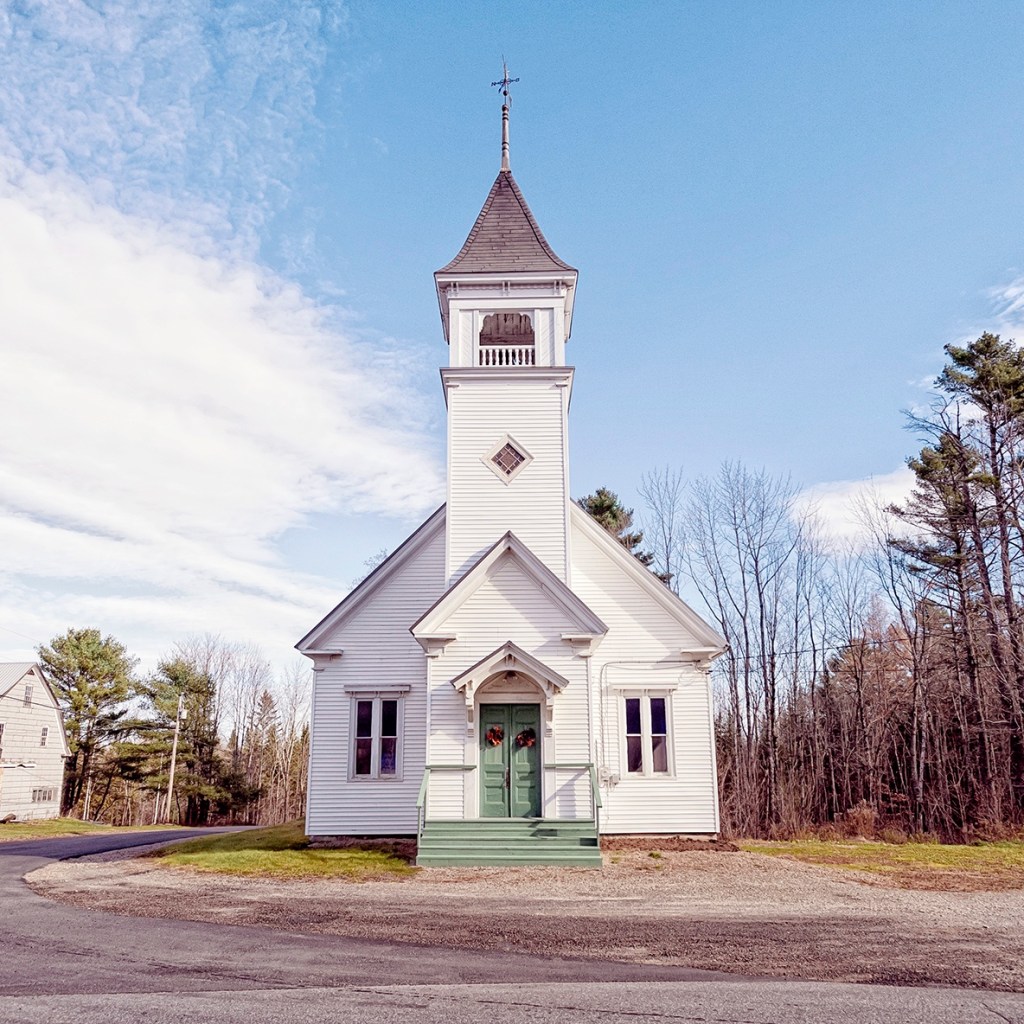
In the year 1812, Jackson, Maine, was organized as a plantation, and the Congregational Church of Jackson was organized the same year with Rev. Silas Warren, as its Pastor. Mr. Warren was born in Weston, Massachusetts and graduated from Harvard University in 1795. He was ordained as Pastor of the Jackson and Brooks Church in 1812 when it opened. The town of Jackson has not grown much since then (610 according to 2020 census) and has maintained its very rural character. The Congregational Church here was likely more vernacular when built and given the belfry after the Civil War. Gotta love these old churches on back roads!
The South Britain Congregational Church in Southbury, Connecticut was built in 1825 and was originally known as the Meeting House of the South Britain Ecclesiastical Society. The congregation dates back to 1766 and its first pastor, Jehu Minor, a Yale educated minister from Woodbury, was chosen in 1768. Members met at the Moses Downs House before its first meetinghouse was built in 1770. When the pre-Revolution church building was deemed inadequate, funds were raised to erect a new house of worship. In 1825, boards and other usable parts from the old building were used to construct the present Federal style church that stands in the middle of the village today. History states that pulleys were attached to an ox cart to hoist the bell up the steeple which is by far the tallest structure in the neighborhood. It is an exceptional example of the Federal style, with beautifully balanced proportions, a front pavilion, fine detailing and an elegant three-story steeple. The church made more history when in on September 25, 1937, 178 acres of land in Southbury, Connecticut was purchased for the German-American Bund, intent on building a Nazi camp. Similar camps were popping up around the nation, in an effort to promote an anti-semitic and pro-Nazi agenda. Led by Reverend Lindsay, the pastor of the church, the townspeople quickly established a zoning commission whose first ordinance forbade land usage in the town for “military training or drilling with or without arms except by the legally constituted armed forces of the United States of America.” Stunting the proliferation of nazism in Connecticut before WWII. This is why Southbury is sometimes known as “The town that said no to the Nazis”.
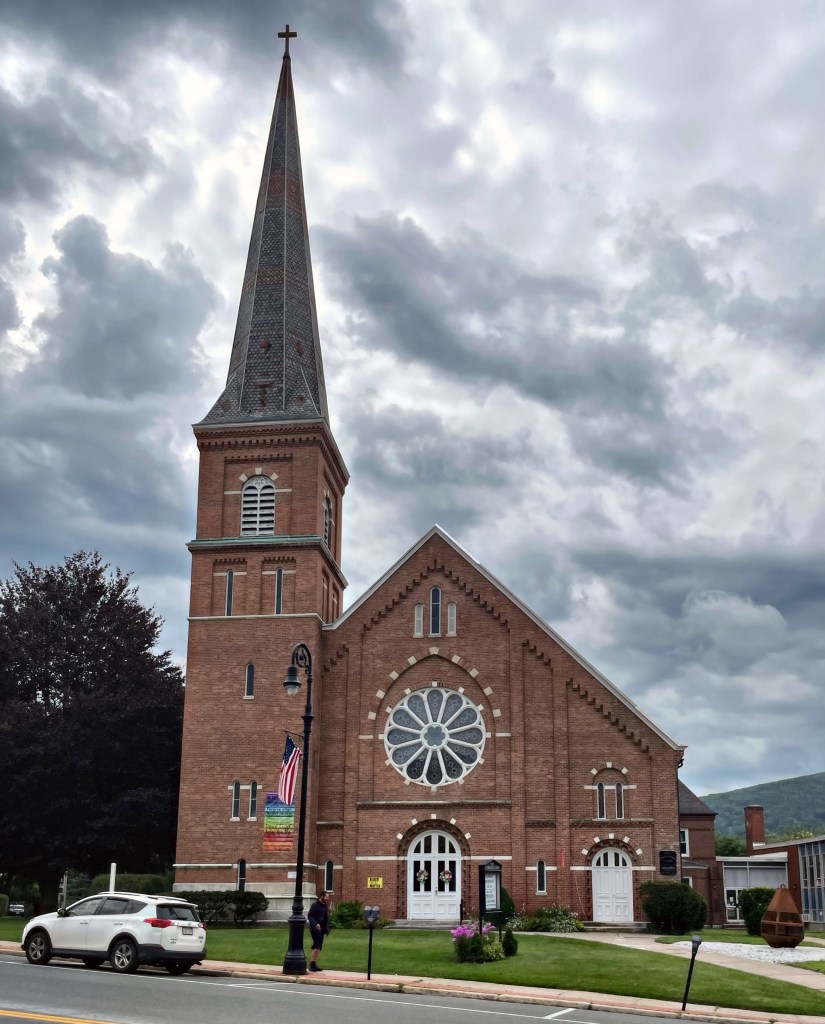
Initially the Congregationalists of Adams and North Adams, Massachusetts met in a small, wooden meetinghouse that was lent to them for use by the Baptist Church. The small, but active congregation totaled just 22 people; 5 men and 17 women. The first minister of the church, John W. Yeomans, worked diligently to see the new church succeed. He was able to raise $3000 from Congregationalist members here and in surrounding communities to build a church of their own. In 1827, a new brick meetinghouse was constructed on the site of the current building. Due to the continuing growth of the church, a new building was necessary after membership outgrew the brick meetinghouse. Bricks from the 1827 building were used in the construction of this church. Architect Charles Edward Parker began construction of the First Congregational Church during 1863 and finished building in 1865. The church was constructed in the Romanesque Revival style; which can be seen in the church’s narrow elongated windows that are covered with wide stone arches, as well as its brick and stone construction, and the building’s slate, conical-shaped roof. What a textbook academic example of an early Romanesque church, especially in a relatively remote town!
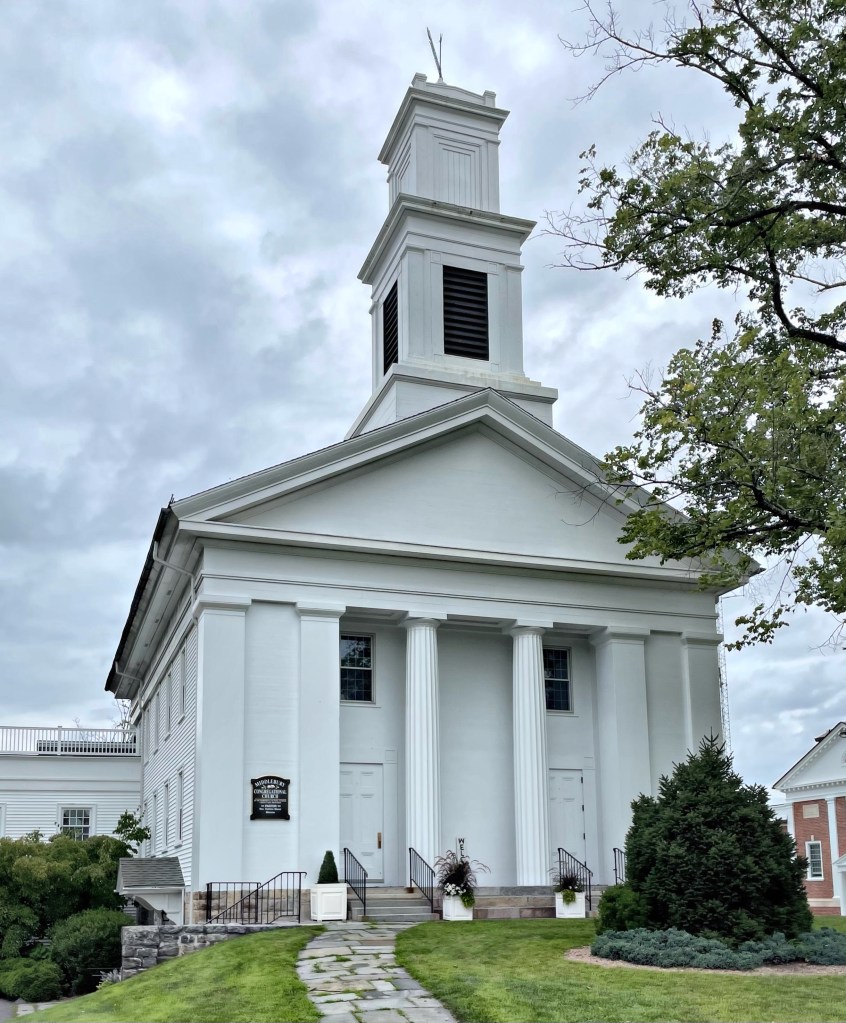
Located next door to the Middlebury Town Hall, the Middlebury Congregational Church has a very similar history to its Classically inspired counterpart. The congregational church here was established in 1791, less than a year after a separate Middlebury ecclesiastical society was granted and the first church here was erected in 1794. Decades later, a more traditional and larger church was desired by the congregation, so they had a Greek Revival style church built in 1839. Nearly 100 years later, the church (and adjacent original town hall building) burned in a large fire in April 1935. Undeterred, the congregation hired architect Elbert G. Richmond, AIA (1886-1965), who as a young man worked in the New Haven office of J. Frederick Kelly, Connecticut’s first and most famous restoration architect. The present building is a near-replica of the mid-19th century church building, and even has a bell that was recast from pieces of the old bell that crashed through the building during the earlier fire. Talk about rebirth!
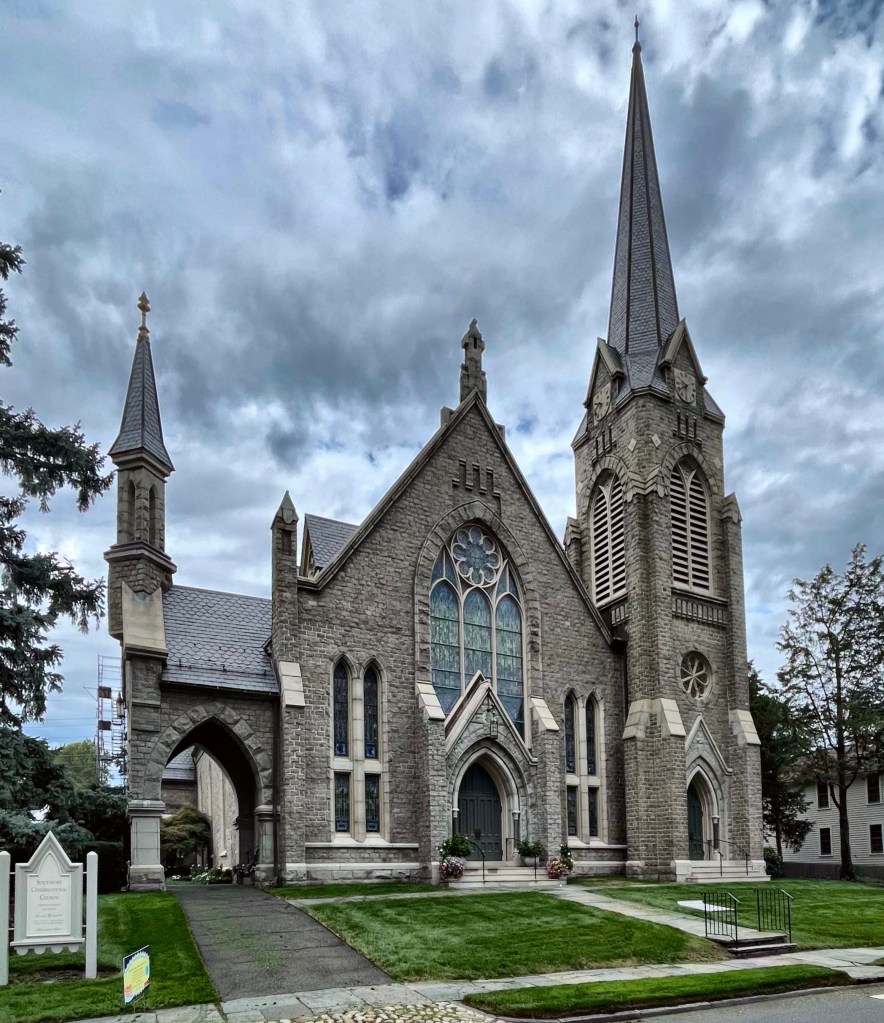
Southport was and still is a part of Fairfield, Connecticut, but it has long been very different from the geographic center of town. Largely due to distance, Fairfield Congregationalists in the Southport area of town sought to establish a new parish to worship closer to home. By the 1840s, their request was granted and a small wood-frame Greek Revival house of worship was built in 1843. By 1871, the increase in population and wealth in the village necessitated a new, larger church. The congregation hired the architectural team of Lambert and Bunnell who made a huge statement here! It is constructed of granite ashlar masonry with a steeply pitched roof and soaring spires.
Local residents of northern Fairfield successfully petitioned the General Assembly to establish a Congregational church in 1725 as a new Northwest Parish, a distinct group from the Fairfield Congregational Church. Their first meeting house was erected just years later in 1727. A larger, more substantial meetinghouse was built in 1760. The area of Greenfield Hill has always been remote and more suburban, but became important in the late 18th century when Timothy Dwight became minister of the Greenfield Hill Congregational Church in 1783. Dwight would go on to become the eighth president of Yale College (1795–1817). With increased funds and affluent members, another church was built in 1850 from plans by esteemed architect Richard Upjohn, in the Gothic style. Sadly, just years after it was completed, a fire from a furnace inside destroyed the church. So again, they rebuilt in 1855 with the building we see today, sort of. Architect Alfred Nash furnished plans for the building which was more Italianate in design. The church would be modernized in the 1940s in the Colonial Revival style, from plans by local architect Cameron Clark, likely inspired by the collection of Colonial-era homes nearby, including his own home in Greenfield Hill. The church remains a visual anchor for the affluent neighborhood.
When the town of Franklin, Connecticut was still a part of Norwich, it was known as West Farms. The residents there had a meetinghouse built there as it took too long to travel into Norwich for town meetings and church services. The first meetinghouse was built in 1718 on what became Meetinghouse Hill. Decades later, the primitive building was replaced by a newer structure. That building was replaced two more times until the present Congregational Church was erected in 1863. The building takes cues from the Greek Revival church designs of decades prior and looks to the future with Italianate detailing and steeple. There remains a small, but active congregation here to this day, who maintain the old building very well!
The First Congregational Church is one of Nantucket’s most prominent historic landmarks and is prominently located on a hilltop, being one of the first buildings you’ll see when arriving to the island by ferry. Constructed from a design by Samuel Waldron, a Boston housewright, the present church blends the Greek and Gothic Revival styles elegantly into a single composition. The interior of the church was painted with architectural trompe l’oeil paintings by E.H. Whitaker of Boston in 1852. The steeple was removed in 1849, likely from engineering concerns and high winds on the island. In 1968, the steeple was reconstructed from historic drawings by Philip Graves of Ames & Graves.