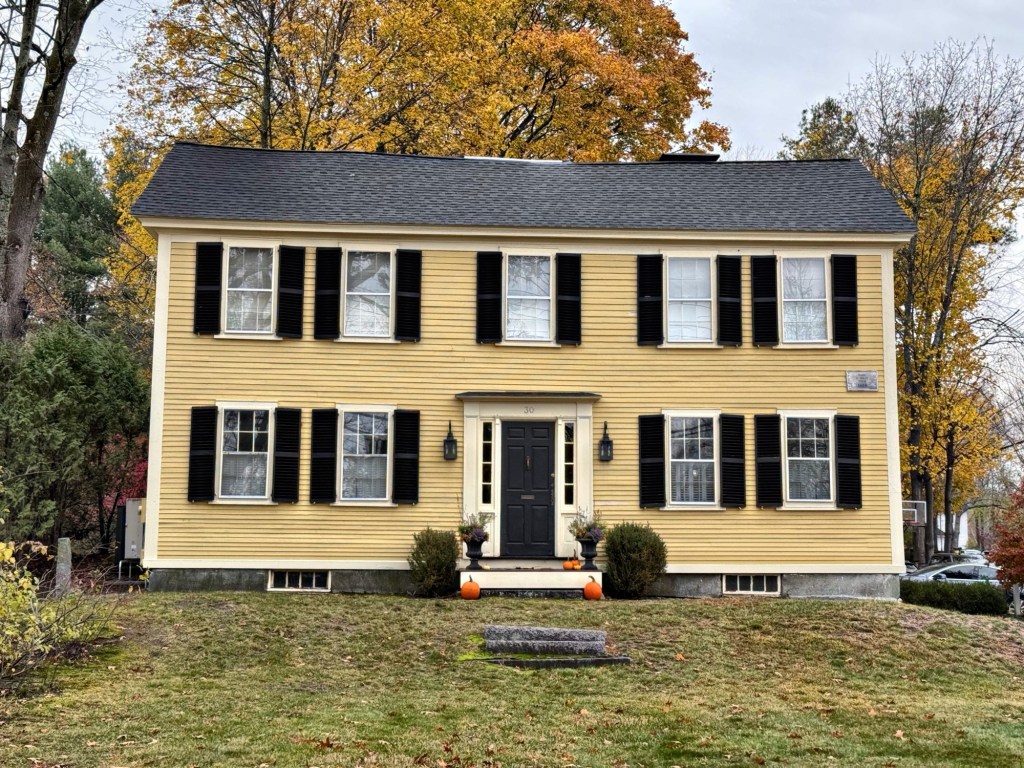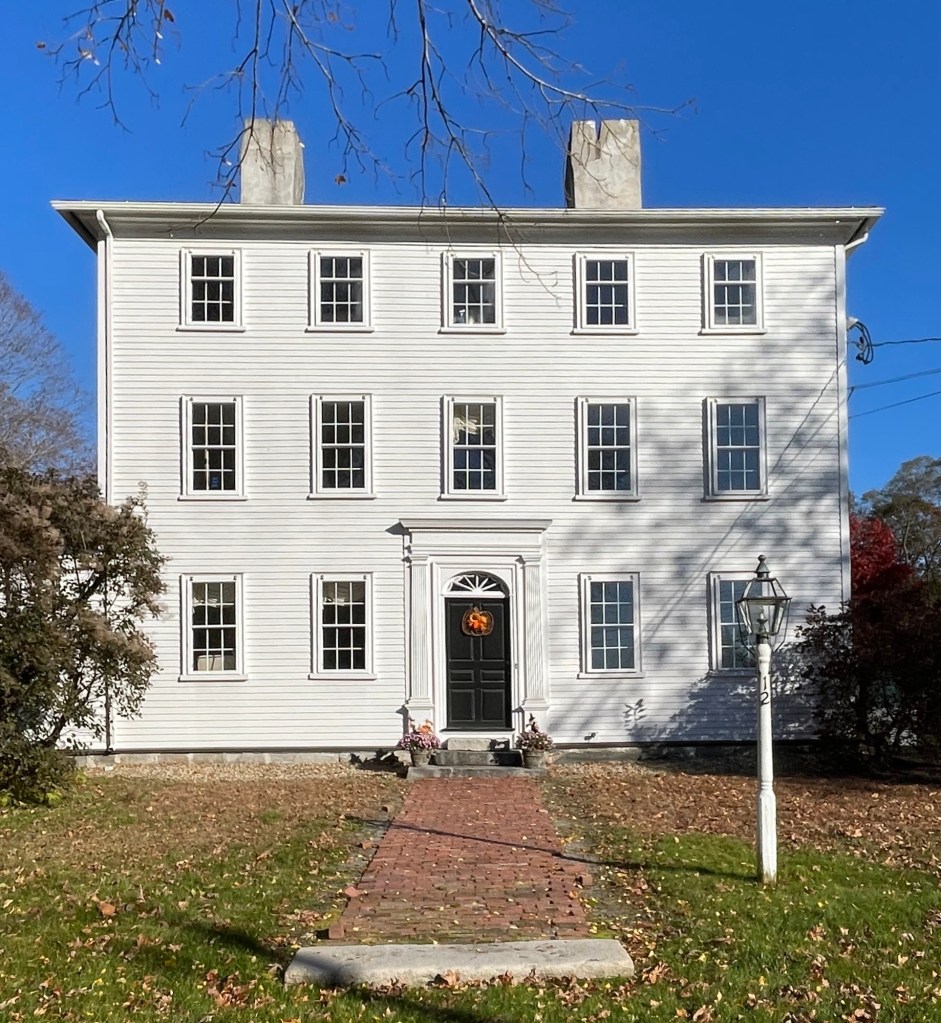
Sibley-Bennett House // c.1818

One of the many great old houses in Wayland, Massachusetts, is this well-proportioned Federal style residence at 30 Cochituate Road. The house was built sometime between 1818 and 1821 when owner Mark C. Sibley (1792-1876) married his first wife, Nancy Rice. Mark Sibley was the innkeeper at the Pequod Inn (no longer extant) that had served as an inn and stagecoach stop from when it was built in 1771. Mark Sibley remarried after Nancy died in 1839 and relocated to Weston. The Sibley House was acquired numerous times by real estate speculators. From 1886 until 1922, the property was owned by Anna Bennett, a widow. The five-bay, two-story Federal style house has a center entrance and six-over-six double-hung windows, all with a historically appropriate color scheme.

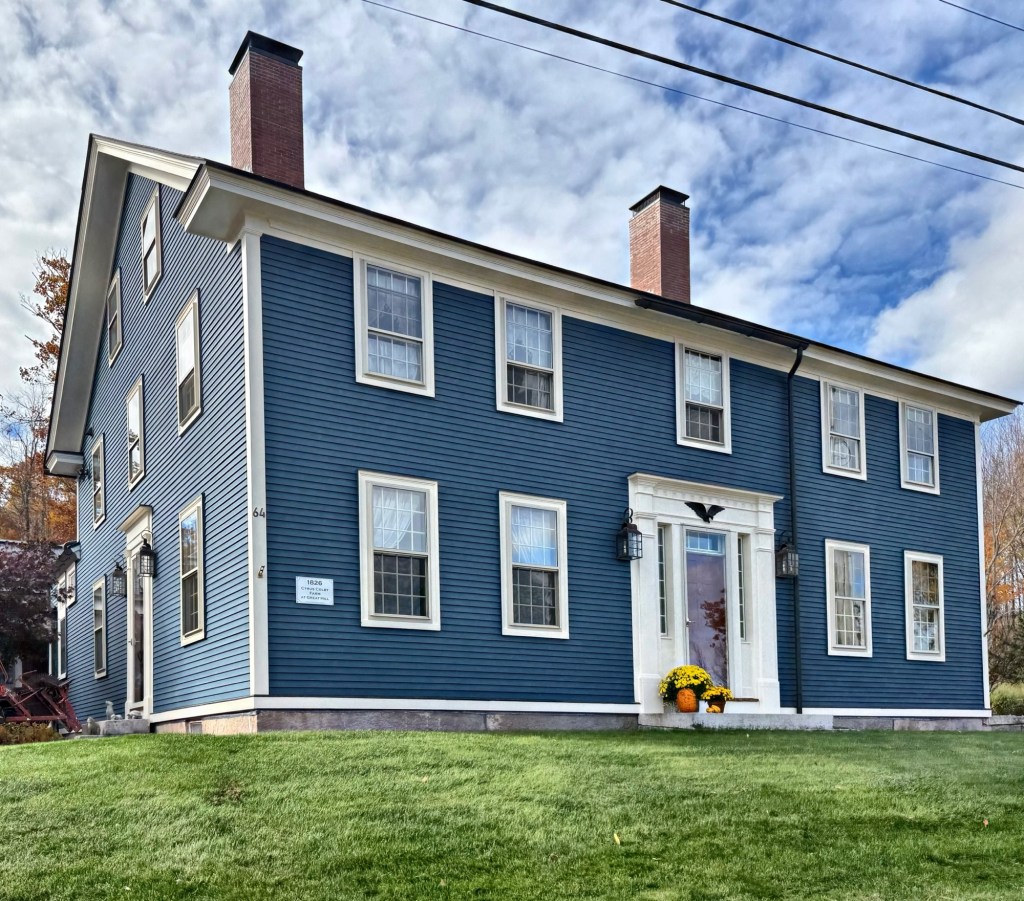
Cyrus Colby Farmhouse // c.1826

This historic farmhouse, tucked away on a quiet dead-end street in Bow, New Hampshire, is known as the Cyrus Colby Farmhouse. The residence dates to about 1826, and was likely built by Cyrus’ father, John Colby (1772-1836) and later inherited and occupied by his son, Cyrus. Cyrus Colby (1822-1900) lived at this house and farmed the land along the hillside and operated a successful family farm which included cornfields and grazing fields for their livestock with various barns on the property, notable for a post-and-beam dairy barn across the road that was built in 1878. The historic farm was purchased and restored, bringing the 200-year-old property a new life, suitable for modern living, while preserving the unique assemblage of farm buildings.

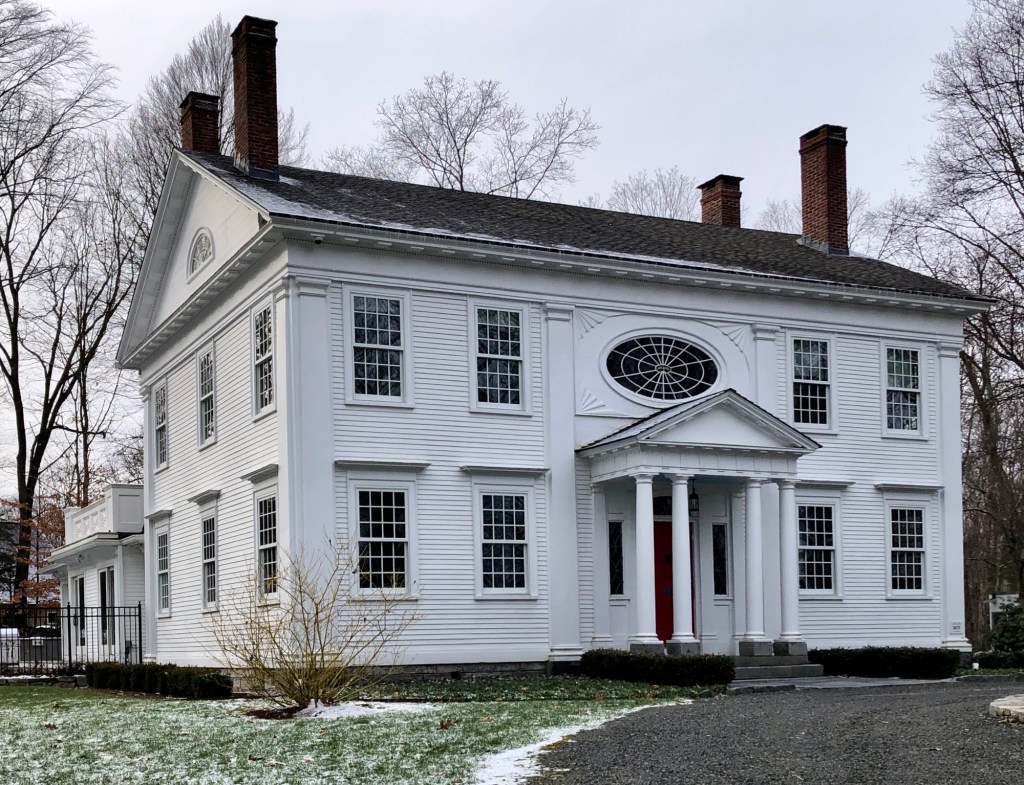
Willard-Stedman Mansion // c.1760

This stately Federal period mansion in Lancaster, Massachusetts, was originally constructed as a Georgian, two-story, five-bay house for Levi Willard (1727-1775), the son of a major landholder and descendant of one of the earliest settlers in the town. The residence is said to have been built by Levi’s cousin, Aaron Willard around 1760. Sometime after Levi’s death in 1775, the property was acquired by William Stedman (1765-1831), a notable attorney who served as town clerk of Lancaster 1795-1800, later becoming a member of the Massachusetts House of Representatives from 1802-1810. It was during Representative Stedman’s ownership that the house was remodelled into the fashionable Federal style appearance we see today, with the third floor added with shallow hip roof and classical entrance with pilasters and fanlight. In the mid-19th century, the house was operated as different boarding schools, though more information is needed. Today, the residence has been preserved and maintained as a single-family home, contributing to the charming Lancaster Center Village.

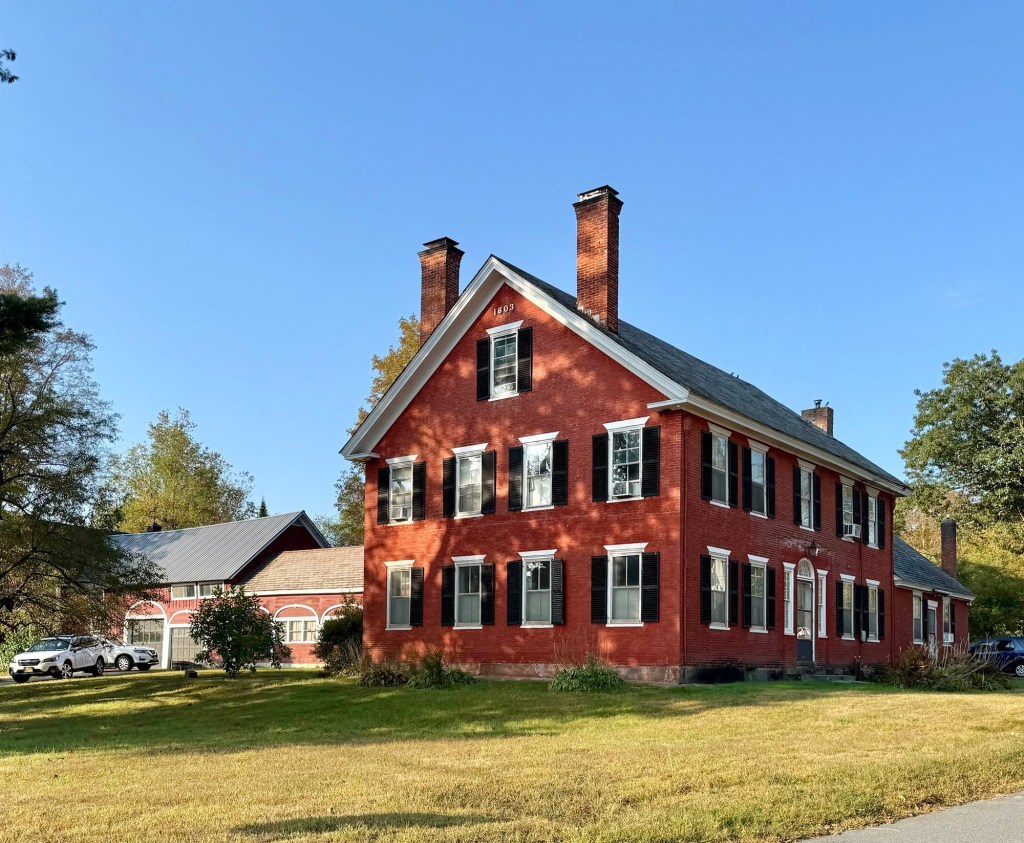
Amos Heald House // 1803

This large brick Federal period house in Chester, Vermont, was built in 1803 and is said to have been a stop on the Underground Railroad. The large residence was built for Amos Heald (1767-1849), who was born in Concord, Massachusetts, and when just a boy of nine years, Amos witnessed the Battle of Concord kicking off the American Revolution. In about 1777, his father, Daniel Heald, moved the family to Chester, Vermont, which was then named New Flemstead, to escape the conflict. Daniel Heald acquired land near the Williams River and built a large Federal style home. He later deeded his son, Amos, land on which he too would build a residence. Amos Heald lived in this brick home and served in many positions in town until his death. The estate was bequeathed to his son, Amos Heald Jr. (1804-1873), who also served in the town offices. Locals state that Amos would shelter escaped enslaved people from the south on their way north to Canada. After his death, his son Prescott took over the property and built a wood-frame addition off the rear stables and barns, which became the town clerk’s office during his tenure, as well as the office for his insurance business. Sometime in the 19th century, the house was renovated with the addition of porches, and later, the building became the Weathervane Inn.

John Larchar House // c.1820

The John Larchar House at 282 Benefit Street in Providence is one of the many stately Federal period homes in the city designed by great architect, John Holden GreeneJohn Larchar (also spelled Larcher), was born in Providence in 1787 and worked in local businesses, eventually becoming a bank director that was involved in many mercantile pursuits. The residence remained in John’s family long after his death in 1863, and has been maintained so well by subsequent owners. The 2½-story, brick Federal house features stone trim, four chimneys, a central elliptical fanlight doorway, modillion cornice and amazing 12-over-12 windows. The cupola at the roof appears to be a is a mid-19th-century addition, possibly after John’s death. The garage and two-story side addition dates to the 1960s but does not detract from the architectural integrity of the home. 

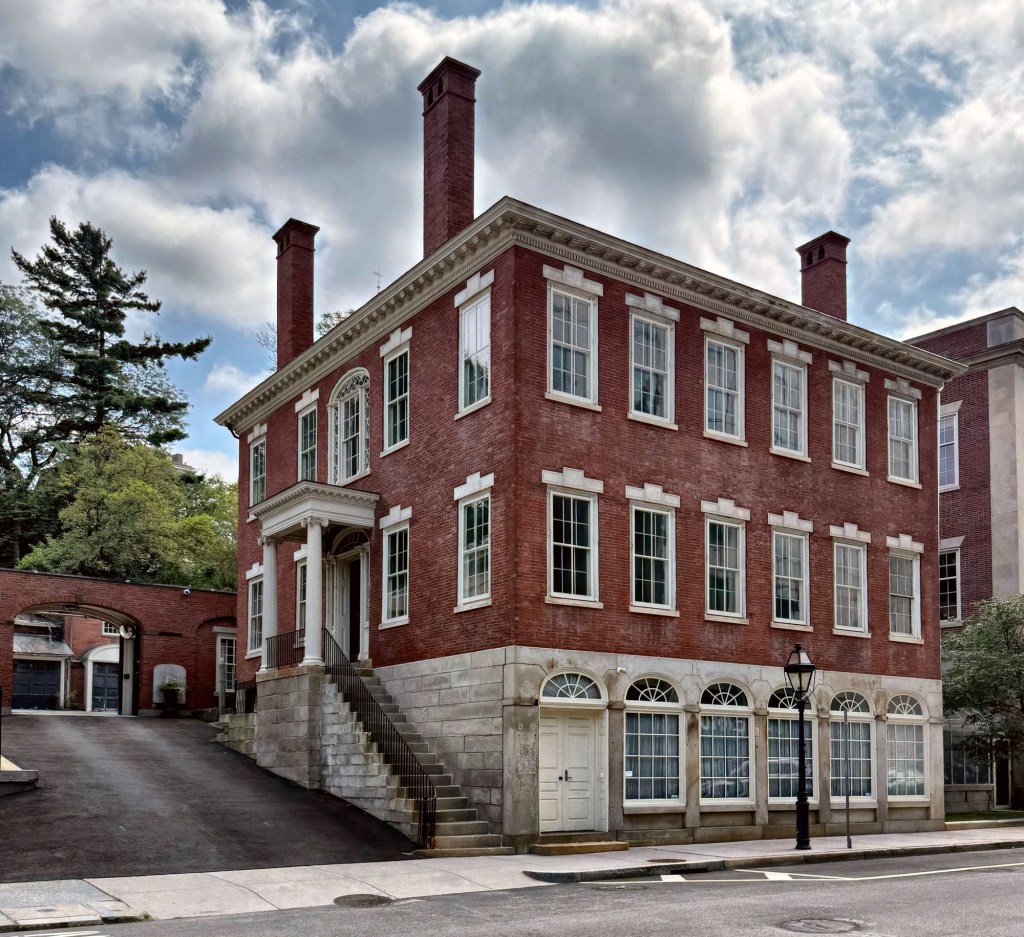
Benoni Cooke House // 1828

The Benoni Cooke House at 110 South Main Street in Providence, Rhode Island, is one of the finest examples of an architect-designed Federal style residence in the state. A fine and somewhat-typical example of architect, John Holden Greene’s 1820s work in the Federal style, the residence is actually the remaining half of what was originally a pair of mirror-image houses, built for two brothers-in-law and business partners, which once faced one another across a driveway leading to a large, well-preserved service court defined by connected stables (most of which remain). The mirror house, built for Rufus Greene, was demolished in 1895 for the expansion of the Old Stone Bank next door. The Benoni Cooke House was built in 1828 and sits atop an arcaded basement on the street elevation, which historically was used for commercial use. The Cooke House retains its iconic hipped roof with monitor (common for John Holden Greene’s works), an Ionic portico sheltering the entry with sidelights and fanlight transom, and elaborate stairhall window above. The building was later occupied as offices for the Old Stone Bank, and along with the Old Stone Bank, was acquired by Brown University, who sold the property in 2009 to an LLC, but its current use is unclear.

Tillinghast House // c.1800

The Tillinghast House at 10 James Street in Providence, Rhode Island, was built around 1800 by Captain Joseph Tillinghast (1734-1816), and it was occupied by a number of his children in the early 19th century. By 1818, with Joseph already deceased, the Federal style home was owned by two of his daughters, Mary, and Amey Tillinghast, who operated a small store from the basement. The two-and-a-half-story, brick Federal house is set on a high basement all with brownstone trim at the stringcourse (between first and second stories) and at the entrance. The house was restored in the late 1970s, along with a new clapboard addition by designers, Luigi Bianco and Georgia Patterson Boomer, of Bianco/Boomer. Without nearly as much ornate detail as many other Federal style homes in the East Side area of Providence, this residence proves that high-quality materials and strong proportions can make a home truly stand out!

William Smith House // c.1826

The William Smith House at 18 James Street in the Fox Point neighborhood of Providence’s East Side, is similar to its neighbor, the William Woodward House in style and design details. Smith, a carpenter by trade, possibly built this house himself, with inspiration or plans by local architect, John Holden Greene, who designed many similar homes in the city around this time. The residence was built around 1826 and it was built into the steeply sloping hill on its raised granite foundation. Besides its elegant proportions, the house features a shallow hipped roof with monitor, fanlight over the door, and brownstone sills and lintels.

Peirce Mansion // 1799

The Peirce Mansion on Court Street in Portsmouth, New Hampshire, is one of the finest, high-style Federal period homes in the United States. Built in 1799 for John Peirce (1746-1814), the residence is said to have been designed by Bradbury Johnson, a local carpenter and builder who was inspired by the designs of Charles Bulfinch. John Peirce began his career in the counting room of Daniel Rindge and worked in business and banking in Portsmouth. Peirce opposed the American rebellion against England but did not serve either side during the war. After the Revolution, in 1789, John Peirce was one of the leading citizens appointed to escort President George Washington around Portsmouth. The Peirce Mansion remained in the family over 150 years until it was sold by his descendants to the Middle Street Baptist Church in 1955, who extensively modified the residence to serve as a vestry and meeting space for church activities. The building was moved back from the road with the four tall chimneys were removed. Architecturally, the Peirce Mansion stands out for its massing, hip-roof with cupola adorned by a balustrade and urns, and the facade with elliptical arches, molded medallions, pilasters, and the Federal style entry treatment with fanlight transom and sidelights.

Long-Ladd House // 1812

The Long-Ladd House at 3 Richards Avenue in Portsmouth, New Hampshire, showcases the versatility of the Federal style, an architectural style that dominated American architectural tastes from the 1780s through the 1830s. This house dates to 1812 and was built for George Long (1762-1849), a sea captain and trader until engaging in politics in his later years. He remained in the home until his death in 1449, leaving the property to his only heir, Marcy, and her husband, Henry Hurd Ladd. The Long-Ladd House is constructed of brick with the facade dominated by four, full-height pilasters breaking up the bays. A center portico shelters the main entrance which is adorned by a fanlight transom and classical surround. In a city full of Federal style homes, this one really stands out!