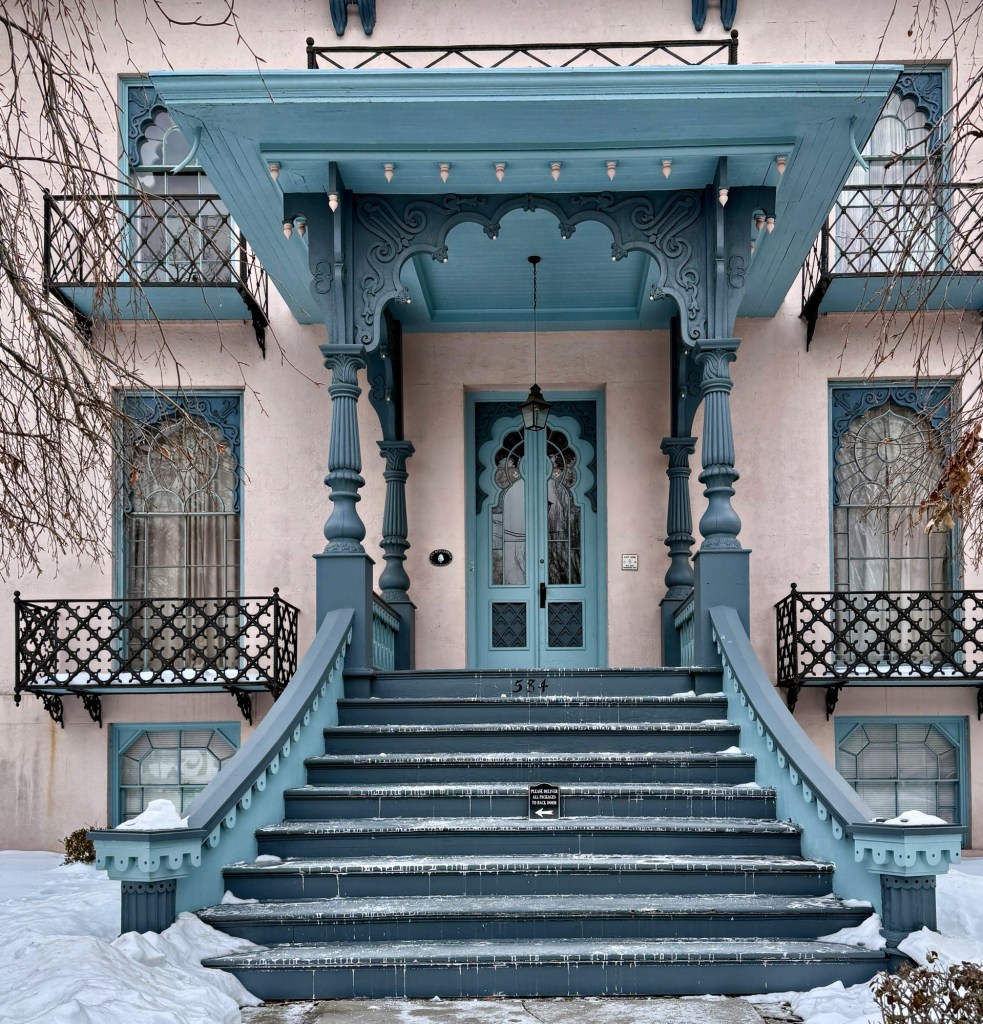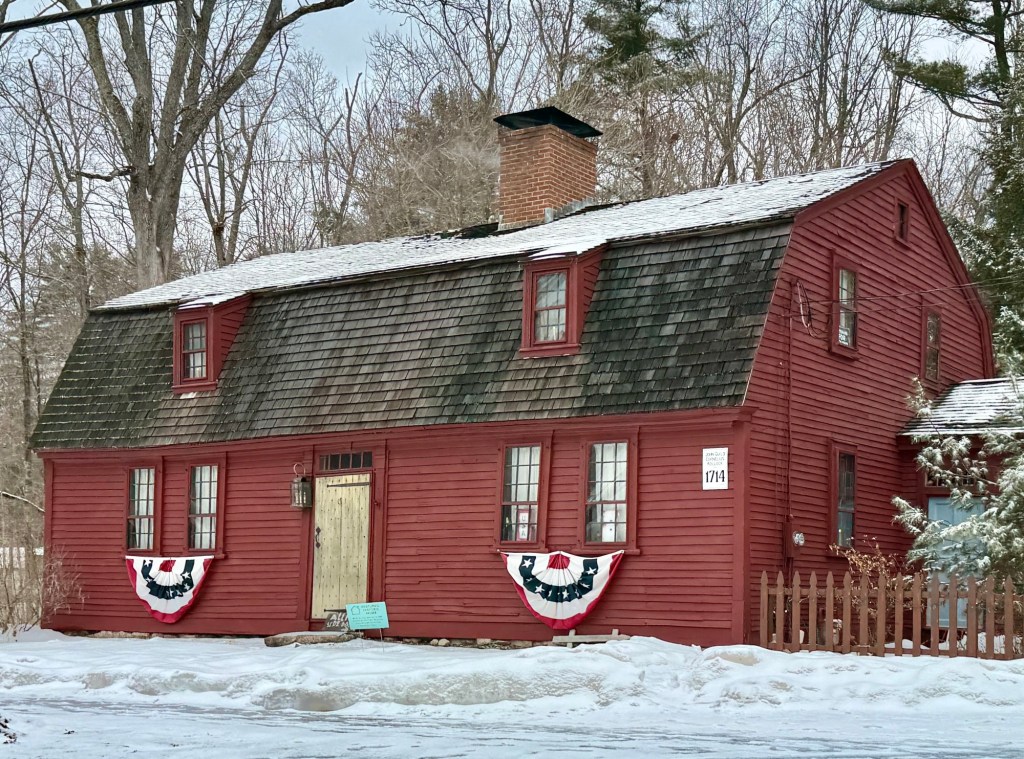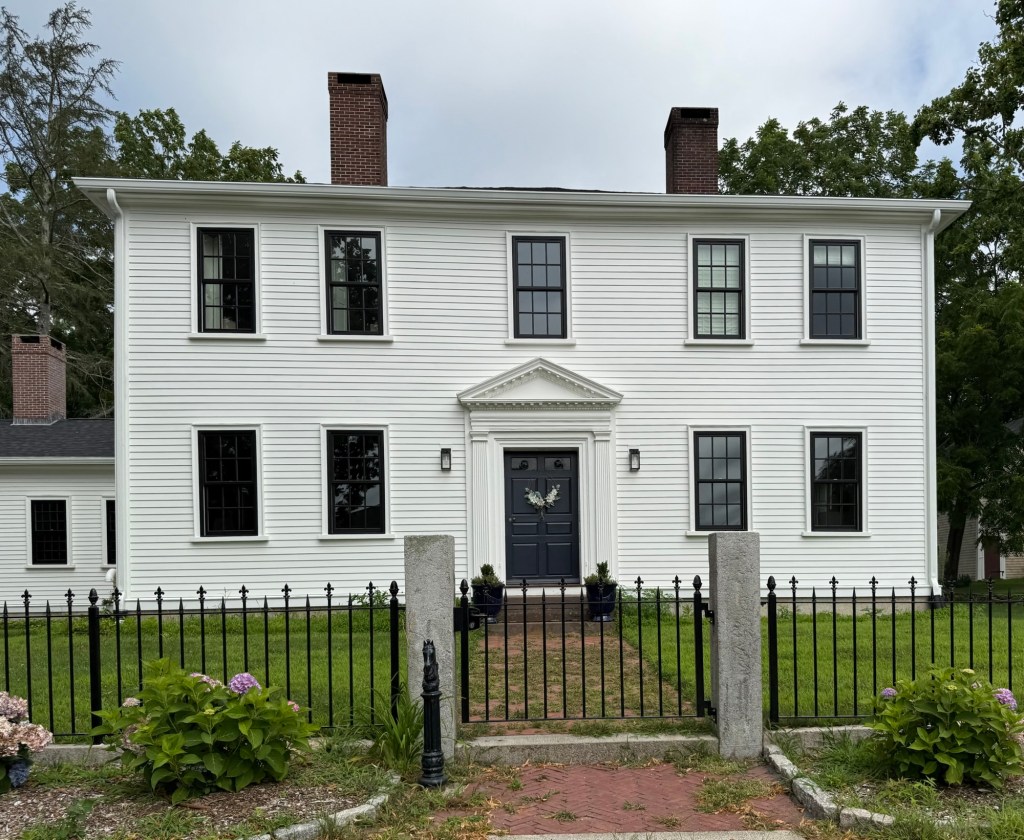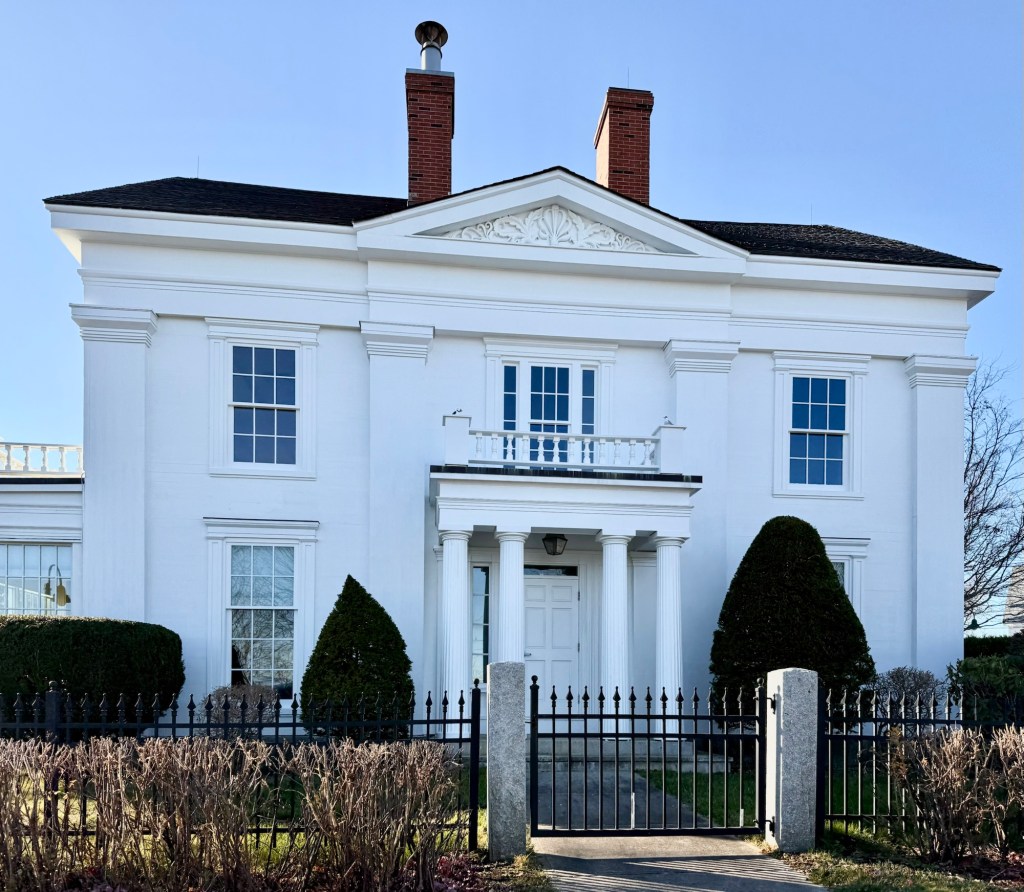
William Sever House // 1755

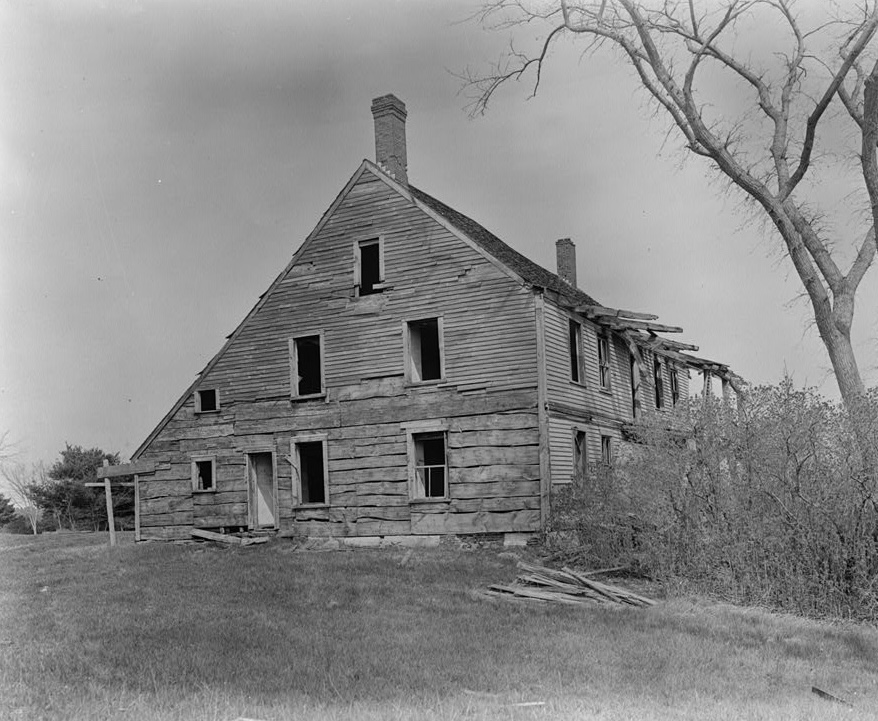
The William Sever House is an architecturally and historically significant residence in the town center of Kingston, Massachusetts. A prosperous merchant, owner of ships involved in coastal and international trade and member of the colony’s House of Representatives, William Sever (1729-1809) was prepared to erect a home of appropriate status when he married his cousin, Sarah Warren, in 1755. Sever joined his father Nicholas Sever’s commercial shipping business after graduating from Harvard College in 1745 and in 1754, was elected to the Massachusetts Bay Colony’s House of Representatives. In 1769, Squire Sever was elected to the Governor’s Council, a position he held until 1774 when he joined the Provincial Congress. Due to his experience and seniority, Sever was appointed to head the Congress and was declared “President of Massachusetts” and endowed with the governor’s executive powers. After his death in 1809, the house remained in the Sever family for generations, including as a summer residence for James W. Sever, the namesake of Sever Hall at Harvard University. The residence is well-preserved and showcases the telescoping nature of some of these early Colonial-era properties, with the main house adjoined by a barn and carriage house and diminutive ells and was thoroughly documented in the 1930s through the Historic American Buildings Survey, with detailed drawings, plans, and photographs of the exterior and interior spaces. 

Israel Snow House // c.1850

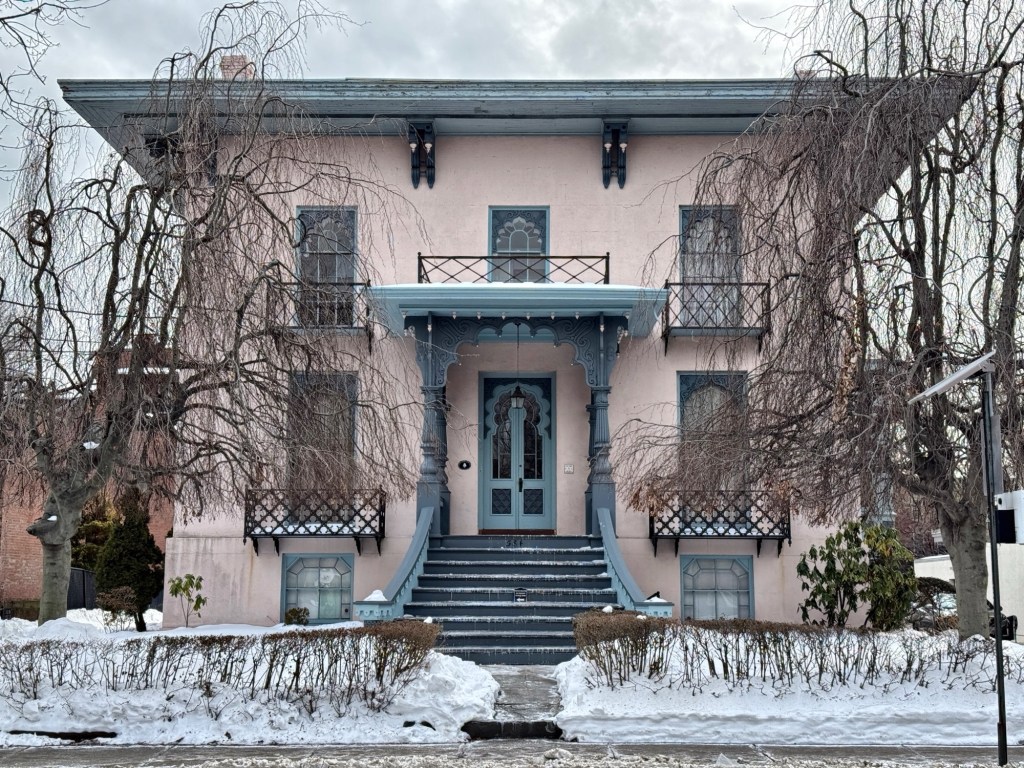
The Israel Snow House stands at 9 Water Street in the South End of Rockland, Maine, and it is one of the region’s finest examples of late Greek Revival architecture. The residence was built for Captain Israel Snow (1801-1875), a mariner and captain of several vessels, including the schooner Maria (1829), the brig Snow (1835-36), the brig Lucy Ann (1842), and the Barque Star (1848). In 1850, he and his wife Lucy moved from Thomaston to Rockland, and he would build this stately mansion where they raised seven children. Some records put the construction of this house at 1861, but that seems very late for such an example of this style. In 1863, he founded Snow’s Point Shipyard on Mechanic Street in the South End. Rockland was the fourth largest seaport in the United States in terms of production and commerce at the time, and Snow’s shipyard was a large part of that production. This residence is now offices to the U.S. Fish and Wildlife Service’s Maine Coastal Islands National Wildlife Refuge Complex.

Asa Kendall House // c.1790

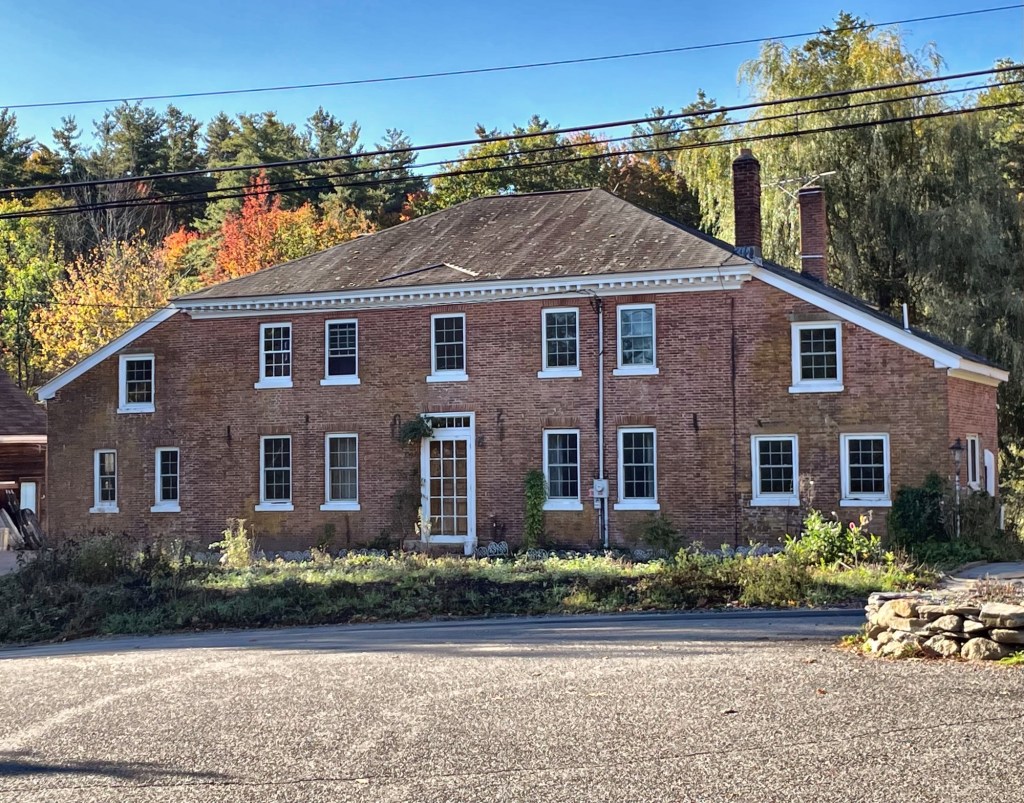
The Asa Kendall House is a significant Federal period house from the late 18th century on Richardson Road in Ashby, Massachusetts. The house here is actually believed to be the second built on this location, the first being the John Fitch House and Garrison. John Fitch was one of the earliest settlers in present-day Ashby, which in the mid-1700s, was sparsely developed and threats of attack by Native peoples limited development for decades. Due to raising tensions in the years leading up to the French and Indian War, Fitch petitioned the government for a garrison manned by three soldiers, which was approved. In 1745, the garrison was attacked and Fitch with his family, were kidnapped by Native Americans, held hostage for six months and brought up to Canada. The homestead and garrison were burned. He and his family were ransomed and would later return settling elsewhere in town. The former location of the garrison was purchased by Asa Kendall and this house was built around 1790 for him. The brick house with sloping wings was extensively documented as part of the Historic American Building Survey in 1936 and has been preserved by later owners ever-since!

Levi Starbuck House // 1838

One of the more unique Greek Revival style houses I have yet seen in New England is the Levi Starbuck House on Orange Street on Nantucket. The house was built in 1838 by housewright William M. Andrews who sold the completed property that year to Levi Starbuck, a wealthy sea captain for $5,000. When he bought the house, Levi Starbuck (1769-1849) was 69-years-old. Levi Starbuck is credited by some as inspiration for the character Starbuck in “Moby Dick.” He would spend the last ten years of his life in this opulent new house on Orange Street. Architecturally, the house is clad with flush siding with projecting paneled pilasters with fret patterns on the top and bottom breaking up the bays of the house.

William W. Wakeman Mansion // c.1833

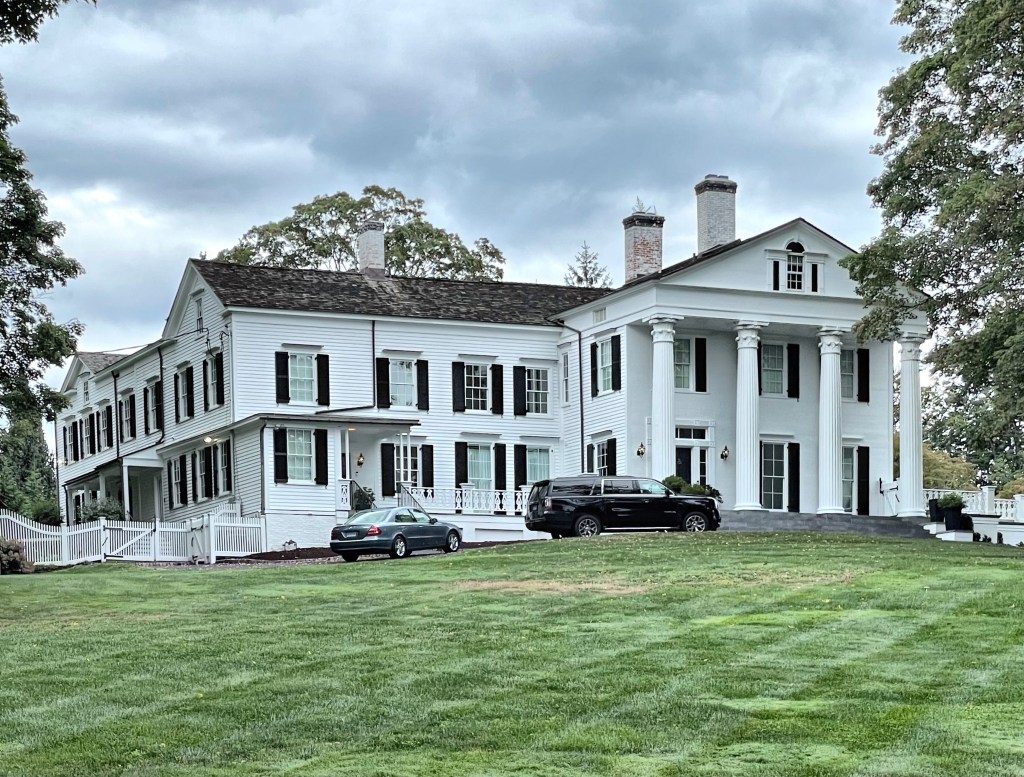
William Webb Wakeman was born in Southport, Connecticut on June 19, 1799, the son of Jesup Wakeman, an eminent citizen of the community. As a young man, William worked with his father in his commercial and trade enterprises. He acquired his own vessel early in his career, and gradually accumulated a line of trade vessels, sailing to New York, Savannah, Georgia and Galveston, Texas. By mid-century he was involved in the East Indian and China trade under the firm name of Wakeman, Dimon & Co. He built and owned a line of steamships during the late 50s, and was commissioned by the Federal government during the Civil War to transport troops and equipment. His massive Greek Revival mansion was built around 1833 on one of the largest house lots in the village, perched high on a hill overlooking the harbor. The three-bayed facade is framed by a two-story portico. Supported by four fluted columns, the capitals and entablature are similar to the “composed” order of Minard Lafever and the “composite” order of Asher Benjamin, popularized in the 1830s and 40s in their pattern books for architects and builders. After William died in 1869, it was likely his widow, Mary Catherine (who lived to be 99 years old, outliving all of her six children) who enlarged the home with massive two-story ells.

Samuel P. Tilton Cottage // 1880

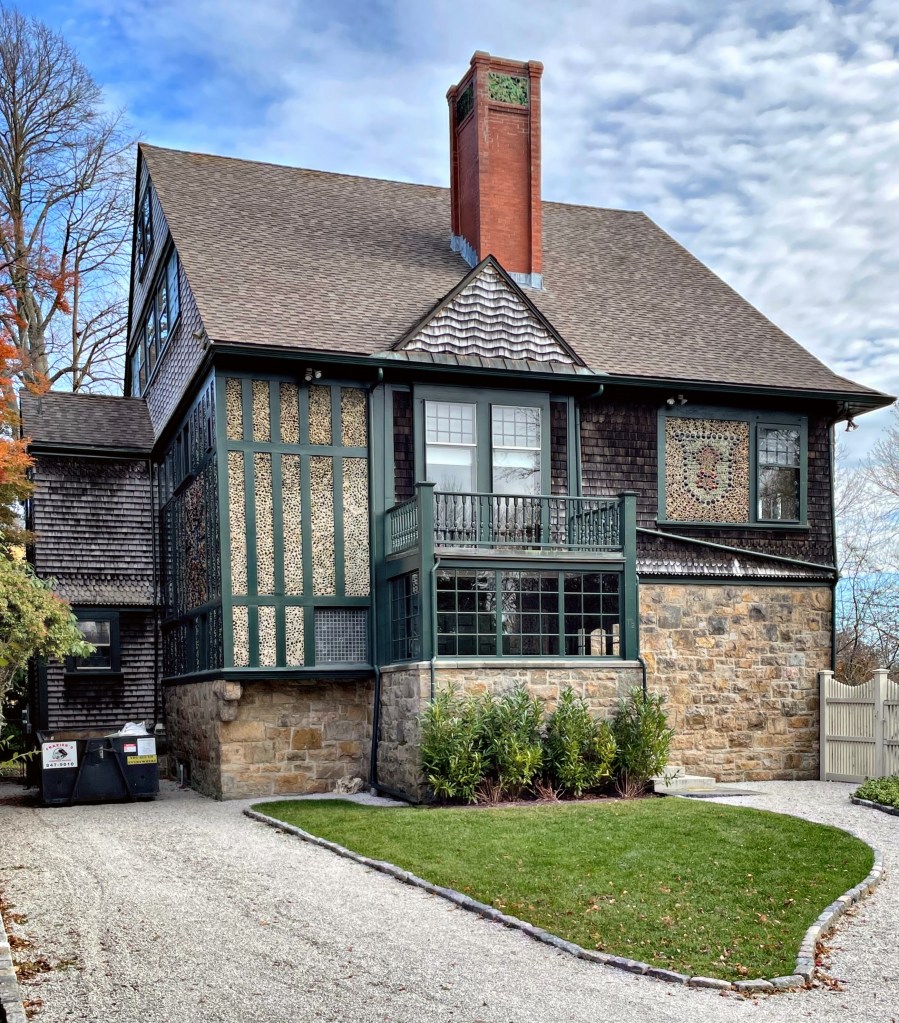
One of the most well-designed and least-pretentious summer cottages in Newport is this charming dwelling on a dead end street. The Samuel P. Tilton Cottage was designed in 1880 by the prestigious firm of McKim, Mead & White as an idiosyncratic blending of Queen Anne and Shingle architectural styles. Mr. Tilton was a milliner (maker and seller of women’s hats) with stores in Boston and Paris, France. He had this cottage built to summer close to the nation’s wealthiest, likely marketing some hats at elaborate Gilded Age events. The facade is assertively Queen Anne with its massing and decorative panels, with shingled side elevation seemingly sprouting from the earth. The architectural terminology for these unique decorative panels is “sgraffito” where here, cement or plaster siding is set and adorned with shells, pebbles, colored glass, and pieces of coal into a cartouche design. The house is one of the finest in Newport, and shows that bigger isn’t always better!

Bull-Mawdsley House // c.1680

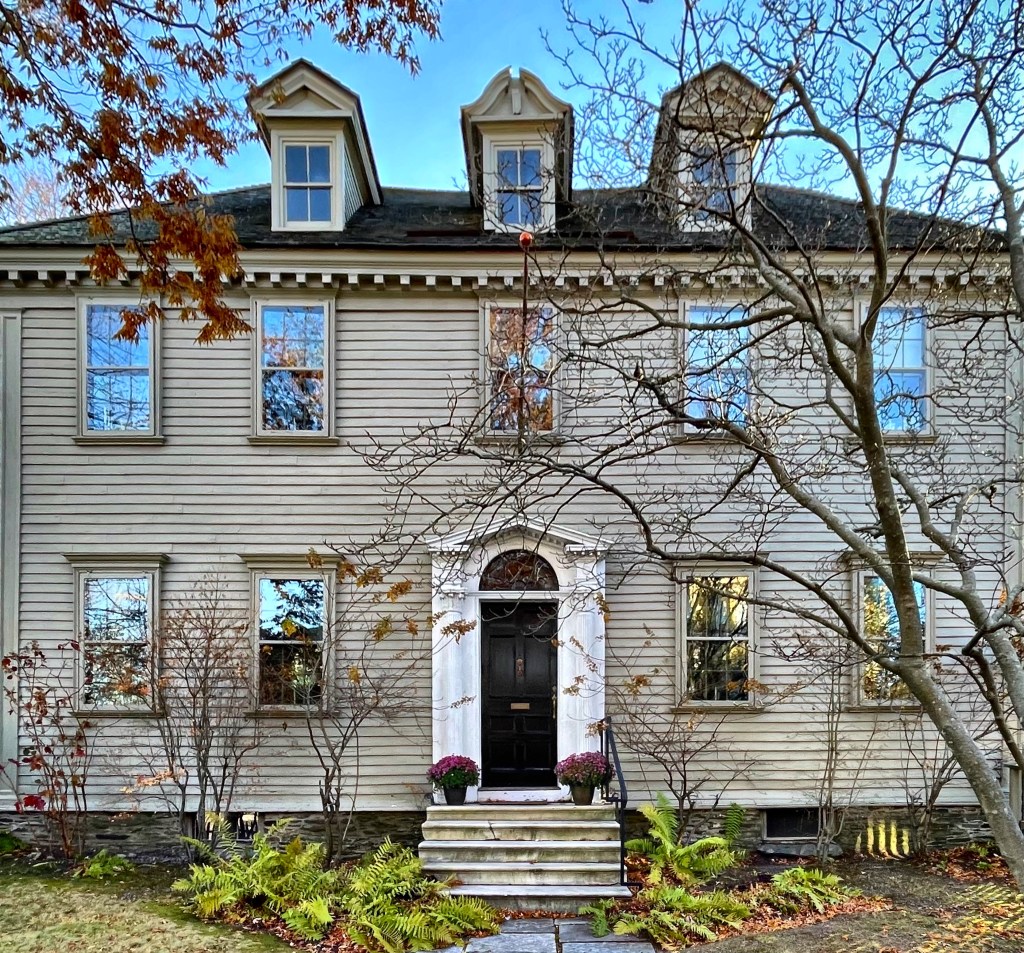
One of the oldest houses in Rhode Island, this beautiful home has a full history that will be hard to fit in a post, but here goes! The earliest, two-room rear part of this house was built around 1680, probably by Jireh Bull near the time of his first marriage to Godsgift Arnold, the daughter of Benedict Arnold, the first Governor of Rhode Island. After Bull’s death, the wealthy businessman and privateer Captain John Mawdsley acquired the house and he enlarged it in keeping with his prominent social status, adding elements inspired by the Georgian classicism. Mawdsley in 1774 owned 20 slaves, many of which likely worked on his ships as crew or cooks. He was a Loyalist, and fled Newport during the American Revolution. During the winter of 1780-81, this was the home of French Major-General François chevalier Beauvoir de Chastellux, who was third in command of French forces in America under the French expeditionary force led by general Rochambeau. After the War, Mawdsley was actually allowed to return to Newport, and resided at the home until his death in 1795. In 1795, after Mawdsley’s death, the house was purchased by slave ship captain and wealthy merchant Caleb Gardner, who is said to have brought thousands of humans in bondage to the shores of Rhode Island and in the Caribbean. Gardner is responsible for the Federal period entry and marble front steps we see today. The home was purchased by Historic New England in the 20th century, and was documented as part of the Historic American Buildings Survey. It is now a private home.

Doe’s Garrison // c.1690-1938

On Doe’s Neck (now Moody Point) in Newmarket, NH, a peninsula at the terminus of the Lamprey River where it meets the Great Bay, has long been a highly desired and contested piece of land. Towards the end of the 17th century, the land here was owned by the Doe Family, who built a Garrison House here. The house was used as a defensive structure to protect those living nearby from Native American attack. The Doe family resided here until after the Revolutionary War. The saltbox building was later altered with full-length porches by later owners, to take advantage of water views. By the Great Depression, the garrison house was suffering from severe neglect, but before it was demolished, it was documented as part of the Historic American Buildings Survey (HABS).

Osborn House // 1772

This homestead in Fairfield, Connecticut is situated on the edge of what was formerly called Pequot Swamp, and was originally built by Stephen Osborn in 1772. It is said to be the third Colonial dwelling erected in this part of the town and was left undisturbed by the British when they burned Fairfield in 1779 and raided various sections of the country along the shore. The home was originally located a few blocks away, but was moved in the 1950s when the highway (I-95) was routed through this part of Fairfield. The saltbox Georgian home was documented prior to the move by the Historic American Buildings Survey (HABS).

Colton House // 1806

Similar to the Charles Leonard House a block away, the Colton House on Main Street in Agawam remains as a historically and architecturally significant Federal style home in Western MA. The home was built in 1806 for Rufus Colton (1776-1862), a couple years after he married his first wife. The home was likely constructed by a local builder who took inspiration from Asher Benjamin’s early plan books and Captain Leonard’s home nearby. The house was later owned by Martin Luther who operated the home as a tavern for travelers along the route from Hartford to Boston. It was later owned by Isaac Cooley and documented under the Historic American Buildings Survey. Architecturally, the house features a stunning broad entry surround which incorporates a generous elliptical fan-light with leaded glass above a paneled door. Directly over the main entry on the second floor is a Palladian window with the side panels showing the urn and leaf pattern, seen only in high-style Federal homes.