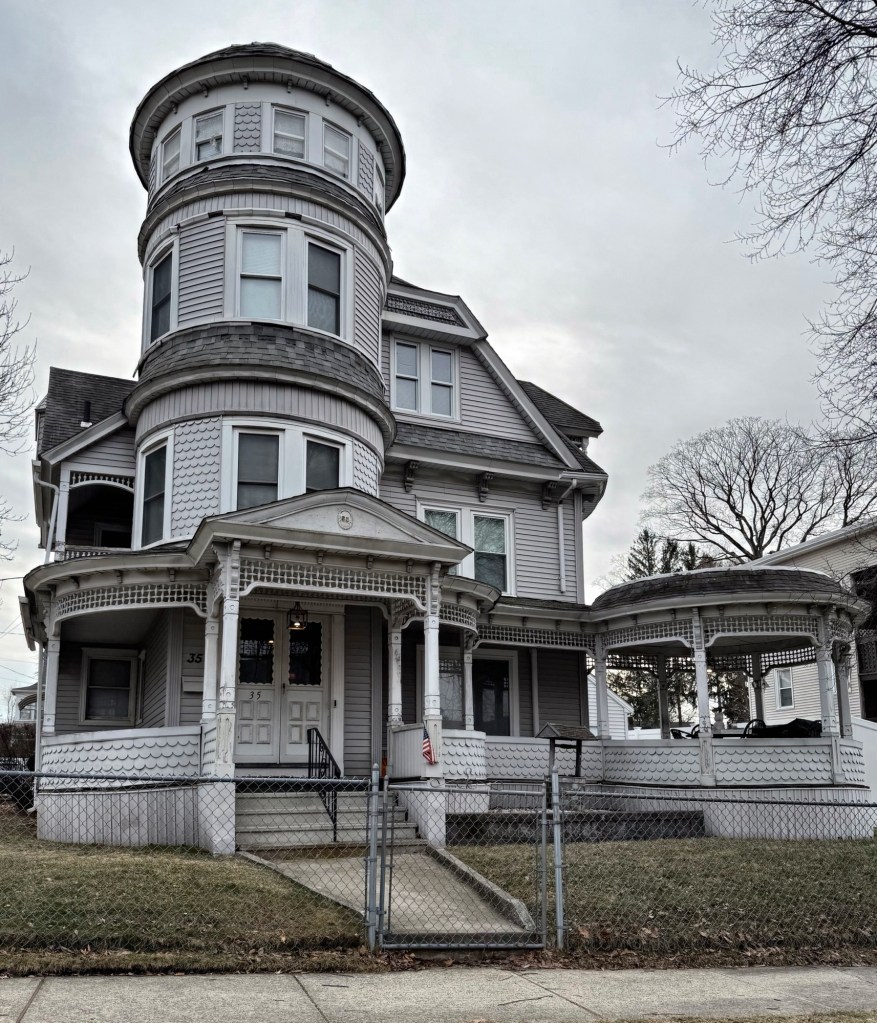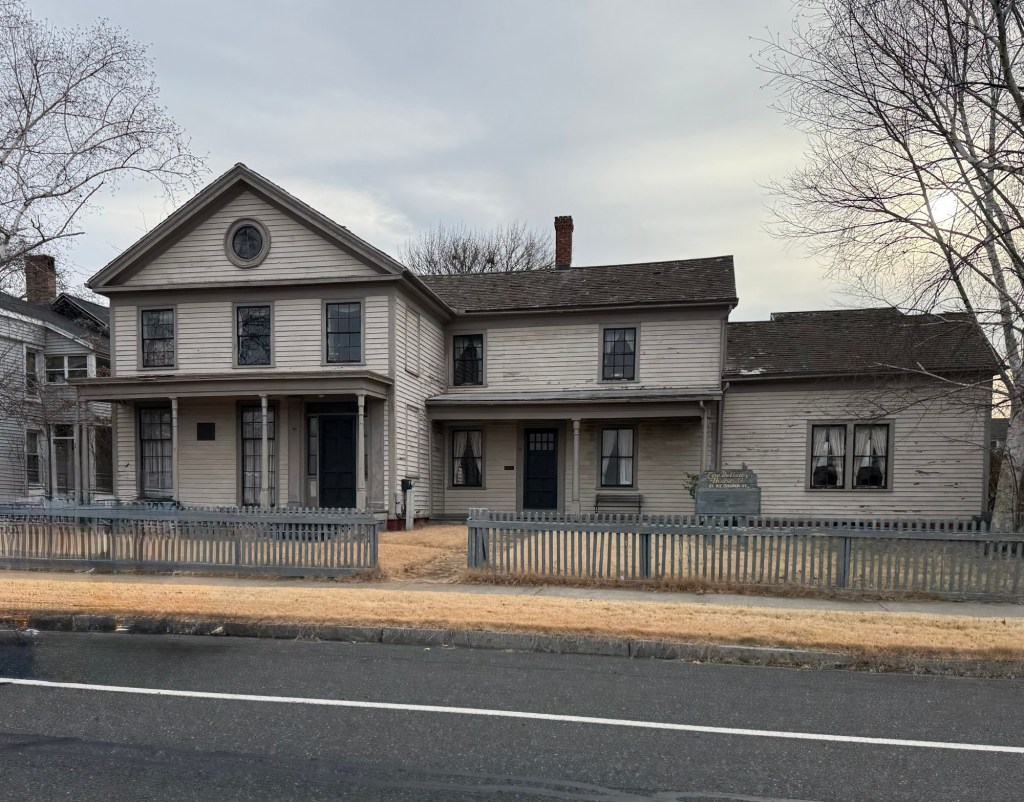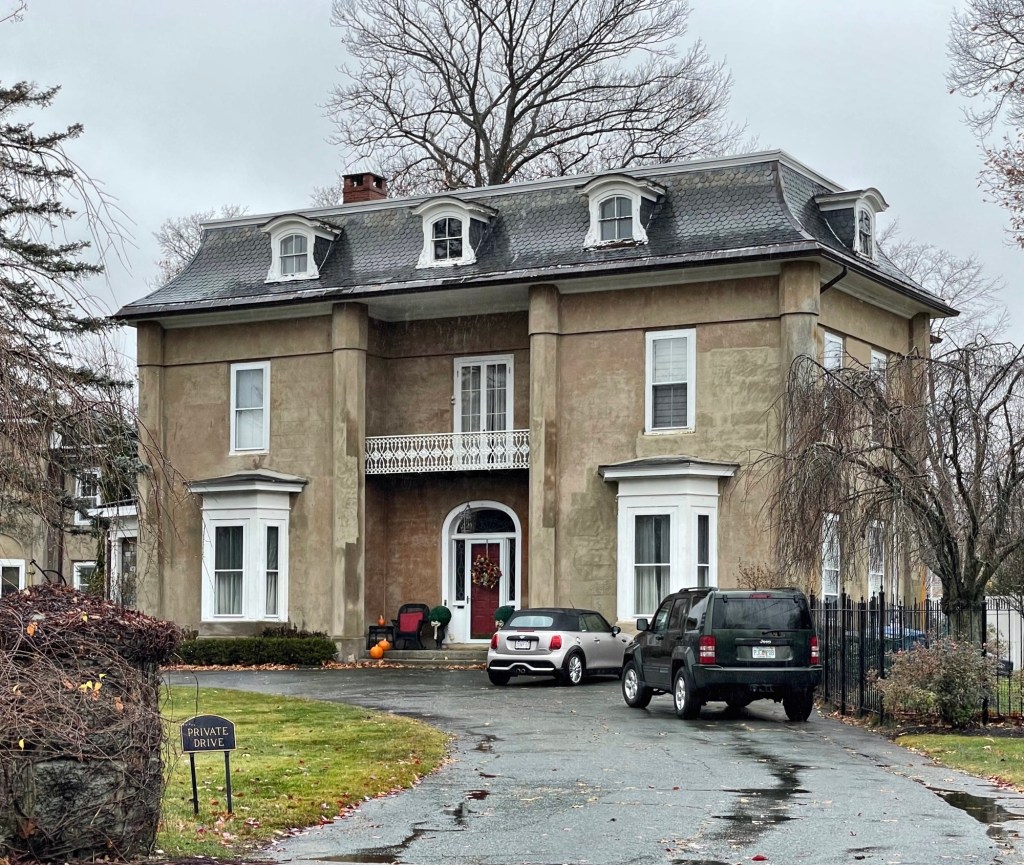
Joshua Silvester House // 1857

This large house sits on Peabody Avenue in Danvers, Massachusetts, and is thought to be the oldest house built of cement in the United States! Joshua Sylvester Silvester (1803-1888), the house’s original owner, was born in Wiscasset, Maine, and began working in the shoemaking business, expanding his products in England, taking many business trips there. While in England, he is said to have particularly admired Charles Dickens’s estate, Gad’s Hill, and modeled his Danvers home after it. Joshua Silvester not only designed this house, but directly supervised its construction which is of hand-poured cement/stucco by two masons imported to town to work on the house. The fifteen-room residence with octagon-shaped barn was complete by 1858. In 1880, the property was purchased by Isaac B. Howe of Clinton, Iowa. Howe was a civil engineer who had helped to lay out the Transcontinental Railroad and had been superintendent of the Iowa division of the Chicago and Northwestern Railroad. Howe died within a year of moving to Danvers,
but his family continued to live in the house for many years.


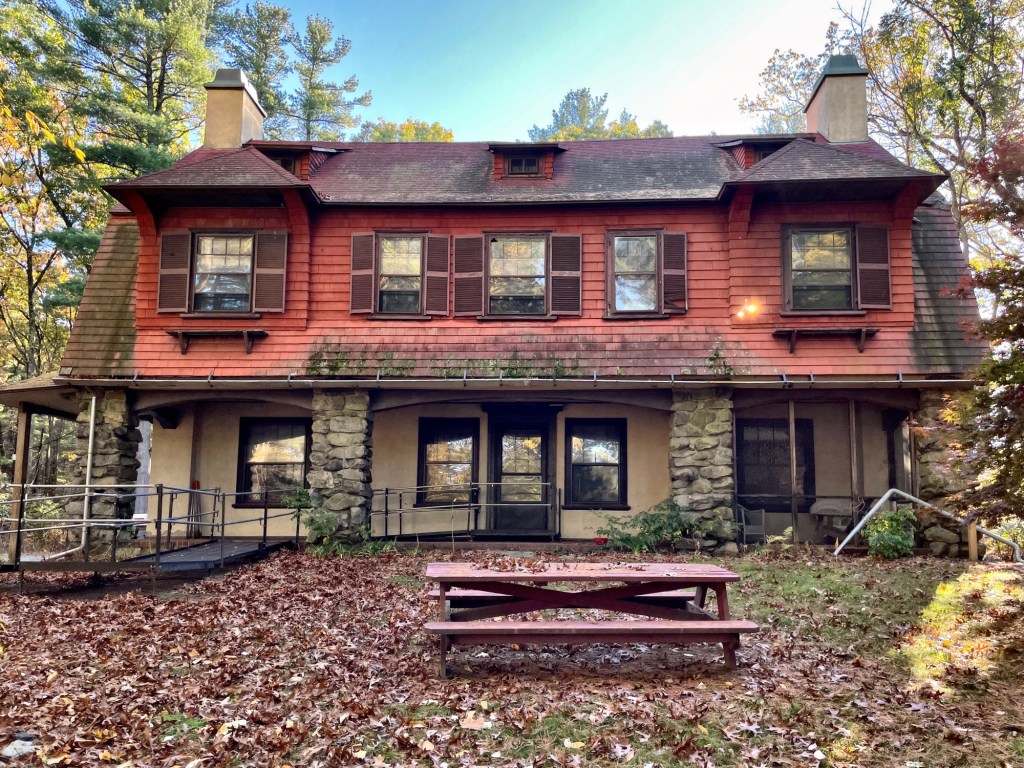
Kennard Estate // 1907

A significant house and grounds are tucked away, hidden off Dudley Road in Newton, Massachusetts. This is the Kennard Estate. Frederic Hedge Kennard (1865-1937) was born in Brookline and attended Harvard College. He did graduate work for a time at the Bussey Institution and the Lawrence Scientific School, and entered the employ of Frederick Law Olmsted, the noted landscape architect, with his office in Brookline. By 1906, he decided to open his own landscape architecture office, opening locations in Boston and Philadelphia. He would purchase this expansive wooded property, and had this house built by 1907. He laid out the grounds, creating paths and gardens on the property and planted native trees. It is unclear who designed the house, sadly. Mr. Kennard was also a noted ornithologist (an expert on birds) and would host visiting scholars at his home, walking the grounds and studying birds there. After his death in 1937, the property was inherited by his son, Harrison Eisenbrey Kennard, and ultimately willed to the City of Newton upon his death in 1982. Since then, Newton Parks and Recreation have maintained the house (though they could be doing more to preserve it), and opened the grounds as Kennard Park, a free public park comprised of wooded trails and streams.

Spofford-Root House // c.1830

The Spofford Family was one of the earliest to settle in present-day Georgetown, with the earliest enclave of homes built along Andover Road in the western part of town. A few generations later, subsequent family members would built in the town center, taking advantage of the growing commercial and business community. This Federal period home (with later alterations) was built around 1830 for Greenleaf Spofford (1801-1887) the same year as his marriage to Emily Willmarth. The couple would move out of town and sold the home to Dr. Richmond Barbour Root (1846-1930),  the second of a highly respected, three generation family to practice medicine in Georgetown. The overlay of machine-sawn Stick Style decorative porch, bracketed cornice and bay windows were likely added by Root sometime after the Civil War. Unlike most owners of Federal and Greek Revival-style dwellings, Dr. Root may have held a valid professional interest in appearing as up-to-date as possible with a “modernized” home that also served as the site of his office and consulting rooms.

Eleazar Spofford House // 1765

One of the many pre-Revolutionary homes in Georgetown, Massachusetts, the Spofford House is located on Andover Road, an important route which was occupied by many residences of the Spofford Family. In 1667,  John Spofford and his family became the first permanent (European) residents in what would become Georgetown. Generations later his ancestor, Eleazar Spofford (1739-1828) would build this home in 1765 to be occupied by his new wife married that year, Mary Flint, and their new family. The Georgian farmhouse has been significantly altered since its original date of construction, but retains its general form and character even with later 19th and 20th century additions, porches, and windows. The Spofford’s had six children in this home and would later move to Jaffrey, New Hampshire after the Revolution, but returned and settled in nearby Groveland. Later generations of the Spofford’s would live-in and modify the home until it finally sold out of the family in the 20th century.

Levi T. Lyon Two-Family House // 1895

When Brookline Village filled in with multi-family housing in the late 19th and early 20th centuries, many speculative real estate developments sprouted up from larger residential estates. As so many were built on speculation, high-quality designs and construction were a necessity to bring in picky buyers. This two-family house was built on the corner of Brook and Toxeth streets by Levi T. Lyon, a builder and developer, who lived on Brook Street. This house was designed by F. Manton Wakefield, a relatively unknown architect who apprenticed under Shingle-style maestro William Ralph Emerson, before opening his own firm. Buildings like this are great as they provide much-needed housing, while being built of a good scale that allows residents to know their neighbors, not as easy in a high-rise.

Fred Holland Day House // 1892

The Day House is a significant landmark in Norwood, Massachusetts. Originally built in 1861 for Lewis Day (1835-1910), a wealthy Boston leather dealer who was born in town. The house was a two-story Second Empire style mansion with mansard roof and detached stable. During 1890-92 the Day House was rebuilt at the direction of the Lewis’ son, F. Holland Day, who hired Boston architect J. Williams Beal to remodel the house in the Tudor Revival style. Fred Holland Day (1864 – 1933) was a prominent photographer and publisher and was an early and vocal advocate for accepting photography as a fine art. Day’s life and works were controversial because he took an unconventional approach to religious subjects and often photographed males nude sometimes the photos being homoerotic, leading many to speculate he was gay, though he never “came out”. Fred Holland Day died in 1933 and the house is today owned and managed by the Norwood Historical Society as a historic house museum.

Chickering Farmhouse // c.1807

The Chickering House at 101 Walpole Street is significant as one of the oldest extant houses in Norwood, Massachusetts. Although local lore dates this house to 1781, it likely dates to 1807 (or was adapted from an earlier house) and was owned by Deacon Dean and Sally Guild Chickering, who farmed on the lot. Three generations of Chickerings farmed the land here until the early 20th century, when John D. Chickering, a local historian, sold much of the land for suburban development. The Federal style farmhouse remains as a vestige of the early, pre-suburbanization that Norwood is now known for.

Joseph P. Allen Cottage // 1877

One of the most picturesque and charming summer cottages (now year-round residences) in the Salem Willows neighborhood in Salem, Massachusetts is this Victorian on Bay View Avenue. The cottage was built around 1877 for Joseph Pray Allen (1822-1897) who was a police officer who likely climbed the ranks in the force to afford a second home in the city. The 1 1/2-story cottage has decorative bargeboards at the eaves and stick bracket at the gable. Perfection!

Patrick Dempsey Cottage // c.1875

This charming mini-mansard summer cottage is located in the coastal neighborhood of Salem Willows, in Salem, Massachusetts. The neighborhood developed in the 1870s-1900s as a summer colony for middle-income families who wanted a second home away from the hustle-and-bustle of urban living in favor of ocean breezes. The cottage likely dates to the mid-1870s as one of the earliest summer homes in the neighborhood, and historic maps show it was owned by a P. Dempsey. It appears this is Patrick Dempsey (1821-1902), an Irish immigrant who settled in Lowell, Massachusetts, making it big as a liquor dealer and saloon-keeper. The Second Empire style cottage has a partially enclosed porch, but retains much of its original character and is located right on the water with sweeping views of the Atlantic Ocean.

John Smith House // c.1895

Hull, Massachusetts is an often overlooked town (besides Nantasket Beach Reservation), but there are some really great old houses and buildings to be found in the seaside town. This is the John Smith House on Meade Avenue in the Atlantic Hill neighborhood inland from the peninsular part of town. Development here was fairly slow, but took-off in the late 19th century when cottagers began to develop some house lots here. They were soon joined by year-round residents like John Smith, an ice merchant who built this home around 1895. Craftsman in style, the house exhibits a mix of building materials with a rough fieldstone porch and two matching stone chimneys together with wood shingle siding. The stunning stonework extends from the foundation, uniting the house to its terraced, rocky site. It is one of a handful of homes here that have not yet been altered or covered up by vinyl siding.