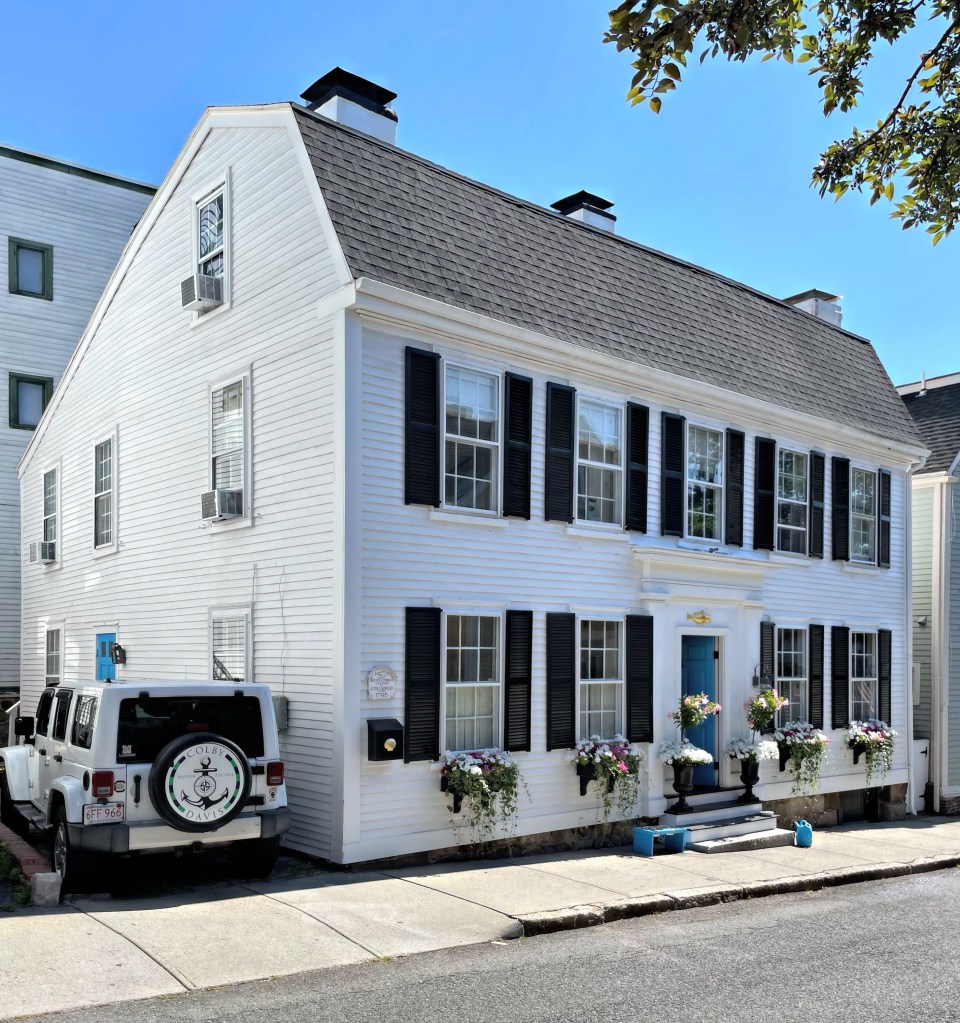
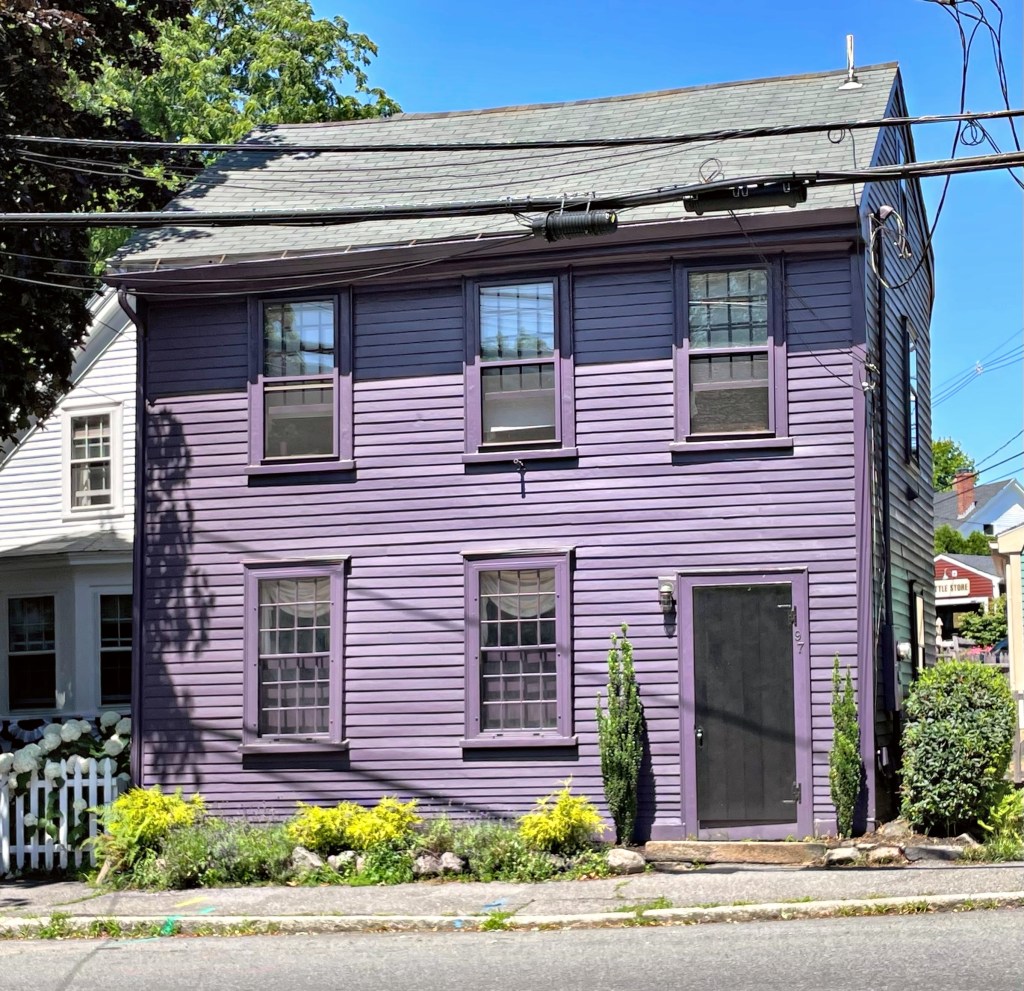
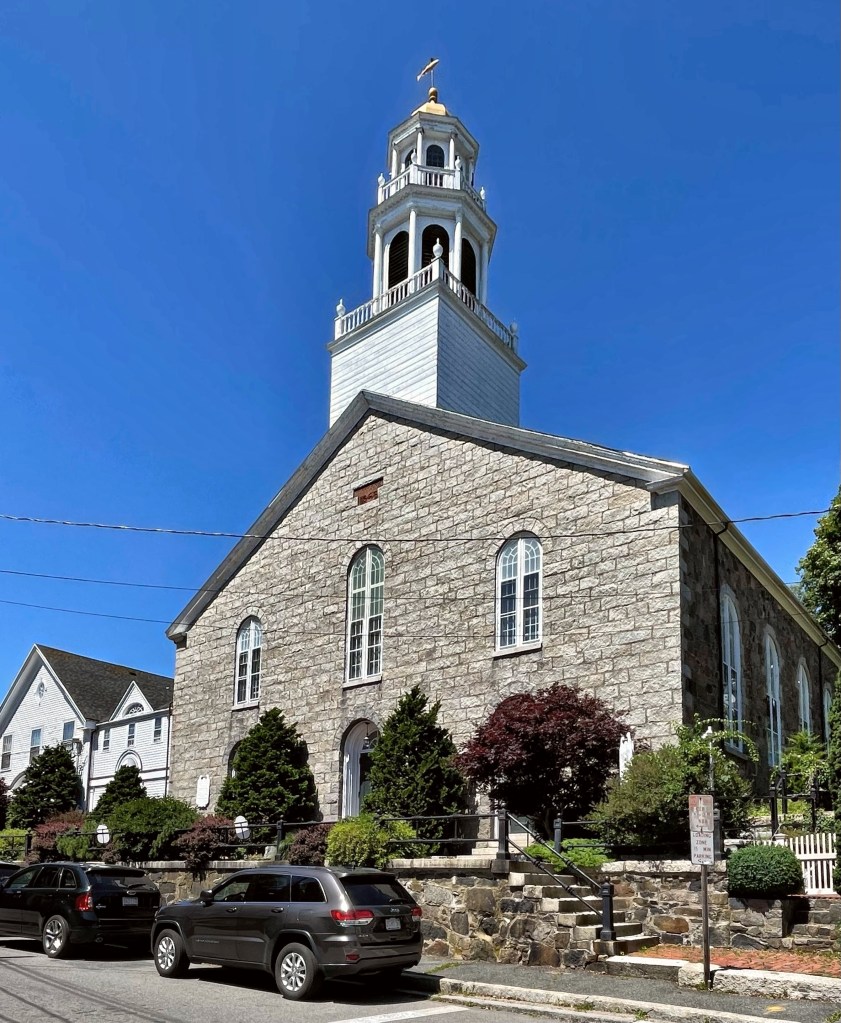
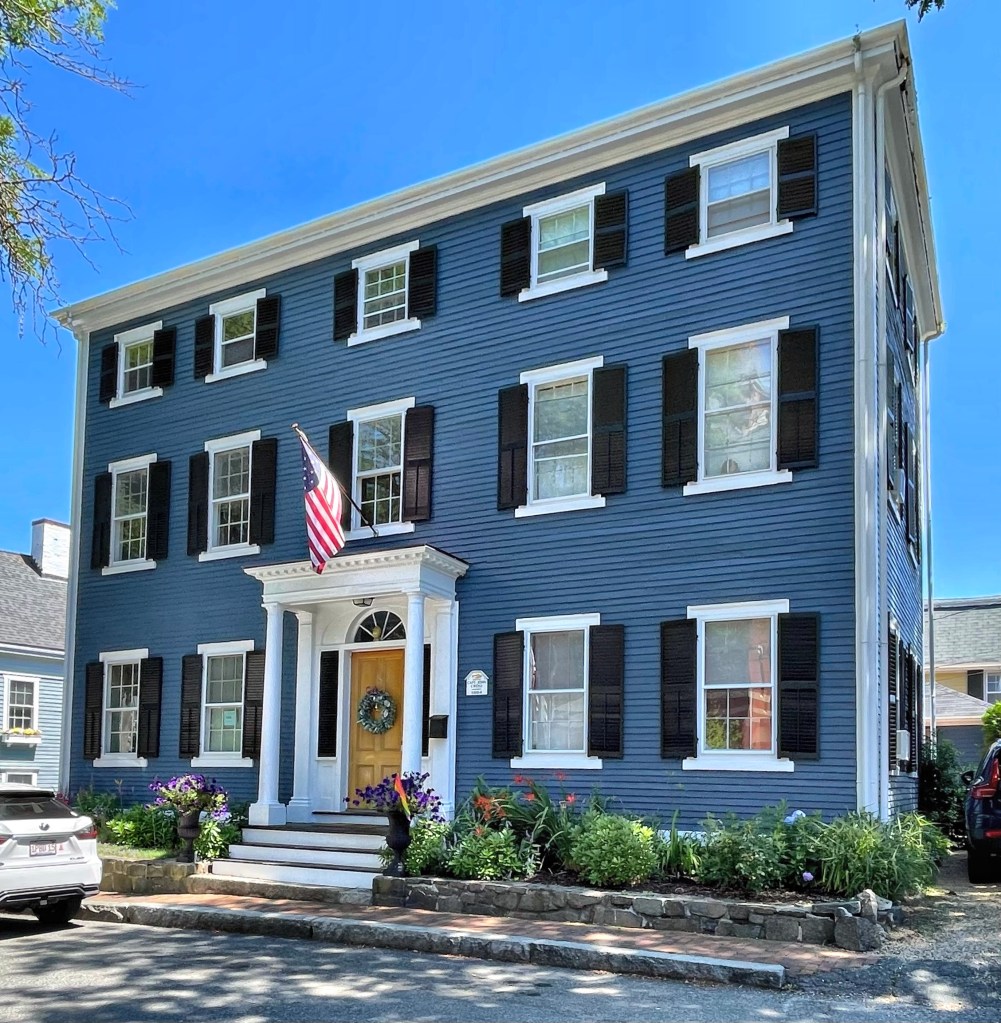
While Salem is best-known for its First Period and Federal style buildings, the Salem Willows neighborhood features some of the finest Victorian summer cottages in the Boston area. This cottage was built in 1885 by William Marston Bates (1820-1912), a Salem-based dentist, as his summer retreat when not in the office. The Stick style cottage has a steep gable roof with jerkinhead clip at the facade and a wrap-around porch with decorative jigsawn bracketed details. The house is a well-preserved example of the style, examples of which are becoming less-and-less frequent in recent years.
Atop the Great Hill on Point Allerton in Hull, Massachusetts, this large summer “cottage” stands out for its unique architecture and siting overlooking the bluffs and Atlantic Ocean. The Shingle style house was built around 1890 by Edward D. Conant, a real estate agent and developer of Newton as his family summer home. The architect is not clear, but the house exhibits a unique four-story crenellated tower, giving the appearance of a castle from a distance. The house was later owned by Cardinal Richard Cushing (1895-1970) as his own summer residence. Cardinal Cushing served as Archbishop of Boston from 1944 to 1970 and was made a cardinal in 1958. Cushing’s main role was as fundraiser and builder of new churches, schools, and institutions, and he helped then-presidential candidate John F. Kennedy deflect fears of papal interference in American government if a Catholic became president. Kennedy grew up spending summers at his grandfather’s home in Hull (featured previously). The Conant-Cushing House remains significant even with 20th century renovations.
Hull, Massachusetts is an often overlooked town (besides Nantasket Beach Reservation), but there are some really great old houses and buildings to be found in the seaside town. This is the John Smith House on Meade Avenue in the Atlantic Hill neighborhood inland from the peninsular part of town. Development here was fairly slow, but took-off in the late 19th century when cottagers began to develop some house lots here. They were soon joined by year-round residents like John Smith, an ice merchant who built this home around 1895. Craftsman in style, the house exhibits a mix of building materials with a rough fieldstone porch and two matching stone chimneys together with wood shingle siding. The stunning stonework extends from the foundation, uniting the house to its terraced, rocky site. It is one of a handful of homes here that have not yet been altered or covered up by vinyl siding.
Abraham Malcolm Sonnabend was born in Boston on December 8, 1896, the son of Esther and Joseph Sonnabend. Sonnabend graduated from Harvard College in 1917 in order to enlist at the outbreak of the Great War. At the end of World War I, Sonnabend joined his father’s real estate organization. He married Esther Lewitt in 1920, and by 1927, he had increased his real estate holdings to a net worth of $350,000. Just before the 1929 stock market crash, Sonnabend hired Boston architect Sumner Schein to design this Tudor Revival style home, on a site formerly occupied by a larger Queen Anne style residence. Built in 1928, the Tudor Revival house features clinker brick walls with cast stone trim and a two-story castellated bay all capped by a slate roof. The enterprising A. M. Sonnabend would eventually outgrow this modest Tudor home after he got into hotels as investments. In 1944, Sonnabend (with seven partners) acquired a package of Palm Beach, Florida hotels for $2.4 million including the Biltmore, Whitehall and the Palm Beach Country Club. He would sell the Biltmore to Conrad Hilton for a massive profit. In 1956, Sonnabend created the Hotel Corporation of America (HCA) and grew the business to new heights. The 1928 Sonnabend House is significant architecturally and as the first purpose-built property by the late-developer.
Charles Saunders, a carpenter, and his wife Annie Saunders, seemingly built and lived in this Shingle style cottage in the Ocean View summer colony of Rockport. The couple shows up in census records as living here in 1910 while in their 50s. The house likely dates to the 1890s and is a great example of the Shingle style for a middle-class residence. The house features a corner tower and a wrap-around porch with continuous shingle siding and columns. The property was deeded to a Lawrence Regester in 1924 when Annie sold the property after Charles’ death. The shingled cottage has remained in a great state of preservation for its existence!
This charming Federal period dwelling in Mansfield, Massachusetts, was built around 1830 by Solomon Pratt and his brother-in-law, Elkanah Bates as a boarding house for the workers at their nearby cotton mill. The duplex was historically split down the middle with a unit on each side, accessed by the shared center stairhall. Local lore states that the Irish immigrant families who lived in this property reported that there were “supernatural” noises in the house, which frightened the occupants, they would tell friends it was “thundering in the castle”, giving the property the nickname, Thunder Castle.
While most of the early homes in Newton Centre were built by a few landowners and rented to tenants, this charming Mansard cottage was owner-occupied from the start. Tucked away on the quiet (and appropriately named) Pleasant Street, the George Cobb House is one of the most beautiful old Victorians in the neighborhood. An early resident was George Washington Cobb (1840-1925) was a druggist who ran an apothecary in East Boston, and he made the long commute there every day from this house. The property has a mansard roof with pedimented dormer and three-story tower capped by a bell-cast mansard roof. Paneled pilasters and brackets add a lot of detail to the primary facade.
Built between 1899-1901, the Boardman rowhouses of North Adams, Massachusetts were constructed by developer and hardware dealer Walter Penniman and his wife Susan Boardman Penniman to serve as much-needed middle-class housing for workers in the growing city. The name “Boardman” was likely taken from Susan’s maiden name. The entire row is comprised of nine rowhouses, all with a front porch, as well as servants’ quarters on the third floor. Each residential unit is fronted by a porch of granite block with Tuscan columns supporting a shed roof. Entrances are recessed behind round-arched openings, also composed of granite blocks. While much architectural details on the second story are obscured by synthetic siding, the building’s gables retain simple bargeboarding, and eaves are bracketed. The Boardman’s designer was Edwin Thayer Barlow who opened an architecture practice in the town in the 1890s. The rowhouses are still some of the finest example of middle-class housing built in North Adams in the 19th century.
This home in Acton Center was built in 1806 by Samuel Jones, shortly after he and other esteemed residents laid out house lots just south of the Town Green.Samuel Jones worked as an attorney and he lived here with his family and widowed mother, who operated a dame school, where she taught local children out of the house. The Federal style farmhouse sits upon a brick and stone foundation and is five-bays at the facade. The entry features a panel front door with sidelights flanking it. The entry is surrounded by a traditional Federal style frame with pilasters and entablature. There is something so beautiful about the simplicity and proportions of old Federal style houses.
Another of Acton’s amazing old Queen Anne homes is the Edgar Hall House, an 1889 gem on Windsor Avenue. The house was built for Edgar Henry Hall and his wife Angelina who raised their daughter, Alice, in the home. Edgar and his brother inherited the family business from their father, Enoch Hall, and they produced wooden pails, tubs, clothing racks, and other wooden goods. The company employed over 30 workers in the early 20th century until it closed during the Great Depression. Edgar retired and relaxed from this stunning Victorian home until his death in 1954.