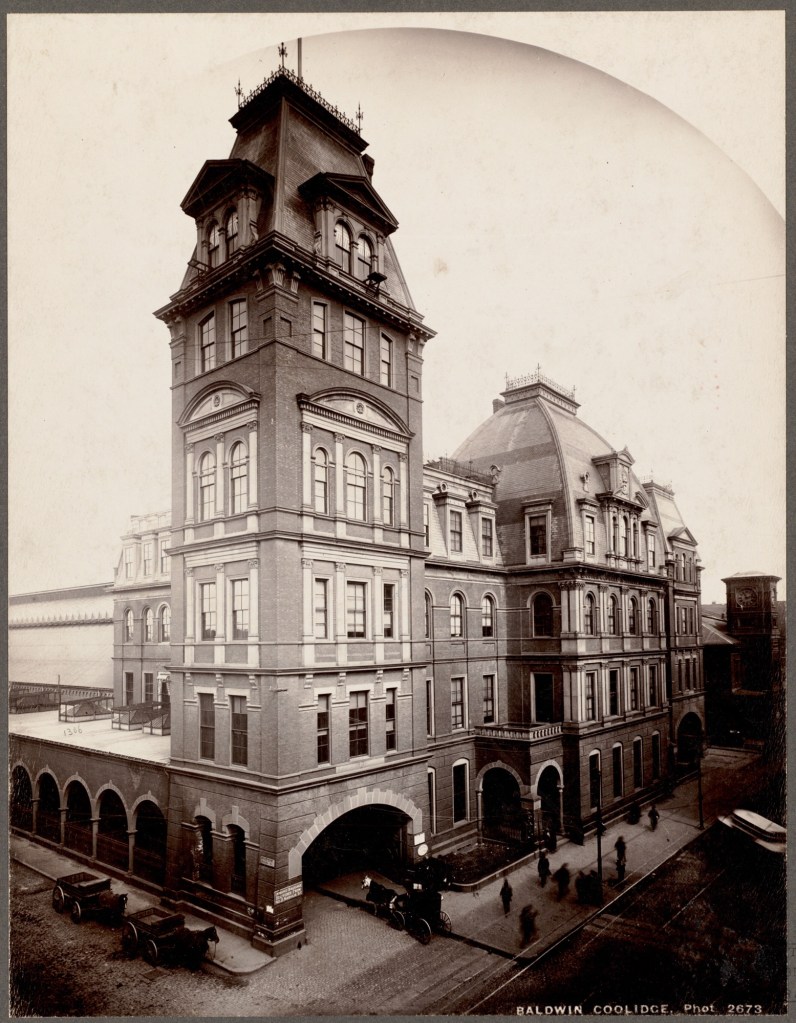
One of the finest commercial buildings in downtown Saugerties, New York, is the Whitaker Block, a landmark Second Empire style structure from the years following the American Civil War. The structure dates to around 1870 and was first owned by an E. Whitaker and was mixed use with retail at the street and offices above. Additionally, the building was home to the local chapter of the Independent Order of Odd Fellows (IOOF) a fraternal social organization. The three-story with mansard roof building stands out for its architectural details and integrity which largely remain intact to this day.
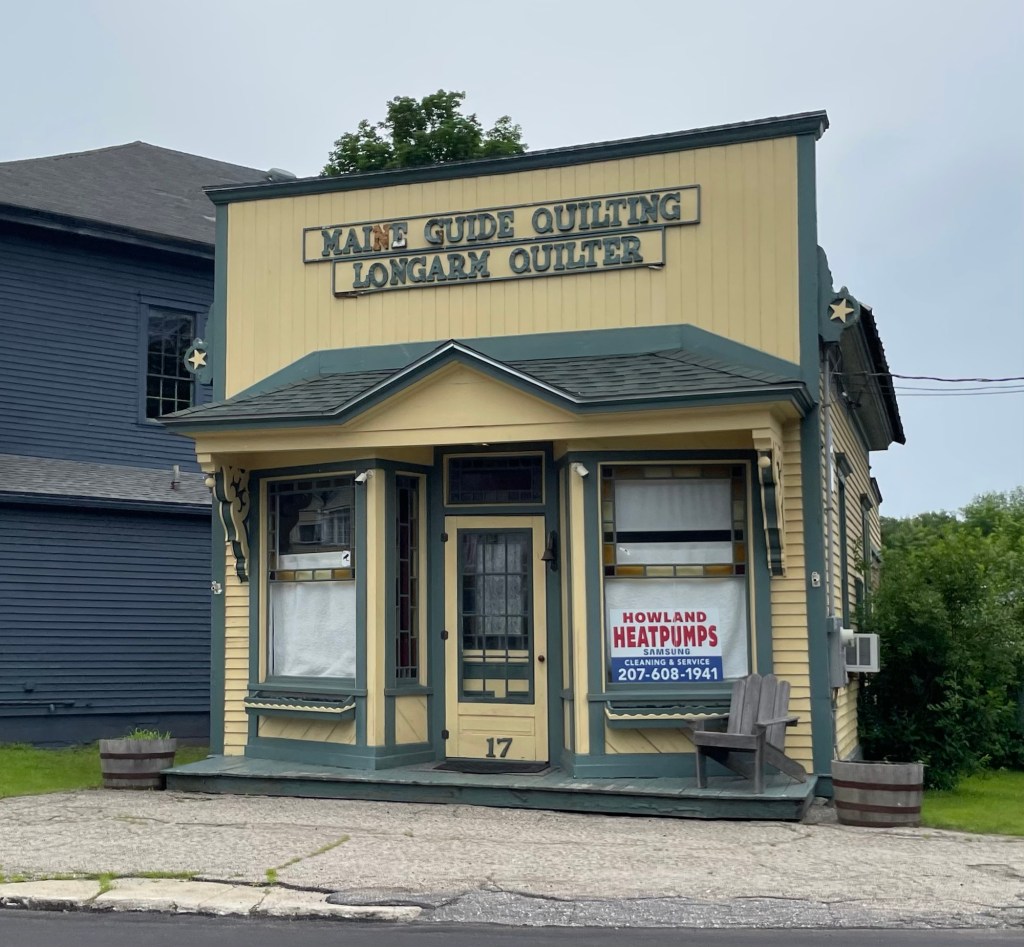
This charming one-story shop sits on the Porter-side of Kezar Falls village, a district that spans the Ossipee River between Porter and Parsonsfield, Maine. This shop was built at the end of the 19th century as a millinery shop (womens’ hat store) for Ms. Florence Perkins (1862-1950), who appears to have been unmarried all of her life. Retaining almost all of its original decorative detail, the building has a symmetrically arranged facade with two-sided projecting bays; the upper sash in the facade windows, including that in the entrance door, has a border of small rectangular colored glass panels. The storefront is a rare survivor of this period, with not many other examples in the area.
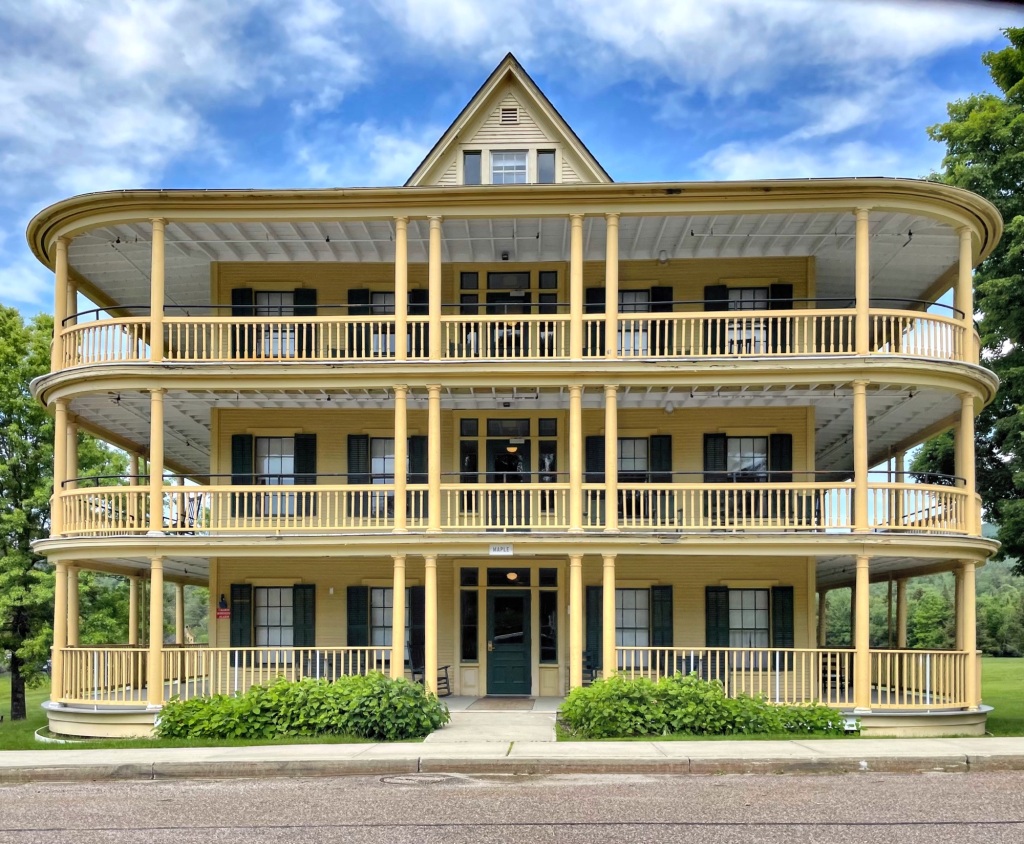
Welcome back to the Bread Loaf Campus! For more early history and context of the complex, check out the post on the Bread Loaf Inn. By 1900, owner Joseph Battell’s enterprise exceeded the capacity of the original inn, and cottages were added to accommodate more guests visiting his new permanent home in the mountains of Ripton, Vermont. Located adjacent to the Mansard-roofed Birch Cottage, one of the most visually striking buildings in the campus is Maple Cottage, which reads more porch than cottage, but it’s 100% perfect. It was the last cottage built by Battell for his family and friends to stay at when visiting. They must have loved evenings on the three-floors of porches looking out over the Green Mountains.
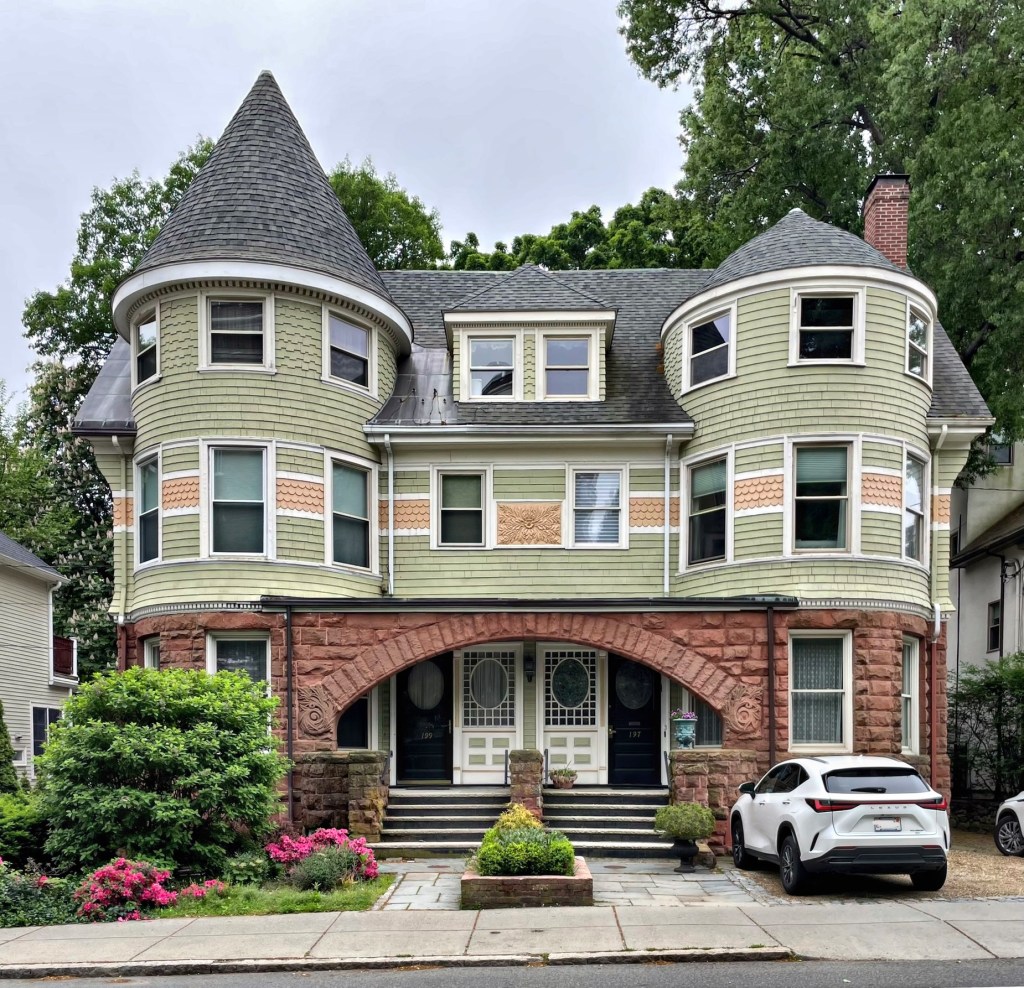
In the late 19th century, the Longwood section of Brookline, saw a second surge of development when larger pieces of land were sold by heirs of the original developers. On the lot across from the Longwood Towers and near the Longwood rail station, Maine-born lumber dealer, John Prescott Webber, built this two-family residence and rented it out for supplemental income. Webber lived in a large home on Beacon Street while renting this and other properties in town to middle-class commuters to Boston. The Queen Anne style residence exhibits a unique rusticated stone first floor with wide arched entry with Richardsonian Romanesque carved detailing.
Timothy Matlack Cheesman was born in New York City in 1824, a son of physician, John Cummins Cheesman. Following in the footsteps of his father, he graduated in 1859 from the College of Physicians and Surgeons, now known as Columbia University Vagelos College of Physicians and Surgeons. Timothy served as Surgeon in the 7th Regiment NY National Guard in 1853 and upon the start of the Civil War, he mustered into US service April of 1861 as a Surgeon. In the late 1880s, like many other wealthy New Yorkers, Dr. Cheesman and his wife, Maria, decided to build a country home in Ridgefield, Connecticut. They chose nearly 30 acres on the east side of East Ridge, an area that was being touted as “Prospect Ridge” for its view. Dr. Cheesman was ill with Bright’s disease and and may have been seeking the clean air of the country climate to help his health or at least as a place to rest. Sadly, he died one year later in 1888, and did not get to fully enjoy his country retreat. He was 63 years old. His widow Maria continued to use Matlack (the house’s name) until her death in 1903. In 1922, the estate was acquired by the Holy Ghost Fathers, who set up a school for new members of the order who would get their initial training to be priests or brothers there. Declining membership and costs required them to sell the campus, which was acquired by the Town of Ridgefield in 1971. Matlack is now the centerpiece of a large housing complex for the elderly in town and is managed by the local housing authority.
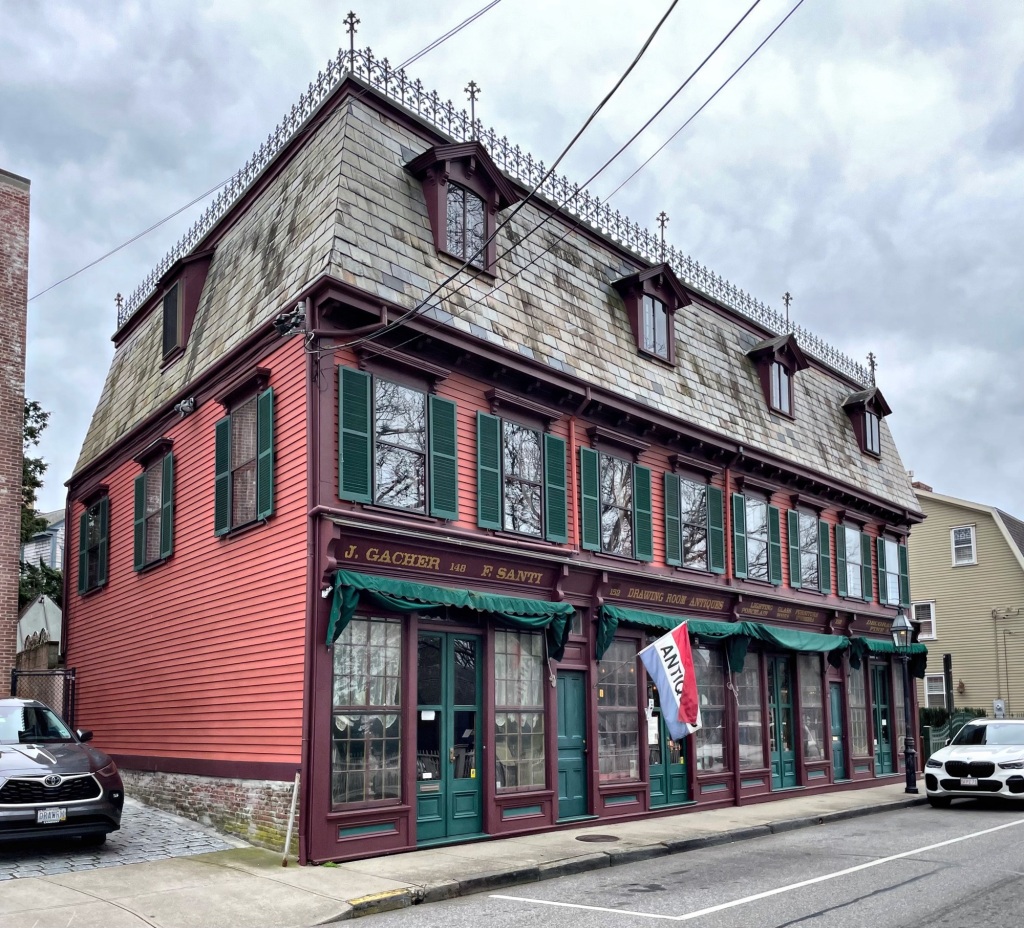
One of the finest commercial blocks in Newport is this building, the Theodore Helme Block, located on Spring Street, just behind Trinity Church. The block was built for Helme by 1875 and was possibly an early design by Dudley Newton, a local architect. The Second Empire style block has a slate roof with rare intact iron cresting and small dormers. The building was restored by Federico Santi & John Gacher, who operate The Drawing Room Antiques here.
As the Old Campus of Yale was being enclosed at its north and east by Farnam and Durfee halls, architect Russell Sturgis was again tasked to design a new building, but for a corner site; though this time, he would design a college chapel. Built between 1874–76, it was funded primarily with gifts from Joseph Battell. Succeeding two previous chapel buildings on Yale’s Old Campus, it provided space for daily chapel services, which were mandatory for Yale students until 1926, which were all-male and mostly Protestant. The large stone chapel is constructed of New Jersey brownstone with decorative elements in sandstone. The design of the Victorian Gothic chapel is great, but how it sits with the entrance unceremoniously dumping out to the end wall of Durfee Hall leaves much to be desired.
Merry Christmas to those who celebrate! As there is no snow on the ground in Boston, I wanted to share a house with a prominent pine tree, which resembles an oversized urban Christmas tree on Beacon Street. This house at the corner of Beacon and Fairfield streets was built in 1871 by architect and builder Frederick B. Pope on speculation. It did not sell as quickly as he would have hoped, and it took two years for it to finally sell at public auction in 1873. The relatively modest brick Second Empire style house was bought and sold numerous times until March 1905, when the residence was purchased by Clarence Walker Barron, a prominent publisher and journalist. In 1903, he purchased Dow Jones & Company and from 1912 until his death in 1928, he was its president. During this period, he was also de facto manager of The Wall Street Journal, he expanded its daily circulation, modernized its printing press operations, and deepened its reporting capabilities. In 1921, he founded Barron’s National Financial Weekly, later renamed Barron’s Magazine. Barron pushed for the intense scrutiny of corporate financial records, and for this reason is considered by many to be the founder of modern financial journalism. In 1920, he investigated Charles Ponzi, inventor of the “Ponzi scheme”. His aggressive questioning and common-sense analysis helped lead to Ponzi’s arrest and conviction. For his Boston townhouse, Barron hired the firm of Cram, Goodhue & Ferguson to completely renovate the dwelling with an extra floor, limestone facades, and more bold roof design.
One of the most ingeniously symmetrical and academic facades on Beacon Street in the Back Bay neighborhood of Boston can be found at the Peleg Chandler House. Built in 1860 for Peleg Whitman Chandler (1816-1889), the two-bay bow-front townhouse appears to have been designed by architect Charles Kirk Kirby, a relatively unknown architect of Boston in this time period. The brownstone home originally had a mansard roof, but it was removed and replaced with a flat roof with parapet during the Great Depression, possibly to reduce the property taxes. Peleg Chandler was an attorney and publisher of the Law Reporter, which he established in 1838. He served as a member of the Massachusetts House of Representatives from 1845 to 1847 and as Boston City Solicitor from 1846 to 1853. He was an early advocate of the Public Garden and led efforts in 1859 to prevent the construction of houses on the eastern side of Arlington Street. The house has been divided up inside and now five fortunate families get to call this stunning building home!
For the last cottage on Grindstone Neck, I present the stunning Whelen Cottage. Charles S. Whelen (1850-1910), a banker and philanthropist who served as one of the directors of the Gouldsboro Land Improvement Company and as one of several of its stock agents in Philadelphia, purchased a house lot for him and his wife Migonette Violett. The couple did not hire Lindley Johnson, like so many other cottage-holders did, but they worked with esteemed architect Wilson Eyre to design the home. The Whelens were typical of the type of person who chose to summer on Grindstone. While comfortably well off, they were not in a financial position to commission the sort of cottages built on an ever increasing scale in Bar Harbor. The property left the Whelen’s ownership in 1897, and the house was altered and enlarged in 1900. The large porte cochere, porch, and additional rooms added at this time by William Winthrop Kent, an alumni of H. H. Richardson’s office.