Kennebunkport Post Office // 1941

During the Great Depression, the federal government built over 1,100 post offices throughout the country as part of the New Deal’s Federal Works Agency. Many of the post offices funded and built in this period were designed by architect Louis Simon, Head of the Office of the Supervising Architect for the U.S. Treasury. Few architects had such a role in designing buildings nationwide than Federal architects who designed buildings ranging from smaller post offices like this to courthouses and federal offices. They really are the unsung designers who impacted the built environment in nearly every corner of the nation. As part of the Treasury Department Section of Fine Arts, artists were hired to complete local murals inside many post offices built in this period, depicting local scenes and histories of the towns they were painted in. In Kennebunkport, artist Elizabeth Tracy who submitted a preliminary sketch of her piece “Bathers” which was approved depicting a beach scene, though the townspeople had not been consulted. Unfortunately, the opinion of a vocal part of the Kennebunkport populace was highly negative to Tracy’s painting, largely due to the fact that her beach scene depicted people on a beach in adjacent Kennebunk, not Kennebunkport! Within a few years, the townspeople gathered funds to hire artist Gordon Grant to paint a satisfactory replacement mural in 1945. The new mural remains inside the post office.

Andrews Hall – Brown University // 1947

Andrews Hall was built after WWII to serve as a dormitory for Pembroke College, the women’s college affiliated with Brown University (later merging in 1971). The new building was named for Elisha Benjamin Andrews, president of Brown University (1889-1898) who was instrumental in the establishment of the college for women in 1891. The new building created a central link, joining Miller and Metcalf halls and nearly doubling the dormitory capacity of Pembroke College, creating an enclosed yard in the process. The architectural firm of Perry, Shaw, Hepburn & Dean (in existence today as Perry Dean Rogers Architects) was hired to provide the plans, which serves a northern edge of the small former Pembroke College quad. Principal architect Thomas Mott Shaw used specially colored brick to give the building a weathered look to achieve harmony with the two buildings which it connected. The style of Andrews Hall is Colonial Revival with a hip on cross-gable roof and is constructed of brick with central three-bays clad limestone facing the courtyard. The building is set over the dining hall which is set into the sunken landscape with the terrace above. The three buildings were recently renovated by CBT Architects and shine today!

Alumnae Hall – Pembroke College – Brown University // 1926

It’s not often that a building has not one, but three distinct and beautifully designed facades. Lucky for us, the 1926 Alumnae Hall at Pembroke College (now Brown University), fits the bill! Alumnae Hall on the Pembroke Campus was dedicated in October 1927 with funds for the building raised through the efforts of the Alumnae Association with Stephen O. Metcalf would duplicate all gifts of students and alumnae. The campaign continued until 1926, when the $50,000 contributed by the students and the $150,000 contributed by the alumnae, together with Mr. Metcalf’s matching funds, were deemed sufficient to start the building. The cornerstone was laid in May 1926 with the Boston architectural firm of Andrews, Jones, Biscoe and Whitmore as architects, who designed the building in the Colonial Revival style. Alumnae Hall, built of brick with limestone trim, was designed to accommodate the social and religious activities of the Women’s College. Its main entrance is a balustraded stone terrace on the campus leading to an auditorium on the main floor, the various sections create a visually stunning complex of wings and facades built into the landscape.

Edward Aldrich House // 1902

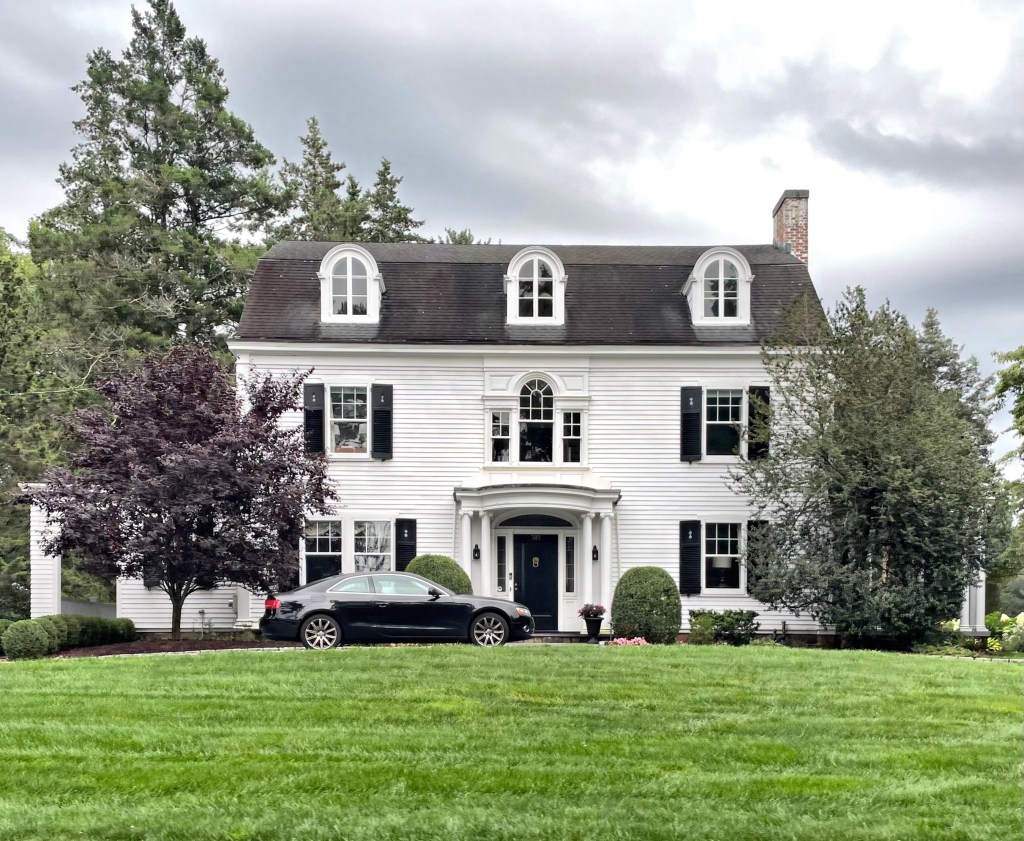
Built next door and just a year after the Hidden Family House (last post), the Edmund Aldrich House in Providence’s College Hill neighborhood shows how stately a wood-frame Colonial Revival house can be! The property was purchased by U.S. Congressman and U.S. Senator, Nelson Wilmarth Aldrich (1841-1915) who quickly sold the lot to his son Edward Aldrich, who worked as president of the Times Publishing Company and was very engaged in Republican politics along with members of his family. The Colonial Revival style dwelling was designed by Providence architecture firm, Stone, Carpenter & Willson, who were pretty prolific in this part of the region by this time. It exhibits a gambrel roof punctuated with segmental pedimented dormers along with a segmental pedimented portico over the entrance. Swoon! In his will, Edward left the property to Brown University, who apparently saw no need for the property and eventually sold it to private owners. The owners today maintain the house very well.

Walter and Kate Hidden House // 1901

I love a good high-style Colonial Revival home with big proportions and warm red brick! This example on College Hill in Providence is a great example. The 2 1/2-story dwelling is five bays at the facade with a center entrance under a hollow pediment hood with an enframement which reads much in the Palladian-realm. Owners Walter and Kate Hidden hired local architect Wallis Eastburn Howe to design their elaborate Colonial-inspired home in 1901, they moved in within a year. Mr. Hidden worked at his father’s business, and in 1875 became a member of the firm of H. A. Hidden & Sons. He did well for himself and became a member in many social and outdoors groups including the Audubon Society, the Squantum Association, the Hope Club, and for five years was president of the Agawam Hunt Club.

Benjamin Bliven House // 1849

Although Benjamin Bliven built this house, he never owned the property, but the name lives on! This house on Angell Street in Providence was originally constructed in 1849 in the Greek Revival style, popular at the time. Bliven, a musician, rented the property to tenants until the deed was transferred to Abby W. Watson, wife of Robert W. Watson (owner of the property next door and featured on this account previously). The first owner-occupants were Grace A. and Eugene H. Greene, who bought the property in 1898. The house was completely remodeled in the early decades of the 20th century with Regency/Colonial Revival detailing. Changes including the former roof with its gable-end facing the street boxed off, a new modillion cornice with parapet above; recessed attic story with balustrade; small wing to the east. The stucco siding and Federal entry is icing on the cake!

Harrishof Houses // 1899 & 1900

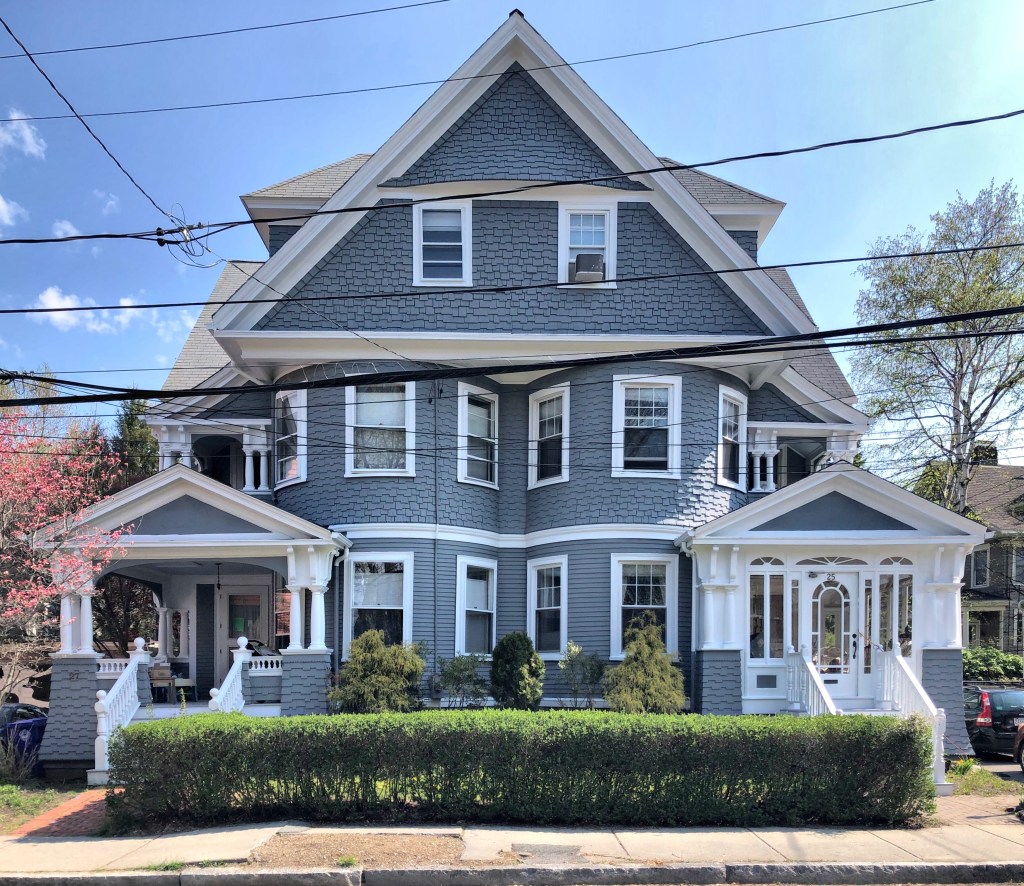
I think I found it… My favorite street in Roxbury. Harrishof Street is a surviving streetscape that shows the beauty and potential of the Washington Park district of Roxbury, a surviving span of houses that dodged the wrecking ball during a period of Urban Renewal. This section of the street runs a stone’s throw from the ruins of the 1857 Horatio Harris Villa (featured previously) and was laid out by Horatio’s heirs who developed the former sprawling estate into multi-family housing, to cash in on suburbanization caused at the turn of the 20th century thanks to electric trolley lines in the neighborhood. The development is credited to Alexander Colin Chisholm (1868-1941), a Canadian-born architect and developer who grew up in Roxbury. He specialized in small residential enclaves of similar houses, including these houses on Harrishof Street, and later on Elm Hill Park. The two-family houses blend Queen Anne and Colonial Revival styles in such a fun way that pushes the boundaries of academic architecture. The houses on the street are all slightly different and have had varied alterations over time, but this is a great candidate for a historic district!

Dimock Center – Cheney Surgical Building // 1899

With funds for expansion at the New England Hospital for Women and Children in Roxbury, the hospital’s board commissioned architect Willard T. Sears (also the architect of the earlier Cary Cottage and Zakrzewska Building) to design a new surgical building at the hospital’s growing campus. Construction began on the new Cheney Surgical building in 1899 on the birthday of its namesake, Edna Dow Cheney an original incorporator of the hospital and then President. The Cheney Surgical Building was designed in the Colonial Revival style in brick, with a four-story central block with three-story wings. The central entranceway is accentuated by a classical porte-cochere topped by a Palladian window, in keeping with the Georgian Revival tradition of symmetry and classical vocabulary. The building is one of the first you see when climbing the hill into the campus.


Dimock Center – Sewall Maternity Building // 1892

As the New England Hospital for Women and Children continued to grow in the decades following its founding in 1862, expanded facilities were needed to deal with increased patients along with new nurses and doctors to treat them. Land was acquired across from the Cary Cottage and Zakrzewska Building, and a second building campaign began to expand the facilities and grow the women’s hospital. The management of the hospital did not hire Cummings and Sears, but went with architect John A. Fox to furnish plans for a new maternity building. The Sewall Maternity Building was designed in the Colonial Revival style, a relatively modest example that features a unique broken pediment over the door housing a large window. In 1916, the building was expanded by an addition at the rear which enclosed a central courtyard, it was also designed by John Fox.

Margaret Fuller Primary School // 1891

The Margaret Fuller Primary School (now Community Academy) is a public school in Boston that shows how much attention to detail the school department and the city architect paid when designing these structures in the late 19th and early 20th centuries. The Fuller School was constructed in 1892 to alleviate an overcrowded school district resulting from rapid urbanization. Jamaica Plain was one of Boston’s first streetcar suburbs largely spurred by the growth of the Boston and Providence Company Railroad between 1860 and 1890, when the area saw a shift from large bucolic estates to subdivided urban housing (largely triple-deckers and apartment buildings along major routes). With the surge in population, many new schools were built city-wide, including this primary school which was designed by Edmund March Wheelwright (1854–1912), a prominent Boston-based architect who served as City Architect for Boston from 1891 to 1895. Architecturally, the building is a stunning example of the Colonial Revival style with red and buff brick walls which are laid in a Flemish bond and rusticated at the first story with single recessed courses of buff brick. An arched entrance and Palladian window with iron false balcony sit at the central bay. The school was named after Margaret Fuller Ossoli (1810-1850) an early transcendentalist and writer advocating for women’s rights born in Cambridge.

J. B. Mulvey Triple Decker // 1904

Across the street from the Lannin Triple Deckers (last post) this large triple decker (and the others in the row) was built in 1904 for developer John B. Mulvey. Mr. Mulvey was born in Ireland and migrated to Boston at the age of 16. He climbed his way up the ladder and worked as a builder and developer, largely in Boston-area suburbs and neighborhoods. At the turn of the century, these triple deckers (also known as three deckers) proliferated throughout the Boston suburbs around train stations providing affordable flats to residents. Many were built and rented out by developers, but eventually, owners would live in one unit and rent the other flats for additional income, providing upward mobility and equity, largely benefiting immigrant communities. This high-style example is very well maintained and is a more uncommon double-three decker.

Academy of the Holy Family // 1914

Built adjacent to and just a few years after the St. Mary of the Immaculate Conception Church in Baltic (last post), the Academy of the Holy Family stands as a high-style Colonial Revival building in the town. The building stands four full floors with a raised basement and attic story, and is symmetrical in its design. A large fan-light transom and stone trimmings add much depth to the buildings large massing. The structure was built in 1914, and has housed the Academy of the Holy Family, a private, Roman-Catholic all-girls prep school, which is still active today.

Cote Block // c.1910

The population of Sprague, Connecticut nearly doubled between 1900 and 1910 from 1,300 to 2,500. As a result, the town needed a new town hall and commercial buildings to service the new residents. A member of the Cote Family in Sprague took this as a good opportunity to erect this three-story mixed-use building on Main Street, renting out space for retail, a confectioner, and a clubhouse with residences above. The building is constructed of concrete block, a building material that surged in popularity after concrete block machines allowed these blocks to be manufactured quickly off molds of uniform style and dimension. The building also features inset center and corner porches off the street and a projecting cornice. The storefronts have since been enclosed, but the building remains one of the finest in town (even with its original windows!)

Robb-Kagan House // 1939

Colonial-inspired homes on Nantucket never will go away, and that is because the entire island is a local historic district! New construction, demolitions, and alterations to existing structures all need to be reviewed and approved on Nantucket, no easy task! This home was built in the inter-war period (before the historic district), when New Englanders still harkened back to the classics, Colonial homes. The house was built in 1939 for Annie Robb, and it was later purchased by artist couple Vladimir Kagan and Erica Wilson. Vladimir had a really interesting life. A cabinetmaker’s son, Mr. Kagan came to the United States at 11 after fleeing Nazi Germany with his family. He trained at his father’s New York workshop and by the 1940s was producing his own designs. One of his first orders was a set of tables and chairs for a delegate lounge at the fledgling United Nations! Meanwhile, across the English Channel, a young woman named Erica Wilson came into the world in 1928 in the town of Tidworth, England. Her father was in the military and the family moved to Bermuda soon after Erica’s birth. A drawing prodigy, Wilson “translated her drawing techniques into needlework,” Illya said. Needlework became her artistic focus and she graduated from the Royal School of Needlework in London. The duo lived in this home as a summer respite, where they could hone their artistry and skills. Their son, Ilya Kagan (also an artist, of course) also stayed in the home and still resides on the island. Love it!

The Nantucket Hotel // 1891

In 1888, Charles F. Folger of Philadelphia purchased the former Elijah Alley house on Easton Street, just north of the main village of Nantucket. Folger hired carpenter Edwin R. Smith to design and build a new grand hotel for summer residents of Nantucket. Originally named the Point Breeze Hotel, the grand resort opened in the summer of 1891. The Queen Anne style hotel contained forty sleeping apartments in the upper floors and was dominated by a corner tower with billiards rooms and a bowling alley in the raised brick basement. Business was booming, and by the early 20th century, Folger expanded the hotel adding the east wing in the Colonial Revival style. In 1925, a fire destroyed the original Point Breeze Hotel, leaving just the East Wing. By this time, the days of the grand, wooden hotels was coming to a close. The Nantucket Institution for Savings acquired the hotel during the Great Depression, until 1936 when Gordon Folger Jr., grandson of the Point Breeze’s original proprietor, purchased the hotel and renamed it after himself, as the Gordon Folger Hotel. By the end of the 20th century, the building sat underutilized, the early 2000s when Little Gem Resorts purchased the hotel, seeking to restore this historic property back to her former glory. The original 1891 hotel was rebuilt in 2012, even down to its iconic corner tower, and the hotel was renamed The Nantucket. The hotel is open year-round and is lavish inside and out, providing you with a sense of home even when on vacation in the middle of the Atlantic!