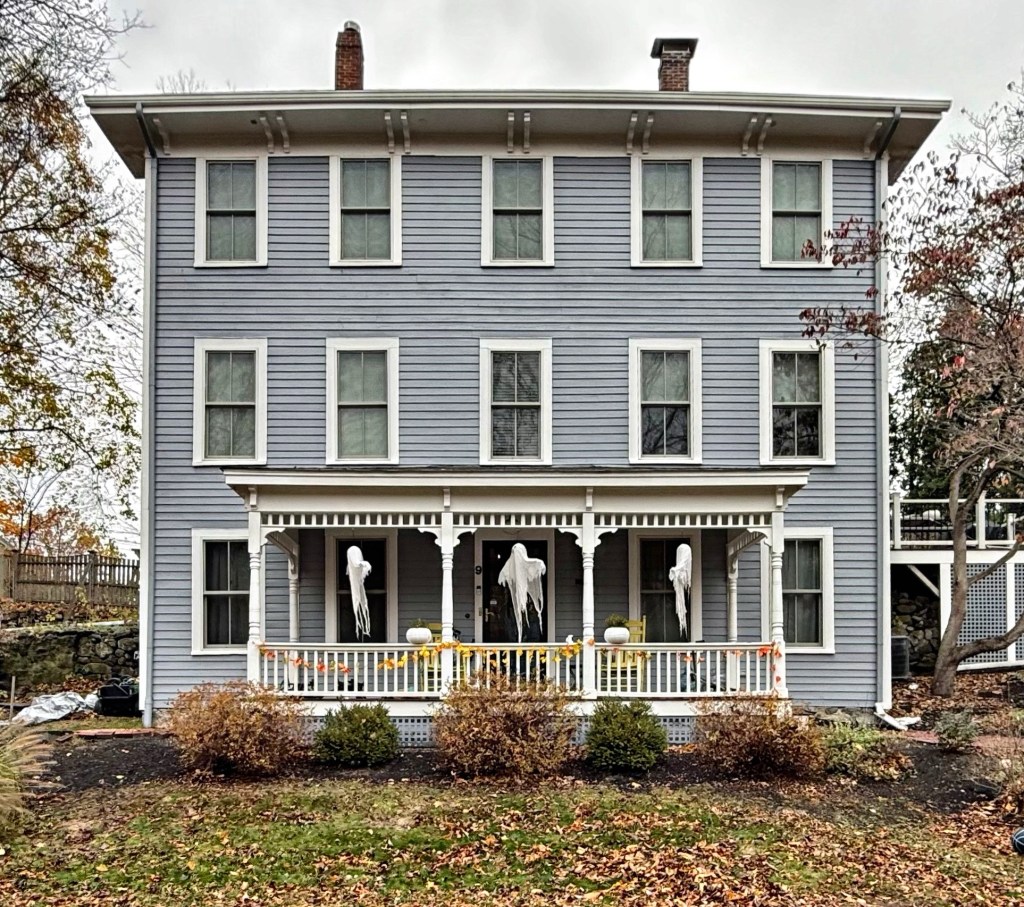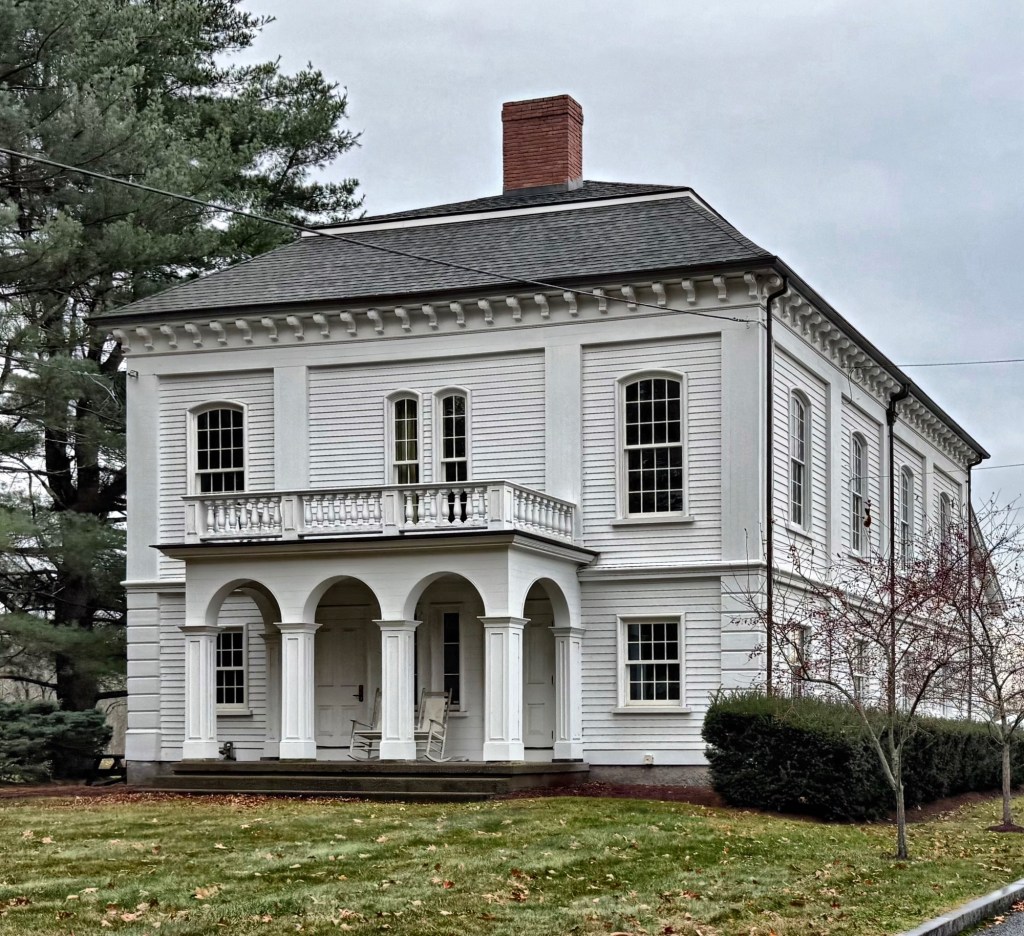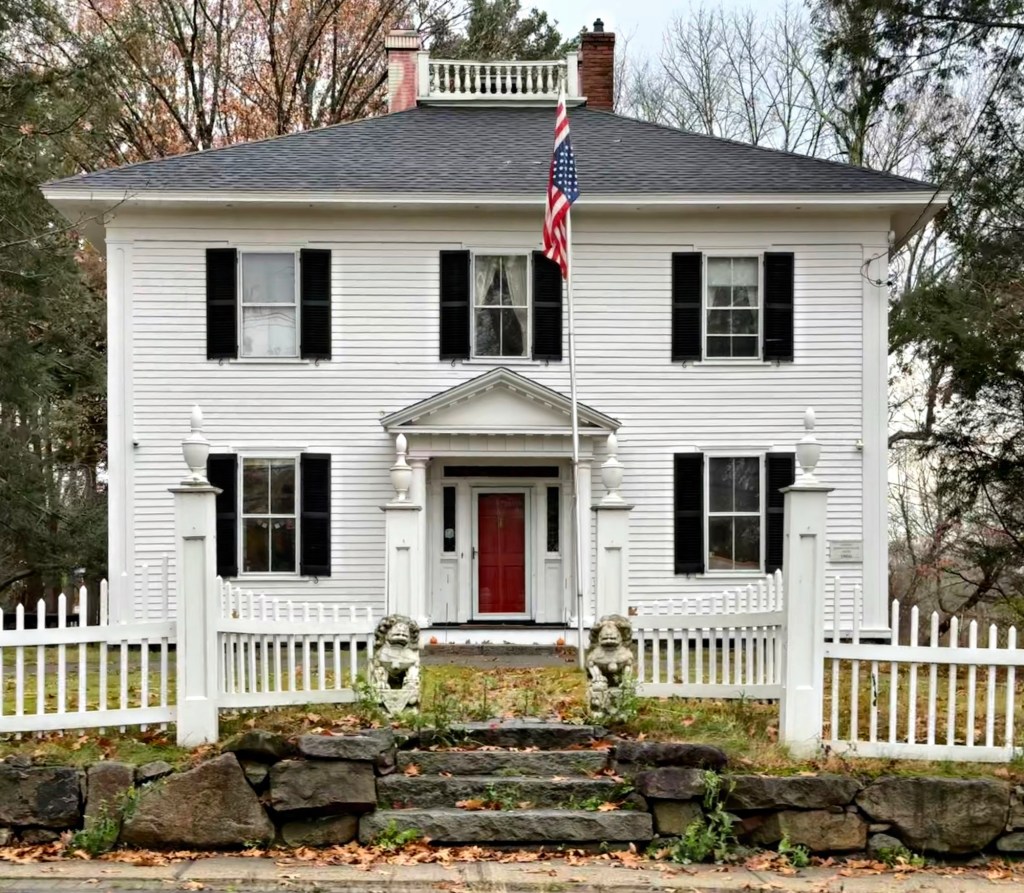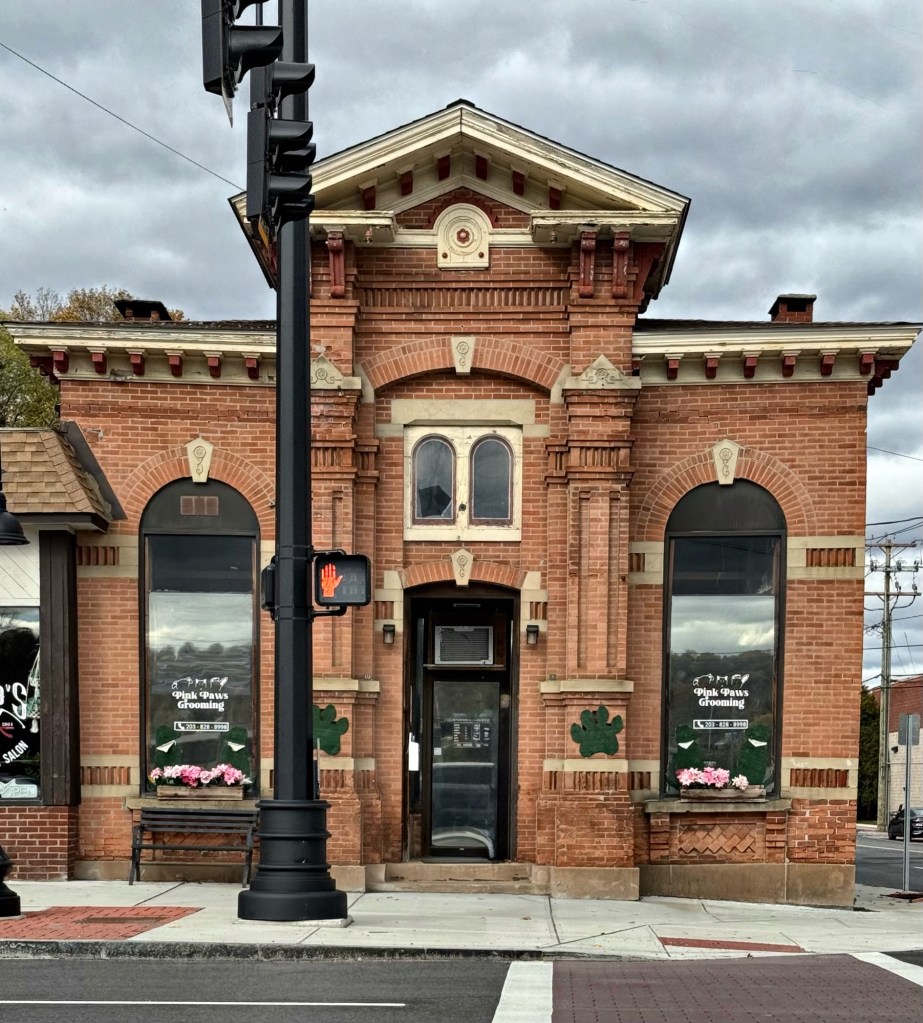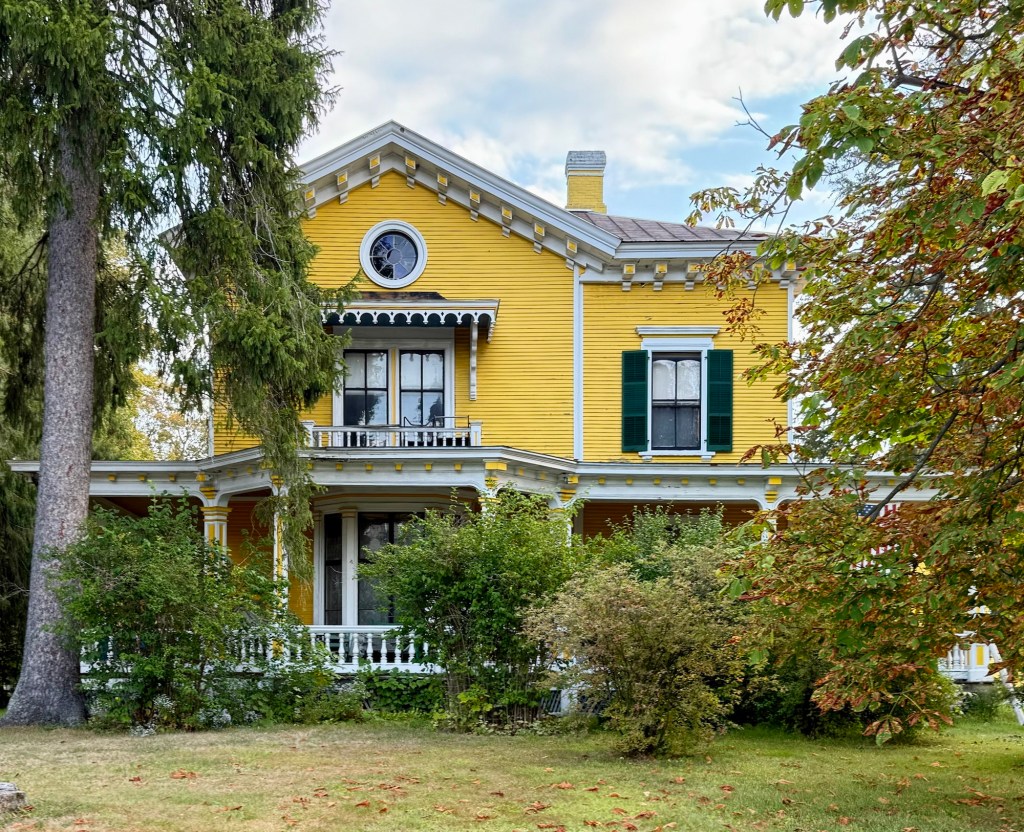
George Washington Smith House // c.1886

This house on Westminster Road in Canterbury, Connecticut, is architecturally distinguished by its extensive and imaginative detailing, which reflects the widespread availability of manufactured architectural ornament in the Victorian period. The porch columns, archways, bay window, and round-arched windows all reflect an Italianate influence and the work of its original owner, Mr. George Washington Smith (1857-1937). The house dates to about 1886 when George W. Smith, built it from his workshop formerly located across the street. Smith manufactured mast-hoops, the wooden fixtures for attaching sails to the masts of sailing ships, and utilized his woodworking skills to build and decorate the exterior of his family home.


Pawtucket Hair Cloth Mill //1864

Despite its name, this handsome mill structure, known as the Pawtucket Hair Cloth Mill, is actually located in Central Falls, Rhode Island. The building, located on Roosevelt Avenue on the banks of the Blackstone River, is a great example of a Civil War-era mill, built for one of the many wool and cloth companies in New England. Begun in a small factory across the street in 1856, this business became successful after the acquisition of patents for weaving haircloth (most of the raw material for which originally came from Russian horse markets) for upholstery, crinolines, and inner linings. The company is said to have once been the largest producer of haircloth in the world. The Italianate style mill stands pretty much as built, besides the tower that has lost its low pyramidal cap. The building was one of the first commissions by great Rhode Island architect, William Walker, who was just 34 at the time of designing this large, and complicated structure.

Valley Falls Mill // 1849

The Valley Falls Mill sits along the Blackstone River in Central Falls, Rhode Island, and is one of the many significant industrial complexes which facilitated the development and growth of the city. The main building in the complex is the four-story rectangular building, constructed in 1849. To meet the requirements of fire resistance, the mill was constructed with load-bearing brick walls and heavy timber columns. Samuel B. and Harvey Chace, sons of Fall River mill owner Oliver Chace, built the mill on this site, influenced not only by the availability of water power, but also by the completion the same year of the Providence & Worcester Railroad, which passes by the mill on its east side. The mill was designed for the manufacture of a variety of cotton products. The Valley Falls Company merged with another industrial concern in 1929, and this mill was subsequently closed the following year. After decades of little-to-no use, the significant Valley Falls Mill was converted into senior housing in 1979 following its listing on the National Register of Historic Places. It ranks as one of the earliest mill conversion projects in New England and while some details were lost, it preserves a significant piece of local history and meets a much-needed demand of housing.

Fales & Jenks Mill // 1863

One of the largest mills in Central Falls, Rhode Island, is this complex tucked away on Foundry Street. Constructed in phases beginning in 1863, the site was originally owned by the firm of Fales & Jenks, manufacturers, and it was the first major factory in the town to not be built on a river, but on the railroad, showcasing a shift in the transportation of goods along with the increasing availability of steam power, relieving mill owners from having to build on the rivers. Fales & Jenks manufactured textile machinery here for just a few years until they moved to Pawtucket, and the complex was purchased by A. & W. Sprague in 1865 and after slight enlargement, was used as a flax mill until the Spragues’ failure in 1873. In the late 19th century, the mill was occupied by the U.S. Cotton Company. The oldest buildings are brick with granite lintels under a monitor roof. Later additions include a massive brick factory with a tower with castellated parapet. The small, two-story gable-roofed building at the corner was the mill office. The complex is today owned and maintained by the Murdock Webbing Company.

Nathan S. Horton House // c.1860

This modest, Italianate style house was built around 1860 by a carpenter and builder as his own residence. Nathan S. Horton (1819-1916) was a busy builder in Central Falls, Rhode Island in the mid-late 19th century as the population boomed along with the industrial growth and wealth that the city saw. For his own residence, Horton built this two-story wood-frame house with side entrances and porches, paired brackets in the eaves, and arched top windows, all commonly found in the Italianate style, popular around the time of the Civil War. Mr. Horton lived to his late 90s and likely remained in this home until his death.

Former Broad Street School // 1861

The oldest extant school building in present-day Central Falls, Rhode Island, is this brick schoolhouse, constructed in 1861, to serve as the main village school. The rather plain two-story brick building was built just before the Civil War, during a period of rapid industrialization and growth in Central Falls, when it was then the dense core of the town of Smithfield, Rhode Island. The building contained classrooms for pupils from elementary through high school. Italianate in style, the rather unadorned building does feature oversized windows with some containing rounded tops, deep eaves, and a subtle recessed arch in the central bay on the facade. The school has been vacated for some time, and in 2024, plans materialized to convert this building into affordable housing. Hopefully the renovation/restoration is thoughtful for such a significant piece of the city’s history.

Thomas Hovey House // c.1785

This lovely three-story frame house on Winter Street in Salem was built in the 1780s for mason, Thomas Hovey. The structure’s front-end, five-by-one-bay portion with stone foundation was built first, in the Federal style, likely with traditional finishes seen in the early Federal period. The building’s rectangular shape, hipped roof, molded corner boards, and foreshortened third-story windows are indicative of its Federal-era origins. By around 1870, the Italianate decorative features, including a hooded double-door entrance, two-over-two windows, a second-story bay window, a bracketed cornice, and bracketed window lintels, were added to the exterior in an effort to modernize the home by later owners. Like many other houses in Salem, this building was extensively documented by Historic Salem Inc. who compiled a detailed history of this and hundreds of other homes nearby.

Brown-Battis House // 1851

Captain Nathaniel Brown (1800-1866), a master mariner in Salem, built this fine brick house on Brown Street in 1851. Captain Brown bought the lot from the heirs of Nathaniel Kinsman in 1850, with an older house already occupying the site. The existing house was razed and construction began on this house, with it completed by 1851. The building is unique as it resembles the Federal period form of the five-bay and three-story residence with shortened third-floor windows under a low hipped roof. Although the Federal period waned in popularity by the 1830s, this house clearly took cues from the earlier homes nearby. Following Nathaniel Brown’s death in 1866, James Herrick Battis, a tobacconist and cigar manufacturer, purchased the home. City records state that Battis was issued a building permit in 1878 for an addition to the dwelling. It is probable that the bay windows and front door hood were also added at this time, giving the residence more of an Italianate style. Battis continued to own the property until his death in 1891. By 1930, the residence was converted into apartments and was known as the Conant Apartments. It remains a six-unit apartment building today.


First Baptist Church of Salem – Essex Law Library // 1805

The First Baptist Church of Salem was built in 1805 on Federal Street and is the oldest brick meetinghouse in Salem. The local Baptist congregation was established in 1804 when 24 parishioners formed the First Baptist Church, and began gathering funds to elect a pastor and build a house of worship. At the time, Baptists were a religious minority in Massachusetts, where nearly all churches were Congregational, so against large odds, the parishioners funded a brick building and lot on the prominent Federal Street in Salem. The structure was completed by 1805 and is said to have been one of only fifty brick structures that stood in the city at the time. A major renovation to the building occurred in 1850, when the church was renovated in the Italianate style. Its three bays are articulated as an English basement containing three identical entrances framed in heavy rusticated brownstone. A belt course separates this basement from a principal story composed of tall arched windows capped by drip-molded brownstone. A lunette window is the centerpiece of the strongly projecting modillioned pediment. The entire composition is very pleasing and showcases the ever-evolving architectural tastes in the 19th century. A tower was later removed due to structural issues. In the early 21st century, the site of the church was needed for an expansion of the Essex County Courts. The congregation sold the property and in the following year, the old brick church was moved a couple hundred feet to the west and restored and was converted into a law library for the new courthouse. Talk about historic preservation at work!

William Hunt Double-House // c.1858

The William Hunt Double House, located at 10-12 Lynde Street in Salem, is a 2 ½ story wood-frame Italianate building that showcases the emerging presence of the Victorian style on residential buildings in the mid-19th century, even in cities with strong support for Colonial and Federal period styles. The two-family house was built by William Hunt, a prominent Salem merchant, as a rental property with occupants of the building in 1859 including: John W. Lefavour, a cashier, and Benjamin F. Faber, a merchant. The property remained in the Hunt Family for three generations, and was converted to a boarding house in the 1930s. In November 2018, a fire gutted much of the building, displacing the residents, and concerned neighbors as to the future of this great property. Luckily for us, the owners hired  Seger Architects, Epsilon Associates and Groom Construction to fully restore the building to its former glory. The resulting project won a Salem Preservation Award and received Federal and State Tax Credits to offset restoration costs. What a great success story!