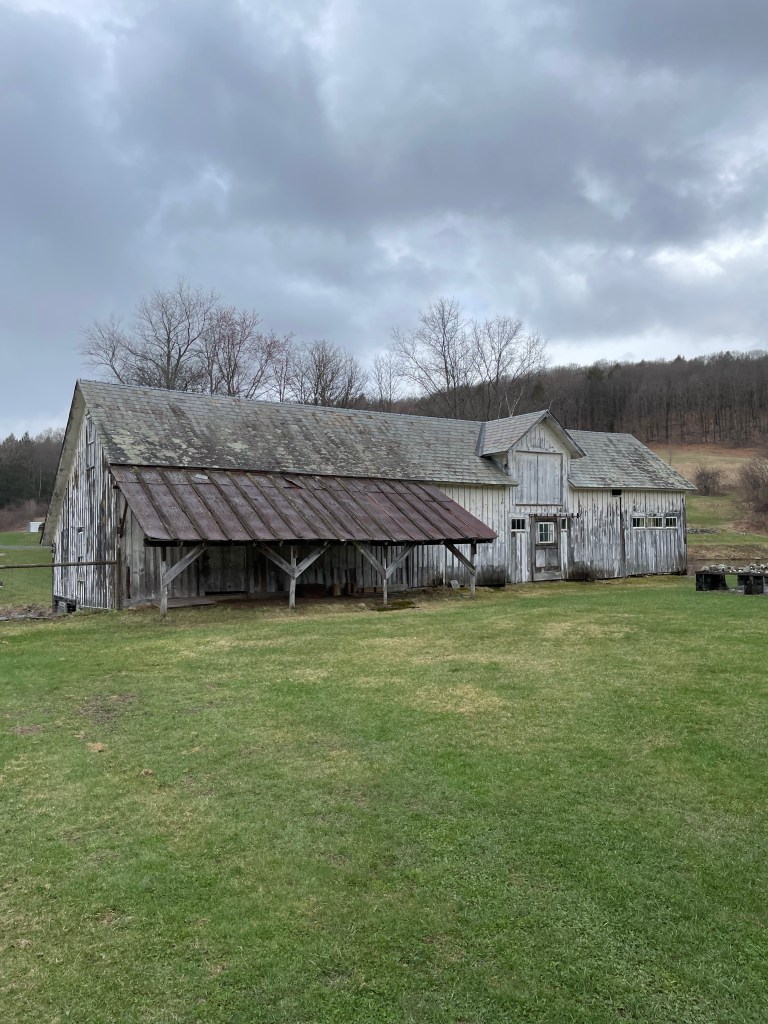
Cows, horses and pigs once dominated the 571-acre landscape of Scott Farm in Dummerston, VT. We have seen where the farmer, cows, and horses lived, so now it’s time to see where the pigs “pigged” out. This barn building was constructed around the time of the horse barn when the farm was owned by Frederick Holbrook II of Boston. The one-and-a-half-story pig barn, like the others, was built into the landscape which would allow for the animals to easily get into the structures. This building was used as the “Cider House” in the 1999 movie Cider House Rules.
Historic barns really are the most charming buildings, and luckily, Vermont is home to soooo many great examples. The Cow Barn at Scott Farm in Dummerston, VT was built in 1862 and constructed into the slope of the land. The barn has a brick and stone foundation, barn board siding, and a roof sheathed with small dark slate. It is built into the slope of the land and has a single-story shed roof addition (c.1915) off the west facade to give the building a saltbox form, and a single story gable roof milk house addition off the east facade. The rear facade has a more rustic appearance and has a large entrance to the space inside which is occupied by The Stone Trust, with the mission to preserve and advance the art and craft of dry stone walling. The organization holds classes and trainings where people can learn how to build a traditional or modern stone wall and more! The barn (and the rest of the buildings on the Scott Farm property) is owned by the Landmark Trust USA.
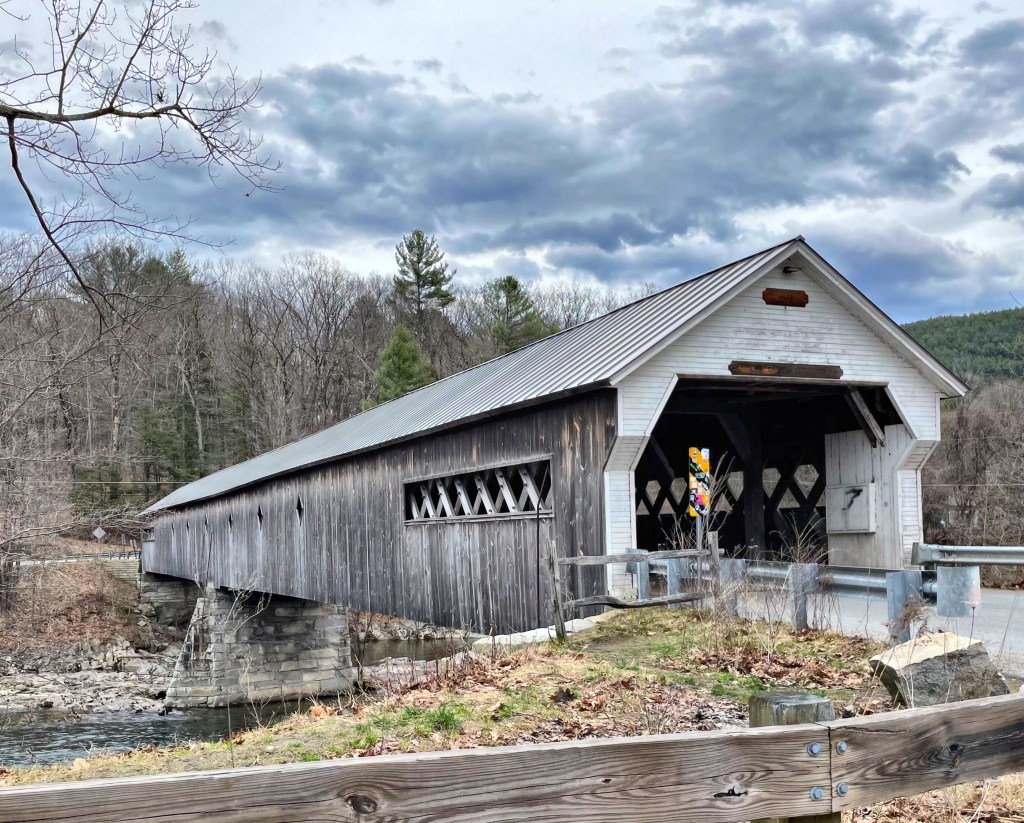
Oh covered bridges, one of the many symbols of New England that always give me joy when I see them! This beauty was constructed in 1872 to span the West River in Dummerston, Vermont and is the longest that is wholly within the State of Vermont. The bridge was designed by Caleb B. Lamson, a master carpenter and the bridge is the only known bridge built by Lamson that survives. Vermont is significant for covered bridges as about one hundred bridges still stand in the state, which is probably the greatest concentration by area of covered bridges in the nation. A reason we have to thank Vermont for this is purely population. With more people living in the state, transportation demands change, and these bridges are often replaced with modern steel structures. Keep doing you Vermont!
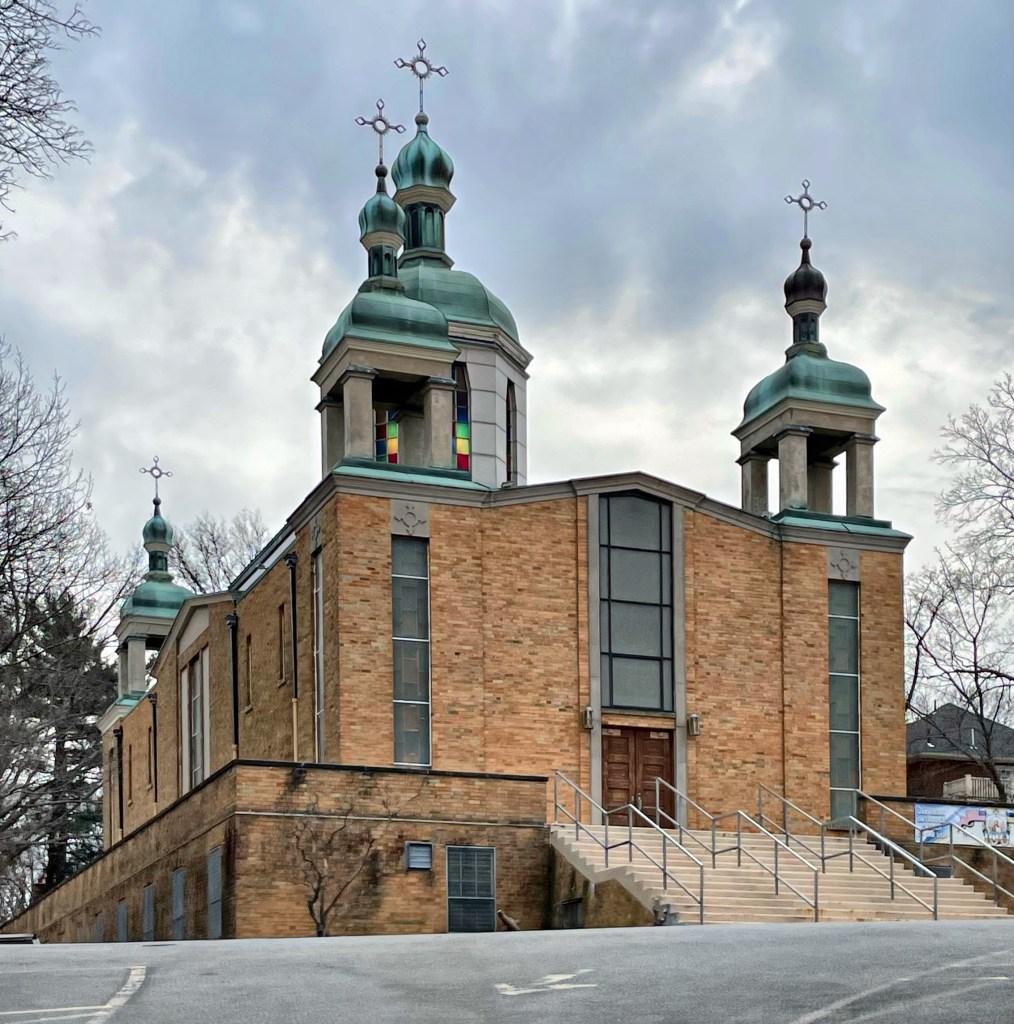
I typically do not connect my posts to current events, but I really wanted to take time to highlight the strength and fortitude of the Ukrainian people fighting to preserve their home and democracy around the globe. Closer to home, a growing Ukrainian community in Boston in 1956, decided to erect a new church in the Forest Hills section of Jamaica Plain. Land was acquired and a blessing ceremony was attended by members of the church, the architect, and Reverend John Theodorovich; the head of the Ukrainian Orthodox Church of America, who was born in Ukraine, and served at chaplain with the Army of the Ukraine National Republic in the war against Russia in 1919-20, before eventually moving to North America. The architect, John Kodak, was a Toronto-based architect of Ukrainian descent who ended up in Canada after fleeing from his home to escape communist rule from the USSR. This church is a Modernist interpretation of the iconic St. Andrew’s Church in Kiev, Ukraine, with its onion domes surmounted by crosses. The church, like many others, is holding prayers for Ukraine and is coordinating donations and aid to the Ukrainian people and related charities.
Built soon after a massive fire destroyed much of North Waterford Village in Maine, the Iocal order of Odd Fellows decided to rebuild, constructing this building for their members. Though active for several decades after the building was reopened, an aging and dwindling membership forced this chapter to merge with the Odd Fellows of nearby Norway, Maine. After, this building was occupied by the Daughters of Rebekah, an auxiliary group of the IOOF for women until 1973 when it was donated to the recently formed Waterford Historical Society. The society has since moved, and listed the building for sale in 2020 for just $10,000!!
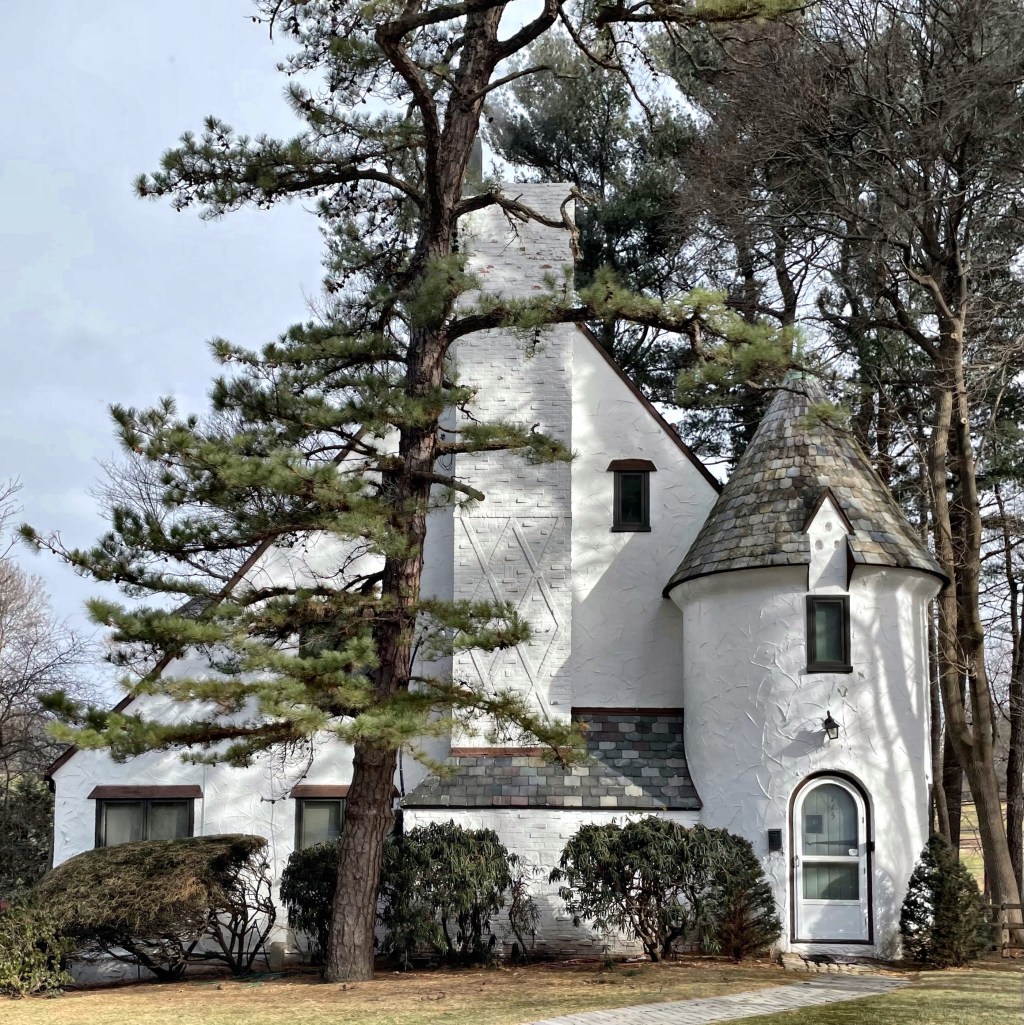
In the inter-war period, Norman Revival houses took off in popularity (though never at the same level as Tudor or Colonial Revival styles), partially due to returning soldiers who served in Normandy France in WWI. Many plans include a small round tower topped by a cone-shaped roof, resembling the grain silos of the ancient Normandy style. The architecture is characterized by steep, conical roofs or hipped roofs and round stair-towers. The style is much less common in the Boston area, but this notable example in Waban Village, Newton, was too good to pass by without snapping a photo! The home was built around 1929 for Edmund and Ethel Sprague. Edmund is listed in directories as a landscaper for trees and shrubs.
While architecturally significant mansions, churches and civic buildings are great, the smaller wood-frame buildings such as this really tell the story of New England. When the town of Sweden, Maine was still in her infancy, the Nevers Family helped to establish the town and diversify its output from the typical agricultural village. Sweden supported an interesting variety of nineteenth century businesses including: general stores, saw mills, copper and cobbler shops, and a straw hat factory. The town of Sweden was distanced from major trade routes, railroads and navigable rivers, so it saw a period of decline from the late 19th to the 20th century. The town has since been a sort of “bedroom community” where people mostly live, but travel outside the town for commerce and work. This blacksmith shop shows us an example of a trade that has largely gone away, but it was a common structure and profession in early America.
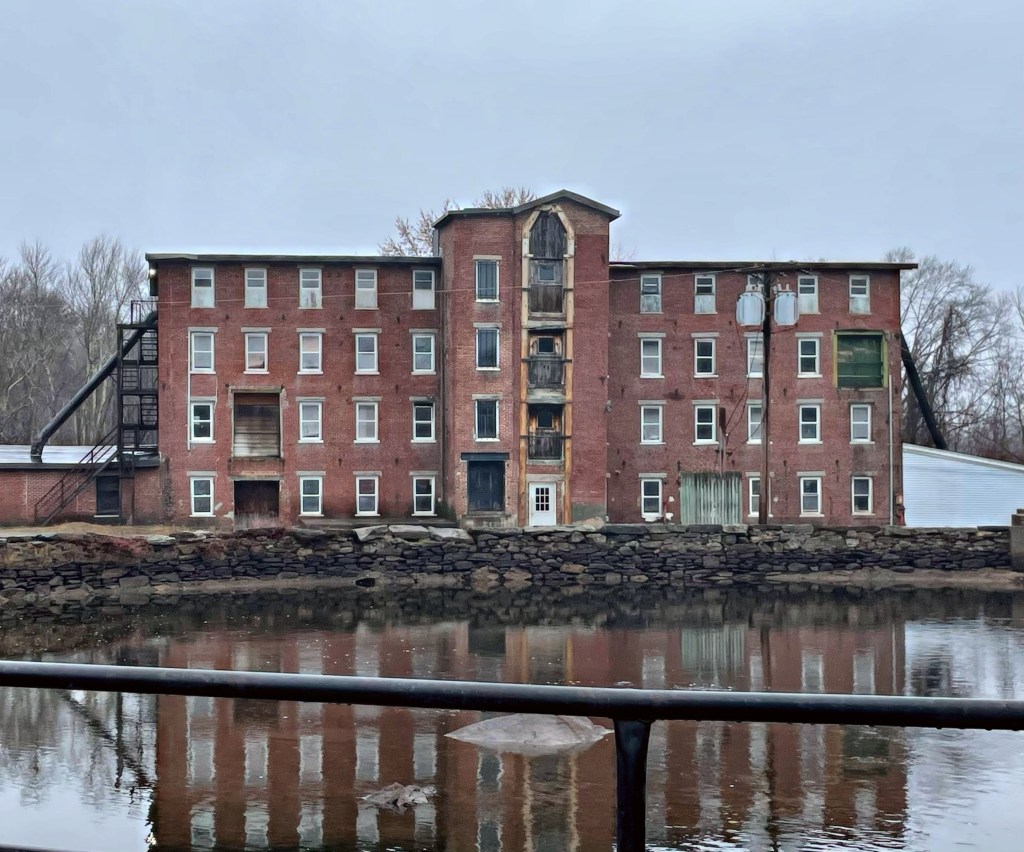
One of the many large brick mills in Millbury, the S&D Spinning Mill (originally Singletary Mill) sits on Singletary Brook, which historically provided power for the facility. The four-story mill building was constructed in 1846 and is believed to be the oldest extant mill structure in town. Beginning in the late 1820s, successive textile mills used the waterpower here, including the companies: Singletary Manufacturing Company, the Boston & Millbury Company, and Farnum & Jenks. Fires destroyed all mills on this site, sometimes within just a couple years of each other. The last mill was destroyed in 1846, and Mowry Farnum, who owned the site, rebuilt a brick mill here, which is what we see today. After a couple companies occupied the building, the Mayo Woolen Company (which was featured on here previously) purchased this mill in 1910, and renamed the structure Mayo Mill No. 2. In 1961 a newly formed company, S&D Spinning Mill Inc. occupied the building. They are best-known today as the sole-manufacturer of the yarn which fills Major League Baseballs! Manufacturing is not dead in New England!
No structure in Newport is as hotly debated than the “Newport Tower” located in Touro Park. The old stone, cylindrical tower stands like an ancient relic of ancient Europe, just dropped in downtown Newport. For centuries, people have debated the structure’s history and use. Some say this structure was built by Viking masons who visited North America 1,000 years ago, while other theories (more rooted in fact) share another story. The tower was located at the upper end of the plot behind the now-demolished mansion built by Benedict Arnold, the first colonial governor of Rhode Island (his grandson was the infamous Benedict Arnold, the traitor who switched sides to fight with the British. In 1677, Arnold mentions “my stone built Wind Mill” in his will is evidence that the tower was once used as a windmill. However, some state that there is no reference to Arnold ever having the structure built, with some stating that he simply repurposed the building to be used as the base of a windmill. In 1837, Danish archaeologist Carl Christian Rafn proposed a Viking origin for the tower in his book Antiquitates Americanæ. This hypothesis is predicated on the uncertainty of the southward extent of the early Norse explorations of North America, particularly in regard to the actual location of Vinland, where Leif Erikson is believed to have first landed around 1000 CE, nearly five centuries before the voyages of Christopher Columbus and John Cabot.. Rafn’s popularization of the theory led to a flurry of interest and “proofs” of Norse settlement in the area. Mortar tests completed in the 20th century basically prove this theory to be false, and date the structure to the middle of the 1600s, but it is fun to imagine it is much older!
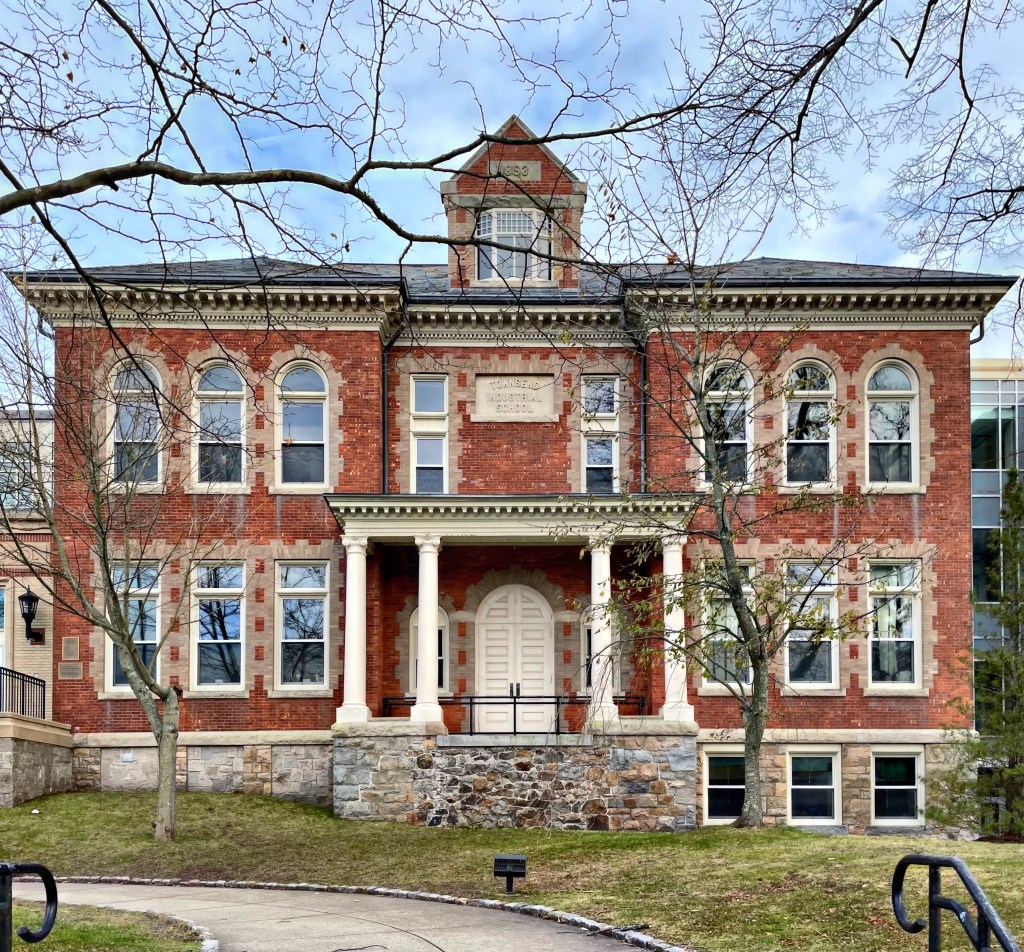
Located next to and predating Newport City Hall (a previous post), the Townsend Industrial School building is a great, eclectic Victorian-era building in Newport, that is often overlooked. The school itself evolved from a vocational school for women, that Katherine Prescott Wormeley began in town in 1872. The school taught pupils “not destined for classic education” but taught them skills that they would be able to use in the “real world”. The school was located next to the Rogers High School (demolished in 1957), which provided a more traditional education. The building was designed by Newport architect James C. Fludder and has maintained its stately presence to this day. The building has been acquired by the City of Newport, who added a Post-Modern addition, and it is now known as the Frank E. Thompson Middle School.
Located just a short walk from the oldest extant Jewish synagogue in the United States, Touro Synagogue (last post), the Touro Jewish Cemetery and stately gate, showcase the significance and position Jewish residents held in Newport, going back to Colonial times. The earliest Jews in Newport arrived from Barbados, where a Jewish community had existed since the 1620s. They were of Spanish and Portuguese origin; their families had migrated from Amsterdam and London to Brazil and then to islands in the Caribbean. After the completion of the synagogue in 1763, the Jewish community in Newport realized the need to acquire land for a Jewish cemetery. Two of the original immigrants, Mordechai Campanal and Moses Pacheco purchased the lot at the corner of what is now Kay and Touro Streets for this purpose. In 1843, the cemetery funded the erection of a cemetery gate and fencing to surround the plot. They hired architect Isaiah Rogers to design the gate, which he took inspiration from his design at Boston’s Granary Burying Ground, completed just two years earlier. The Egyptian Revival gate is a very rare example of the style in the United States. On the granite gate, the torches turned to face downward are an acknowledgement of the ending of life’s flame.
The first ready-to-use axes produced in the United States came from the Connecticut-based Collins Company, which was founded in the early 1800s. Prior to the firm’s establishment, consumers either purchased unground axes imported from Europe or looked to a local blacksmith who, along with his other activities, might also make axe heads. The Collins Company factory opened in 1826 by Samuel W. and David C. Collins, with the purchase of an old gristmill and a few acres of land along the Farmington River in Canton. As the company grew, the village of South Canton grew around it, and was later renamed Collinsville after the company (imagine if we had Starbuckstown or Walmartville!) In the 1840s, the company expanded and sold internationally with their machete; it sold more than 150 varieties of machetes in 35 countries, supplying 80% of the world’s machetes at that time. In the 1860s, the company built several dams along the Farmington River to produce hydroelectric power to run its factory. It saw steady growth during World Wars I and II. However, after the Flood of 1955 wiped out the railroad line, the company could not match the foreign competition. Portions of the business were sold to the Stanley Works in New Britain and to other firms. In 1966, the Collins Company closed after 140 years in business. Some of the old buildings along the river have since been demolished, others left vacant. Some have been repurposed into other uses, thankfully.
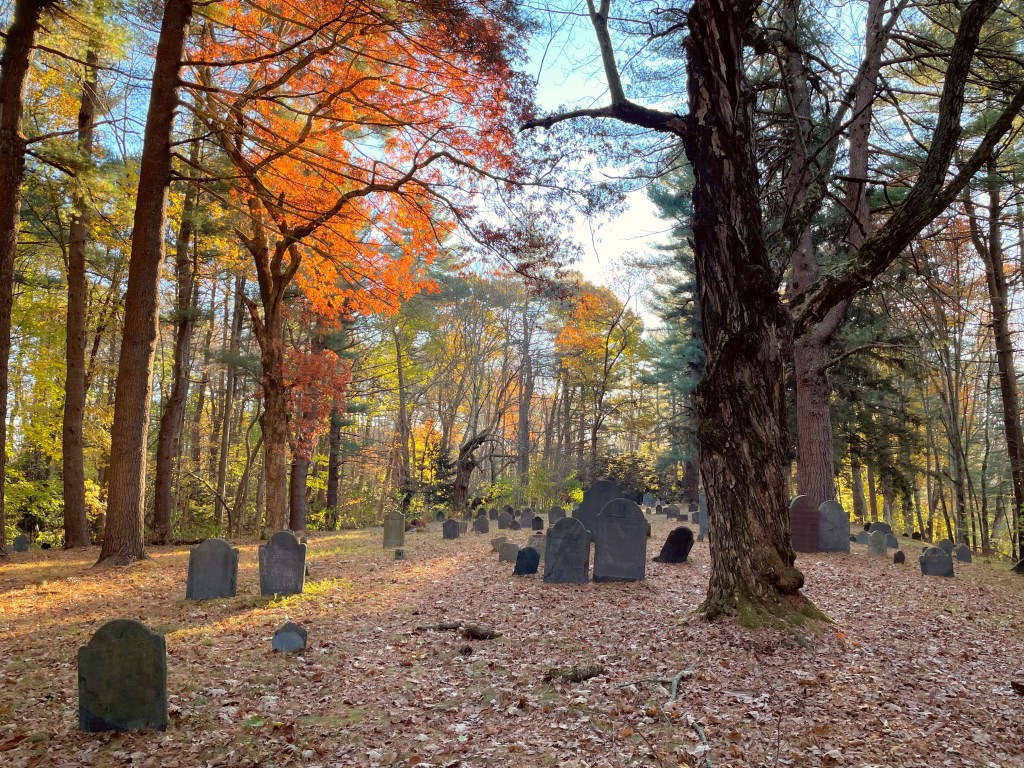
I know.. I know.. It’s not a building, but I couldn’t help myself but to find this hidden cemetery and take some photos! Tucked way off a street, across railroad tracks and down into a grove of trees, I came across this Colonial-era cemetery known as the Old Settlers’ Burying Ground. Established by 1674, it is the town’s oldest formal cemetery with gravestones dispersed, both standing up to the heavens and seemingly jutting out of the ground like crooked teeth. The Old Settlers’ Burying Ground contains approximately 196 stones and an estimated 230 burials. The stones in the cemetery reflect the continuum of headstone iconography popular from the 17th through 19th centuries, depicting winged death’s head, soul effigy, heart, hourglass, skeleton, and cherubs, to name a few. The cemetery is thought to possibly have unmarked graves of the colonists who were killed during the Lancaster Raid, the first in a series of five planned raids on English colonist towns during the winter of 1675 as part of King Philip’s War. Metacom, known by English colonists as King Philip, was a Wampanoag sachem involved in leading and organizing Wampanoag warriors during the war. The tension that led to these raids began from the decline in the fur trade due to overhunting, the decrease in the native population due to European-derived diseases, and the invasion of English livestock on native land. According to one estimate, at least fourteen Lancaster inhabitants died and twenty-three were captured and taken as prisoners, some of those 14 are likely buried here in unmarked graves.
This large, shingled horse barn at Canterbury Shaker Village in New Hampshire, was built in 1819 and measures 60 x 40 feet. The massive barn structure showcases the significance of horses and agriculture for the rural community, which lived off the land.
Everybody poops, even the Shakers. While not the sexiest building or topic, I couldn’t help but share this mid-19th century privy (outhouse) located in the Canterbury Shaker Village. The small clapboard privy measures just 6.5 x 13 feet and has two chambers, which face outward overlooking the apple orchard, making it a great place to do your business!