Oceanview House // 1883

At the tail-end of the 19th century, the active fishing town of Stonington, Maine, like many other coastal communities Down East, began to see growing seasonal tourism and summer residents escaping the woes of city life for the cool sea breezes. Although there were neighborhoods of summer cottages built and occupied in the 1890s on Deer Isle, no summer colonies formed in Stonington in the late 19th century, likely due to its industrial nature with fishermen and quarry-workers living in the village. There were however, visitors, and the 1883 Oceanview House was built to house “people from away” every summer. The Oceanview House property also included its own water tank and windmill along with a meeting room for local groups. The late Italianate style building has been lovingly maintained by later owners and most recently, housed an antique store!

Thurlow Building – Stonington Public Library // 1897

This historic building on Main Street in the working harbor village of Stonington, Maine, was built in 1897 as a commercial block for Mr. Thurlow. John Leman Thurlow (1842-1928) was born on Deer Isle and was engaged in business in town. Mr. Thurlow had this commercial building constructed to house a local grocery store with residences above. Just before its completion, the Deer Isle Gazette wrote, “J. L. Thurlow’s new store is up and the side finish is being put on. It will be a fine commodious two story and a half building, an ornament to the place.” The building later was occupied as a millinery shop, a dress shop, and was purchased in 1959 by a newly established library association. The all-volunteer operation to establish a library in town began in 1955, and a collection of donated books was eventually housed in a rented space until this building was purchased as the home of the village library.

Central Hall // c.1885

Located next door to the former High School (now the Town Hall) of Stonington, this mansard-roofed commercial building on Main Street is a prototypical example of late 19th century mixed-use architecture seen all over Maine. This building was constructed in the 1880s and known as Central Hall. The building contained retail spaces at the ground floor and tenement housing in the upper floors for workers at local granite quarries. The building is well-preserved and an important contributing building to the working village of Stonington.

Stonington Town Hall // 1885

Overlooking an archipelago of over sixty islands, the working port town of Stonington, Maine, is one of the more vibrant and active ports in the Pine Tree State. With a population of just over 1,000 residents, the town is consistently ranked among the top lobster ports in the country and is the largest lobster port in Maine. In 2011, 14,854,989 pounds of lobster were landed by Stonington fishermen! The town was originally a part of Deer Isle, with the main village known as Green’s Landing, until 1897 when it incorporated as its own municipality in 1897, choosing the name Stonington after the area’s granite quarries. This handsome mansard building was constructed in 1885 as the village’s school. Named Rockbound School, the building features an intact belltower at the rear. The school would eventually close in the second half of the 20th century, and became the Town Hall of Stonington after a fire destroyed the previous building in the 1970s.

Prospect Hill Tower // 1903

Originally part of the town of Charlestown, Massachusetts, Prospect Hill is now located in the nearby town of Somerville, established in 1842. As one of the hills closest to the city of Boston, the hill played a pivotal role in the line of defensive works constructed after the Battle of Bunker Hill. The area developed slowly, with old farms around Prospect Hill, largely subdivided in the late 19th century for residential development. Around this time, in 1886, the Prospect Hill Park Association was formed, and in 1898, land here was purchased for a public park. The focal point of the iconic neighborhood park is the stone castle structure at the top. Completed in 1903 to commemorate soldiers of the Revolutionary and Civil wars, the rusticated granite tower was designed by Ernest W. Bailey, the City Engineer of Somerville, who also worked to landscape the surrounding park. The granite blocks were shipped in from Deer Isle, Maine. By the 1960s, the structure began to suffer from deferred maintenance. The City of Somerville added the concrete retaining walls to shore up the landscape, which worked for some time. Decades later in the early 2000s, the structure was at risk of further deterioration. Through Community Preservation Act funds, the tower and surrounding landscape were restored and made safer, making this important memorial accessible and enhanced for all to enjoy. 

Louville V. Niles House // 1887

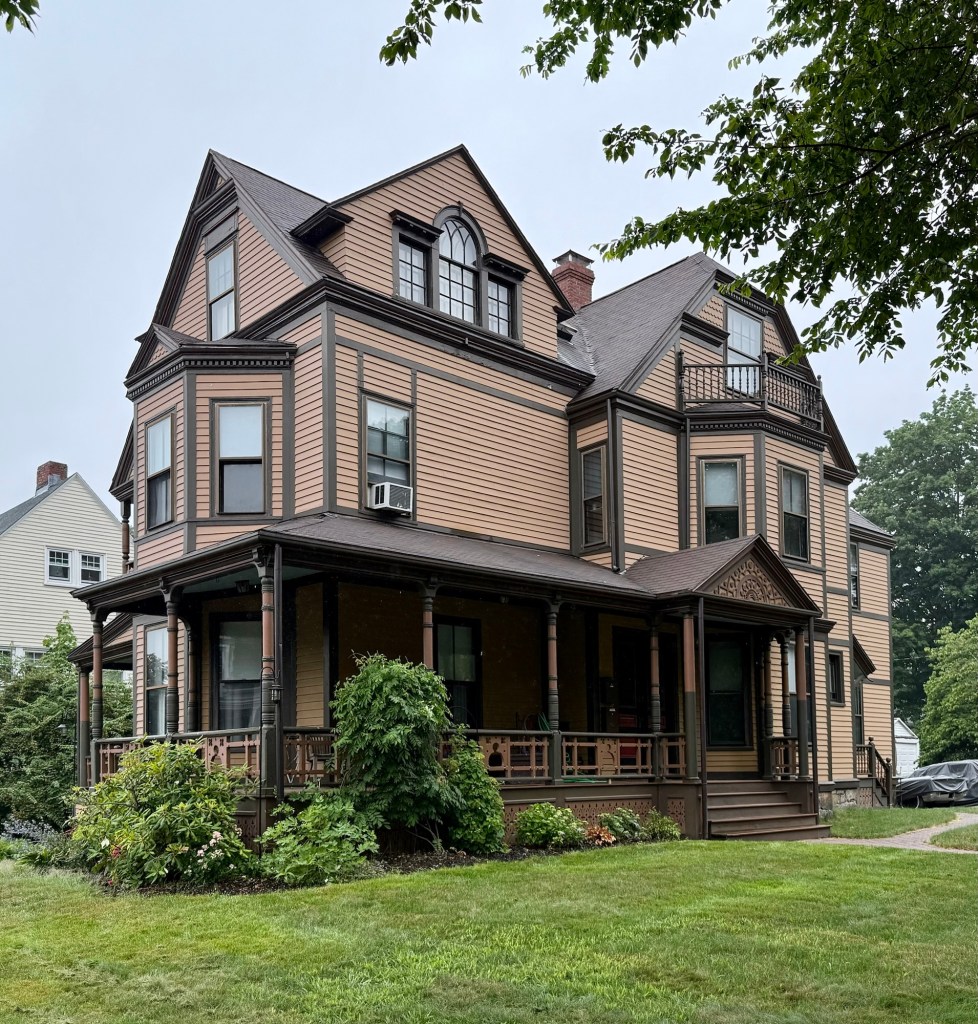
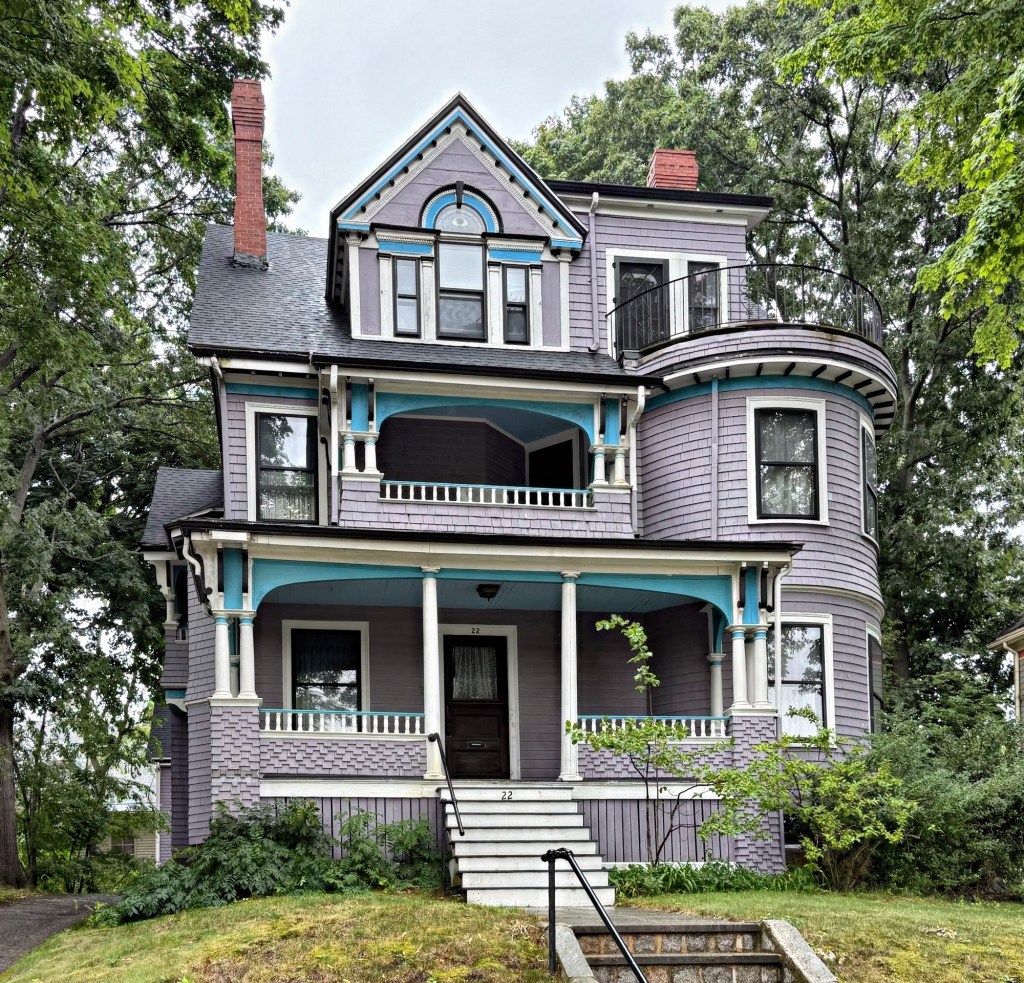
Louville Varanus Niles (1839-1928) was born in Maine and came to Boston in 1860 for the chance to make his fortune. In 1870, he formed a partnership with his two brothers in the provisions business under the name Niles Brothers. The company would later merge with the Boston Packing and Provision Company. Niles moved from Boston to Somerville in 1882, purchasing the Bradshaw estate on Walnut Street. He remained in the house until he decided to redevelop the property, building a number of dwellings on the former estate bounded by Walnut, Boston and Munroe streets. For his own residence, Louville hired the firm of T. B. Blaikie and Son, who designed this beautiful example of a Queen Anne style house in 1887. The building has irregular massing, with numerous gables and rooflines. There is a prominent two-story, rounded tower at the corner, capped with a conical roof, and applied ornament in the gable ends, all common features in this style in the Victorian period. The owners have painted the house to accent the many unique details found here. 

Hollander Apartment Buildings // 1892

These two stunning apartment buildings were constructed in the early 1890s in the Prospect Hill neighborhood of Somerville. Known as the Hollander Blocks after their original owner, Theodore Clarence Hollander, the two apartment buildings are some of the finest in the Boston suburbs. Both detached buildings follow a traditional three-decker block massing and form, but are decorated with varied siding, two-story columned porticos, and elaborate cornice. 

First United Methodist Church of Somerville // 1874

This handsome Victorian Gothic church sits on Summer Street in Somerville, defining the northern edge of the Union Square area. The church was built for the local Methodist congregation, which was established in 1855. The group would meet in local meeting halls and houses until this building was completed in 1874. The towering brick church was once even taller, but its steeple came down following the Great New England Hurricane of 1938. The church closed in the second half of the 20th century and the building was used by the Somerville Community News for years until it was purchased by a developer and converted to condominiums.

John E. Sylvester House // 1884

One of the many beautiful old Victorian houses in the Prospect Hill area of Somerville can be found here on Summit Avenue, a tree-lined street with sweeping views to Boston and other neighborhoods. This house was built in 1884 for John Edwards Sylvester (1839-1901) and his wife Clarissa (Clara). The Queen Anne style house has a brick ground floor with shingled walls above. The facade is dominated by its gable roof with varied shingle siding, decorative belt course, and oriel window with highly ornate pediment above. The house was likely designed by the Boston firm of Sturgis & Brigham, who included Sylvester in their list of clients. Mr. John E. Sylvester was head of the John E. Slyvester Co. in Somerville, a spike manufacturing company started by his father. After John died in the home from heart failure in 1901, his widow, Clara, remained in the home with her daughter until after WWI, when the property was sold. 

Mrs. Laura Haley House // 1894

This charming, gambrel-roofed house at the corner of Vinal and Pleasant avenues in Somerville, Massachusetts, was built in 1894 from local developer H. W. P. Colson, and sold upon completion to Mrs. Laura (French) Haley. An architect could not be located. Laura Haley was recently widowed and lived in the house with her daughter, with her son purchasing the house next door. The Haley House is notable for its gambrel roof with gambrelled center gable, pilastered dormers, stained glass windows, and full-length porch with columns and rubblestone base. The well-preserved house blends Queen Anne and Colonial Revival styles under one broad roof. It is magnificent!