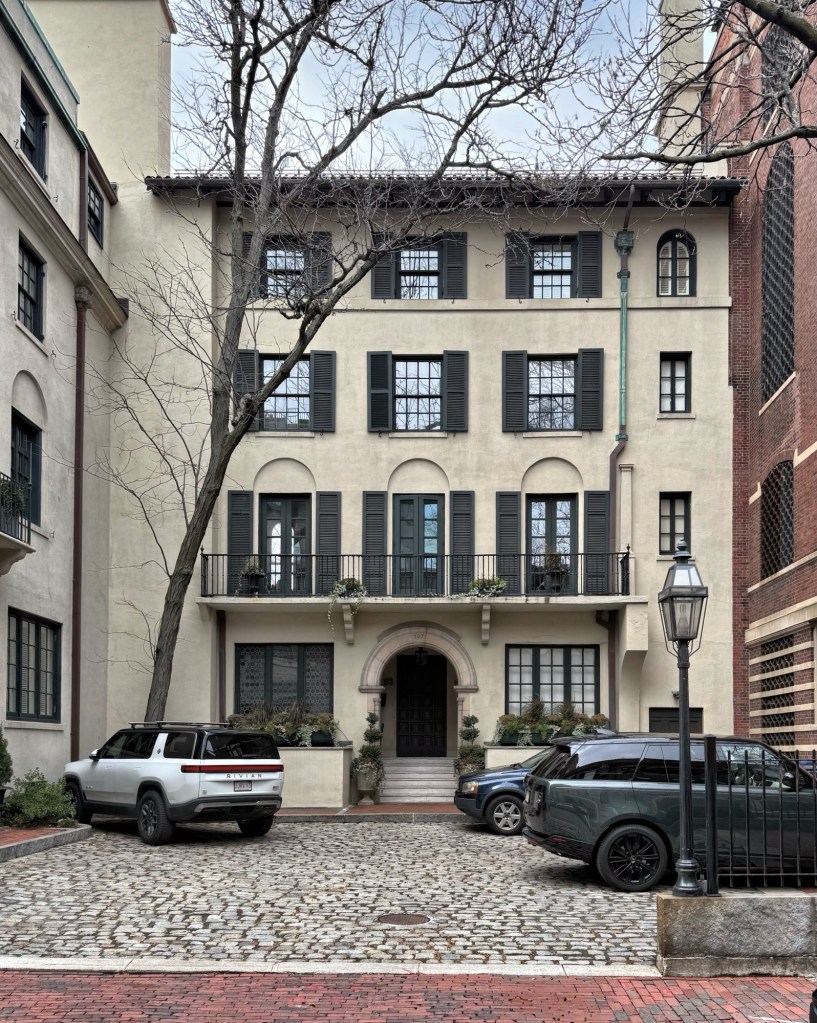
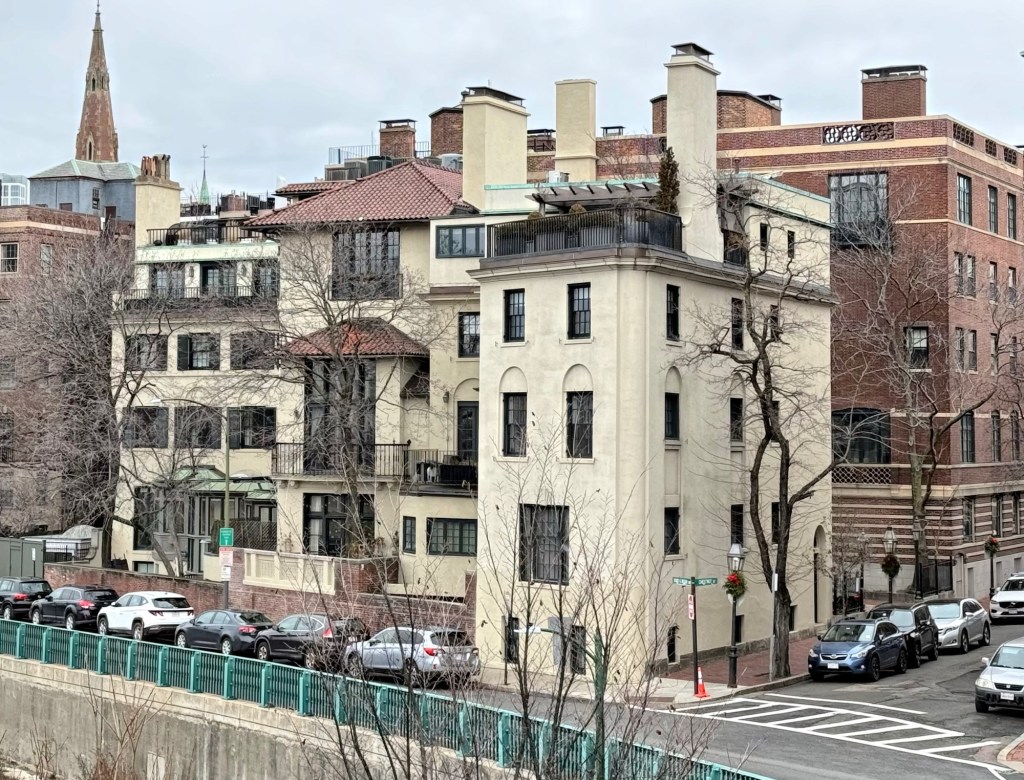
Located at the western end of Chestnut Street in the Flat of Beacon Hill, you will find this stucco residence, one of the finest mansions in Boston. The four-story residence with two entrances is built of brick and covered with stucco and was constructed for Miss Grace Nichols (1874-1944), the daughter of John Howard Nichols, who worked for John Lowell Gardner (the husband of Isabella Stewart Gardner) as a merchant transporting goods between Boston and Chinese markets, before overseeing mills. As a single woman, Grace inherited much of her parents wealth upon their deaths, and in 1913, hired architect, William Chester Chase, to design her Beacon Hill home in the Italian Renaissance Revival style, similar to Isabella Stewart Gardner’s Fenway Court mansion (1903). Grace Nichols married Richard Pearson Strong, a Harvard professor and medical researcher, in 1936 and the couple lived here with servants until their deaths in 1944 and 1948 respectively. After their death, the building was either purchased by or willed to the Boston Society of Natural History and the New England Museum of Natural History, which moved out of their Berkeley Street location in 1946. The Nichols Mansion served as the new Boston Museum of Science until 1951, when the new and current museum was built between Boston and Cambridge. Today, the former Nichols mansion is five condominium units, with owners having one of the most enchanting and unique properties in the exclusive Beacon Hill neighborhood.
 Buildings of New England