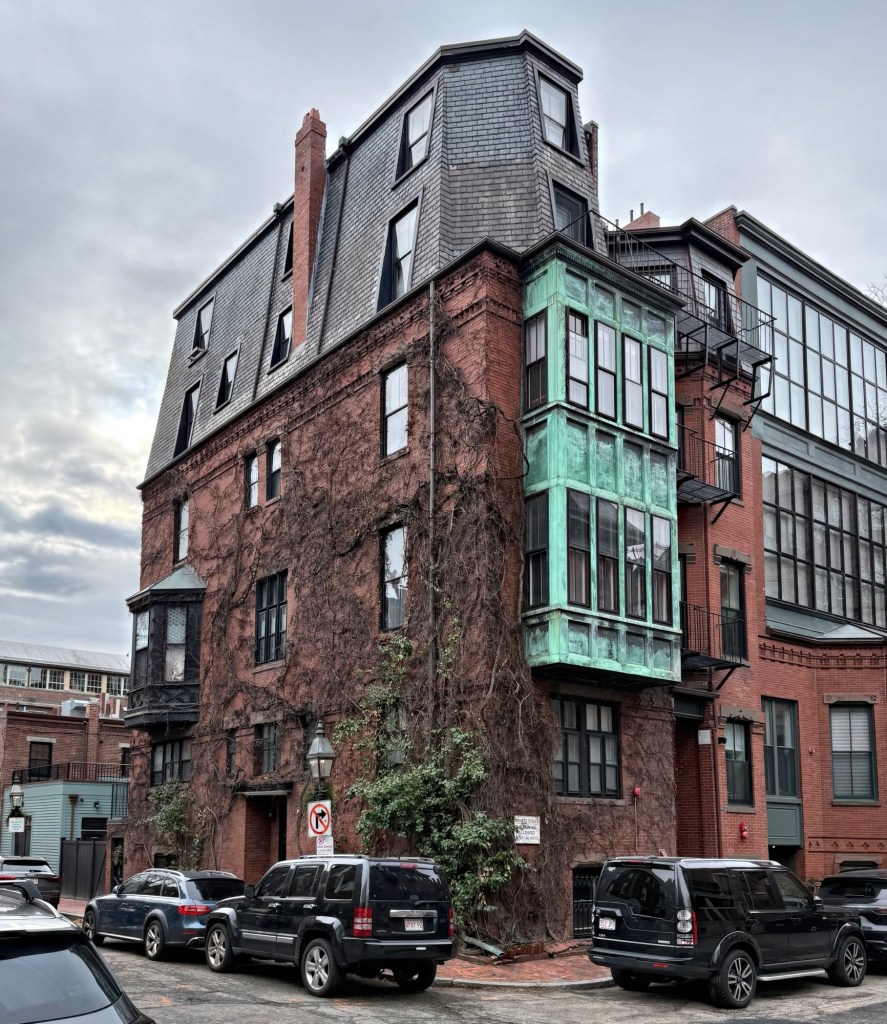
Martin-Ware House // 1872

One of the most interesting houses in Beacon Hill is this unique Second Empire style townhouse with towering two-story mansard roof at 3 Otis Place/49 Brimmer Street. When walking around Boston and exploring other cities, it is always fun to delve into research and learn about the built environment and the stories that brought these places to be! This residence was constructed in 1872 on land that was filled here between 1867 and 1869 formerly occupied by the Charles River. Creating the land at and around Otis Place was one of a series of responses to the need for more physical space in Boston and to cover the pollution of the Charles River along the West End and what would become the Back Bay. The houses at 3-4 Otis Place were originally owned and designed by architect, Abel C. Martin, who resided next door to the topic of this post until his death. In the early 20th century, this house was owned by Charles Eliot Ware Jr. a publisher, who in 1929, hired architect, Charles Greely Loring to add the copper-clad oriel window on the north elevation and elevate the mansard roof to create the unique two-story mansard. The old Martin-Ware house has been apartments since at least the 1960s.
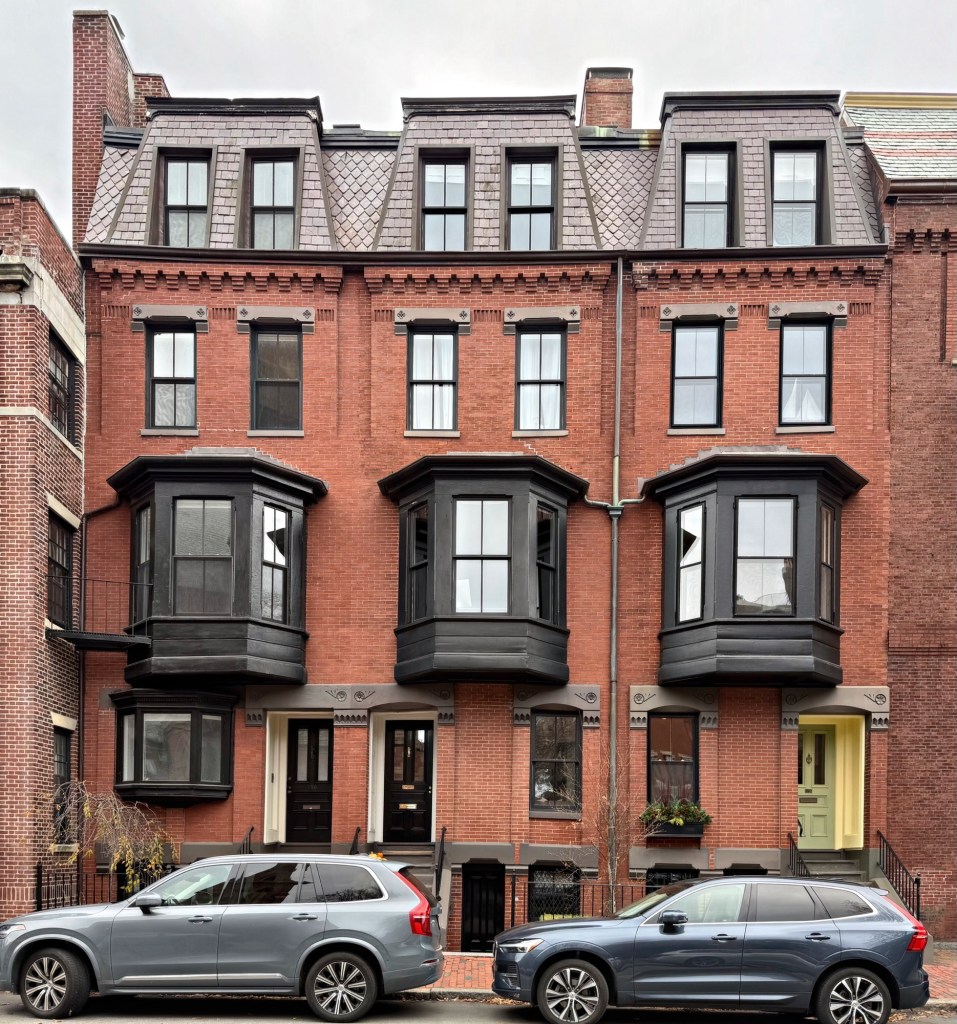
Samuel and Emily Eliot Rowhouses // 1871

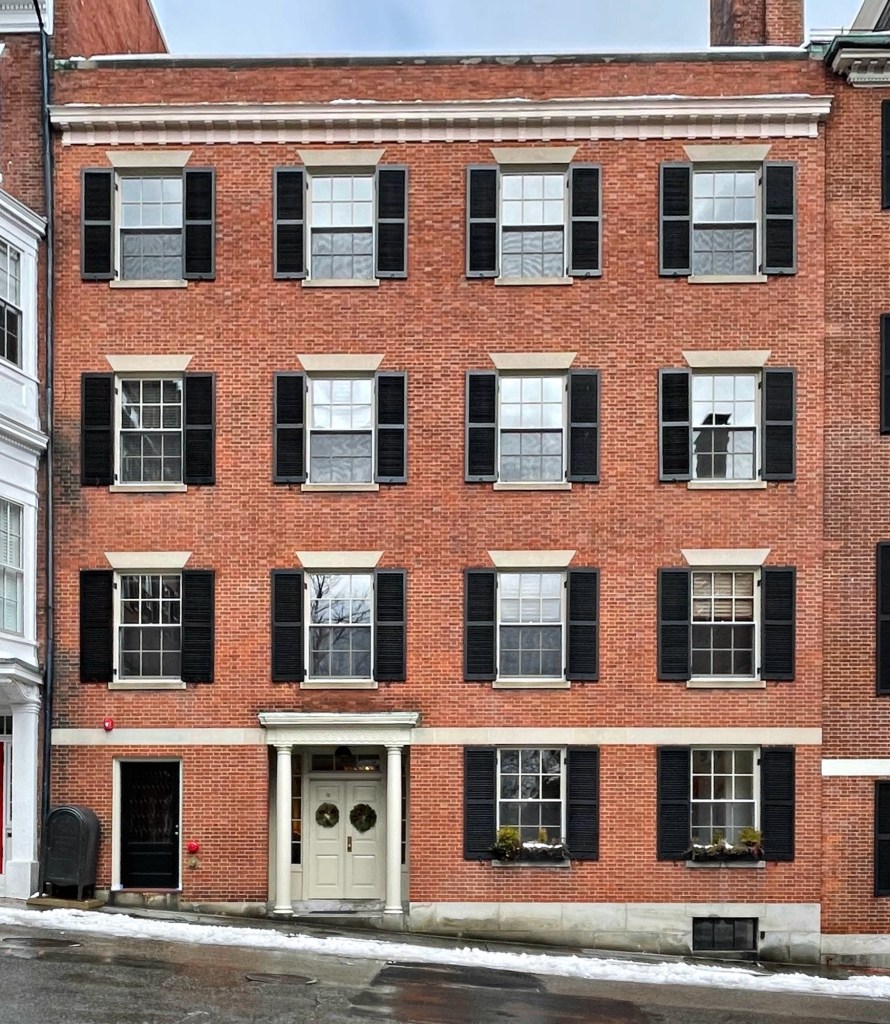
These three identical three-story houses at 156, 158 & 160 Mt. Vernon Street in Beacon Hill Flat were built in 1871 as income producing properties for Samuel and Emily Otis Eliot who lived next door on the corner of Brimmer Street. The architect is not evident from my research, but they were likely designed by Abel C. Martin, who furnished speculative housing for the Eliot’s elsewhere in the neighborhood. All three residences feature brick facades with off-center recessed entries on raised stoops. The use of brownstone lintels and sills, decorative brick cornice, and second-story hexagonal oriel windows add intrigue to the design, along with the slate mansard roofs. The three houses were sold or rented and all were owned by various families, but notable owners of the central house include the architect George Russell Shaw (1848-1937) of the firm Shaw and Hunnewell through the early 1900s. Later in the 20th century, the house was owned by Kevin White (1929-2012), who served as the mayor of Boston for four terms from 1968 to 1984.
All three residences are well-preserved and look much as they did when constructed over 150 years ago.

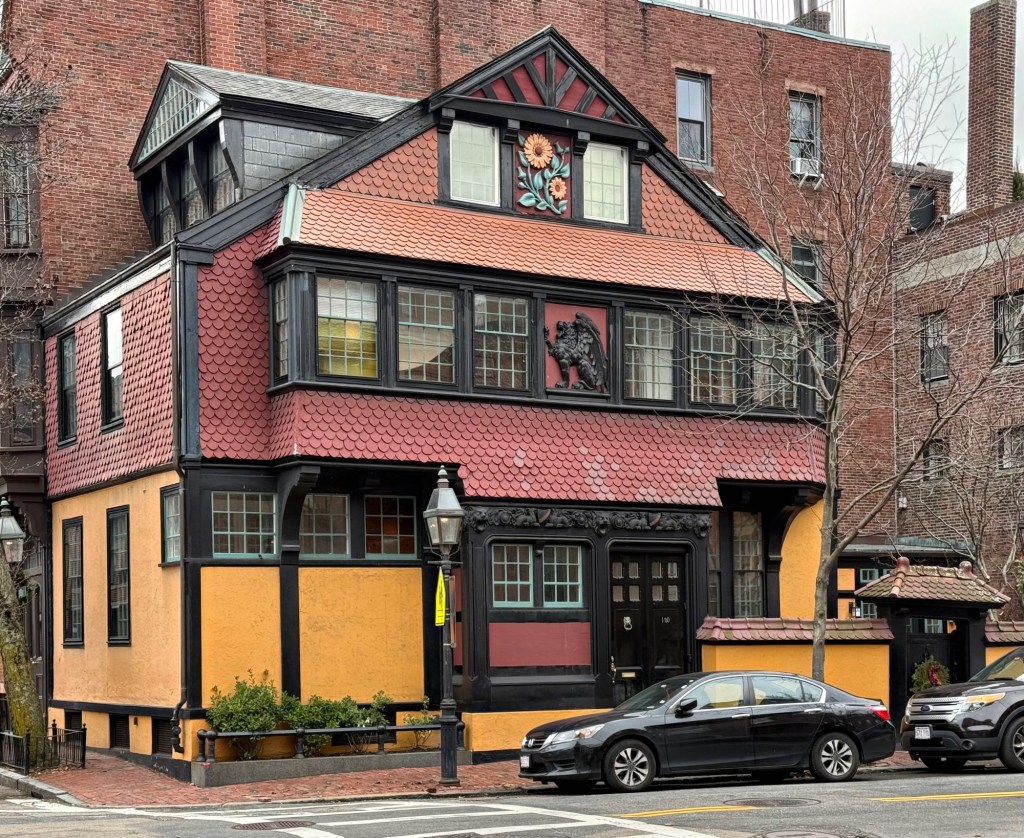
Sunflower Castle // 1878

This absolutely unusual and enchanting cottage on Mount Vernon Street in Beacon Hill, Boston, was originally was constructed in the 1840s but completely altered decades later in its distinctive English Queen Anne style. In 1878, Frank Hill Smith, an artist and interior designer, worked with architect, Clarence Luce to renovate what was originally a two-story Greek Revival house into one of the most eclectic and unique residences in New England. The Sunflower Castle, a name reputedly coined by Oliver Wendell Holmes, features a yellow stucco first floor with the upper floors covered with red fish-scale shingles. Further detail includes the half-timbering, decorative panels depicting a gryffin and a sunflower in the gable, and carved wood frieze over the doorway. Clarence Luce was likely so inspired by this project, that he built an even more extravagant example of this house for Edward Stanwood in Brookline soon after. By 1903, the property was sold to the painter, Gertrude Beals Bourne and her husband, architect, Frank A. Bourne, who were both key players in the revival and gentrification of the Beacon Hill Flat neighborhood west of Charles Street in the early 20th century. The Sunflower Castle was used as their home and as an artist’s studio for the couple, with Frank adding the side garden wall with tile-roofed gateway to enclose a private open space. The property remains as a private residence.


Braman-Cabot House // 1869

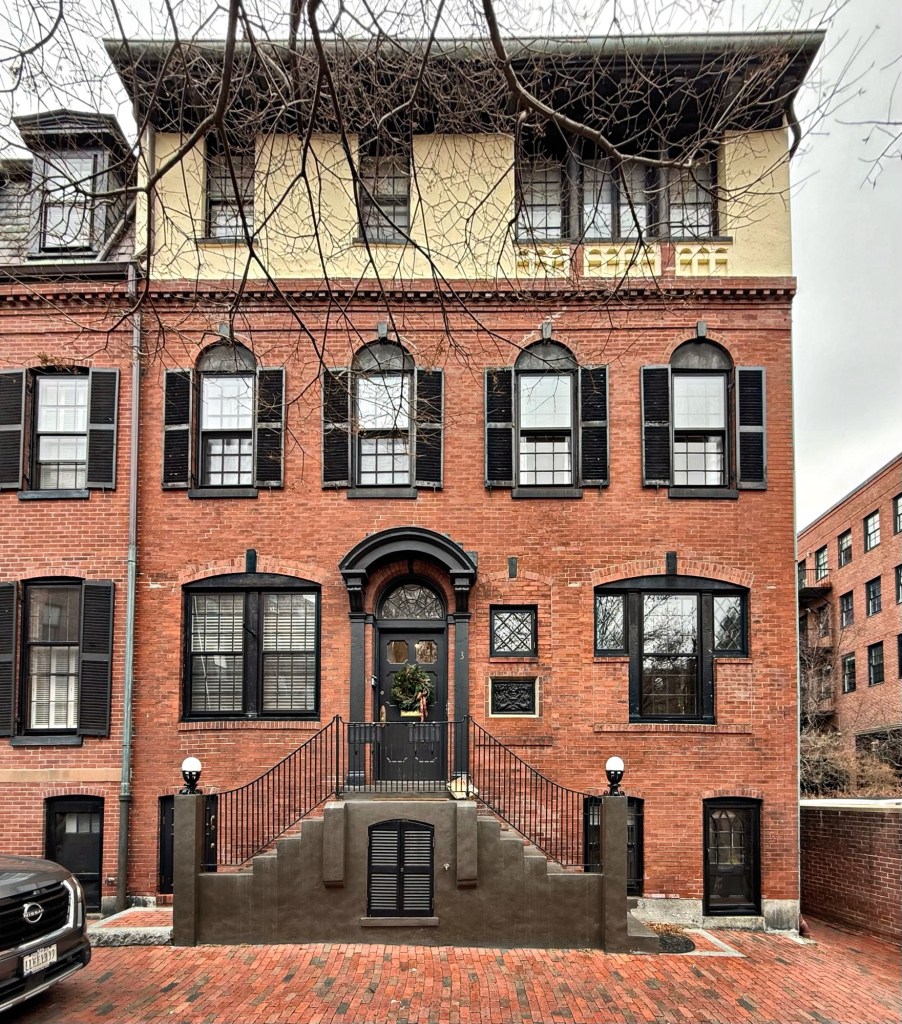
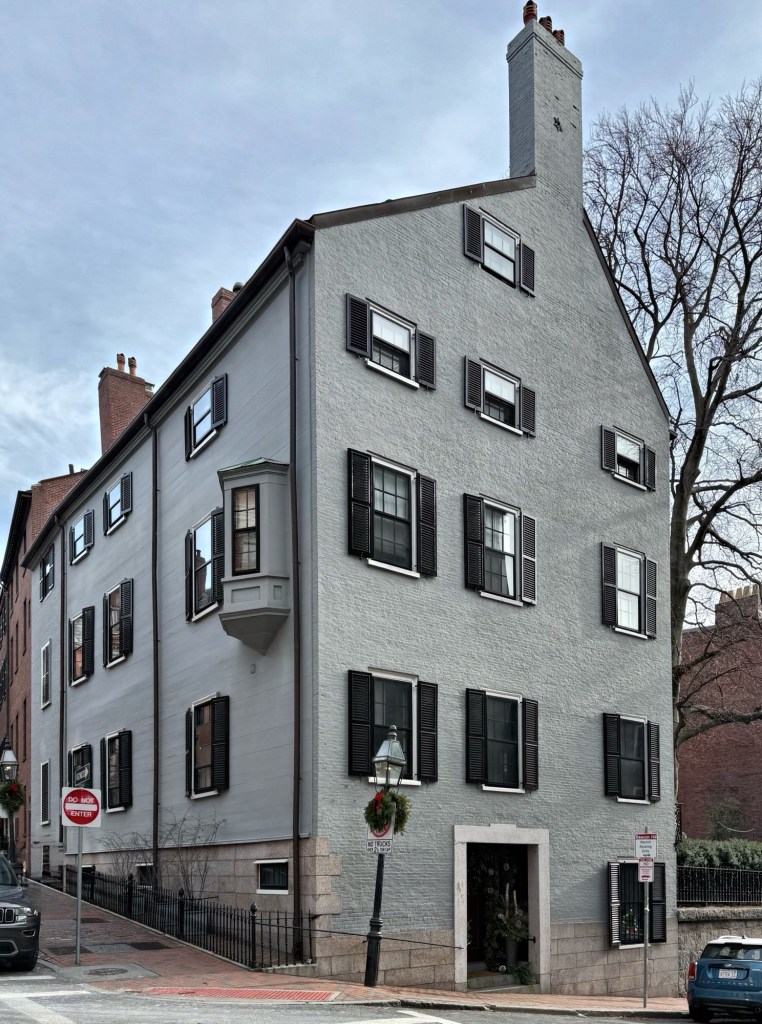
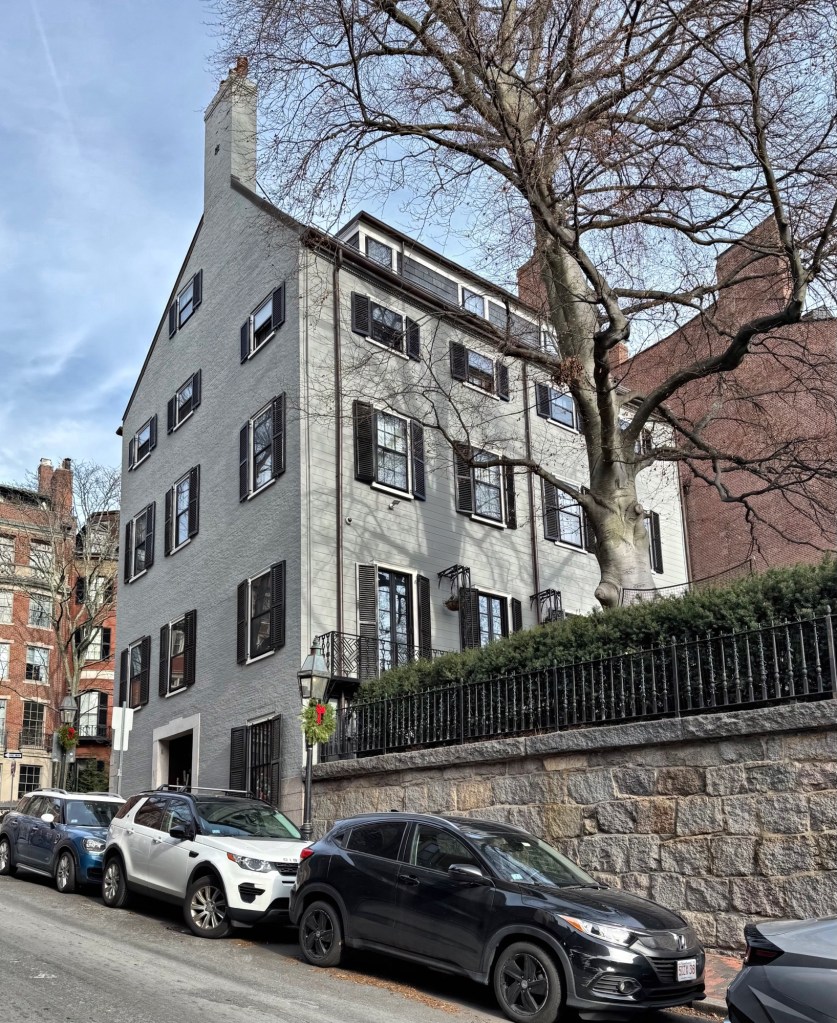
This charming residence is one of a few hidden houses tucked away on Mt. Vernon Square in Boston’s Beacon Hill. The small enclave of four houses with a stable was developed in 1869 by the partnership of builder Daniel Davies and Grenville T. W. Braman, a businessman turned real estate developer in the mid-late 19th century. The residence pictured is today known as 3 Mt. Vernon Square, but was once a double-house that was rented to families by Braman before they were sold off to separate owners. In 1903, Philip Cabot (1872-1941), a member of the wealthy Cabot Family of Boston, purchased both 3 and 4 Mt. Vernon Square and had the homes combined to a single-family home for his family. It is unclear who was hired as architect, but the property was renovated with a new central entrance, full third floor faced with stucco replacing the former mansard roof, diamond-pane and blind arched windows, and a decorative metal or cast-stone panel inlaid in the facade. Philip was married to Lucy Fuller but filed for divorce in 1910 after she deserted him according to local papers, and in 1911, she married Winthrop Ames, of the wealthy Ames Family of North Easton, Massachusetts. Philip Cabot also remarried, and sold the house on Mount Vernon Square to Frank Washburn Grinnell, a successful attorney.

Faulkner-Hayden House // 1881

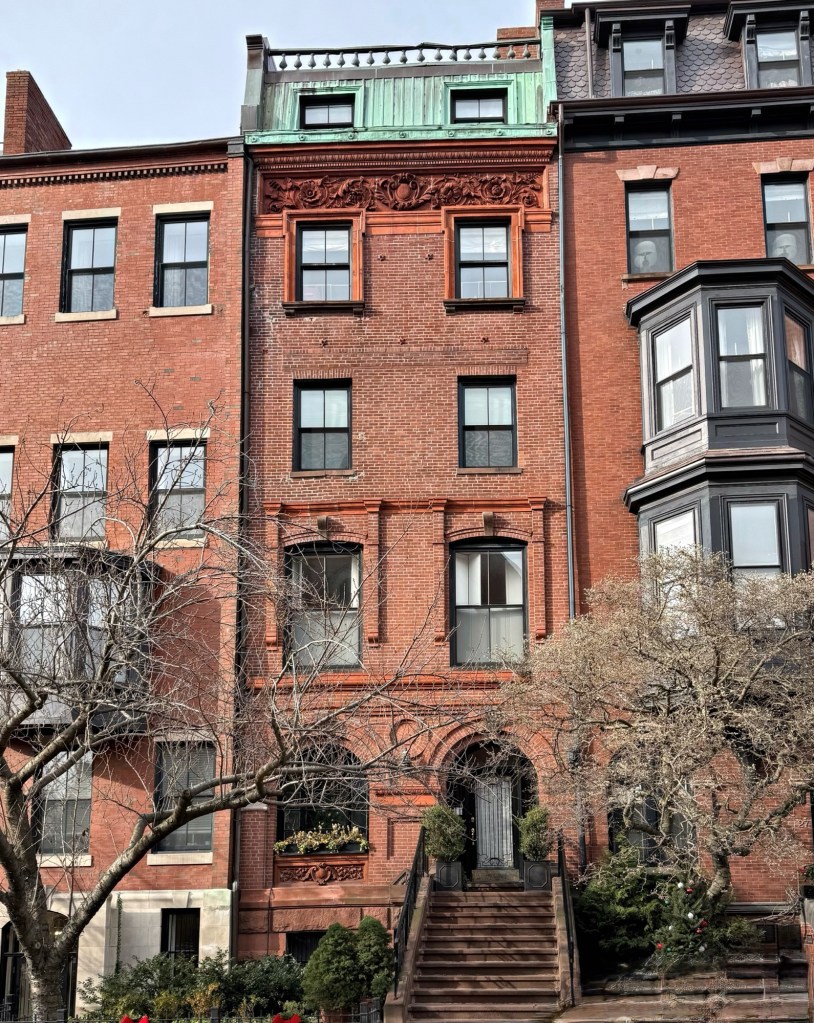
This unique house at 29 Brimmer Street in Boston’s Beacon Hill, was completed in 1881 is architecturally distinctive compared to the early 19th century homes that the neighborhood is known for. The five-story residence has a raised entrance up a flight of steps set within an arched opening. To the side, an arched window frames the facade and has an ornate terracotta panel as a base. More terracotta ornament can be found at the second floor and under the cornice as a thick band frieze with a copper-clad mansard roof above. The single-family residence was built in 1881 for Charles Faulkner (1811-1885), a commission merchant, for his daughter, Ann Ruth Faulkner the year of her marriage to Charles Rowley Hayden. Mr. Hayden was a musician and vocalist. For the new wedding gift, Faulkner hired the esteemed architectural firm of Bradlee & Winslow prepare the designs. The former Faulkner-Hayden House today contains five condominiums.


Baker-Byrd House // 1888

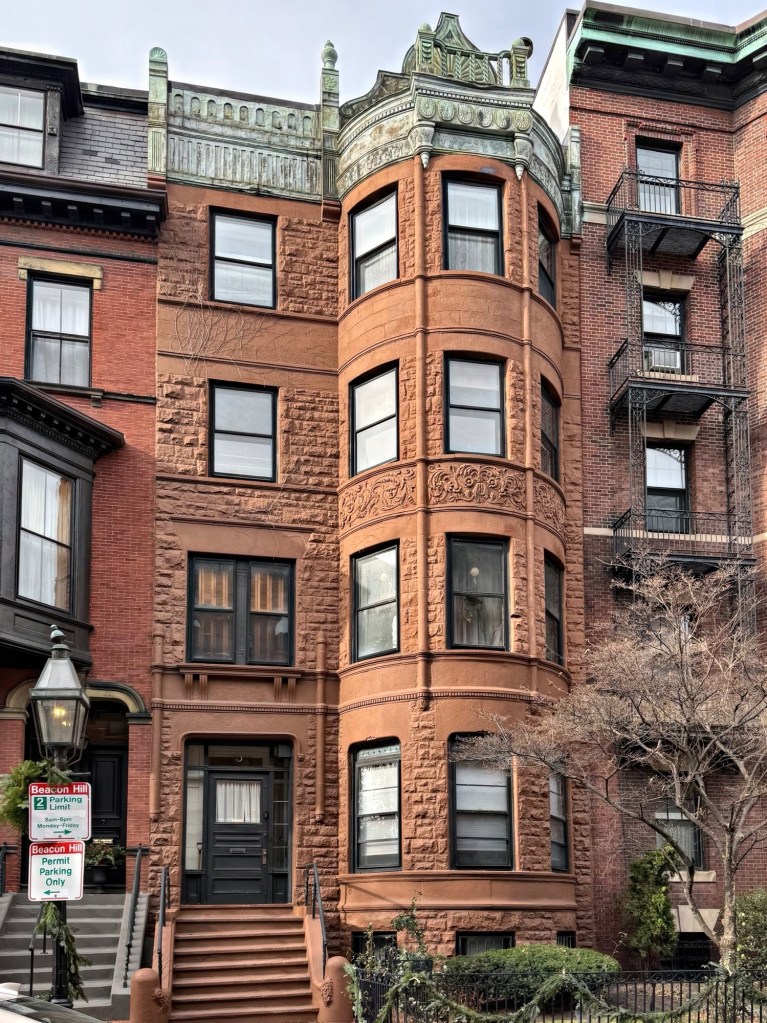
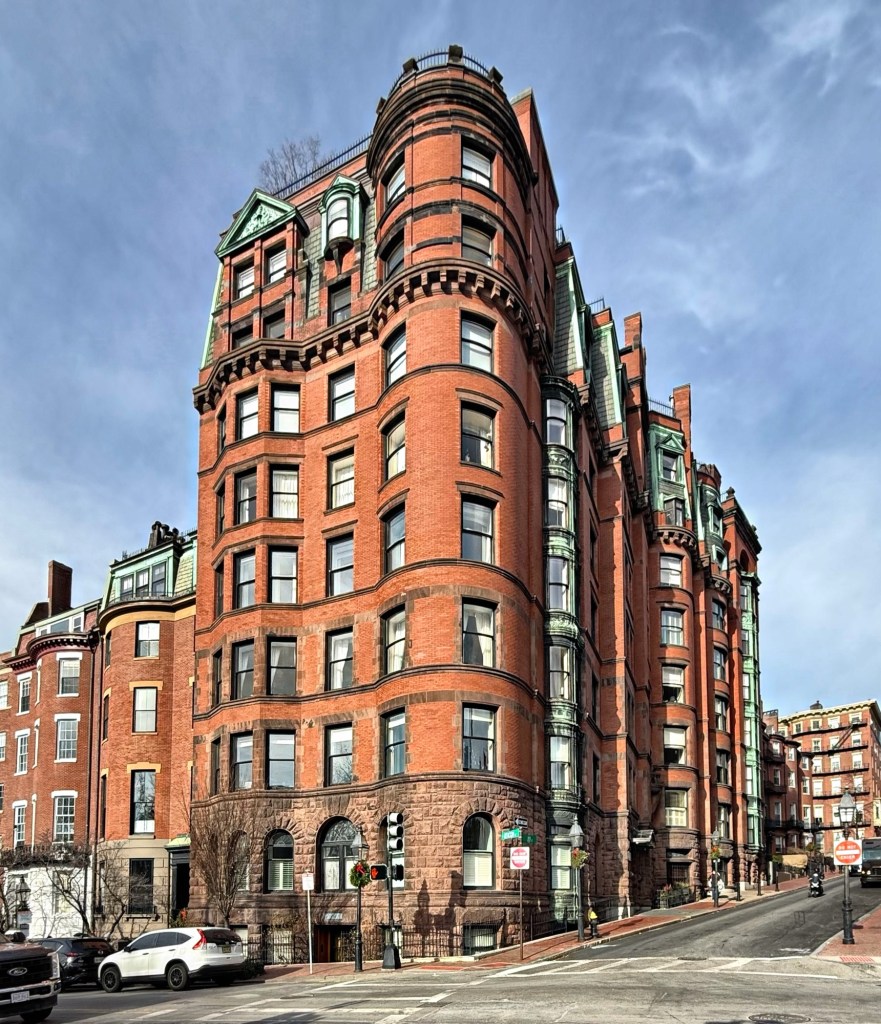
Located on Brimmer Street in Beacon Hill, this handsome residence is constructed of rough-faced brownstone laid in a random ashlar pattern and is among the most unique in a neighborhood known for brick townhouses. Decorative treatment includes a stone band that is carved with foliate and faces, colonettes that rise along the facade at the bay, and an ornate molded copper entablature and parapet at the roof. The residence dates to 1888 and was built for Seth R. Baker, a Boston real estate developer at the end of the 19th century. It can be inferred that the building was designed by architect, Ernest N. Boyden, as Baker hired Boyden as architect for a half-dozen other apartment buildings between 1888-1890. Antoino Xavier, a Portuguese-born mason is listed as the builder. In the 1910s, the property was purchased by Marie Ames Byrd, wife of polar explorer Richard A. Byrd, who lived a few houses away at 9 Brimmer Street. She rented the four apartments to boarders through the 1930s.


Eliot C. Clarke Townhouse // 1884

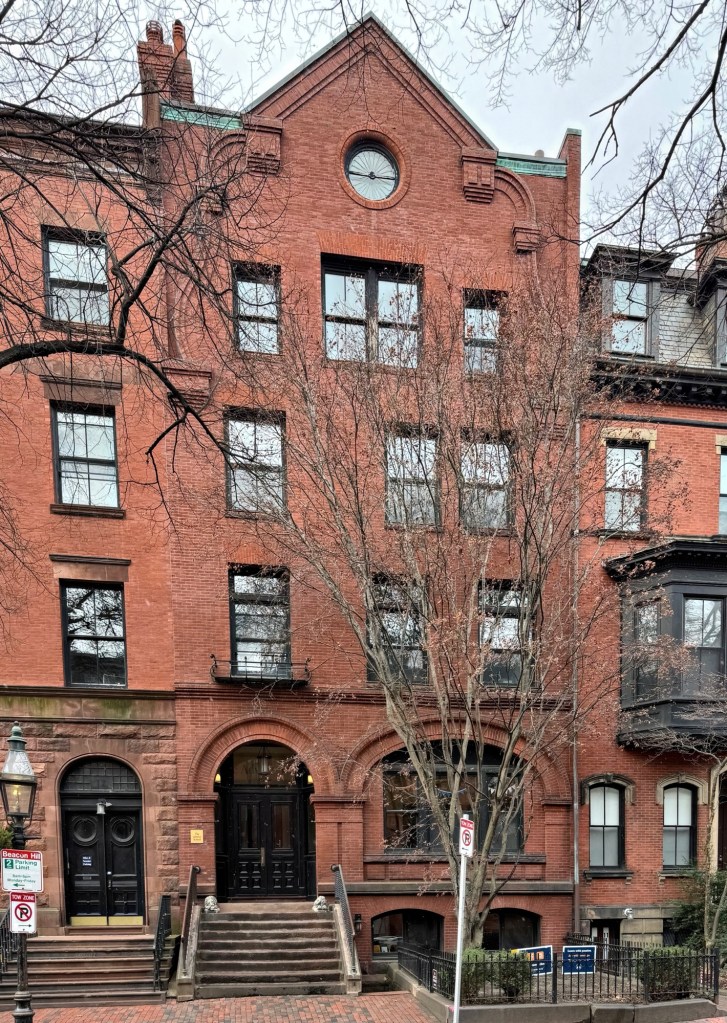
One of the many great townhouses on Brimmer Street in Boston’s Beacon Hill neighborhood is this residence designed as a unique interpretation of Queen Anne and Romanesque Revival styles. Original owner, Eliot Channing Clarke (1845-1921), an MIT-educated civil engineer. His uncle, Thomas Curtis Clarke, was a noted civil engineer, a member of the firm of Clarke, Reeves & Co., Bridge Builders in Pennsylvania, and served later as President of the American Society of Civil Engineers. When Thomas Clarke’s firm was designing and building a new bridge over the Mississippi River in Quincy, Illinois, he had his nephew lead in the design. In 1876, Eliot was appointed engineer in charge of a survey for a main drainage system for Boston. The project was adopted and construction began a year later, taking years to complete. In 1885, Clarke published the work that he oversaw, modernizing a rapidly growing Boston water and plumbing system. He became one of the leading sanitary engineers of the United States. In 1884, Clarke hired architect, S. Edwin Tobey, who designed this townhouse with a unique gable containing a ocular window and panel brick parapet as an interpretation of a Flemish gable. A traditional arched entry in brick is a nod to the Romanesque Revival style, which surged in popularity in Boston following the completion of H. H. Richardson’s Trinity Church. In 1969, the Clarke house’s interior was connected with its neighbor as the Advent School, a private K-6 school associated with the Church of the Advent across the street.

West Hill Place // 1916

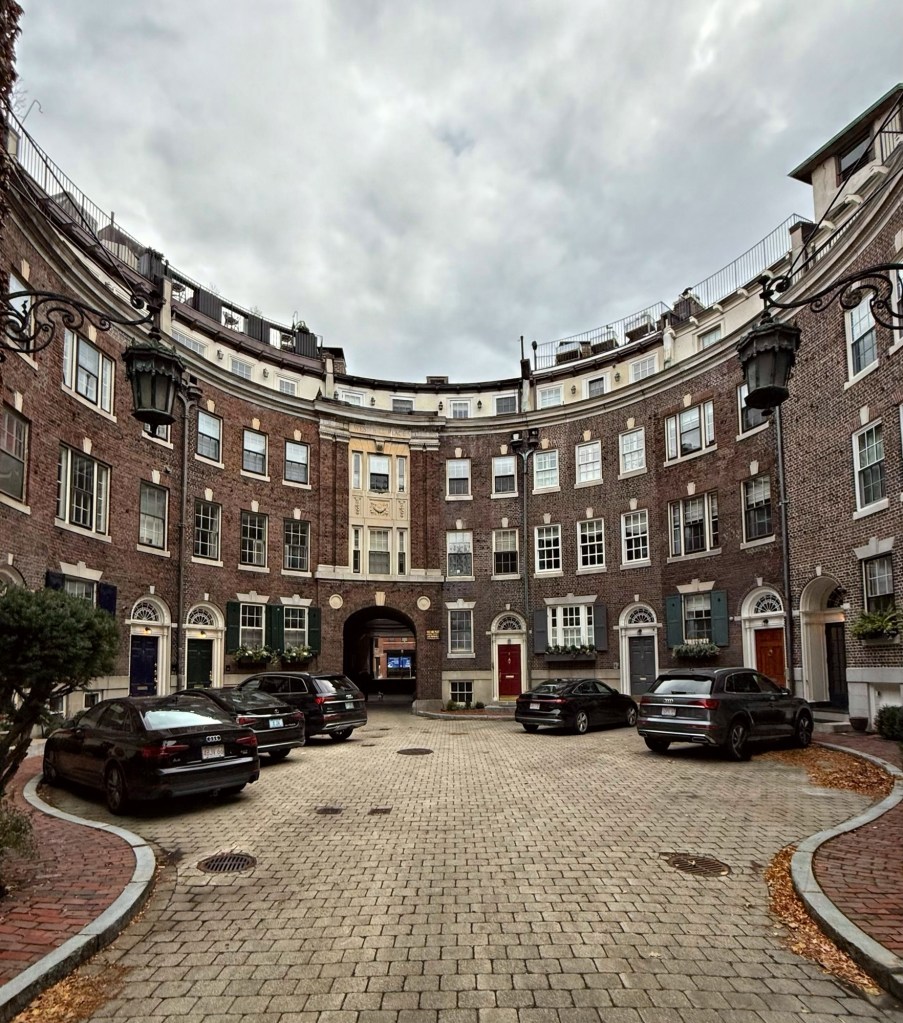
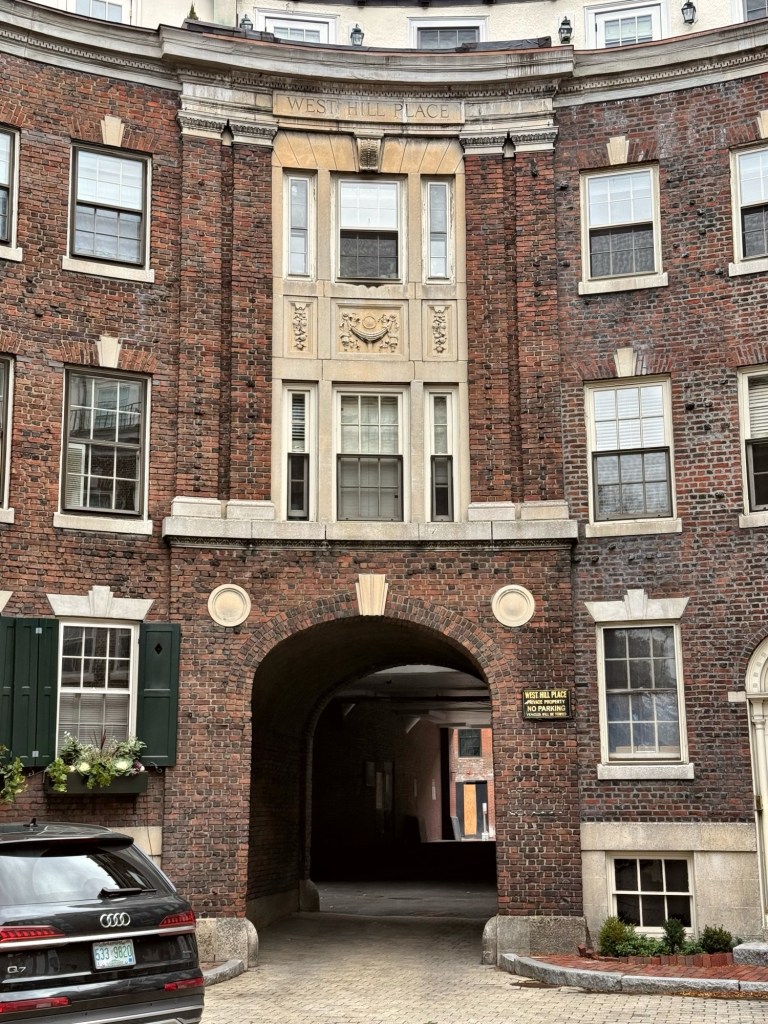
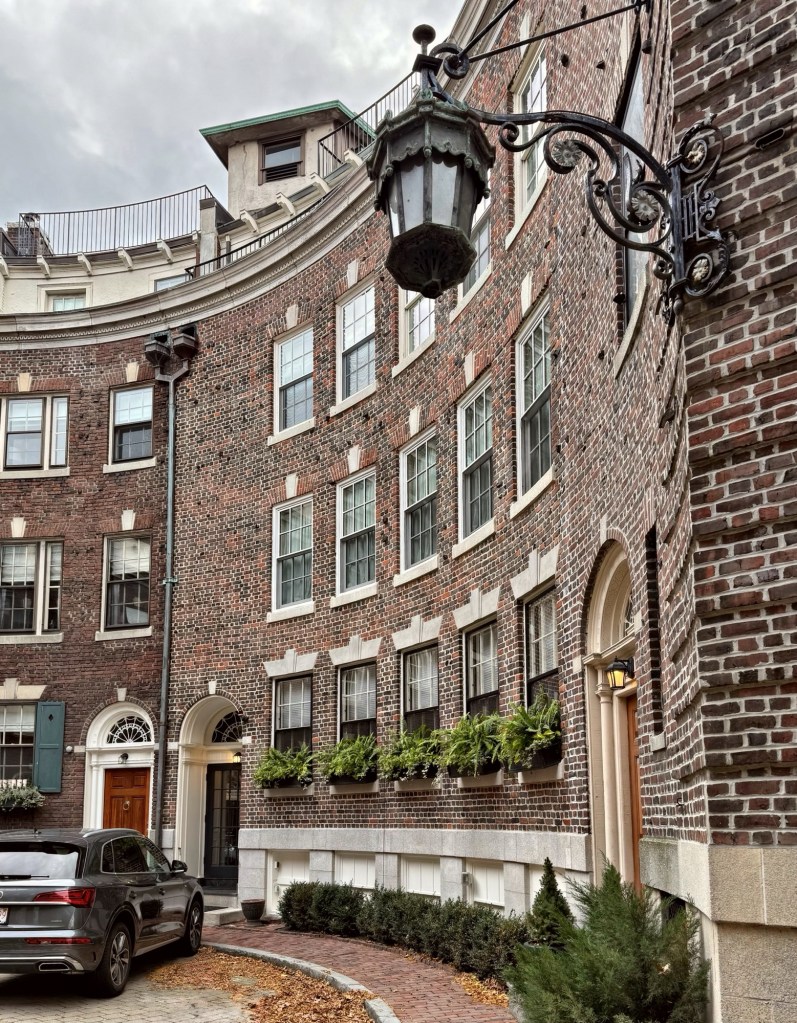
West Hill Place is a small development in Beacon Hill that feels like it was transported to Boston from London! The group of 14 four-story brick townhouses that comprise West Hill Place were built on the site of a gas holder in 1916. The Georgian Revival style development was designed by the firm of Coolidge and Carlson, who aligned six of the townhomes to face west on the Charles River Embankment and arranged the remaining eight residences around a circular court. The development was inspired by Charles River Square, located to its south and built six years prior. The driveway extends off what is today Storrow Drive, with a second exit set within an arched passageway that connects through the Charles Street garage, which was built later. The dark brick with cast stone trim works elegantly with the curving facades facing the courtyard, many of which are adorned with arched doorways and the original iron lanterns. The development has been harmed by the creation of Storrow Drive in the 1950s, but it remains one of the most unique and picturesque enclaves in New England. 

Charles and Elizabeth Ware Mansion // 1870

Located at the corner of Brimmer and Mount Vernon streets in Beacon Hill, this stately mansion showcases the various architectural styles and methods utilized by architects in the waning decades Victorian-era Boston. Set atop a brownstone base, the floors above are in the “Panel Brick” style, which utilizes brick masonry in a variety of decorative patterns of slight projecting or receding panels. The style was popularized by the Boston architectural firm of Ware & Van Brunt, as noted by architectural historian, Bainbridge Bunting. As expected, this house (and the attached townhouse next door) was designed by William Robert Ware for his uncle, Dr. Charles Eliot Ware (1814-1887) and his wife, Elizabeth Cabot Lee Ware. Dr. Ware was a physician at Massachusetts General Hospital and secretary of the Massachusetts Medical Society. After the death of Dr. Ware and Elizabeth, the property was inherited by their daughter, Mary L. Ware (1858-1937), a naturalist and botanist who was the principal sponsor of the Harvard Museum of Natural History‘s famous Glass Flowers. After the death of Mary, the property sold out of the family to Robert Wales Emmons III, a financier from a yachting family. The mansion remains in a great state of preservation, and is among the great Victorian-era residences in Beacon Hill.

Simmons House – Japanese Relocation Hostel // 1856

Together with its two neighbors to the south, this townhouse at 6 Walnut Street represents the development of the South Slope of Beacon Hill in the second half of the 19th century, when larger estates continued to be carved up for housing, typically in the Italianate/Second Empire styles. Built in 1856, this residence was constructed on one of the last undeveloped lots in the area and was originally owned by George W. Simmons. Simmons was the owner of a well-known clothing emporium at Oak Hall, North Street, where he sold all kinds of ready-made clothing for men, including that needed by sailors, as well as sets of clothing for those headed for the California gold fields. His business was renowned also for its ambitious and creative advertising campaigns. Simmons died in late 1882, leaving this property to his heirs who sold the property. After successive ownership, the residence was converted to a boarding house during the Great Depression and rented out to families who could no longer afford the large single-family dwellings in the city. After WWII, in 1945, the boarding house was converted into the first Relocation Hostel for Japanese Americans in New England. The mission of the Relocation Hostels was to provide temporary lodging and career guidance to Japanese Americans who had been uprooted from their homes because of unfounded accusations of sabotage during World War II. Massachusetts joined New York, Pennsylvania, Illinois, and other states in establishing these hostels. Today, the residence is a four-unit condominium.