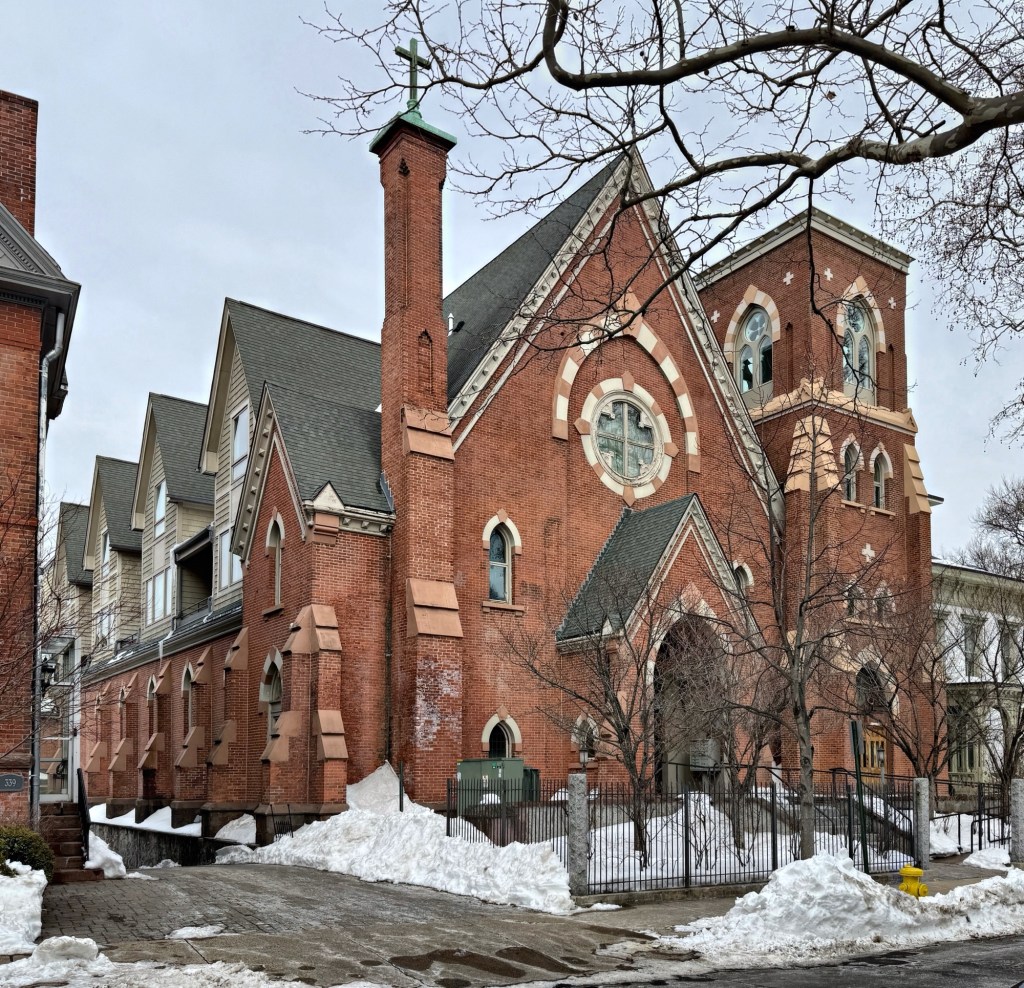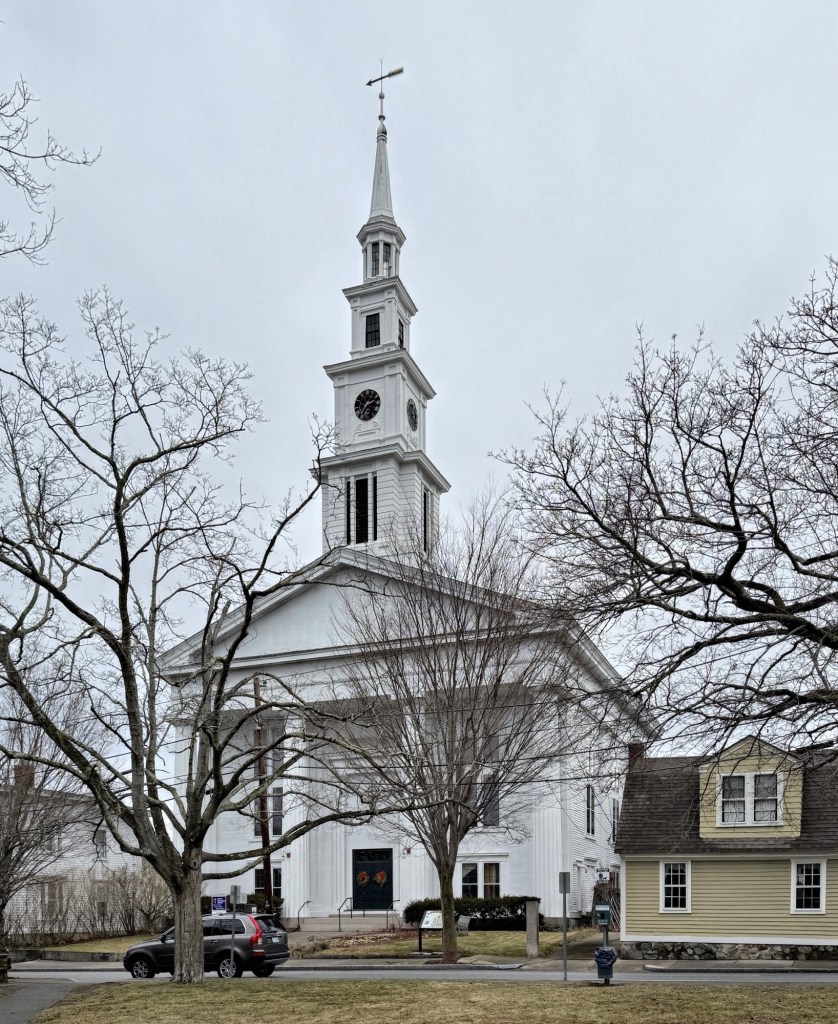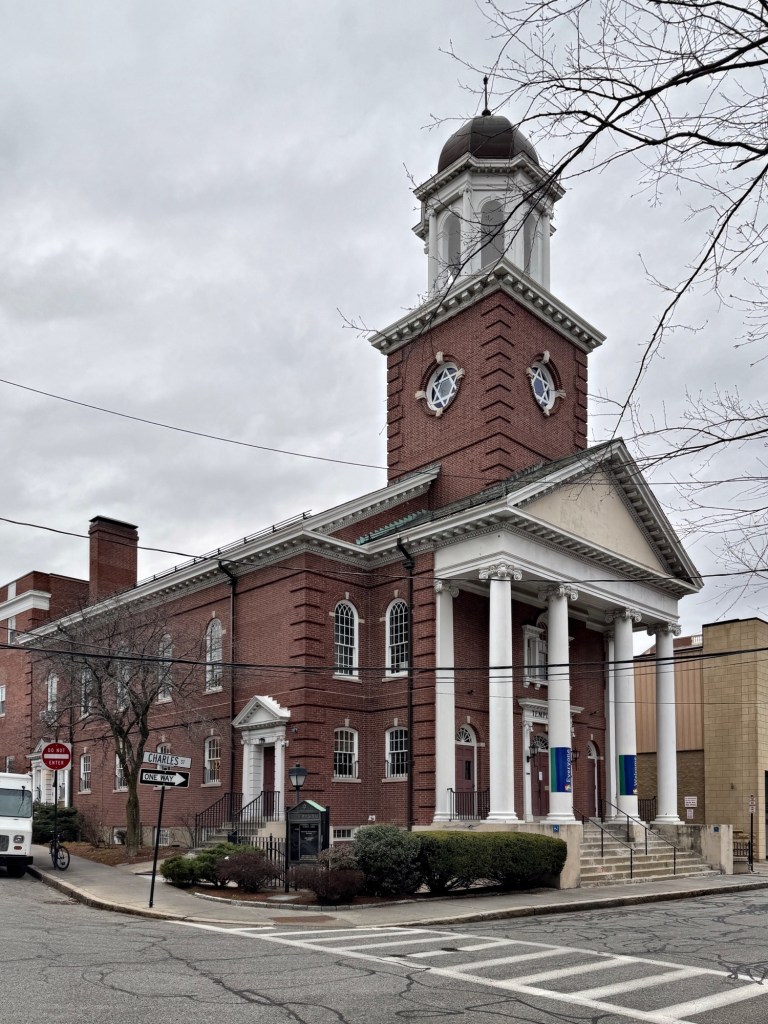
St. Mary of the Assumption Catholic Church, Brookline Village // 1880

St. Mary of the Assumption church was the first Catholic Church established in Brookline, Massachusetts, in 1852 when a congregation of Catholics began to congregate to worship together at the old Lyceum Hall. The congregation primarily consisted of Irish immigrants who settled in Brookline, where they often found work at the many large estates and building the new branch railroad in town, but desired a true house of worship close to their homes. By 1853, a modest wood-frame Gothic Revival style church was built in the Village, but was quickly outgrown. In 1873, the pastor of the congregation, Irish-born Rev. Lawrence Morris (1845-1900) began purchasing land at the corner of Harvard Street and Linden Place to establish a new church, large enough to comfortably fit the congregation and various church-related buildings. In 1880, the firm of Peabody & Stearns was hired to furnish plans for the Victorian Gothic edifice in brick and brownstone. Although the church was designed in 1880, it was not dedicated until 1886, and at this time, Pope Leo XIII sent a chalice to the Parish in honor of the completion of this church, the first in America to be named Saint Mary of the Assumption.

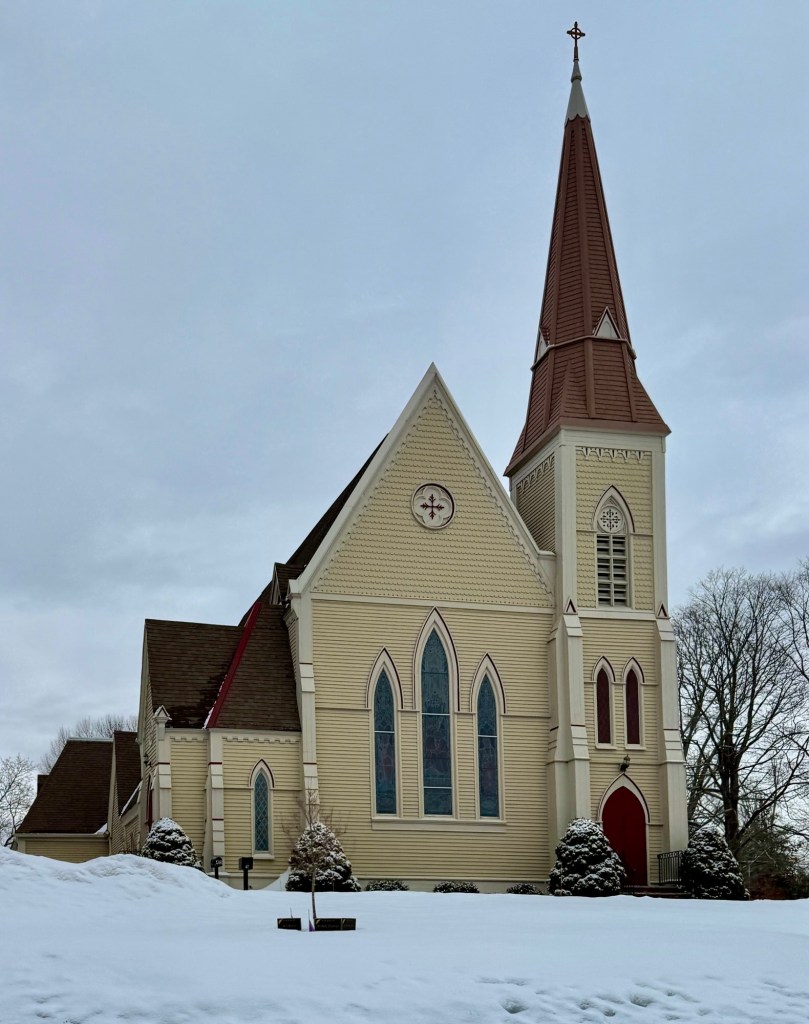
Swedenborgian Church of Lancaster // 1881

Built in 1881, the Swedenborgian Church of the New Jerusalem in Lancaster, Massachusetts, is a handsome Victorian-era chapel that has been well-preserved for nearly 150 years. The Queen Anne/Shingle style church was designed by architect Francis Ward Chandler of the firm, Cabot & Chandler, for the local Swedenborgians in Lancaster, some of which likely spent summers in Lancaster from Boston. The membership of the church dwindled in the early 20th century, and the congregation sold the church to a local women’s social group, the Current Topics Club in 1923. The women’s club met in the old church and maintained the building for nearly a century until the building sold to private owners in about 2007, who converted it to a residence, preserving the unique architecture we still see today.

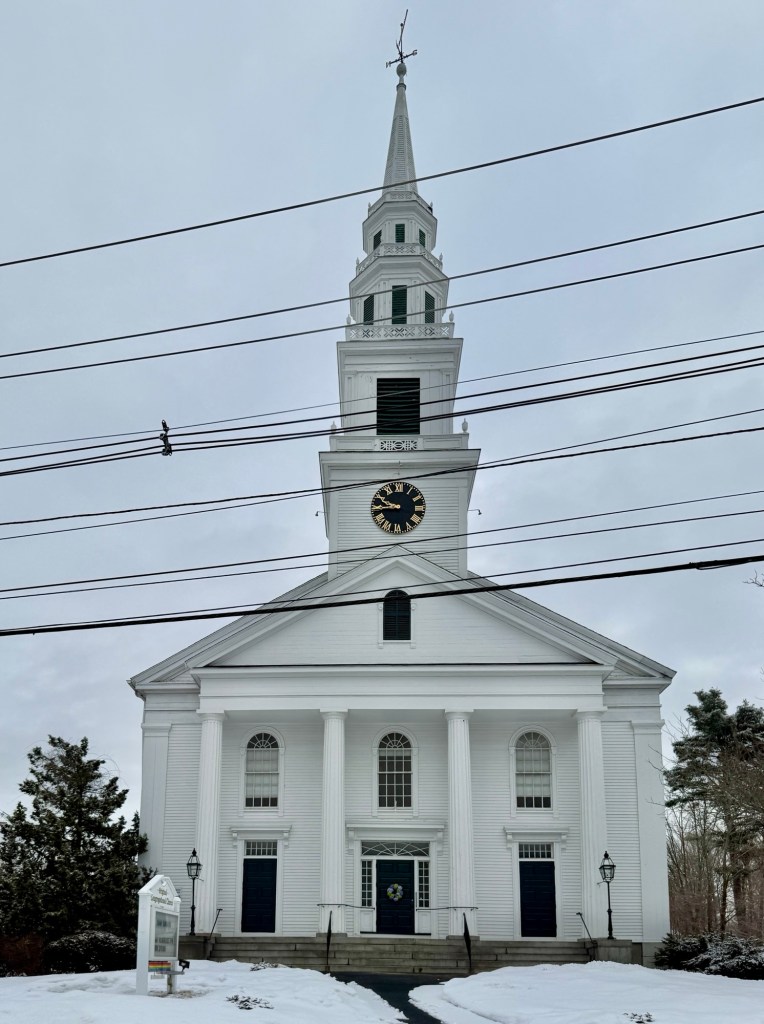
First Church of Lancaster // 1816

Built in 1816, the First Church of Lancaster is one of just two extant church buildings designed by famed American architect, Charles Bulfinch, and is said to be one of the finest churches in the Federal style in the United States. The fifth meetinghouse of the Unitarian First Church of Christ in Lancaster, this building was constructed of local brick, slate, and lumber from master-builder, Thomas Hearsey. Hearsey is said to have modified Bulfinch’s design, which had proposed one tall center arch flanked by two lower arches to reflect the unequal heights of the three vestibule doors behind them; instead going with three, identical arches. Other than this change, the church remains substantially as originally built, even without artificial lighting or central heat inside. Besides the iconic arched portico, the two- stage brick tower topped by a beautifully proportioned wood cupola surrounded by Roman Ionic columns, and fronted by a giant arcuated portico, is especially noteworthy. The congregation, which dates back to 1653 as a Puritan congregation was the first parish established in Central Massachusetts and remains active to this day.

Old St. Stephen’s Church – Barker Playhouse // 1840

The old St. Stephen’s Episcopal Church in Providence’s Fox Point neighborhood is an architecturally distinctive Greek Revival style church building located on charming Benefit Street. The church had its beginnings in 1839, when the newly established congregation called on 29-year-old Francis Vinton to serve as their first pastor. The congregation funded this small church which broke ground in 1840, and before it was completed, Rev. Vinton resigned as Rector. The building, built of stone and covered in stucco, once had a spire and belfry above the main entrance. The congregation grew over the next decade and it was soon realized that a larger and more central church should be built for members, many of whom were wealthy residents with mansions surrounding Brown College. In 1860, the parish purchased a lot on George Street, and hired architect, Richard Upjohn to design the new church in the Gothic style. For reasons of location, and possibly social class, twenty-two men and women remained here at the less fashionable church and formed a new parish, the Church of the Saviour. The smaller, mission church with its stucco walls, remained until the property was sold in 1932 to house the Barker Playhouse, reputed to be the oldest continuously operating little theatre in the United States.


St. John’s Church, Portsmouth // 1807

St. John’s Episcopal Church is located on Chapel Street, atop Church Hill near the historic commercial center of Portsmouth, New Hampshire. A church has been located on this site since 1732, when British Anglicans built Queen’s Chapel here. It was named “Queen’s Chapel” after King George II’s wife, Queen Caroline, who donated many fine gifts to help the new parish. The congregation increased in growth alongside the community until a tragic fire on Christmas Eve in 1806, which destroyed over 300 buildings in Portsmouth including the original wooden structure of St. John’s and most of its contents. The parishioners immediately began to raise funds to erect the present brick church, with its cornerstone laid in June 1807. The Federal style church was one of the first known buildings by architect-engineer, Alexander Parris, in the time before he moved to Boston, designing many iconic buildings there. St. John’s Church of Portsmouth stands as the oldest Episcopal Parish in New Hampshire and was individually listed on the National Register of Historic Places in 1978.

St. Mark’s Orthodox Church // 1882

Built in 1882 as a Catholic mission church, the St. Mark’s Orthodox Church on Main Street in Kingston, Massachusetts, stands as a lovely example of a Victorian Gothic ecclesiastical building in a great state of preservation. In the waning decades of the 19th century, the Irish and Catholic population of Kingston grew, which led members to petition the Diocese to erect a mission church closer to their homes, rather than attend St. Peter’s in Plymouth. Originally called St. Joseph’s Church, the building served the local Catholic population until after the new, brick St. Joseph’s. Church was built further down Main Street in the 1930s. The local St. Mark Of Ephesus Orthodox Church congregation purchased the chapel in 1995 and restored the building, removing faux-brick shingling and reshingled the exterior.

First Parish Church, Kingston // 1851

The original Congregational Church of Kingston was part of the established, tax-supported church of the Commonwealth of Massachusetts, and was built in 1718, after present-day Kingston established itself as Plymouth’s North Parish. The church was replaced in 1798 with a more substantial building with two steeples. In 1833, when the separation of church and state was finalized in the Commonwealth, two new religious societies formed in Kingston and established churches. The 1798 church, which had been built as the only church in town, was now too large for its diminished population and suffering from structural difficulties. In the spring of 1851, the 1798 church was taken down, and the present church, the third on the site, was constructed. The church blends Greek Revival and Italianate styles, both popular for ecclesiastical buildings of its time, and the structure looks much like it did when built 175 years ago. The congregation here is Universal Unitarian.

Memorial Church of All Angels, Twilight Park // 1896

The Memorial Church of All Angels is located in the center of the summer colony of Twilight Park, found in the town of Hunter in the Catskill Mountains. The founding of the church began shortly after the colony was established in 1888, when two years later, the Rev. H. M. Baum from Evanston, Pa., an early visitor to the Park, realized the need for an Episcopal Church, and funds were raised to build a small chapel, known as the St. Paul’s Church. The church was foreclosed upon in a matter of years. In 1895, church services were again reinvigorated when the Rev. Henry Yates Satterlee, the first bishop of Washington, then the Rector of Calvary Church, New York, had taken the cottage of his cousin, the artist Walter Satterlee, for his summer home. He set out to establish a summer chapel for Episcopalians in Twilight Park, and he hired architect Alexander Mackintosh, to furnish plans for the church. The church opened in 1896, and it would be expanded in 1909 with an addition and porch and again in 1915 with the belltower. The church opens every summer for services and is one of the finest Episcopal chapels in the Northeast.

Dorchester Temple Baptist Church // 1889

Located at the corner of Washington Street and Welles Avenue, the Dorchester Temple Baptist Church was designed in 1889 by architect Arthur H. Vinal, as one of the best examples of a church designed in the Shingle Style in New England. The church began in 1886 as a mission church of the Tremont Temple Baptist Church in Boston. At this time, Dorchester was a semi-rural area and would surge in development when the streetcars were electrified in the 1880s. With a rapidly developing neighborhood, the congregation here, purchased lots and hired Vinal to furnish plans for a house of worship. The church’s cornerstone was laid October 3, 1889, with the church membership numbering ninety-nine at that time. Membership would decline in the decades following WWII, and shifting racial and ethnic demographics in the neighborhood brought new members to worship here. The building was renamed as the Global Ministries Christian Church by the current congregation, who with the assistance of preservation grants, worked with Mills Whitaker architects to restore the iconic landmark. Specific details of the building stand out, including the stained glass windows, the belfry with bulbous form, and the arched openings with continuous shingled walls.

Westborough Unitarian Universalist Church // 1850

The Unitarian Universalist Church of Westborough, Massachusetts is architecturally significant as an excellent example of a ecclesiastical building in the Greek Revival style, but it is also significant historically as it tells a richer history of the community and New England as a whole. The Congregational Church has its roots in the first church in Westborough, established in 1724 under Reverend Ebenezer Parkman. The Religious Freedom Act of 1811 and the official separation of church and state in 1825 encouraged a diversity of religious views in Westborough and a branching out from the first church both spiritually and since churches needed new houses of worship. As a result, the local church in Westborough split due to differing beliefs, with the Congregationalists building a church and a few years later, the Unitarians building this church, both in variations of the same architectural style. The UU Church in Westborough was built by 1850 and was expanded as the congregation grew. The building remains nearly identical to when it was built except for the steeple, which in 1921, was in such bad repair that it had to be removed. Less than a decade later in 1930, member Isadore Forbes donated the funds to have the steeple rebuilt and a bell installed.