This handsome Shingle style building was constructed in 1906 as a carriage house of a larger farm property in Scotland, Connecticut. The barn is said to have been built for Archie Gallup, who purchased the old Manning farm just west of the town green in Scotland. The 1 1/2-story carriage-house with a gambrel-roof stands out for its principal entry of paneled wooden doors and above, a large, flared hood featuring two pedimented gable-dormers. The entire building is clad with varied shingles to add complexity to the design, catching the attention of all who drive by.
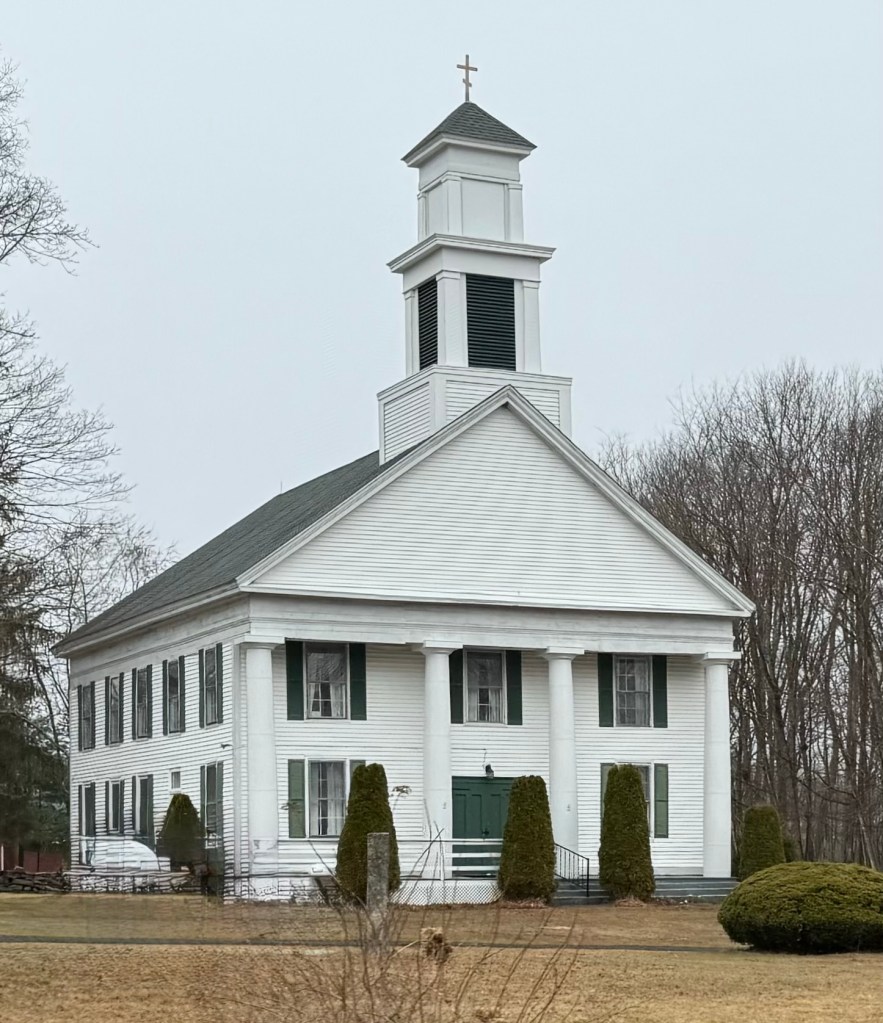
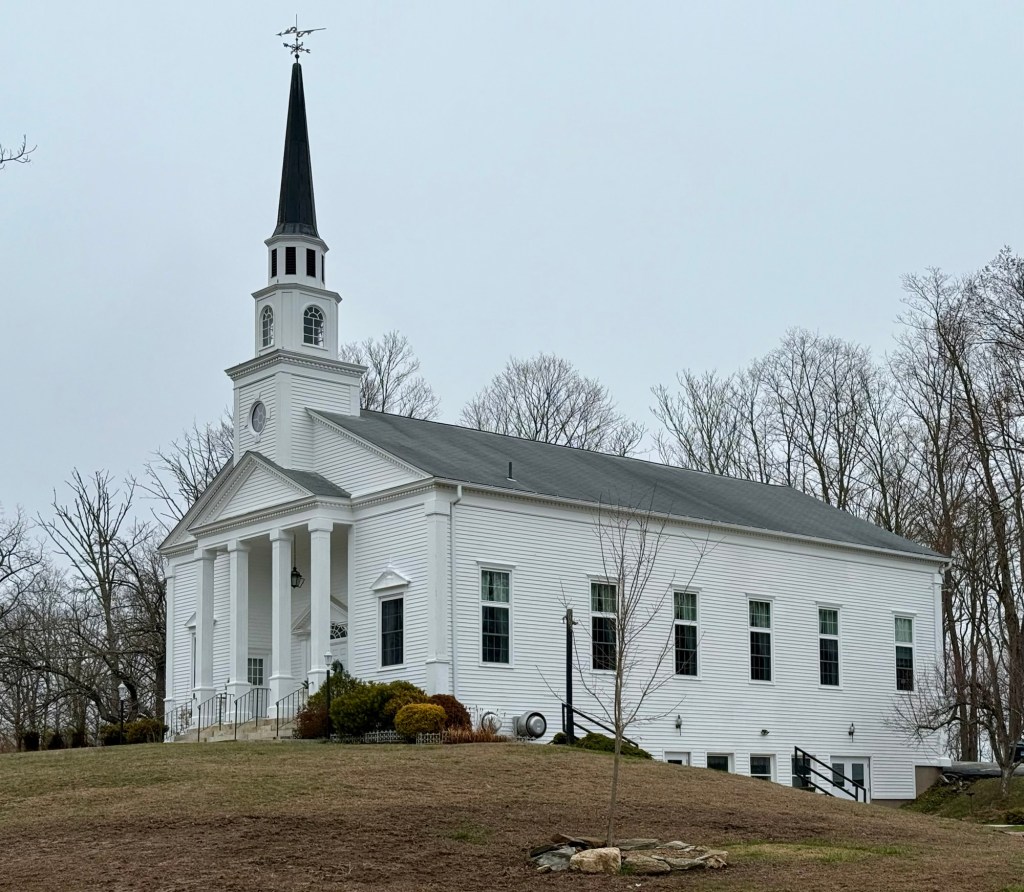
The main visual anchor of the charming town green of Scotland, Connecticut, is this building, the Scotland Congregational Church. Built in 1842 as the congregation’s third building, this Greek Revival style edifice features stately proportions, temple-front with four large Doric columns supporting the portico, and a two-stage belfry. The chapel (some say it was converted from the original town hall) was acquired by the congregation in 1867, and has remained in its new location ever since. Later alterations include the stained glass windows and clock in the pediment, which dates to the early 20th century.
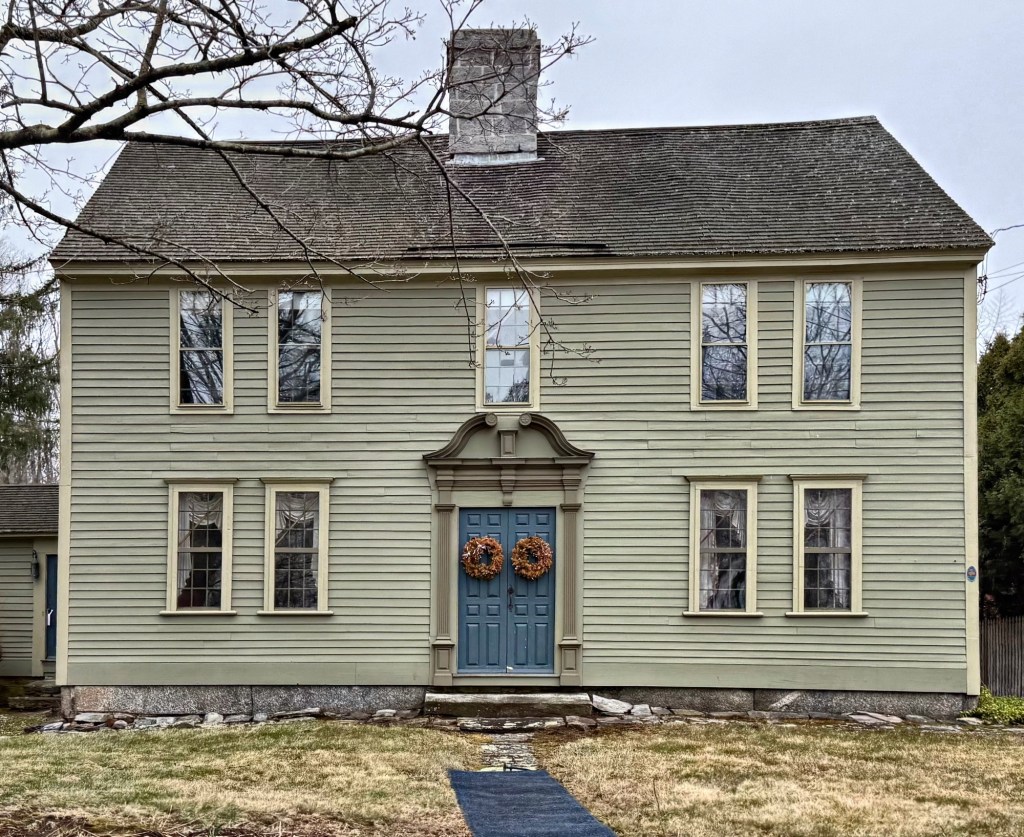
The Huntington Homestead in Scotland, Connecticut, was the birthplace and boyhood home of Samuel Huntington (1731–1796), a Founding Father, a signer of the Declaration of Independence and a distinguished statesman during the Revolutionary War and early Republic. The remarkably well-preserved site includes an eighteenth century house on its original foundation surrounded by acres of farmland and is now protected as a museum. The house was built sometime between the transfer of land in 1715 from Deacon Joseph Huntington to his son Nathaniel, and Nathaniel’s marriage in 1723 to Mehetabel Thurston. As originally constructed, the house consisted of a two-story structure with an end chimney on the west end and one large room on each floor. By the time of Nathanielís death in 1767, the house had been doubled in size with the addition of two rooms west of the chimney, giving the house its current five-bay form. The Georgian style Colonial-era home features a symmetrical facade, twelve-over-twelve windows, and a saltbox roof and is one of the finest Colonial-era homes in this part of the state.
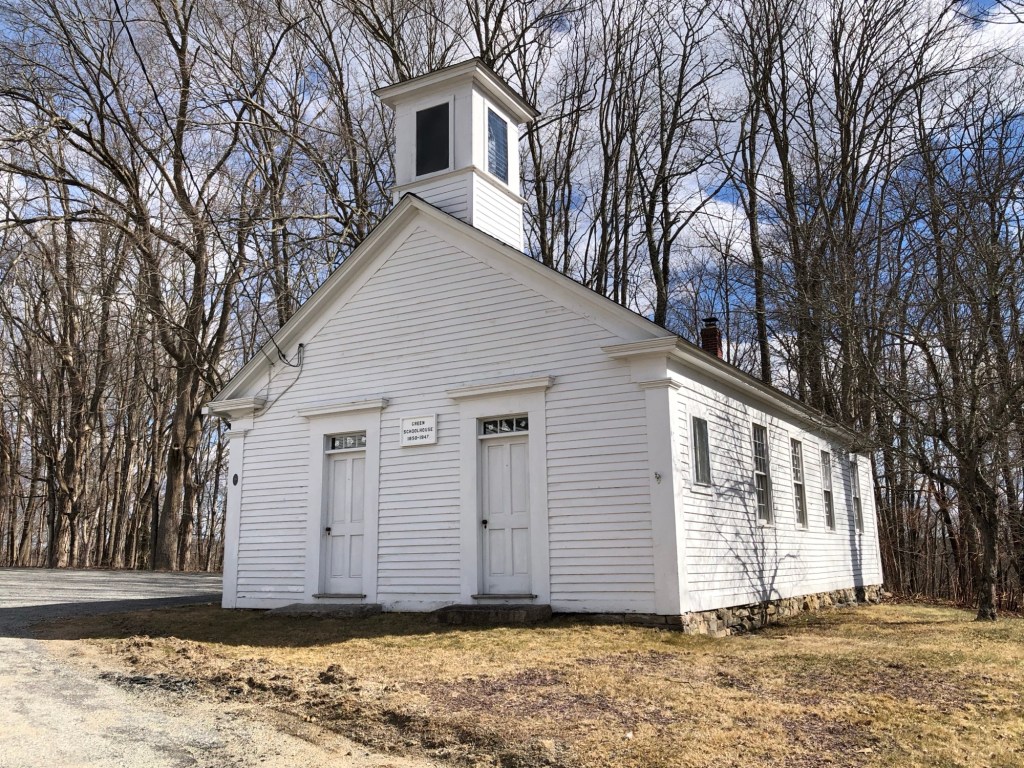
The town of Scotland, Connecticut, is a rural community centered around agriculture and is the smallest municipality in Windham County’s ‘Quiet Corner‘. European settlement began in earnest following the purchase of 1,950 acres of land from then Windham, by Isaac Magoon, a Scotsman, who named the new village after his ancestral home. The present-day town hall and offices of Scotland, was originally built in the 1840s as a one-room schoolhouse. In 1894, the town voted to consolidate all the school districts in a single building, and to expand the one-room village school to accommodate them. The present two-story structure was completed in 1896 and was added to the front of the old building. It is unclear if anything remains of the original schoolhouse. The vernacular, Stick style building served as the town’s consolidated school until a modern school building was constructed in the 1960s. This building became the town hall/offices and remains a significant visual anchor to the town’s common.
Charles Henry Farnam (1846-1909) was a lawyer, genealogist, and the son of Henry Farnam, a wealthy railroad industrialist in New Haven, Connecticut. Following his father’s death in 1883, Charles, who may have inherited a small fortune in the will, purchased a house lot on the finest residential street in New Haven, Hillhouse Avenue. The existing house on the lot, the Benjamin Silliman House, was relocated to front Trumbull Street (and recently relocated again to 85 Trumbull Street), clearing the site for his new mansion. He hired esteemed architect J. Cleaveland Cady, who designed a large, Queen Anne/Romanesque masonry home unlike anything else on the Avenue. The house features an asymmetrical plan, corner tower, a Flemish style gable, fancy brickwork and terracotta detailing, and a slate mansard roof. Charles H. Farnam would sell the property to Henry S. Parmelee, a noted businessman and piano manufacturer, who also is credited with inventing the first automated sprinkler head and as a result, owning the first building in the United States to be equipped with a fire suppression system, his piano factory. Parmelee hired local architect Leoni Robinson, to design a rear addition for the house. Parmelee died in 1902, and the property was maintained by his widow and daughter, until it was acquired by Yale University in 1920. Today, the Farnam Mansion is occupied by the Economics Department.
John Pitkin Norton (1822-1852) was a successful educator, chemist, and author, who at just 27-years-old, built this stately mansion on Hillhouse Avenue in New Haven, Connecticut, for his young family. John P. Norton studied chemistry under Benjamin Silliman at Yale College, and was eventually appointed Professor of Agricultural Chemistry at Yale in 1846. He helped to found the Department of Philosophy and the Arts at Yale College and authored many scientific papers, dealing with the chemistry of crops. Coming from an established family and beginning a successful career himself, John hired New Haven-based architect, Henry Austin, to design this large, Italianate villa. The window surrounds, canopies, and flamboyant Moorish entryway are typical of Austin, with the general form and detailing taking cues from architect Alexander Jackson Davis‘ work. The Norton Mansion was purchased by Yale University in 1923 and was long the home to the Yale School of Management and is now occupied by the Jackson School of Global Affairs.
One of the finest houses in New Haven is this stately residence, the Aaron Skinner Mansion on Hillhouse Avenue. The mansion was built in 1832 for Aaron Nichols Skinner (1800-1858) from plans by architect Alexander Jackson Davis. Skinner was a Mayor of New Haven (1850-1854), and for a short time, ran a boy’s boarding school out of this house. Skinner was also a CT State Representative, serving two terms. The house was originally built as a three-bay, two-story house with one-story side wings and a rear ell. After his death, the house was purchased by Judge William W. Boardman, who in 1859, modernized the property hiring architect, Henry Austin, who filled in the side wings and added Italianate window mouldings. The monumental portico supported by fluted, Ionic columns, creates such a stately presence for the early house on the street. In the early 20th century, the mansion was owned by Rutherford Trowbridge, who renovated the house for his own use. The house remained in the Trowbridge family until the death of his last daughter, Miss C. Rachel Trowbridge, when the estate became the property of Yale University.
In 1871, wealthy engineer and philanthropist, Henry Farnam (1803-1883), purchased a house lot on the desirable Hillhouse Avenue in New Haven, Connecticut, where he would live out his final days in retirement. Mr. Farnam made his fortune beginning in 1839, when he was instrumental in building the railroad connecting New Haven to New York. In 1850, he moved to Illinois where he partnered with Joseph E. Sheffield to build the Chicago, Rock Island and Pacific Railroad, becoming that railroad’s president in 1854. In 1868, Farnam moved back to New Haven when he hired Russell Sturgis, Jr., to design and oversee construction on his home there. Henry Farnam also worked with Sturgis on Farnam Hall at Yale, where he is the benefactor and namesake of the building. Henry Farnam died in 1883, and in his will, he stipulated that he would gift his property to Yale College under the condition that his son, Henry W. Farnam, could live there until his death. Henry Walcott Farnam was an economist, and served as president of the American Economic Association. In 1933, the property ownership was officially transferred to Yale University, who in 1936, renovated the property, changing its appearance from Victorian Gothic to Colonial Revival. Architects, Richard A. Kimball and Ellery Husted furnished the designs for the stately residence. Since that time, the Farnam House has served as the residence of the Yale President.
This site, in the heart of Cornwall village, was once occupied by an early 19th century Federal style residence, built by the wealthy Pierce family in town. The Pierces’ large home was acquired by John E. Calhoun (1859-1940), a successful New York businessman, who retreated to his father’s hometown for summers away from the city. In 1911, a fire destroyed the home, which was wood-frame construction. This event mobilized Mr. Calhoun, who was untrained but interested in architecture, to begin planning a new summer residence, but of fireproof construction. Calhoun is said to have designed (and funded) the town’s library just years before, and modeled his home in line with the Colonial-era residences in the village, just larger and of brick. From the 1950s through the 1990s, the house was occupied by the headmaster and administration of the local Marvelwood School, but was re-established as a private home, a use that remains today.
The main village in Cornwall, Connecticut, looks like a postcard. Mature trees and beautiful, historic homes line the bucolic streets with sweeping views of the Litchfield Hills in the distance; it is what many envision when they think of “New England charm”. This stately Federal style mansion is sited deep on its lot beyond a field and dates to the first decades of the 19th century, it is the village’s grandest early home. The house was built for Amos Barnes, but supposedly remained unfinished when he died suddenly. Barnes’ widow sold the property to the local Foreign Mission School as a dormitory for students. The school’s (in my opinion, problematic) mission was to educate students of non-Christian cultures, including Native Americans, East Asian, and Hawaiian pupils, for them to become missionaries, preachers, translators, teachers, and health workers in their native communities in the Christian faith. These types of programs furthered the erasure of other cultures and promoted Christianity in all corners of the world, but I digress. In 1826, this home was acquired by Frederick Kellogg, the long-time town clerk and Judge of Probate, who owned the property until his death in 1891.