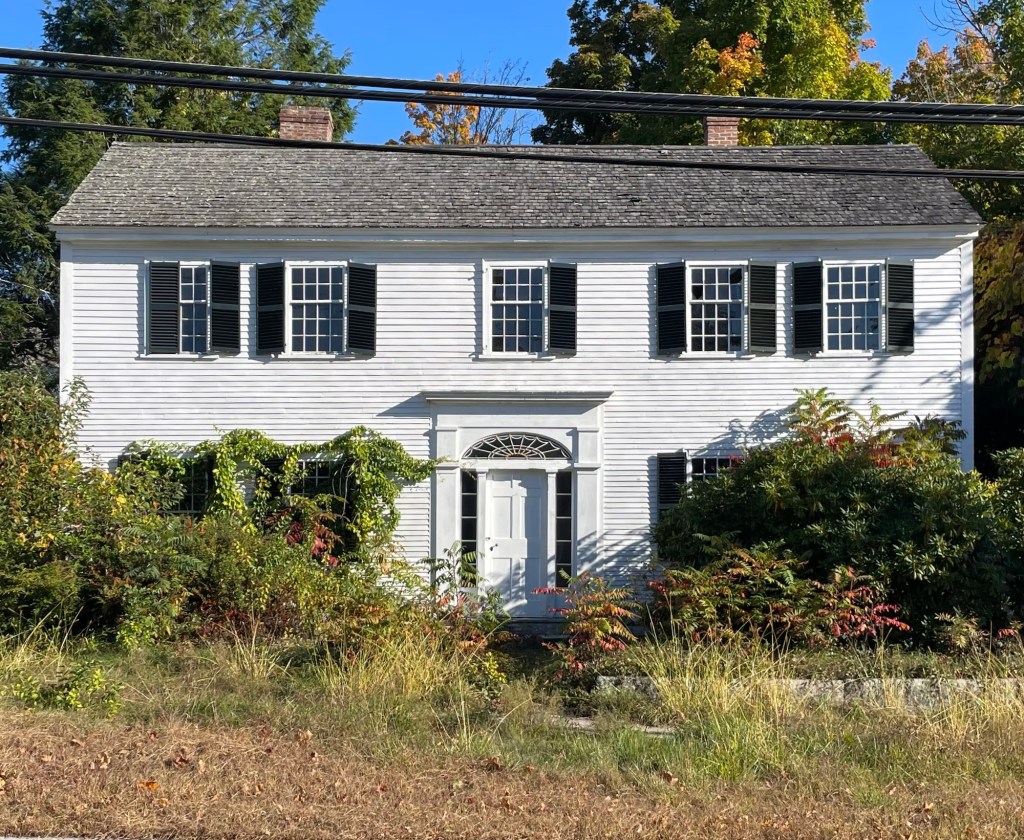
Samuel Perley House // c.1784

Built around 1784 for Reverend Samuel Perley, this Federal style home is one of the finest in the town of Gray, Maine. Samuel Perley (1742-1830) was educated at Harvard College and while there, met and befriended John Adams, who would later become the second President of the United States. The two maintained a lifelong friendship. Perley came to Gray in 1784 as a pastor of Gray’s first church. He likely had this house built at the time or purchased an existing house and updated it and the house is said to have Moses Eaton stencilling inside. At one point, Rev. Perley and his wife lived on one side of the house while his son Isaac, his wife, and their twelve children lived on the other.
Wellington-Sears House // c.1810

One of the many Federal period houses in Ashby Center is this lovely c.1810 residence on Main Street. The house is known as the Wellington House, and was possibly built by Darius Wellington, a carpenter who assisted with building the town’s First Parish Church in 1809. The house exhibited a symmetrical facade with stunning fanlight transom over the main entrance and eight-over-twelve sash windows. In the latter half of the 19th century, the property was owned by Cyrus Sears, a prominent sea captain, who sought a life inland with his family. He would serve in the Civil War, but had the half-decade house “modernized” with new bay windows and an entry porch. He would later move to Baltimore and serve as a port captain and consul to Cuba. In the past few years, the owners have restored the home to its original Federal design, re-emphasizing the stunning fanlight transom and sidelight details.

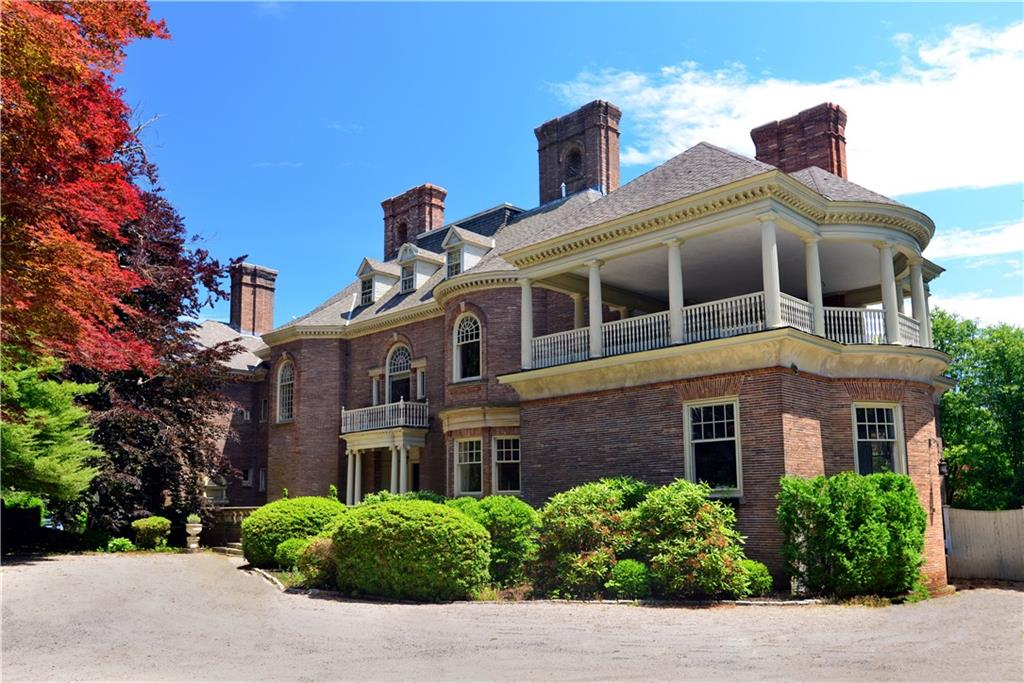
Sunnyside // 1886

Photo from recent real estate listing

During the height of the Shingle and Queen Anne styles’ popularity, architect Stanford White of McKim, Mead & White completed plans for one of the earliest Colonial Revival style residences, “Sunnyside” in Newport, Rhode Island. The residence was built in 1886 for “Commodore” William Edgar (1810-1887) and his wife, Eliza Lucille Rhinelander (1832-1916). William was a co-founder of the New York Yacht Club in 1844 and heir to a New York fortune. Eliza was an aunt of Edith Wharton and a grand-daughter of William Rhinelander, co-founder of the Rhinelander Sugar Refinery. The property remained in the Edgar Family as Lucille Rhinelander Edgar (1858-1948), an unmarried daughter of the couple, would live here year-round with servants. The house is built of buff-Roman-brick with a large central block flanked by L-plan wings under a hipped roof punctuated by massive chimneys. Of special note on the facade are the rounded bays, entry portico with Palladian window above, and side porch.

Dr. Ralph Fogg House // 1893

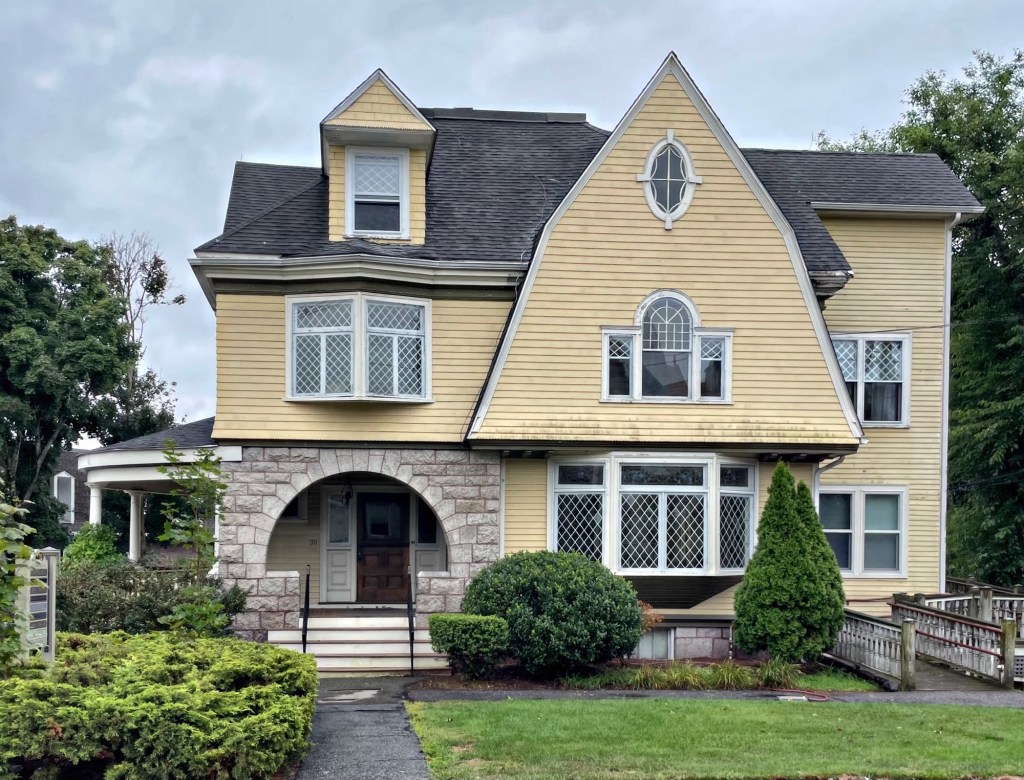
Built in 1893, this house in Norwood, Massachusetts, was built for Dr. Ralph Fogg, a leading dentist in the Boston area with offices in Boston, Norwood, and Quincy. Dr. Fogg was dissatisfied with nitrous oxide gas as an anesthetic, as it failed to protect the patient against pain; and, in trying to find some harmless compound to accomplish the desired results, he produced the “Boston Vegetable Vapor,” an anesthetic to compete with nitrous oxide in markets. In 1885, the Boston Vegetable Anesthetic Company was formed for the purpose of placing the vapor in the market, and it was used by leading dentists across the country. With his dental practice growth and success of his new invention, Dr. Fogg and his new wife, Anna Saville, hired architect, Herbert Mosely, to design a stately home for their family. The Queen Anne/Shingle style house features a sophisticated use of stone, clapboard and wood shingle materials. It’s main facade is dominated by a broad gambrel gable with the main entrance set within a rusticated stone arch which is edged with large voussoir blocks.

Sewall-Scripture House // 1832

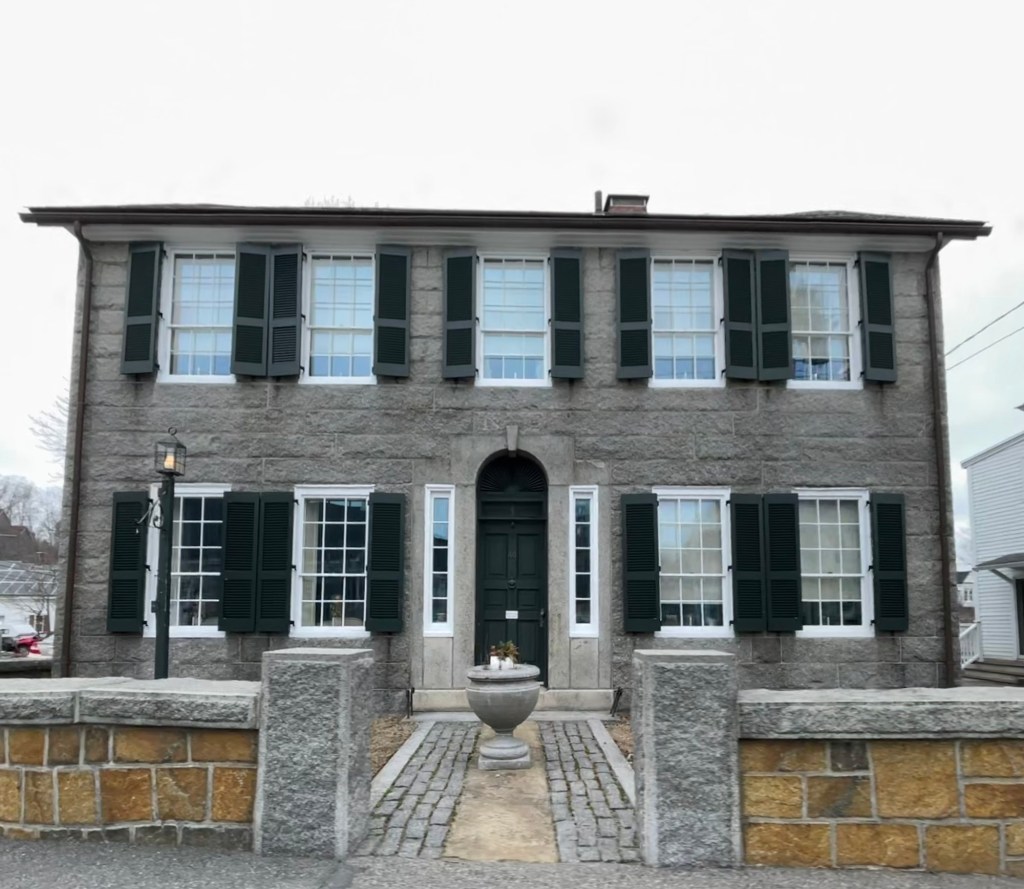
Levi Sewall (1805-1880), a native of Maine, built this stunning granite Federal style house in Rockport, Massachusetts in 1832 in preparation for his marriage to Mary Ann Robards. The granite blocks used to build the house were hauled by oxen from Sewall’s own quarry in Pigeon Cove, which is said to have produced stone of excellent quality. Sewall was one of the towns earliest entrepreneurs in the granite business and did quite well, supplying the building material to many of the region’s buildings in the mid 19th century. The property was inherited by Levi and Mary’s son-in-law, Frank Scripture, who took over the family business. Levi Sewall’s descendants occupied the Sewall-Scripture House until 1957, and ever since, it has been home to the Sandy Bay Historical Society and Museum.

Joseph P. Allen Cottage // 1877

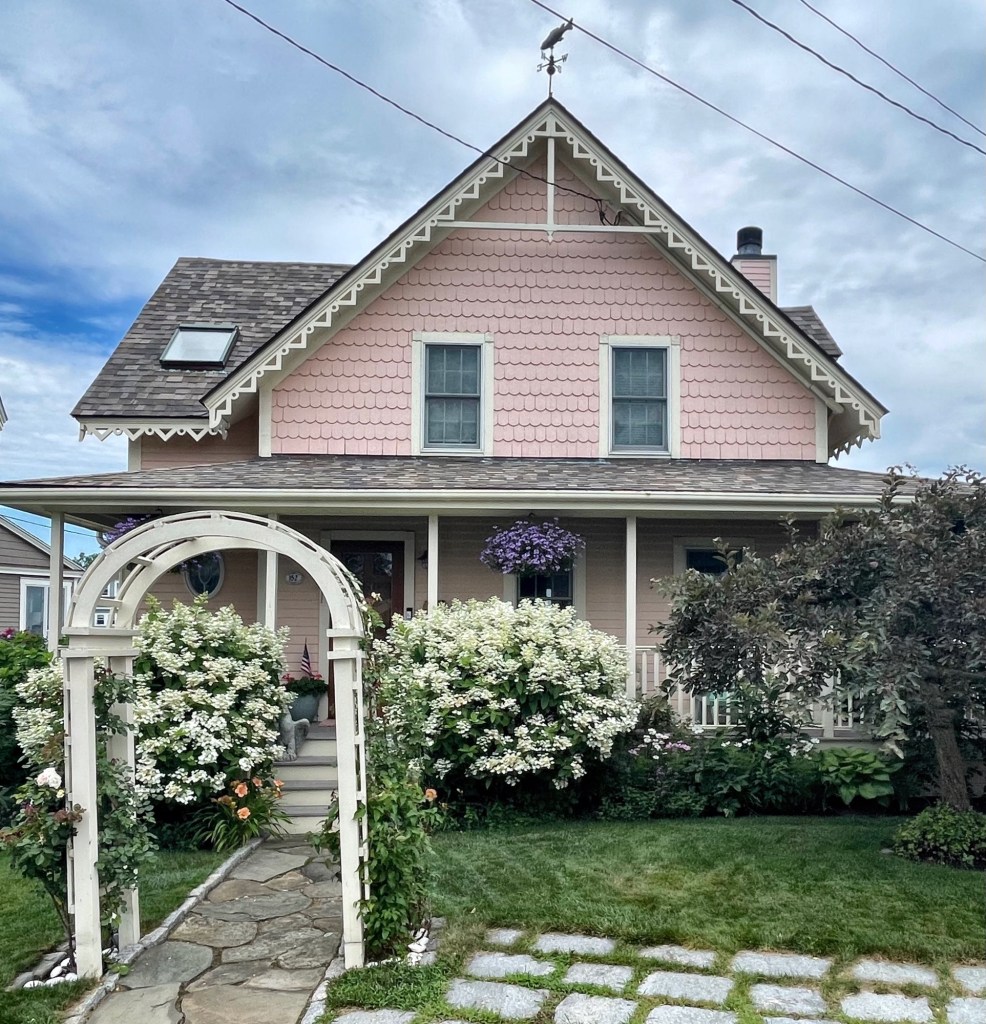
One of the most picturesque and charming summer cottages (now year-round residences) in the Salem Willows neighborhood in Salem, Massachusetts is this Victorian on Bay View Avenue. The cottage was built around 1877 for Joseph Pray Allen (1822-1897) who was a police officer who likely climbed the ranks in the force to afford a second home in the city. The 1 1/2-story cottage has decorative bargeboards at the eaves and stick bracket at the gable. Perfection!

Gurley Tavern // 1822

Chaplin, Connecticut was incorporated in 1822 and in that same year, this stately Federal style residence was built and operated as a tavern by Chauncey and Julia Gurley. The house in the late 19th century was used as a private school and residence and was later owned by Ruth E. Snow Bowden (1895-1983) known lovingly as “The Quilt Lady”. Ruth was one of the foremost quilt-makers in Connecticut and her Chaplin home, as a result, became known as The Quilt Shop. By the late 1900s, the tavern was converted to an inn, but closed years later from few bookings. The new owners have restored and maintained this charming old tavern back to its original appearance.

Goodell-Bill House // 1828

One of the finest houses in the small town of Chaplin, Connecticut is this Federal manse, located right on the edge of the town center. The brick residence was built in 1828 by Isaac Goodell (1770-1856) who raised his family in the stately home. After Goodell’s death, the property was inherited by his daughter, Mary and her husband, Lester Bill. The house stands out for its painted brick walls, symmetrical facade with fanlight and sidelights at the entry, and the large Palladian window on the second floor.

Benjamin Bosworth House // 1800

One of the most unique houses in Connecticut is this massive Federal style residence located in the small town of Eastford. Built next to the Congregational Church of Eastford (1829-2023), which burned down in 2023 by arson, the massive house has been known as both the Benjamin Bosworth House and Squire Bosworth’s Castle due to its first owner, Benjamin Bosworth (1762-1850). According to the Bosworth Family, the house was built in 1800 by Bosworth was a wealthy merchant, who hired Vini Goodell, a local carpenter to design and build the large Federal home. The house was completed by 1801 when the local Masonic group met in the building. As Bosworth was also a merchant, he used the basement as a storeroom. The house is also unusual for its monitor roof, a rarity in Federal period construction, which reads like a second structure on the house, due to the building’s size. After Bosworth’s death, the house was occupied by his niece, and was later purchased by Elisha Grant Trowbridge in 1897. Trowbridge was a grand-nephew of General Nathaniel Lyon (1818-1861), a local hero who was the first Union general killed during the Civil War. Trowbridge, an engineer, lived here until he died in 1963 at the age of 96. Later owners have had the monumental task of restoring and maintaining this behemoth of a house, to great success.

Sumner-Carpenter House // 1806

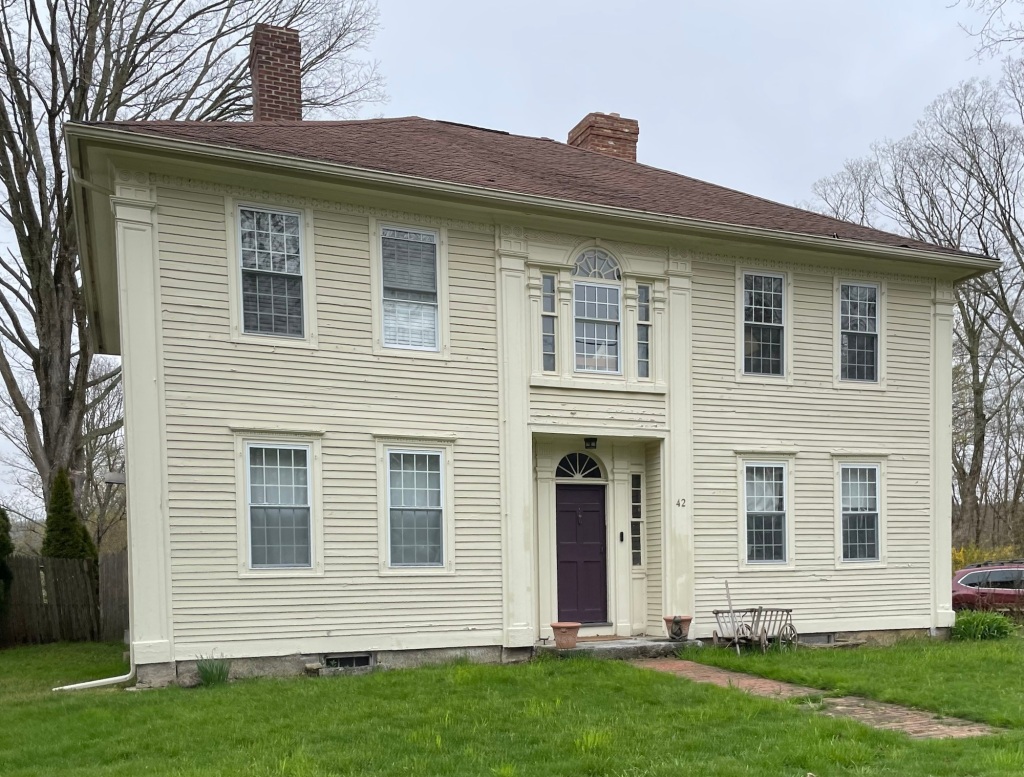
I don’t think any state does the Federal style as well as Connecticut (Massachusetts is a close second)! This is the Sumner-Carpenter House, a high-style example of a Federal residence that is located on the backroads of the small town of Eastford, Connecticut. The house was built in 1806 for John Newman Sumner (1775-1831) who resided here until just before his death. The elaborate Federal period house was sold out of the family. After trading hands a half-dozen times, the property was purchased by David and Harriet Carpenter in 1881. The property remained in the Carpenter family for generations, and remained as such after Orlo Carpenter (1865-1938) was killed in the collapse of a barn during the hurricane of 1938. Architecturally, the house has all of the hallmarks of the Federal style, with the symmetrical main facade five bays wide, with a center entrance flanked by wide sidelights, and topped by a fanlight transom and corniced entablature. The window above the entrance is in the Palladian style, with a rounded center window flanked by narrower sashes. The house is very well preserved and was listed on the National Register of Historic Places for its architectural quality and preservation.