Otis Company Mill #1 // 1845

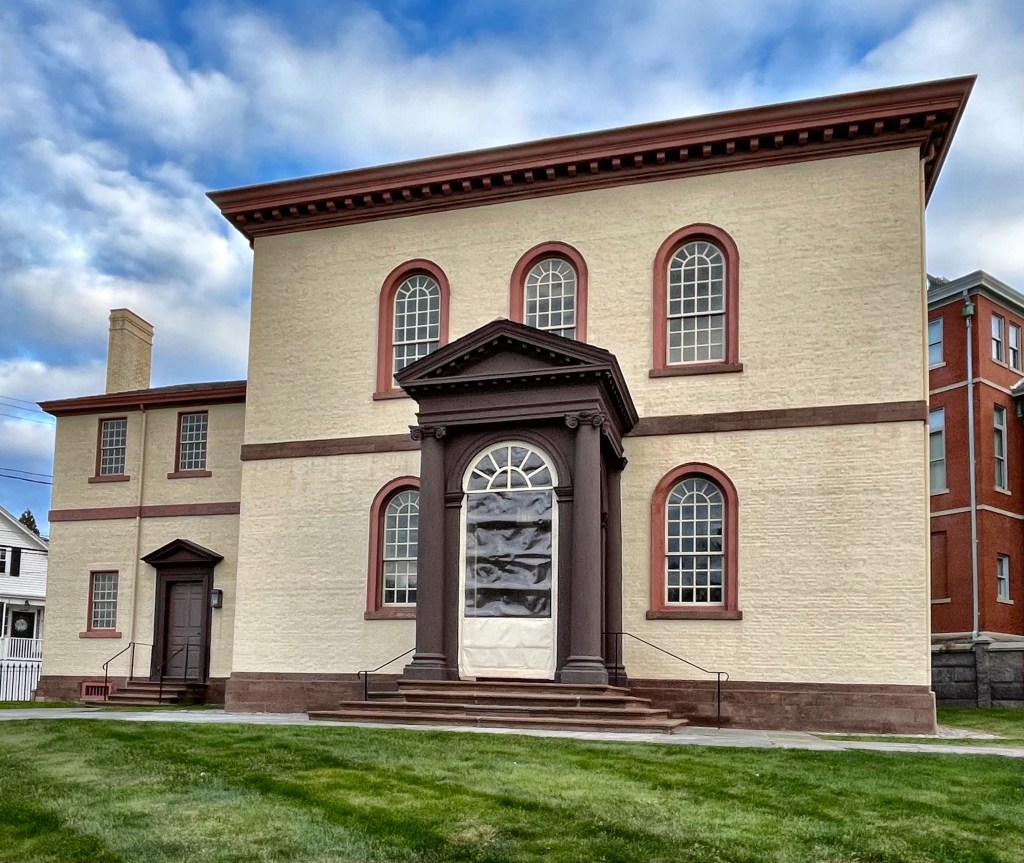
This five-story granite mill building was one of the major catalysts for the 19th century population surge in Ware, Massachusetts. As New England’s fledgling textile industry of the era played a vanguard role in transforming the U.S. into an industrial nation, the significance of this type of mill can hardly be understated. The Otis Mill #1 in Ware is one of the last remaining granite textile mills of this early period in central/western Massachusetts. The mill was built in 1845 for the Otis Company, which initially manufactured woven cotton fabric, but later branched out into stockings, woolen shirts and drawers underwear. The company was Ware’s largest employer for about 100 years! The company prospered thru WWI employing over 2,500 people. During the 1920’s the business began a decline due to the southern state’s mills and lack of modernization. In the mid 30’s the Otis Co sold its property to the citizens of Ware, which they formed Ware Industries, Inc to continue the major employer in the town. Due to this Ware came to be known nation-wide as “The Town That Can’t Be Licked.” The mill is now home to local small businesses as a sort of incubator, providing jobs to local residents!

Manley-Lefevre House // c.1820

The last (but certainly not least) building in Dorset, Vermont I’ll be featuring is the Manley-Lefevre House aka. Marble House! This stunning Federal period home was built around 1820 by Martin Manley (1783-1856) on land originally owned by his father George. The house is constructed of ashlar marble that was quarried with hand tools from the lower quarry located approximately 200′ behind the site of the house with dressed marble finished in town and brought back for installation at the lintels, sills, and door surround. In 1907, Edwin Lefevre, Sr. (1871-1943) traveled by train from Bronxville, New York to Dorset at the suggestion of the artist Lorenzo Hatch, with the intention of locating a summer residence for his family. They purchased this home, which became known as “The Old Stone House” and hired Eugene J. Lang, a New York architect, to remodel the house, design a kitchen wing and remodel the barn into a garage (1909). While in Italy, Lefevre fell in love with the formal gardens there, and wanted something like this for his country estate. Upon his return, he retained garden designer Charles Downing Lay to design the gardens that surround the house. The country estate is now home to The Marble House Project, a multi-disciplinary artist residency program.

Dorset Playhouse // 1929

During the spring of 1927, Mr. and Mrs. Edward Goodman, devotees of the performing arts, were able to interest a number of Dorset residents in producing a play. In April 1927, a three-act play entitled ’39 East’ was presented in the Dorset Town Hall for the benefit of the PTA and was received with great enthusiasm. From this, a movement took off. Many summer residents and artists in town formed a group, the Dorset Players, who would continue performances for the town. They realized that the space in Town Hall was not suitable nor permanent enough for the goals of the group. May Goodman purchased land at the edge of the village and the group held two years of performances in nearby towns to gather funding to erect a playhouse. Ernest West, a member, offered two barns on his property in town and it, plus one more barn, were incorporated into the new playhouse. The auditorium was built so that the weathered sides of the barn boards were on the inside and hand hewn timbers 12 by 12 inches were used to achieve a rustic effect which draws many favorable comments from those visiting the Playhouse. It remains a cultural center of the town and greater region to this day.

Hodge-Weeks House // c.1790

One of the oldest extant houses in Dorset, Vermont, this gorgeous Federal Cape house adds so much charm to the village. The house is possibly the homestead of James Abel Hodge (1756-1826) who settled in Dorset from Connecticut after serving in the Revolutionary War. Hodge settled in the town when it was but wilderness, opening up a store in the village and helping the infant township grow into a thriving marble manufactory. This house was later owned by stonecutter I. W. Dunton and after, by “Grandma” Annette Weeks (1841-1925). Like many Cape houses, it probably evolved, adding wings to the right and left as the family inside grew.

Old Peru Schoolhouse // 1864

In 1816, the turnpike to Manchester, Vermont was completed and ran through the small town of Peru. As a result, inns and taverns were built, and the young village of Peru began to grow, with farming and lumber businesses being the most common employment in town. A village school was built here and in the town’s other school districts. By the end of the 19th century, the lure of moving to the Western U.S. and cities for industrial work caused some population decline in Peru, and a larger, consolidated school was built in the town village. This schoolhouse on the hill was constructed in 1864, replacing the former one-room schoolhouse on the lot. The school consolidated again in the mid-20th century when further population decline necessitated a school district encompassing Peru and nearby towns. This building was later converted to town offices, a use that remains to this day.

The good news is that the town’s population is seeing a resurgence, led by both tourism and the Bromley Mountain Ski Resort as an anchor.

Russell House // c.1810

Landgrove, like many other rural towns of Vermont, has seen a lot of investment from out-of-state residents who pick up historic farm properties and renovate them. This is a great thing for many, as with investment comes tax-dollars and preservation of these historic buildings. On the other side, it prices out many who have grown up in these rural towns. Many villages and regions in Vermont have strict zoning which limits density, to maintain the character and charm of these back roads. Another Catch-22, as more housing (especially multi-family) means lower costs for limited available housing, but it can adversely impact what makes these rural towns so enchanting. Anyways, here is a beautifully restored Federal house!

St. Mary’s Episcopal Church // 1813

Lower Falls Village in Newton, Massachusetts was first settled in the early 18th century by colonists due to the area’s natural waterfalls and rapids which was perfect for early industry. By the early 19th century, up to four paper mills lined the Charles River here at a dam which provided power and steady water supply for their facilities. The village saw a large population increase from that point until the end of the 19th century when larger mills in the state were built. One of the major community spaces for the growing village was it’s main church, St. Mary’s Episcopal Church, which is the oldest extant church in Newton and the first Episcopal church built immediately west of Boston. The cornerstone for the building was laid in September 1813 containing a package of coins and a silver plate. Previously services had been held in the Lower Falls schoolhouse, with the first Episcopal service held in 1811. The land for the church was donated by Samuel Brown a wealthy Boston merchant who invested in the paper mills in Lower Falls. Many of the founding members and parishioners were in the paper making business in Lower Falls and buried in the adjacent cemetery. The Federal style church was altered in 1838 and given Gothic detailing, including lancet windows and finials at the steeple. In 1954, the bell tower was altered with the gothic finials replaced with the current urns on the balustrade, the gothic arched openings were changed to the current arched shape, and entablature, pilasters, and a cross were added.

King’s Head Tavern // 1691-1870

Another of Boston’s Lost buildings is the King’s Head Tavern, an old establishment that was built in the early days of Boston and rebuilt following a fire in 1691. It stood on the corner of Lewis and North Streets, in the North End near Scarlett’s Wharf. Due to its proximity to the harbor and wharfs, it became the first place weary sailors stopped to get a drink on solid ground. The two-story, brick tavern was capped with a gambrel roof, which was later filled with wooden additions giving the structure a boxy look. The establishment was named the King’s Head Tavern after a popular London tavern of the same name. Like much of the North End, surging immigrant populations put immense strain on the built environment and many older buildings were demolished in the late 19th and early 20th centuries for tenement housing. The old King’s Head Tavern was demolished in 1870, just two years after the photo was taken.

Lamont Residence // 1907

In 1907, William F. Lamont and his family moved into this beautiful turn-of-the-century home in the rapidly developing Waban Village in Newton, Massachusetts. The extension of the circuit railroad connected this part of Newton (which had previously been farmland) to Downtown Boston, opening up the area to development for middle-income families who sought land and fresh air in the suburbs. The first house on Alban Road in Waban was built for the Lamont Family, and it perfectly blends multiple architectural styles under a gambrel roof.

What is your favorite feature of this house?

Thomas Snow Shop // 1854

This tiny building next to the John Palmer House featured previously was built in 1854 by Thomas Snow as an income-producing property. According to the sign, Snow was a grocer in town and must have rented the small building, which was developed on a small sliver of land, formerly a side garden. I’d guess that the building was originally 1 1/2-stories with the brick first floor added underneath sometime later. The house is vernacular Greek Revival in style and the scale is exactly what makes Marblehead so charming to get lost walking in!