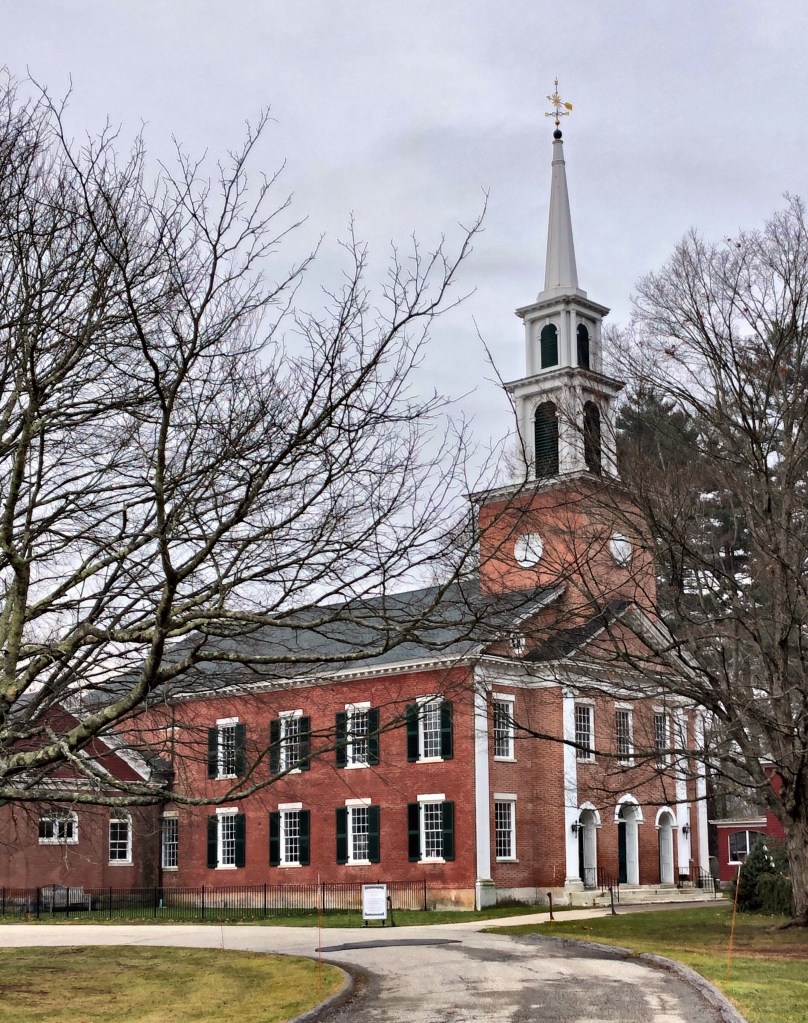
The Town of Stockbridge, MA was incorporated on June 22, 1739. After that time the town held meetings and conducted business in the First Congregational Meeting House until 1840 when this Greek Revival town hall building was erected on the church’s property as a gift. A stipulation was made that if the Town government constructed or moved to a new town hall building, the property ownership would revert to the Church. The town outgrew the building and constructed a new building toward the center of town, but named it Town Offices, a cheeky way to retain ownership of this building. Eventually, that building too was outgrown, and the town hired Pittsfield-based architect Harry E. Weeks to modify and enlarge the building in 1903, in the Neo-Classical style to compliment the original Greek detailing. As expected, the town moved again in the 2000s to a former school, on Main Street, but again retained the building.
Stockbridge, Massachusetts was settled by English missionaries in 1734, who established it as a praying town (an effort to convert the local Native American tribes to Christianity), for the Mohican tribe known as the Stockbridge Indians. The township was set aside for the tribe by English colonists as a reward for their assistance against the French in the French and Indian Wars. From this, a Yale-educated missionary, John Sergeant began converting native people to Christianity, essentially stripping them of their own religious culture and practices. Although Massachusetts General Court had assured the Stockbridge Indians that their land would never be sold, the agreement was rescinded. Despite the aid by the tribe during the Revolutionary War, the state forced their relocation to the west, to New York and then to Wisconsin. The village was then taken over by British-American settlers who created the township.
The first congregational church here was formed by Sergeant in 1734, and later succeeded by Jonathan Edwards, another minister. During his time in Stockbridge, Edwards wrote his masterpiece, Freedom of the Will, which remains one of the most studied works in American theology. Edwards later left the church to become the President of The College of New Jersey, now known as a little school by the name of Princeton. The first church was built in 1739, later replaced by a second church building that stood from 1785 to 1824. The present brick building was built in 1824 in the Federal Style. The space was occupied for town functions until the 1840s, when an official town hall was erected next door, demarcating the separation of church and state. The stunning church marks the immense influence religion had in the early colonial days of New England and the impact it had on native peoples (for better or worse).
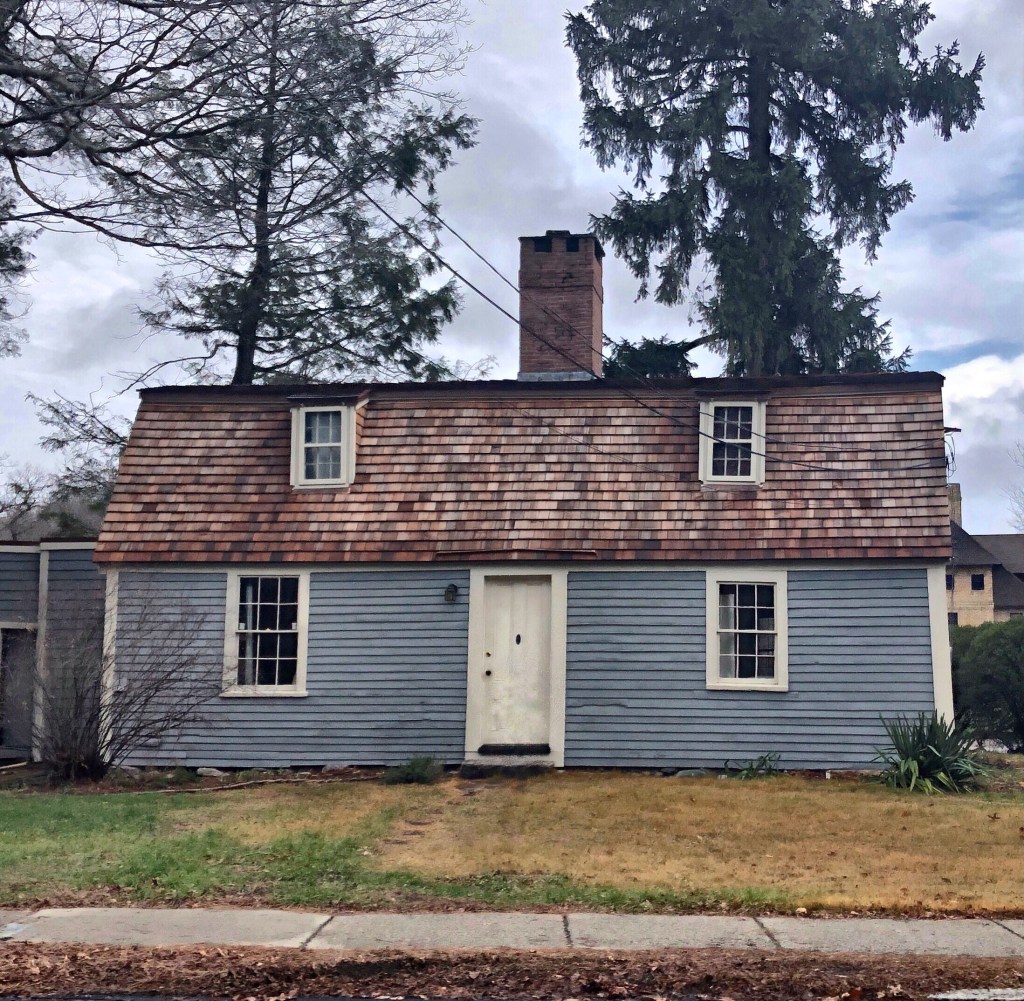
This cute little Georgian home in Brookline was built around 1772 for Hannah Winchester Harris, a widow at the time. Hannah’s husband, Timothy died in 1772 and it appears the widow had this small gambrel-roofed home constructed sometime soon after. Ms. Harris died in 1805 and the home was occupied by a new family, who added the saltbox addition. The home is today owned by the Town of Brookline, who maintain the building through the Brookline Historical Society. the home sits on the boundary of the old Weld Estate.
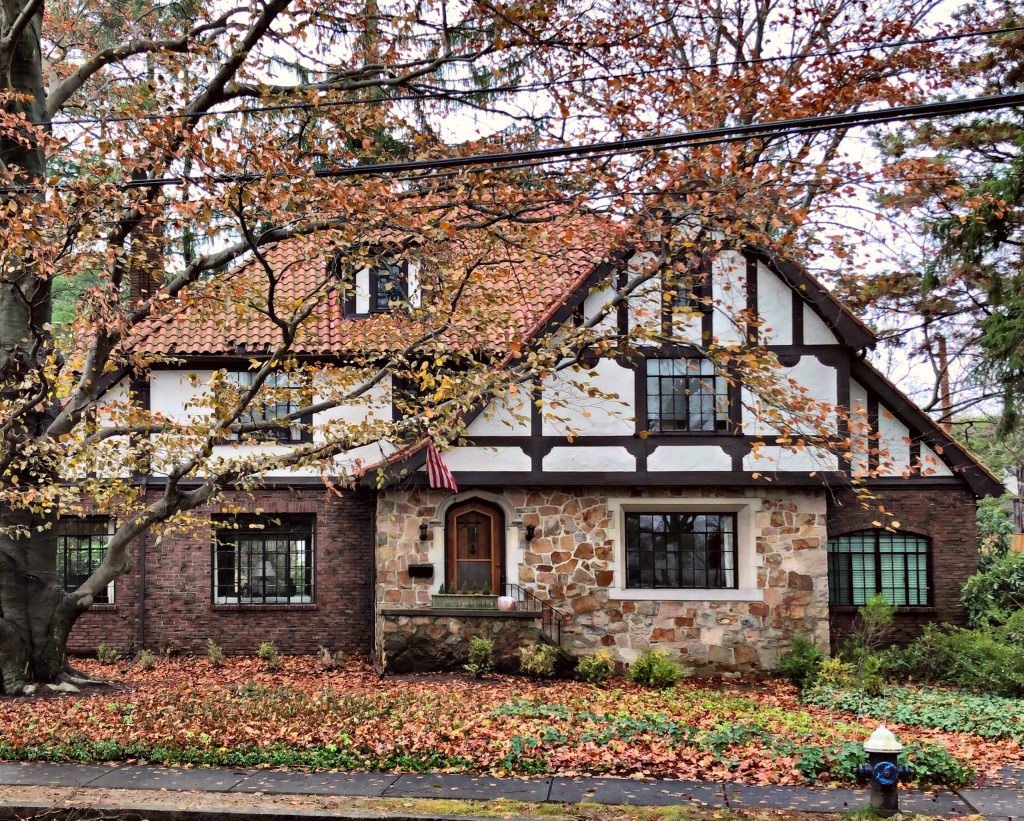
Residential architecture of the early decades of the 20th century is among my favorites as the Tudor Revival movement took off and was sometimes mixed with other revival styles at the time, creating really unique homes. The Glacy House in South Brookline, MA was built in 1930 as one of the earlier homes in the Walnut Hill development. It was likely designed and built by Walter L. Fernandez, a contractor who appears to have design-built a handful of spec homes to help get the neighborhood’s development going in the early stages. This home was originally occupied by George and Mary Glacy. George later worked as Vice President of the Boston & Maine Railroad, though he later got into legal trouble for hiring companies for railroad projects where he had financial interests, becoming indicted in an antitrust case by a Federal grand jury. The home features a first floor constructed of stone and brick with half-timbering on the floor above. The building is topped by a terracotta red tile roof, which is fairly uncommon for the region.
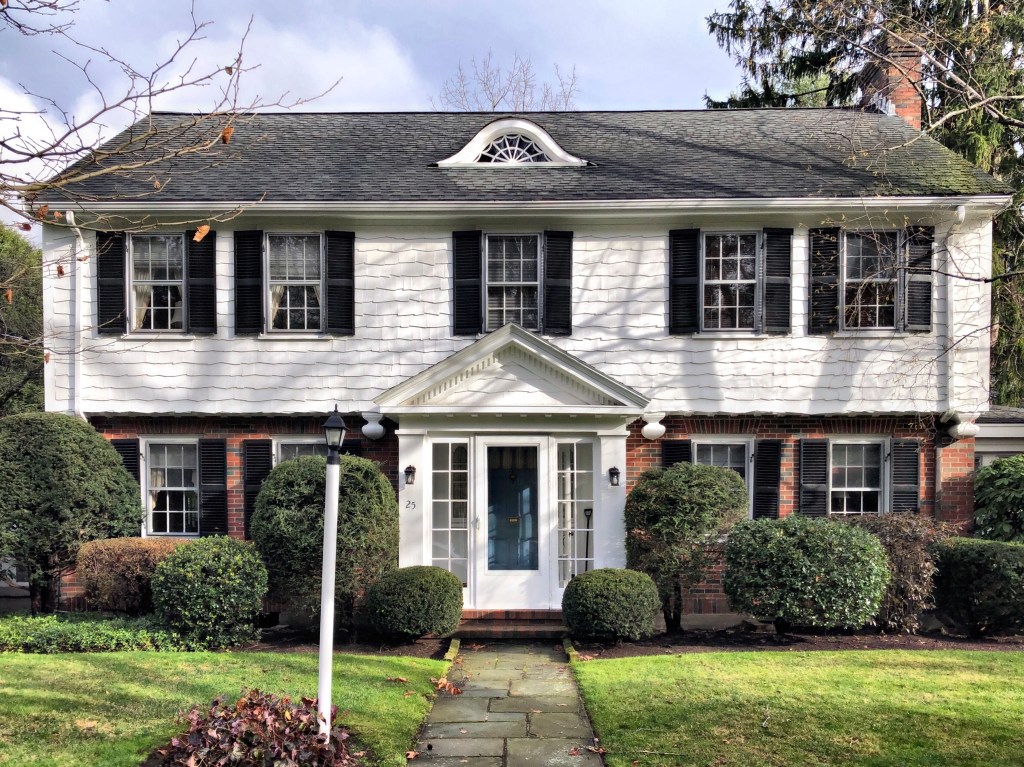
Located in South Brookline, a neighborhood of mostly early-mid 20th century architecture, you can find amazing residential designs for middle-class suburban families in the Boston area. This home was built in 1935 for Max and Rebeccah Webber in the Garrison Colonial Revival style. The home, designed by architect Harry Morton Ramsay, is characterized by a second-story shingled overhang with decorative pendants reminiscent of 17th century American homes. Adding some extra flair, an eyebrow dormer can be found at the roof, as well as a glazed projecting entry porch with a broad pediment and corner pilasters.
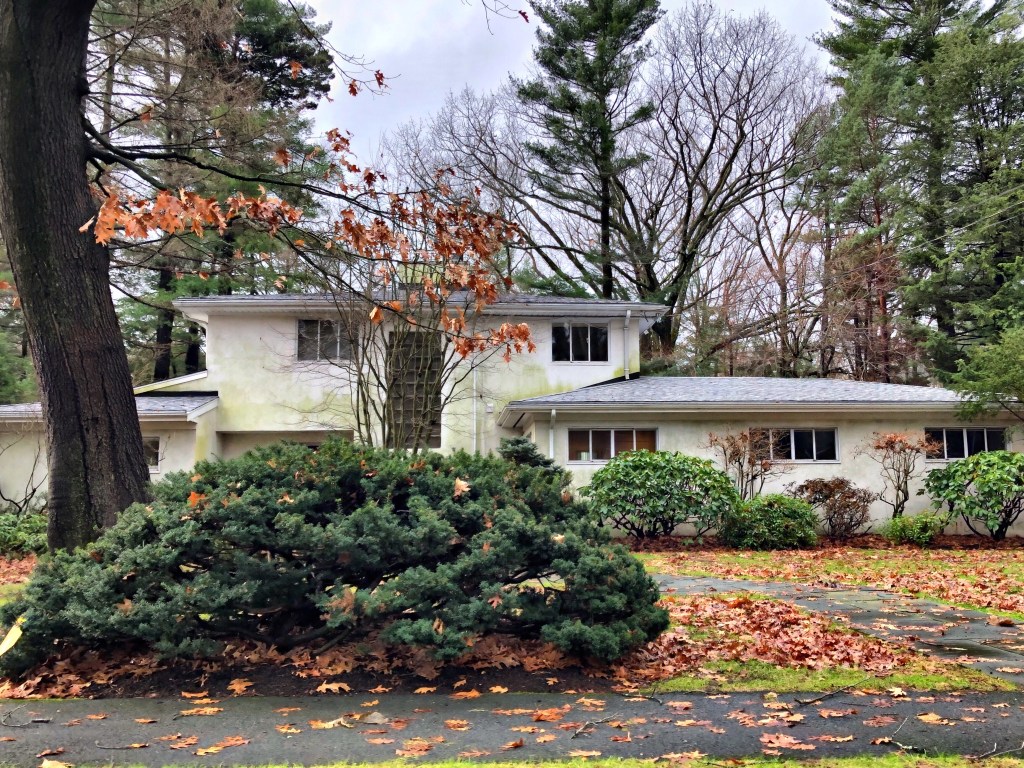
Built in 1935 (the same year as the Webber House in the last post), the Melnick House in South Brookline shows how the historically oriented designs of colonial New England converged with the Modern principles brought over from the Bauhaus movement from Germany. The 1930s were an interesting time for residential design around Boston as the two diverging styles were often located in the same neighborhoods. The Melnick House was designed by architect Samuel Glaser for Edward S. T. Melnick and his wife, Ethyle Melnick. Edward worked in Downtown Boston as the assistant division manager at Filene’s department store. Architect Samuel Glaser (1902-1983) was born in Riga, Latvia and at the age of four came to the United States with his family, settling in Brookline. He studied architecture at MIT and started his own practice in Boston a niche as a designer of moderately priced homes, particularly in the expanding suburbs where young Jewish families had begun living. The Melnick home combines the austere stucco walls and lack of applied ornament typical of late 1930s Modern architecture in the Boston area with a hipped-roof main block and flanking wings more commonly associated with traditional style houses of the same period. The home features a vertical glass block window which illuminates the interior stair hall.
Ca. 1910 image courtesy of Boston Public Archives.
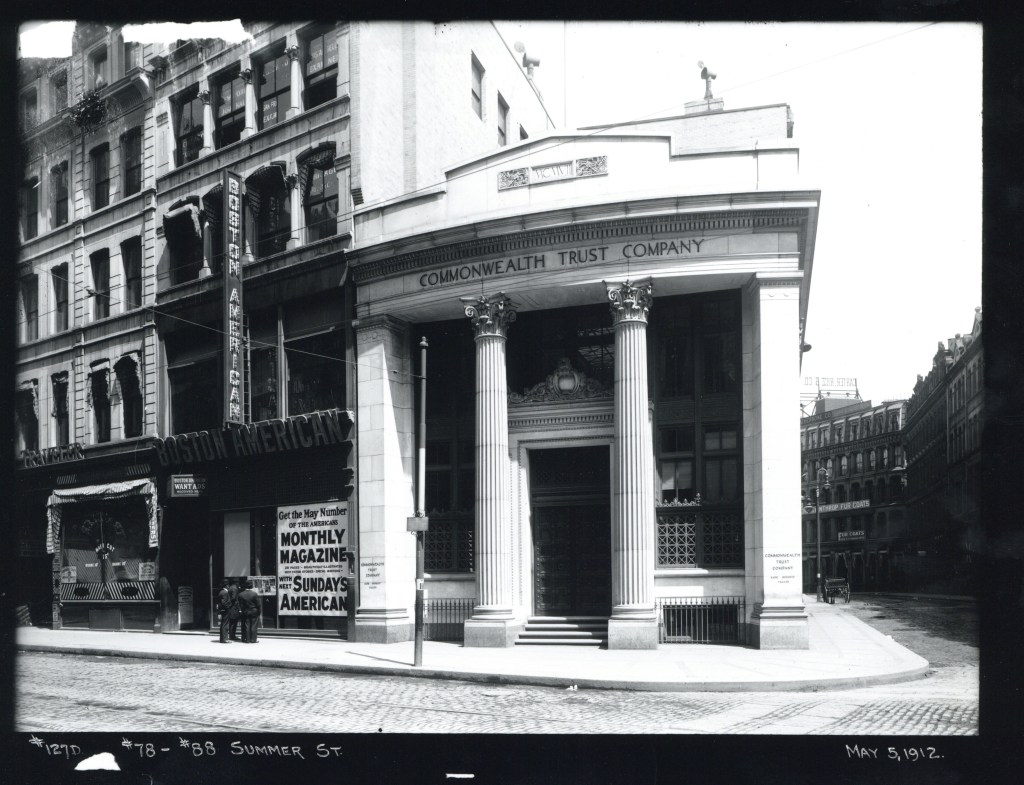
Located at the corner of Summer and Devonshire Streets in Downtown Boston, the Commonwealth Trust Company’s two-story marble banking house commanded the corner, despite its short stature. The building, completed in 1908, was constructed with Lee marble and decorated with ornate wrought and cast-iron grilles over windows. The building was designed by the architectural firm of Parker, Thomas & Rice in the Classical mode with large, fluted Corinthian columns and boxed corner pilasters framing the recessed center entrance, Corinthian pilasters ran along the side facade. At the inside, the building was coated with Cararra and Blanco marble with paneled oak offices. At the ground floor, offices and banking stations framed the outer walls, with the safety deposit boxes located on the second floor. The building was demolished by the 1970s and replaced with a one-story minimalist Modern building (I could not figure out why the former building was razed). The new building was demolished after a few decades with a larger building, better fitting the commercial district.
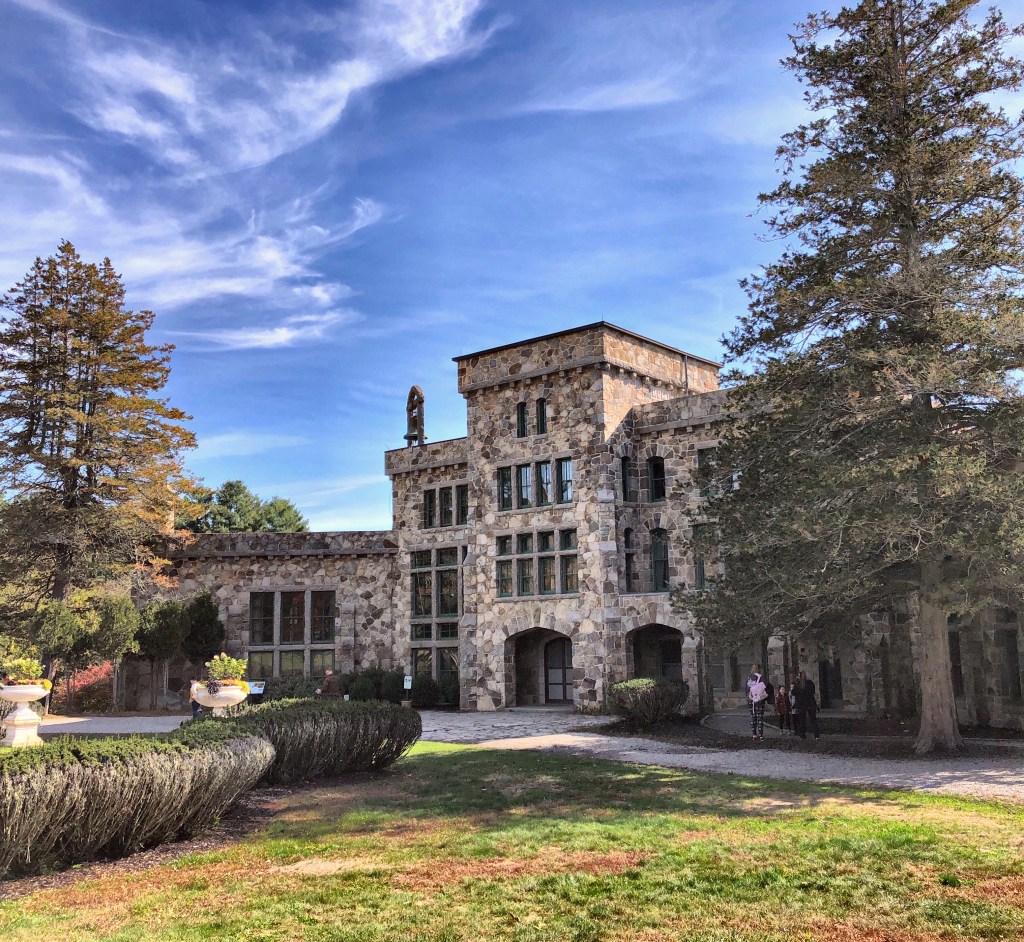
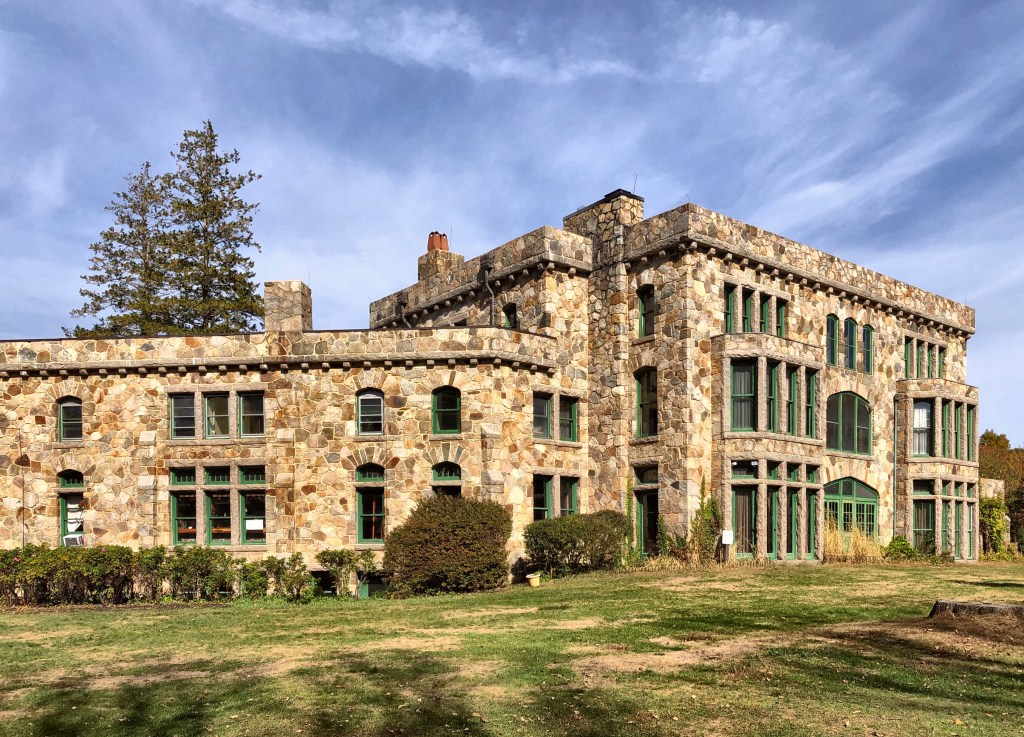
One of the more stunning homes and parks in Massachusetts is located in Easton, known as the Borderland State Park. Borderland was the 1,200-acre estate of Blanche Ames Ames, an artist, political activist, inventor, writer, and prominent supporter of women’s suffrage and birth control. Blanche Ames’ husband, Oakes Ames (of the Ames Family of Easton), came from a wealthy Massachusetts family that owned the Ames Shovel Works. Marrying in 1900, Blanche and Oakes (who were not related even though they had the same last name) constructed their stone mansion in 1910 and created a system of ponds and dams on their property. Blanche and Oakes, who wanted a fireproof house, became displeased with the work of their architect because of the challenges he faced with their design and engineering requirements. Dismissing the architect, Blanche took over the design and construction management of the mansion and hired the Concrete Engineering Company to draw plans according to her specifications. Also on the grounds is a hunting lodge with fireplace, overlooking the large pond on the estate.
Once the mansion was completed, Blanche set up a studio on in the house and developed a scientific color system for mixing paints. She became the sole illustrator of her husband’s botanical books (Oakes was a renowned authority on orchids and taught botany at Harvard from 1900 until his retirement in 1941). Later in life, Blanche became the co-founder of the Birth Control League of Massachusetts and the Treasurer of the League of Women Voters from 1915 to 1918. She also gained notoriety for her political cartoons depicting the struggle for women’s suffrage. In addition to these many accomplishments, Blanche was an inventor who, in 1939, designed a hexagonal lumber cutter. During World War II she designed, tested and patented a method for ensnaring enemy airplanes in wires hung from balloons. Remaining active her entire life, Blanche received a patent for a water anti-pollution device in 1969, a year before her death.
Located across the street from the Oakes Ames Memorial Hall and the Ames Free Library, the North Easton Savings Bank and Post Office building perfectly compliments the Romanesque Revival motif seen in the village. The building was constructed in 1904 in a Richardsonian Romanesque design with rough-faced granite ashlar walls with brownstone trim. The three-bay front façade contains centered entrances recessed behind a wide brownstone arch in the signature Richardsonian manner. The building was designed by Shepley, Rutan and Coolidge, a Boston-based architectural firm which grew out of Henry Hobson Richardson’s office, where they completed many of Richardson’s unfinished works after his death.
The Ames Free Libraryfirst opened its doors in 1883. Under the terms of the will of Oliver Ames II, $50,000, in trust, was left for the construction and support of a library for the benefit of the inhabitants Easton. The library was designed by Henry Hobson Richardson in 1877 and opened in 1883, becoming one of the finest public libraries in the region. The library is built of Milford granite with the same Longmeadow trim used on his famous Trinity Church in Boston. The very low cavernous arch over the doorway was used here by Richardson for the first time and became one of the most prominent and widely imitated characteristics of his style.



 Buildings of New England