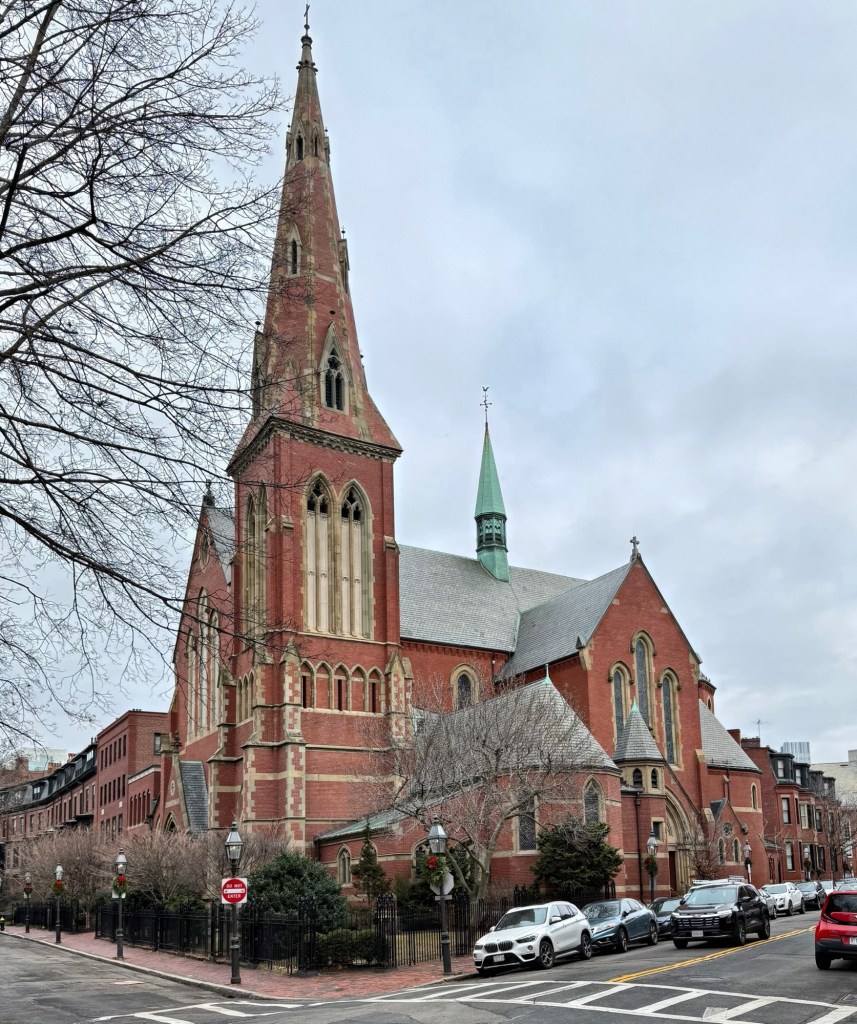
Church of the Advent // 1878

The Church of the Advent in Beacon Hill, Boston, is a landmark example of a church designed in the Victorian Gothic style with strong English influence. The congregation, established in 1844, purchased a large corner lot at Brimmer and Mount Vernon streets on the newly made filled land west of Charles Street in Beacon Hill Flat, to construct their new church. In 1875, John Hubbard Sturgis, a Boston architect and parishioner, began designing the red brick with sandstone-trimmed church set on a corner lot with dominant corner tower and octagonal steeple. Construction began in phases beginning in 1878 and took years until the steeple was completed in 1888. Before its completion, John H. Sturgis died and his nephew, Richard Clipston Sturgis, oversaw the completion of the church, which became somewhat of a memorial to his late uncle. Following the completion of the Church of the Advent, Sturgis’ widow, extended family and clients donated a major portion of the interior art, stained glass windows, and furnishings. The polychromatic exterior in red and charred brick mixed with sandstone trim appears to have been inspired by his designs for the original Boston Museum of Fine Arts (1876, demolished in 1911.) The Church of the Advent in Boston is one of the finest ecclesiastical buildings in New England and is the master-work of one of America’s great architects.

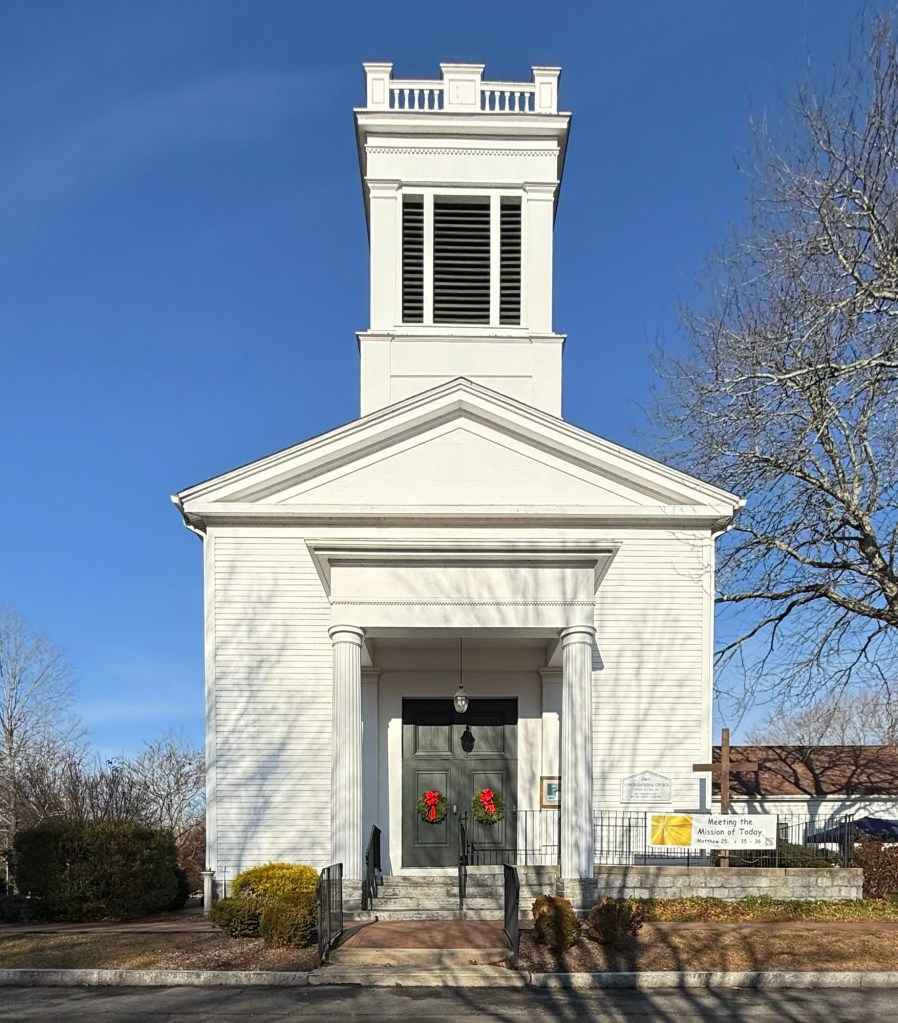
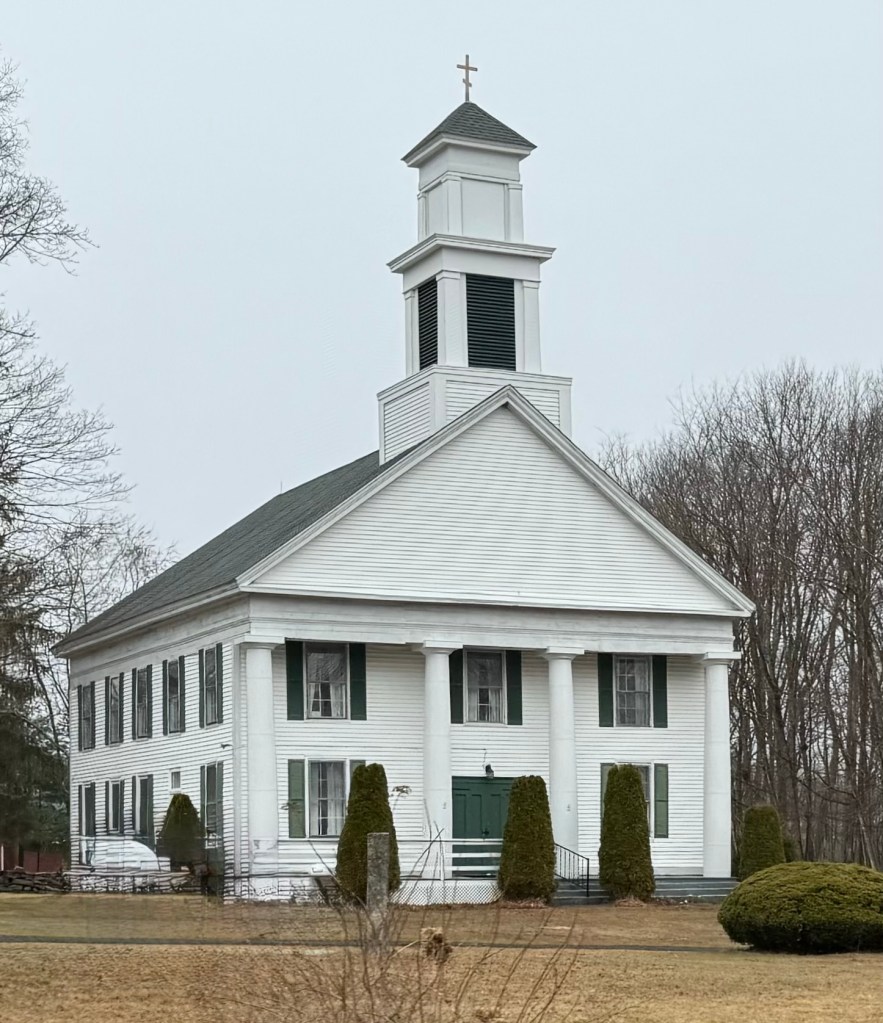
Congregational Church of Deep River // 1833

The town of Deep River, Connecticut, was originally a part of the Saybrook Colony, a large area at the mouth of the Connecticut River that was settled by English colonists. As what has become Old Saybrook grew, settlers moved further and further away from the original settlement and, eventually they received permission to form their own parishes so that they would not have to travel so far on Sundays to attend church services. As these outlying parishes grew, they separated from Saybrook and became the present day towns of Lyme, Old Lyme, Westbrook, Chester, Essex, and Deep River. Residents of present-day Deep River traveled to church services in Centerbrook, a village in Essex until this church was built in 1833. First services were held here the following December. The Greek Revival style church is ecovative of many similar 1830s village churches in New England, employing elements of the Greek Revival architecture style, with large doric columns, corner pilasters, and square belfry also with pilasters. The congregation here has been active for nearly 200 years.

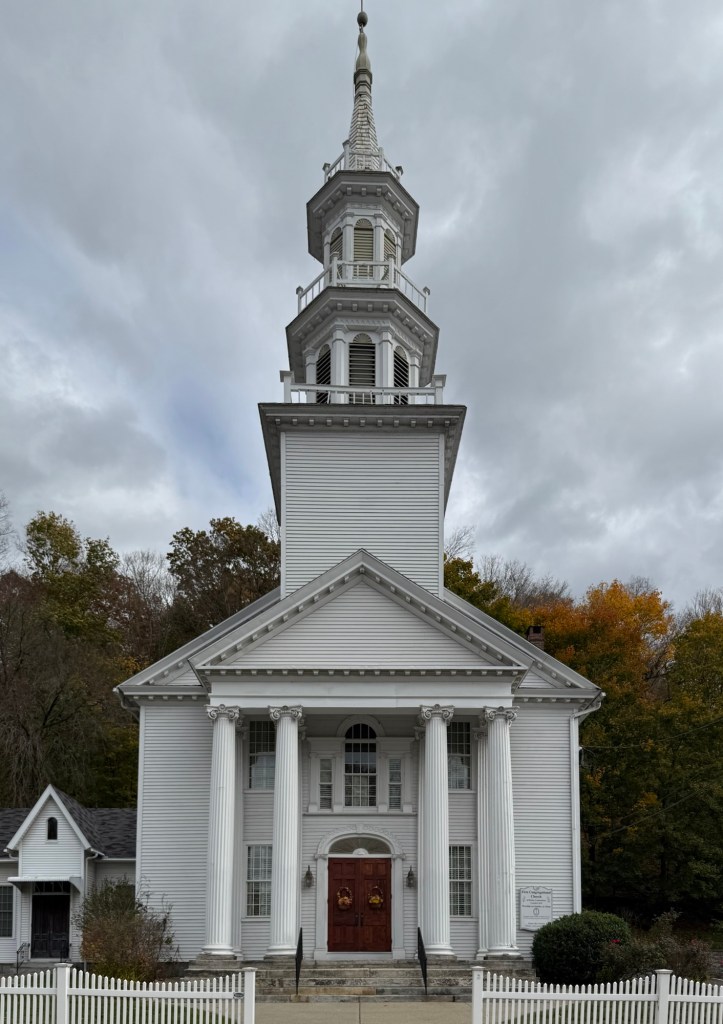
First Congregational Church of Derby // 1821

Derby, Connecticut was settled by colonists in 1642 as a trading post with local Native people under the name Paugasset. The community was eventually named after Derby, England, in 1675 and incorporated 100 years later in 1775. Like all communities in New England, it was required to have a meeting house, where religious services and town business would take place. Derby had its first meeting house built in 1681, a rustic, square structure which was eventually replaced with a new meeting house on “The Common”, now the East Derby Green. The building served its purpose for over 100 years, with sermons led by Rev. Daniel Humphreys (1706-1787) for 54 years. In that church, his son, David Humphreys (1752-1818) was baptized, he later became George Washington’s aide and most trusted general, later becoming the first presidential speech-writer. That meetinghouse was eventually outgrown, and the present Congregational Church of Derby was built on its present site on the eastern banks of the Naugatuck River in 1821. The Federal style church building was built by Williams and Barnum from Brookfield, who likely utilized plan books by Asher Benjamin for the finishes. The Congregational Church of Derby has watched as the commercial “downtown” of the city shifted to the other side of the river and has stood here for over 200 years as a landmark of “old Derby”.

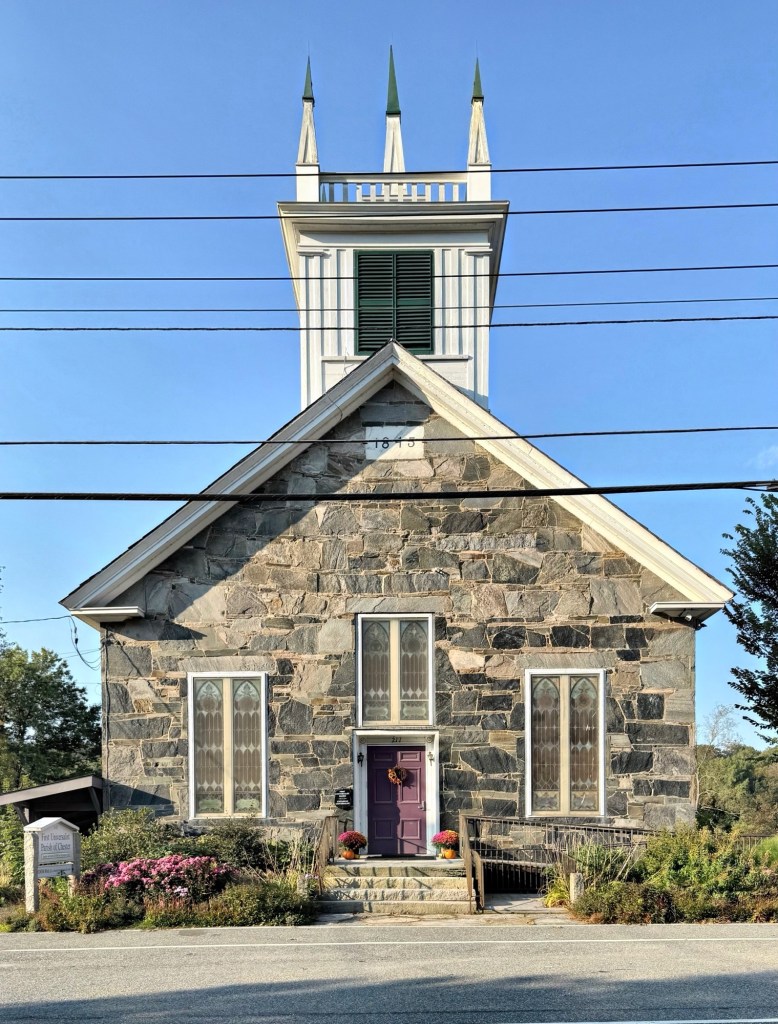
Stone Village Unitarian Church // 1845

The Stone Village of Chester, Vermont, is said to be the largest collection of stone buildings in the state, and is anchored by its largest building, the Unitarian Church. Built in 1845, the Unitarian Universalist Church is one of a few dozen “snecked ashlar” buildings in the region, where rubblestone is laid up with mortar using small long stones called “snecks” to tie an outer and an inner wall together. The construction method is said to have been brought to the area by masons from Scotland and Ireland which is known there as ‘Celtic Bond’. Oral tradition state that Scottish masons from Canada introduced the technique to local masons while erecting a mill in nearby Cavendish in 1832. Local Chester resident, Dr. Ptolemy Edson became such a fan of the building that in 1834, he had his home, the first stone building in Chester, built in this method. Dr. Edson served on the building committee for the new village church, and likely pushed for a cohesive material and construction method for this church and other buildings soon after. The Stone Village Unitarian Church blends Greek Revival and Gothic Revival styles in a more vernacular way, typical in many rural Vermont communities. The building exhibits stained glass windows that were added sometime in the late 19th or early 20th century.

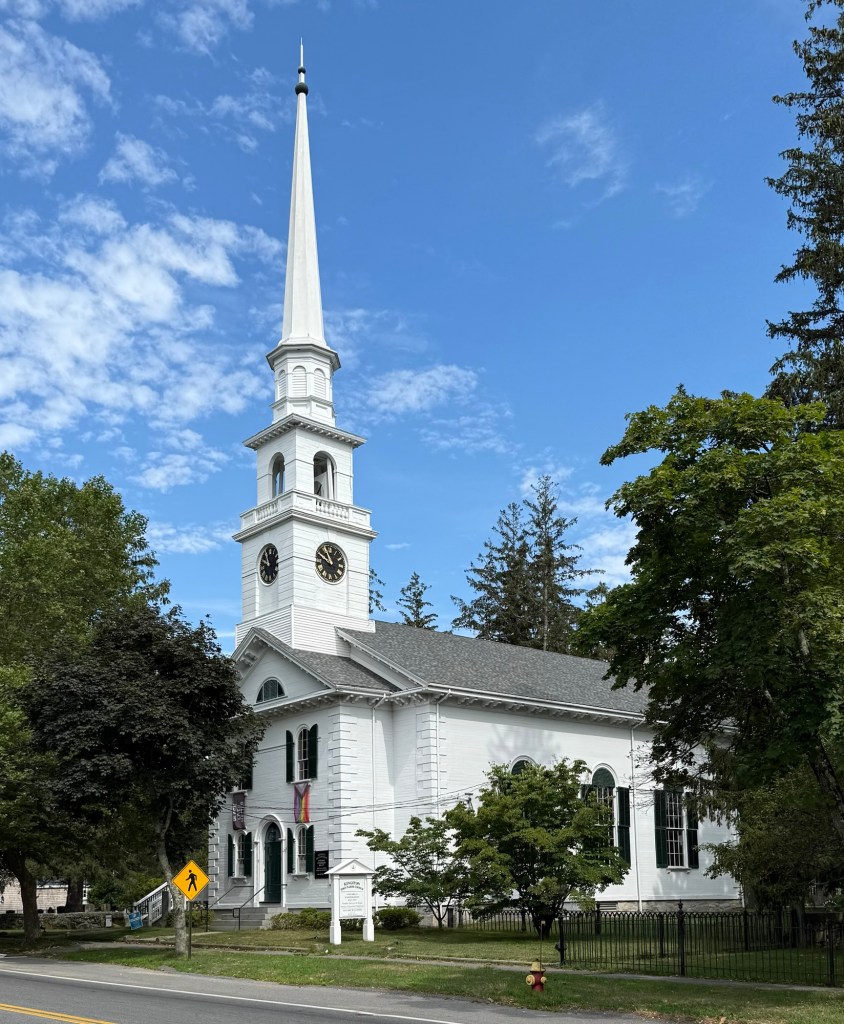
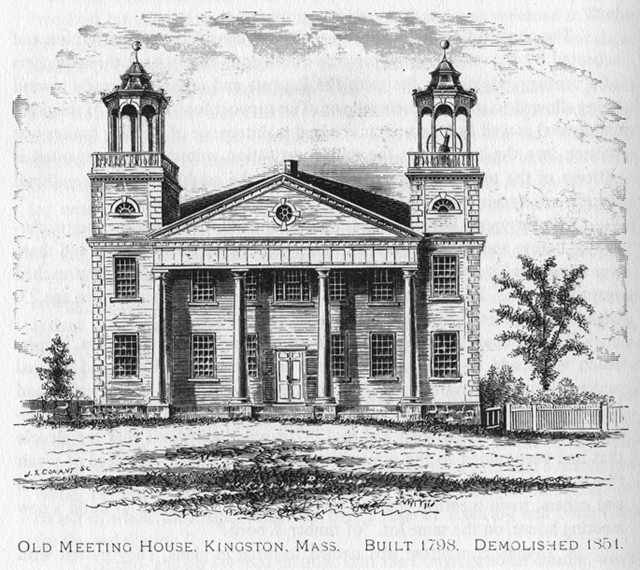
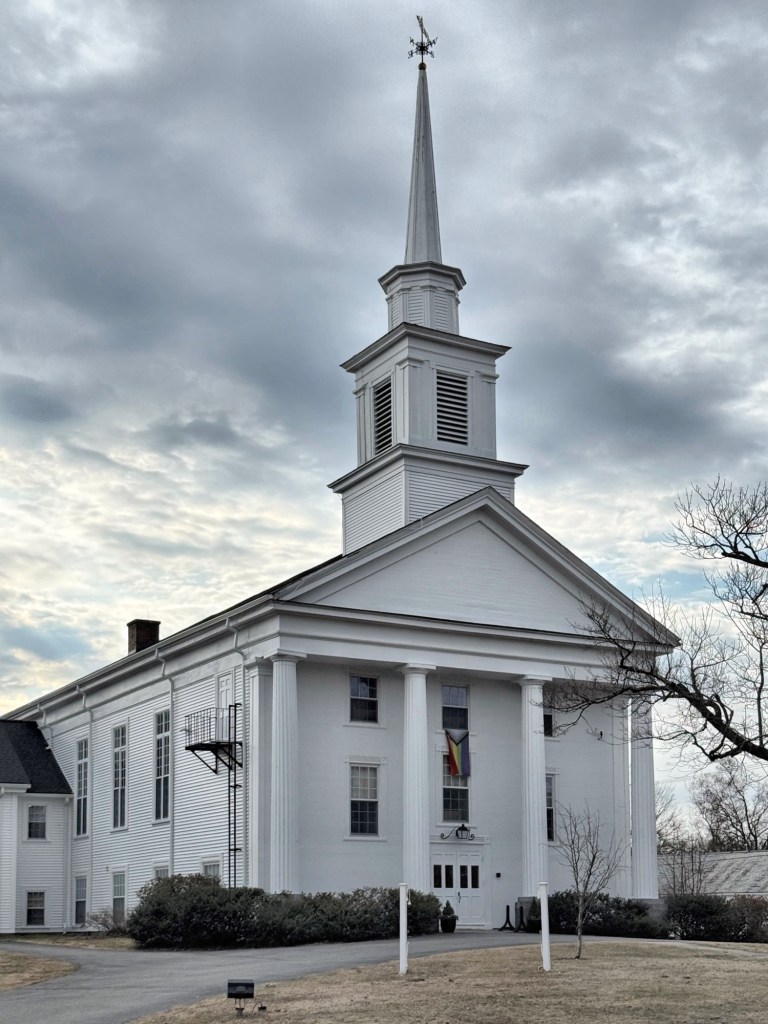
First Parish Church, Kingston // 1851

The original Congregational Church of Kingston was part of the established, tax-supported church of the Commonwealth of Massachusetts, and was built in 1718, after present-day Kingston established itself as Plymouth’s North Parish. The church was replaced in 1798 with a more substantial building with two steeples. In 1833, when the separation of church and state was finalized in the Commonwealth, two new religious societies formed in Kingston and established churches. The 1798 church, which had been built as the only church in town, was now too large for its diminished population and suffering from structural difficulties. In the spring of 1851, the 1798 church was taken down, and the present church, the third on the site, was constructed. The church blends Greek Revival and Italianate styles, both popular for ecclesiastical buildings of its time, and the structure looks much like it did when built 175 years ago. The congregation here is Universal Unitarian.

Westminster Meetinghouse // 1770

The Westminster Meetinghouse (aka the Westminster Congregational Church) was built in 1770 by Canterbury, Connecticut residents who in the 1760s, created a separate religious jurisdiction, the Westminster Society, due to their reluctance to travel long distances to Canterbury village for required religious services. Local resident John Parks donated land to be used as a public green, as well as a site for a cemetery and this meetinghouse. Sherebiah Butts, captain of the local militia, was engaged as master builder and architect, who along with his sons and other helpers, constructed the church by 1770. The original church, originally a square-plan meetinghouse, initially faced east, but was rotated to face south by around 1840, when the entire structure was remodelled in the prevailing Greek Revival style. The church is said to be one of the oldest continually utilized meetinghouses in Connecticut.

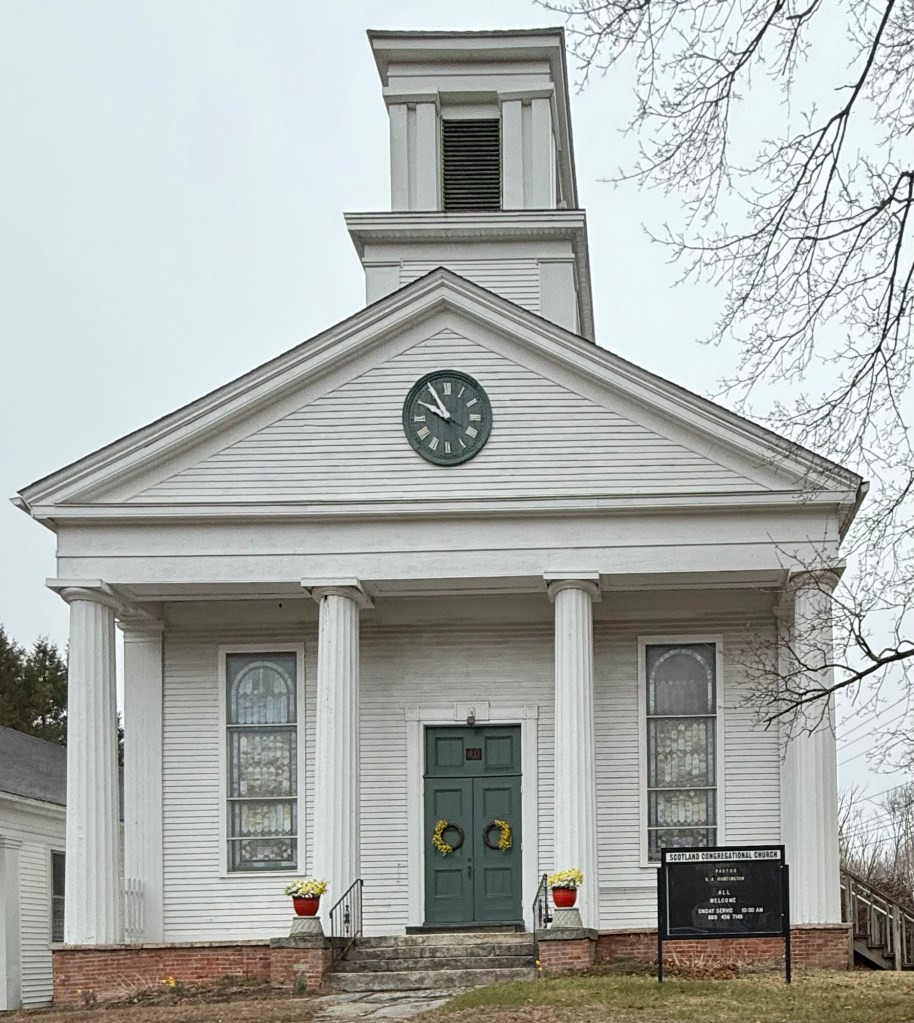
Scotland Congregational Church // 1842

The main visual anchor of the charming town green of Scotland, Connecticut, is this building, the Scotland Congregational Church. Built in 1842 as the congregation’s third building, this Greek Revival style edifice features stately proportions, temple-front with four large Doric columns supporting the portico, and a two-stage belfry. The chapel (some say it was converted from the original town hall) was acquired by the congregation in 1867, and has remained in its new location ever since. Later alterations include the stained glass windows and clock in the pediment, which dates to the early 20th century.

St. George’s Episcopal Church, Central Falls // 1922

Tucked away in the middle of a residential neighborhood in the dense city of Central Falls, Rhode Island, this Neo-Gothic style church more closely resembles an English country church than one typically found in a dense, industrial city. This is the St. George’s Episcopal Church, located at the corner of Central and Clinton streets, and built for the local Episcopal congregation there in 1922. The church was designed by the Rhode Island architectural firm of Clarke & Howe and is built of rough-faced stone with limestone trim. The highlight of the design is the large central tower with lancet, stained glass window, and belfry. 

East Church of Salem – Salem Witch Museum // 1844

One of the most recognizable buildings in Salem is the former East Church, now occupied by the Salem Witch Museum. The East Church was constructed between 1844 and 1846 for the oldest branch of the First Church of Salem, which originally organized in 1718. The stunning Gothic Revival church has been credited to architect Minard Lafever (1798-1854), a prominent New York architect known for his Gothic, Greek and other Exotic Revival style buildings. Constructed of brownstone, a material Lafever utilized for his New York City churches built at the same time, the East Church exhibited pointed arch stained glass windows, crenellation resembling battlements, and once featured two, four-stage octagonal towers, which were cut down in the 1920s to their current height. The church suffered from a massive fire in the early 20th century and the church eventually moved out in the 1950s. The building was occupied by the Salem Auto Museum until another fire in 1969. In 1972, the Salem Witch Museum moved in and completely updated the interior.

Assumption Roman Catholic Church // 1922

As Chicopee developed into one of the major industrial cities in Western Massachusetts, immigrant groups moved there, finding work at some of the major manufacturing companies. Irish and Polish churches were built and French and French Canadian residents too built their own church, where they could gather and worship in their native language. A wood-frame church was first built in the 1870s and used until it was destroyed by fire in 1912. It took a decade for the congregation to gather enough funds to purchase a new lot and build a new church, but patience was a virtue as their church is a stunner! The cornerstone for the church was laid in 1922 and the building was designed by local architect, George P. Dion, and constructed at the cost of $200,000. The building was dedicated in 1925 and is one of the finest, and most unique churches in the state. Italian Renaissance Revival in style, the church stands out for its 85-foot-tall campanile and cast-stone high-relief in the pediment at the facade. It is believed that within the relief, that depicts the figure of Mary surrounded by Cherubs, depicting the “Assumption of the Virgin,” George P. Dion used the likeness of his granddaughter as a face of one of the cherubs. The congregation moved out of the building but has been recently mortgaged to a new church, Iglesia Cristiana Casa De Paz y Restauración, showcasing the ever-changing demographics that keep our cities vibrant and stewards that do right by our collective history and buildings.